TANNINS
By Princi Thapak
B.Pharm 5th Semester
Path for the presentation
 Introduction
 Properties
 Classification
 Hydrolysable Tannins
 Condensed Tannins
 Pseudo Tannins
 Identification Tests
2
Introduction
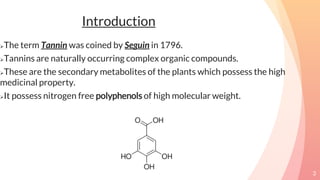
The term Tannin was coined by Seguin in 1796.
Tannins are naturally occurring complex organic compounds.
These are the secondary metabolites of the plants which possess the high
medicinal property.
It possess nitrogen free polyphenols of high molecular weight.
3
How can we define tannins?
“The complex organic non nitrogenous, poly phenolic
substances of high molecular weight.”
4
Properties
Chemical Properties:
They are soluble in water.
They are soluble in dilute alkalis, alcohols, glycerol, and acetone.
They are sparingly soluble in organic solvents.
Their solutions precipitate all heavy metals
“
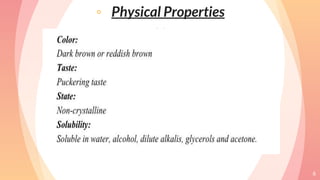
◦ Physical Properties
6
Medicinal & Biological Properties
 Tannins are the drugs which can stop hemorrhage.
 They precipitate proteins.
 They are used as an astringent.
 They are used in the treatment of burns.
 They act as anti diarrheal.
 They are employed as an antidote for heavy metal poisoning.
 They are most potent antioxidant.
7
“
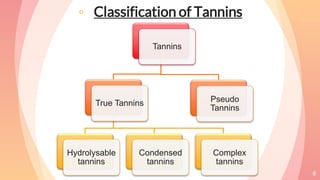
◦ Classification of Tannins
8
Tannins
True Tannins
Hydrolysable
tannins
Condensed
tannins
Complex
tannins
Pseudo
Tannins
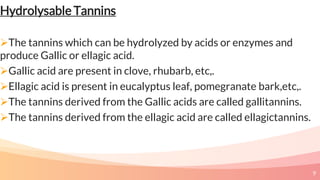
Hydrolysable Tannins
The tannins which can be hydrolyzed by acids or enzymes and
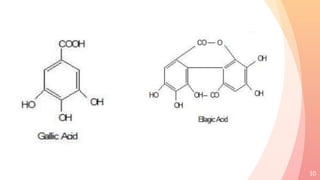
produce Gallic or ellagic acid.
Gallic acid are present in clove, rhubarb, etc,.
Ellagic acid is present in eucalyptus leaf, pomegranate bark,etc,.
The tannins derived from the Gallic acids are called gallitannins.
The tannins derived from the ellagic acid are called ellagictannins.
9
ZZ
10
11
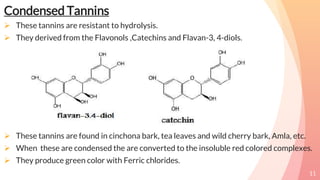
Condensed Tannins
 These tannins are resistant to hydrolysis.
 They derived from the Flavonols ,Catechins and Flavan-3, 4-diols.
 These tannins are found in cinchona bark, tea leaves and wild cherry bark, Amla, etc.
 When these are condensed the are converted to the insoluble red colored complexes.
 They produce green color with Ferric chlorides.
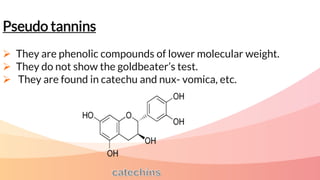
Pseudo tannins
 They are phenolic compounds of lower molecular weight.
 They do not show the goldbeater’s test.
 They are found in catechu and nux- vomica, etc.
Extraction of tannins
 Tannins are the compounds of high molecular weight so they are
difficult to isolate.
 The solvents used are alcohol, ether, water and acetone.
13
14
Identification Test
1. Gelatin test:
To a solution of tannin, aqueous solution of gelatin and sodium chloride are added. A
white buff colored precipitate is formed.
2. Goldbeater’s skin test:
A small piece of goldbeater skin (membrane prepared from the intestine of an ox) is
soaked in 20% hydrochloric acid, ringed with distilled water and placed in a solution of
tannin for 5 minutes. The skin piece is washed with distilled water and kept in a solution
of ferrous sulphate. A brown or black colour is produced on the skin due presence of
tannins.
3. Phenazone test:
A mixture of aqueous extract of a drug and sodium acid phosphate is heated and cooled
and filtered. A solution of phenazone is added to the filtrate. A bulky coloured
precipitate is formed.
4. Match stick test (Catechin test):
A match stick is dipped in aqueous plant extract, dried near burner and moistened
with concentrated hydrochloric acid.
On warming near flame, the matchstick wood turns pink or red due to formation
of phloroglucinol.
16
Thanks!

Tannins

  • 1.
  • 2.
    Path for thepresentation  Introduction  Properties  Classification  Hydrolysable Tannins  Condensed Tannins  Pseudo Tannins  Identification Tests 2
  • 3.
    Introduction The term Tanninwas coined by Seguin in 1796. Tannins are naturally occurring complex organic compounds. These are the secondary metabolites of the plants which possess the high medicinal property. It possess nitrogen free polyphenols of high molecular weight. 3
  • 4.
    How can wedefine tannins? “The complex organic non nitrogenous, poly phenolic substances of high molecular weight.” 4
  • 5.
    Properties Chemical Properties: They aresoluble in water. They are soluble in dilute alkalis, alcohols, glycerol, and acetone. They are sparingly soluble in organic solvents. Their solutions precipitate all heavy metals
  • 6.
  • 7.
    Medicinal & BiologicalProperties  Tannins are the drugs which can stop hemorrhage.  They precipitate proteins.  They are used as an astringent.  They are used in the treatment of burns.  They act as anti diarrheal.  They are employed as an antidote for heavy metal poisoning.  They are most potent antioxidant. 7
  • 8.
    “ ◦ Classification ofTannins 8 Tannins True Tannins Hydrolysable tannins Condensed tannins Complex tannins Pseudo Tannins
  • 9.
    Hydrolysable Tannins The tanninswhich can be hydrolyzed by acids or enzymes and produce Gallic or ellagic acid. Gallic acid are present in clove, rhubarb, etc,. Ellagic acid is present in eucalyptus leaf, pomegranate bark,etc,. The tannins derived from the Gallic acids are called gallitannins. The tannins derived from the ellagic acid are called ellagictannins. 9
  • 10.
  • 11.
    11 Condensed Tannins  Thesetannins are resistant to hydrolysis.  They derived from the Flavonols ,Catechins and Flavan-3, 4-diols.  These tannins are found in cinchona bark, tea leaves and wild cherry bark, Amla, etc.  When these are condensed the are converted to the insoluble red colored complexes.  They produce green color with Ferric chlorides.
  • 12.
    Pseudo tannins  Theyare phenolic compounds of lower molecular weight.  They do not show the goldbeater’s test.  They are found in catechu and nux- vomica, etc.
  • 13.
    Extraction of tannins Tannins are the compounds of high molecular weight so they are difficult to isolate.  The solvents used are alcohol, ether, water and acetone. 13
  • 14.
    14 Identification Test 1. Gelatintest: To a solution of tannin, aqueous solution of gelatin and sodium chloride are added. A white buff colored precipitate is formed. 2. Goldbeater’s skin test: A small piece of goldbeater skin (membrane prepared from the intestine of an ox) is soaked in 20% hydrochloric acid, ringed with distilled water and placed in a solution of tannin for 5 minutes. The skin piece is washed with distilled water and kept in a solution of ferrous sulphate. A brown or black colour is produced on the skin due presence of tannins. 3. Phenazone test: A mixture of aqueous extract of a drug and sodium acid phosphate is heated and cooled and filtered. A solution of phenazone is added to the filtrate. A bulky coloured precipitate is formed.
  • 15.
    4. Match sticktest (Catechin test): A match stick is dipped in aqueous plant extract, dried near burner and moistened with concentrated hydrochloric acid. On warming near flame, the matchstick wood turns pink or red due to formation of phloroglucinol.
  • 16.