Tannins
Dr. Mbinji Omale
Definition of Tannins
• The name ‘tannin’ is derived from the French ‘tanin’ (tanning substance) and is used
for a range of natural polyphenols.
• Tannins are complex organic, non-nitrogenous plant products, which generally have
astringent properties.
• The term ‘tannin’ was first used by Seguin in 1796 to denote substances which have
the ability to combine with the protein of animal hides, prevent their putrefaction
and convert them into leather which is known as tanning of the hide.
• According to this, tannins are substances which are detected by a tanning test due to
its absorption on standard hide powder.
• The test is known as Goldbeater’s skin test.
• This definition excludes simpler phenolic substances, often present with tannins,
such as gallic acid, catechins and chlorogenic acid, although they may under certain
conditions give precipitates with gelatin and be partly retained by hide powder.
• Such substances of relatively low molecular weight are called ‘pseudo-tannins’. Most
true tannins have molecular weights of from about 1000 to 5000.
• Many tannins are glycosides in nature
Cont.
•The tannin-protein co-precipitation is important not only in the
leather industry but also in relation to the physiological activity of
herbal medicines, taste of foodstuffs and beverages, and in the
nutritional value of feeds for herbivores.
Classification of Tannins
The tannin compounds can be divided into two major groups on the
basis of Goldbeater’s skin test.
A group of tannins showing the positive tanning test may be regarded
as true tannins, whereas those, which are partly retained by the hide
powder and fail to give the test, are called as pseudotannins.
Classification of Tannins
• Most of the true tannins are high molecular weight compounds.
• These compounds are complex polyphenolics, which are produced
by polymerization of simple polyphenols.
• They may form complex glycosides or remains as such which may
be observed by their typical hydrolytic reaction with the mineral
acids and enzymes.
• Two major chemical classes of tannins are usually recognized based
on this hydrolytic reaction and nature of phenolic nuclei involved in
the tannins structure.
1. Hydrolysable tannins
2. Condensed tannins.
Hydrolysable tannins
• These may be hydrolysed by acids or enzymes such as tannase.
• They are formed from several molecules of phenolic acids such as gallic and
hexahydroxydiphenic acids which are united by ester linkages to a central glucose molecule.
• The hydrolysable tannins can further be classified on the basis of the phenolic acids
produced after the hydrolysis;
1. Gallotannins composed of gallic acid
2. Ellagitannins which contains hexahydrodiphenic acid which after intraesterification
produces ellagic acid.
The hydrolysable
tannins are soluble
in water, and their
solution produces
blue colour with
ferric chloride.
General occurrence
• Examples of drugs containing hydrolysable tannins are:
i. Gallitannins: Rhubarb, cloves, red rose petals, bearberry leaves,
Chinese galls, Turkish galls, hamamelis, chestnut and maple.
ii. Ellagitannins: Pomegranate rind, pomegranate bark, myrobalans,
eucalyptus leaves, kousso, some Australian kinos, chestnut
(Castanea spp.) and oak bark.
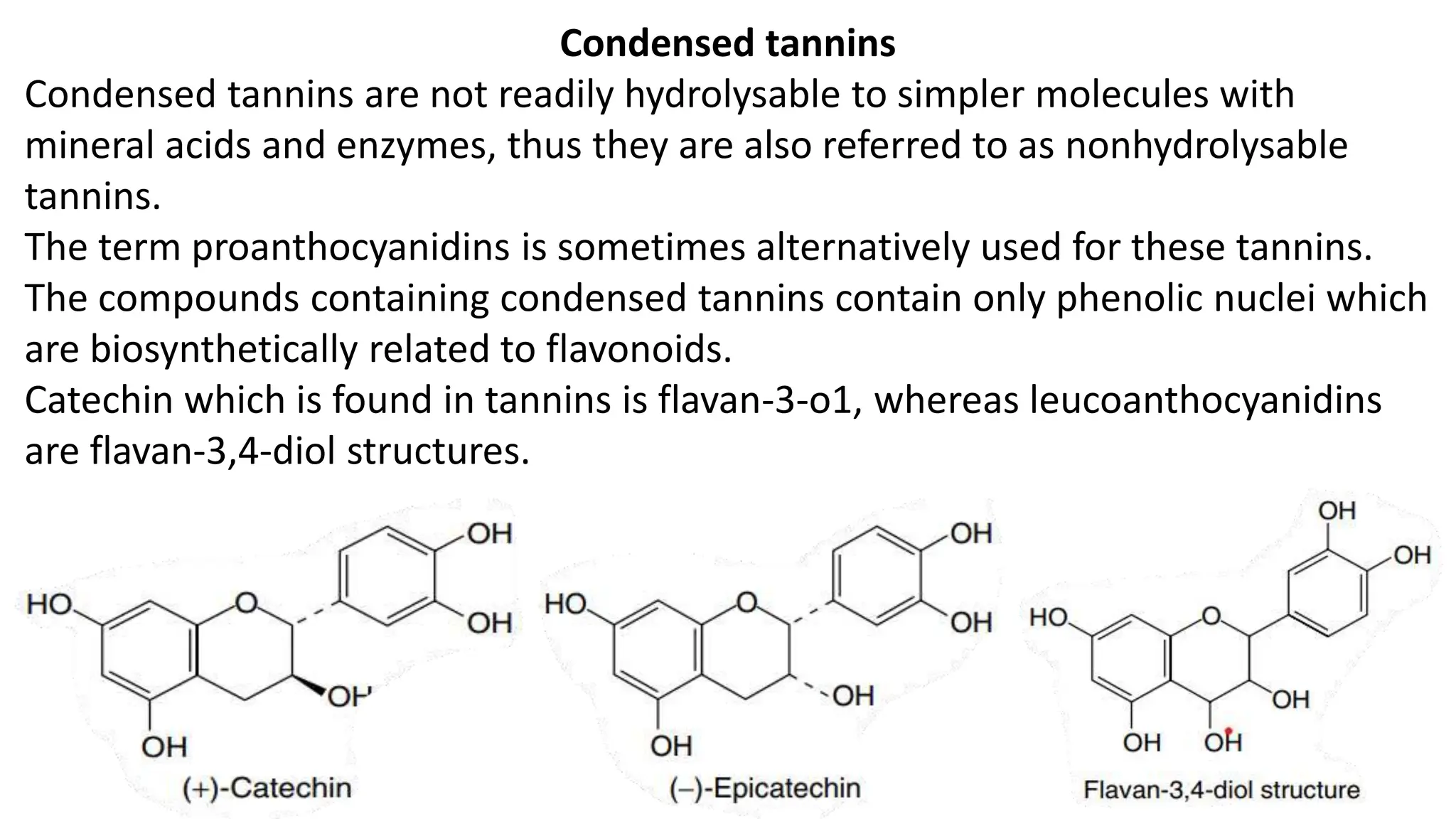
Condensed tannins
Condensed tannins are not readily hydrolysable to simpler molecules with
mineral acids and enzymes, thus they are also referred to as nonhydrolysable
tannins.
The term proanthocyanidins is sometimes alternatively used for these tannins.
The compounds containing condensed tannins contain only phenolic nuclei which
are biosynthetically related to flavonoids.
Catechin which is found in tannins is flavan-3-o1, whereas leucoanthocyanidins
are flavan-3,4-diol structures.
Cont.
• These phenolics are frequently linked to carbohydrates or protein
molecules to produce more complex tannin compounds.
• When treated with acids or enzymes, they tend to polymerize yielding
insoluble red coloured products known as phlobaphens.
• The phlobaphens give characteristic red colour to many drugs such as
cinchona and wild cherry bark.
• On dry distillation, they yield catechol derivatives and these tannins are
therefore sometimes called catechol tannins.
• Condensed tannins are also soluble in water and produces green colour
with ferric chloride.
General occurrence of Tannins
• Some drugs (e.g. tea, hamamelis leaves and hamamelis bark) contain both
hydrolysable and condensed tannins.
• The following are rich in condensed tannins:
1. Barks: cinnamon, wild cherry, cinchona, willow, acacia (wattle, mimosa), oak
and hamamelis
2. Roots and rhizomes: krameria (rhatany) and male fern
3. Flowers: lime and hawthorn
4. Seeds: cocoa, guarana, kola and areca
5. Fruits: cranberries, grapes (red wines), hawthorn
6. Leaves: hamamelis, hawthorn and tea, especially green tea
7. Extracts and dried juices: catechu, acacia and mangrove cutches, East Indian
kino, butea gum and eucalyptus kino.
Genera characteristics of Tannins
1. Tannins are soluble in water (exception of some high molecular weight
structures), dilute alkalis, alcohol, glycerol and acetone, but generally only
sparingly soluble in other organic solvents.
2. Solutions precipitate heavy metals, alkaloids, glycosides and gelatin.
3. With ferric salts, gallitannins and ellagitannins give blue-black precipitates
and condensed tannins brownish-green ones.
4. If a very dilute ferric chloride solution is gradually added to an aqueous
extract of hamamelis leaves (which contains both types of tannin), a blue
colour is produced which changes to olive-green as more ferric chloride is
added.
5. Molecular weight ranging from 500 to >20,000.
6. Can bind with proteins and form insoluble or soluble tannin—protein
complexes
Biosynthesis of Tannins
• Tannins belong to the phenolics class of secondary metabolites.
• All phenolic compounds; either primary or secondary are in one way or another
formed through shikimic acid pathway (phenylpropanoid pathway).
• Other phenolics such as isoflavones, coumarins, lignins, and aromatic amino acids
(tryptophan, phenylalanine, and tyrosine) are also formed by the same pathway.
• Hydrolysable tannins (Hts) and condensed tannins (proanthocyanidins) are formed
as follows;
1. Gallic acid is derived from quinic acid.
2. Ellagotannins are formed from hexahydroxydiphenic acid esters by the oxidative
coupling of neighboring gallic acid units attached to a D-glucose core.
3. Further oxidative coupling forms the hydrolysable tannin polymers.
4. Proanthocyanidin (PA) biosynthetic precursors are the leucocyanidins (flavan-3,4-
diol and flavan-4-ol) which on autoxidation, in the absence of heat, form
anthocyanidin and 3-deoxyanthocianidin, which, in turn, polymerize to form PAs.
Chemical tests for Tannins
1. Goldbeater’s skin test:
• Goldbeater’s skin is a membrane produced from the intestine of Ox.
• It behaves just like untanned animal hide.
• A piece of goldbeaters skin previously soaked in 2% hydrochloric acid
and washed with distilled water is placed in a solution of tannin for 5
minutes.
• It is then washed with distilled water and transferred to 1% ferrous
sulphate solution.
• A change of the colour of the goldbeater’s skin to brown or black
indicates the presence of tannin.
• Hydrolysable and condensed tannins both give the positive goldbeater’s
test, whereas pseudotannins show very little colour or negative test.
Cont.
2. Phenazone Test:
• To 5 ml of aqueous solution of tannin containing drug, add 0.5 g of sodium acid
phosphate.
• Warm the solution, cool, and filter.
• Add 2% phenazone solution to the filtrate.
• All tannins are precipitated as bulky, coloured precipitate.
3. Gelatin Test:
• To a 1% gelatine solution, add little 10% sodium chloride.
• If a 1% solution of tannin is added to the gelatine solution, tannins cause
precipitation of gelatine from solution.
4. Test for catechin (matchstick Test)
•Catechin test is the modification of the well-known
phloroglucinol test for lignin.
• Matchstick contains lignin.
•Dip a matchstick in the dilute extract of the drug, dry,
moisten it with concentrated hydrochloric acid, and warm it
near a flame.
•Catechin in the presence of acid produces phloroglucinol
which stains the lignified wood pink or red.
Isolation of Tannins
• Both hydrolysable and condensed tannins are highly soluble in water and alcohol
but insoluble in organic solvents such as solvent ether, chloroform, and benzene.
• Tannin compounds can be easily extracted by water or alcohol.
• The general method for the extraction of tannic acid from various galls is either
with water-saturated ether, or with mixture of water, alcohol, and ether.
• In such cases, free acids such as Gallic and ellagic acid go along with ether, whereas
true tannin gets extracted in water.
• If the drug consists of chlorophyll or pigment, it may be removed by ether.
• After extraction, the aqueous and ethereal layers are separately concentrated,
dried, and subjected to further isolation and purification using various separation
techniques of chromatography.
Drugs containing tannins
1. Galls and Tannic Acid
• Turkish galls (Turkey
Galls; Galla) are
vegetable growths
formed on the young
twigs of the dyer’s oak,
Quercus infectoria
(Fagaceae), as a result
of the deposition of the
eggs of the gall-wasp
Adleria gallaetinctoriae
Cont.
• The dyer’s oak is a small tree or shrub about 2 m high which is found in Turkey, Syria,
Persia, Cyprus and Greece.
• Abnormal development of vegetable tissue round the larva is due to an enzyme-
containing secretion, produced by the young insect after it has emerged from the egg,
which by the rapid conversion of starch into sugar stimulates cell division.
• As starch disappears from the neighborhood of the insect, shrinkage occurs and a
central cavity is formed in which the insect passes through the larval and pupal stages.
• Finally, if the galls are not previously collected and dried, the mature insect or imago
bores its way out of the gall and escapes.
• During these changes the colour of the gall passes from a bluish-grey through olive-
green to almost white.
• Galls are collected by hand.
• After drying they are graded according to colour into three grades, blue, green and
white, which are found on the London market
Cont.
Constituents
• Galls contain 50–70% of the tannin known as gallotannic acid (Tannic
Acid BP/EP); this is a complex mixture of phenolic acid glycosides
varying greatly in composition.
• It is prepared by fermenting the galls and extracting with water-
saturated ether. Galls also contain gallic acid (about 2–4%), ellagic
acid, sitosterol, methyl betulate, methyl oleanolate, starch and
calcium oxalate.
Uses
Tannic acid is used as an astringent and styptic.
Galls are used as a source of tannic acid, for tanning and dyeing, and
in the manufacture of inks.
2. Hamamelis leaf
• Hamamelis leaf (witch hazel leaves) consists of the dried leaves of
Hamamelis virginiana L. (Hamamelidaceae), a shrub or small tree 2–
5 m high, which is widely distributed in Canada and the USA.
• It is official in the BP/EP
Constituents
• Hamamelis contains gallitannis, ellagitannins, gallic acid,
proanthocyanidins, bitter principles and traces of volatile oil.
Uses
• it has astringent, antiinflammatory and haemostatic properties due
to tannins.
Pale Catechu
Synonym
• Gambier
Source
• Gambir or pale catechu is the dried aqueous extract from the leaves
and twigs of Uncaria gambir.
• It is cultivated in Indonesia and Malaya. It contains about 7%
catechins, 22-50% catechutannic acid, catechu red, quercetin and
gambir-florescin.
• It may be adulterated with cutch or black catechu which is an extract
from Acacia catechu. It can be distinguished using gambir-fluorescin.
• Uses. Catechu is used as an astringent.
Black catechu
Synonym
• Cutch, kattha
Biological Source
• Black catechu is the dried aqueous extract prepared from the heartwood of Acacia
catechu Willdenow, belonging to family, Leguminosae.
Chemical Constituents
• Black catechu resembles pale catechu in its composition.
• It contains about 2–12% of catechin and about 25 to 33% of phlobatannin
catechutannic acid.
• The principle fraction of cutch has been identified as a mixture of catechin isomers
which includes (-) epicatechin, acatechin, DL-acacatechin, L-acacatechin and D-
isoacacatechin.
• It also contains 20–30% gummy matter, catechin red, quercetin and querecitin. It
yields 2–3% of ash.
Uses
• Cutch is used in medicine as astringent.
• It cures troubles of mouth, diseases of the throat and diarrhoea.
• It also used as an apetitezer.
• In dyeing industries, cutch is used for dyeing fabrics brown or black.
• It is also used in calico printing.
Rhatany
• Rhatany is the dried root of Krameria triandra.
• It is a small shrub collected in Bolivia and Peru.
• The root contains only condensed tannins (krameria-tannic acid), a
phlobaphene and benzofuran derivatives (ratanhiaphenols I and II)
which are effective UV filters.
Uses
• An astringent and antimicrobial agent suitable for use in mouth and
throat infections.
Pomegranate rind
• The pomegranate fruit is one of the oldest known to man and has featured in
mythology, and as a food and medicine from ancient civilizations of the Middle
East to its present wide cultivation around the world.
• Pomegranate rind consists of the dried pericarp of the fruit of Punica
granatum (Punicaceae).
• It occurs in thin, curved pieces about 1.5 mm thick, some of which bear the
remains of the woody calyx or a scar left by the stalk. The outer surface is
brownish-yellow or reddish. The inner surface bears impressions left by the
seeds.
• Pomegranate rind is used in herbal remedy for non-specific diarrhea
• It is very astringent and contains about 28% of tannin (ellagitannins) and
colouring matters.
• It should be distinguished from the root bark, which contains alkaloids
Hawthorn
• It is derived from false fruits of Crataegus monogyna and C. laevigata, family
Rosaceae, together with their hybrids are official in the EP, BP and BHP; similarly the
leaf and flower, for which there is also an ESCOP monograph.
• The leaves, flowers and false fruits are all medicinally useful, the leaves and flowers
being used principally for the preparation of infusions, etc. with the fruits employed
in the manufacture of prepared medicaments.
Constituents
• The fruits contain 1–3% oligomeric procyanidins and flavonoids, principally
hyperoside about 1%.
• The leaves in contrast contain less hyperoside and more vitexin rhamnoside.
Uses
• Hawthorn is widely used as a mild cardiac tonic particularly for patients of advancing
age.
• It does not have the toxic effects of Digitalis and can usefully be employed before
recourse is made to the digitalis cardioactive glycosides.
Other tannin containing drugs
1. Oak bark-Quercus robur L
2. Tormenyil – potentilla spp
3. Agrimony –Agrimonia eupatoria L
e.t.c.
END

Tannins.pptx Chemical test, Constituents and Sources

  • 1.
  • 2.
    Definition of Tannins •The name ‘tannin’ is derived from the French ‘tanin’ (tanning substance) and is used for a range of natural polyphenols. • Tannins are complex organic, non-nitrogenous plant products, which generally have astringent properties. • The term ‘tannin’ was first used by Seguin in 1796 to denote substances which have the ability to combine with the protein of animal hides, prevent their putrefaction and convert them into leather which is known as tanning of the hide. • According to this, tannins are substances which are detected by a tanning test due to its absorption on standard hide powder. • The test is known as Goldbeater’s skin test. • This definition excludes simpler phenolic substances, often present with tannins, such as gallic acid, catechins and chlorogenic acid, although they may under certain conditions give precipitates with gelatin and be partly retained by hide powder. • Such substances of relatively low molecular weight are called ‘pseudo-tannins’. Most true tannins have molecular weights of from about 1000 to 5000. • Many tannins are glycosides in nature
  • 3.
    Cont. •The tannin-protein co-precipitationis important not only in the leather industry but also in relation to the physiological activity of herbal medicines, taste of foodstuffs and beverages, and in the nutritional value of feeds for herbivores. Classification of Tannins The tannin compounds can be divided into two major groups on the basis of Goldbeater’s skin test. A group of tannins showing the positive tanning test may be regarded as true tannins, whereas those, which are partly retained by the hide powder and fail to give the test, are called as pseudotannins.
  • 4.
    Classification of Tannins •Most of the true tannins are high molecular weight compounds. • These compounds are complex polyphenolics, which are produced by polymerization of simple polyphenols. • They may form complex glycosides or remains as such which may be observed by their typical hydrolytic reaction with the mineral acids and enzymes. • Two major chemical classes of tannins are usually recognized based on this hydrolytic reaction and nature of phenolic nuclei involved in the tannins structure. 1. Hydrolysable tannins 2. Condensed tannins.
  • 5.
    Hydrolysable tannins • Thesemay be hydrolysed by acids or enzymes such as tannase. • They are formed from several molecules of phenolic acids such as gallic and hexahydroxydiphenic acids which are united by ester linkages to a central glucose molecule. • The hydrolysable tannins can further be classified on the basis of the phenolic acids produced after the hydrolysis; 1. Gallotannins composed of gallic acid 2. Ellagitannins which contains hexahydrodiphenic acid which after intraesterification produces ellagic acid. The hydrolysable tannins are soluble in water, and their solution produces blue colour with ferric chloride.
  • 6.
    General occurrence • Examplesof drugs containing hydrolysable tannins are: i. Gallitannins: Rhubarb, cloves, red rose petals, bearberry leaves, Chinese galls, Turkish galls, hamamelis, chestnut and maple. ii. Ellagitannins: Pomegranate rind, pomegranate bark, myrobalans, eucalyptus leaves, kousso, some Australian kinos, chestnut (Castanea spp.) and oak bark.
  • 7.
    Condensed tannins Condensed tanninsare not readily hydrolysable to simpler molecules with mineral acids and enzymes, thus they are also referred to as nonhydrolysable tannins. The term proanthocyanidins is sometimes alternatively used for these tannins. The compounds containing condensed tannins contain only phenolic nuclei which are biosynthetically related to flavonoids. Catechin which is found in tannins is flavan-3-o1, whereas leucoanthocyanidins are flavan-3,4-diol structures.
  • 8.
    Cont. • These phenolicsare frequently linked to carbohydrates or protein molecules to produce more complex tannin compounds. • When treated with acids or enzymes, they tend to polymerize yielding insoluble red coloured products known as phlobaphens. • The phlobaphens give characteristic red colour to many drugs such as cinchona and wild cherry bark. • On dry distillation, they yield catechol derivatives and these tannins are therefore sometimes called catechol tannins. • Condensed tannins are also soluble in water and produces green colour with ferric chloride.
  • 9.
    General occurrence ofTannins • Some drugs (e.g. tea, hamamelis leaves and hamamelis bark) contain both hydrolysable and condensed tannins. • The following are rich in condensed tannins: 1. Barks: cinnamon, wild cherry, cinchona, willow, acacia (wattle, mimosa), oak and hamamelis 2. Roots and rhizomes: krameria (rhatany) and male fern 3. Flowers: lime and hawthorn 4. Seeds: cocoa, guarana, kola and areca 5. Fruits: cranberries, grapes (red wines), hawthorn 6. Leaves: hamamelis, hawthorn and tea, especially green tea 7. Extracts and dried juices: catechu, acacia and mangrove cutches, East Indian kino, butea gum and eucalyptus kino.
  • 10.
    Genera characteristics ofTannins 1. Tannins are soluble in water (exception of some high molecular weight structures), dilute alkalis, alcohol, glycerol and acetone, but generally only sparingly soluble in other organic solvents. 2. Solutions precipitate heavy metals, alkaloids, glycosides and gelatin. 3. With ferric salts, gallitannins and ellagitannins give blue-black precipitates and condensed tannins brownish-green ones. 4. If a very dilute ferric chloride solution is gradually added to an aqueous extract of hamamelis leaves (which contains both types of tannin), a blue colour is produced which changes to olive-green as more ferric chloride is added. 5. Molecular weight ranging from 500 to >20,000. 6. Can bind with proteins and form insoluble or soluble tannin—protein complexes
  • 11.
    Biosynthesis of Tannins •Tannins belong to the phenolics class of secondary metabolites. • All phenolic compounds; either primary or secondary are in one way or another formed through shikimic acid pathway (phenylpropanoid pathway). • Other phenolics such as isoflavones, coumarins, lignins, and aromatic amino acids (tryptophan, phenylalanine, and tyrosine) are also formed by the same pathway. • Hydrolysable tannins (Hts) and condensed tannins (proanthocyanidins) are formed as follows; 1. Gallic acid is derived from quinic acid. 2. Ellagotannins are formed from hexahydroxydiphenic acid esters by the oxidative coupling of neighboring gallic acid units attached to a D-glucose core. 3. Further oxidative coupling forms the hydrolysable tannin polymers. 4. Proanthocyanidin (PA) biosynthetic precursors are the leucocyanidins (flavan-3,4- diol and flavan-4-ol) which on autoxidation, in the absence of heat, form anthocyanidin and 3-deoxyanthocianidin, which, in turn, polymerize to form PAs.
  • 12.
    Chemical tests forTannins 1. Goldbeater’s skin test: • Goldbeater’s skin is a membrane produced from the intestine of Ox. • It behaves just like untanned animal hide. • A piece of goldbeaters skin previously soaked in 2% hydrochloric acid and washed with distilled water is placed in a solution of tannin for 5 minutes. • It is then washed with distilled water and transferred to 1% ferrous sulphate solution. • A change of the colour of the goldbeater’s skin to brown or black indicates the presence of tannin. • Hydrolysable and condensed tannins both give the positive goldbeater’s test, whereas pseudotannins show very little colour or negative test.
  • 13.
    Cont. 2. Phenazone Test: •To 5 ml of aqueous solution of tannin containing drug, add 0.5 g of sodium acid phosphate. • Warm the solution, cool, and filter. • Add 2% phenazone solution to the filtrate. • All tannins are precipitated as bulky, coloured precipitate. 3. Gelatin Test: • To a 1% gelatine solution, add little 10% sodium chloride. • If a 1% solution of tannin is added to the gelatine solution, tannins cause precipitation of gelatine from solution.
  • 14.
    4. Test forcatechin (matchstick Test) •Catechin test is the modification of the well-known phloroglucinol test for lignin. • Matchstick contains lignin. •Dip a matchstick in the dilute extract of the drug, dry, moisten it with concentrated hydrochloric acid, and warm it near a flame. •Catechin in the presence of acid produces phloroglucinol which stains the lignified wood pink or red.
  • 15.
    Isolation of Tannins •Both hydrolysable and condensed tannins are highly soluble in water and alcohol but insoluble in organic solvents such as solvent ether, chloroform, and benzene. • Tannin compounds can be easily extracted by water or alcohol. • The general method for the extraction of tannic acid from various galls is either with water-saturated ether, or with mixture of water, alcohol, and ether. • In such cases, free acids such as Gallic and ellagic acid go along with ether, whereas true tannin gets extracted in water. • If the drug consists of chlorophyll or pigment, it may be removed by ether. • After extraction, the aqueous and ethereal layers are separately concentrated, dried, and subjected to further isolation and purification using various separation techniques of chromatography.
  • 16.
    Drugs containing tannins 1.Galls and Tannic Acid • Turkish galls (Turkey Galls; Galla) are vegetable growths formed on the young twigs of the dyer’s oak, Quercus infectoria (Fagaceae), as a result of the deposition of the eggs of the gall-wasp Adleria gallaetinctoriae
  • 17.
    Cont. • The dyer’soak is a small tree or shrub about 2 m high which is found in Turkey, Syria, Persia, Cyprus and Greece. • Abnormal development of vegetable tissue round the larva is due to an enzyme- containing secretion, produced by the young insect after it has emerged from the egg, which by the rapid conversion of starch into sugar stimulates cell division. • As starch disappears from the neighborhood of the insect, shrinkage occurs and a central cavity is formed in which the insect passes through the larval and pupal stages. • Finally, if the galls are not previously collected and dried, the mature insect or imago bores its way out of the gall and escapes. • During these changes the colour of the gall passes from a bluish-grey through olive- green to almost white. • Galls are collected by hand. • After drying they are graded according to colour into three grades, blue, green and white, which are found on the London market
  • 18.
    Cont. Constituents • Galls contain50–70% of the tannin known as gallotannic acid (Tannic Acid BP/EP); this is a complex mixture of phenolic acid glycosides varying greatly in composition. • It is prepared by fermenting the galls and extracting with water- saturated ether. Galls also contain gallic acid (about 2–4%), ellagic acid, sitosterol, methyl betulate, methyl oleanolate, starch and calcium oxalate. Uses Tannic acid is used as an astringent and styptic. Galls are used as a source of tannic acid, for tanning and dyeing, and in the manufacture of inks.
  • 19.
    2. Hamamelis leaf •Hamamelis leaf (witch hazel leaves) consists of the dried leaves of Hamamelis virginiana L. (Hamamelidaceae), a shrub or small tree 2– 5 m high, which is widely distributed in Canada and the USA. • It is official in the BP/EP Constituents • Hamamelis contains gallitannis, ellagitannins, gallic acid, proanthocyanidins, bitter principles and traces of volatile oil. Uses • it has astringent, antiinflammatory and haemostatic properties due to tannins.
  • 20.
    Pale Catechu Synonym • Gambier Source •Gambir or pale catechu is the dried aqueous extract from the leaves and twigs of Uncaria gambir. • It is cultivated in Indonesia and Malaya. It contains about 7% catechins, 22-50% catechutannic acid, catechu red, quercetin and gambir-florescin. • It may be adulterated with cutch or black catechu which is an extract from Acacia catechu. It can be distinguished using gambir-fluorescin. • Uses. Catechu is used as an astringent.
  • 21.
    Black catechu Synonym • Cutch,kattha Biological Source • Black catechu is the dried aqueous extract prepared from the heartwood of Acacia catechu Willdenow, belonging to family, Leguminosae. Chemical Constituents • Black catechu resembles pale catechu in its composition. • It contains about 2–12% of catechin and about 25 to 33% of phlobatannin catechutannic acid. • The principle fraction of cutch has been identified as a mixture of catechin isomers which includes (-) epicatechin, acatechin, DL-acacatechin, L-acacatechin and D- isoacacatechin. • It also contains 20–30% gummy matter, catechin red, quercetin and querecitin. It yields 2–3% of ash.
  • 22.
    Uses • Cutch isused in medicine as astringent. • It cures troubles of mouth, diseases of the throat and diarrhoea. • It also used as an apetitezer. • In dyeing industries, cutch is used for dyeing fabrics brown or black. • It is also used in calico printing.
  • 23.
    Rhatany • Rhatany isthe dried root of Krameria triandra. • It is a small shrub collected in Bolivia and Peru. • The root contains only condensed tannins (krameria-tannic acid), a phlobaphene and benzofuran derivatives (ratanhiaphenols I and II) which are effective UV filters. Uses • An astringent and antimicrobial agent suitable for use in mouth and throat infections.
  • 24.
    Pomegranate rind • Thepomegranate fruit is one of the oldest known to man and has featured in mythology, and as a food and medicine from ancient civilizations of the Middle East to its present wide cultivation around the world. • Pomegranate rind consists of the dried pericarp of the fruit of Punica granatum (Punicaceae). • It occurs in thin, curved pieces about 1.5 mm thick, some of which bear the remains of the woody calyx or a scar left by the stalk. The outer surface is brownish-yellow or reddish. The inner surface bears impressions left by the seeds. • Pomegranate rind is used in herbal remedy for non-specific diarrhea • It is very astringent and contains about 28% of tannin (ellagitannins) and colouring matters. • It should be distinguished from the root bark, which contains alkaloids
  • 25.
    Hawthorn • It isderived from false fruits of Crataegus monogyna and C. laevigata, family Rosaceae, together with their hybrids are official in the EP, BP and BHP; similarly the leaf and flower, for which there is also an ESCOP monograph. • The leaves, flowers and false fruits are all medicinally useful, the leaves and flowers being used principally for the preparation of infusions, etc. with the fruits employed in the manufacture of prepared medicaments. Constituents • The fruits contain 1–3% oligomeric procyanidins and flavonoids, principally hyperoside about 1%. • The leaves in contrast contain less hyperoside and more vitexin rhamnoside. Uses • Hawthorn is widely used as a mild cardiac tonic particularly for patients of advancing age. • It does not have the toxic effects of Digitalis and can usefully be employed before recourse is made to the digitalis cardioactive glycosides.
  • 26.
    Other tannin containingdrugs 1. Oak bark-Quercus robur L 2. Tormenyil – potentilla spp 3. Agrimony –Agrimonia eupatoria L e.t.c. END