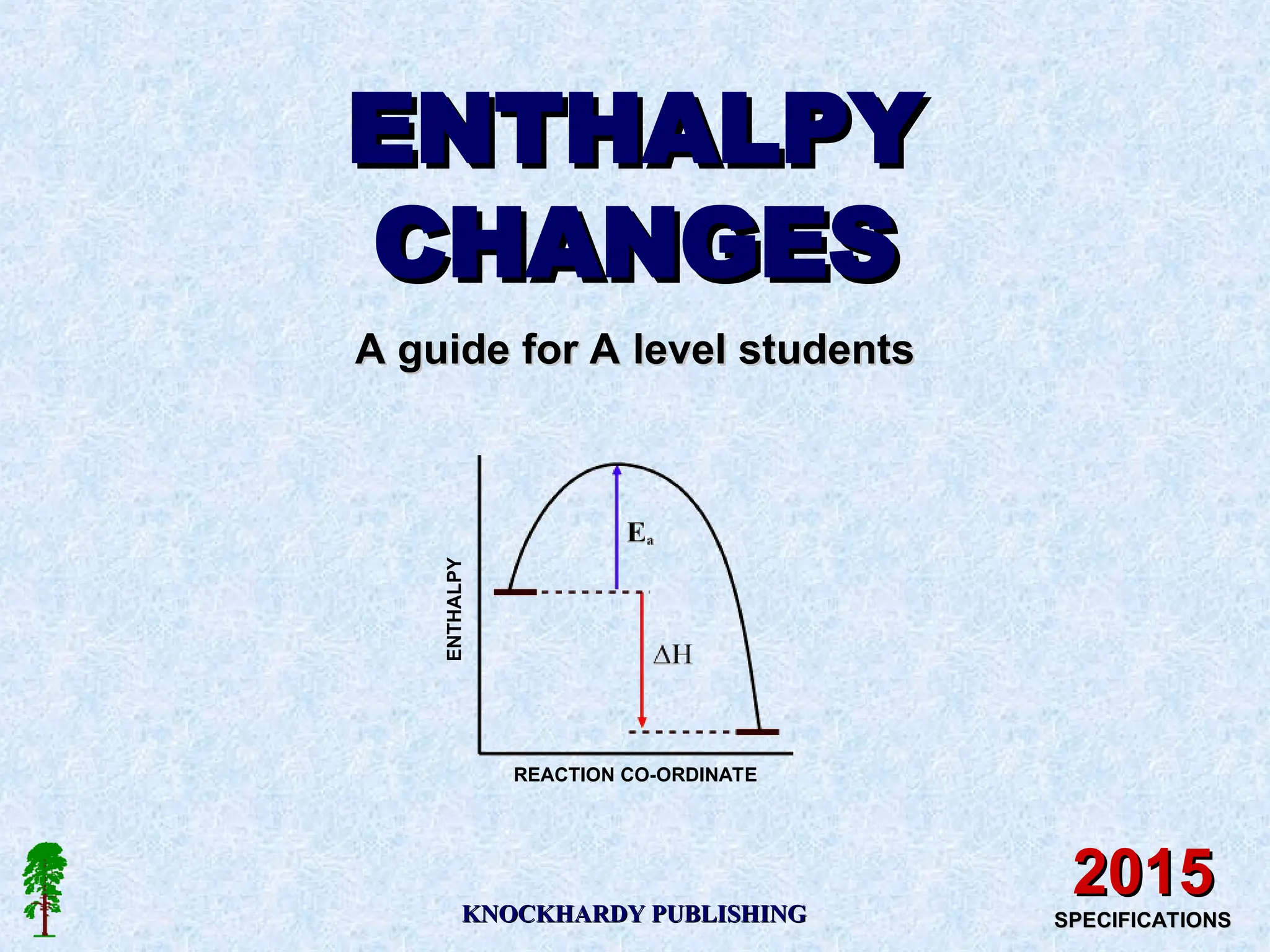
ENTHALPY
ENTHALPY
CHANGES
CHANGES
A guide forA level students
A guide for A level students
KNOCKHARDY PUBLISHING
KNOCKHARDY PUBLISHING
2015
2015
SPECIFICATIONS
SPECIFICATIONS
REACTION CO-ORDINATE
ENTHALPY
2.
ENTHALPY CHANGES
ENTHALPY CHANGES
INTRODUCTION
ThisPowerpoint show is one of several produced to help students understand
selected topics at AS and A2 level Chemistry. It is based on the requirements of
the AQA and OCR specifications but is suitable for other examination boards.
Individual students may use the material at home for revision purposes or it may
be used for classroom teaching if an interactive white board is available.
Accompanying notes on this, and the full range of AS and A2 topics, are available
from the KNOCKHARDY SCIENCE WEBSITE at...
www.knockhardy.org.uk/sci.htm
Navigation is achieved by...
either clicking on the grey arrows at the foot of each page
or using the left and right arrow keys on the keyboard
3.
ENTHALPY CHANGES
ENTHALPY CHANGES
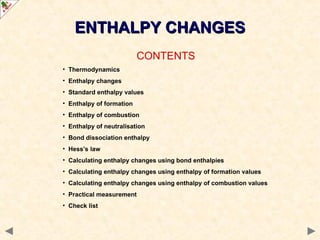
CONTENTS
•Thermodynamics
• Enthalpy changes
• Standard enthalpy values
• Enthalpy of formation
• Enthalpy of combustion
• Enthalpy of neutralisation
• Bond dissociation enthalpy
• Hess’s law
• Calculating enthalpy changes using bond enthalpies
• Calculating enthalpy changes using enthalpy of formation values
• Calculating enthalpy changes using enthalpy of combustion values
• Practical measurement
• Check list
4.
Before you startit would be helpful to…
• be able to balance equations
• be confident with simple arithmetical operations
ENTHALPY CHANGES
ENTHALPY CHANGES
5.
THERMODYNAMICS
THERMODYNAMICS
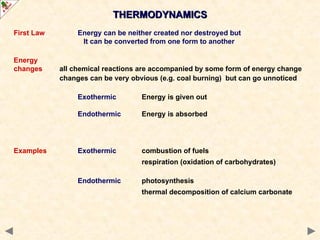
First Law Energycan be neither created nor destroyed but
It can be converted from one form to another
Energy
changes all chemical reactions are accompanied by some form of energy change
changes can be very obvious (e.g. coal burning) but can go unnoticed
Exothermic Energy is given out
Endothermic Energy is absorbed
Examples Exothermic combustion of fuels
respiration (oxidation of carbohydrates)
Endothermic photosynthesis
thermal decomposition of calcium carbonate
6.
THERMODYNAMICS -
THERMODYNAMICS -ENTHALPY CHANGES
ENTHALPY CHANGES
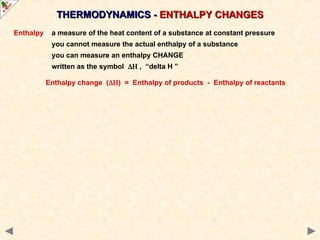
Enthalpy a measure of the heat content of a substance at constant pressure
you cannot measure the actual enthalpy of a substance
you can measure an enthalpy CHANGE
written as the symbol , “delta H ”
Enthalpy change () = Enthalpy of products - Enthalpy of reactants
7.
Enthalpy a measureof the heat content of a substance at constant pressure
you cannot measure the actual enthalpy of a substance
you can measure an enthalpy CHANGE
written as the symbol , “delta H ”
Enthalpy change () = Enthalpy of products - Enthalpy of reactants
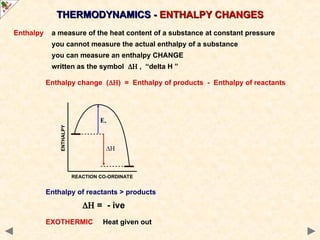
Enthalpy of reactants > products
= - ive
EXOTHERMIC Heat given out
REACTION CO-ORDINATE
ENTHALPY
THERMODYNAMICS -
THERMODYNAMICS - ENTHALPY CHANGES
ENTHALPY CHANGES
8.
Enthalpy a measureof the heat content of a substance at constant pressure
you cannot measure the actual enthalpy of a substance
you can measure an enthalpy CHANGE
written as the symbol , “delta H ”
Enthalpy change () = Enthalpy of products - Enthalpy of reactants
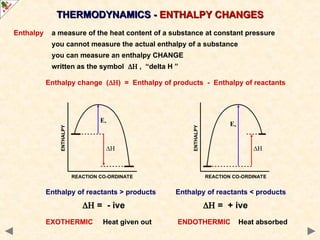
Enthalpy of reactants > products Enthalpy of reactants < products
= - ive = + ive
EXOTHERMIC Heat given out ENDOTHERMIC Heat absorbed
REACTION CO-ORDINATE
ENTHALPY
REACTION CO-ORDINATE
ENTHALPY
THERMODYNAMICS -
THERMODYNAMICS - ENTHALPY CHANGES
ENTHALPY CHANGES
9.
Why a
standard? enthalpyvalues vary according to the conditions
a substance under these conditions is said to be in its standard state ...
Pressure:- 100 kPa (1 atmosphere)
A stated temperature usually 298K (25°C)
• as a guide, just think of how a substance would be under normal lab conditions
• assign the correct subscript [(g), (l) or (s) ] to indicate which state it is in
• any solutions are of concentration 1 mol dm-3
• to tell if standard conditions are used we modify the symbol for .
Enthalpy Change Standard Enthalpy Change
(at 298K)
STANDARD ENTHALPY CHANGES
STANDARD ENTHALPY CHANGES
10.
ENTHALPY CHANGE OFFORMATION
ENTHALPY CHANGE OF FORMATION
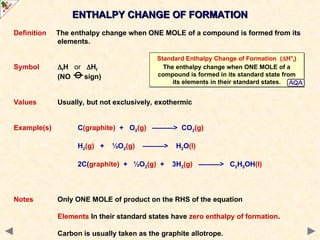
Definition The enthalpy change when ONE MOLE of a compound is formed from its
elements.
Symbol fH or Hf
(NO sign)
Values Usually, but not exclusively, exothermic
Example(s) C(graphite) + O2(g) ———> CO2(g)
H2(g) + ½O2(g) ———> H2O(l)
2C(graphite) + ½O2(g) + 3H2(g) ———> C2H5OH(l)
Notes Only ONE MOLE of product on the RHS of the equation
Elements In their standard states have zero enthalpy of formation.
Carbon is usually taken as the graphite allotrope.
Standard Enthalpy Change of Formation (H°f)
The enthalpy change when ONE MOLE of a
compound is formed in its standard state from
its elements in their standard states.
11.
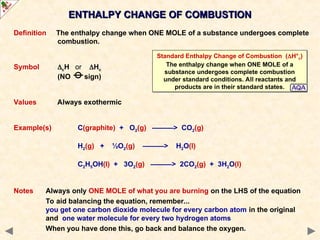
Definition The enthalpychange when ONE MOLE of a substance undergoes complete
combustion.
Symbol cH or Hc
(NO sign)
Values Always exothermic
Example(s) C(graphite) + O2(g) ———> CO2(g)
H2(g) + ½O2(g) ———> H2O(l)
C2H5OH(l) + 3O2(g) ———> 2CO2(g) + 3H2O(l)
Notes Always only ONE MOLE of what you are burning on the LHS of the equation
To aid balancing the equation, remember...
you get one carbon dioxide molecule for every carbon atom in the original
and one water molecule for every two hydrogen atoms
When you have done this, go back and balance the oxygen.
ENTHALPY CHANGE OF COMBUSTION
ENTHALPY CHANGE OF COMBUSTION
Standard Enthalpy Change of Combustion (H°c)
The enthalpy change when ONE MOLE of a
substance undergoes complete combustion
under standard conditions. All reactants and
products are in their standard states.
12.
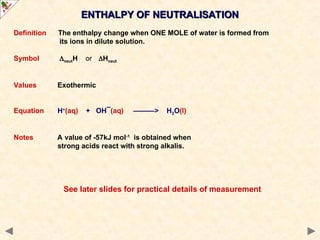
Definition The enthalpychange when ONE MOLE of water is formed from
its ions in dilute solution.
Symbol neutH or Hneut
Values Exothermic
Equation H+
(aq) + OH¯(aq) ———> H2O(l)
Notes A value of -57kJ mol-1
is obtained when
strong acids react with strong alkalis.
See later slides for practical details of measurement
ENTHALPY OF NEUTRALISATION
ENTHALPY OF NEUTRALISATION
13.
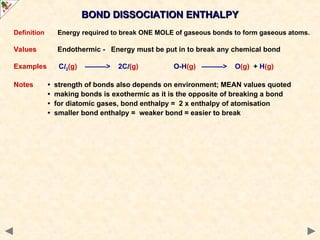
Definition Energy requiredto break ONE MOLE of gaseous bonds to form gaseous atoms.
Values Endothermic - Energy must be put in to break any chemical bond
Examples Cl2(g) ———> 2Cl(g) O-H(g) ———> O(g) + H(g)
Notes • strength of bonds also depends on environment; MEAN values quoted
• making bonds is exothermic as it is the opposite of breaking a bond
• for diatomic gases, bond enthalpy = 2 x enthalpy of atomisation
• smaller bond enthalpy = weaker bond = easier to break
BOND DISSOCIATION ENTHALPY
BOND DISSOCIATION ENTHALPY
14.
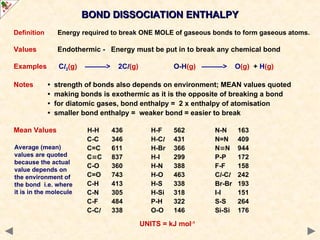
Definition Energy requiredto break ONE MOLE of gaseous bonds to form gaseous atoms.
Values Endothermic - Energy must be put in to break any chemical bond
Examples Cl2(g) ———> 2Cl(g) O-H(g) ———> O(g) + H(g)
Notes • strength of bonds also depends on environment; MEAN values quoted
• making bonds is exothermic as it is the opposite of breaking a bond
• for diatomic gases, bond enthalpy = 2 x enthalpy of atomisation
• smaller bond enthalpy = weaker bond = easier to break
Mean Values H-H 436 H-F 562 N-N 163
C-C 346 H-Cl 431 N=N 409
C=C 611 H-Br 366 NN 944
CC 837 H-I 299 P-P 172
C-O 360 H-N 388 F-F 158
C=O 743 H-O 463 Cl-Cl 242
C-H 413 H-S 338 Br-Br 193
C-N 305 H-Si 318 I-I 151
C-F 484 P-H 322 S-S 264
C-Cl 338 O-O 146 Si-Si 176
BOND DISSOCIATION ENTHALPY
BOND DISSOCIATION ENTHALPY
Average (mean)
values are quoted
because the actual
value depends on
the environment of
the bond i.e. where
it is in the molecule
UNITS = kJ mol-1
15.
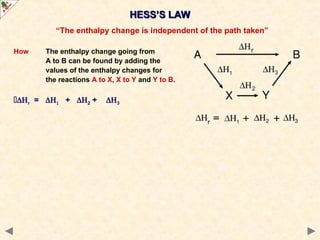
“The enthalpy changeis independent of the path taken”
How The enthalpy change going from
A to B can be found by adding the
values of the enthalpy changes for
the reactions A to X, X to Y and Y to B.
r = + 2 + 3
HESS’S LAW
HESS’S LAW
16.
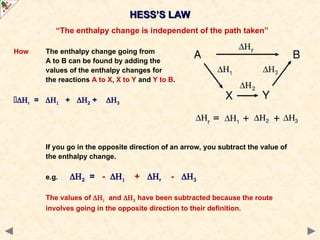
“The enthalpy changeis independent of the path taken”
How The enthalpy change going from
A to B can be found by adding the
values of the enthalpy changes for
the reactions A to X, X to Y and Y to B.
r = + 2 + 3
If you go in the opposite direction of an arrow, you subtract the value of
the enthalpy change.
e.g. 2 = - + r - 3
The values of and3 have been subtracted because the route
involves going in the opposite direction to their definition.
HESS’S LAW
HESS’S LAW
17.
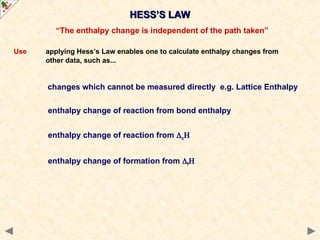
“The enthalpy changeis independent of the path taken”
Use applying Hess’s Law enables one to calculate enthalpy changes from
other data, such as...
changes which cannot be measured directly e.g. Lattice Enthalpy
enthalpy change of reaction from bond enthalpy
enthalpy change of reaction from c
enthalpy change of formation from f
HESS’S LAW
HESS’S LAW
18.
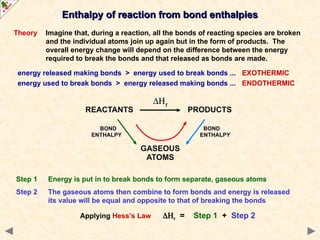
Theory Imagine that,during a reaction, all the bonds of reacting species are broken
and the individual atoms join up again but in the form of products. The
overall energy change will depend on the difference between the energy
required to break the bonds and that released as bonds are made.
energy released making bonds > energy used to break bonds ... EXOTHERMIC
energy used to break bonds > energy released making bonds ... ENDOTHERMIC
Enthalpy of reaction from bond enthalpies
Enthalpy of reaction from bond enthalpies
Step 1 Energy is put in to break bonds to form separate, gaseous atoms
Step 2 The gaseous atoms then combine to form bonds and energy is released
its value will be equal and opposite to that of breaking the bonds
Applying Hess’s Law r = Step 1 + Step 2
19.
Enthalpy of reactionfrom bond enthalpies
Enthalpy of reaction from bond enthalpies
= bond enthalpies – bond enthalpies
of reactants of products
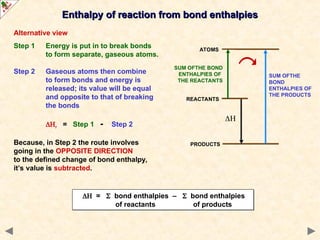
Alternative view
Step 1 Energy is put in to break bonds
to form separate, gaseous atoms.
Step 2 Gaseous atoms then combine
to form bonds and energy is
released; its value will be equal
and opposite to that of breaking
the bonds
r = Step 1 - Step 2
Because, in Step 2 the route involves
going in the OPPOSITE DIRECTION
to the defined change of bond enthalpy,
it’s value is subtracted.
SUM OFTHE BOND
ENTHALPIES OF
THE REACTANTS
REACTANTS
PRODUCTS
ATOMS
SUM OFTHE
BOND
ENTHALPIES OF
THE PRODUCTS
20.
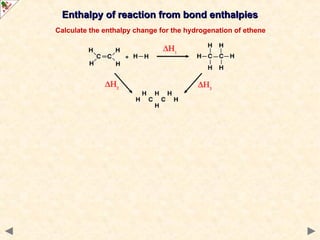
Calculate the enthalpychange for the hydrogenation of ethene
Enthalpy of reaction from bond enthalpies
Enthalpy of reaction from bond enthalpies
21.
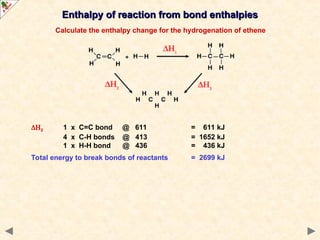
Calculate the enthalpychange for the hydrogenation of ethene
Enthalpy of reaction from bond enthalpies
Enthalpy of reaction from bond enthalpies
2 1 x C=C bond @ 611 = 611 kJ
4 x C-H bonds @ 413 = 1652 kJ
1 x H-H bond @ 436 = 436 kJ
Total energy to break bonds of reactants = 2699 kJ
22.
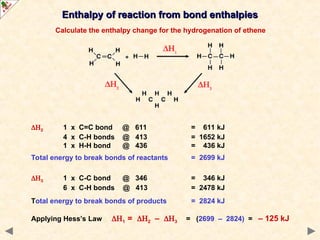
Calculate the enthalpychange for the hydrogenation of ethene
Enthalpy of reaction from bond enthalpies
Enthalpy of reaction from bond enthalpies
2 1 x C=C bond @ 611 = 611 kJ
4 x C-H bonds @ 413 = 1652 kJ
1 x H-H bond @ 436 = 436 kJ
Total energy to break bonds of reactants = 2699 kJ
3 1 x C-C bond @ 346 = 346 kJ
6 x C-H bonds @ 413 = 2478 kJ
Total energy to break bonds of products = 2824 kJ
Applying Hess’s Law 1 = 2 – 3 = (2699 – 2824) = – 125 kJ
23.
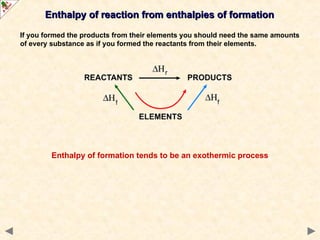
If you formedthe products from their elements you should need the same amounts
of every substance as if you formed the reactants from their elements.
Enthalpy of formation tends to be an exothermic process
Enthalpy of reaction from enthalpies of formation
Enthalpy of reaction from enthalpies of formation
24.
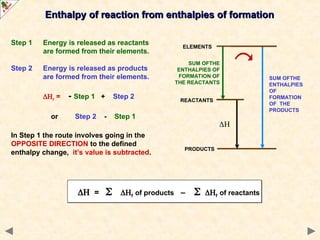
Step 1 Energyis released as reactants
are formed from their elements.
Step 2 Energy is released as products
are formed from their elements.
r = - Step 1 + Step 2
or Step 2 - Step 1
In Step 1 the route involves going in the
OPPOSITE DIRECTION to the defined
enthalpy change, it’s value is subtracted.
SUM OFTHE
ENTHALPIES OF
FORMATION OF
THE REACTANTS
REACTANTS
PRODUCTS
ELEMENTS
SUM OFTHE
ENTHALPIES
OF
FORMATION
OF THE
PRODUCTS
Enthalpy of reaction from enthalpies of formation
Enthalpy of reaction from enthalpies of formation
= f of products – f of reactants
25.
Sample calculation
Calculate thestandard enthalpy change for the following reaction, given that the
standard enthalpies of formation of water, nitrogen dioxide and nitric acid are -286,
+33 and -173 kJ mol-1
respectively; the value for oxygen is ZERO as it is an element
2H2O(l) + 4NO2(g) + O2(g) ———> 4HNO3(l)
By applying Hess’s Law ... The Standard Enthalpy of Reaction °r will be...
PRODUCTS REACTANTS
[ 4 x f of HNO3 ] minus [ (2 x f of H2O) + (4 x f of NO2) + (1 x f of O2) ]
°r = 4 x (-173) - 2 x (-286) + 4 x (+33) + 0
ANSWER = - 252 kJ
Enthalpy of reaction from enthalpies of formation
Enthalpy of reaction from enthalpies of formation
= f of products – f of reactants
26.
Enthalpy of reactionfrom enthalpies of combustion
Enthalpy of reaction from enthalpies of combustion
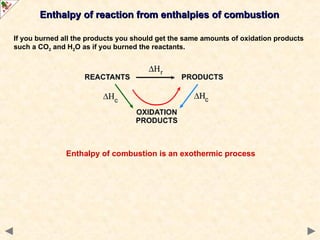
If you burned all the products you should get the same amounts of oxidation products
such a CO2 and H2O as if you burned the reactants.
Enthalpy of combustion is an exothermic process
27.
= c of reactants – c of products
Enthalpy of reaction from enthalpies of combustion
Enthalpy of reaction from enthalpies of combustion
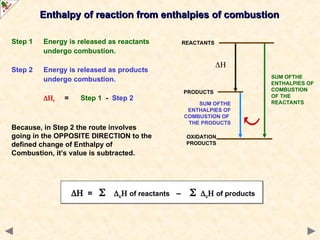
Step 1 Energy is released as reactants
undergo combustion.
Step 2 Energy is released as products
undergo combustion.
r = Step 1 - Step 2
Because, in Step 2 the route involves
going in the OPPOSITE DIRECTION to the
defined change of Enthalpy of
Combustion, it’s value is subtracted.
SUM OFTHE
ENTHALPIES OF
COMBUSTION
OF THE
REACTANTS
REACTANTS
PRODUCTS
OXIDATION
PRODUCTS
SUM OFTHE
ENTHALPIES OF
COMBUSTION OF
THE PRODUCTS
28.
Enthalpy of reactionfrom enthalpies of combustion
Enthalpy of reaction from enthalpies of combustion
Sample calculation
Calculate the standard enthalpy of formation of methane; the standard enthalpies of
combustion of carbon, hydrogen and methane are -394, -286 and -890 kJ mol-1
.
C(graphite) + 2H2(g) ———> CH4(g)
By applying Hess’s Law ... The Standard Enthalpy of Reaction °r will be...
REACTANTS PRODUCTS
[ (1 x c of C) + (2 x c of H2) ] minus [ 1 x c of CH4]
°r = 1 x (-394) + 2 x (-286) - 1 x (-890)
ANSWER = - 76 kJ mol-1
= c of reactants – c of products
29.
Calorimetry involves thepractical determination of enthalpy changes
usually involves heating (or cooling) known amounts of water
water is heated up reaction is EXOTHERMIC
water cools down reaction is ENDOTHERMIC
Calculation The energy required to change the temperature
of a substance can be calculated using... q = m x c x
where q = heat energy kJ
m = mass kg
c = Specific Heat Capacity kJ K -1
kg -1
[ water is 4.18 ]
= change in temperature K
MEASURING ENTHALPY CHANGES
MEASURING ENTHALPY CHANGES
30.
Calorimetry involves thepractical determination of enthalpy changes
usually involves heating (or cooling) known amounts of water
water is heated up reaction is EXOTHERMIC
water cools down reaction is ENDOTHERMIC
Calculation The energy required to change the temperature
of a substance can be calculated using... q = m x c x
where q = heat energy kJ
m = mass kg
c = Specific Heat Capacity kJ K -1
kg -1
[ water is 4.18 ]
= change in temperature K
Example On complete combustion, 0.18g of hexane raised the temperature of
100g water from 22°C to 47°C. Calculate its enthalpy of combustion.
Heat absorbed by the water (q) = 0.1 x 4.18 x 25 = 10.45 kJ
Moles of hexane burned = mass / Mr = 0.18 / 86
= 0.00209
Enthalpy change = heat energy / moles = 10.45 / 0.00209
ANS = 5000 kJ mol -1
MEASURING ENTHALPY CHANGES
MEASURING ENTHALPY CHANGES
31.
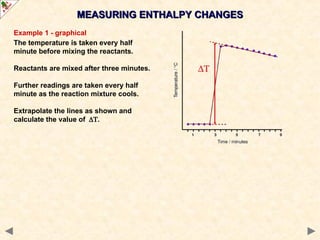
Example 1 -graphical
The temperature is taken every half
minute before mixing the reactants.
Reactants are mixed after three minutes.
Further readings are taken every half
minute as the reaction mixture cools.
Extrapolate the lines as shown and
calculate the value of.
MEASURING ENTHALPY CHANGES
MEASURING ENTHALPY CHANGES
32.
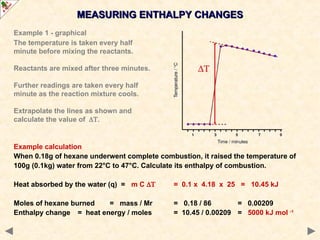
Example 1 -graphical
The temperature is taken every half
minute before mixing the reactants.
Reactants are mixed after three minutes.
Further readings are taken every half
minute as the reaction mixture cools.
Extrapolate the lines as shown and
calculate the value of.
Example calculation
When 0.18g of hexane underwent complete combustion, it raised the temperature of
100g (0.1kg) water from 22°C to 47°C. Calculate its enthalpy of combustion.
Heat absorbed by the water (q) = m C = 0.1 x 4.18 x 25 = 10.45 kJ
Moles of hexane burned = mass / Mr = 0.18 / 86 = 0.00209
Enthalpy change = heat energy / moles = 10.45 / 0.00209 = 5000 kJ mol -1
MEASURING ENTHALPY CHANGES
MEASURING ENTHALPY CHANGES
33.
Example 2
25cm3
of 2.0MHCl was added to 25cm3
of 2.0M NaOH in an insulated beaker. The initial
temperature of both solutions was 20°C. The highest temperature reached by the
solution was 33°C. Calculate the Molar Enthalpy of Neutralisation. [The specific heat
capacity (c) of water is 4.18 kJ K -1
kg -1
]
NaOH + HCl ——> NaCl + H2O
MEASURING ENTHALPY CHANGES
MEASURING ENTHALPY CHANGES
34.
Example 2
25cm3
of 2.0MHCl was added to 25cm3
of 2.0M NaOH in an insulated beaker. The initial
temperature of both solutions was 20°C. The highest temperature reached by the
solution was 33°C. Calculate the Molar Enthalpy of Neutralisation. [The specific heat
capacity (c) of water is 4.18 kJ K -1
kg -1
]
NaOH + HCl ——> NaCl + H2O
Temperature rise () = 306K – 293K = 13K
Volume of resulting solution= 25 + 25 = 50cm3
= 0.05 dm3
Equivalent mass of water = 50g = 0.05 kg
(density is 1g per cm3
)
Heat absorbed by the water (q) = m x c x 0.05 x 4.18 x 13 =
2.717 kJ
MEASURING ENTHALPY CHANGES
MEASURING ENTHALPY CHANGES
35.
Example 2
25cm3
of 2.0MHCl was added to 25cm3
of 2.0M NaOH in an insulated beaker. The initial
temperature of both solutions was 20°C. The highest temperature reached by the
solution was 33°C. Calculate the Molar Enthalpy of Neutralisation. [The specific heat
capacity (c) of water is 4.18 kJ K -1
kg -1
]
NaOH + HCl ——> NaCl + H2O
Temperature rise () = 306K – 293K = 13K
Volume of resulting solution= 25 + 25 = 50cm3
= 0.05 dm3
Equivalent mass of water = 50g = 0.05 kg
(density is 1g per cm3
)
Heat absorbed by the water (q) = m x c x 0.05 x 4.18 x 13 =
2.717 kJ
Moles of HCl reacting = 2 x 25/1000 = 0.05 mol
Moles of NaOH reacting = 2 x 25/1000 = 0.05 mol
Moles of water produced = 0.05 mol
Enthalpy change per mol () = heat energy / moles of water = 2.717 / 0.05
= 54.34 kJ mol -1
MEASURING ENTHALPY CHANGES
MEASURING ENTHALPY CHANGES
36.
REVISION CHECK
REVISION CHECK
Whatshould you be able to do?
Explain the difference between an endothermic and exothermic reaction
Understand the reasons for using standard enthalpy changes
Recall the definitions of enthalpy of formation and combustion
Write equations representing enthalpy of combustion and formation
Recall and apply Hess’s law
Recall the definition of bond dissociation enthalpy
Calculate standard enthalpy changes using bond enthalpy values
Calculate standard enthalpy changes using enthalpies of formation and combustion
Know simple calorimetry methods for measuring enthalpy changes
Calculate enthalpy changes from calorimetry measurements
CAN YOU DO ALL OF THESE?
CAN YOU DO ALL OF THESE? YES
YES NO
NO
37.
You need togo over the
You need to go over the
relevant topic(s) again
relevant topic(s) again
Click on the button to
Click on the button to
return to the menu
return to the menu



![Why a
standard? enthalpy values vary according to the conditions
a substance under these conditions is said to be in its standard state ...
Pressure:- 100 kPa (1 atmosphere)
A stated temperature usually 298K (25°C)
• as a guide, just think of how a substance would be under normal lab conditions
• assign the correct subscript [(g), (l) or (s) ] to indicate which state it is in
• any solutions are of concentration 1 mol dm-3
• to tell if standard conditions are used we modify the symbol for .
Enthalpy Change Standard Enthalpy Change
(at 298K)
STANDARD ENTHALPY CHANGES
STANDARD ENTHALPY CHANGES](https://image.slidesharecdn.com/15deltahpp-250401060535-d37f3e60/85/ENTHALPY-CHANGES-A-guide-for-A-level-stu-9-320.jpg)
![Sample calculation
Calculate the standard enthalpy change for the following reaction, given that the
standard enthalpies of formation of water, nitrogen dioxide and nitric acid are -286,
+33 and -173 kJ mol-1
respectively; the value for oxygen is ZERO as it is an element
2H2O(l) + 4NO2(g) + O2(g) ———> 4HNO3(l)
By applying Hess’s Law ... The Standard Enthalpy of Reaction °r will be...
PRODUCTS REACTANTS
[ 4 x f of HNO3 ] minus [ (2 x f of H2O) + (4 x f of NO2) + (1 x f of O2) ]
°r = 4 x (-173) - 2 x (-286) + 4 x (+33) + 0
ANSWER = - 252 kJ
Enthalpy of reaction from enthalpies of formation
Enthalpy of reaction from enthalpies of formation
= f of products – f of reactants](https://image.slidesharecdn.com/15deltahpp-250401060535-d37f3e60/85/ENTHALPY-CHANGES-A-guide-for-A-level-stu-25-320.jpg)
![Enthalpy of reaction from enthalpies of combustion
Enthalpy of reaction from enthalpies of combustion
Sample calculation
Calculate the standard enthalpy of formation of methane; the standard enthalpies of
combustion of carbon, hydrogen and methane are -394, -286 and -890 kJ mol-1
.
C(graphite) + 2H2(g) ———> CH4(g)
By applying Hess’s Law ... The Standard Enthalpy of Reaction °r will be...
REACTANTS PRODUCTS
[ (1 x c of C) + (2 x c of H2) ] minus [ 1 x c of CH4]
°r = 1 x (-394) + 2 x (-286) - 1 x (-890)
ANSWER = - 76 kJ mol-1
= c of reactants – c of products](https://image.slidesharecdn.com/15deltahpp-250401060535-d37f3e60/85/ENTHALPY-CHANGES-A-guide-for-A-level-stu-28-320.jpg)
![Calorimetry involves the practical determination of enthalpy changes
usually involves heating (or cooling) known amounts of water
water is heated up reaction is EXOTHERMIC
water cools down reaction is ENDOTHERMIC
Calculation The energy required to change the temperature
of a substance can be calculated using... q = m x c x
where q = heat energy kJ
m = mass kg
c = Specific Heat Capacity kJ K -1
kg -1
[ water is 4.18 ]
= change in temperature K
MEASURING ENTHALPY CHANGES
MEASURING ENTHALPY CHANGES](https://image.slidesharecdn.com/15deltahpp-250401060535-d37f3e60/85/ENTHALPY-CHANGES-A-guide-for-A-level-stu-29-320.jpg)
![Calorimetry involves the practical determination of enthalpy changes
usually involves heating (or cooling) known amounts of water
water is heated up reaction is EXOTHERMIC
water cools down reaction is ENDOTHERMIC
Calculation The energy required to change the temperature
of a substance can be calculated using... q = m x c x
where q = heat energy kJ
m = mass kg
c = Specific Heat Capacity kJ K -1
kg -1
[ water is 4.18 ]
= change in temperature K
Example On complete combustion, 0.18g of hexane raised the temperature of
100g water from 22°C to 47°C. Calculate its enthalpy of combustion.
Heat absorbed by the water (q) = 0.1 x 4.18 x 25 = 10.45 kJ
Moles of hexane burned = mass / Mr = 0.18 / 86
= 0.00209
Enthalpy change = heat energy / moles = 10.45 / 0.00209
ANS = 5000 kJ mol -1
MEASURING ENTHALPY CHANGES
MEASURING ENTHALPY CHANGES](https://image.slidesharecdn.com/15deltahpp-250401060535-d37f3e60/85/ENTHALPY-CHANGES-A-guide-for-A-level-stu-30-320.jpg)
![Example 2
25cm3
of 2.0M HCl was added to 25cm3
of 2.0M NaOH in an insulated beaker. The initial
temperature of both solutions was 20°C. The highest temperature reached by the
solution was 33°C. Calculate the Molar Enthalpy of Neutralisation. [The specific heat
capacity (c) of water is 4.18 kJ K -1
kg -1
]
NaOH + HCl ——> NaCl + H2O
MEASURING ENTHALPY CHANGES
MEASURING ENTHALPY CHANGES](https://image.slidesharecdn.com/15deltahpp-250401060535-d37f3e60/85/ENTHALPY-CHANGES-A-guide-for-A-level-stu-33-320.jpg)
![Example 2
25cm3
of 2.0M HCl was added to 25cm3
of 2.0M NaOH in an insulated beaker. The initial
temperature of both solutions was 20°C. The highest temperature reached by the
solution was 33°C. Calculate the Molar Enthalpy of Neutralisation. [The specific heat
capacity (c) of water is 4.18 kJ K -1
kg -1
]
NaOH + HCl ——> NaCl + H2O
Temperature rise () = 306K – 293K = 13K
Volume of resulting solution= 25 + 25 = 50cm3
= 0.05 dm3
Equivalent mass of water = 50g = 0.05 kg
(density is 1g per cm3
)
Heat absorbed by the water (q) = m x c x 0.05 x 4.18 x 13 =
2.717 kJ
MEASURING ENTHALPY CHANGES
MEASURING ENTHALPY CHANGES](https://image.slidesharecdn.com/15deltahpp-250401060535-d37f3e60/85/ENTHALPY-CHANGES-A-guide-for-A-level-stu-34-320.jpg)
![Example 2
25cm3
of 2.0M HCl was added to 25cm3
of 2.0M NaOH in an insulated beaker. The initial
temperature of both solutions was 20°C. The highest temperature reached by the
solution was 33°C. Calculate the Molar Enthalpy of Neutralisation. [The specific heat
capacity (c) of water is 4.18 kJ K -1
kg -1
]
NaOH + HCl ——> NaCl + H2O
Temperature rise () = 306K – 293K = 13K
Volume of resulting solution= 25 + 25 = 50cm3
= 0.05 dm3
Equivalent mass of water = 50g = 0.05 kg
(density is 1g per cm3
)
Heat absorbed by the water (q) = m x c x 0.05 x 4.18 x 13 =
2.717 kJ
Moles of HCl reacting = 2 x 25/1000 = 0.05 mol
Moles of NaOH reacting = 2 x 25/1000 = 0.05 mol
Moles of water produced = 0.05 mol
Enthalpy change per mol () = heat energy / moles of water = 2.717 / 0.05
= 54.34 kJ mol -1
MEASURING ENTHALPY CHANGES
MEASURING ENTHALPY CHANGES](https://image.slidesharecdn.com/15deltahpp-250401060535-d37f3e60/85/ENTHALPY-CHANGES-A-guide-for-A-level-stu-35-320.jpg)