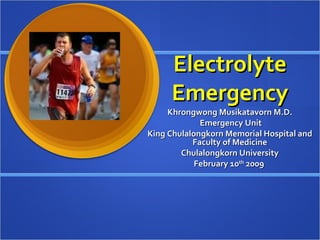
Electrolyte Emergency Khrongwong Musikatavorn M.D. Emergency Unit King Chulalongkorn Memorial Hospital and Faculty of Medicine Chulalongkorn University February 10 th  2009
Common life-threatening Electrolyte disturbances  Dysnatremias (hyponatremia, hyprenatremia) Dyskalemias (hyperkalemia, hypokalemia) Dyscalcemias (hypercalcemia, hypocalcemia) Hypomagnesemia
Sodium homeostasis Disease of water homeostasis ~ 60% of total body composition = water 2/3 = intracellular space  1/3 extracellular space (interstitial + intravascular) Sodium homeostasis and water balance regulates by renin-angiotensin-aldosterone system and antidiuretic hormone (ADH) ADH    water reabsorption, stimulated by volume depletion and many other conditions
Hyponatremia Sodium concentration < 135 mmol/L The most common electrolyte abnormality in the hospitalized patients 1 Mild hyponatremia 15-22% of ambulatory patients 2 N Engl J Med 2000;342:1581-9 Clin Chim Acta 2003;337:169-72
Hyponatremia Hypo-osmolarity hypotonicity hyponatremia excess of free water Hyper-osmolarity hypotonicity hyponatremia Hyper-osmolar agents: hyperglycemia, mannitol Pseudohyponatremia
Hyponatremia Decrease volume of extracellular fluid Renal sodium loss Diuretics, osmotic agents, adrenal insufficiency, salt  wasting nephropathy Extrarenal sodium loss Diarrhea, vomiting, excessive sweating, “third space loss”  N Engl J Med 2000;342:1581-9
Hyponatremia Increase volume of extracellular fluid Congestive heart failure Cirrhosis Nephrotic syndrome Renal failure Pregnancy N Engl J Med 2000;342:1581-9
Hyponatremia Normal volume of extracellular fluid SIAD** Adrenal insufficiency Hypothyroidism Thiazide diuretic Excessive water intake Primary polydipsia, tap-water enema, accidental ingestion of water, sodium-free irrigant solution  N Engl J Med 2000;342:1581-9
Signs and Symptoms of hyponatremia Rate of decrease in [Na + ] and level of [Na + ] Usually asymptomatic if [Na + ] ≥ 125 mmol/L Headache, nausea, vomiting, anorexia,  muscle cramps, lethargy, restlessness, disorientation Seizures, coma, permanent brain damage, respiratory arrest, brain-stem herniation
Evaluation of hyponatremia Rule out hyper-osmolar hyponatremia and pseudohyponatremia    “true” hyponatremia How is the patient’s volume status? Hypervolemic, hypovolumic or euvolemic 2 litres of 0.9% NaCl over 24-48 hours can be tried if hypovolemia is doubtful  1 . Serial [Na + ] follow-up is necessary Determine the causes of hyponatremia Hormone depletion should be worked up in the specific cases 1. N Engl J Med 2007; 356: 2064-72
Evaluation of hyponatremia Hypo-osmolarity hypotonicity hyponatremia =  true hyponatremia Direct serum osmolarity measurement or calculated osmolarity effective osmolarity < 275 mOsm/kg Measured osmolarity – BUN(mg/dl)/2.8  Or 2[Na + ] + glucose(mg/dl)/18 N Engl J Med 2007; 356: 2064-72
Treatment of hyponatremia Aggressiveness of the treatment Is patient symtomatic of hyponatremia? Volume status of the patient Detection and treatment of the preventable causes of hyponatremia Serial monitoring of [Na + ] during treatment
Symptomatic hyponatremia “an emergency condition” Aggressive sodium correction 3% NaCl (513 mmol/L) in the rate of 1-2 mmol/L/hour In hypervolemic or euvolemic patient, furosemide should be used with hypertonic saline The symptoms usually improve within the few hours Rapid correction can be very harmful Serial monitoring of [Na + ]
Correction of hyponatremia Generally not faster than 0.5 mmol/L/hour or 12 mmol/L in 24 hours Varies from 8-20 mmol/L/day Too rapid = Osmotic demyelination syndrome (ODS) Central pontine myelinolysis (CPM) and extrapontine (EPM Biphasic course of neurological deterioration Dysarthria, dysphagia, flaccid quadriplegia (CPM) Movement disorder (eg. Parkinsonism) in EPM J Neurol Neurosurg Psychiatry 2004;75(Suppl III):iii22–iii28
Calculation of sodium deficit Traditional formula (Desired[Na + ] – Measured[Na + ])x(0.6)(Weight in kilograms) =  mmol[Na + ]administered Eg : Symptomatic hyponatremic man 70 kg.needs  2 mmol/L raising of his [Na + ] (105 to 107 mmol/L) within 2 hours with 3% NaCl (Na +  513 mmol/1000 ml) (107-105)X(0.6)(70)  ≅  84 mmol  of Na +  = 84/513 =  0.16 litre of 3% 0.16 litre (160 ml) given in 2 hours, so the rate of IV is 160/2  =  80 ml/hr
Calculation of sodium deficit N Engl J Med 2007; 356: 2064-72
Syndrome of Inappropriate Antidiuresis (SIAD)  The most common cause of hyponatremia Euvolemic patients Inappropriate secretion of ADH Many etiologies
Causes of SIAD Malignant diseases Pulmonary disorders CNS disorders Drugs  : antidepressants and antipsychotics,  chlorpropamide, clofibrate, vincristine, cyclophosphamide, ifosfamide, Narcotics, “ectasy”, NSAIDs Nausea, Pain, Stress
Diagnosis of SIAD Decrease effective osmolarity < 275 mOsm/kg Urine Osm > 100 mOsm/kg Clinical euvolemia Urine sodium > 40 mmol/L with normal salt intake Normal thyroid and adrenal function No recent diuretic use
Treatment of SIAD Failure to correct with 0.9% NaCl Symptomatic SIAD : 3% NaCl infusion 1-2 mmol/L for 2 hour Not faster than 0.5 mmol/L/hour in 24 hours Serial [Na + ] monitoring Chronic SIAD : fluid restriction, salt and protein diet
Hypernatremia Sodium concentration > 145 mmol/L Free water or hypotonic fluid loss Iatrogenic : hypertonic sodium administration Happened in the patients with failure to water access and thirst eg. Elderly, infant, neurological impairment, intubated patient
Signs and symptoms of hypernatremia Rate of increase in [Na + ] and level of [Na + ] confusion, weakness, alteration of consciousness, seizure and coma Vascular rupture from brain shrinkage : eg. SAH Too rapid decreasing in [Na + ] = cerebral edema
Treatment of hypernatremia Detection and correction of the causes  : Fever, GI loss, withdrawal of diuretic, change in high-sodium diet formulation Hypotonic fluid administration  : oral or IV route 0.9% NaCl should be avoided  unless circulatory failure
Hypotonic fluid administration Give the hypotonic fluid of which the patients have lost Pure water insensible loss (Fever, respiratory) = pure water GI or skin loss = hypotonic saline eg. 0.45% NaCl Oral route can be pure water IV route = 5% dextrose in water, 0.2% NaCl, 0.45% NaCl
Calculation of water deficit  N Engl J Med 2000;342:1493-9
Calculation of water deficit  Example of calculation Hypernatremic 60 kg. man with [Na + ] 158 mmol/L was considered to correct his sodium with  IV 0.45% NaCl Change in [Na + ] with 1 litre of 0.45% NaCl in this patient  = (infusate Na +  - serum Na + )/TBW+1 = (77-158)/(0.6)(60)+1 = -2.16 mmol/L And, we want to correct his [Na + ] down to 150 mmol/L in 24 hours (Δ 8 mmol/L). So, in 24 hours, we have to give him 8/2.16  ≅ 3.7 litre of 0.45% NaCl , the rate is  154 ml/hr
Calculation of water deficit  Traditional formula can be used : water deficit = (total body water) X (1-[140÷serum sodium concentration])  But can  underestimate in the case of hypotonic fluid loss The o.5 mmol/L/hour is the same rule for hyponatremia to avoid cerebral edema from rapid decrease in [Na + ] Serial monitoring of serum [Na + ]
Potassium [K + ] homeostasis Important in function of muscle and nerve conductivity Most intracellular, 2% in the extracellular compartment Normal serum concentration of [K + ] 3.5 – 5 mmol/L  Potassium handling 90% by kidney Patients with impaired renal function are at risk of hyperkalemia
Hyperkalemia Serum K concentration  > 5 mmol/L  mild hyperkalemia 5-5.9 mmol/L moderate 6.0-7.0 mmol/L severe ≥ 7.0 mmol/L  ≥  10 mmol/L usually fatal   Circulation 2005; 112: IV-121-IV-125
Hyperkalemia
Signs and Symptoms of  Hyperkalemia Muscle weakness,  flaccid paralysis, paraesthesia, depressed deep tendon reflexes or respiratory distress May be overlooked as a symptom in patient with underlying diseases Asymptomatic patient still life-threatened Patients with suspicious clinical background of hyperkalemia must be checked for serum [K + ] and EKG
EKG abnormalities of Hyperkalemia Cardiac presentation : EKG abnormality, arrhythmia, cardiac arrest Depends on level and rate of increase in [K + ] Earliest EKG change started when [K + ] > 5.5 mmol/L =  Symmetrical tall peaked T wave  (only 20% of patients) 1 EKG usually changes when [K + ] > 6.7 mmol/L 1. Br Med J  2002;324:1320-4
EKG abnormalities of Hyperkalemia
EKG abnormalities of Hyperkalemia Tall peaked T wave
EKG abnormalities of Hyperkalemia Tented T waves, loss of P waves and a wide QRS complex a sinewave pattern
EKG abnormalities of Hyperkalemia Severe bradycardia Ventricular tachycardia
Arrhythmia from hyperkalemia Bradycardia may be unresponsive to transcutaneous, transvenous and atropine, even in the patient with permanent pacemaker  1 Calcium can worsen the bradyarrhythmia to asystole  2 Asystolic cardiac arrest due to hyperkalaemia is usually fatal if the serum potassium is not returned to normal  3 Hemodialysis during CPR had been reported to successful results  4,5,6   1. Resuscitation 2004;62:119-20 2. Semin Dial 2000;13:279-80 3. Am Heart J 1974;88:360-71 4. Inten Care Med 1989;15:325-6 5. Crit Care Med 1981;9:556-7 6. Intensive Care Med 1994;20:287-90
Treatment of hyperkalemia Calcium chloride and calcium gluconate -  Antagonize cardiac membrane excitability  -  Prevention arrhythmia in life-threatening ECG change - 10% calcium chloride 10 ml (Calcium 6.8 mmol)  - 10% calcium gluconate 10 ml   (Calcium 2.2 mmol) - may need higher dose   - Efficacy of Calcium <   1 hour 
Treatment of hyperkalemia Insulin/glucose, Sodium bicarbonate, Beta agonist - K +  shifting to intracellular compartment - Insulin/Glucose   lower K 0.65-1 mmol/L in 60 min - Sodium bicarbonate is less efficient than   insulin/glucose  and   beta  agonist and in the patient without acidosis  1 - Insulin/50% glucose : 10 units IV/ 25 grams glucose - Sodium bicarbonate : 1 mmol/kg IV - Salbutamol : 0.5 mg IV/ 20 mg NB 1. Nephrol Dial  Transplant 2003;18:2215-8
Treatment of hyperkalemia Exchange resins - Calcium or sodium polystyrene sulfonate - Slow onset (1-2 hours) - Reports not significantly decrease [K + ]  1,2 - 15-30 grams PO/PR Cochrane Database System Rev 2005;2(Issue). Art. No.: CD003235 J Am Soc Nephrol 1998;10:1924-30
Treatment of hyperkalemia Hemodialysis -  The  most reliable  method to lower serum potassium level - In life-threatening hyperkalemia, hemodialysis must be emergently scheduled despite administration potassium-lowering agents
Indication for emergency hemodialysis in hyperkalemia Severe hyperkalemia with impaired renal function Life-threatening arrhythmia from hyperkalemia unresponsive to medical treatment J Crit Care 2006;21: 316-21
Indication for hospital admission in hyperkalemia EKG abnormalities other than peaked T wave Severe hyperkalemia (> 8 mmol/L) Renal failure Medical comorbidities Arch Intern Med 2000;160: 1605-11
Hypokalemia Serum K +   ≤  3.5 mmol/L  mild  3.0 -3.5 mmol/L moderate  2.5 - 3.0 mmol/L severe  < 2.5 mmol/L
Causes of hypokalemia Resuscitation 2006;70: 10-25
Signs and Symptoms of hypokalemia Fatigue, weakness, leg cramps, constipation In severe cases, rhabdomyolysis, ascending paralysis and respiratory difficulties   
EKG abnormalities in hypokalemia T wave flattening, prominent U wave, ST segment changes  Long QT interval, Torsade de pointes, VT or   VF  
EKG abnormalities in hypokalemia T wave flattening, prominent U wave, ST segment changes in   Hypokalemia
EKG abnormalities in hypokalemia Prominent U wave (arrow) in hypokalemia
Treatment of hypokalemia The causes of hypokalemia must be corrected Adequate rehydration  in renal or GI potassium loss Serum K +  decreases 0.3 mmol/L in every 100 mmol of total body potassium storage , depends on patient’s body mass  1 In non-life-threatening condition, serum K +  should be gradually corrected orally or intravenously, guided by serum K +  monitoring Should be very careful in patient with impaired renal function 1. New Eng J Med 1998;339:451-8
Treatment of hypokalemia Maximal recommended intravenous dose = 20 mmol/hour In unstable arrhythmia, K +  can be given  2 mmol/min in 10 minutes, followed by 10 mmol in 5-10 minutes In cardiac arrest due to hypokalemia, K +  can be given  20 mmol over 2-3 minutes , followed by 1 minute bolus of MgSO 4 Magnesium sulfate (MgSO 4 ) 1-2 grams should be given without laboratory confirmation  (8 mmol of elemental Mg = 1 gram of MgSO 4 ) Resuscitation 2006;70: 10-25
Calcium homeostasis Parathyroid hormone (PTH) and vitamin D PTH    increase Ca 2+  by increase GI absorption and bone resorption Active vitamin D (1α,25(OH) 2 D 3 )    increase Ca 2+  and PO 4 3-  absorption of small intestine Increasing level of Ca 2+  and vitamin D level has negative feedback to suppress PTH secretion Normal serum Ca 2+  level 8 – 10 mg/dL (2.1 – 2.6 mmol/L)
Hypercalcemia Serum calcium >   10 mg/dL  Mild hypercalcemia < 12 mg/dL Moderate hypercalcemia 12-14 mg/dL Severe hypercalcemia > 14 mg/dL
Signs and Symptoms of hypercalcemia nausea, vomiting, anorexia, weakness, constipation 0r   alteration of mental status Can be mimic the symptoms of patient’s malignancy  polyuria, nocturia or   dehydration  Sometimes patients can be presented as acute pancreatitis or peptic ulcer
Causes of hypercalcemia Increase bone resorption Primary hyperparathypoidism, Hypercalcemia of malignancy, hyperthyroidism, Paget’s disease Increase intestinal absorption Renal failure (often with vitamin D supplementation), Milk-alkaline syndrome, Hypervitaminosis D (Chronic granulomatous disease, lymphoma, increase intake of vitD) Miscellaneous  : thiazide, lithium toxicity, immobilization, TPN, Familial hypocalciuric hypercalcemia
Differential diagnosis of hypercalcemia History : malignancy, drugs eg. Thiazide, lithium, renal failure, urolithiasis etc. Serum PTH level
Emergency treatment of hypercalcemia general supportive care and   treatment of primary disease Rehydration Enhancement of renal calcium excretion Inhibition of bone resorption
Emergency treatment of hypercalcemia Rev Endocr Metab Disord. 2003; 4: 167-75
Emergency treatment of hypercalcemia Rehydration -  Hypercalcemic patients always dehydrate -  0.9% NaCl 3,000 ml/day (up to 6,000) - Promote urine flow to increase urinary Ca 2+  excretion - Should be careful in elderly patient or that with  cardiovascular problems
Emergency treatment of hypercalcemia Enhancement of urinary calcium excretion Loop diuretic : furosemide 20-120 mg every 2-6 hours Complication : volume depletion, hypokalemia, hypomagnesemia
Emergency treatment of hypercalcemia Inhibit bone resorption Calcitonin  4 -8  IU/kg IM or SQ onset 2-4 hours Indicated in patients who cannot tolerate large volume expansion or moderate to severe hypercalcemia Tachyphylaxis and hypersensitivity
Emergency treatment of hypercalcemia Bisphosphonates Pamidronate 90 mg or Zoledronate 4 mg  High potency but slow onset (48 hours) Moderate to severe hypercalcemia Adjusted with decrease in renal function Nausea/vomiting, flu-like symptoms, hypophosphatemia
Emergency   treatment   of hypercalcemia Reduction of intestinal calcium absorption Inhibit vitamin D  Prednisolone 40-100 mg OD or   Dexamethasone 4-8 mg bid   / tid Only hypercalcemia from lymphoproliferative or   granulomatous disease GI hemorrhage, hyperglycemia, osteoporosis or   Cushing’s syndrome
Hypocalcemia Serum calcium < 8 mg/dL Corrected calcium = Serum calcium + 0.8[4-serum albumin (g/L)]
Causes   of   hypocalcemia
Signs   and   Symptoms   of   hypocalcemia Increase neuroexcitibility   :   tingling, numbness, muscle twitching and spasms  In severe cases, tetany, seizure or   cardiac arrhythmias Symptoms depend on rate of decrease in  Ca 2+ . Patients can be asymtomatic even very low serum Ca 2+ Some can present with phychiatric symptoms, cataract, increase intracranial pressure or bone pain
Signs   and   Symptoms   of   hypocalcemia Positive Chvostek’s More specific = Trousseau’s sign  Chvostek’s sign Trousseau’s sign Br Med J 2008;336;1298-1302
Treatment of hypocalcemia No need for emergency treatment if asymptomatic  unless the level is less than 7.3 mg/dL (1.9 mmol/L) Need for emergency treatment if symptomatic  : -  General supportive care - EKG monitoring - Threatening condition to airway – laryngeal spasm - Calcium replacement  Br Med J 2008;336;1298-1302
Calcium replacement for hypocalcemia Calcium gluconate or calcium chloride Less irritation in gluconate form 10 ml Calcium gluconate 1-2 ampoules diluted in 50-100 ml of 5% dextrose solution slowly infused in 10 minutes Repeat until the symptoms disappear Maintenance dose : 10 ml of calcium gluconate 10 ampoules in 5%dextrose or   0.9% saline rate 50 ml/hour  Aim to raise [Ca 2+ ]   in the lower end of normal range  Br Med J 2008;336;1298-1302 Oxford textbook of medicine. 4th ed. Oxford: Oxford  University Press, 2003
Hypomagnesemia Concomitant electrolyte abnormalities with hypokalemia and hypocalcemia Neuromuscular system and cardiac arrhythmia Normal serum magnesium (Mg 2+ )   level = 0.7 - 1.0 mmol/L (1.7-2.4 mg/dL)
Signs and symptoms of hypomagnesemia Sign and symptom of hypokalemia and hypocalcemia Neuromuscular : tetany, carpo-pedal spasm, seizure, weakness, psychosis Cardiovascular : Dysrhythmias (VT and torsade de pointe) prolonged QT, prolonged PR, ST depression
Dysrhythmias in hypomagnesemia QT prolongation (QTc = 0.513 msec)
Dysrhythmias in hypomagnesemia Torsade de pointes
Treatment of hypomagnesemia Symptomatic patient – need for emergency treatment Hypokalemia and hypocalcemia must be treated simultaneously In seizures or arrhythmias :  MgSO4 1-2 grams (8-16 mEq of elemental Mg) in   5-10 min.   until symptoms disappear Maintenance : 6 grams (48 mEq of   Mg) drip in 24 hours   to maintain [Mg 2+ ] and   restore body total Mg 2+  storage Magnesium. 1989;8:201-212  J Intensive Care Med 2005; 20: 3-17
Treatment of hypomagnesemia Compatibility with certain calcium solution Reduce half of the dosage in the renal failure patient [Mg 2+ ] monitoring at lease once a day Mg toxicity in [Mg 2+ ] > 3 – 4 mEq/L hypotension, flushing, nausea, lethargy  และ   decreased deep tendon reflexes.   In severe cases, respiratory compromise from muscle weakness or   cardiac arrest Pharmacol Rev. 1977;29:273-300  J Intensive Care Med 2005; 20: 3-17
 

TAEM10:Electrolyte emergency

  • 1.
    Electrolyte Emergency KhrongwongMusikatavorn M.D. Emergency Unit King Chulalongkorn Memorial Hospital and Faculty of Medicine Chulalongkorn University February 10 th 2009
  • 2.
    Common life-threatening Electrolytedisturbances Dysnatremias (hyponatremia, hyprenatremia) Dyskalemias (hyperkalemia, hypokalemia) Dyscalcemias (hypercalcemia, hypocalcemia) Hypomagnesemia
  • 3.
    Sodium homeostasis Diseaseof water homeostasis ~ 60% of total body composition = water 2/3 = intracellular space 1/3 extracellular space (interstitial + intravascular) Sodium homeostasis and water balance regulates by renin-angiotensin-aldosterone system and antidiuretic hormone (ADH) ADH  water reabsorption, stimulated by volume depletion and many other conditions
  • 4.
    Hyponatremia Sodium concentration< 135 mmol/L The most common electrolyte abnormality in the hospitalized patients 1 Mild hyponatremia 15-22% of ambulatory patients 2 N Engl J Med 2000;342:1581-9 Clin Chim Acta 2003;337:169-72
  • 5.
    Hyponatremia Hypo-osmolarity hypotonicityhyponatremia excess of free water Hyper-osmolarity hypotonicity hyponatremia Hyper-osmolar agents: hyperglycemia, mannitol Pseudohyponatremia
  • 6.
    Hyponatremia Decrease volumeof extracellular fluid Renal sodium loss Diuretics, osmotic agents, adrenal insufficiency, salt wasting nephropathy Extrarenal sodium loss Diarrhea, vomiting, excessive sweating, “third space loss” N Engl J Med 2000;342:1581-9
  • 7.
    Hyponatremia Increase volumeof extracellular fluid Congestive heart failure Cirrhosis Nephrotic syndrome Renal failure Pregnancy N Engl J Med 2000;342:1581-9
  • 8.
    Hyponatremia Normal volumeof extracellular fluid SIAD** Adrenal insufficiency Hypothyroidism Thiazide diuretic Excessive water intake Primary polydipsia, tap-water enema, accidental ingestion of water, sodium-free irrigant solution N Engl J Med 2000;342:1581-9
  • 9.
    Signs and Symptomsof hyponatremia Rate of decrease in [Na + ] and level of [Na + ] Usually asymptomatic if [Na + ] ≥ 125 mmol/L Headache, nausea, vomiting, anorexia, muscle cramps, lethargy, restlessness, disorientation Seizures, coma, permanent brain damage, respiratory arrest, brain-stem herniation
  • 10.
    Evaluation of hyponatremiaRule out hyper-osmolar hyponatremia and pseudohyponatremia  “true” hyponatremia How is the patient’s volume status? Hypervolemic, hypovolumic or euvolemic 2 litres of 0.9% NaCl over 24-48 hours can be tried if hypovolemia is doubtful 1 . Serial [Na + ] follow-up is necessary Determine the causes of hyponatremia Hormone depletion should be worked up in the specific cases 1. N Engl J Med 2007; 356: 2064-72
  • 11.
    Evaluation of hyponatremiaHypo-osmolarity hypotonicity hyponatremia = true hyponatremia Direct serum osmolarity measurement or calculated osmolarity effective osmolarity < 275 mOsm/kg Measured osmolarity – BUN(mg/dl)/2.8 Or 2[Na + ] + glucose(mg/dl)/18 N Engl J Med 2007; 356: 2064-72
  • 12.
    Treatment of hyponatremiaAggressiveness of the treatment Is patient symtomatic of hyponatremia? Volume status of the patient Detection and treatment of the preventable causes of hyponatremia Serial monitoring of [Na + ] during treatment
  • 13.
    Symptomatic hyponatremia “anemergency condition” Aggressive sodium correction 3% NaCl (513 mmol/L) in the rate of 1-2 mmol/L/hour In hypervolemic or euvolemic patient, furosemide should be used with hypertonic saline The symptoms usually improve within the few hours Rapid correction can be very harmful Serial monitoring of [Na + ]
  • 14.
    Correction of hyponatremiaGenerally not faster than 0.5 mmol/L/hour or 12 mmol/L in 24 hours Varies from 8-20 mmol/L/day Too rapid = Osmotic demyelination syndrome (ODS) Central pontine myelinolysis (CPM) and extrapontine (EPM Biphasic course of neurological deterioration Dysarthria, dysphagia, flaccid quadriplegia (CPM) Movement disorder (eg. Parkinsonism) in EPM J Neurol Neurosurg Psychiatry 2004;75(Suppl III):iii22–iii28
  • 15.
    Calculation of sodiumdeficit Traditional formula (Desired[Na + ] – Measured[Na + ])x(0.6)(Weight in kilograms) = mmol[Na + ]administered Eg : Symptomatic hyponatremic man 70 kg.needs 2 mmol/L raising of his [Na + ] (105 to 107 mmol/L) within 2 hours with 3% NaCl (Na + 513 mmol/1000 ml) (107-105)X(0.6)(70) ≅ 84 mmol of Na + = 84/513 = 0.16 litre of 3% 0.16 litre (160 ml) given in 2 hours, so the rate of IV is 160/2 = 80 ml/hr
  • 16.
    Calculation of sodiumdeficit N Engl J Med 2007; 356: 2064-72
  • 17.
    Syndrome of InappropriateAntidiuresis (SIAD) The most common cause of hyponatremia Euvolemic patients Inappropriate secretion of ADH Many etiologies
  • 18.
    Causes of SIADMalignant diseases Pulmonary disorders CNS disorders Drugs : antidepressants and antipsychotics, chlorpropamide, clofibrate, vincristine, cyclophosphamide, ifosfamide, Narcotics, “ectasy”, NSAIDs Nausea, Pain, Stress
  • 19.
    Diagnosis of SIADDecrease effective osmolarity < 275 mOsm/kg Urine Osm > 100 mOsm/kg Clinical euvolemia Urine sodium > 40 mmol/L with normal salt intake Normal thyroid and adrenal function No recent diuretic use
  • 20.
    Treatment of SIADFailure to correct with 0.9% NaCl Symptomatic SIAD : 3% NaCl infusion 1-2 mmol/L for 2 hour Not faster than 0.5 mmol/L/hour in 24 hours Serial [Na + ] monitoring Chronic SIAD : fluid restriction, salt and protein diet
  • 21.
    Hypernatremia Sodium concentration> 145 mmol/L Free water or hypotonic fluid loss Iatrogenic : hypertonic sodium administration Happened in the patients with failure to water access and thirst eg. Elderly, infant, neurological impairment, intubated patient
  • 22.
    Signs and symptomsof hypernatremia Rate of increase in [Na + ] and level of [Na + ] confusion, weakness, alteration of consciousness, seizure and coma Vascular rupture from brain shrinkage : eg. SAH Too rapid decreasing in [Na + ] = cerebral edema
  • 23.
    Treatment of hypernatremiaDetection and correction of the causes : Fever, GI loss, withdrawal of diuretic, change in high-sodium diet formulation Hypotonic fluid administration : oral or IV route 0.9% NaCl should be avoided unless circulatory failure
  • 24.
    Hypotonic fluid administrationGive the hypotonic fluid of which the patients have lost Pure water insensible loss (Fever, respiratory) = pure water GI or skin loss = hypotonic saline eg. 0.45% NaCl Oral route can be pure water IV route = 5% dextrose in water, 0.2% NaCl, 0.45% NaCl
  • 25.
    Calculation of waterdeficit N Engl J Med 2000;342:1493-9
  • 26.
    Calculation of waterdeficit Example of calculation Hypernatremic 60 kg. man with [Na + ] 158 mmol/L was considered to correct his sodium with IV 0.45% NaCl Change in [Na + ] with 1 litre of 0.45% NaCl in this patient = (infusate Na + - serum Na + )/TBW+1 = (77-158)/(0.6)(60)+1 = -2.16 mmol/L And, we want to correct his [Na + ] down to 150 mmol/L in 24 hours (Δ 8 mmol/L). So, in 24 hours, we have to give him 8/2.16 ≅ 3.7 litre of 0.45% NaCl , the rate is 154 ml/hr
  • 27.
    Calculation of waterdeficit Traditional formula can be used : water deficit = (total body water) X (1-[140÷serum sodium concentration]) But can underestimate in the case of hypotonic fluid loss The o.5 mmol/L/hour is the same rule for hyponatremia to avoid cerebral edema from rapid decrease in [Na + ] Serial monitoring of serum [Na + ]
  • 28.
    Potassium [K +] homeostasis Important in function of muscle and nerve conductivity Most intracellular, 2% in the extracellular compartment Normal serum concentration of [K + ] 3.5 – 5 mmol/L Potassium handling 90% by kidney Patients with impaired renal function are at risk of hyperkalemia
  • 29.
    Hyperkalemia Serum Kconcentration > 5 mmol/L mild hyperkalemia 5-5.9 mmol/L moderate 6.0-7.0 mmol/L severe ≥ 7.0 mmol/L ≥ 10 mmol/L usually fatal Circulation 2005; 112: IV-121-IV-125
  • 30.
  • 31.
    Signs and Symptomsof Hyperkalemia Muscle weakness, flaccid paralysis, paraesthesia, depressed deep tendon reflexes or respiratory distress May be overlooked as a symptom in patient with underlying diseases Asymptomatic patient still life-threatened Patients with suspicious clinical background of hyperkalemia must be checked for serum [K + ] and EKG
  • 32.
    EKG abnormalities ofHyperkalemia Cardiac presentation : EKG abnormality, arrhythmia, cardiac arrest Depends on level and rate of increase in [K + ] Earliest EKG change started when [K + ] > 5.5 mmol/L = Symmetrical tall peaked T wave (only 20% of patients) 1 EKG usually changes when [K + ] > 6.7 mmol/L 1. Br Med J 2002;324:1320-4
  • 33.
  • 34.
    EKG abnormalities ofHyperkalemia Tall peaked T wave
  • 35.
    EKG abnormalities ofHyperkalemia Tented T waves, loss of P waves and a wide QRS complex a sinewave pattern
  • 36.
    EKG abnormalities ofHyperkalemia Severe bradycardia Ventricular tachycardia
  • 37.
    Arrhythmia from hyperkalemiaBradycardia may be unresponsive to transcutaneous, transvenous and atropine, even in the patient with permanent pacemaker 1 Calcium can worsen the bradyarrhythmia to asystole 2 Asystolic cardiac arrest due to hyperkalaemia is usually fatal if the serum potassium is not returned to normal 3 Hemodialysis during CPR had been reported to successful results 4,5,6 1. Resuscitation 2004;62:119-20 2. Semin Dial 2000;13:279-80 3. Am Heart J 1974;88:360-71 4. Inten Care Med 1989;15:325-6 5. Crit Care Med 1981;9:556-7 6. Intensive Care Med 1994;20:287-90
  • 38.
    Treatment of hyperkalemiaCalcium chloride and calcium gluconate - Antagonize cardiac membrane excitability - Prevention arrhythmia in life-threatening ECG change - 10% calcium chloride 10 ml (Calcium 6.8 mmol) - 10% calcium gluconate 10 ml (Calcium 2.2 mmol) - may need higher dose - Efficacy of Calcium < 1 hour 
  • 39.
    Treatment of hyperkalemiaInsulin/glucose, Sodium bicarbonate, Beta agonist - K + shifting to intracellular compartment - Insulin/Glucose lower K 0.65-1 mmol/L in 60 min - Sodium bicarbonate is less efficient than insulin/glucose and beta agonist and in the patient without acidosis 1 - Insulin/50% glucose : 10 units IV/ 25 grams glucose - Sodium bicarbonate : 1 mmol/kg IV - Salbutamol : 0.5 mg IV/ 20 mg NB 1. Nephrol Dial Transplant 2003;18:2215-8
  • 40.
    Treatment of hyperkalemiaExchange resins - Calcium or sodium polystyrene sulfonate - Slow onset (1-2 hours) - Reports not significantly decrease [K + ] 1,2 - 15-30 grams PO/PR Cochrane Database System Rev 2005;2(Issue). Art. No.: CD003235 J Am Soc Nephrol 1998;10:1924-30
  • 41.
    Treatment of hyperkalemiaHemodialysis - The most reliable method to lower serum potassium level - In life-threatening hyperkalemia, hemodialysis must be emergently scheduled despite administration potassium-lowering agents
  • 42.
    Indication for emergencyhemodialysis in hyperkalemia Severe hyperkalemia with impaired renal function Life-threatening arrhythmia from hyperkalemia unresponsive to medical treatment J Crit Care 2006;21: 316-21
  • 43.
    Indication for hospitaladmission in hyperkalemia EKG abnormalities other than peaked T wave Severe hyperkalemia (> 8 mmol/L) Renal failure Medical comorbidities Arch Intern Med 2000;160: 1605-11
  • 44.
    Hypokalemia Serum K+ ≤ 3.5 mmol/L mild 3.0 -3.5 mmol/L moderate 2.5 - 3.0 mmol/L severe < 2.5 mmol/L
  • 45.
    Causes of hypokalemiaResuscitation 2006;70: 10-25
  • 46.
    Signs and Symptomsof hypokalemia Fatigue, weakness, leg cramps, constipation In severe cases, rhabdomyolysis, ascending paralysis and respiratory difficulties  
  • 47.
    EKG abnormalities inhypokalemia T wave flattening, prominent U wave, ST segment changes Long QT interval, Torsade de pointes, VT or VF  
  • 48.
    EKG abnormalities inhypokalemia T wave flattening, prominent U wave, ST segment changes in Hypokalemia
  • 49.
    EKG abnormalities inhypokalemia Prominent U wave (arrow) in hypokalemia
  • 50.
    Treatment of hypokalemiaThe causes of hypokalemia must be corrected Adequate rehydration in renal or GI potassium loss Serum K + decreases 0.3 mmol/L in every 100 mmol of total body potassium storage , depends on patient’s body mass 1 In non-life-threatening condition, serum K + should be gradually corrected orally or intravenously, guided by serum K + monitoring Should be very careful in patient with impaired renal function 1. New Eng J Med 1998;339:451-8
  • 51.
    Treatment of hypokalemiaMaximal recommended intravenous dose = 20 mmol/hour In unstable arrhythmia, K + can be given 2 mmol/min in 10 minutes, followed by 10 mmol in 5-10 minutes In cardiac arrest due to hypokalemia, K + can be given 20 mmol over 2-3 minutes , followed by 1 minute bolus of MgSO 4 Magnesium sulfate (MgSO 4 ) 1-2 grams should be given without laboratory confirmation (8 mmol of elemental Mg = 1 gram of MgSO 4 ) Resuscitation 2006;70: 10-25
  • 52.
    Calcium homeostasis Parathyroidhormone (PTH) and vitamin D PTH  increase Ca 2+ by increase GI absorption and bone resorption Active vitamin D (1α,25(OH) 2 D 3 )  increase Ca 2+ and PO 4 3- absorption of small intestine Increasing level of Ca 2+ and vitamin D level has negative feedback to suppress PTH secretion Normal serum Ca 2+ level 8 – 10 mg/dL (2.1 – 2.6 mmol/L)
  • 53.
    Hypercalcemia Serum calcium> 10 mg/dL Mild hypercalcemia < 12 mg/dL Moderate hypercalcemia 12-14 mg/dL Severe hypercalcemia > 14 mg/dL
  • 54.
    Signs and Symptomsof hypercalcemia nausea, vomiting, anorexia, weakness, constipation 0r alteration of mental status Can be mimic the symptoms of patient’s malignancy polyuria, nocturia or dehydration Sometimes patients can be presented as acute pancreatitis or peptic ulcer
  • 55.
    Causes of hypercalcemiaIncrease bone resorption Primary hyperparathypoidism, Hypercalcemia of malignancy, hyperthyroidism, Paget’s disease Increase intestinal absorption Renal failure (often with vitamin D supplementation), Milk-alkaline syndrome, Hypervitaminosis D (Chronic granulomatous disease, lymphoma, increase intake of vitD) Miscellaneous : thiazide, lithium toxicity, immobilization, TPN, Familial hypocalciuric hypercalcemia
  • 56.
    Differential diagnosis ofhypercalcemia History : malignancy, drugs eg. Thiazide, lithium, renal failure, urolithiasis etc. Serum PTH level
  • 57.
    Emergency treatment ofhypercalcemia general supportive care and treatment of primary disease Rehydration Enhancement of renal calcium excretion Inhibition of bone resorption
  • 58.
    Emergency treatment ofhypercalcemia Rev Endocr Metab Disord. 2003; 4: 167-75
  • 59.
    Emergency treatment ofhypercalcemia Rehydration - Hypercalcemic patients always dehydrate - 0.9% NaCl 3,000 ml/day (up to 6,000) - Promote urine flow to increase urinary Ca 2+ excretion - Should be careful in elderly patient or that with cardiovascular problems
  • 60.
    Emergency treatment ofhypercalcemia Enhancement of urinary calcium excretion Loop diuretic : furosemide 20-120 mg every 2-6 hours Complication : volume depletion, hypokalemia, hypomagnesemia
  • 61.
    Emergency treatment ofhypercalcemia Inhibit bone resorption Calcitonin 4 -8 IU/kg IM or SQ onset 2-4 hours Indicated in patients who cannot tolerate large volume expansion or moderate to severe hypercalcemia Tachyphylaxis and hypersensitivity
  • 62.
    Emergency treatment ofhypercalcemia Bisphosphonates Pamidronate 90 mg or Zoledronate 4 mg High potency but slow onset (48 hours) Moderate to severe hypercalcemia Adjusted with decrease in renal function Nausea/vomiting, flu-like symptoms, hypophosphatemia
  • 63.
    Emergency treatment of hypercalcemia Reduction of intestinal calcium absorption Inhibit vitamin D Prednisolone 40-100 mg OD or Dexamethasone 4-8 mg bid / tid Only hypercalcemia from lymphoproliferative or granulomatous disease GI hemorrhage, hyperglycemia, osteoporosis or Cushing’s syndrome
  • 64.
    Hypocalcemia Serum calcium< 8 mg/dL Corrected calcium = Serum calcium + 0.8[4-serum albumin (g/L)]
  • 65.
    Causes of hypocalcemia
  • 66.
    Signs and Symptoms of hypocalcemia Increase neuroexcitibility : tingling, numbness, muscle twitching and spasms In severe cases, tetany, seizure or cardiac arrhythmias Symptoms depend on rate of decrease in Ca 2+ . Patients can be asymtomatic even very low serum Ca 2+ Some can present with phychiatric symptoms, cataract, increase intracranial pressure or bone pain
  • 67.
    Signs and Symptoms of hypocalcemia Positive Chvostek’s More specific = Trousseau’s sign Chvostek’s sign Trousseau’s sign Br Med J 2008;336;1298-1302
  • 68.
    Treatment of hypocalcemiaNo need for emergency treatment if asymptomatic unless the level is less than 7.3 mg/dL (1.9 mmol/L) Need for emergency treatment if symptomatic : - General supportive care - EKG monitoring - Threatening condition to airway – laryngeal spasm - Calcium replacement Br Med J 2008;336;1298-1302
  • 69.
    Calcium replacement forhypocalcemia Calcium gluconate or calcium chloride Less irritation in gluconate form 10 ml Calcium gluconate 1-2 ampoules diluted in 50-100 ml of 5% dextrose solution slowly infused in 10 minutes Repeat until the symptoms disappear Maintenance dose : 10 ml of calcium gluconate 10 ampoules in 5%dextrose or 0.9% saline rate 50 ml/hour Aim to raise [Ca 2+ ] in the lower end of normal range Br Med J 2008;336;1298-1302 Oxford textbook of medicine. 4th ed. Oxford: Oxford University Press, 2003
  • 70.
    Hypomagnesemia Concomitant electrolyteabnormalities with hypokalemia and hypocalcemia Neuromuscular system and cardiac arrhythmia Normal serum magnesium (Mg 2+ ) level = 0.7 - 1.0 mmol/L (1.7-2.4 mg/dL)
  • 71.
    Signs and symptomsof hypomagnesemia Sign and symptom of hypokalemia and hypocalcemia Neuromuscular : tetany, carpo-pedal spasm, seizure, weakness, psychosis Cardiovascular : Dysrhythmias (VT and torsade de pointe) prolonged QT, prolonged PR, ST depression
  • 72.
    Dysrhythmias in hypomagnesemiaQT prolongation (QTc = 0.513 msec)
  • 73.
  • 74.
    Treatment of hypomagnesemiaSymptomatic patient – need for emergency treatment Hypokalemia and hypocalcemia must be treated simultaneously In seizures or arrhythmias : MgSO4 1-2 grams (8-16 mEq of elemental Mg) in 5-10 min. until symptoms disappear Maintenance : 6 grams (48 mEq of Mg) drip in 24 hours to maintain [Mg 2+ ] and restore body total Mg 2+ storage Magnesium. 1989;8:201-212 J Intensive Care Med 2005; 20: 3-17
  • 75.
    Treatment of hypomagnesemiaCompatibility with certain calcium solution Reduce half of the dosage in the renal failure patient [Mg 2+ ] monitoring at lease once a day Mg toxicity in [Mg 2+ ] > 3 – 4 mEq/L hypotension, flushing, nausea, lethargy และ decreased deep tendon reflexes. In severe cases, respiratory compromise from muscle weakness or cardiac arrest Pharmacol Rev. 1977;29:273-300 J Intensive Care Med 2005; 20: 3-17
  • 76.