Potassium Disorders
Dr
Yasser Matter
Nephrology and Kidney Transplantation
Specialist
Urology and Nephrology center
Mansoura University -Egypt
yassermatter86@gmail.com
yassermatter@mans.edu.eg
Outlines
• General principals and physiology.
• Hypo & Hyperkalemia :
 causes
Manifestations and diagnostic approach
Management
• Some updates .
General principals and physiology
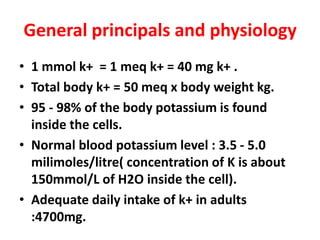
• 1 mmol k+ = 1 meq k+ = 40 mg k+ .
• Total body k+ = 50 meq x body weight kg.
• 95 - 98% of the body potassium is found
inside the cells.
• Normal blood potassium level : 3.5 - 5.0
milimoles/litre( concentration of K is about
150mmol/L of H2O inside the cell).
• Adequate daily intake of k+ in adults
:4700mg.
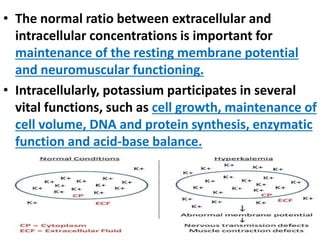
• The normal ratio between extracellular and
intracellular concentrations is important for
maintenance of the resting membrane potential
and neuromuscular functioning.
• Intracellularly, potassium participates in several
vital functions, such as cell growth, maintenance of
cell volume, DNA and protein synthesis, enzymatic
function and acid-base balance.
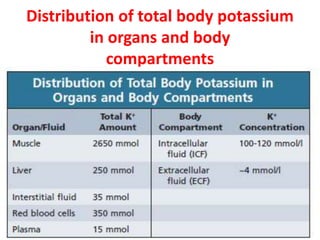
Distribution of total body potassium
in organs and body
compartments
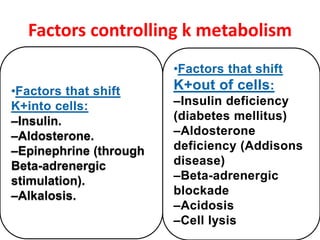
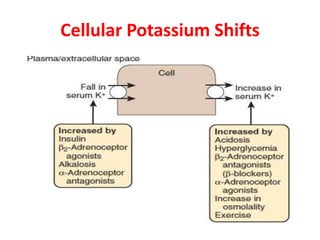
Factors controlling k metabolism
•Factors that shift
K+into cells:
–Insulin.
–Aldosterone.
–Epinephrine (through
Beta-adrenergic
stimulation).
–Alkalosis.
•Factors that shift
K+out of cells:
–Insulin deficiency
(diabetes mellitus)
–Aldosterone
deficiency (Addisons
disease)
–Beta-adrenergic
blockade
–Acidosis
–Cell lysis
Cellular Potassium Shifts
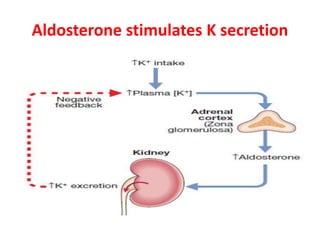
Aldosterone stimulates K secretion
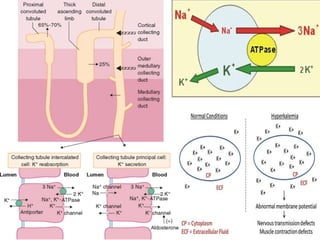
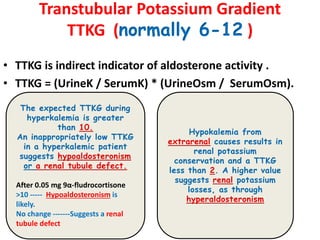
Transtubular Potassium Gradient
TTKG (normally 6-12 )
• TTKG is indirect indicator of aldosterone activity .
• TTKG = (UrineK / SerumK) * (UrineOsm / SerumOsm).
Hypokalemia from
extrarenal causes results in
renal potassium
conservation and a TTKG
less than 2. A higher value
suggests renal potassium
losses, as through
hyperaldosteronism
The expected TTKG during
hyperkalemia is greater
than 10.
An inappropriately low TTKG
in a hyperkalemic patient
suggests hypoaldosteronism
or a renal tubule defect.
After 0.05 mg 9α-fludrocortisone
>10 ----- Hypoaldosteronism is
likely.
No change -------Suggests a renal
tubule defect
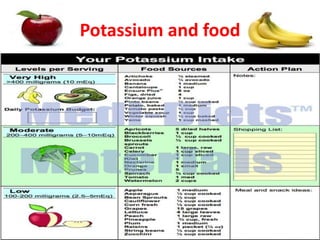
Potassium and food
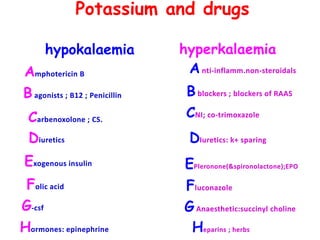
Amphotericin B
Bagonists ; B12 ; Penicillin
Carbenoxolone ; CS.
Diuretics
Exogenous insulin
Folic acid
G-csf
Anti-inflamm.non-steroidals
Bblockers ; blockers of RAAS
CNI; co-trimoxazole
DIuretics: k+ sparing
EPleronone(&spironolactone);EPO
Fluconazole
GAnaesthetic:succinyl choline
Heparins ; herbs
Potassium and drugs
hyperkalaemiahypokalaemia
Hormones: epinephrine
HYPOKALEMIA
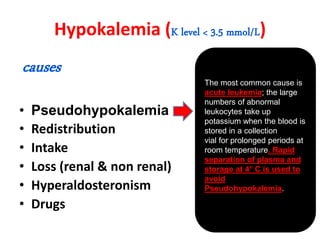
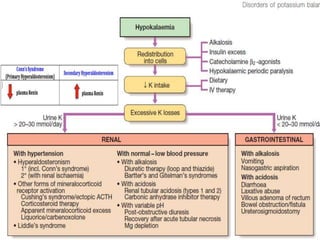
Hypokalemia (K level < 3.5 mmol/L)
causes
• Pseudohypokalemia
• Redistribution
• Intake
• Loss (renal & non renal)
• Hyperaldosteronism
• Drugs
The most common cause is
acute leukemia; the large
numbers of abnormal
leukocytes take up
potassium when the blood is
stored in a collection
vial for prolonged periods at
room temperature. Rapid
separation of plasma and
storage at 4° C is used to
avoid
Pseudohypokalemia.
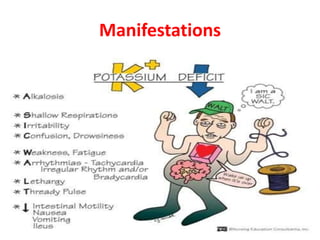
Manifestations
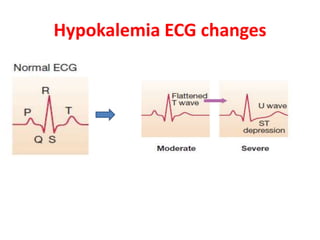
Hypokalemia ECG changes
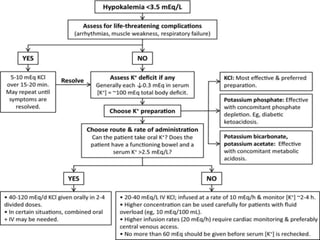
Treatment of Hypokalemia
• Every 1mmEq/ L [K+] depletion = 10 % Reduction
of total body K+store.
• [Total body K+content = 50mEq/ KG]
• For a 60 kg person, total body K+store = 60 x 50=
3000 mEq. Therefore, 1 mEq/ L [K+] depletion =
3000 x 10% = 300 mEq. = Total K+ deficit.
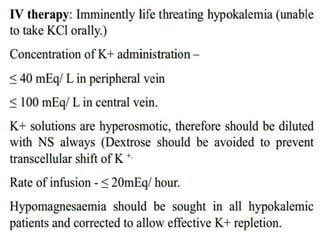
• Oral or enteral administration is preferred if the
patient can take oral medication and has normal GI
tract function. Acute hyperkalemia is highly
unusual when potassium is given orally.
• parenteral KCl should be administered in dextrose-
free solutions.
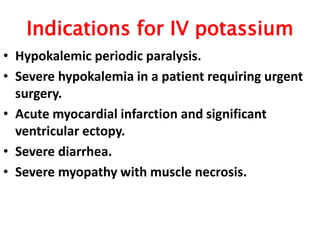
Indications for IV potassium
• Hypokalemic periodic paralysis.
• Severe hypokalemia in a patient requiring urgent
surgery.
• Acute myocardial infarction and significant
ventricular ectopy.
• Severe diarrhea.
• Severe myopathy with muscle necrosis.
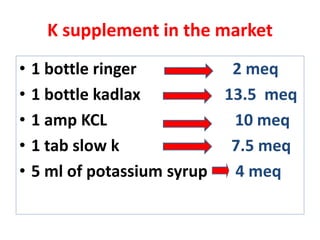
K supplement in the market
• 1 bottle ringer 2 meq
• 1 bottle kadlax 13.5 meq
• 1 amp KCL 10 meq
• 1 tab slow k 7.5 meq
• 5 ml of potassium syrup 4 meq
Hyperkalemia
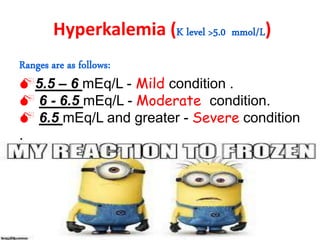
Hyperkalemia (K level >5.0 mmol/L)
Ranges are as follows:
5.5 – 6 mEq/L - Mild condition .
 6 - 6.5 mEq/L - Moderate condition.
 6.5 mEq/L and greater - Severe condition
.
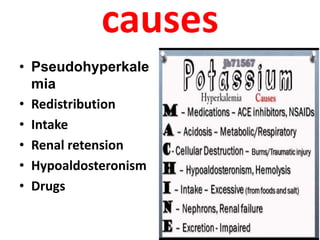
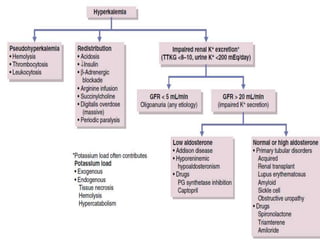
causes
• Pseudohyperkale
mia
• Redistribution
• Intake
• Renal retension
• Hypoaldosteronism
• Drugs
Pseudohyperkalemia
Causes
 Sever Leukocytosis
 Sever Thrombocytosis
 Hemolysis :
Ischemia from prolonged tourniquet time
IN patients with RA or IMN or abnormal
RBC membrane potassium permeability (IVH)
Pseudohyperkalemia
• There is raised serum (clotted blood) potassium
concentration with concurrently normal plasma (non-clotted
blood) potassium concentration
• It is the clotting process with subsequent release of
potassium from cells and platelets that causes an
increase in the serum potassium concentration by an
average of 0.4 mmol/L.
• Pseudo-hyperkalaemia can be excluded by performing
simultaneous measurements of plasma potassium in a
lithium heparin anti-coagulated specimen and in a clotted
sample.
Pseudohyperkalemia
• This will provide two values with the lower being in
the heparinised specimen.
• Pseudo-hyperkalaemia is detected when the serum
potassium concentration exceeds that of the plasma
by more than 0.4 mmol/L.
• The difference in results may be in the order of
several mmol/L. A full blood count should also be
performed to exclude a haematological disorder.
Pseudohyperkalemia
Technique of blood drawing
• Mechanical trauma during venipuncture can
result in the release of potassium from red cells and
a characteristic reddish tint of the serum due to
the concomitant release of hemoglobin.
• Potassium moves out of muscle cells with exercise.
repeated fist clenching during blood drawing can acutely
raise the serum potassium concentration by more
than 1 to 2 meq/L in that forearm
Pseudohyperkalemia
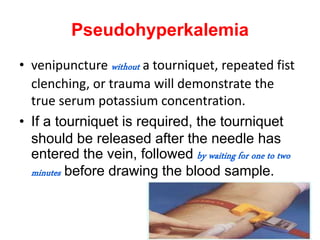
• venipuncture without a tourniquet, repeated fist
clenching, or trauma will demonstrate the
true serum potassium concentration.
• If a tourniquet is required, the tourniquet
should be released after the needle has
entered the vein, followed by waiting for one to two
minutes before drawing the blood sample.
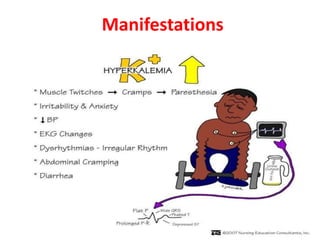
Manifestations
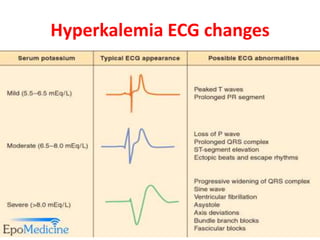
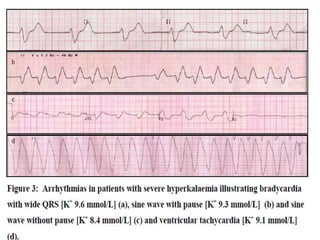
Hyperkalemia ECG changes
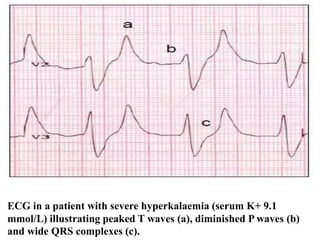
ECG in a patient with severe hyperkalaemia (serum K+ 9.1
mmol/L) illustrating peaked T waves (a), diminished P waves (b)
and wide QRS complexes (c).
Treatment of Hyperkalemia
AVOID
POTASSIUM
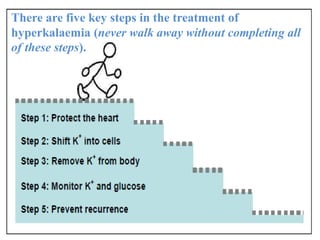
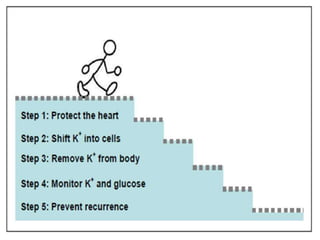
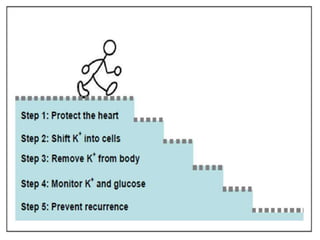
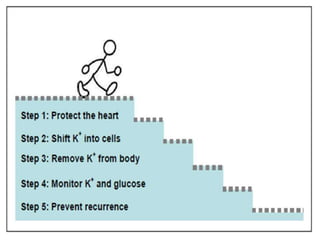
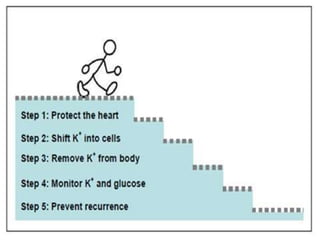
There are five key steps in the treatment of
hyperkalaemia (never walk away without completing all
of these steps).
STEP 1 -Protect the heart;
intravenous calcium salts
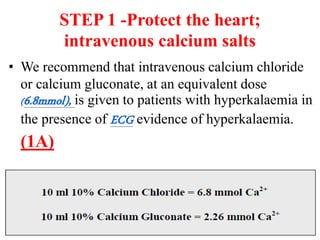
• We recommend that intravenous calcium chloride
or calcium gluconate, at an equivalent dose
(6.8mmol), is given to patients with hyperkalaemia in
the presence of ECG evidence of hyperkalaemia.
(1A)
• ca chloride salt has been recommended in the setting of
haemodynamic instability, including cardiac arrest , because
the active calcium is released immediately on
infusion, unlike calcium gluconate, which requires liver
metabolism to release the calcium.
• IV calcium antagonises the cardiac membrane excitability
thereby protecting the heart against arrhythmias .
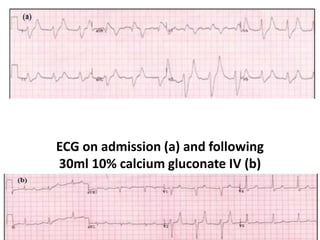
• It is effective within 3 minutes as shown by an improvement in the
ECG appearance (e.g. narrowing of the QRS complex). The dose
should be repeated if there is no effect within 5-10 minutes.
ECG on admission (a) and following
30ml 10% calcium gluconate IV (b)
patient with serum K+ 9.3 mmol/L
STEP 2 – Shift K+ into cells
• Insulin-glucose infusion
• B2 agonist
• Sodium bicarbonate
Insulin-glucose infusion &salbutamol
• We recommend that insulin-glucose (10 units soluble
insulin in 25g glucose) by intravenous infusion is used to
treat severe (K+ ≥ 6.5 mmol/L) hyperkalaemia. (1B)
• We recommend nebulised salbutamol 10-20mg is used as
adjuvant therapy for severe (K+ ≥ 6.5 mmol/L)
hyperkalaemia. (1B)
• We recommend that salbutamol is not used as
monotherapy in the treatment of severe hyperkalaemia.
(1A)
• The efficacy of insulin-glucose is increased if given
in combination with salbutamol. The peak K+
lowering effect with combination therapy at 60
minutes was found to be 1.2 mmol/L with nebulised
beta-agonist therapy.
• Up to 40% of patients with ESRD do not respond to
salbutamol, even in the absence of beta-blocker
therapy, and the mechanism for this resistance is
unknown.
• A frequent mistake when administering nebulized
β2-adrenoceptor agonists is underdosage (salbutamol
10-20mg )
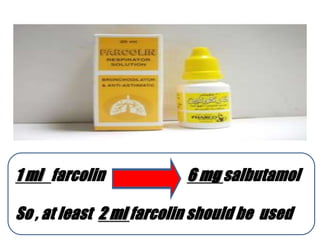
1 ml farcolin 6 mg salbutamol
So , at least 2 ml farcolin should be used
Sodium bicarbonate
• We suggest that intravenous sodium bicarbonate
infusion is not used routinely for the acute treatment of
hyperkalaemia. (2C)
• Do not use(NaHCO3) therapy unless the patient is
frankly acidotic (pH <7.2) or unless substantial
endogenous renal function is present.
STEP 3 – Remove K+ from body,
resins (30-60 gm )
• We suggest that cation-exchange resins are not
used in the emergency management of severe
hyperkalaemia, but may be considered in patients
with mild to moderate hyperkalaemia. (2B)
• multiple doses were required over several days with
the effect on lowering the serum K+ noted over 1 to
5 days.
• These resins exchange sodium(Kayexalate) or
calcium(resonium), respectively, for potassium in
the GI tract to remove K . It can be administered
orally or rectally as a retention enema.
• Constipation is common; therefore, resins are
usually given in combination with a cathartic, (20%
sorbitol).
• If given as an enema, sorbitol should be avoided,
because rectal administration of cation exchange
resins with sorbitol can cause colonic perforation
STEP 3 – Remove K+ from body,
Hemodialysis
• Acute hemodialysis is the primary method of
potassium removal when renal function is
significantly impaired, either from AKI or advanced
CKD, and severe hyperkalemia.
• Serum potassium can decrease as much as 1.2 to
1.5 mmol/h.
STEP 4 - Blood monitoring; serum
K+
• We recommend that the serum K+ is monitored
closely in all patients with hyperkalaemia to
assess efficacy of treatment and look for rebound
hyperkalaemia. (1B)
• We suggest that serum potassium be assessed at
least 1, 2, 4, 6 and 24 hours after identification and
treatment of hyperkalaemia. (2C)
STEP 4 - Blood monitoring; blood
glucose
• We recommend that the blood glucose
concentration is monitored at regular
intervals (0, 15, 30, 60, 90, 120, 180, 240, 300, 360
minutes) for a minimum of 6 hours after
administration of insulin-glucose infusion in
all patients with hyperkalaemia. (1C)
Some Updates
Zirconium cyclosilicate(ZS-9)
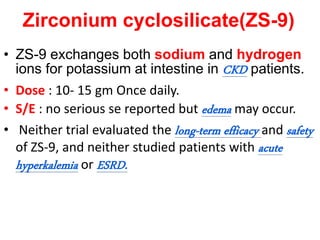
• ZS-9 exchanges both sodium and hydrogen
ions for potassium at intestine in CKD patients.
• Dose : 10- 15 gm Once daily.
• S/E : no serious se reported but edema may occur.
• Neither trial evaluated the long-term efficacy and safety
of ZS-9, and neither studied patients with acute
hyperkalemia or ESRD.
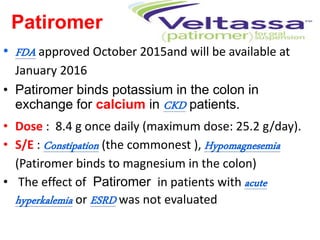
Patiromer
• FDA approved October 2015and will be available at
January 2016
• Patiromer binds potassium in the colon in
exchange for calcium in CKD patients.
• Dose : 8.4 g once daily (maximum dose: 25.2 g/day).
• S/E : Constipation (the commonest ), Hypomagnesemia
(Patiromer binds to magnesium in the colon)
• The effect of Patiromer in patients with acute
hyperkalemia or ESRD was not evaluated
References
• Potassium and its disorders. Presentation of Prof.
Essam Nour Eldin at acid base and electrolytes
disturbance conference ,Cairo, October ,2014 .
• ANDREOLI AND CARPENTER ’ S CECIL ESSENTIALS
OF MEDICINE , 8th edition,2010.
• COMPREHENSIVE CLINICAL NEPHROLOGY , 5th
edition ,2015.
• Davidsons Principles and Practice of Medicine ,22nd
edition ,2014.
References
• Uptodate , 2016.
• CLINICAL PRACTICE GUIDELINES , TREATMENT OF
ACUTE HYPERKALAEMIA IN ADULTS , UK Renal
Association ,2014 .

Potassium disorders , comprehensive & practical approach .

  • 1.
    Potassium Disorders Dr Yasser Matter Nephrologyand Kidney Transplantation Specialist Urology and Nephrology center Mansoura University -Egypt yassermatter86@gmail.com yassermatter@mans.edu.eg
  • 2.
    Outlines • General principalsand physiology. • Hypo & Hyperkalemia :  causes Manifestations and diagnostic approach Management • Some updates .
  • 4.
    General principals andphysiology • 1 mmol k+ = 1 meq k+ = 40 mg k+ . • Total body k+ = 50 meq x body weight kg. • 95 - 98% of the body potassium is found inside the cells. • Normal blood potassium level : 3.5 - 5.0 milimoles/litre( concentration of K is about 150mmol/L of H2O inside the cell). • Adequate daily intake of k+ in adults :4700mg.
  • 5.
    • The normalratio between extracellular and intracellular concentrations is important for maintenance of the resting membrane potential and neuromuscular functioning. • Intracellularly, potassium participates in several vital functions, such as cell growth, maintenance of cell volume, DNA and protein synthesis, enzymatic function and acid-base balance.
  • 6.
    Distribution of totalbody potassium in organs and body compartments
  • 7.
    Factors controlling kmetabolism •Factors that shift K+into cells: –Insulin. –Aldosterone. –Epinephrine (through Beta-adrenergic stimulation). –Alkalosis. •Factors that shift K+out of cells: –Insulin deficiency (diabetes mellitus) –Aldosterone deficiency (Addisons disease) –Beta-adrenergic blockade –Acidosis –Cell lysis
  • 8.
  • 9.
  • 11.
    Transtubular Potassium Gradient TTKG(normally 6-12 ) • TTKG is indirect indicator of aldosterone activity . • TTKG = (UrineK / SerumK) * (UrineOsm / SerumOsm). Hypokalemia from extrarenal causes results in renal potassium conservation and a TTKG less than 2. A higher value suggests renal potassium losses, as through hyperaldosteronism The expected TTKG during hyperkalemia is greater than 10. An inappropriately low TTKG in a hyperkalemic patient suggests hypoaldosteronism or a renal tubule defect. After 0.05 mg 9α-fludrocortisone >10 ----- Hypoaldosteronism is likely. No change -------Suggests a renal tubule defect
  • 12.
  • 13.
    Amphotericin B Bagonists ;B12 ; Penicillin Carbenoxolone ; CS. Diuretics Exogenous insulin Folic acid G-csf Anti-inflamm.non-steroidals Bblockers ; blockers of RAAS CNI; co-trimoxazole DIuretics: k+ sparing EPleronone(&spironolactone);EPO Fluconazole GAnaesthetic:succinyl choline Heparins ; herbs Potassium and drugs hyperkalaemiahypokalaemia Hormones: epinephrine
  • 14.
  • 15.
    Hypokalemia (K level< 3.5 mmol/L) causes • Pseudohypokalemia • Redistribution • Intake • Loss (renal & non renal) • Hyperaldosteronism • Drugs The most common cause is acute leukemia; the large numbers of abnormal leukocytes take up potassium when the blood is stored in a collection vial for prolonged periods at room temperature. Rapid separation of plasma and storage at 4° C is used to avoid Pseudohypokalemia.
  • 17.
  • 18.
  • 19.
  • 20.
    • Every 1mmEq/L [K+] depletion = 10 % Reduction of total body K+store. • [Total body K+content = 50mEq/ KG] • For a 60 kg person, total body K+store = 60 x 50= 3000 mEq. Therefore, 1 mEq/ L [K+] depletion = 3000 x 10% = 300 mEq. = Total K+ deficit. • Oral or enteral administration is preferred if the patient can take oral medication and has normal GI tract function. Acute hyperkalemia is highly unusual when potassium is given orally. • parenteral KCl should be administered in dextrose- free solutions.
  • 21.
    Indications for IVpotassium • Hypokalemic periodic paralysis. • Severe hypokalemia in a patient requiring urgent surgery. • Acute myocardial infarction and significant ventricular ectopy. • Severe diarrhea. • Severe myopathy with muscle necrosis.
  • 24.
    K supplement inthe market • 1 bottle ringer 2 meq • 1 bottle kadlax 13.5 meq • 1 amp KCL 10 meq • 1 tab slow k 7.5 meq • 5 ml of potassium syrup 4 meq
  • 25.
  • 26.
    Hyperkalemia (K level>5.0 mmol/L) Ranges are as follows: 5.5 – 6 mEq/L - Mild condition .  6 - 6.5 mEq/L - Moderate condition.  6.5 mEq/L and greater - Severe condition .
  • 27.
    causes • Pseudohyperkale mia • Redistribution •Intake • Renal retension • Hypoaldosteronism • Drugs
  • 28.
    Pseudohyperkalemia Causes  Sever Leukocytosis Sever Thrombocytosis  Hemolysis : Ischemia from prolonged tourniquet time IN patients with RA or IMN or abnormal RBC membrane potassium permeability (IVH)
  • 29.
    Pseudohyperkalemia • There israised serum (clotted blood) potassium concentration with concurrently normal plasma (non-clotted blood) potassium concentration • It is the clotting process with subsequent release of potassium from cells and platelets that causes an increase in the serum potassium concentration by an average of 0.4 mmol/L. • Pseudo-hyperkalaemia can be excluded by performing simultaneous measurements of plasma potassium in a lithium heparin anti-coagulated specimen and in a clotted sample.
  • 30.
    Pseudohyperkalemia • This willprovide two values with the lower being in the heparinised specimen. • Pseudo-hyperkalaemia is detected when the serum potassium concentration exceeds that of the plasma by more than 0.4 mmol/L. • The difference in results may be in the order of several mmol/L. A full blood count should also be performed to exclude a haematological disorder.
  • 31.
    Pseudohyperkalemia Technique of blooddrawing • Mechanical trauma during venipuncture can result in the release of potassium from red cells and a characteristic reddish tint of the serum due to the concomitant release of hemoglobin. • Potassium moves out of muscle cells with exercise. repeated fist clenching during blood drawing can acutely raise the serum potassium concentration by more than 1 to 2 meq/L in that forearm
  • 32.
    Pseudohyperkalemia • venipuncture withouta tourniquet, repeated fist clenching, or trauma will demonstrate the true serum potassium concentration. • If a tourniquet is required, the tourniquet should be released after the needle has entered the vein, followed by waiting for one to two minutes before drawing the blood sample.
  • 34.
  • 35.
  • 36.
    ECG in apatient with severe hyperkalaemia (serum K+ 9.1 mmol/L) illustrating peaked T waves (a), diminished P waves (b) and wide QRS complexes (c).
  • 38.
  • 40.
    There are fivekey steps in the treatment of hyperkalaemia (never walk away without completing all of these steps).
  • 41.
    STEP 1 -Protectthe heart; intravenous calcium salts • We recommend that intravenous calcium chloride or calcium gluconate, at an equivalent dose (6.8mmol), is given to patients with hyperkalaemia in the presence of ECG evidence of hyperkalaemia. (1A)
  • 42.
    • ca chloridesalt has been recommended in the setting of haemodynamic instability, including cardiac arrest , because the active calcium is released immediately on infusion, unlike calcium gluconate, which requires liver metabolism to release the calcium. • IV calcium antagonises the cardiac membrane excitability thereby protecting the heart against arrhythmias . • It is effective within 3 minutes as shown by an improvement in the ECG appearance (e.g. narrowing of the QRS complex). The dose should be repeated if there is no effect within 5-10 minutes.
  • 43.
    ECG on admission(a) and following 30ml 10% calcium gluconate IV (b) patient with serum K+ 9.3 mmol/L
  • 45.
    STEP 2 –Shift K+ into cells • Insulin-glucose infusion • B2 agonist • Sodium bicarbonate
  • 46.
    Insulin-glucose infusion &salbutamol •We recommend that insulin-glucose (10 units soluble insulin in 25g glucose) by intravenous infusion is used to treat severe (K+ ≥ 6.5 mmol/L) hyperkalaemia. (1B) • We recommend nebulised salbutamol 10-20mg is used as adjuvant therapy for severe (K+ ≥ 6.5 mmol/L) hyperkalaemia. (1B) • We recommend that salbutamol is not used as monotherapy in the treatment of severe hyperkalaemia. (1A)
  • 47.
    • The efficacyof insulin-glucose is increased if given in combination with salbutamol. The peak K+ lowering effect with combination therapy at 60 minutes was found to be 1.2 mmol/L with nebulised beta-agonist therapy. • Up to 40% of patients with ESRD do not respond to salbutamol, even in the absence of beta-blocker therapy, and the mechanism for this resistance is unknown. • A frequent mistake when administering nebulized β2-adrenoceptor agonists is underdosage (salbutamol 10-20mg )
  • 48.
    1 ml farcolin6 mg salbutamol So , at least 2 ml farcolin should be used
  • 49.
    Sodium bicarbonate • Wesuggest that intravenous sodium bicarbonate infusion is not used routinely for the acute treatment of hyperkalaemia. (2C) • Do not use(NaHCO3) therapy unless the patient is frankly acidotic (pH <7.2) or unless substantial endogenous renal function is present.
  • 51.
    STEP 3 –Remove K+ from body, resins (30-60 gm ) • We suggest that cation-exchange resins are not used in the emergency management of severe hyperkalaemia, but may be considered in patients with mild to moderate hyperkalaemia. (2B) • multiple doses were required over several days with the effect on lowering the serum K+ noted over 1 to 5 days.
  • 52.
    • These resinsexchange sodium(Kayexalate) or calcium(resonium), respectively, for potassium in the GI tract to remove K . It can be administered orally or rectally as a retention enema. • Constipation is common; therefore, resins are usually given in combination with a cathartic, (20% sorbitol). • If given as an enema, sorbitol should be avoided, because rectal administration of cation exchange resins with sorbitol can cause colonic perforation
  • 53.
    STEP 3 –Remove K+ from body, Hemodialysis • Acute hemodialysis is the primary method of potassium removal when renal function is significantly impaired, either from AKI or advanced CKD, and severe hyperkalemia. • Serum potassium can decrease as much as 1.2 to 1.5 mmol/h.
  • 55.
    STEP 4 -Blood monitoring; serum K+ • We recommend that the serum K+ is monitored closely in all patients with hyperkalaemia to assess efficacy of treatment and look for rebound hyperkalaemia. (1B) • We suggest that serum potassium be assessed at least 1, 2, 4, 6 and 24 hours after identification and treatment of hyperkalaemia. (2C)
  • 56.
    STEP 4 -Blood monitoring; blood glucose • We recommend that the blood glucose concentration is monitored at regular intervals (0, 15, 30, 60, 90, 120, 180, 240, 300, 360 minutes) for a minimum of 6 hours after administration of insulin-glucose infusion in all patients with hyperkalaemia. (1C)
  • 58.
  • 59.
    Zirconium cyclosilicate(ZS-9) • ZS-9exchanges both sodium and hydrogen ions for potassium at intestine in CKD patients. • Dose : 10- 15 gm Once daily. • S/E : no serious se reported but edema may occur. • Neither trial evaluated the long-term efficacy and safety of ZS-9, and neither studied patients with acute hyperkalemia or ESRD.
  • 60.
    Patiromer • FDA approvedOctober 2015and will be available at January 2016 • Patiromer binds potassium in the colon in exchange for calcium in CKD patients. • Dose : 8.4 g once daily (maximum dose: 25.2 g/day). • S/E : Constipation (the commonest ), Hypomagnesemia (Patiromer binds to magnesium in the colon) • The effect of Patiromer in patients with acute hyperkalemia or ESRD was not evaluated
  • 63.
    References • Potassium andits disorders. Presentation of Prof. Essam Nour Eldin at acid base and electrolytes disturbance conference ,Cairo, October ,2014 . • ANDREOLI AND CARPENTER ’ S CECIL ESSENTIALS OF MEDICINE , 8th edition,2010. • COMPREHENSIVE CLINICAL NEPHROLOGY , 5th edition ,2015. • Davidsons Principles and Practice of Medicine ,22nd edition ,2014.
  • 64.
    References • Uptodate ,2016. • CLINICAL PRACTICE GUIDELINES , TREATMENT OF ACUTE HYPERKALAEMIA IN ADULTS , UK Renal Association ,2014 .