SUBMITTED
PONDIC
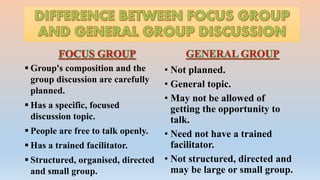
 Group's composition and the
group discussion are carefully
planned.
 Has a specific, focused
discussion topic.
 People are free to talk openly.
 Has a trained facilitator.
 Structured, organised, directed
and small group.
• Not planned.
• General topic.
• May not be allowed of
getting the opportunity to
talk.
• Need not have a trained
facilitator.
• Not structured, directed and
may be large or small group.
• A focus group of parents of pre-schoolers meets to discuss
child care needs both in day care centres and at home.
• An agency wants to open a group home for
developmentally disabled adults in a quiet residential
area. It convenes a group of prospective neighbours.
• A focus group of senior citizens meets at the new senior
centre.
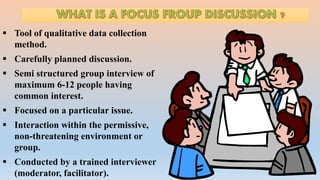
 Tool of qualitative data collection
method.
 Carefully planned discussion.
 Semi structured group interview of
maximum 6-12 people having
common interest.
 Focused on a particular issue.
 Interaction within the permissive,
non-threatening environment or
group.
 Conducted by a trained interviewer
(moderator, facilitator).
Suggest potential solutions to problems
identified.
To collect qualitative data.
To promote self-disclosure among
participants.
Attitudes and perceptions are developed
in part by interaction with other people.
• Insight not Rules.
• Social not Individual.
• Words not Numbers.
• Flexible not standardised.
• Homogenous not Diverse.
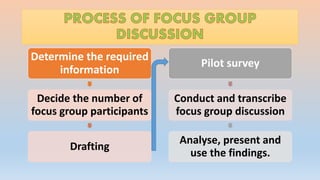
Determine the required
information
Decide the number of
focus group participants
Drafting
Pilot survey
Conduct and transcribe
focus group discussion
Analyse, present and
use the findings.
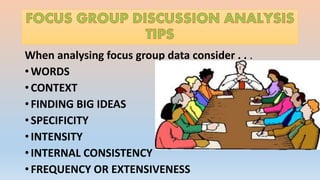
When analysing focus group data consider . . .
•WORDS
•CONTEXT
•FINDING BIG IDEAS
•SPECIFICITY
•INTENSITY
•INTERNAL CONSISTENCY
•FREQUENCY OR EXTENSIVENESS
Development of learning tools that will appeal to student’s
interest and needs.
Evaluation of student’s knowledge or attitudes about
curriculum issues.
Enhancement of survey results in education research.
Aid in the development of surveys and interview guides.
Clarify research findings, new research areas in education.
• Rapport & Language
• Deciding the number of focus groups
for a single topic.
• Taking extreme care with the
sampling because sampling is a
major key to success of focus group.
• Ensuring that participants have
something to say and feel
comfortable.
• Ability to produce a large amount of data on a topic in short
time.
• Provides access to comparisons that focus group participation
make between their experiences.
• Quick and relatively easy to set up.
• They can save time and money compared to individual
interviews.
• Can provide a broader range of information & opportunity to
seek clarification.
• Data may be difficult to analyse.(qualitative data)
• The number of people tends to be small.
• They tend to yield numerical, quantifiable or
generalizable data.
• May yield information less than a survey.
• The number of topics to be covered may be limited.
• Data may lack overall reliability.
FOCUS GROUP DISCUSSION.pptx

FOCUS GROUP DISCUSSION.pptx

  • 1.
  • 2.
     Group's compositionand the group discussion are carefully planned.  Has a specific, focused discussion topic.  People are free to talk openly.  Has a trained facilitator.  Structured, organised, directed and small group. • Not planned. • General topic. • May not be allowed of getting the opportunity to talk. • Need not have a trained facilitator. • Not structured, directed and may be large or small group.
  • 3.
    • A focusgroup of parents of pre-schoolers meets to discuss child care needs both in day care centres and at home. • An agency wants to open a group home for developmentally disabled adults in a quiet residential area. It convenes a group of prospective neighbours. • A focus group of senior citizens meets at the new senior centre.
  • 4.
     Tool ofqualitative data collection method.  Carefully planned discussion.  Semi structured group interview of maximum 6-12 people having common interest.  Focused on a particular issue.  Interaction within the permissive, non-threatening environment or group.  Conducted by a trained interviewer (moderator, facilitator).
  • 5.
    Suggest potential solutionsto problems identified. To collect qualitative data. To promote self-disclosure among participants. Attitudes and perceptions are developed in part by interaction with other people.
  • 6.
    • Insight notRules. • Social not Individual. • Words not Numbers. • Flexible not standardised. • Homogenous not Diverse.
  • 7.
    Determine the required information Decidethe number of focus group participants Drafting Pilot survey Conduct and transcribe focus group discussion Analyse, present and use the findings.
  • 8.
    When analysing focusgroup data consider . . . •WORDS •CONTEXT •FINDING BIG IDEAS •SPECIFICITY •INTENSITY •INTERNAL CONSISTENCY •FREQUENCY OR EXTENSIVENESS
  • 9.
    Development of learningtools that will appeal to student’s interest and needs. Evaluation of student’s knowledge or attitudes about curriculum issues. Enhancement of survey results in education research. Aid in the development of surveys and interview guides. Clarify research findings, new research areas in education.
  • 10.
    • Rapport &Language • Deciding the number of focus groups for a single topic. • Taking extreme care with the sampling because sampling is a major key to success of focus group. • Ensuring that participants have something to say and feel comfortable.
  • 11.
    • Ability toproduce a large amount of data on a topic in short time. • Provides access to comparisons that focus group participation make between their experiences. • Quick and relatively easy to set up. • They can save time and money compared to individual interviews. • Can provide a broader range of information & opportunity to seek clarification.
  • 12.
    • Data maybe difficult to analyse.(qualitative data) • The number of people tends to be small. • They tend to yield numerical, quantifiable or generalizable data. • May yield information less than a survey. • The number of topics to be covered may be limited. • Data may lack overall reliability.