Dr.V. S. Swathi
Assistant Professor
 Syphilis is caused by the spirochete
Treponema pallidum and is characterised by
three sequential clinical, symptomatic
stages separated by periods of
asymptomatic latent infections.
 Each year, there are an estimated 6 million
new cases of syphilis globally in persons
aged 15-49 years
 In 2015, syphilis cases found in India were
30,000 approximately
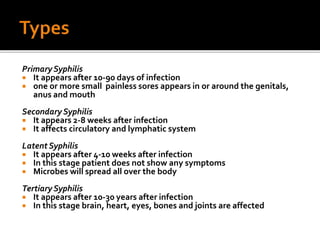
PrimarySyphilis
 It appears after 10-90 days of infection
 one or more small painless sores appears in or around the genitals,
anus and mouth
Secondary Syphilis
 It appears 2-8 weeks after infection
 It affects circulatory and lymphatic system
Latent Syphilis
 It appears after 4-10 weeks after infection
 In this stage patient does not show any symptoms
 Microbes will spread all over the body
Tertiary Syphilis
 It appears after 10-30 years after infection
 In this stage brain, heart, eyes, bones and joints are affected
 Persons having unprotected sex
 HIV patients
 Persons with multiple sex partners
 Unborn babies of mothers who are having
Syphilis
 It is caused by bacterium called Treponema
pallidum
 It is mostly transmitted by sexual
intercourse with affected patients with
Syphilis
 It can also transmitted to baby by mother
with Syphilis
 Occasionally it is transmitted through
contact with lesions of infected patients
and through blood transfusions
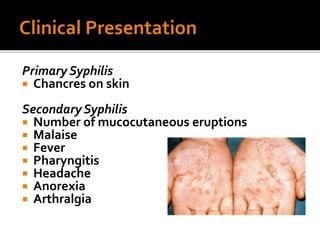
Primary Syphilis
 Chancres on skin
Secondary Syphilis
 Number of mucocutaneous eruptions
 Malaise
 Fever
 Pharyngitis
 Headache
 Anorexia
 Arthralgia
Latent Syphilis- Asymptomatic
Tertiary Syphilis:
Neurosyphilis
 Severe headache
 Difficulty in coordinating muscle movements
 Paralysis
 Numbness
 Dementia
Ocular Syphilis
 Blurred division
 Blindness
 Neurosyphilis
 Ocular syphilis
 Cardiovascular syphilis
 Congenital syphilis
 Joint/ bone syphilis
 Microscopic examination of serous material
from a suspected syphilis lesion
 Direct fluorescent antibody test for
Treponema pallidum (DFA-TP)
 Venereal disease research laboratory test
(VDRL) slide test
 Rapid plasma regain (RPR) card test
 Unheated serum reagin (USR) test
 Toludene red unheated serum test (TRUST)
 PCR test
 Counselling to avoid unprotected sex,
having multiple sex partners
 Take proper measures to keep environment
hygienic
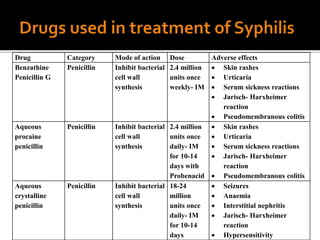
Drug Category Mode of action Dose Adverse effects
Benzathine
Penicillin G
Penicillin Inhibit bacterial
cell wall
synthesis
2.4 million
units once
weekly- IM
 Skin rashes
 Urticaria
 Serum sickness reactions
 Jarisch- Harxheimer
reaction
 Pseudomembranous colitis
Aqueous
procaine
penicillin
Penicillin Inhibit bacterial
cell wall
synthesis
2.4 million
units once
daily- IM
for 10-14
days with
Probenacid
 Skin rashes
 Urticaria
 Serum sickness reactions
 Jarisch- Harxheimer
reaction
 Pseudomembranous colitis
Aqueous
crystalline
penicillin
Penicillin Inhibit bacterial
cell wall
synthesis
18-24
million
units once
daily- IM
for 10-14
days
 Seizures
 Anaemia
 Interstitial nephritis
 Jarisch- Harxheimer
reaction
 Hypersensitivity
Ceftrioxone Cephalosporin Inhibit bacterial
cell wall synthesis
1-2g-IM/ IV
four times for
28 days
 Eosinophilia
 Thrombocytosis
 Diarrhoea
 Hepatotoxicity
 Nephrotoxicity
Tetracycline Tetracycline Inhibit bacterial
protein synthesis
500mg- four
times orally
for 14-28 days
 Epigastric distress
 Teeth discoloration
 Photosensitivity
 Nephrotoxicity
 Hepatotoxicity
Doxycycline Tetracycline Inhibit bacterial
protein synthesis
100mg-twice
daily for 14
days
 Anorexia
 Tooth discoloration
 Diarrhoea
 Dysphagia
 Enterocolitis
Probenacid Uricosuric agent Along with
penicillin it
increases penicillin
levels in body by
inhibiting tubular
secretion of
penicillin
500mg- four
times- orally
for 10-14 days
along with Aq.
Procaine
Penicillin
 Anaemia
 Leucopoenia
 Renal calculi
 Exacerbation of gout
 Gouty Arthralgia
 https://www.ncbi.nlm.nih.gov/pmc/articles
/PMC5434955/
 http://www.neurologyindia.com/text.asp?
2016/64/7/131/178060
 http://www.ijmm.org/text.asp?2016/34/1/1
11/167674
 https://doi.org/10.1016/j.ijgo.2015.04.014
 https://www.ncbi.nlm.nih.gov/pmc/articles
/PMC4386224/

Syphilis

  • 1.
  • 2.
     Syphilis iscaused by the spirochete Treponema pallidum and is characterised by three sequential clinical, symptomatic stages separated by periods of asymptomatic latent infections.
  • 3.
     Each year,there are an estimated 6 million new cases of syphilis globally in persons aged 15-49 years  In 2015, syphilis cases found in India were 30,000 approximately
  • 4.
    PrimarySyphilis  It appearsafter 10-90 days of infection  one or more small painless sores appears in or around the genitals, anus and mouth Secondary Syphilis  It appears 2-8 weeks after infection  It affects circulatory and lymphatic system Latent Syphilis  It appears after 4-10 weeks after infection  In this stage patient does not show any symptoms  Microbes will spread all over the body Tertiary Syphilis  It appears after 10-30 years after infection  In this stage brain, heart, eyes, bones and joints are affected
  • 5.
     Persons havingunprotected sex  HIV patients  Persons with multiple sex partners  Unborn babies of mothers who are having Syphilis
  • 6.
     It iscaused by bacterium called Treponema pallidum  It is mostly transmitted by sexual intercourse with affected patients with Syphilis  It can also transmitted to baby by mother with Syphilis  Occasionally it is transmitted through contact with lesions of infected patients and through blood transfusions
  • 9.
    Primary Syphilis  Chancreson skin Secondary Syphilis  Number of mucocutaneous eruptions  Malaise  Fever  Pharyngitis  Headache  Anorexia  Arthralgia
  • 10.
    Latent Syphilis- Asymptomatic TertiarySyphilis: Neurosyphilis  Severe headache  Difficulty in coordinating muscle movements  Paralysis  Numbness  Dementia Ocular Syphilis  Blurred division  Blindness
  • 11.
     Neurosyphilis  Ocularsyphilis  Cardiovascular syphilis  Congenital syphilis  Joint/ bone syphilis
  • 12.
     Microscopic examinationof serous material from a suspected syphilis lesion  Direct fluorescent antibody test for Treponema pallidum (DFA-TP)  Venereal disease research laboratory test (VDRL) slide test  Rapid plasma regain (RPR) card test  Unheated serum reagin (USR) test  Toludene red unheated serum test (TRUST)  PCR test
  • 14.
     Counselling toavoid unprotected sex, having multiple sex partners  Take proper measures to keep environment hygienic
  • 16.
    Drug Category Modeof action Dose Adverse effects Benzathine Penicillin G Penicillin Inhibit bacterial cell wall synthesis 2.4 million units once weekly- IM  Skin rashes  Urticaria  Serum sickness reactions  Jarisch- Harxheimer reaction  Pseudomembranous colitis Aqueous procaine penicillin Penicillin Inhibit bacterial cell wall synthesis 2.4 million units once daily- IM for 10-14 days with Probenacid  Skin rashes  Urticaria  Serum sickness reactions  Jarisch- Harxheimer reaction  Pseudomembranous colitis Aqueous crystalline penicillin Penicillin Inhibit bacterial cell wall synthesis 18-24 million units once daily- IM for 10-14 days  Seizures  Anaemia  Interstitial nephritis  Jarisch- Harxheimer reaction  Hypersensitivity
  • 17.
    Ceftrioxone Cephalosporin Inhibitbacterial cell wall synthesis 1-2g-IM/ IV four times for 28 days  Eosinophilia  Thrombocytosis  Diarrhoea  Hepatotoxicity  Nephrotoxicity Tetracycline Tetracycline Inhibit bacterial protein synthesis 500mg- four times orally for 14-28 days  Epigastric distress  Teeth discoloration  Photosensitivity  Nephrotoxicity  Hepatotoxicity Doxycycline Tetracycline Inhibit bacterial protein synthesis 100mg-twice daily for 14 days  Anorexia  Tooth discoloration  Diarrhoea  Dysphagia  Enterocolitis Probenacid Uricosuric agent Along with penicillin it increases penicillin levels in body by inhibiting tubular secretion of penicillin 500mg- four times- orally for 10-14 days along with Aq. Procaine Penicillin  Anaemia  Leucopoenia  Renal calculi  Exacerbation of gout  Gouty Arthralgia
  • 18.
     https://www.ncbi.nlm.nih.gov/pmc/articles /PMC5434955/  http://www.neurologyindia.com/text.asp? 2016/64/7/131/178060 http://www.ijmm.org/text.asp?2016/34/1/1 11/167674  https://doi.org/10.1016/j.ijgo.2015.04.014  https://www.ncbi.nlm.nih.gov/pmc/articles /PMC4386224/