Gout
Dr. V. S. Swathi
Assistant Professor
Definition
ď‚— Gout is most common inflammatory
disease caused by deposition of
mono sodium urate crystals in
joints and tissues following chronic
Hyperurecemia
Epidemiology
ď‚— In the world, prevalence of gout
ranges from 0.1%-10%
ď‚— In India, prevalence of gout is
0.12%
Types
Based on progression of disease
Asymptomatic Hyperurecemia
ď‚— In this, patients will not show any symptoms
ď‚— Uric acid levels in the synovial fluid increases
ď‚— Patients are treated by non pharmacological management (life
style changes)
Acute Gout
ď‚— Uric acid crystals deposited and cause inflammation and
intense pain
ď‚— Pain subside within 3-10 days
ď‚— It is triggered by stress, alcohol, drugs, and cold weather
Interval Gout
ď‚— It is the stage between attacks of acute gout
ď‚— In this stage, deposition of urate crystals occurs continuously
Chronic tophaceous Gout
ď‚— It is severe condition
ď‚— Permanent damage occurs in joints
and kidneys
ď‚— Patients develops tophi in joints
and fingers
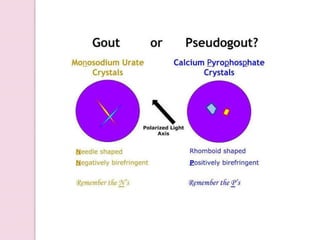
Pseudo Gout
ď‚— Here symptoms are similar to Gout
ď‚— Crystals which are deposited in
joints are calcium pyrophosphate
Based on Causes
ď‚— Primary Gout- It is not a
consequence of acquired disorder
ď‚— Secondary Gout- It is a
consequence of specific disorder
and specific use of drugs
Risk factors
ď‚— Family history
ď‚— Genitical defects in Enzymes (HPRT)
ď‚— Etiology
ď‚— Renal disease
ď‚— Obesity
ď‚— Gender-Men are having more risk than
women
ď‚— Dyslipidemia
ď‚— Glucose Intolerance
ď‚— Hypertension
ď‚— Diet
ď‚— Alcohol consumption
ď‚— Medications
Etiology
Primary Gout
ď‚— Rare enzyme deficiencies
 Hypoxanthine –Guanine
phosphoribosyl transferase deficiency
(HPRT)
ď‚— Phosphoribosyl pyrophosphate
synthetase superactivity
ď‚— Ribose -5-Phospahe AMPdeaminase
deficiency
Secondary Gout
Increased uric acid production
ď‚— Chronic haemolytic anemias
ď‚— Secondary polycythemia
ď‚— Severe exfoliative psoriasis
 Gaucher’s disease
ď‚— Cytotoxic drugs
ď‚— Glucose-6-Phosphate deficiency
ď‚— High purine diet
Decreased uric acid excretion
ď‚— Renal failure
ď‚— Alcohol
 Down’s Syndrome
ď‚— Myxedema
ď‚— Lead poisoning
ď‚— Beryllium poisoning
ď‚— Drugs like:
ď‚– Aspirin
ď‚– Ciclosporin
ď‚– Cytotoxic drugs
ď‚– Diuretics
ď‚– Ethambutol
ď‚– Levodopa
ď‚– Pyrizinamide
ď‚– Ribavirin
ď‚– Interferon
ď‚– Teriparatide
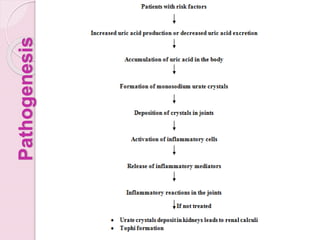
Pathogenesis
Clinical Presentation
In the joints of lower limbs like big toe, ankles, knees,
arms
â—¦ Pain
â—¦ Swelling
â—¦ Redness
â—¦ Warmth
ď‚— Shiny overlying skin
ď‚— Anorexia
ď‚— Nausea
ď‚— Change in mood
ď‚— Pruritis
ď‚— Tophi
Complications
ď‚— Secondary infections
ď‚— Chronic renal failure
ď‚— Severe degenerative arthritis
ď‚— Uric acid nephropathy
ď‚— Nerve/ Spinal cord impingement
ď‚— Joint damage
ď‚— Joint deformity
ď‚— Loss of mobility
ď‚— Osteoporosis
Diagnosis
ď‚— Medical history
ď‚— Medication history
ď‚— Family history
ď‚— Clinical presentation
ď‚— Physical examination
ď‚— Lab tests (Elevated ESR, WBC)
ď‚— Synovial fluid exam
ď‚— Polarised light microscopy
Diagnostic criteria
According to American college of Rheumatology
ď‚— Presence of characteristic urate crystals in the joint fluid/
ď‚— Presence of tophi which contain urate crystals by chemicals or
polarised light microscopy/
ď‚— Presence of six or more of the following:
â—¦ Asymptomatic swelling with in a joint on radiography
â—¦ Attack of mono articular arthritis
â—¦ Culture of joint fluid negative for microbes during attack of joint
inflammation
â—¦ Development of maximal inflammation with in one day
â—¦ Hyperurecemia
â—¦ Joint redness
â—¦ More than one attack of acute arthritis
â—¦ Pain/ redness in the first metatarsophalangeal joint
â—¦ Subcortical cyst without erosions on radiography
â—¦ Suspected tophi
â—¦ Unilateral attack involving first metatarsophalangeal joint
â—¦ Unilateral attack involving tarsal joint
Non Pharmacological
Treatment
ď‚— Avoid purine rich food like meat, sea foods, and
sweet soft drinks
ď‚— Avoid alcohol consumption
ď‚— Exercise in interval attacks
ď‚— Rest in acute attacks
ď‚— Avoid medications which decrease uric acid
excretion
ď‚— Topical ice application
ď‚— Patient counselling
ď‚— Hydration
ď‚— Surgery
â—¦ Tophi removal
â—¦ Joint fusion
â—¦ Joint replacement
Treatment Algorithm
Acute attack
ď‚— Rest for 1-3 days and Topical ice application
ď‚— Review medication and life style
ď‚— Resolve pain with NSAIDs/ Colchicine/
Corticosteroid
Chronic attack
ď‚— Uricostatic agents-Allopurinol/ Febuxostat
ď‚— Uricosuric agents-Probenacid/ Sulfinpyrazone
ď‚— Uricolytic agents- Rasburicase/ PEG-Uricase
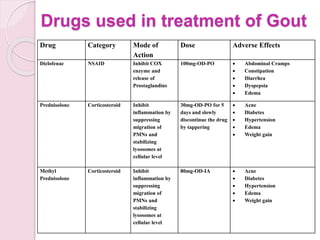
Drugs used in treatment of Gout
Drug Category Mode of
Action
Dose Adverse Effects
Diclofenac NSAID Inhibit COX
enzyme and
release of
Prostaglandins
100mg-OD-PO ď‚· Abdominal Cramps
ď‚· Constipation
ď‚· Diarrhea
ď‚· Dyspepsia
ď‚· Edema
Prednisolone Corticosteroid Inhibit
inflammation by
suppressing
migration of
PMNs and
stabilizing
lysosomes at
cellular level
30mg-OD-PO for 5
days and slowly
discontinue the drug
by tappering
ď‚· Acne
ď‚· Diabetes
ď‚· Hypertension
ď‚· Edema
ď‚· Weight gain
Methyl
Prednisolone
Corticosteroid Inhibit
inflammation by
suppressing
migration of
PMNs and
stabilizing
lysosomes at
cellular level
80mg-OD-IA ď‚· Acne
ď‚· Diabetes
ď‚· Hypertension
ď‚· Edema
ď‚· Weight gain
Allopurinol Xanthine
Oxidase
Inhibitor
Inhibit uric
acid
production
100-900mg/day-
PO
ď‚· Rash
ď‚· Fever
ď‚· Nephrotoxicity
ď‚· Hepatotoxicity
ď‚· Vasculitis
Febuxostat Xanthine
Oxidase
Inhibitor
Inhibit uric
acid
production
80-120mg/day-
PO
ď‚· Respiratory infection
ď‚· Diarrhea
ď‚· Headache
ď‚· Hepatotoxicity
ď‚· Arthralgia
Probenacid Uricosuric
agent
Increases uric
acid excretion
0.5-2g/day-PO ď‚· Head ache
ď‚· Loss of Appetite
ď‚· Anemia
ď‚· Renal calculi
ď‚· Leukopenia
Sulfinpyrazone Uricosuric
agent
Increases uric
acid excretion
200-800mg/day-
PO
ď‚· Unusual bleeding
ď‚· Hepatotoxicity
ď‚· Nephrotoxicity
ď‚· GI ulceration
ď‚· Fluid retention
Rasburicase Uricolytic
agent
It coverts
insoluble uric
acid in to
soluble
allontoin
0.2mg/kg for 5-
7 days
ď‚· Fever
ď‚· Rash
ď‚· Diarrhea
ď‚· Head ache
ď‚· Hypersensitivity
Colchicine Uricosuric
agent
It prevents
activation,
degranulation
and migration
of neutrophils
and increases
uric acid
excretion
1-1.8mg-OD-
PO
ď‚· GI disturbances
ď‚· Bone marrow
suppression
ď‚· Neuropathy
ď‚· Myopathy
ď‚· Hepatotoxicity
Anakinra Immunomod
ulator
Inhibits
Interleukin
actions by
binding to IL-
1 receptor
100mg/day-SC ď‚· Injection site reactions
ď‚· Arthralgia
ď‚· Pyrexia
ď‚· Nasopharyngitis
ď‚· Neutropenia
Resources
ď‚— https://www.ncbi.nlm.nih.gov/pmc/artic
les/PMC6322774/
ď‚— https://www.sciencedirect.com/science
/article/pii/S0041134518302343?via%
3Dihub
ď‚— https://www.ncbi.nlm.nih.gov/pmc/artic
les/PMC6254413/
ď‚— https://www.ncbi.nlm.nih.gov/pmc/artic
les/PMC6196879/

Gout

  • 1.
    Gout Dr. V. S.Swathi Assistant Professor
  • 2.
    Definition ď‚— Gout ismost common inflammatory disease caused by deposition of mono sodium urate crystals in joints and tissues following chronic Hyperurecemia
  • 3.
    Epidemiology ď‚— In theworld, prevalence of gout ranges from 0.1%-10% ď‚— In India, prevalence of gout is 0.12%
  • 4.
    Types Based on progressionof disease Asymptomatic Hyperurecemia ď‚— In this, patients will not show any symptoms ď‚— Uric acid levels in the synovial fluid increases ď‚— Patients are treated by non pharmacological management (life style changes) Acute Gout ď‚— Uric acid crystals deposited and cause inflammation and intense pain ď‚— Pain subside within 3-10 days ď‚— It is triggered by stress, alcohol, drugs, and cold weather Interval Gout ď‚— It is the stage between attacks of acute gout ď‚— In this stage, deposition of urate crystals occurs continuously
  • 5.
    Chronic tophaceous Gout ď‚—It is severe condition ď‚— Permanent damage occurs in joints and kidneys ď‚— Patients develops tophi in joints and fingers Pseudo Gout ď‚— Here symptoms are similar to Gout ď‚— Crystals which are deposited in joints are calcium pyrophosphate
  • 6.
    Based on Causes ď‚—Primary Gout- It is not a consequence of acquired disorder ď‚— Secondary Gout- It is a consequence of specific disorder and specific use of drugs
  • 7.
    Risk factors ď‚— Familyhistory ď‚— Genitical defects in Enzymes (HPRT) ď‚— Etiology ď‚— Renal disease ď‚— Obesity ď‚— Gender-Men are having more risk than women ď‚— Dyslipidemia ď‚— Glucose Intolerance ď‚— Hypertension ď‚— Diet ď‚— Alcohol consumption ď‚— Medications
  • 8.
    Etiology Primary Gout  Rareenzyme deficiencies  Hypoxanthine –Guanine phosphoribosyl transferase deficiency (HPRT)  Phosphoribosyl pyrophosphate synthetase superactivity  Ribose -5-Phospahe AMPdeaminase deficiency
  • 9.
    Secondary Gout Increased uricacid production  Chronic haemolytic anemias  Secondary polycythemia  Severe exfoliative psoriasis  Gaucher’s disease  Cytotoxic drugs  Glucose-6-Phosphate deficiency  High purine diet
  • 10.
    Decreased uric acidexcretion  Renal failure  Alcohol  Down’s Syndrome  Myxedema  Lead poisoning  Beryllium poisoning  Drugs like:  Aspirin  Ciclosporin  Cytotoxic drugs  Diuretics  Ethambutol  Levodopa  Pyrizinamide  Ribavirin  Interferon  Teriparatide
  • 11.
  • 13.
    Clinical Presentation In thejoints of lower limbs like big toe, ankles, knees, arms â—¦ Pain â—¦ Swelling â—¦ Redness â—¦ Warmth ď‚— Shiny overlying skin ď‚— Anorexia ď‚— Nausea ď‚— Change in mood ď‚— Pruritis ď‚— Tophi
  • 16.
    Complications ď‚— Secondary infections ď‚—Chronic renal failure ď‚— Severe degenerative arthritis ď‚— Uric acid nephropathy ď‚— Nerve/ Spinal cord impingement ď‚— Joint damage ď‚— Joint deformity ď‚— Loss of mobility ď‚— Osteoporosis
  • 17.
    Diagnosis ď‚— Medical history ď‚—Medication history ď‚— Family history ď‚— Clinical presentation ď‚— Physical examination ď‚— Lab tests (Elevated ESR, WBC) ď‚— Synovial fluid exam ď‚— Polarised light microscopy
  • 19.
    Diagnostic criteria According toAmerican college of Rheumatology ď‚— Presence of characteristic urate crystals in the joint fluid/ ď‚— Presence of tophi which contain urate crystals by chemicals or polarised light microscopy/ ď‚— Presence of six or more of the following: â—¦ Asymptomatic swelling with in a joint on radiography â—¦ Attack of mono articular arthritis â—¦ Culture of joint fluid negative for microbes during attack of joint inflammation â—¦ Development of maximal inflammation with in one day â—¦ Hyperurecemia â—¦ Joint redness â—¦ More than one attack of acute arthritis â—¦ Pain/ redness in the first metatarsophalangeal joint â—¦ Subcortical cyst without erosions on radiography â—¦ Suspected tophi â—¦ Unilateral attack involving first metatarsophalangeal joint â—¦ Unilateral attack involving tarsal joint
  • 20.
    Non Pharmacological Treatment ď‚— Avoidpurine rich food like meat, sea foods, and sweet soft drinks ď‚— Avoid alcohol consumption ď‚— Exercise in interval attacks ď‚— Rest in acute attacks ď‚— Avoid medications which decrease uric acid excretion ď‚— Topical ice application ď‚— Patient counselling ď‚— Hydration ď‚— Surgery â—¦ Tophi removal â—¦ Joint fusion â—¦ Joint replacement
  • 21.
    Treatment Algorithm Acute attack ď‚—Rest for 1-3 days and Topical ice application ď‚— Review medication and life style ď‚— Resolve pain with NSAIDs/ Colchicine/ Corticosteroid Chronic attack ď‚— Uricostatic agents-Allopurinol/ Febuxostat ď‚— Uricosuric agents-Probenacid/ Sulfinpyrazone ď‚— Uricolytic agents- Rasburicase/ PEG-Uricase
  • 22.
    Drugs used intreatment of Gout Drug Category Mode of Action Dose Adverse Effects Diclofenac NSAID Inhibit COX enzyme and release of Prostaglandins 100mg-OD-PO ď‚· Abdominal Cramps ď‚· Constipation ď‚· Diarrhea ď‚· Dyspepsia ď‚· Edema Prednisolone Corticosteroid Inhibit inflammation by suppressing migration of PMNs and stabilizing lysosomes at cellular level 30mg-OD-PO for 5 days and slowly discontinue the drug by tappering ď‚· Acne ď‚· Diabetes ď‚· Hypertension ď‚· Edema ď‚· Weight gain Methyl Prednisolone Corticosteroid Inhibit inflammation by suppressing migration of PMNs and stabilizing lysosomes at cellular level 80mg-OD-IA ď‚· Acne ď‚· Diabetes ď‚· Hypertension ď‚· Edema ď‚· Weight gain
  • 23.
    Allopurinol Xanthine Oxidase Inhibitor Inhibit uric acid production 100-900mg/day- PO ď‚·Rash ď‚· Fever ď‚· Nephrotoxicity ď‚· Hepatotoxicity ď‚· Vasculitis Febuxostat Xanthine Oxidase Inhibitor Inhibit uric acid production 80-120mg/day- PO ď‚· Respiratory infection ď‚· Diarrhea ď‚· Headache ď‚· Hepatotoxicity ď‚· Arthralgia Probenacid Uricosuric agent Increases uric acid excretion 0.5-2g/day-PO ď‚· Head ache ď‚· Loss of Appetite ď‚· Anemia ď‚· Renal calculi ď‚· Leukopenia Sulfinpyrazone Uricosuric agent Increases uric acid excretion 200-800mg/day- PO ď‚· Unusual bleeding ď‚· Hepatotoxicity ď‚· Nephrotoxicity ď‚· GI ulceration ď‚· Fluid retention
  • 24.
    Rasburicase Uricolytic agent It coverts insolubleuric acid in to soluble allontoin 0.2mg/kg for 5- 7 days ď‚· Fever ď‚· Rash ď‚· Diarrhea ď‚· Head ache ď‚· Hypersensitivity Colchicine Uricosuric agent It prevents activation, degranulation and migration of neutrophils and increases uric acid excretion 1-1.8mg-OD- PO ď‚· GI disturbances ď‚· Bone marrow suppression ď‚· Neuropathy ď‚· Myopathy ď‚· Hepatotoxicity Anakinra Immunomod ulator Inhibits Interleukin actions by binding to IL- 1 receptor 100mg/day-SC ď‚· Injection site reactions ď‚· Arthralgia ď‚· Pyrexia ď‚· Nasopharyngitis ď‚· Neutropenia
  • 25.
    Resources ď‚— https://www.ncbi.nlm.nih.gov/pmc/artic les/PMC6322774/ ď‚— https://www.sciencedirect.com/science /article/pii/S0041134518302343?via% 3Dihub ď‚—https://www.ncbi.nlm.nih.gov/pmc/artic les/PMC6254413/ ď‚— https://www.ncbi.nlm.nih.gov/pmc/artic les/PMC6196879/