Powerpoint Templates Page 1
Peer Group Presentation
Subject – Medical Surgical Nursing
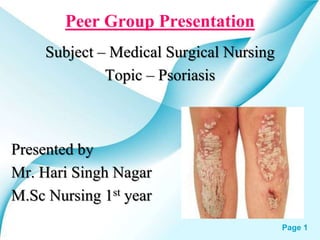
Topic – Psoriasis
Presented by
Mr. Hari Singh Nagar
M.Sc Nursing 1st year
Powerpoint Templates Page 2
Psoriasis
It is one of the most common skin disease.
It is thought that this chronic disease stems
from a hereditary effect that causes
overproduction of keratin.
Incidence - It affect approximately 2% of
the population. It occurs in any age, most
commonly occurs in people between 15-35
years of age.
Powerpoint Templates Page 3
Definition
It is a chronic, non-infectious skin inflammation
involving keratin synthesis that results in psoriatic
patches.
It is an inflammatory skin disease in which the skin
cell replicate at an extremely rapid rate. New cells
are produced 8 times faster then normal but the rate
at which old cells sloughed off is unchanged, this
cause the cell build up on skin surface, forming thick
patches or plaque of red sores, covered with flaky,
silvery white dead skin cells (scale).
Powerpoint Templates Page 4
Etiology
• Unknown
• Genetic
Some factor may aggravate the condition such as: -
• Stress
• Smoking, alcohol
• Trauma
• Obesity
• Hormonal changes
• Climate
• Autoimmune disease
• Medication – lithium salt, beta blockers
Powerpoint Templates Page 5
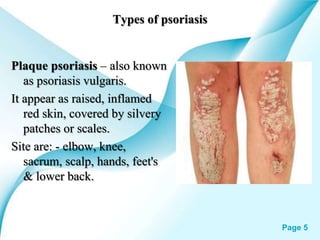
Types of psoriasis
Plaque psoriasis – also known
as psoriasis vulgaris.
It appear as raised, inflamed
red skin, covered by silvery
patches or scales.
Site are: - elbow, knee,
sacrum, scalp, hands, feet's
& lower back.
Powerpoint Templates Page 6
Guttate psoriasis
Eruption of small papule
over the upper trunk and
proximal extremities.
Powerpoint Templates Page 7
Inverse psoriasis
It is found in the skin
folds such as inguinal,
axilla and sweating
areas. Scaling is minimal
or absent and lesion
appears glossy, smooth
and bright red.
Powerpoint Templates Page 8
Pustular psoriasis
It is an pus filled lesion
surrounded by a red
skin. It appears at hands
and feet.
Powerpoint Templates Page 9
Erythrodermic psoriasis
it is a superficial scaling/
peeling that may appear
like burning. It affect all
the body sites. Causes is
sunburn, allergic
reaction and strong coal
product use.
Powerpoint Templates Page 10
Nail psoriasis
It appear as small nail,
yellow brown nail with
chalk like debris build
up under nails.
Powerpoint Templates Page 11
Psoriatic arthritis
This condition involve
both psoriasis and joint
inflammation.
Powerpoint Templates Page 12
Pathophysiology
Due to E/F
Hyperactivity of T-cells
Epidermis infiltration & keratinocyte proliferation
Deregulated inflammatory response
Large production of various cytokines
Superficial blood vessels dilated and vascular engorgement
Epidermal hyperplasia & improper cell maturation
Fails to release adequate lipid which lead to flaking,
scaling presentation of psoriasis lesion
Silvery scale of the skin
Powerpoint Templates Page 13
Clinical manifestation
• The first sign is ‘red spot’ on body.
• Patches of the skin is dry, swollen and inflamed covered
with silvery flakes.
• Raised and thick skin.
• Pain, itching and burning.
• Yellow discolouration, pitting and thickening of the nails
are noted if they are affected.
• Cracked and bleeding points, if the scale are scraped
away.
• Koebner phenomenon – it is develop at the site of injury
such as scratch or sunburn.
Powerpoint Templates Page 14
Diagnostic evaluation
• History
• Physical examination
• Skin biopsy
• Blood and radiography to rule out psoriatic arthritis.
Powerpoint Templates Page 15
Management
1. Topical treatment – it slow overactive epidermis.
I. Topical corticosteroids – they slow the turnover by
suppressing the immune system which reduce
inflammation & relieve itching.
II. Topical steroids
III. Vitamin D analogues – e.g.. – calcipotriene, it
suppress epidermopoiesis (development of epidermal
cells) causing sloughing of growing epidermal cells.
IV. Coal tar – dry distillation product of organic matter
heated in the absence of oxygen, combination of
creams, ointments and pastes.
Powerpoint Templates Page 16
V. Tazarotene – it reduce mainly scaling & plaque
Thickness, normalize the DNA activity.
VI. Topical Calcineurin Inhibitors – tracolimus, they
inhibit activation of the cells which reduce
inflammation and plaque build up.
VII. Emollients – to avoid dryness. It reduce scaling and
limit pain.
2. Phototherapy
I. Sunlight – activated T-cells in skin are destroy lead to
reduce scaling and inflammation.
II. UV broadband phototherapy – artificial light
Powerpoint Templates Page 17
sources. It used to treat single patches.
IV. Photo chemotherapy Plus UVA – light sensitizing
medication taken before exposure to UV light.
V. Eximer laser – control beam of UVB light directed to
psoriatic plaque to control scaling.
VI. Pulse dye laser – it destroy the tiny blood vessels that
contribute psoriasis.
3. Systemic therapy – e.g. Cyclosporine, methotraxate,
acitretin.
Complication
• Psoriatic arthritis
• Erythrodermic psoriasis
Powerpoint Templates Page 18
Nursing management
1. Nursing diagnosis – Impaired skin integrity related to
lesion & inflammatory response as evidence by itching
all over the body.
Nursing goal – To maintain skin integrity
Intervention
• To advice the patient not to scratch the affected areas.
• Too frequent washing produce more soreness & scaling
water should be warm, not hot and the skin should be
dry by patting a towel rather then rubbing. .
• Apply a thin film of emollients after washing the area.
• Provide a calorie and high protein diet.
Powerpoint Templates Page 19
2. Nursing diagnosis – risk of infection related to
hyponatremia as evidence by loss of protein and fluid
from lesion.
Nursing goal – To prevent from infection
Intervention
• Monitor vital sign.
• Examine for sign of infection.
• Keep the lesion clean.
• Motivate the patient to improve the nutrition.
• To provide the antibiotics.
Powerpoint Templates Page 20
3. Nursing diagnosis – acute pain related to inflammation
as evidence by patient verbalization.
Nursing goal – to reduce the pain
Intervention
• Provide the emollients after washing the area it will
relieve the soreness.
• To provide the comfort measures.
• To provide the pain medication which relieves pain.
Powerpoint Templates Page 21
Recent studies on psoriasis
An Italian Study on Psoriasis and Depression
The aim of this study was to investigate the prevalence
of depressive symptomatology among Italian patients
with psoriasis vulgaris,
Depression Scale (CES-D) questionnaire, a 20-item
instrument developed to perform epidemiological
studies of depressive symptomatology in the general
population.
Powerpoint Templates Page 22
Recent studies on psoriasis
Results:
• We received evaluable questionnaires from 2,391
patients, including 1,528 men (63.9%) and 863 women
(36.1%).
• Depressive symptomatology was observed in 1,482/2,391
patients (62% overall; females, 63%; males, 61%).
• Men <40 years of age were significantly more likely to
report depressive symptoms than were men ≧40 years of
age.
• Depressive symptomatology was more prevalent in
psoriatic patients with only primary or secondary
education than in psoriatic patients with higher education.
Powerpoint Templates Page 23

Psoriasis

  • 1.
    Powerpoint Templates Page1 Peer Group Presentation Subject – Medical Surgical Nursing Topic – Psoriasis Presented by Mr. Hari Singh Nagar M.Sc Nursing 1st year
  • 2.
    Powerpoint Templates Page2 Psoriasis It is one of the most common skin disease. It is thought that this chronic disease stems from a hereditary effect that causes overproduction of keratin. Incidence - It affect approximately 2% of the population. It occurs in any age, most commonly occurs in people between 15-35 years of age.
  • 3.
    Powerpoint Templates Page3 Definition It is a chronic, non-infectious skin inflammation involving keratin synthesis that results in psoriatic patches. It is an inflammatory skin disease in which the skin cell replicate at an extremely rapid rate. New cells are produced 8 times faster then normal but the rate at which old cells sloughed off is unchanged, this cause the cell build up on skin surface, forming thick patches or plaque of red sores, covered with flaky, silvery white dead skin cells (scale).
  • 4.
    Powerpoint Templates Page4 Etiology • Unknown • Genetic Some factor may aggravate the condition such as: - • Stress • Smoking, alcohol • Trauma • Obesity • Hormonal changes • Climate • Autoimmune disease • Medication – lithium salt, beta blockers
  • 5.
    Powerpoint Templates Page5 Types of psoriasis Plaque psoriasis – also known as psoriasis vulgaris. It appear as raised, inflamed red skin, covered by silvery patches or scales. Site are: - elbow, knee, sacrum, scalp, hands, feet's & lower back.
  • 6.
    Powerpoint Templates Page6 Guttate psoriasis Eruption of small papule over the upper trunk and proximal extremities.
  • 7.
    Powerpoint Templates Page7 Inverse psoriasis It is found in the skin folds such as inguinal, axilla and sweating areas. Scaling is minimal or absent and lesion appears glossy, smooth and bright red.
  • 8.
    Powerpoint Templates Page8 Pustular psoriasis It is an pus filled lesion surrounded by a red skin. It appears at hands and feet.
  • 9.
    Powerpoint Templates Page9 Erythrodermic psoriasis it is a superficial scaling/ peeling that may appear like burning. It affect all the body sites. Causes is sunburn, allergic reaction and strong coal product use.
  • 10.
    Powerpoint Templates Page10 Nail psoriasis It appear as small nail, yellow brown nail with chalk like debris build up under nails.
  • 11.
    Powerpoint Templates Page11 Psoriatic arthritis This condition involve both psoriasis and joint inflammation.
  • 12.
    Powerpoint Templates Page12 Pathophysiology Due to E/F Hyperactivity of T-cells Epidermis infiltration & keratinocyte proliferation Deregulated inflammatory response Large production of various cytokines Superficial blood vessels dilated and vascular engorgement Epidermal hyperplasia & improper cell maturation Fails to release adequate lipid which lead to flaking, scaling presentation of psoriasis lesion Silvery scale of the skin
  • 13.
    Powerpoint Templates Page13 Clinical manifestation • The first sign is ‘red spot’ on body. • Patches of the skin is dry, swollen and inflamed covered with silvery flakes. • Raised and thick skin. • Pain, itching and burning. • Yellow discolouration, pitting and thickening of the nails are noted if they are affected. • Cracked and bleeding points, if the scale are scraped away. • Koebner phenomenon – it is develop at the site of injury such as scratch or sunburn.
  • 14.
    Powerpoint Templates Page14 Diagnostic evaluation • History • Physical examination • Skin biopsy • Blood and radiography to rule out psoriatic arthritis.
  • 15.
    Powerpoint Templates Page15 Management 1. Topical treatment – it slow overactive epidermis. I. Topical corticosteroids – they slow the turnover by suppressing the immune system which reduce inflammation & relieve itching. II. Topical steroids III. Vitamin D analogues – e.g.. – calcipotriene, it suppress epidermopoiesis (development of epidermal cells) causing sloughing of growing epidermal cells. IV. Coal tar – dry distillation product of organic matter heated in the absence of oxygen, combination of creams, ointments and pastes.
  • 16.
    Powerpoint Templates Page16 V. Tazarotene – it reduce mainly scaling & plaque Thickness, normalize the DNA activity. VI. Topical Calcineurin Inhibitors – tracolimus, they inhibit activation of the cells which reduce inflammation and plaque build up. VII. Emollients – to avoid dryness. It reduce scaling and limit pain. 2. Phototherapy I. Sunlight – activated T-cells in skin are destroy lead to reduce scaling and inflammation. II. UV broadband phototherapy – artificial light
  • 17.
    Powerpoint Templates Page17 sources. It used to treat single patches. IV. Photo chemotherapy Plus UVA – light sensitizing medication taken before exposure to UV light. V. Eximer laser – control beam of UVB light directed to psoriatic plaque to control scaling. VI. Pulse dye laser – it destroy the tiny blood vessels that contribute psoriasis. 3. Systemic therapy – e.g. Cyclosporine, methotraxate, acitretin. Complication • Psoriatic arthritis • Erythrodermic psoriasis
  • 18.
    Powerpoint Templates Page18 Nursing management 1. Nursing diagnosis – Impaired skin integrity related to lesion & inflammatory response as evidence by itching all over the body. Nursing goal – To maintain skin integrity Intervention • To advice the patient not to scratch the affected areas. • Too frequent washing produce more soreness & scaling water should be warm, not hot and the skin should be dry by patting a towel rather then rubbing. . • Apply a thin film of emollients after washing the area. • Provide a calorie and high protein diet.
  • 19.
    Powerpoint Templates Page19 2. Nursing diagnosis – risk of infection related to hyponatremia as evidence by loss of protein and fluid from lesion. Nursing goal – To prevent from infection Intervention • Monitor vital sign. • Examine for sign of infection. • Keep the lesion clean. • Motivate the patient to improve the nutrition. • To provide the antibiotics.
  • 20.
    Powerpoint Templates Page20 3. Nursing diagnosis – acute pain related to inflammation as evidence by patient verbalization. Nursing goal – to reduce the pain Intervention • Provide the emollients after washing the area it will relieve the soreness. • To provide the comfort measures. • To provide the pain medication which relieves pain.
  • 21.
    Powerpoint Templates Page21 Recent studies on psoriasis An Italian Study on Psoriasis and Depression The aim of this study was to investigate the prevalence of depressive symptomatology among Italian patients with psoriasis vulgaris, Depression Scale (CES-D) questionnaire, a 20-item instrument developed to perform epidemiological studies of depressive symptomatology in the general population.
  • 22.
    Powerpoint Templates Page22 Recent studies on psoriasis Results: • We received evaluable questionnaires from 2,391 patients, including 1,528 men (63.9%) and 863 women (36.1%). • Depressive symptomatology was observed in 1,482/2,391 patients (62% overall; females, 63%; males, 61%). • Men <40 years of age were significantly more likely to report depressive symptoms than were men ≧40 years of age. • Depressive symptomatology was more prevalent in psoriatic patients with only primary or secondary education than in psoriatic patients with higher education.
  • 23.