Dr. V.S.SWATHI
ASSISTANT PROFESSOR
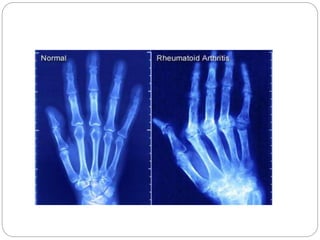
Rheumatoid Arthritis
Definition
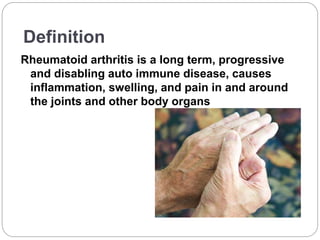
Rheumatoid arthritis is a long term, progressive
and disabling auto immune disease, causes
inflammation, swelling, and pain in and around
the joints and other body organs
Epidemiology
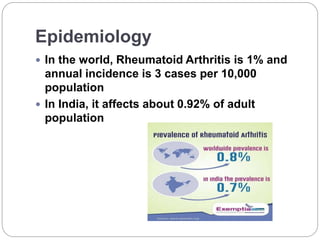
 In the world, Rheumatoid Arthritis is 1% and
annual incidence is 3 cases per 10,000
population
 In India, it affects about 0.92% of adult
population
Types
Seropositive RA
 Here there is positive results for Rheumatoid factor(R) and anti
cyclic citrullinated peptide(ACCP)
 Body produces immune reactions to normal tissue
 Chances of developing RA is four times greater if parents are
having RA
 80% of people who are having RA are with RF positive
Seronegative RA
 Here there is negative results for Rheumatoid factor(RF) and anti
cyclic citrullinated peptide(ACCP)
 RA is confirmed by other tests
Juvenile Idiopathic RA
 It is common in children younger than age 17
 Symptoms may be temporary and lasts for lifetime
 In severe conditions, it interferes with child growth and
development
Risk factors
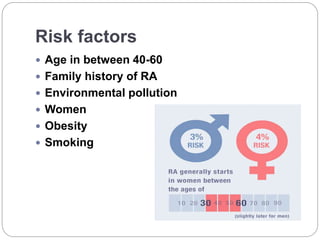
 Age in between 40-60
 Family history of RA
 Environmental pollution
 Women
 Obesity
 Smoking
Etiology
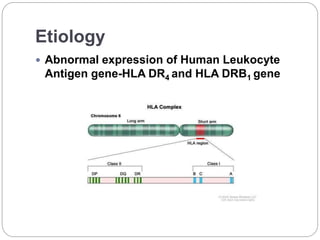
 Abnormal expression of Human Leukocyte
Antigen gene-HLA DR4 and HLA DRB1 gene
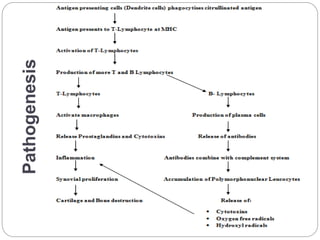
Pathogenesis
Clinical Presentation
Early stages of disease
 Pain
 Stiffness (mostly in morning lasts for 30
minutes to several hours)
 Swelling
In metacarpophalangeal joints of fingers
In proximal interphalangeal joints of fingers
In interphalangeal joints of thumb
In metatarsophalangeal joints
In joints of wrist
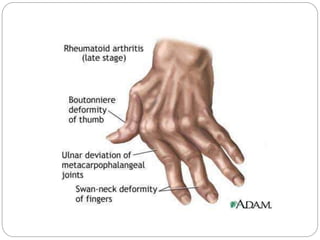
Late stages of disease
 Boutonniere deformity of thumb
 Ulnar deviation of metacarpophalangeal joints
 Swan-neck deformity of fingers
Other manifestations
 Myalgia
 Fatigue
 Low grade fever
 Weight loss
 Depression
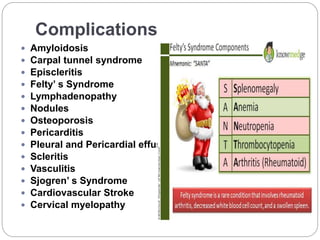
Complications
 Amyloidosis
 Carpal tunnel syndrome
 Episcleritis
 Felty’ s Syndrome
 Lymphadenopathy
 Nodules
 Osteoporosis
 Pericarditis
 Pleural and Pericardial effusion
 Scleritis
 Vasculitis
 Sjogren’ s Syndrome
 Cardiovascular Stroke
 Cervical myelopathy
Diagnosis
American Rheumatism Association (ARA) criteria for the
diagnosis of Rheumatoid Arthritis
 Morning stiffness in and around the joints for at least 6
weeks, lasting at least 1 hour before maximal improvement
 Swelling of 3/ more joints for at least 6 weeks
 Swelling of the wrist, metacarpophalangeal/ proximal
interphalangeal joints for at least 6 weeks
 Symmetric joint swelling for at least 6 weeks
 Hand X-ray changes typical of Rheumatoid arthritis that
must include erosions/ unequivocal bony decalcification
around the joints
 Rheumatoid subcutaneous nodules
 Positive rheumatoid factor
Interpretation: Presence of at least 4 of these indicators
diagnosis of Rheumatoid Arthritis
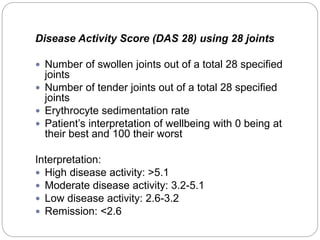
Disease Activity Score (DAS 28) using 28 joints
 Number of swollen joints out of a total 28 specified
joints
 Number of tender joints out of a total 28 specified
joints
 Erythrocyte sedimentation rate
 Patient’s interpretation of wellbeing with 0 being at
their best and 100 their worst
Interpretation:
 High disease activity: >5.1
 Moderate disease activity: 3.2-5.1
 Low disease activity: 2.6-3.2
 Remission: <2.6
 Anti cyclic citrullinated peptide antibody
(ACCP)
 Rheumatoid factor
 Antinuclear antibodies (ANA)
 Alkaline phosphatise
 Platelet count
 Serum albumin
 Neutrophils
Non Pharmacological
Treatment
 Patient education and counselling on risk
factors
 Stopping of alcohol and smoking
 Rest
 Occupational therapy
 Trancutaneous electric nerve stimulator
(TENS)
 Hydrotherapy
 Surgical interventions like Synovectomy and
Arthoplasty
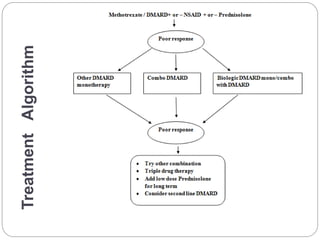
TreatmentAlgorithm
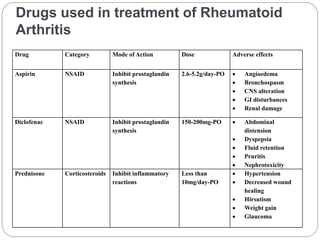
Drugs used in treatment of Rheumatoid
Arthritis
Drug Category Mode of Action Dose Adverse effects
Aspirin NSAID Inhibit prostaglandin
synthesis
2.6-5.2g/day-PO  Angioedema
 Bronchospasm
 CNS alteration
 GI disturbances
 Renal damage
Diclofenac NSAID Inhibit prostaglandin
synthesis
150-200mg-PO  Abdominal
distension
 Dyspepsia
 Fluid retention
 Pruritis
 Nephrotoxicity
Prednisone Corticosteroids Inhibit inflammatory
reactions
Less than
10mg/day-PO
 Hypertension
 Decreased wound
healing
 Hirsutism
 Weight gain
 Glaucoma
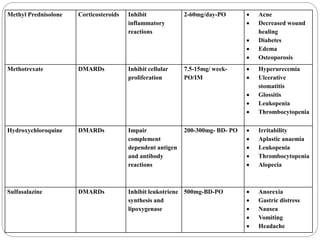
Methyl Prednisolone Corticosteroids Inhibit
inflammatory
reactions
2-60mg/day-PO  Acne
 Decreased wound
healing
 Diabetes
 Edema
 Osteoporosis
Methotrexate DMARDs Inhibit cellular
proliferation
7.5-15mg/ week-
PO/IM
 Hyperurecemia
 Ulcerative
stomatitis
 Glossitis
 Leukopenia
 Thrombocytopenia
Hydroxychloroquine DMARDs Impair
complement
dependent antigen
and antibody
reactions
200-300mg- BD- PO  Irritability
 Aplastic anaemia
 Leukopenia
 Thrombocytopenia
 Alopecia
Sulfasalazine DMARDs Inhibit leukotriene
synthesis and
lipoxygenase
500mg-BD-PO  Anorexia
 Gastric distress
 Nausea
 Vomiting
 Headache
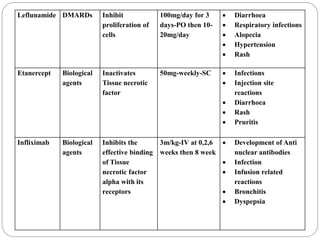
Leflunamide DMARDs Inhibit
proliferation of
cells
100mg/day for 3
days-PO then 10-
20mg/day
 Diarrhoea
 Respiratory infections
 Alopecia
 Hypertension
 Rash
Etanercept Biological
agents
Inactivates
Tissue necrotic
factor
50mg-weekly-SC  Infections
 Injection site
reactions
 Diarrhoea
 Rash
 Pruritis
Infliximab Biological
agents
Inhibits the
effective binding
of Tissue
necrotic factor
alpha with its
receptors
3m/kg-IV at 0,2,6
weeks then 8 week
 Development of Anti
nuclear antibodies
 Infection
 Infusion related
reactions
 Bronchitis
 Dyspepsia
Resources
 ncbi.nlm.nih.gov/pmc/articles/PMC5215647/
 https://www.ncbi.nlm.nih.gov/pmc/articles/PM
C3516026/
 https://www.ncbi.nlm.nih.gov/pmc/articles/PM
C5206883/
 https://www.ncbi.nlm.nih.gov/pmc/articles/PM
C4860498/
 https://www.ncbi.nlm.nih.gov/pmc/articles/PM
C5051257/

Rheumatoid arthritis

  • 1.
  • 2.
    Definition Rheumatoid arthritis isa long term, progressive and disabling auto immune disease, causes inflammation, swelling, and pain in and around the joints and other body organs
  • 3.
    Epidemiology  In theworld, Rheumatoid Arthritis is 1% and annual incidence is 3 cases per 10,000 population  In India, it affects about 0.92% of adult population
  • 4.
    Types Seropositive RA  Herethere is positive results for Rheumatoid factor(R) and anti cyclic citrullinated peptide(ACCP)  Body produces immune reactions to normal tissue  Chances of developing RA is four times greater if parents are having RA  80% of people who are having RA are with RF positive Seronegative RA  Here there is negative results for Rheumatoid factor(RF) and anti cyclic citrullinated peptide(ACCP)  RA is confirmed by other tests Juvenile Idiopathic RA  It is common in children younger than age 17  Symptoms may be temporary and lasts for lifetime  In severe conditions, it interferes with child growth and development
  • 5.
    Risk factors  Agein between 40-60  Family history of RA  Environmental pollution  Women  Obesity  Smoking
  • 6.
    Etiology  Abnormal expressionof Human Leukocyte Antigen gene-HLA DR4 and HLA DRB1 gene
  • 7.
  • 8.
    Clinical Presentation Early stagesof disease  Pain  Stiffness (mostly in morning lasts for 30 minutes to several hours)  Swelling In metacarpophalangeal joints of fingers In proximal interphalangeal joints of fingers In interphalangeal joints of thumb In metatarsophalangeal joints In joints of wrist
  • 9.
    Late stages ofdisease  Boutonniere deformity of thumb  Ulnar deviation of metacarpophalangeal joints  Swan-neck deformity of fingers Other manifestations  Myalgia  Fatigue  Low grade fever  Weight loss  Depression
  • 11.
    Complications  Amyloidosis  Carpaltunnel syndrome  Episcleritis  Felty’ s Syndrome  Lymphadenopathy  Nodules  Osteoporosis  Pericarditis  Pleural and Pericardial effusion  Scleritis  Vasculitis  Sjogren’ s Syndrome  Cardiovascular Stroke  Cervical myelopathy
  • 12.
    Diagnosis American Rheumatism Association(ARA) criteria for the diagnosis of Rheumatoid Arthritis  Morning stiffness in and around the joints for at least 6 weeks, lasting at least 1 hour before maximal improvement  Swelling of 3/ more joints for at least 6 weeks  Swelling of the wrist, metacarpophalangeal/ proximal interphalangeal joints for at least 6 weeks  Symmetric joint swelling for at least 6 weeks  Hand X-ray changes typical of Rheumatoid arthritis that must include erosions/ unequivocal bony decalcification around the joints  Rheumatoid subcutaneous nodules  Positive rheumatoid factor Interpretation: Presence of at least 4 of these indicators diagnosis of Rheumatoid Arthritis
  • 14.
    Disease Activity Score(DAS 28) using 28 joints  Number of swollen joints out of a total 28 specified joints  Number of tender joints out of a total 28 specified joints  Erythrocyte sedimentation rate  Patient’s interpretation of wellbeing with 0 being at their best and 100 their worst Interpretation:  High disease activity: >5.1  Moderate disease activity: 3.2-5.1  Low disease activity: 2.6-3.2  Remission: <2.6
  • 15.
     Anti cycliccitrullinated peptide antibody (ACCP)  Rheumatoid factor  Antinuclear antibodies (ANA)  Alkaline phosphatise  Platelet count  Serum albumin  Neutrophils
  • 16.
    Non Pharmacological Treatment  Patienteducation and counselling on risk factors  Stopping of alcohol and smoking  Rest  Occupational therapy  Trancutaneous electric nerve stimulator (TENS)  Hydrotherapy  Surgical interventions like Synovectomy and Arthoplasty
  • 18.
  • 19.
    Drugs used intreatment of Rheumatoid Arthritis Drug Category Mode of Action Dose Adverse effects Aspirin NSAID Inhibit prostaglandin synthesis 2.6-5.2g/day-PO  Angioedema  Bronchospasm  CNS alteration  GI disturbances  Renal damage Diclofenac NSAID Inhibit prostaglandin synthesis 150-200mg-PO  Abdominal distension  Dyspepsia  Fluid retention  Pruritis  Nephrotoxicity Prednisone Corticosteroids Inhibit inflammatory reactions Less than 10mg/day-PO  Hypertension  Decreased wound healing  Hirsutism  Weight gain  Glaucoma
  • 20.
    Methyl Prednisolone CorticosteroidsInhibit inflammatory reactions 2-60mg/day-PO  Acne  Decreased wound healing  Diabetes  Edema  Osteoporosis Methotrexate DMARDs Inhibit cellular proliferation 7.5-15mg/ week- PO/IM  Hyperurecemia  Ulcerative stomatitis  Glossitis  Leukopenia  Thrombocytopenia Hydroxychloroquine DMARDs Impair complement dependent antigen and antibody reactions 200-300mg- BD- PO  Irritability  Aplastic anaemia  Leukopenia  Thrombocytopenia  Alopecia Sulfasalazine DMARDs Inhibit leukotriene synthesis and lipoxygenase 500mg-BD-PO  Anorexia  Gastric distress  Nausea  Vomiting  Headache
  • 21.
    Leflunamide DMARDs Inhibit proliferationof cells 100mg/day for 3 days-PO then 10- 20mg/day  Diarrhoea  Respiratory infections  Alopecia  Hypertension  Rash Etanercept Biological agents Inactivates Tissue necrotic factor 50mg-weekly-SC  Infections  Injection site reactions  Diarrhoea  Rash  Pruritis Infliximab Biological agents Inhibits the effective binding of Tissue necrotic factor alpha with its receptors 3m/kg-IV at 0,2,6 weeks then 8 week  Development of Anti nuclear antibodies  Infection  Infusion related reactions  Bronchitis  Dyspepsia
  • 22.
    Resources  ncbi.nlm.nih.gov/pmc/articles/PMC5215647/  https://www.ncbi.nlm.nih.gov/pmc/articles/PM C3516026/ https://www.ncbi.nlm.nih.gov/pmc/articles/PM C5206883/  https://www.ncbi.nlm.nih.gov/pmc/articles/PM C4860498/  https://www.ncbi.nlm.nih.gov/pmc/articles/PM C5051257/