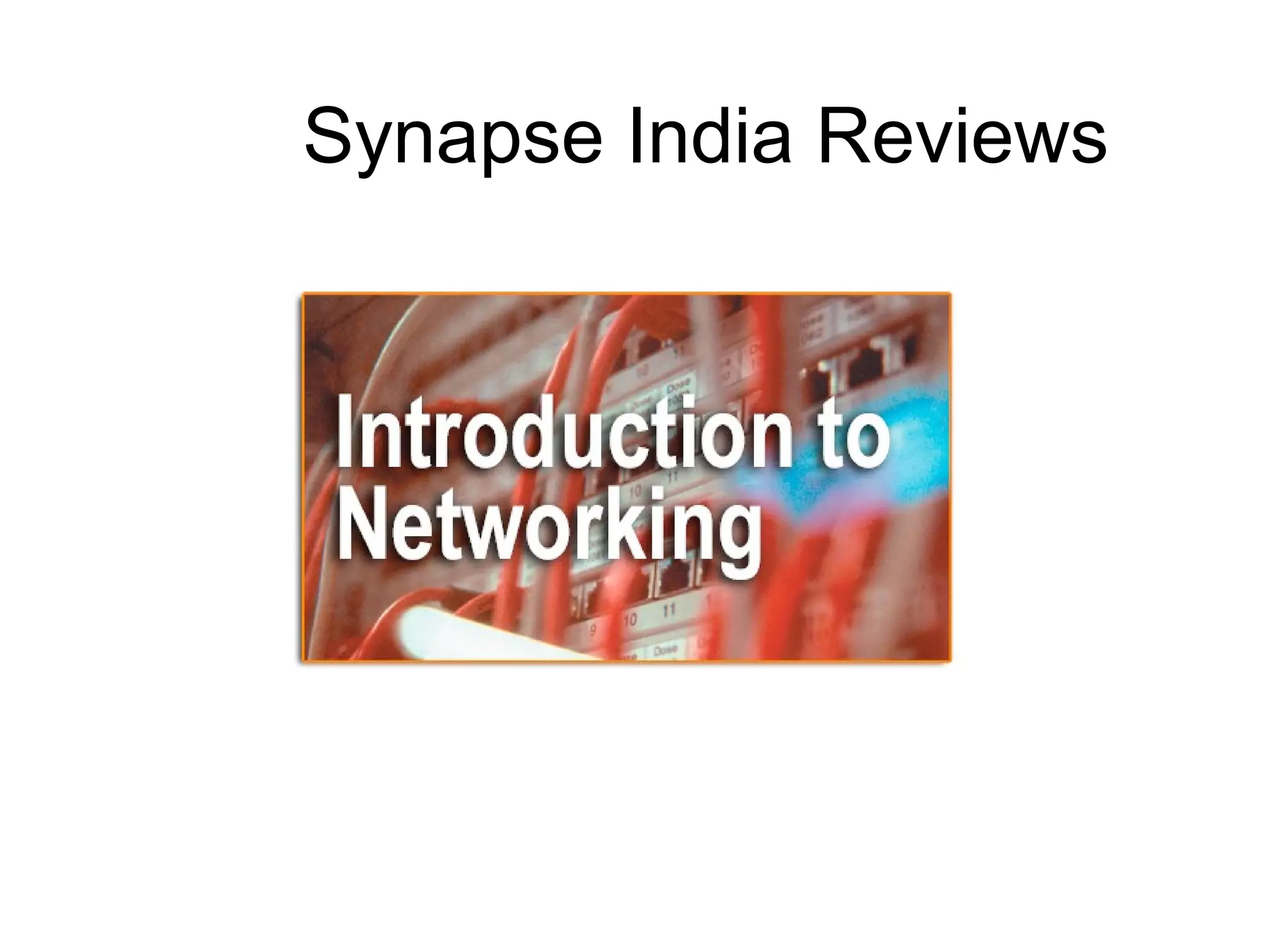
Synapse India Reviews
Overview 
• Introduction to networks. 
• Need for networks. 
• Classification of networks.
Introduction to Networks 
• A network consists of two or more entities 
or objects sharing resources and 
information. 
• A computer network consists of two or 
more computing devices connected to 
each other to share resources and 
information. 
• The network becomes a powerful tool 
when computers communicate and share 
resources with other computers on the 
same network or entirely distinct networks.
Introduction to Networks 
• Computers on a network can act as a 
client or a server. 
• A client is a computer that requests for 
resources. 
• A server is a computer that controls and 
provides access to resources.
Introduction to Networks 
• Data is a piece of information. 
• The computing concept ‘hierarchy of data’ is used 
when planning a network. 
• It is essential to maintain a hierarchy of data to 
manage and control resources among computers. 
• Network access to data must be evaluated carefully 
to avoid security issues.
Need for Networks 
• A computer that operates independently 
from other computers is called a stand-alone 
computer. 
• The process of printing or transferring data 
from one system to another using various 
storage devices is called sneakernet.
Need for Networks 
• Enhance communication. 
• Share resources. 
• Facilitate centralized management.
Enhance Communication 
• Computer networks use electronic mail (e-mail) 
as the choice for most of the 
communication. 
• By using networks, information can be 
sent to a larger audience in an extremely 
fast and efficient manner.
Share Resources 
• A copy of data or application stored at a single 
central location is shared over a network. 
• Computer peripheral devices, referred to as 
additional components, can be attached to a 
computer and be shared in a network.
Share Resources 
• Peripheral devices include faxes, 
modems, scanners, plotters, and any 
other device that connects to the 
computers. 
• Equipments having common requirements 
can be shared in order to reduce 
maintenance cost.
Share Resources 
• Important data can also be stored centrally 
to make it accessible to users, thereby 
saving storage space on individual 
computers. 
• Computer applications, which take up a 
considerable amount of storage space, 
can be installed centrally on the network, 
saving storage space.
Facilitate Centralized 
Management 
• Networks are used to assist in 
management tasks associated with their 
own operation and maintenance. 
• Using networks results in increased 
efficiency and a resultant reduction in 
maintenance costs.
Facilitate Centralized 
Management 
Software: 
– Software is a set of instructions or programs 
that control the operation of a computer. 
– Software can be installed at a central location 
using servers, where the installation files are 
made accessible over the network.
Classification of Networks 
• Classification by network geography. 
• Classification by component roles.
Classification by Network 
Geography 
• Networks are frequently classified 
according to the geographical boundaries 
spanned by the network itself. 
• LAN, WAN, and MAN are the basic types 
of classification, of which LAN and WAN 
are frequently used.
Classification by Network 
Geography 
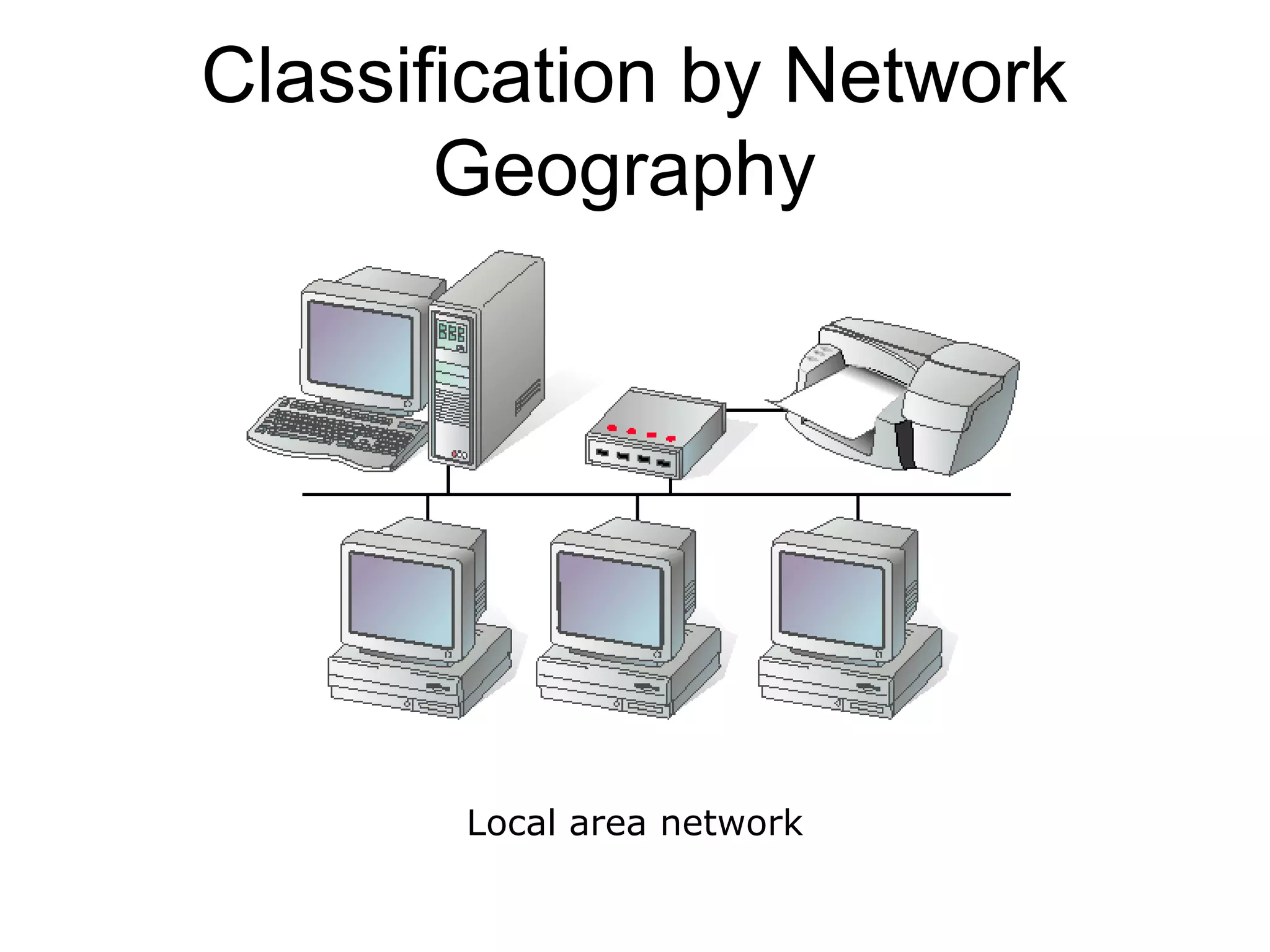
Local area network (LAN): 
– A LAN covers a relatively small area such as 
a classroom, school, or a single building. 
– LANs are inexpensive to install and also 
provide higher speeds.
Classification by Network 
Geography 
Local area network
Classification by Network 
Geography 
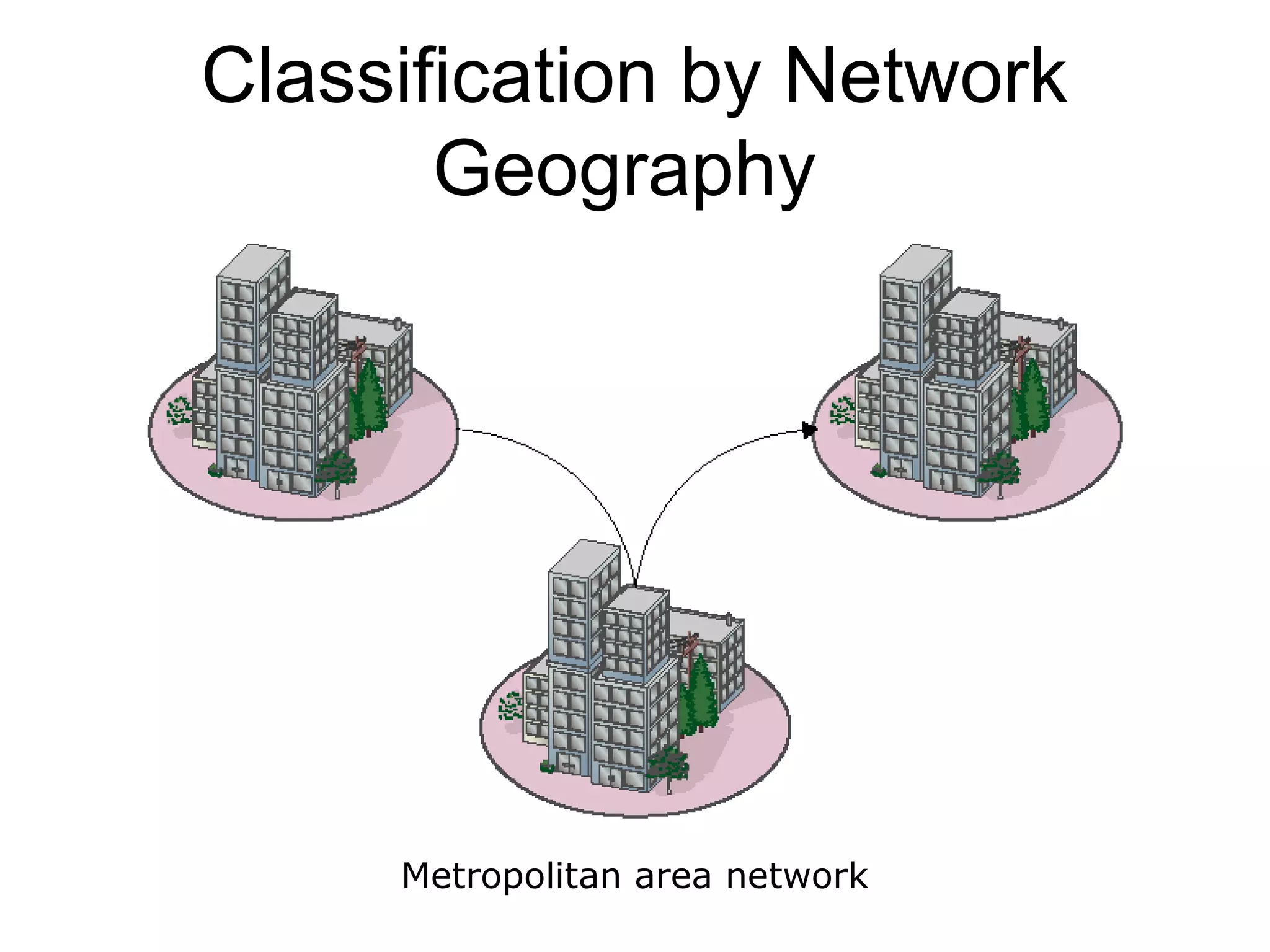
Metropolitan area network (MAN): 
– A MAN spans the distance of a typical 
metropolitan city. 
– The cost of installation and operation is 
higher. 
– MANs use high-speed connections such as 
fiber optics to achieve higher speeds.
Classification by Network 
Geography 
Metropolitan area network
Classification by Network 
Geography 
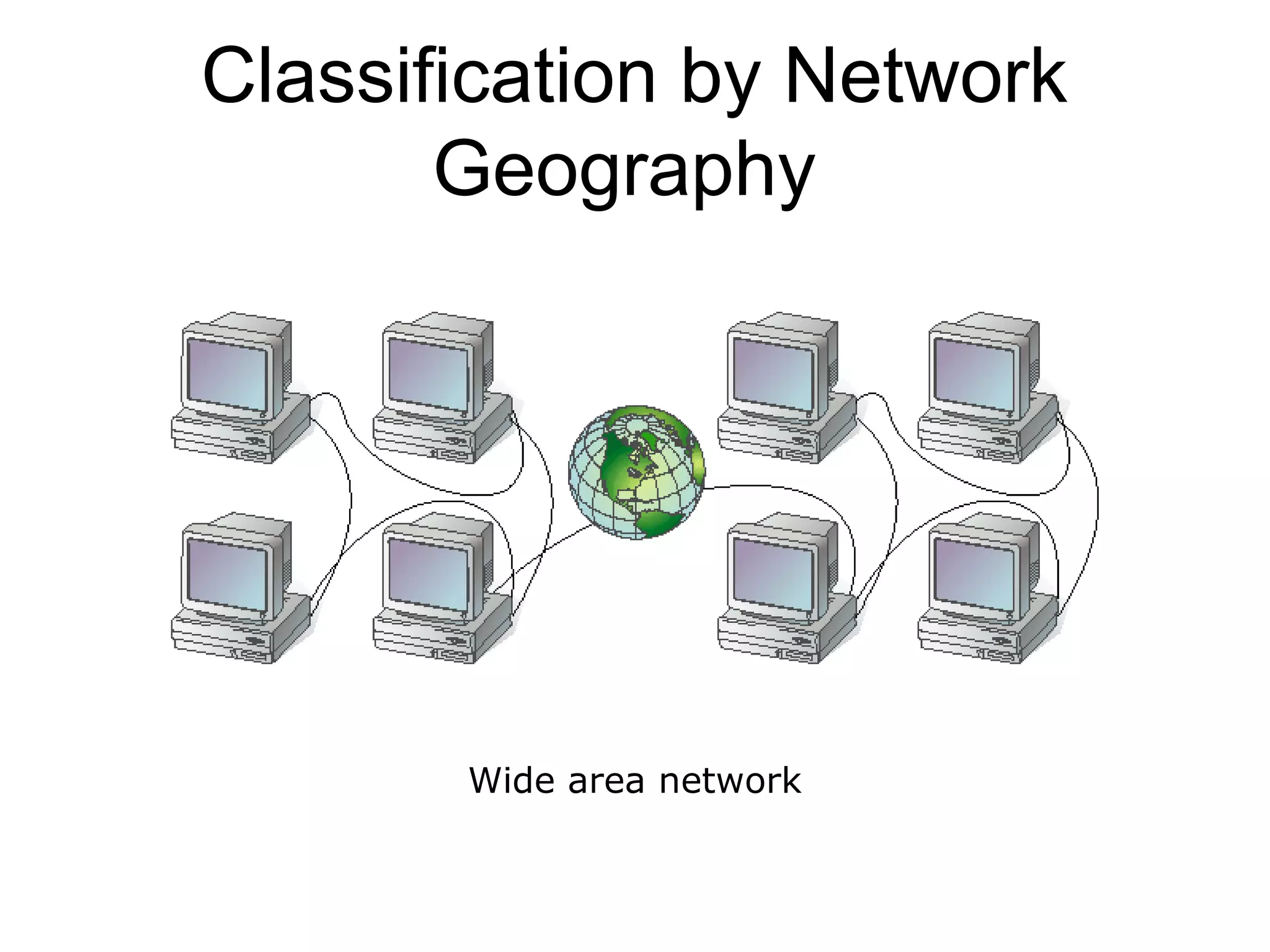
Wide area network (WAN): 
– WANs span a larger area than a single city. 
– These use long distance telecommunication 
networks for connection, thereby increasing 
the cost. 
– The Internet is a good example of a WAN.
Classification by Network 
Geography 
Wide area network
Classification by Component 
Roles 
• Networks can also be classified according 
to the roles that the networked computers 
play in the network’s operation. 
• Peer-to-peer, server-based, and client-based 
are the types of roles into which 
networks are classified.
Classification by Component 
Roles 
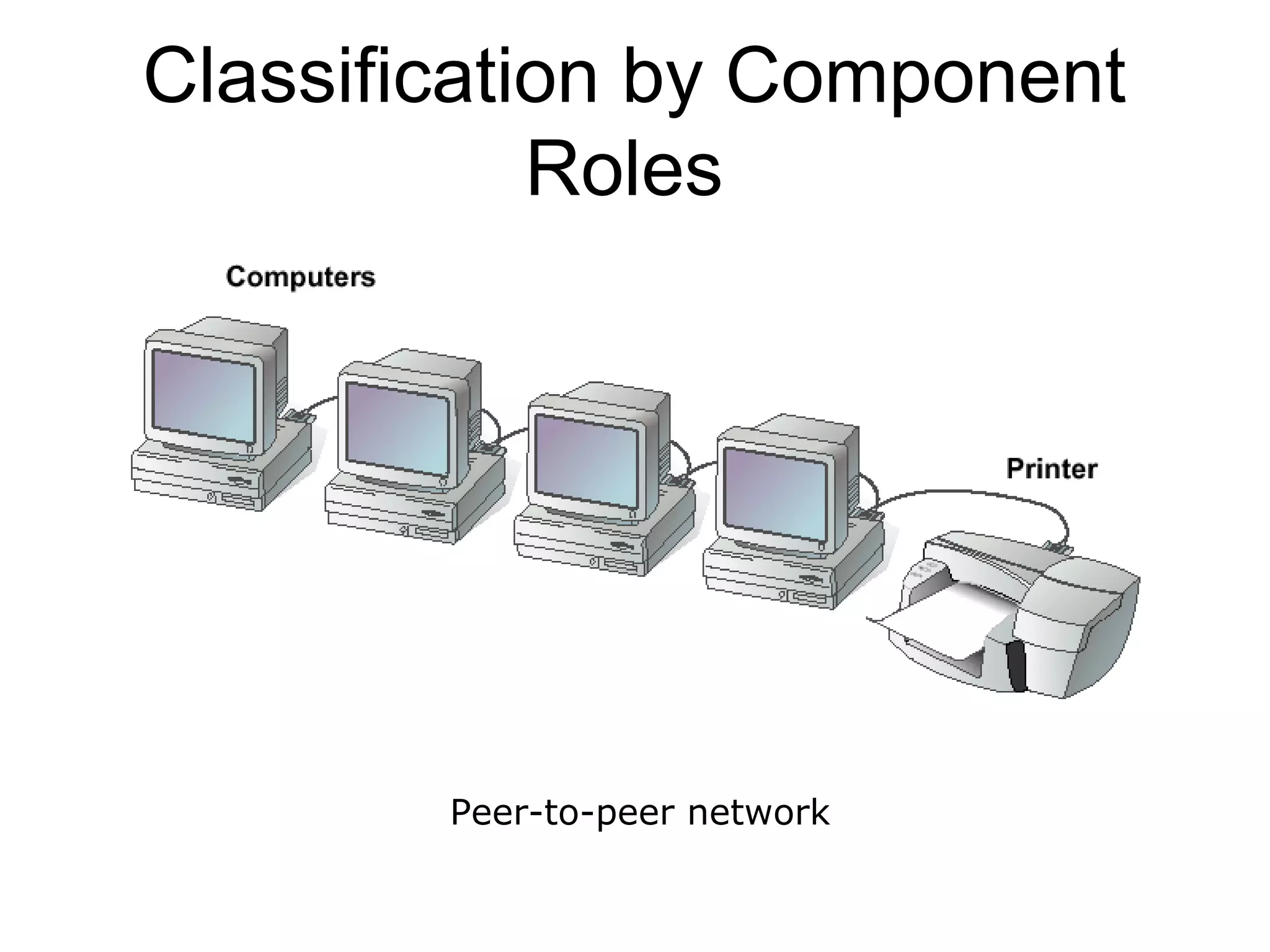
Peer-to-peer: 
– In a peer-to-peer network, all computers are considered equal. 
– Each computer controls its own information and is capable of 
functioning as either a client or a server depending upon the 
requirement. 
– Peer-to-peer networks are inexpensive and easy to install. 
– They are popular as home networks and for use in small companies.
Classification by Component 
Roles 
Peer-to-peer (continued): 
– Most operating systems come with built-in 
peer-to-peer networking capability. 
– The maximum number of peers that can 
operate on a peer-to-peer network is ten. 
– Each peer shares resources and allows 
others open access to them.
Classification by Component 
Roles 
Peer-to-peer (continued): 
– Peer-to-peer networks become difficult to 
manage when more security is added to 
resources, since the users control their 
security by password-protecting shares. 
– Shares can be document folders, printers, 
peripherals, and any other resource that they 
control on their computers.
Classification by Component 
Roles 
Peer-to-peer network
Classification by Component 
Roles 
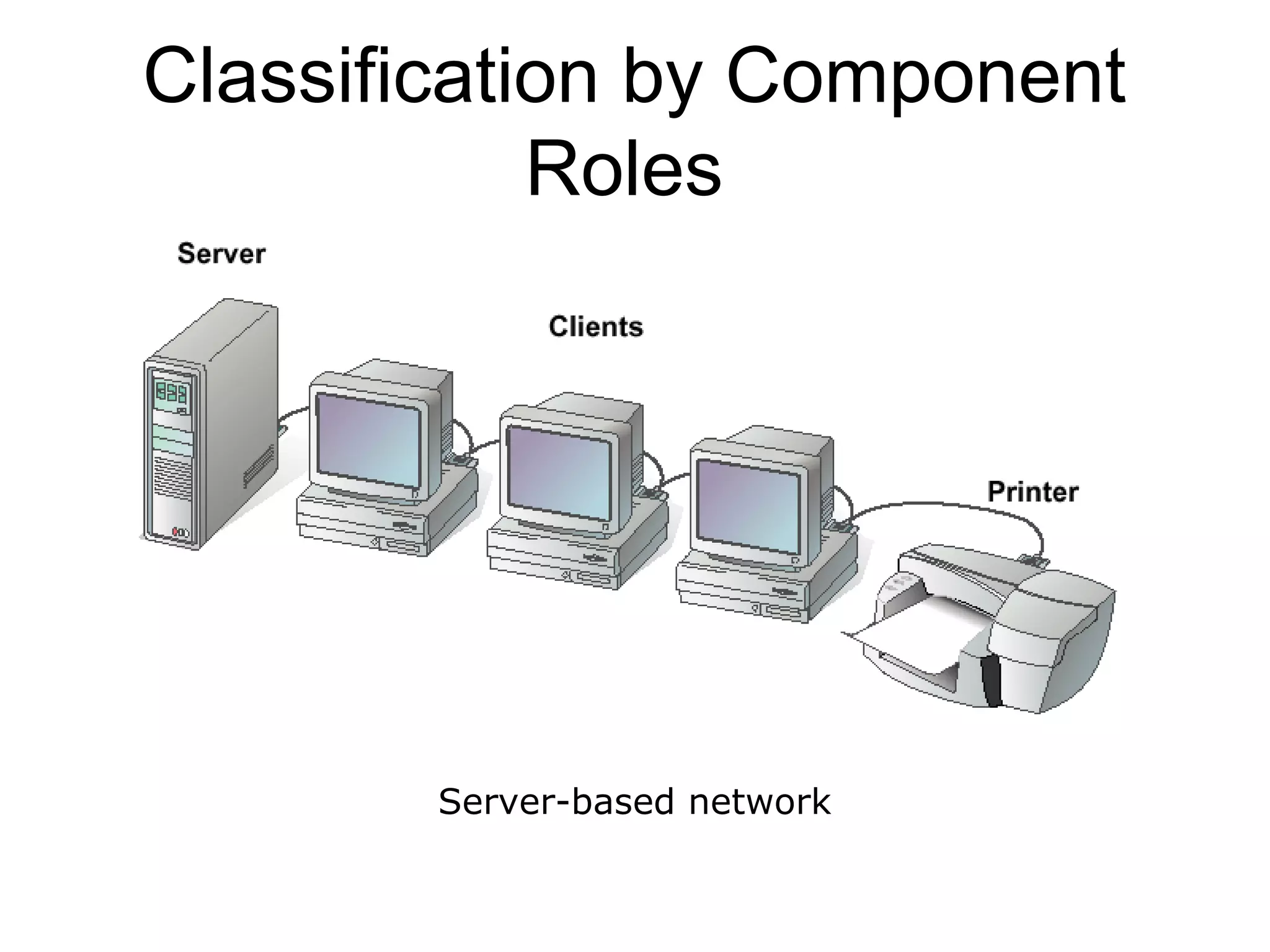
Server-based: 
– A server-based network offers centralized 
control and is designed for secure operations. 
– In a server-based network, a dedicated server 
controls the network.
Classification by Component 
Roles 
Server-based (continued): 
– A dedicated server is one that services the 
network by storing data, applications, 
resources, and also provides access to 
resources required by the client. 
– These servers can also control the network’s 
security from one centralized location or share 
it with other specially configured servers.
Classification by Component 
Roles 
Server-based network
Classification by Component 
Roles 
Client-based: 
– Client-based network servers process 
requests from clients and return just the 
results. 
– These networks take advantage of the 
powerful processing capabilities of both the 
client and the server. 
– Application servers and communications 
servers are examples of client-based 
networks.
Classification by Component 
Roles 
Client-based network
Summary 
• A network consists of two or more entities 
sharing resources and information. 
• A computer network consists of two or 
more computers that are connected and 
are able to communicate.
Summary 
• The basic purpose of networks is to 
enable effective communication, share 
resources, and facilitate centralized 
management of data. 
• Networks can be classified according to 
their geographical boundaries or their 
component roles.

Synapseindia revirews about networking

  • 1.
  • 2.
    Overview • Introductionto networks. • Need for networks. • Classification of networks.
  • 3.
    Introduction to Networks • A network consists of two or more entities or objects sharing resources and information. • A computer network consists of two or more computing devices connected to each other to share resources and information. • The network becomes a powerful tool when computers communicate and share resources with other computers on the same network or entirely distinct networks.
  • 4.
    Introduction to Networks • Computers on a network can act as a client or a server. • A client is a computer that requests for resources. • A server is a computer that controls and provides access to resources.
  • 5.
    Introduction to Networks • Data is a piece of information. • The computing concept ‘hierarchy of data’ is used when planning a network. • It is essential to maintain a hierarchy of data to manage and control resources among computers. • Network access to data must be evaluated carefully to avoid security issues.
  • 6.
    Need for Networks • A computer that operates independently from other computers is called a stand-alone computer. • The process of printing or transferring data from one system to another using various storage devices is called sneakernet.
  • 7.
    Need for Networks • Enhance communication. • Share resources. • Facilitate centralized management.
  • 8.
    Enhance Communication •Computer networks use electronic mail (e-mail) as the choice for most of the communication. • By using networks, information can be sent to a larger audience in an extremely fast and efficient manner.
  • 9.
    Share Resources •A copy of data or application stored at a single central location is shared over a network. • Computer peripheral devices, referred to as additional components, can be attached to a computer and be shared in a network.
  • 10.
    Share Resources •Peripheral devices include faxes, modems, scanners, plotters, and any other device that connects to the computers. • Equipments having common requirements can be shared in order to reduce maintenance cost.
  • 11.
    Share Resources •Important data can also be stored centrally to make it accessible to users, thereby saving storage space on individual computers. • Computer applications, which take up a considerable amount of storage space, can be installed centrally on the network, saving storage space.
  • 12.
    Facilitate Centralized Management • Networks are used to assist in management tasks associated with their own operation and maintenance. • Using networks results in increased efficiency and a resultant reduction in maintenance costs.
  • 13.
    Facilitate Centralized Management Software: – Software is a set of instructions or programs that control the operation of a computer. – Software can be installed at a central location using servers, where the installation files are made accessible over the network.
  • 14.
    Classification of Networks • Classification by network geography. • Classification by component roles.
  • 15.
    Classification by Network Geography • Networks are frequently classified according to the geographical boundaries spanned by the network itself. • LAN, WAN, and MAN are the basic types of classification, of which LAN and WAN are frequently used.
  • 16.
    Classification by Network Geography Local area network (LAN): – A LAN covers a relatively small area such as a classroom, school, or a single building. – LANs are inexpensive to install and also provide higher speeds.
  • 17.
    Classification by Network Geography Local area network
  • 18.
    Classification by Network Geography Metropolitan area network (MAN): – A MAN spans the distance of a typical metropolitan city. – The cost of installation and operation is higher. – MANs use high-speed connections such as fiber optics to achieve higher speeds.
  • 19.
    Classification by Network Geography Metropolitan area network
  • 20.
    Classification by Network Geography Wide area network (WAN): – WANs span a larger area than a single city. – These use long distance telecommunication networks for connection, thereby increasing the cost. – The Internet is a good example of a WAN.
  • 21.
    Classification by Network Geography Wide area network
  • 22.
    Classification by Component Roles • Networks can also be classified according to the roles that the networked computers play in the network’s operation. • Peer-to-peer, server-based, and client-based are the types of roles into which networks are classified.
  • 23.
    Classification by Component Roles Peer-to-peer: – In a peer-to-peer network, all computers are considered equal. – Each computer controls its own information and is capable of functioning as either a client or a server depending upon the requirement. – Peer-to-peer networks are inexpensive and easy to install. – They are popular as home networks and for use in small companies.
  • 24.
    Classification by Component Roles Peer-to-peer (continued): – Most operating systems come with built-in peer-to-peer networking capability. – The maximum number of peers that can operate on a peer-to-peer network is ten. – Each peer shares resources and allows others open access to them.
  • 25.
    Classification by Component Roles Peer-to-peer (continued): – Peer-to-peer networks become difficult to manage when more security is added to resources, since the users control their security by password-protecting shares. – Shares can be document folders, printers, peripherals, and any other resource that they control on their computers.
  • 26.
    Classification by Component Roles Peer-to-peer network
  • 27.
    Classification by Component Roles Server-based: – A server-based network offers centralized control and is designed for secure operations. – In a server-based network, a dedicated server controls the network.
  • 28.
    Classification by Component Roles Server-based (continued): – A dedicated server is one that services the network by storing data, applications, resources, and also provides access to resources required by the client. – These servers can also control the network’s security from one centralized location or share it with other specially configured servers.
  • 29.
    Classification by Component Roles Server-based network
  • 30.
    Classification by Component Roles Client-based: – Client-based network servers process requests from clients and return just the results. – These networks take advantage of the powerful processing capabilities of both the client and the server. – Application servers and communications servers are examples of client-based networks.
  • 31.
    Classification by Component Roles Client-based network
  • 32.
    Summary • Anetwork consists of two or more entities sharing resources and information. • A computer network consists of two or more computers that are connected and are able to communicate.
  • 33.
    Summary • Thebasic purpose of networks is to enable effective communication, share resources, and facilitate centralized management of data. • Networks can be classified according to their geographical boundaries or their component roles.