Synapseindia Reviews Cross 
Platform Mobile Application 
Development
So. . . 
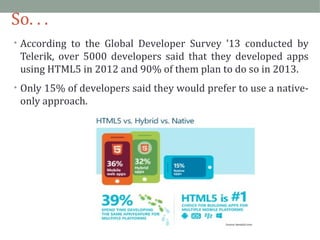
• According to the Global Developer Survey ’13 conducted by 
Telerik, over 5000 developers said that they developed apps 
using HTML5 in 2012 and 90% of them plan to do so in 2013. 
• Only 15% of developers said they would prefer to use a native-only 
approach.
Why Cross Platform 
• What your app will do? 
• Who it’s for? 
• Where it will run? 
• Do you maintain different and completely independent apps 
for each platform? 
• Design a hybrid app with one code base? 
• Pros and cons?
Main Features 
• Support Web Services ranging from JSON, XML, SOAP, HTTP 
etc. 
• These tools cannot access device specific feature like the 
bluetooth, NFC and other controls. 
• Source code is typically organized in the MVC format 
separating data tier, application and the interface. 
• Problem with compiling iOS Applications
Titanium 
• Developed by Appcelerator Inc. 
• Titanium is free and opensource 
• Apps written in javascript 
• Support to build Android, iOS and Blackberry Apps, trying to extend support for 
Windows. 
• Interpreter for Android and BlackBerry is MozillaRhino, for iOS JavascriptCore 
• Native experience – ‘not quite there’ 
• Source code organization 
• Device Specific Functionality – No built in support for Bluetooth and NFC. 
• Web services – SOAP, XML, JSON 
• Code maintenance 
• MBaaS support
PhoneGap 
• Developed by Adobe Systems 
• Free and opensource 
• Apps written in HTML5, CSS3 and Javascript 
• Support for Android, iOS, Blackberry, WebOS, Windows 
Phone, Symbian and Bada. 
• Apache Cordova is the heart of the backend. 
• Performance limited because of hybrid nature of the app. 
• Source code organization 
• No built in support for Bluetooth and NFC. 
• No Web services support built in.
Rhodes 
• Developed by Motorola. 
• Native app like feel. 
• Apps written in Ruby and recently extended for JavaScript 
• Support to build Android, iOS, Blackberry Apps, Windows 
phone and Mobile. 
• Source code organization 
• Device Specific Functionality – No built in support for 
Bluetooth and NFC. 
• Rich web service support built in. 
• Free but not for commercial users. 
• RhoHub is their MBaaS
Sencha Touch 
• Over 50 built-in components. 
• Built-in MVC system 
• Apps written in HML5 and CSS3. 
• Sencha Touch 2.2 is the latest version 
• Faster, Cheaper and highly customizable 
• PC developers can now create iOS applications without 
needing a Mac. 
• More than 500,000 developers 
• Rich set of documentation
jQuery Mobile 
• Built on the rock-solid jQuery and jQuery UI foundation 
• Its lightweight size makes it a speed freak 
• JQuery Mobile 1.3.1 recently launched 
• AJAX-powered navigation system 
• Extensions are easy to make 
• No established architecture 
• Easy to debug 
• Markup-based and is backed by a smart community
What is good about CPD? 
• Implement a feature once and share it across platforms 
• Using a webview might be faster than writing a native 
implementation for simple screens 
• Update content without requiring a full app release by serving 
your pages off a server 
• One tool to create, debug, and deploy. 
• Speed increases and cost decreases 
• Multiple security methods aren’t needed 
• Simple for web developers to use
Cons 
• Requires a bridge for their pages to interact with native 
chrome and call native APIs 
• Maintain a fork, if new functionality is added 
• Write a little code, run it on iPhone, Android, Windows Mobile 
simulator. 
• Several straightforward implementations for a single complex 
implementation. 
• Harder problems are inconsistencies in platform conventions. 
• Maybe web technology will one day be as fast as native code
What does it all boil down to?
Questions

Synapse india reviews on cross plateform mobile apps development

  • 1.
    Synapseindia Reviews Cross Platform Mobile Application Development
  • 2.
    So. . . • According to the Global Developer Survey ’13 conducted by Telerik, over 5000 developers said that they developed apps using HTML5 in 2012 and 90% of them plan to do so in 2013. • Only 15% of developers said they would prefer to use a native-only approach.
  • 3.
    Why Cross Platform • What your app will do? • Who it’s for? • Where it will run? • Do you maintain different and completely independent apps for each platform? • Design a hybrid app with one code base? • Pros and cons?
  • 4.
    Main Features •Support Web Services ranging from JSON, XML, SOAP, HTTP etc. • These tools cannot access device specific feature like the bluetooth, NFC and other controls. • Source code is typically organized in the MVC format separating data tier, application and the interface. • Problem with compiling iOS Applications
  • 5.
    Titanium • Developedby Appcelerator Inc. • Titanium is free and opensource • Apps written in javascript • Support to build Android, iOS and Blackberry Apps, trying to extend support for Windows. • Interpreter for Android and BlackBerry is MozillaRhino, for iOS JavascriptCore • Native experience – ‘not quite there’ • Source code organization • Device Specific Functionality – No built in support for Bluetooth and NFC. • Web services – SOAP, XML, JSON • Code maintenance • MBaaS support
  • 6.
    PhoneGap • Developedby Adobe Systems • Free and opensource • Apps written in HTML5, CSS3 and Javascript • Support for Android, iOS, Blackberry, WebOS, Windows Phone, Symbian and Bada. • Apache Cordova is the heart of the backend. • Performance limited because of hybrid nature of the app. • Source code organization • No built in support for Bluetooth and NFC. • No Web services support built in.
  • 7.
    Rhodes • Developedby Motorola. • Native app like feel. • Apps written in Ruby and recently extended for JavaScript • Support to build Android, iOS, Blackberry Apps, Windows phone and Mobile. • Source code organization • Device Specific Functionality – No built in support for Bluetooth and NFC. • Rich web service support built in. • Free but not for commercial users. • RhoHub is their MBaaS
  • 8.
    Sencha Touch •Over 50 built-in components. • Built-in MVC system • Apps written in HML5 and CSS3. • Sencha Touch 2.2 is the latest version • Faster, Cheaper and highly customizable • PC developers can now create iOS applications without needing a Mac. • More than 500,000 developers • Rich set of documentation
  • 9.
    jQuery Mobile •Built on the rock-solid jQuery and jQuery UI foundation • Its lightweight size makes it a speed freak • JQuery Mobile 1.3.1 recently launched • AJAX-powered navigation system • Extensions are easy to make • No established architecture • Easy to debug • Markup-based and is backed by a smart community
  • 10.
    What is goodabout CPD? • Implement a feature once and share it across platforms • Using a webview might be faster than writing a native implementation for simple screens • Update content without requiring a full app release by serving your pages off a server • One tool to create, debug, and deploy. • Speed increases and cost decreases • Multiple security methods aren’t needed • Simple for web developers to use
  • 11.
    Cons • Requiresa bridge for their pages to interact with native chrome and call native APIs • Maintain a fork, if new functionality is added • Write a little code, run it on iPhone, Android, Windows Mobile simulator. • Several straightforward implementations for a single complex implementation. • Harder problems are inconsistencies in platform conventions. • Maybe web technology will one day be as fast as native code
  • 12.
    What does itall boil down to?
  • 13.