Trends in distributed systems
• Significant changes in current distributed
systems:
– The emergence of pervasive technology
– The emergence of ubiquitous & mobile computing
– The increasing demand of multimedia technology
– The view of distributed systems as a utility
Trends in distributed systems
• Pervasive technology
– Modern Internet – Collection of internetworked
devices- wired & wireless
– Pervasive resources and devices can be connected
at any time and in any place
Trends in distributed systems
intranet
ISP
desktop computer:
backbone
satellite link
server:
☎
network link:
☎
☎
☎
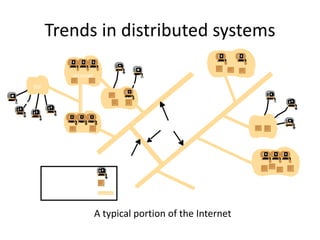
A typical portion of the Internet
Trends in distributed systems
• Mobile & ubiquitous computing
– Small and portable devices are possible to be used
within distributed systems
• E.g. laptop computers, handheld devices, wearable
devices, devices embedded in appliances
– Mobile computing: portability of the devices and
the ability to connect to networks in different
places
– Ubiquitous computing: small computing devices
that available everywhere and are easily attached
to networks
Trends in distributed systems
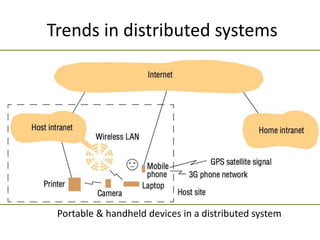
Portable & handheld devices in a distributed system
Trends in distributed systems
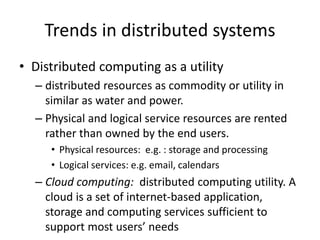
• Distributed multimedia systems
– The use of multimedia contents in distributed
systems
• Multimedia support
– Major benefits of multimedia support
• Distributed multimedia computing can be accessed
through desktop or mobile devices. E.g. live tv
broadcast, video-on-demand, IP telephony, webcasting,
etc.
Trends in distributed systems
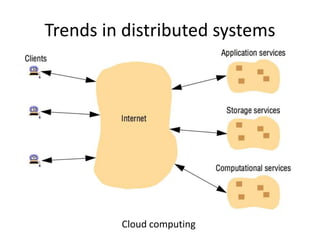
• Distributed computing as a utility
– distributed resources as commodity or utility in
similar as water and power.
– Physical and logical service resources are rented
rather than owned by the end users.
• Physical resources: e.g. : storage and processing
• Logical services: e.g. email, calendars
– Cloud computing: distributed computing utility. A
cloud is a set of internet-based application,
storage and computing services sufficient to
support most users’ needs
Trends in distributed systems
Cloud computing
Trends in distributed systems
• Cloud are implemented on cluster computers
to provide the appropriate scale and
performance required by such services
– A cluster computer: a set of interconnected
computers that cooperate closely to provide a
single integrated high-performance computing
capability
– A blade server: a computer server that has been
designed to minimize the use of physical space
and energy
Trends in distributed systems
• Grid Computing
– Is a form of cloud computing
– Authorized users share processing power, memory
and data storage
– Use to support scientific applications

Trends in distributed systems

  • 1.
    Trends in distributedsystems • Significant changes in current distributed systems: – The emergence of pervasive technology – The emergence of ubiquitous & mobile computing – The increasing demand of multimedia technology – The view of distributed systems as a utility
  • 2.
    Trends in distributedsystems • Pervasive technology – Modern Internet – Collection of internetworked devices- wired & wireless – Pervasive resources and devices can be connected at any time and in any place
  • 3.
    Trends in distributedsystems intranet ISP desktop computer: backbone satellite link server: ☎ network link: ☎ ☎ ☎ A typical portion of the Internet
  • 4.
    Trends in distributedsystems • Mobile & ubiquitous computing – Small and portable devices are possible to be used within distributed systems • E.g. laptop computers, handheld devices, wearable devices, devices embedded in appliances – Mobile computing: portability of the devices and the ability to connect to networks in different places – Ubiquitous computing: small computing devices that available everywhere and are easily attached to networks
  • 5.
    Trends in distributedsystems Portable & handheld devices in a distributed system
  • 6.
    Trends in distributedsystems • Distributed multimedia systems – The use of multimedia contents in distributed systems • Multimedia support – Major benefits of multimedia support • Distributed multimedia computing can be accessed through desktop or mobile devices. E.g. live tv broadcast, video-on-demand, IP telephony, webcasting, etc.
  • 7.
    Trends in distributedsystems • Distributed computing as a utility – distributed resources as commodity or utility in similar as water and power. – Physical and logical service resources are rented rather than owned by the end users. • Physical resources: e.g. : storage and processing • Logical services: e.g. email, calendars – Cloud computing: distributed computing utility. A cloud is a set of internet-based application, storage and computing services sufficient to support most users’ needs
  • 8.
    Trends in distributedsystems Cloud computing
  • 9.
    Trends in distributedsystems • Cloud are implemented on cluster computers to provide the appropriate scale and performance required by such services – A cluster computer: a set of interconnected computers that cooperate closely to provide a single integrated high-performance computing capability – A blade server: a computer server that has been designed to minimize the use of physical space and energy
  • 10.
    Trends in distributedsystems • Grid Computing – Is a form of cloud computing – Authorized users share processing power, memory and data storage – Use to support scientific applications

Editor's Notes

  • #4 - This figure shows a typical portion of the Internet. Computers in the network interact by passing messages. - The Internet Protocol (IP) enables programs running anywhere to address messages to programs anywhere. The Internet is an example of a very large distributed system. The figure also shows collections of Intranets ( a sub-network that operated by organizations) A backbone is a network link with a high transmission capacity, utilizing satellite connections, fibre optics and other high-bandwidth circuits.
  • #6 This figure shows how a user can access resources at office network via his/her home network
  • #9 The aim of cloud computing is to reduce requirement of end-user devices, allowing them to has all the required resources through simple desktop or handheld devices.