1
1
BY:
Megha Yadav
Grid Computing
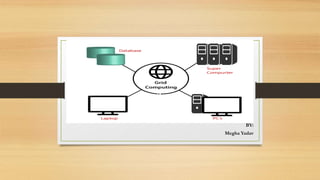
• A computing grid interconnects resources such as high performance
computers, scientific databases, and computer controlled scientific
instruments of cooperating organizations each of which is autonomous.
• Grid computing is define as “An infrastructure that enables the integrated,
collaborative use of high-end computers, networks, databases, and scientific
instruments owned and managed by multiple organizations”.
• “Grid computing provides the ability using a set of open standards and
protocols to gain access to applications and data, processing power, storage
capacity, and vast array of computing resources over the Internet.
• It is a type of parallel and distributed system that enables the sharing,
selection, and aggregation of resources distributed across multiple
administrative domains based on their availability, capacity, performance,
cost, and users’ quality of service requirements.”
Characteristics of a Computational Grid
• Heterogeneity: The grid involves a number of resources that are varied in nature
and can encompass a large geographical distance through various domains.
• Scalability: The grid should be tolerant to handle a large number of nodes without
any performance degradation.
• Adaptability or Fault Tolerant :In a grid unexpected computational aborts,
hardware or software faults etc. are high. These faults are generally handled by
Resource Managers.
• Security :All the user participating computers should be protected from any
malicious manipulations or interventions.
Grid Components
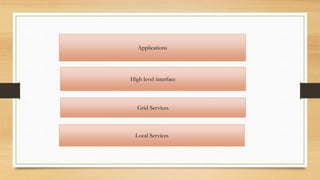
• User Level: This layer houses the Application and High level Interfaces.
Applications can be varied and encompass a vast variety of problems from
chemistry to Nuclear Engineering. The high level interfaces implement an interface
and protocols allowing the applications and users to access the middleware services.
• Middleware Level: This layer provides many services like Resource discovery,
resource scheduling and allocation, fault tolerance, security mechanisms and load
balancing. It should provide the users a transparent view of the resources available.
• Resource Level This layer typically provides local services that render
computational resources like CPU cycles, storage, computers, Network
infrastructure, software etc.
Applications
High level interface
Grid Services
Local Services
Working:
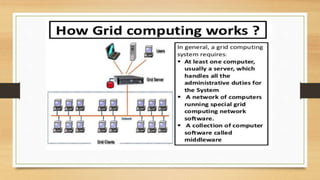
A Grid computing network mainly consists of these three types of machines
• Control Node:
A computer, usually a server or a group of servers which administrates the whole
network and keeps the account of the resources in the network pool.
• Provider:
The computer which contributes it’s resources in the network resource pool.
• User:
The computer that uses the resources on the network.
• When a computer makes a request for resources to the control node, control node
gives the user access to the resources available on the network. When it is not in use
it’s resources to the network. Hence a normal computer on the node can swing in
between being a user or a provider .
• For controlling the network and it’s resources a software/networking protocol is
used known as Middleware. This is responsible for administrating the network.
• Grid computing system should use only unused resources of a computer, it is the
job of the control node that any provider is not overloaded with tasks.
• In a grid computing system, a provider gives permission to the user to run
anything on it’s computer, hence it is a huge security threat for the network.
Hence a middleware should ensure that there is no unwanted task being
executed on the network.
• Currently grid computing is being used in various institutions to solve a lot
of mathematical, analytical and physics problems.
Advantages of Grid Computing:
• It is not centralized, as there are no servers required, except the control node
which is just used for controlling and not for processing.
• Multiple heterogeneous machines i.e. machines with different Operating
Systems can use a single grid computing network.
• Tasks can be performed parallel across various physical locations and the
users don’t have to pay for it(with money).
Disadvantages of Grid Computing
• Grid software and standards are still evolving.
• Learning curve to get started.
• Non-interactive job submission.
• You may need to have a fast interconnect between compute resources.
Grid computing

Grid computing

  • 1.
  • 2.
    Grid Computing • Acomputing grid interconnects resources such as high performance computers, scientific databases, and computer controlled scientific instruments of cooperating organizations each of which is autonomous. • Grid computing is define as “An infrastructure that enables the integrated, collaborative use of high-end computers, networks, databases, and scientific instruments owned and managed by multiple organizations”.
  • 3.
    • “Grid computingprovides the ability using a set of open standards and protocols to gain access to applications and data, processing power, storage capacity, and vast array of computing resources over the Internet. • It is a type of parallel and distributed system that enables the sharing, selection, and aggregation of resources distributed across multiple administrative domains based on their availability, capacity, performance, cost, and users’ quality of service requirements.”
  • 4.
    Characteristics of aComputational Grid • Heterogeneity: The grid involves a number of resources that are varied in nature and can encompass a large geographical distance through various domains. • Scalability: The grid should be tolerant to handle a large number of nodes without any performance degradation. • Adaptability or Fault Tolerant :In a grid unexpected computational aborts, hardware or software faults etc. are high. These faults are generally handled by Resource Managers. • Security :All the user participating computers should be protected from any malicious manipulations or interventions.
  • 5.
    Grid Components • UserLevel: This layer houses the Application and High level Interfaces. Applications can be varied and encompass a vast variety of problems from chemistry to Nuclear Engineering. The high level interfaces implement an interface and protocols allowing the applications and users to access the middleware services. • Middleware Level: This layer provides many services like Resource discovery, resource scheduling and allocation, fault tolerance, security mechanisms and load balancing. It should provide the users a transparent view of the resources available. • Resource Level This layer typically provides local services that render computational resources like CPU cycles, storage, computers, Network infrastructure, software etc.
  • 6.
  • 8.
    Working: A Grid computingnetwork mainly consists of these three types of machines • Control Node: A computer, usually a server or a group of servers which administrates the whole network and keeps the account of the resources in the network pool. • Provider: The computer which contributes it’s resources in the network resource pool. • User: The computer that uses the resources on the network.
  • 9.
    • When acomputer makes a request for resources to the control node, control node gives the user access to the resources available on the network. When it is not in use it’s resources to the network. Hence a normal computer on the node can swing in between being a user or a provider . • For controlling the network and it’s resources a software/networking protocol is used known as Middleware. This is responsible for administrating the network. • Grid computing system should use only unused resources of a computer, it is the job of the control node that any provider is not overloaded with tasks.
  • 10.
    • In agrid computing system, a provider gives permission to the user to run anything on it’s computer, hence it is a huge security threat for the network. Hence a middleware should ensure that there is no unwanted task being executed on the network. • Currently grid computing is being used in various institutions to solve a lot of mathematical, analytical and physics problems.
  • 11.
    Advantages of GridComputing: • It is not centralized, as there are no servers required, except the control node which is just used for controlling and not for processing. • Multiple heterogeneous machines i.e. machines with different Operating Systems can use a single grid computing network. • Tasks can be performed parallel across various physical locations and the users don’t have to pay for it(with money).
  • 12.
    Disadvantages of GridComputing • Grid software and standards are still evolving. • Learning curve to get started. • Non-interactive job submission. • You may need to have a fast interconnect between compute resources.