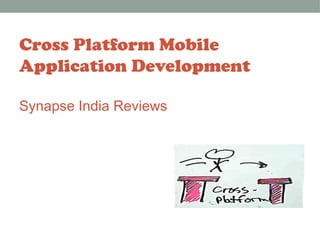
Cross Platform Mobile 
Application Development 
Synapse India Reviews
So. . . 
• According to the Global Developer Survey ’13 conducted by 
Telerik, over 5000 developers said that they developed apps 
using HTML5 in 2012 and 90% of them plan to do so in 2013. 
• Only 15% of developers said they would prefer to use a native-only 
approach.
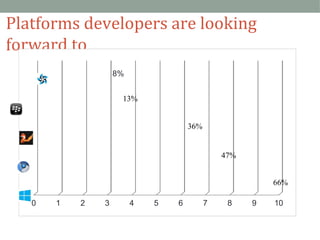
Platforms developers are looking 
forward to 
8% 
13% 
36% 
47% 
66% 
0 1 2 3 4 5 6 7 8 9 10
Development Difficulty 
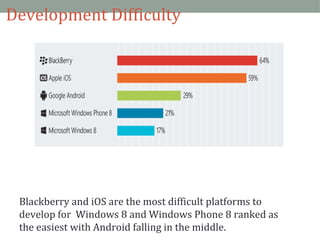
Blackberry and iOS are the most difficult platforms to 
develop for Windows 8 and Windows Phone 8 ranked as 
the easiest with Android falling in the middle.
Types of Apps being built using 
HTML5 
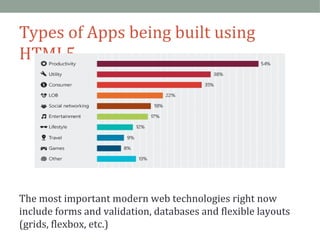
The most important modern web technologies right now 
include forms and validation, databases and flexible layouts 
(grids, flexbox, etc.)
Usage 
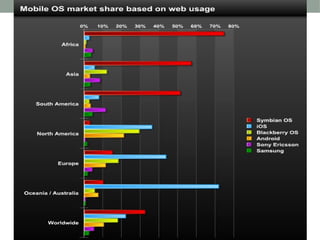
• Apple’s iOS is the leading mobile OS in 30 countries. Canada- 
83.7%, United States at 35.2%. 
• Android accounts for more than 50% of the mobile web traffic 
with South Korea at 78.3% and United States at 23.3%. 
• Blackberry is the leading mobile OS in four countries, Dominican 
Republic, 57.1% and United States, 32.0% 
• Symbian is the leading mobile OS in more than 100 countries, 
Nokia’s Symbian-based phones are widely used in developing 
nations. However, it has almost no foothold in the US market.
Why Cross Platform 
• What your app will do? 
• Who it’s for? 
• Where it will run? 
• Do you maintain different and completely independent apps 
for each platform? 
• Design a hybrid app with one code base? 
• Pros and cons?
Main Features 
• Most of them use web based languages – HTML5, javascript 
• Performance solely depends on the language being used. 
• Provide Backend as a Service (MBaaS) which includes cloud 
storage, social networking and ‘push notifications’. 
• Support Web Services ranging from JSON, XML, SOAP, HTTP 
etc. 
• These tools cannot access device specific feature like the 
bluetooth, NFC and other controls. 
• Source code is typically organized in the MVC format 
separating data tier, application and the interface. 
• Problem with compiling iOS Applications
Titanium 
• Developed by Appcelerator Inc. 
• Titanium is free and opensource 
• Apps written in javascript 
• Support to build Android, iOS and Blackberry Apps, trying to extend support for 
Windows. 
• Interpreter for Android and BlackBerry is MozillaRhino, for iOS JavascriptCore 
• Native experience – ‘not quite there’ 
• Source code organization 
• Device Specific Functionality – No built in support for Bluetooth and NFC. 
• Web services – SOAP, XML, JSON 
• Code maintenance 
• MBaaS support
PhoneGap 
• Developed by Adobe Systems 
• Free and opensource 
• Apps written in HTML5, CSS3 and Javascript 
• Support for Android, iOS, Blackberry, WebOS, Windows Phone, 
Symbian and Bada. 
• Apache Cordova is the heart of the backend. 
• Performance limited because of hybrid nature of the app. 
• Source code organization 
• No built in support for Bluetooth and NFC. 
• No Web services support built in. 
• Cloud Compiler
Rhodes 
• Developed by Motorola. 
• Native app like feel. 
• Apps written in Ruby and recently extended for JavaScript 
• Support to build Android, iOS, Blackberry Apps, Windows phone and 
Mobile. 
• Source code organization 
• Device Specific Functionality – No built in support for Bluetooth and 
NFC. 
• Rich web service support built in. 
• Free but not for commercial users. 
• RhoHub is their MBaaS
Corona 
• Developed by Corona Labs. 
• Apps written in Lua. 
• Free until app isn’t published. 
• Support to build Android, iOS, NOOK and Kindle Fire Applications. 
• Application is compiled using Lua libraries mashed with OpenGL and 
OpenAL. 
• Native controls using underlying library 
• Device Specific Functionality – No built in support for Bluetooth and 
NFC. 
• Web services – HTTP,HTTPS,SOAP, JSON 
• Cloud service is called Corona Cloud. 
• Targeted for game developers.
Marmalade 
• Developed by Ideaworks3d. 
• Upfront licensing. 
• Apps written in C++ 
• Support to build iOS, Android, BlackBerry PlayBook OS, and bada. 
• Binary combined with Segundo Embedded Execution Environment 
(S3E) 
• All device specific functionality except Bluetooth and NFC. 
• Web services – SOAP, XML, JSON 
• Marmalade Juice – plan to port Objective C source code into 
Marmalade.
MonoCross 
• Part of the Mono Project 
• Built on the .NET framework. 
• C# is used to build apps. 
• Support to build Android and iOS. 
• Specific platform tools – Xamarin Mono and Xamarin MonoTouch. 
• Interpreter for Android and BlackBerry is MozillaRhino, for iOS 
JavascriptCore 
• Native experience – ‘not quite there’ 
• Source code organization 
• Device Specific Functionality – No built in support for Bluetooth and 
NFC. 
• Windows Communication Foundation– Bing Maps API
Sencha Touch 
• Over 50 built-in components. 
• Built-in MVC system 
• Apps written in HML5 and CSS3. 
• Sencha Touch 2.2 is the latest version 
• Faster, Cheaper and highly customizable 
• PC developers can now create iOS applications without 
needing a Mac. 
• More than 500,000 developers 
• Rich set of documentation
jQuery Mobile 
• Built on the rock-solid jQuery and jQuery UI foundation 
• Its lightweight size makes it a speed freak 
• JQuery Mobile 1.3.1 recently launched 
• AJAX-powered navigation system 
• Extensions are easy to make 
• No established architecture 
• Easy to debug 
• Markup-based and is backed by a smart community
What is good about CPD? 
• Implement a feature once and share it across platforms 
• Using a webview might be faster than writing a native 
implementation for simple screens 
• Update content without requiring a full app release by serving 
your pages off a server 
• One tool to create, debug, and deploy. 
• Speed increases and cost decreases 
• Multiple security methods aren’t needed 
• Simple for web developers to use
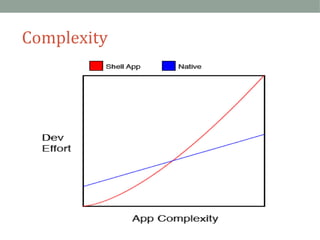
Complexity
Cons 
• Requires a bridge for their pages to interact with native 
chrome and call native APIs 
• Maintain a fork, if new functionality is added 
• Write a little code, run it on iPhone, Android, Windows Mobile 
simulator. 
• Several straightforward implementations for a single complex 
implementation. 
• Harder problems are inconsistencies in platform conventions. 
• Maybe web technology will one day be as fast as native code
What does it all boil down to?
Questions

Synapse india reviews on mobile application development

  • 1.
    Cross Platform Mobile Application Development Synapse India Reviews
  • 2.
    So. . . • According to the Global Developer Survey ’13 conducted by Telerik, over 5000 developers said that they developed apps using HTML5 in 2012 and 90% of them plan to do so in 2013. • Only 15% of developers said they would prefer to use a native-only approach.
  • 3.
    Platforms developers arelooking forward to 8% 13% 36% 47% 66% 0 1 2 3 4 5 6 7 8 9 10
  • 4.
    Development Difficulty Blackberryand iOS are the most difficult platforms to develop for Windows 8 and Windows Phone 8 ranked as the easiest with Android falling in the middle.
  • 5.
    Types of Appsbeing built using HTML5 The most important modern web technologies right now include forms and validation, databases and flexible layouts (grids, flexbox, etc.)
  • 7.
    Usage • Apple’siOS is the leading mobile OS in 30 countries. Canada- 83.7%, United States at 35.2%. • Android accounts for more than 50% of the mobile web traffic with South Korea at 78.3% and United States at 23.3%. • Blackberry is the leading mobile OS in four countries, Dominican Republic, 57.1% and United States, 32.0% • Symbian is the leading mobile OS in more than 100 countries, Nokia’s Symbian-based phones are widely used in developing nations. However, it has almost no foothold in the US market.
  • 8.
    Why Cross Platform • What your app will do? • Who it’s for? • Where it will run? • Do you maintain different and completely independent apps for each platform? • Design a hybrid app with one code base? • Pros and cons?
  • 9.
    Main Features •Most of them use web based languages – HTML5, javascript • Performance solely depends on the language being used. • Provide Backend as a Service (MBaaS) which includes cloud storage, social networking and ‘push notifications’. • Support Web Services ranging from JSON, XML, SOAP, HTTP etc. • These tools cannot access device specific feature like the bluetooth, NFC and other controls. • Source code is typically organized in the MVC format separating data tier, application and the interface. • Problem with compiling iOS Applications
  • 10.
    Titanium • Developedby Appcelerator Inc. • Titanium is free and opensource • Apps written in javascript • Support to build Android, iOS and Blackberry Apps, trying to extend support for Windows. • Interpreter for Android and BlackBerry is MozillaRhino, for iOS JavascriptCore • Native experience – ‘not quite there’ • Source code organization • Device Specific Functionality – No built in support for Bluetooth and NFC. • Web services – SOAP, XML, JSON • Code maintenance • MBaaS support
  • 11.
    PhoneGap • Developedby Adobe Systems • Free and opensource • Apps written in HTML5, CSS3 and Javascript • Support for Android, iOS, Blackberry, WebOS, Windows Phone, Symbian and Bada. • Apache Cordova is the heart of the backend. • Performance limited because of hybrid nature of the app. • Source code organization • No built in support for Bluetooth and NFC. • No Web services support built in. • Cloud Compiler
  • 12.
    Rhodes • Developedby Motorola. • Native app like feel. • Apps written in Ruby and recently extended for JavaScript • Support to build Android, iOS, Blackberry Apps, Windows phone and Mobile. • Source code organization • Device Specific Functionality – No built in support for Bluetooth and NFC. • Rich web service support built in. • Free but not for commercial users. • RhoHub is their MBaaS
  • 13.
    Corona • Developedby Corona Labs. • Apps written in Lua. • Free until app isn’t published. • Support to build Android, iOS, NOOK and Kindle Fire Applications. • Application is compiled using Lua libraries mashed with OpenGL and OpenAL. • Native controls using underlying library • Device Specific Functionality – No built in support for Bluetooth and NFC. • Web services – HTTP,HTTPS,SOAP, JSON • Cloud service is called Corona Cloud. • Targeted for game developers.
  • 14.
    Marmalade • Developedby Ideaworks3d. • Upfront licensing. • Apps written in C++ • Support to build iOS, Android, BlackBerry PlayBook OS, and bada. • Binary combined with Segundo Embedded Execution Environment (S3E) • All device specific functionality except Bluetooth and NFC. • Web services – SOAP, XML, JSON • Marmalade Juice – plan to port Objective C source code into Marmalade.
  • 15.
    MonoCross • Partof the Mono Project • Built on the .NET framework. • C# is used to build apps. • Support to build Android and iOS. • Specific platform tools – Xamarin Mono and Xamarin MonoTouch. • Interpreter for Android and BlackBerry is MozillaRhino, for iOS JavascriptCore • Native experience – ‘not quite there’ • Source code organization • Device Specific Functionality – No built in support for Bluetooth and NFC. • Windows Communication Foundation– Bing Maps API
  • 16.
    Sencha Touch •Over 50 built-in components. • Built-in MVC system • Apps written in HML5 and CSS3. • Sencha Touch 2.2 is the latest version • Faster, Cheaper and highly customizable • PC developers can now create iOS applications without needing a Mac. • More than 500,000 developers • Rich set of documentation
  • 17.
    jQuery Mobile •Built on the rock-solid jQuery and jQuery UI foundation • Its lightweight size makes it a speed freak • JQuery Mobile 1.3.1 recently launched • AJAX-powered navigation system • Extensions are easy to make • No established architecture • Easy to debug • Markup-based and is backed by a smart community
  • 18.
    What is goodabout CPD? • Implement a feature once and share it across platforms • Using a webview might be faster than writing a native implementation for simple screens • Update content without requiring a full app release by serving your pages off a server • One tool to create, debug, and deploy. • Speed increases and cost decreases • Multiple security methods aren’t needed • Simple for web developers to use
  • 19.
  • 20.
    Cons • Requiresa bridge for their pages to interact with native chrome and call native APIs • Maintain a fork, if new functionality is added • Write a little code, run it on iPhone, Android, Windows Mobile simulator. • Several straightforward implementations for a single complex implementation. • Harder problems are inconsistencies in platform conventions. • Maybe web technology will one day be as fast as native code
  • 21.
    What does itall boil down to?
  • 22.