Network Architecture
 Network Architecture is the complete framework of an organization's
computer network
 The diagram of the network architecture provides a full picture of the
established network with detailed view of all the resources accessible.
 It includes hardware components used for communication, cabling and device
types, network layout and topologies, physical and wireless connections,
implemented areas and future plans.
 In addition, the software rules and protocols also constitute to the network
architecture.
 This architecture is always designed by a network manager/administrator
with coordination of network engineers and other design engineers.
Cont.……
 Network Architecture provides the detail overview of a network.
 It is used to classify all the network layers step-by-step in logical form by
describing each step in detail.
 It is also based on the complete working definitions of the protocols.
 The architecture is emphasized in a distributed computing environment and
its complexity can not be understood without a framework.
 Therefore there is a need to develop applications or methods to layout an
overview of a network.
Types of Network Architecture
 Two of the most widely used types of network architecture
1. peer-to-peer
2. client/server
peer-to-peer
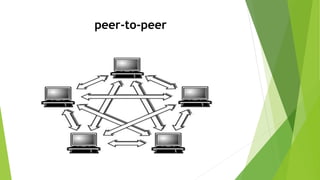
 the tasks are allocated among all the members of the network.
 A peer-to-peer network does not use a central computer server that controls
network activity.
 every computer on the network has a special software running that allows for
communications between all the computers.
 Peer-to-peer is mostly used for file sharing.
 A peer-to-peer network is robust in the sense that if one or several of the
individual computers stop working for some reason.
 For example, in the case of file sharing, if very few people make their files
available, there is very little for users to download.
peer-to-peer
Advantages of Peer-to-peer networking
1) It is easy to install and so is the configuration of computers on this network.
2) All the resources and contents are shared by all the peers, unlike server-client
architecture where Server shares all the contents and resources.
3) P2P is more reliable as central dependency is eliminated. Failure of one peer
doesn’t affect the functioning of other peers. In case of Client –Server network,
if server goes down whole network gets affected.
4) There is no need for full-time System Administrator. Every user is the
administrator of his machine. User can control their shared resources.
5) The over-all cost of building and maintaining this type of network is
comparatively very less.
Disadvantages(drawbacks) of Peer to
peer architecture
1)In this network, the whole system is decentralized thus it is difficult to
administer. That is one person cannot determine the whole accessibility setting
of whole network.
2) Security in this system is very less viruses, spywares, Trojans, etc..
malwares can easily transmitted over this P-2-P architecture.
3) Data recovery or backup is very difficult. Each computer should have its own
back-up system
4) Lot of movies, music and other copyrighted files are transferred using this
type of file transfer. P2P is the technology used in torrents.
Client/Server
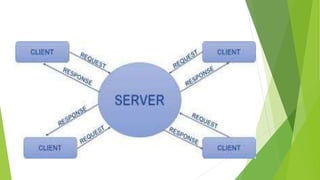
 a number of network clients or workstations request resources or services
from the network.
 One or more network servers manage and provide these resources or services.
 The clients are computers that depend on the server for data and software.
 Network servers are also referred to as computer servers, or simply servers.
 Sometimes a server is described in terms of the specific service
 it provides, such as
e-mail server
print server
or storage server Some servers, however, can provide all these services.
Cont.……..
 Servers are typically computers with more processing speed, memory and
hard disk space than a regular desktop computer.
 The network servers run their own operating system that manages the
various network tasks as well as services that run on the network.
 Depending on the need for network storage and services, a single network
may only use one or a large number of servers.
 Clients are hardware devices which provide end users with access to data and
services on the server.
 You can use these devices more or less independently.
 For example, you can open up software applications, create and edit
documents and save files on the local storage medium, such as a hard disk.
Advantages of Client Server Networks
1) Centralization :Unlike P2P, where there is no central administration, here in this
architecture there is a centralized control. Servers help in administering the whole
set-up. Access rights and resource allocation is done by Servers.
2) Proper Management: All the files are stored at the same place. In this way,
management of files becomes easy. Also it becomes easier to find files.
3) Back-up and Recovery possible : As all the data is stored on server its easy to
make a back-up of it. Also, in case of some break-down if data is lost, it can be
recovered easily and efficiently. While in peer computing we have to take back-up at
every workstation.
4) Up gradation and Scalability in Client-server set-up : Changes can be made easily
by just upgrading the server. Also new resources and systems can be added by making
necessary changes in server.
5) Accessibility : From various platforms in the network, server can be accessed
remotely.
6) As new information is uploaded in database , each workstation need not have its
own storage capacities increased (as may be the case in peer-to-peer systems). All the
changes are made only in central computer on which server database exists.
7) Security : Rules defining security and access rights can be defined at the time of
set-up of server.
8) Servers can play different roles for different clients.
Disadvantages of Client Server
Architecture
1) Congestion in Network :Too many requests from the clients may lead to
congestion, which rarely takes place in P2P network. Overload can lead to breaking-
down of servers. In peer-to-peer, the total bandwidth of the network increases as the
number of peers increase.
2) Client-Server architecture is not as robust as a P2P and if the server fails, the
whole network goes down. Also, if you are downloading a file from server and it gets
abandoned due to some error, download stops altogether. However, if there would
have been peers, they would have provided the broken parts of file.
3) Cost : It is very expensive to install and manage this type of computing.
4) You need professional IT people to maintain the servers and other technical
details of network.

Network archetecture

  • 1.
    Network Architecture  NetworkArchitecture is the complete framework of an organization's computer network  The diagram of the network architecture provides a full picture of the established network with detailed view of all the resources accessible.  It includes hardware components used for communication, cabling and device types, network layout and topologies, physical and wireless connections, implemented areas and future plans.  In addition, the software rules and protocols also constitute to the network architecture.  This architecture is always designed by a network manager/administrator with coordination of network engineers and other design engineers.
  • 2.
    Cont.……  Network Architectureprovides the detail overview of a network.  It is used to classify all the network layers step-by-step in logical form by describing each step in detail.  It is also based on the complete working definitions of the protocols.  The architecture is emphasized in a distributed computing environment and its complexity can not be understood without a framework.  Therefore there is a need to develop applications or methods to layout an overview of a network.
  • 3.
    Types of NetworkArchitecture  Two of the most widely used types of network architecture 1. peer-to-peer 2. client/server
  • 4.
    peer-to-peer  the tasksare allocated among all the members of the network.  A peer-to-peer network does not use a central computer server that controls network activity.  every computer on the network has a special software running that allows for communications between all the computers.  Peer-to-peer is mostly used for file sharing.  A peer-to-peer network is robust in the sense that if one or several of the individual computers stop working for some reason.  For example, in the case of file sharing, if very few people make their files available, there is very little for users to download.
  • 5.
  • 6.
    Advantages of Peer-to-peernetworking 1) It is easy to install and so is the configuration of computers on this network. 2) All the resources and contents are shared by all the peers, unlike server-client architecture where Server shares all the contents and resources. 3) P2P is more reliable as central dependency is eliminated. Failure of one peer doesn’t affect the functioning of other peers. In case of Client –Server network, if server goes down whole network gets affected. 4) There is no need for full-time System Administrator. Every user is the administrator of his machine. User can control their shared resources. 5) The over-all cost of building and maintaining this type of network is comparatively very less.
  • 7.
    Disadvantages(drawbacks) of Peerto peer architecture 1)In this network, the whole system is decentralized thus it is difficult to administer. That is one person cannot determine the whole accessibility setting of whole network. 2) Security in this system is very less viruses, spywares, Trojans, etc.. malwares can easily transmitted over this P-2-P architecture. 3) Data recovery or backup is very difficult. Each computer should have its own back-up system 4) Lot of movies, music and other copyrighted files are transferred using this type of file transfer. P2P is the technology used in torrents.
  • 8.
    Client/Server  a numberof network clients or workstations request resources or services from the network.  One or more network servers manage and provide these resources or services.  The clients are computers that depend on the server for data and software.  Network servers are also referred to as computer servers, or simply servers.  Sometimes a server is described in terms of the specific service  it provides, such as e-mail server print server or storage server Some servers, however, can provide all these services.
  • 9.
    Cont.……..  Servers aretypically computers with more processing speed, memory and hard disk space than a regular desktop computer.  The network servers run their own operating system that manages the various network tasks as well as services that run on the network.  Depending on the need for network storage and services, a single network may only use one or a large number of servers.  Clients are hardware devices which provide end users with access to data and services on the server.  You can use these devices more or less independently.  For example, you can open up software applications, create and edit documents and save files on the local storage medium, such as a hard disk.
  • 11.
    Advantages of ClientServer Networks 1) Centralization :Unlike P2P, where there is no central administration, here in this architecture there is a centralized control. Servers help in administering the whole set-up. Access rights and resource allocation is done by Servers. 2) Proper Management: All the files are stored at the same place. In this way, management of files becomes easy. Also it becomes easier to find files. 3) Back-up and Recovery possible : As all the data is stored on server its easy to make a back-up of it. Also, in case of some break-down if data is lost, it can be recovered easily and efficiently. While in peer computing we have to take back-up at every workstation. 4) Up gradation and Scalability in Client-server set-up : Changes can be made easily by just upgrading the server. Also new resources and systems can be added by making necessary changes in server. 5) Accessibility : From various platforms in the network, server can be accessed remotely. 6) As new information is uploaded in database , each workstation need not have its own storage capacities increased (as may be the case in peer-to-peer systems). All the changes are made only in central computer on which server database exists. 7) Security : Rules defining security and access rights can be defined at the time of set-up of server. 8) Servers can play different roles for different clients.
  • 12.
    Disadvantages of ClientServer Architecture 1) Congestion in Network :Too many requests from the clients may lead to congestion, which rarely takes place in P2P network. Overload can lead to breaking- down of servers. In peer-to-peer, the total bandwidth of the network increases as the number of peers increase. 2) Client-Server architecture is not as robust as a P2P and if the server fails, the whole network goes down. Also, if you are downloading a file from server and it gets abandoned due to some error, download stops altogether. However, if there would have been peers, they would have provided the broken parts of file. 3) Cost : It is very expensive to install and manage this type of computing. 4) You need professional IT people to maintain the servers and other technical details of network.