CONTENT
Introduction
Advantage of Networking
Network Components
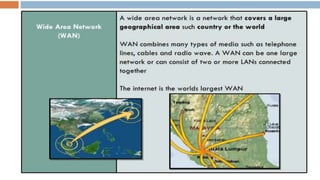
Types of Network
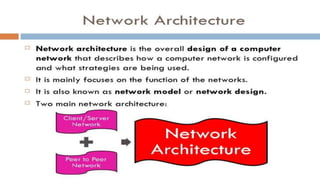
Network Architecture
Network Security
The computer in a network can communicate with each other as well as
work independently . Each computer in a network is called a Node.
The computer in a network may be linked through Cable, Telephone
ADVANTAGE OF NETWORKING
• Efficient Use of Storage Media
• Preserving Information
• Reduction in Hardware Costs
• Efficiency
• Redundancy
• Quickest Document Delivery
NETWORKING COMPONENTS
NETWORK CARD
HUBS
SWITCH
WIRELESS CABLE
ROUTER
HUB :
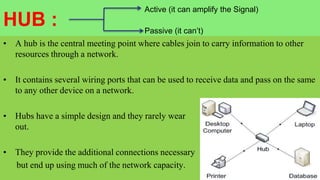
• A hub is the central meeting point where cables join to carry information to other
resources through a network.
• It contains several wiring ports that can be used to receive data and pass on the same
to any other device on a network.
• Hubs have a simple design and they rarely wear
out.
• They provide the additional connections necessary
but end up using much of the network capacity.
Active (it can amplify the Signal)
Passive (it can’t)
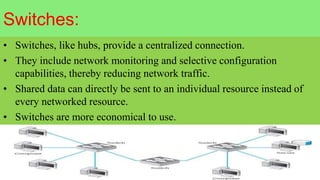
Switches:
• Switches, like hubs, provide a centralized connection.
• They include network monitoring and selective configuration
capabilities, thereby reducing network traffic.
• Shared data can directly be sent to an individual resource instead of
every networked resource.
• Switches are more economical to use.
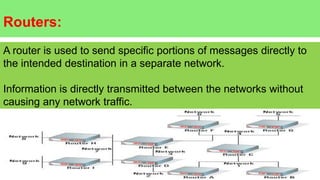
Routers:
A router is used to send specific portions of messages directly to
the intended destination in a separate network.
Information is directly transmitted between the networks without
causing any network traffic.
Client Server :
Peer to Peer :
• Network security consists of the policies and
practices adopted to prevent and monitor
unauthorized access, misuse, modification, or
denial of a computer network and network-
accessible resources.
Based upon your user name , you are given rights ,like
Read –Only access or Read – Write Access or No Access at
all.
A combination of be rights can also be granted to
the same user for different sets of data.
Netwoking

Netwoking

  • 2.
    CONTENT Introduction Advantage of Networking NetworkComponents Types of Network Network Architecture Network Security
  • 4.
    The computer ina network can communicate with each other as well as work independently . Each computer in a network is called a Node. The computer in a network may be linked through Cable, Telephone
  • 5.
    ADVANTAGE OF NETWORKING •Efficient Use of Storage Media • Preserving Information • Reduction in Hardware Costs • Efficiency • Redundancy • Quickest Document Delivery
  • 6.
  • 9.
    HUB : • Ahub is the central meeting point where cables join to carry information to other resources through a network. • It contains several wiring ports that can be used to receive data and pass on the same to any other device on a network. • Hubs have a simple design and they rarely wear out. • They provide the additional connections necessary but end up using much of the network capacity. Active (it can amplify the Signal) Passive (it can’t)
  • 10.
    Switches: • Switches, likehubs, provide a centralized connection. • They include network monitoring and selective configuration capabilities, thereby reducing network traffic. • Shared data can directly be sent to an individual resource instead of every networked resource. • Switches are more economical to use.
  • 12.
    Routers: A router isused to send specific portions of messages directly to the intended destination in a separate network. Information is directly transmitted between the networks without causing any network traffic.
  • 19.
  • 20.
  • 21.
    • Network securityconsists of the policies and practices adopted to prevent and monitor unauthorized access, misuse, modification, or denial of a computer network and network- accessible resources.
  • 23.
    Based upon youruser name , you are given rights ,like Read –Only access or Read – Write Access or No Access at all. A combination of be rights can also be granted to the same user for different sets of data.