Objectives
• Define synapses
•Functions of synapses.
• Structure of synapses
• Types of synapses: anatomical & functional.
• Synaptic transmission & neurotransmitters
• Fate of neurotransmitters.
• Electrical events at synapses (EPSPs & IPSPs).
• Properties of synaptic transmission
• Factors affecting synaptic transmission
3.
INTRODUCTION TO SYNAPSE:
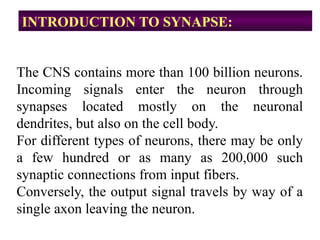
TheCNS contains more than 100 billion neurons.
Incoming signals enter the neuron through
synapses located mostly on the neuronal
dendrites, but also on the cell body.
For different types of neurons, there may be only
a few hundred or as many as 200,000 such
synaptic connections from input fibers.
Conversely, the output signal travels by way of a
single axon leaving the neuron.
4.
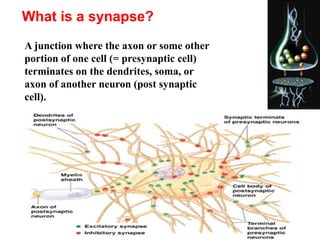
What is asynapse?
A junction where the axon or some other
portion of one cell (= presynaptic cell)
terminates on the dendrites, soma, or
axon of another neuron (post synaptic
cell).
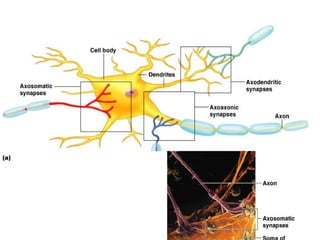
• Axodendritic –synapses between the
axon of one neuron and the dendrite of
another
• Axosomatic – synapses between the axon
of one neuron and the soma of another
• Other types of synapses include:
– Axoaxonic (axon to axon)
– Dendrodendritic (dendrite to dendrite)
– Dendrosomatic (dendrites to soma)
Anatomical Types of Synapses
Functional types ofsynapses
A. Chemical synapse
Almost all synapses used for signal
transmission in the CNS of human being are
chemical synapses.
i.e. first neuron secretes a chemical substance
called neurotransmitter at the synapse to act
on receptor on the next neuron to excite it,
inhibit or modify its sensitivity.
9.
– Are lesscommon than chemical synapses
– Correspond to gap junctions found in other cell types
– Are important in the CNS in:
• Mental attention
• Emotions and memory
• Arousal from sleep
• Ion and water homeostasis
B. Electrical Synapses
Membranes of the pre- and post-synaptic neurons
come close together and gap junctions forms low
membrane borders which allow passage of ions.
10.
C. Conjoint synapse
Bothelectrical and chemical.
Examples neurons in lateral
vestibular nucleus.
11.
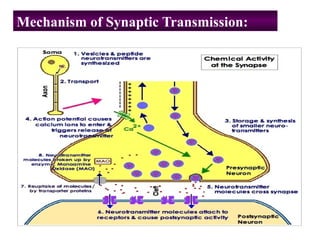
What happens atthe synapse?
Information is transmitted in the CNS mainly in the form of
APs “=nerve impulse”, which pass from one neuron to
another.
Each impulse through its way from one neuron to another
may be:-
1. blocked in its transmission from one neuron to
another
2. changed from single impulse to repetitive impulses.
Synaptic transmission is a complex process that permits
grading and adjustment of neural activity necessary for
normal function.
12.
Examples of synapsesoutside CNS
1.NMJ
2.Contact between:
autonomic neurons and
smooth , cardiac muscles,
and other effector cells.
13.
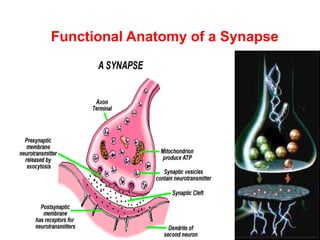
SYNAPSE: STRUCTURE &FUNCTIONS
Synaptic cleft: This the space between the
axon terminal and sarcolemma. It has a width of
200-300 angstroms.
Synaptic knobs (presynaptic terminal ) cover
about 40% of soma and 70% of dendritic
membrane
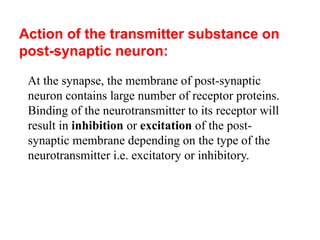
Action of thetransmitter substance on
post-synaptic neuron:
At the synapse, the membrane of post-synaptic
neuron contains large number of receptor proteins.
Binding of the neurotransmitter to its receptor will
result in inhibition or excitation of the post-
synaptic membrane depending on the type of the
neurotransmitter i.e. excitatory or inhibitory.
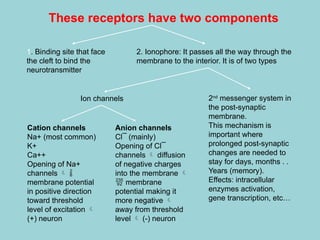
16.
These receptors havetwo components
1. Binding site that face
the cleft to bind the
neurotransmitter
2. Ionophore: It passes all the way through the
membrane to the interior. It is of two types
Ion channels 2nd
messenger system in
the post-synaptic
membrane.
This mechanism is
important where
prolonged post-synaptic
changes are needed to
stay for days, months . .
Years (memory).
Effects: intracellular
enzymes activation,
gene transcription, etc…
Cation channels
Na+ (most common)
K+
Ca++
Opening of Na+
channels
membrane potential
in positive direction
toward threshold
level of excitation
(+) neuron
Anion channels
Cl¯ (mainly)
Opening of Cl¯
channels diffusion
of negative charges
into the membrane
membrane
potential making it
more negative
away from threshold
level (-) neuron
17.
Fate of aneurotransmitter
After a transmitter substance is released at a
synapse, it must be removed by:-
Diffusion out of synaptic cleft into surrounding
fluid
Enzymatic destruction e.g. Ach esterase for Ach
Active transport back into pre-synaptic terminal
itself e.g. norepinephrine
18.
Electrical events inpost-synaptic neurons:
1. RMP of neuronal soma:
~ 65mV i.e. less than sk. ms. [70 to 90mV]
- If the voltage is less negative the neuron is
excitable
Causes of RMP:
1. Leakage of K+ (high K+ permeability)
2. Large number of negative ions inside: proteins, phosphate
3. Excess pumping of Na+ out by Na+-K+ pump
19.
2. Excitatory post-synapticpotential
[EPSPs]
When excitatory neurotransmitter binds to its receptor on
post-synaptic membrane
partial depolarization [ Na influx] of post-synaptic cell
membrane immediately under presynaptic ending, i.e. EPSPs
If this potential rises enough to threshold level AP will
develop and excite the neuron ( via central or neuronal
summation)
20.
This summation willcause the membrane
potential to increase from 65mV to 45mV.
EPSPs = +20mV which makes the membrane
reach the firing level AP develops at axon
hillock.
N.B. Discharge of a single pre-synaptic terminal
can never increase the neuronal potential from
65mV to 45mV.
21.
How EPSPs differsfrom Action potential?
• Graded, unpropagated response.
• Proportionate to the strength of the stimulus
• Can be summated
• If large enough to reach firing level AP is
produced
22.
3. Inhibitory post-synapticpotentials
(IPSPs):
When an inhibitory neurotransmitter binds to its receptor on post-
synaptic membrane, it causes hyperpolarization of the post-synaptic
membrane.
How?
1-Increasing membrane permeability to Cl¯ of post-synaptic
memb. (produced by inhibitory neurotransmitter)
excitability and memb. potential becomes away from firing level.
-Opening of K+ channels outward movement of K+
-Closure of Na+ or Ca++ channels
-IPSP = 5mV
23.
Synaptic properties
1. One-wayconduction
Synapses generally permit conduction of
impulses in one-way i.e. from pre-synaptic to
post-synaptic neuron.
24.
Properties of synapses(con…)
2. Synaptic delay
Is the minimum time required for transmission across the
synapse. It is 0.5 ms for transmission across one synapse.
This time is taken by
Discharge of transmitter substance by pre-synaptic
terminal
Diffusion of transmitter to post-synaptic membrane
Action of transmitter on its receptor
Action of transmitter to membrane permeability
Increased diffusion of Na+ to post-synaptic potential
25.
Properties of synapses(con…)
3. Synaptic inhibition:
Types:
A. Direct inhibition
B. Indirect inhibition
C. Reciprocal inhibition
D. Inhibitory interneuron
26.
Types of synapticinhibition,…….
A. Direct inhibition:
Occurs when an inhibitory neuron (releasing
inhibitory substance) acts on a post-synaptic neuron
leading to its hyperpolarization due to opening of
Cl¯ [IPSPs] and/or K+ channels.
Example : Glycine at the level of the spinal cord to
block pain impulses.
27.
Types of synapticinhibition,…….
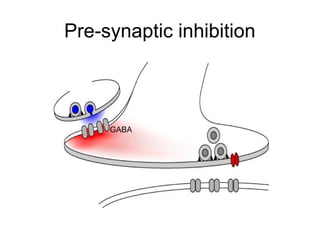
B. Indirect Inhibition:
(=Pre-synaptic inhibition).
This happens when an inhibitory synaptic knob lie directly on
the termination of a pre-synaptic excitatory fiber.
The inhibitory synaptic knob release a transmitter which
inhibits the release of excitatory transmitter from the pre-
synaptic fiber.
Example:The transmitter released at the inhibitory knob is
GABA.
The inhibition is produced by Cl¯ and K+. e.g. occurs in
dorsal horn pain gating.
Types of synapticinhibition,…….
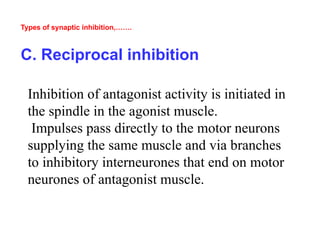
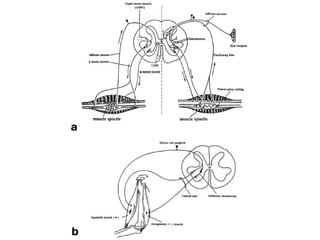
C. Reciprocal inhibition
Inhibition of antagonist activity is initiated in
the spindle in the agonist muscle.
Impulses pass directly to the motor neurons
supplying the same muscle and via branches
to inhibitory interneurones that end on motor
neurones of antagonist muscle.
31.
Types of synapticinhibition,…….
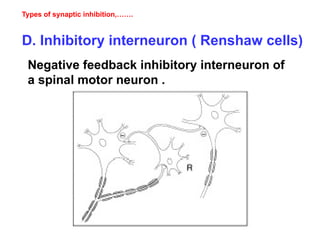
D. Inhibitory interneuron ( Renshaw cells)
Negative feedback inhibitory interneuron of
a spinal motor neuron .
32.
Properties of synapses(con…)
4. Summation:
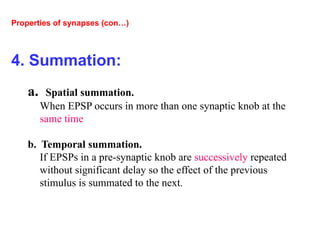
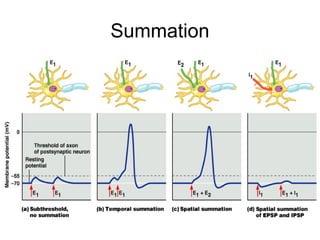
a. Spatial summation.
When EPSP occurs in more than one synaptic knob at the
same time.
b. Temporal summation.
If EPSPs in a pre-synaptic knob are successively repeated
without significant delay so the effect of the previous
stimulus is summated to the next.
Properties of synapses(con…)
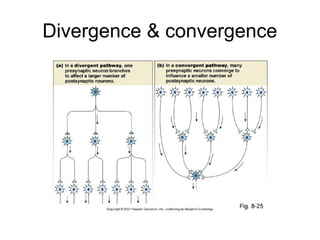
5. Convergence and divergence:
Convergence
When many pre-synaptic neurons converge
on any single post-synaptic neuron.
Divergence
Axons of pre-synaptic neurons divide into
many branches that diverge to end on many
post-synaptic neurons.
Properties of synapses(con…)
6. Fatigue
It is due to exhaustion of neurotransmitter.
If the pre synaptic neurons are continuously stimulated there
may be an exhaustion of the neurotransmitter. Resulting in
stoppage of synaptic transmission.
37.
Factors affecting synaptictransmission:
Alkalosis:
Normally, alkalosis greatly increases neuronal excitability.
For instance, a rise in arterial blood pH from the 7.4 norm to 7.8 to 8.0
often causes cerebral epileptic seizures because of increased
excitability of some or all of the cerebral neurons.
This can be demonstrated by asking a person who is predisposed to
epileptic seizures to over breathe.
The over breathing blows off carbon dioxide and therefore elevates
the pH of the blood momentarily
38.
Acidosis:
Conversely, acidosis greatlydepresses neuronal
activity;
A fall in pH from 7.4 to below 7.0 usually
causes a comatose state.
For instance, in very severe diabetic or uremic
acidosis, coma virtually always develops.
39.
Drugs:
Many drugs areknown to increase the excitability
of neurons, and others are known to decrease
excitability.
Caffeine found in coffee, tea, increases neuronal
excitability, by reducing the threshold for excitation
of neurons.
40.
Strychnine:
Is one ofthe best known of all agents that increase
excitability of neurons.
It inhibits the action of some normally inhibitory
transmitter substances, especially glycine in the spinal
cord.
Therefore, the effects of the excitatory transmitters
become overwhelming, and the neurons become so
excited that they go into rapidly repetitive discharge,
resulting in severe tonic muscle spasms.

![Electrical events in post-synaptic neurons:
1. RMP of neuronal soma:
~ 65mV i.e. less than sk. ms. [70 to 90mV]
- If the voltage is less negative the neuron is
excitable
Causes of RMP:
1. Leakage of K+ (high K+ permeability)
2. Large number of negative ions inside: proteins, phosphate
3. Excess pumping of Na+ out by Na+-K+ pump](https://image.slidesharecdn.com/l1-synapses-251014044958-0784f755/85/L1-Synapses-pptxfor-health-science-students-18-320.jpg)
![2. Excitatory post-synaptic potential
[EPSPs]
When excitatory neurotransmitter binds to its receptor on
post-synaptic membrane
partial depolarization [ Na influx] of post-synaptic cell
membrane immediately under presynaptic ending, i.e. EPSPs
If this potential rises enough to threshold level AP will
develop and excite the neuron ( via central or neuronal
summation)](https://image.slidesharecdn.com/l1-synapses-251014044958-0784f755/85/L1-Synapses-pptxfor-health-science-students-19-320.jpg)
![Types of synaptic inhibition,…….
A. Direct inhibition:
Occurs when an inhibitory neuron (releasing
inhibitory substance) acts on a post-synaptic neuron
leading to its hyperpolarization due to opening of
Cl¯ [IPSPs] and/or K+ channels.
Example : Glycine at the level of the spinal cord to
block pain impulses.](https://image.slidesharecdn.com/l1-synapses-251014044958-0784f755/85/L1-Synapses-pptxfor-health-science-students-26-320.jpg)