SYNAPSES & their transmission
Dr Shamshad
Majmaah University
KSA
Objectives
1.Define synapse
2. Discuss the classification of synapses
3.Describe the functional anatomy of synapse
4.Describe the electrical events occurring at the synapse
5.Discuss the properties of synapse
1.Define synapse
A junction point where axon or other part of
nerve cell (presynaptic cell) terminates on
the dendrites, soma, or axon of another
neuron( postsynaptic cell).
2. Classification of synapses
I:Functional classification
Conjoint
(SO-soma; D-dendrite; A-axon; SP-spinous)
Pre-syn; Neuron Post-syn; Neuron
SO SO
D D
A A
SP SP
II:Anatomical types
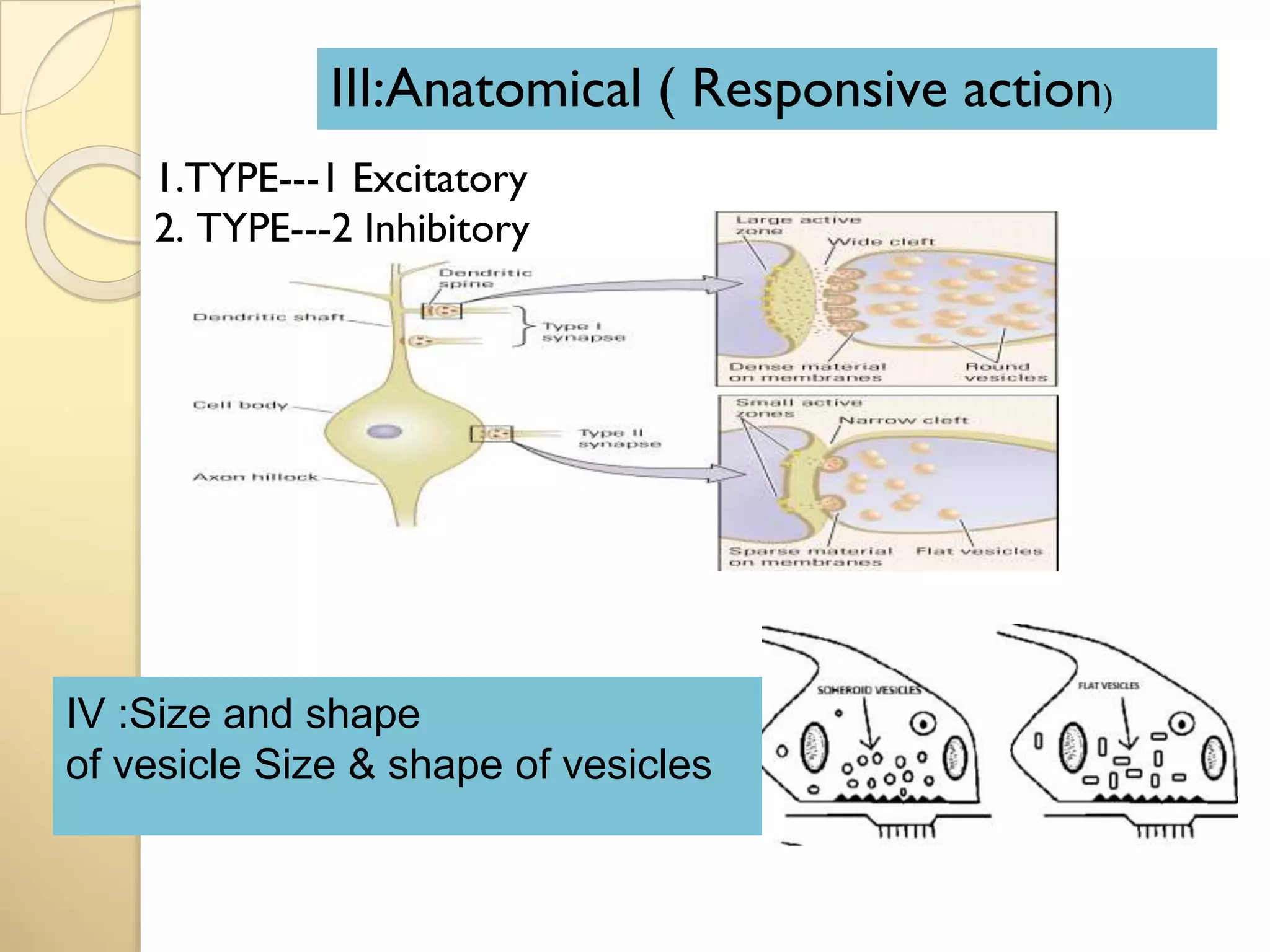
IV :Size and shape
of vesicle Size & shape of vesicles
1.TYPE---1 Excitatory
2. TYPE---2 Inhibitory
III:Anatomical ( Responsive action)
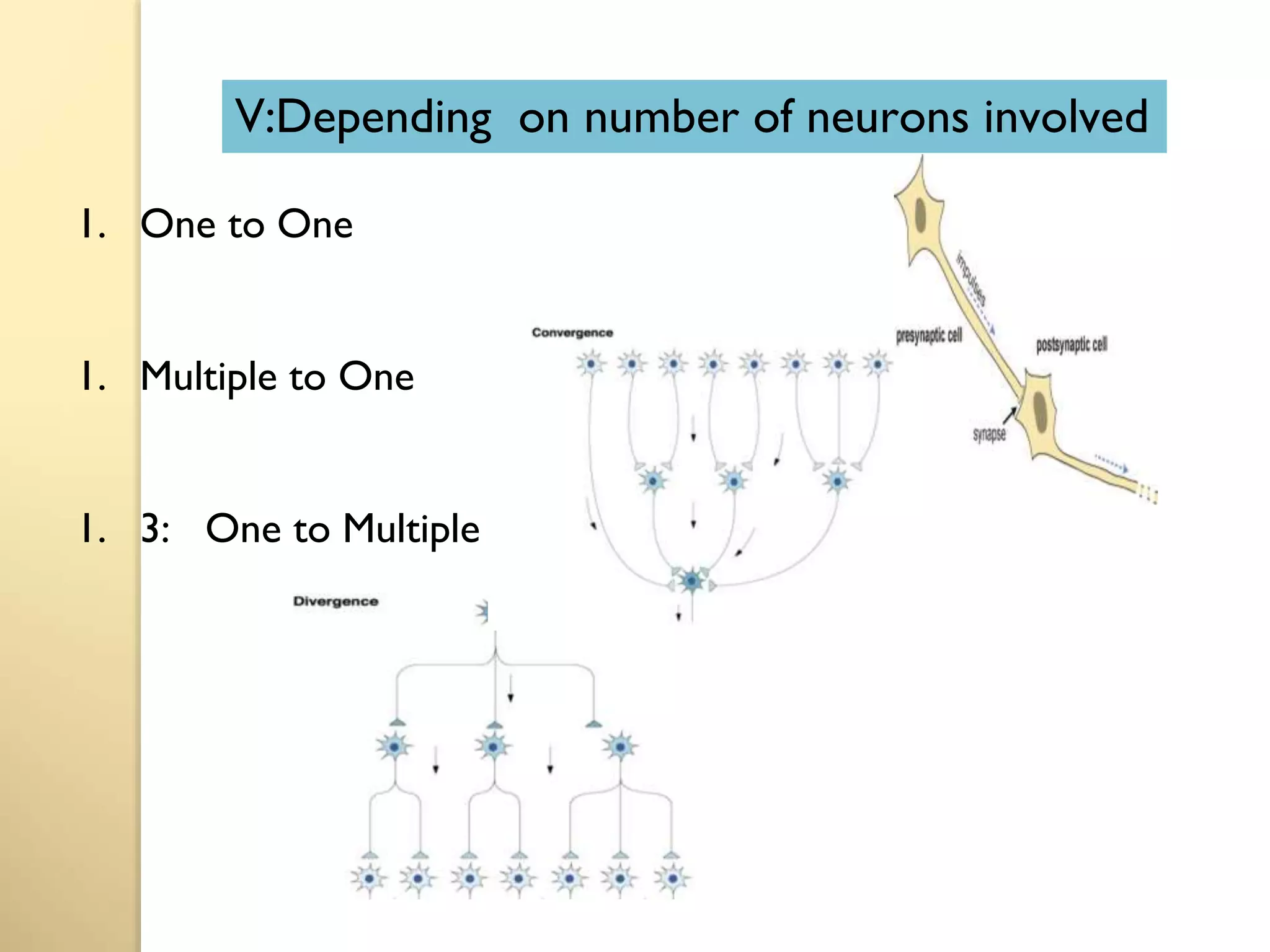
1. One to One
1. Multiple to One
1. 3: One to Multiple
V:Depending on number of neurons involved
Clear core
Dense core
Cholinergic synapses
Adrenergic synapses
VI: Depending upon contents in synaptic
vesicles
VII: Depending on type of neuro-transmitter
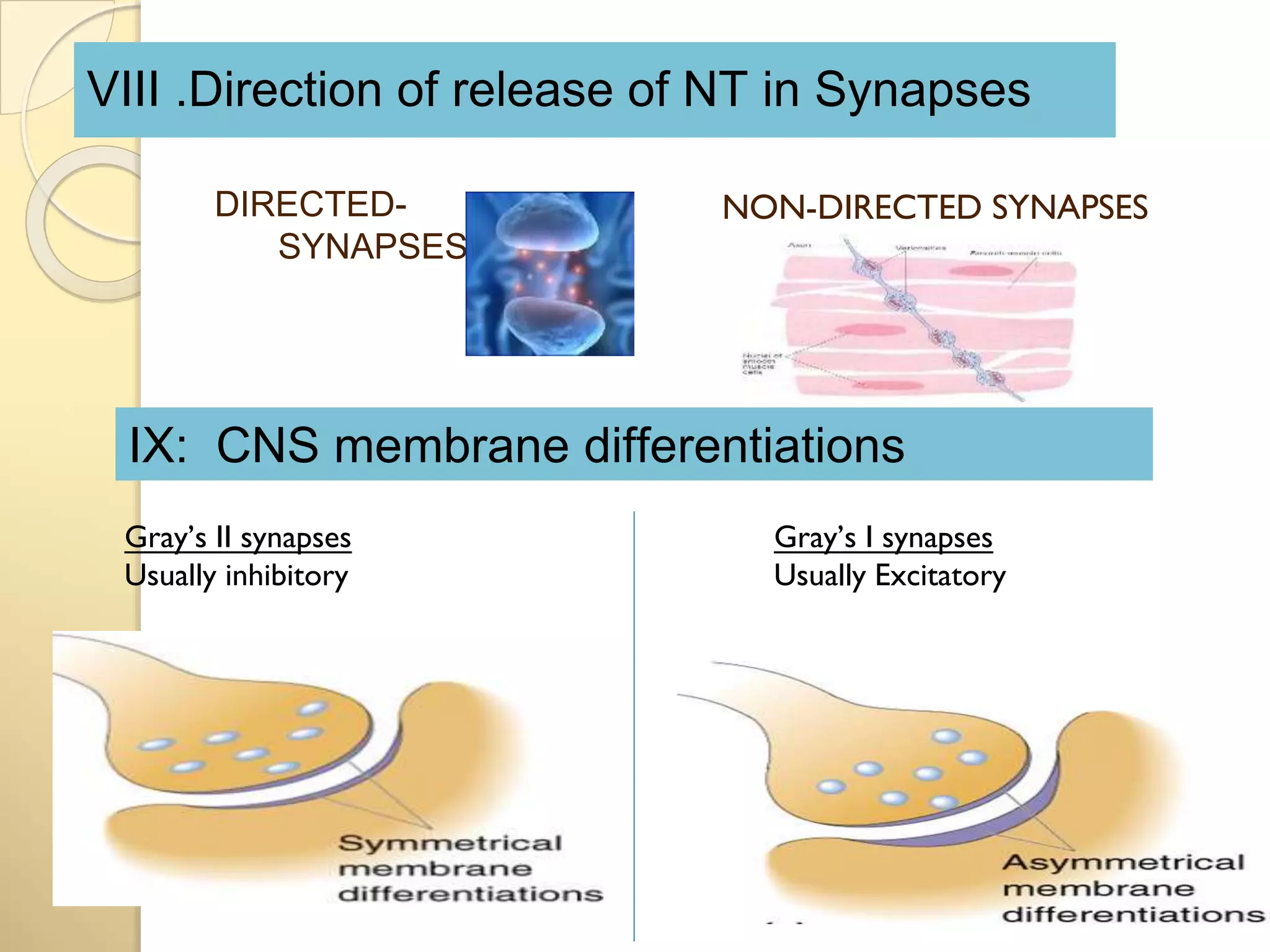
VIII .Direction of release of NT in Synapses
DIRECTED-
SYNAPSES
NON-DIRECTED SYNAPSES
Gray’s I synapses
Usually Excitatory
IX: CNS membrane differentiations
Gray’s II synapses
Usually inhibitory
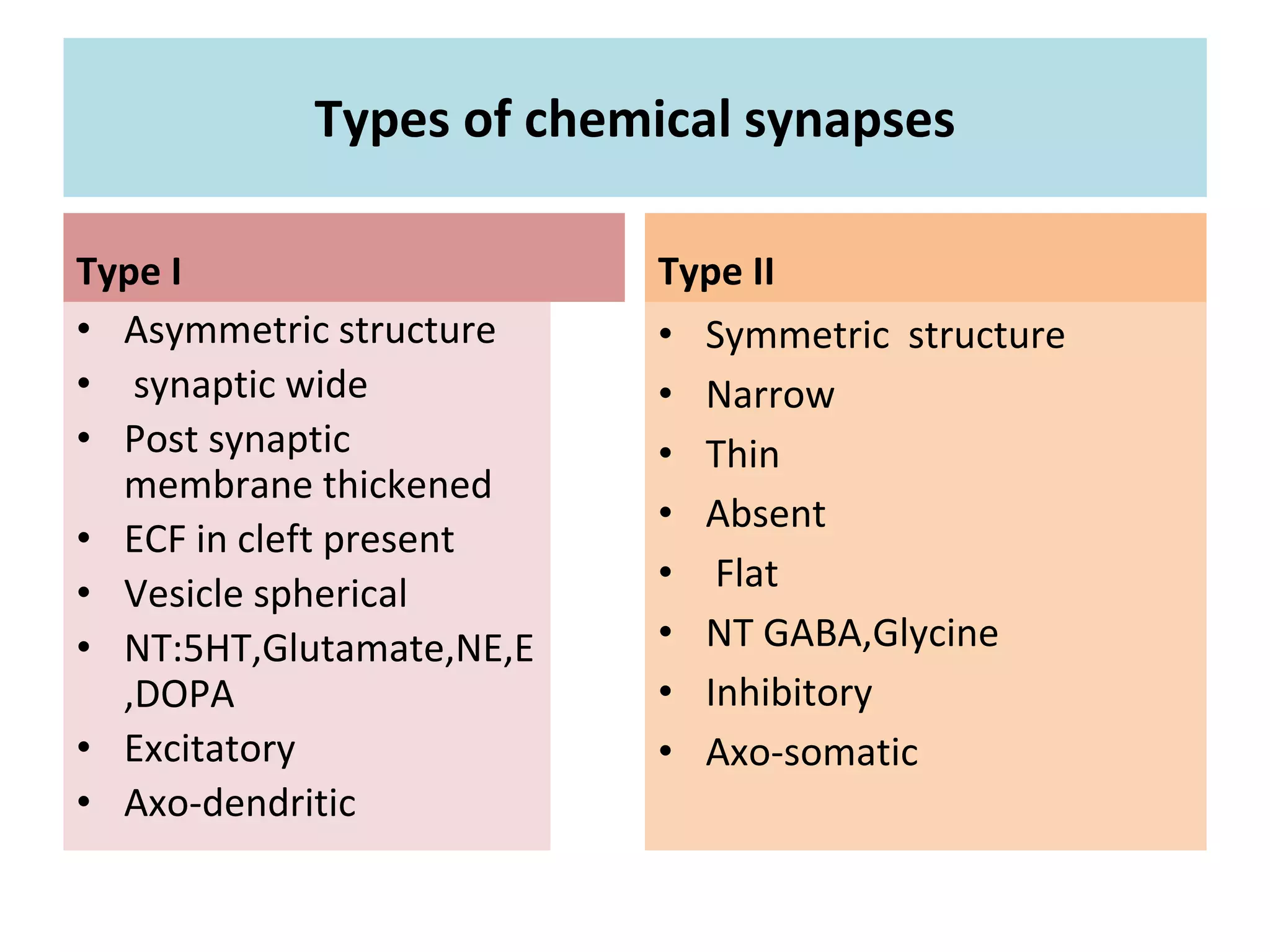
Types of chemical synapses
Type I
• Asymmetric structure
• synaptic wide
• Post synaptic
membrane thickened
• ECF in cleft present
• Vesicle spherical
• NT:5HT,Glutamate,NE,E
,DOPA
• Excitatory
• Axo-dendritic
Type II
• Symmetric structure
• Narrow
• Thin
• Absent
• Flat
• NT GABA,Glycine
• Inhibitory
• Axo-somatic
3.Describe the functional anatomy of
synapse
Structure of chemical synapse
1. Presynaptic
a flat, 20-μm2 membrane area,
Synaptic knob , tuft, bulb of axon
2. Synaptic cleft (20-30 nm)
2. Postsynaptic neuron
(grid,subsynaptic memebrane,
subsynaptic web).
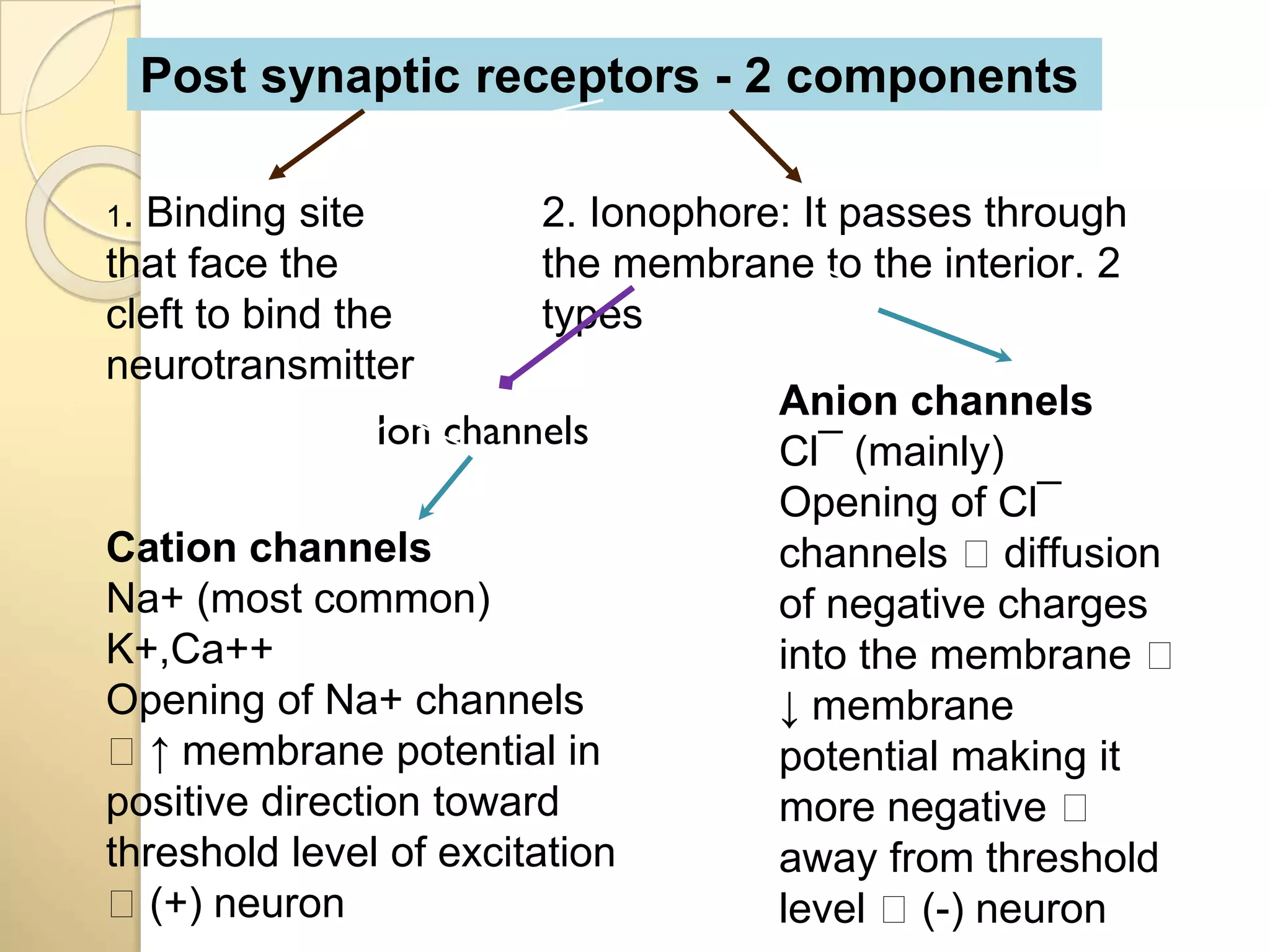
Post synaptic receptors - 2 components
1. Binding site
that face the
cleft to bind the
neurotransmitter
2. Ionophore: It passes through
the membrane to the interior. 2
types
Ion channels
Cation channels
Na+ (most common)
K+,Ca++
Opening of Na+ channels
🡪 ↑ membrane potential in
positive direction toward
threshold level of excitation
🡪 (+) neuron
Anion channels
Cl¯ (mainly)
Opening of Cl¯
channels 🡪 diffusion
of negative charges
into the membrane 🡪
↓ membrane
potential making it
more negative 🡪
away from threshold
level 🡪 (-) neuron
2nd messenger system in the post-synaptic
membrane.
Important mechanism where prolonged post-synaptic
changes are needed to stay for days, months . . Years
(memory).
As channels close in milliseconds.
Differences : chemical & electrical synapses
CHEMICAL
1.Liberation of NT.
2.Most common.
non-economical
3.Synatic cleft 20-30nm
4.Delay-1-3msec.
2msec-000,ms
5.Hypoxia-sensitive
6.Active process
ELECTRICAL
1. NO.
2. Economical
i.e. hippo,C.C, glial
3. 2nm.
4.Absent
5.Insensitive
6. passive
Chemical
7.Slower transmission.
8.Unidirectional-pre to post.
9.Membrane Polarity changes
with the graded potential.
10. Can have inhibitory effect.
11. Can have longer-term
actions mediated by second
messengers.
12. Transmission of Ion
current from outside to inside
Electrical
7. Extremely fast
8. Bi / Unidirectional (rare )
9. No.
10. cannot have inhibitory
effect.
11. Cannot have longer-term
actions mediated by second
messengers
12 From cell inside to inside
Types of neural circuit
1:Convering
2:Diverging
3:Reverberating
Passage of impulse from presynaptic neuron and again
back to presynaptic neuron to cause continuous stimulation
of presynaptic neuron.
Used in:breathing, coordinated muscular activities, waking
up, & short term memory.
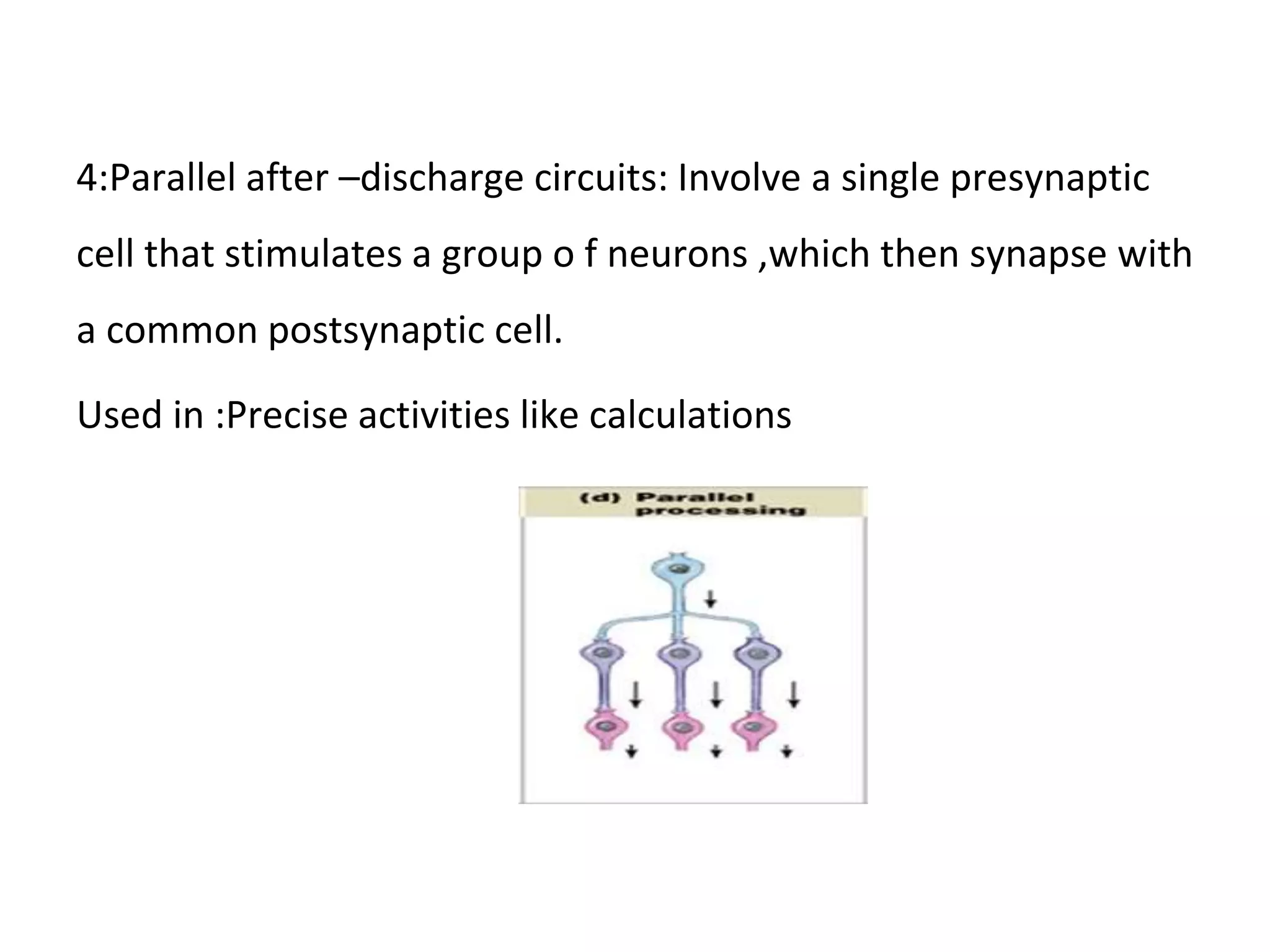
4:Parallel after –discharge circuits: Involve a single presynaptic
cell that stimulates a group o f neurons ,which then synapse with
a common postsynaptic cell.
Used in :Precise activities like calculations
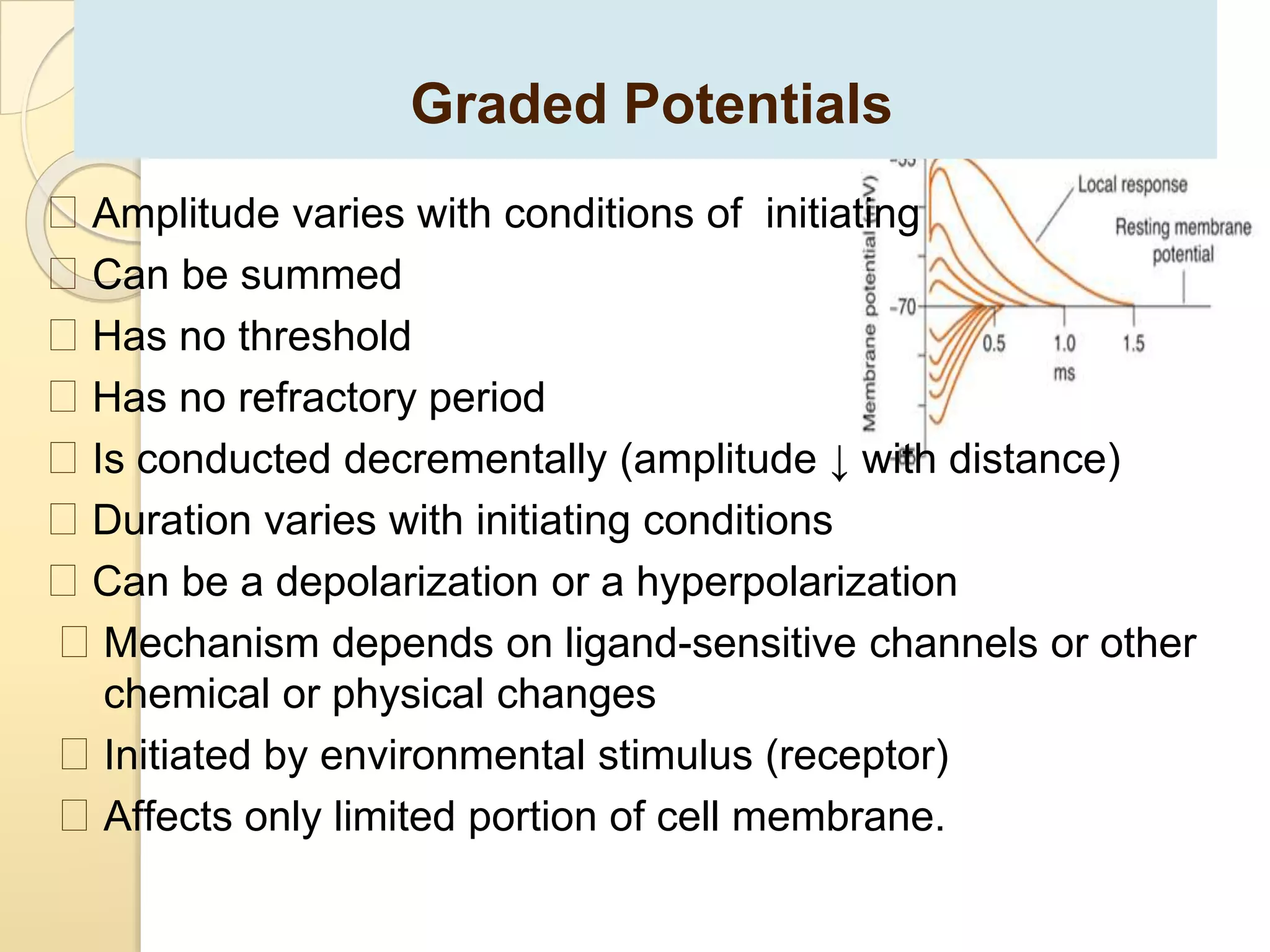
Graded Potentials
🡪 Amplitude varies with conditions of initiating
🡪 Can be summed
🡪 Has no threshold
🡪 Has no refractory period
🡪 Is conducted decrementally (amplitude ↓ with distance)
🡪 Duration varies with initiating conditions
🡪 Can be a depolarization or a hyperpolarization
🡪 Mechanism depends on ligand-sensitive channels or other
chemical or physical changes
🡪 Initiated by environmental stimulus (receptor)
🡪 Affects only limited portion of cell membrane.
5.Discuss : properties of synapse
🡪 One way conduction
🡪 Synaptic delay
🡪 Post Synaptic Potential:
🡪 EPSP
🡪 Summation
:Spatial and
:Temporal summation
🡪 IPSP:
:Presynaptic inhibition
:Postsynaptic inhibition
:Reciprocal inhibition
🡪 Conversions and divergence
🡪 Occlusion and subliminal fringe phenomenon
🡪 Facilitation
🡪 Synaptic fatigue
🡪 Recruitment
🡪 Synaptic plasticity ,learning and habituation
🡪 Reverberation
🡪 Reciprocal inhibition
🡪 After discharge
🡪 Effect of
Acidosis and alkalosis
Hypoxia
Drugs
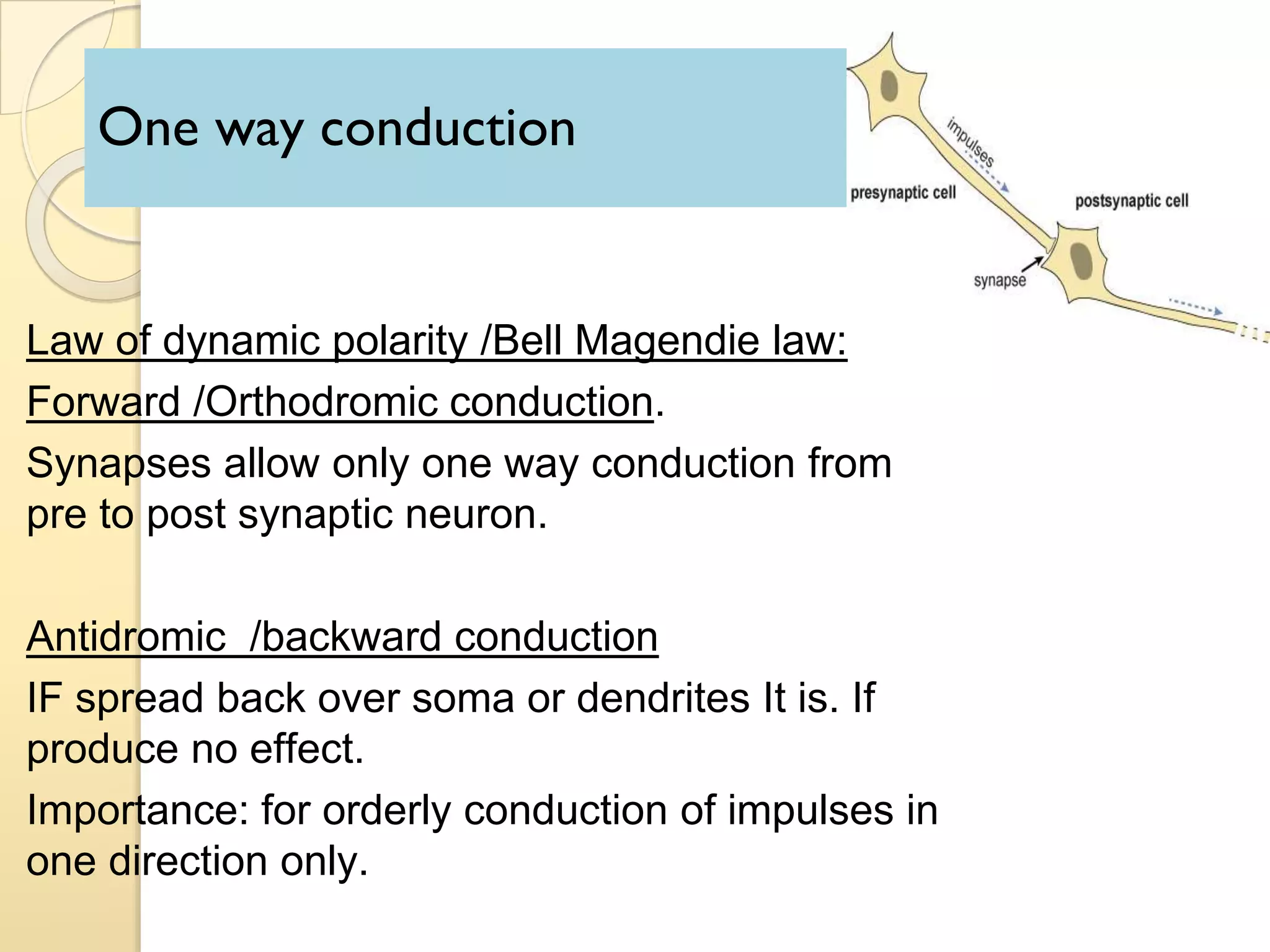
One way conduction
Law of dynamic polarity /Bell Magendie law:
Forward /Orthodromic conduction.
Synapses allow only one way conduction from
pre to post synaptic neuron.
Antidromic /backward conduction
IF spread back over soma or dendrites It is. If
produce no effect.
Importance: for orderly conduction of impulses in
one direction only.
Synaptic delay
Time passed between arrival of an action potential to the
synaptic knob & the occurrence of response in the
postsynaptic neuron.
Mechanism: Release and diffusion of the NT
Binding of the NT to the post SM.
Generation of PSP and its summation to generate AP.
Minimum delay :0.5 msec.
Importance: can be used to determine the number of
synapses present in a polysynaptic reflex.
Graded potentials EPSP &IPSP
EPSP:
An electrical charge on
the post synaptic
membrane(post SM)
🡪 Caused by the
binding of the
excitatory NT &
makes post SM
generate an AP.
IPSP:
An electrical charge on
the post SM
🡪 Caused by the
inhibitory NT &
makes Post SM
membrane less likely
to generate an AP.
🡪 Caused by flow of
+vly charged ions.
🡪 A depolarization.
🡪 Brings the Post SM
towards threshold.
🡪 Makes the Post SM
excited.
🡪 Facilitated the firing of
an AP on Post SM.
🡪 Generated by flow of
glutamate or Na+
aspartate ions.
🡪 Caused by flow of –
vly charged ions.
🡪 A hyperpolarization.
🡪 Takes the post SM
away from threshold.
🡪 Makes the post SM
less excited.
🡪 Lowers the firing of an
AP on the post SM.
🡪 Generated by flow of
glycine and GABA Cl-
.
ELECTRICAL ACTIVITY EVENTS AT SYNAPSES
(PSP)
METHOD OF STUDY.
RESULTS EPSP &IPSP
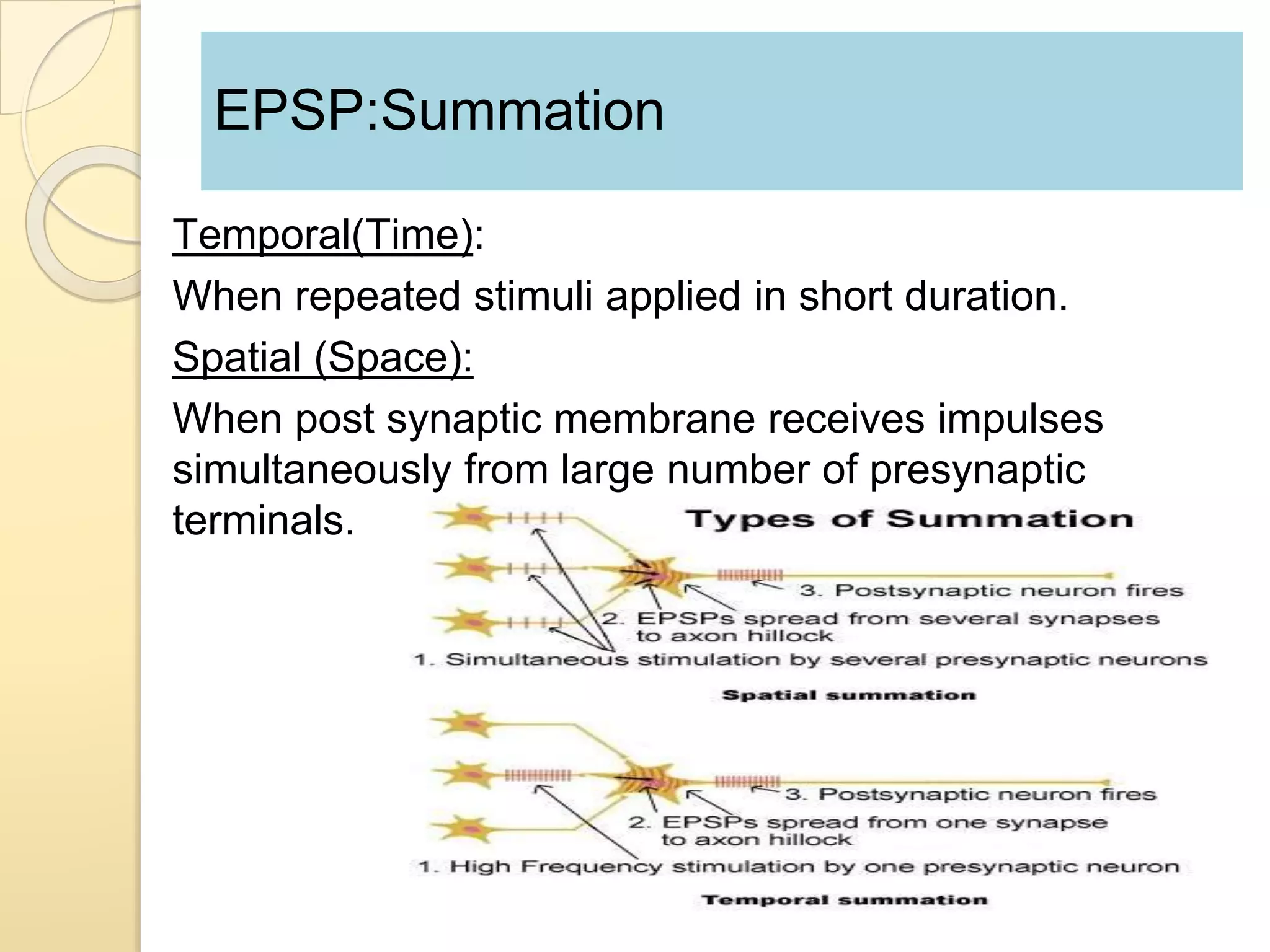
EPSP:Summation
Temporal(Time):
When repeated stimuli applied in short duration.
Spatial (Space):
When post synaptic membrane receives impulses
simultaneously from large number of presynaptic
terminals.
Inhibition
Postsynaptic : Direct by releasing inhibitory NT due to
refractory period. By development of IPSP . Golgi-tendon
inhibition
Presynaptic: Release of GABA opens K+ or Cl channels—
leads to diffusion of K ions or Cl ions .
Hyperpolarization of post synaptic membrane by inhibitory.
Feedforward inhibition. Neuron connected through 2
pathways Excitatory and inhibitory.
It allows brief and precisely timed excitation.
EX : Deep neural circuit of cerebellum
Importance:For restriction over neurons and muscles
to react properly and appropriately
Feedback (Renshaw cell inhibition)
In spinal alpha motor neuron
Neuron inhibit those neuron which excite it
Importance:
It serves to limit excitability of motor
neurons.
Fatigue
Defn: progressive decline in rate of discharge of the
Post SN,following intense prolonged stimulation of
the PreSN .
If sever can lead to compete stop called synaptic
block
Temporary in nature.
Cause:
Fatigue is mainly due to exhaustion of Nm
substances .
Due to lack of time to resynthesize and reuptake of
NT.
Importance: protects CNS from over excitability.
Dale law
Only one type of NT is released at one synapse.
Either excitatory or Inhibitory.
Occlusion
Response to stimulation of 2 presynaptic neurons is
less than sum total of the response obtained when
stimulated separately.
Synaptic plasticity , and learning
Synaptic transmission can be increased or
decreased on the basis of past experience
Post tetanic potentiation: When presynaptic axon is
stimulated with several consecutive individual stimuli
each evokes larger post synaptic potential than
previous stimuli
Also called post tetanic facilitation or potentiation.
Mechanism: By excess rise of Ca ions in the synaptic
knob which causes more vesicle to release NT
,producing a greater response of the Post SN.
Importance: Not known. May be short term memory
Long term potentiation
Similar to post tetanic potentiation.
Last for several days.
Mechanism: it is initiated by an increase of
intracellular calcium ion in post SN through opening
of Ca 2+ channels in post SM after binding of
glutamate to its specific NMDA receptors
Importance: seen in many parts of CNS
Mainly in hippocampus
Play role in long term memory and learning.

Synapses ppt

  • 1.
    SYNAPSES & theirtransmission Dr Shamshad Majmaah University KSA
  • 2.
    Objectives 1.Define synapse 2. Discussthe classification of synapses 3.Describe the functional anatomy of synapse 4.Describe the electrical events occurring at the synapse 5.Discuss the properties of synapse
  • 3.
    1.Define synapse A junctionpoint where axon or other part of nerve cell (presynaptic cell) terminates on the dendrites, soma, or axon of another neuron( postsynaptic cell).
  • 4.
  • 5.
  • 6.
    (SO-soma; D-dendrite; A-axon;SP-spinous) Pre-syn; Neuron Post-syn; Neuron SO SO D D A A SP SP II:Anatomical types
  • 7.
    IV :Size andshape of vesicle Size & shape of vesicles 1.TYPE---1 Excitatory 2. TYPE---2 Inhibitory III:Anatomical ( Responsive action)
  • 8.
    1. One toOne 1. Multiple to One 1. 3: One to Multiple V:Depending on number of neurons involved
  • 9.
    Clear core Dense core Cholinergicsynapses Adrenergic synapses VI: Depending upon contents in synaptic vesicles VII: Depending on type of neuro-transmitter
  • 10.
    VIII .Direction ofrelease of NT in Synapses DIRECTED- SYNAPSES NON-DIRECTED SYNAPSES Gray’s I synapses Usually Excitatory IX: CNS membrane differentiations Gray’s II synapses Usually inhibitory
  • 11.
    Types of chemicalsynapses Type I • Asymmetric structure • synaptic wide • Post synaptic membrane thickened • ECF in cleft present • Vesicle spherical • NT:5HT,Glutamate,NE,E ,DOPA • Excitatory • Axo-dendritic Type II • Symmetric structure • Narrow • Thin • Absent • Flat • NT GABA,Glycine • Inhibitory • Axo-somatic
  • 12.
    3.Describe the functionalanatomy of synapse
  • 13.
    Structure of chemicalsynapse 1. Presynaptic a flat, 20-μm2 membrane area, Synaptic knob , tuft, bulb of axon 2. Synaptic cleft (20-30 nm) 2. Postsynaptic neuron (grid,subsynaptic memebrane, subsynaptic web).
  • 15.
    Post synaptic receptors- 2 components 1. Binding site that face the cleft to bind the neurotransmitter 2. Ionophore: It passes through the membrane to the interior. 2 types Ion channels Cation channels Na+ (most common) K+,Ca++ Opening of Na+ channels 🡪 ↑ membrane potential in positive direction toward threshold level of excitation 🡪 (+) neuron Anion channels Cl¯ (mainly) Opening of Cl¯ channels 🡪 diffusion of negative charges into the membrane 🡪 ↓ membrane potential making it more negative 🡪 away from threshold level 🡪 (-) neuron
  • 16.
    2nd messenger systemin the post-synaptic membrane. Important mechanism where prolonged post-synaptic changes are needed to stay for days, months . . Years (memory). As channels close in milliseconds.
  • 19.
    Differences : chemical& electrical synapses CHEMICAL 1.Liberation of NT. 2.Most common. non-economical 3.Synatic cleft 20-30nm 4.Delay-1-3msec. 2msec-000,ms 5.Hypoxia-sensitive 6.Active process ELECTRICAL 1. NO. 2. Economical i.e. hippo,C.C, glial 3. 2nm. 4.Absent 5.Insensitive 6. passive
  • 20.
    Chemical 7.Slower transmission. 8.Unidirectional-pre topost. 9.Membrane Polarity changes with the graded potential. 10. Can have inhibitory effect. 11. Can have longer-term actions mediated by second messengers. 12. Transmission of Ion current from outside to inside Electrical 7. Extremely fast 8. Bi / Unidirectional (rare ) 9. No. 10. cannot have inhibitory effect. 11. Cannot have longer-term actions mediated by second messengers 12 From cell inside to inside
  • 22.
    Types of neuralcircuit 1:Convering 2:Diverging 3:Reverberating Passage of impulse from presynaptic neuron and again back to presynaptic neuron to cause continuous stimulation of presynaptic neuron. Used in:breathing, coordinated muscular activities, waking up, & short term memory.
  • 23.
    4:Parallel after –dischargecircuits: Involve a single presynaptic cell that stimulates a group o f neurons ,which then synapse with a common postsynaptic cell. Used in :Precise activities like calculations
  • 24.
    Graded Potentials 🡪 Amplitudevaries with conditions of initiating 🡪 Can be summed 🡪 Has no threshold 🡪 Has no refractory period 🡪 Is conducted decrementally (amplitude ↓ with distance) 🡪 Duration varies with initiating conditions 🡪 Can be a depolarization or a hyperpolarization 🡪 Mechanism depends on ligand-sensitive channels or other chemical or physical changes 🡪 Initiated by environmental stimulus (receptor) 🡪 Affects only limited portion of cell membrane.
  • 25.
  • 26.
    🡪 One wayconduction 🡪 Synaptic delay 🡪 Post Synaptic Potential: 🡪 EPSP 🡪 Summation :Spatial and :Temporal summation 🡪 IPSP: :Presynaptic inhibition :Postsynaptic inhibition :Reciprocal inhibition
  • 27.
    🡪 Conversions anddivergence 🡪 Occlusion and subliminal fringe phenomenon 🡪 Facilitation 🡪 Synaptic fatigue 🡪 Recruitment 🡪 Synaptic plasticity ,learning and habituation 🡪 Reverberation 🡪 Reciprocal inhibition 🡪 After discharge 🡪 Effect of Acidosis and alkalosis Hypoxia Drugs
  • 28.
    One way conduction Lawof dynamic polarity /Bell Magendie law: Forward /Orthodromic conduction. Synapses allow only one way conduction from pre to post synaptic neuron. Antidromic /backward conduction IF spread back over soma or dendrites It is. If produce no effect. Importance: for orderly conduction of impulses in one direction only.
  • 29.
    Synaptic delay Time passedbetween arrival of an action potential to the synaptic knob & the occurrence of response in the postsynaptic neuron. Mechanism: Release and diffusion of the NT Binding of the NT to the post SM. Generation of PSP and its summation to generate AP. Minimum delay :0.5 msec. Importance: can be used to determine the number of synapses present in a polysynaptic reflex.
  • 30.
    Graded potentials EPSP&IPSP EPSP: An electrical charge on the post synaptic membrane(post SM) 🡪 Caused by the binding of the excitatory NT & makes post SM generate an AP. IPSP: An electrical charge on the post SM 🡪 Caused by the inhibitory NT & makes Post SM membrane less likely to generate an AP.
  • 31.
    🡪 Caused byflow of +vly charged ions. 🡪 A depolarization. 🡪 Brings the Post SM towards threshold. 🡪 Makes the Post SM excited. 🡪 Facilitated the firing of an AP on Post SM. 🡪 Generated by flow of glutamate or Na+ aspartate ions. 🡪 Caused by flow of – vly charged ions. 🡪 A hyperpolarization. 🡪 Takes the post SM away from threshold. 🡪 Makes the post SM less excited. 🡪 Lowers the firing of an AP on the post SM. 🡪 Generated by flow of glycine and GABA Cl- .
  • 33.
    ELECTRICAL ACTIVITY EVENTSAT SYNAPSES (PSP) METHOD OF STUDY. RESULTS EPSP &IPSP
  • 34.
    EPSP:Summation Temporal(Time): When repeated stimuliapplied in short duration. Spatial (Space): When post synaptic membrane receives impulses simultaneously from large number of presynaptic terminals.
  • 35.
    Inhibition Postsynaptic : Directby releasing inhibitory NT due to refractory period. By development of IPSP . Golgi-tendon inhibition Presynaptic: Release of GABA opens K+ or Cl channels— leads to diffusion of K ions or Cl ions . Hyperpolarization of post synaptic membrane by inhibitory.
  • 36.
    Feedforward inhibition. Neuronconnected through 2 pathways Excitatory and inhibitory. It allows brief and precisely timed excitation. EX : Deep neural circuit of cerebellum Importance:For restriction over neurons and muscles to react properly and appropriately Feedback (Renshaw cell inhibition) In spinal alpha motor neuron Neuron inhibit those neuron which excite it Importance: It serves to limit excitability of motor neurons.
  • 37.
    Fatigue Defn: progressive declinein rate of discharge of the Post SN,following intense prolonged stimulation of the PreSN . If sever can lead to compete stop called synaptic block Temporary in nature. Cause: Fatigue is mainly due to exhaustion of Nm substances . Due to lack of time to resynthesize and reuptake of NT. Importance: protects CNS from over excitability.
  • 38.
    Dale law Only onetype of NT is released at one synapse. Either excitatory or Inhibitory.
  • 39.
    Occlusion Response to stimulationof 2 presynaptic neurons is less than sum total of the response obtained when stimulated separately.
  • 40.
    Synaptic plasticity ,and learning Synaptic transmission can be increased or decreased on the basis of past experience Post tetanic potentiation: When presynaptic axon is stimulated with several consecutive individual stimuli each evokes larger post synaptic potential than previous stimuli Also called post tetanic facilitation or potentiation. Mechanism: By excess rise of Ca ions in the synaptic knob which causes more vesicle to release NT ,producing a greater response of the Post SN. Importance: Not known. May be short term memory
  • 41.
    Long term potentiation Similarto post tetanic potentiation. Last for several days. Mechanism: it is initiated by an increase of intracellular calcium ion in post SN through opening of Ca 2+ channels in post SM after binding of glutamate to its specific NMDA receptors Importance: seen in many parts of CNS Mainly in hippocampus Play role in long term memory and learning.