I am Usman Gani Al Haque, M.Ed student of Pondicherry
University, going to teach you a lesson from your paper
“ Learning and Teaching”
Hope you will enjoy the class
Good afternoon every body
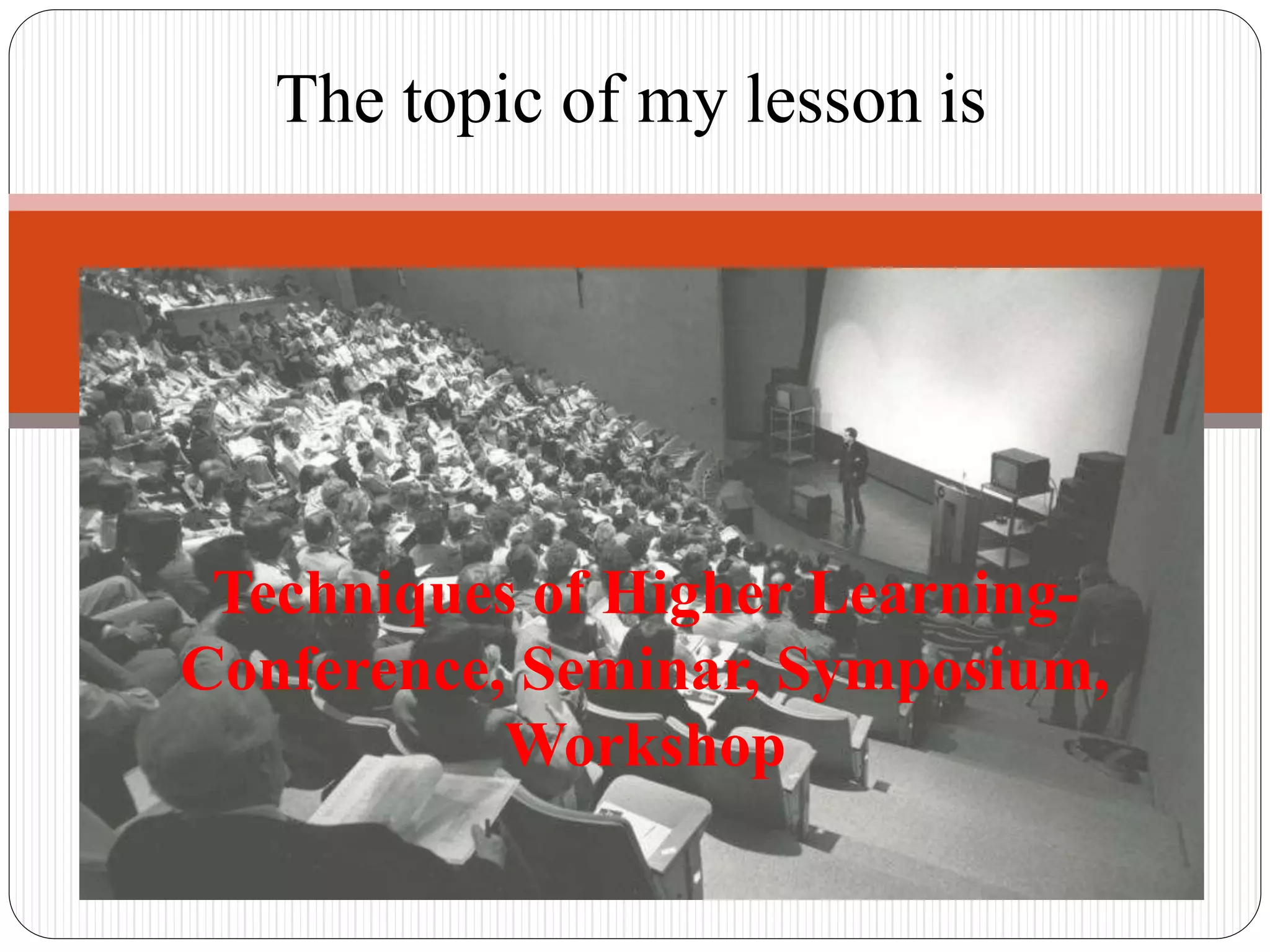
Techniques of Higher Learning-
Conference, Seminar, Symposium,
Workshop
The topic of my lesson is
It is a meeting of large group, organized to discuss current
problems and its specifics to provide a workable solution.
The conference technique has acquired important place in
different areas to discuss and solve the problem: Social,
Political, Health, Religious, educational.
 In the area of higher teaching-learning, the conference is one
of the most important technique. The higher cognitive and
effective objectives of education are achieved by employing the
conference technique.
Conference
The objectives of conference are usually broad to develop
cognitive and affective aspects.
Cognitive Objectives- The conference technique has the focus
to achieve the following cognitive objectives:
 To develop analysis, synthesis and evaluation or creative
abilities of the participants
 To develop reasoning and critical abilities.
 To develop the abilities to study in depth of facts, concepts
and problems,
Objectives of Conference
Affective Objective:
 To develop the tendency to study a fact or concept in broader
perspective
 To develop the tendency to emotional balance.
 To respect and tolerate anti-ideas and criticism by others
 To develop the feelings of cooperation and freedom of thoughts.
By participating the conference , behavioural skills and good
cultural manners start developed among the participants. They are
trained to present and defend ideas. They learn how to put questions
and how to answer the questions and how the clarification is
sought.
 Democratic values are developed among the participants.
 It develops the habit of independent study and to think
independently on a theme.
 Ability of problem- solving is developed among the
participants.
 Capacity of tolerance of anti-ideas of others is also
developed.
Ability of expressing ideas and feelings is developed by
attending a conference
 Good manners for asking questions, seeking clarification,
presenting own point of view and defending others ideas are
developed.
Advantages of Conference
A conference technique suffers from the following limitations:
 It is hard to predict attendance. Advance arrangements must
be made for conference facilities and housing accommodation.
 Generally the nature of topic is broad, hence discussion is
confined to specific issues.
 Group discussion is generally dominated by the good
speakers or those who talk too much and do not give
opportunities to take part in the discussions.
Limitations of Conference Technique
 Seminar is an instructional technique of higher learning
which involves paper reading on a theme and followed by the
group discussion to clarify the complex aspects of the theme.
 Illustration
 Time given
Objectives of Seminar:
Cognitive Objectives:
 To develop the higher cognitive abilities: analysis, synthesis and evaluation.
 To develop the ability of keen observation experiences, feelings and to present
them effectively.
 To develop the ability to seek clarification and defend the ideas of others
effectively.
Seminar Techniques
The following higher aspect of affective domain are developed
by employing the seminar technique:
 To develop the feeling of tolerance on the opposite ideas of
others.
 To develop the emotional stability among the participants of
the seminar.
 To acquire the good manners of putting questions and
answering the questions of others effectively.
 To develop the feelings of cooperation with other colleagues
Affective Objectives of Seminar
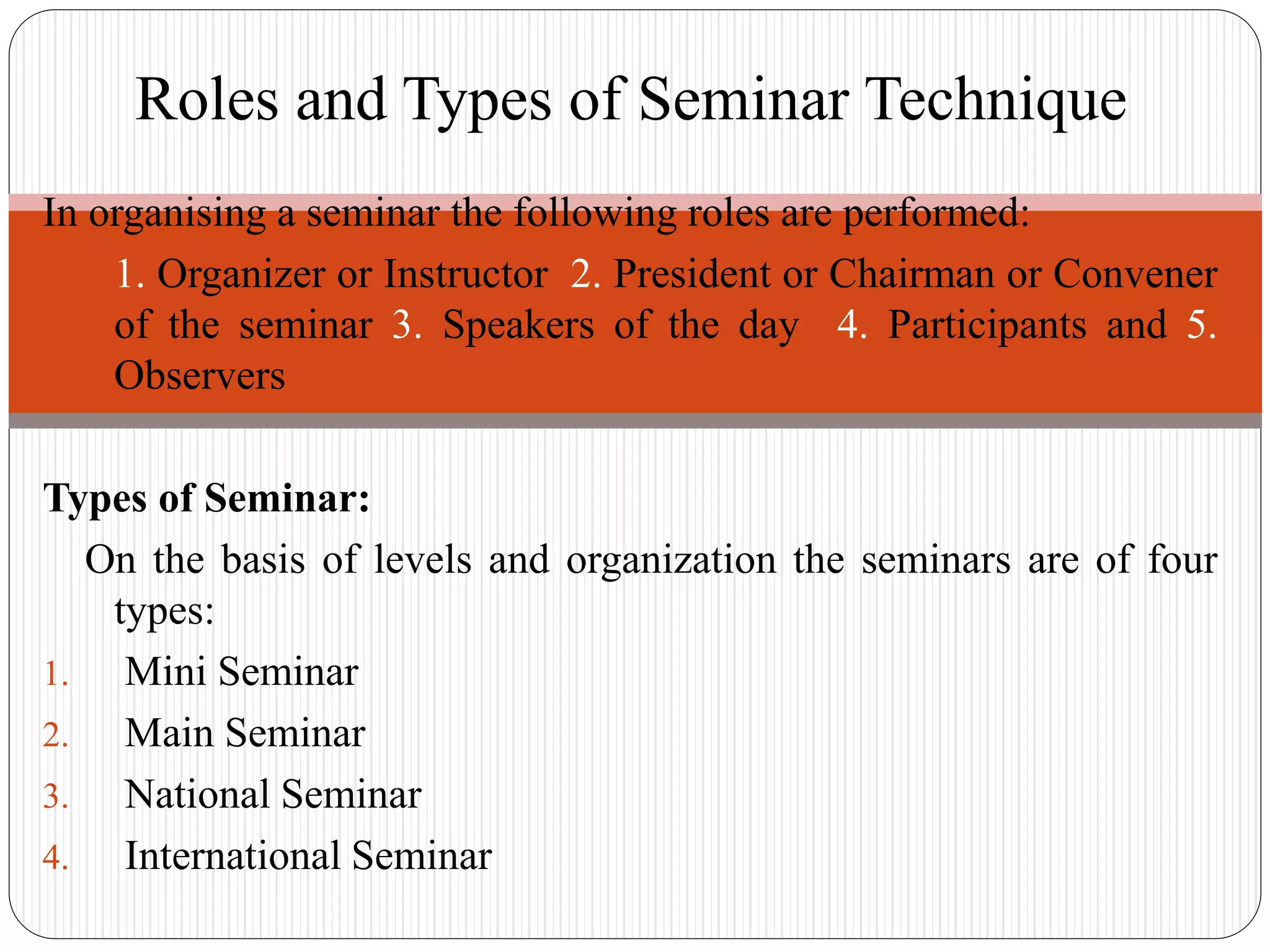
In organising a seminar the following roles are performed:
1. 1. Organizer or Instructor 2. President or Chairman or Convener
of the seminar 3. Speakers of the day 4. Participants and 5.
Observers
Types of Seminar:
On the basis of levels and organization the seminars are of four
types:
1. Mini Seminar
2. Main Seminar
3. National Seminar
4. International Seminar
Roles and Types of Seminar Technique
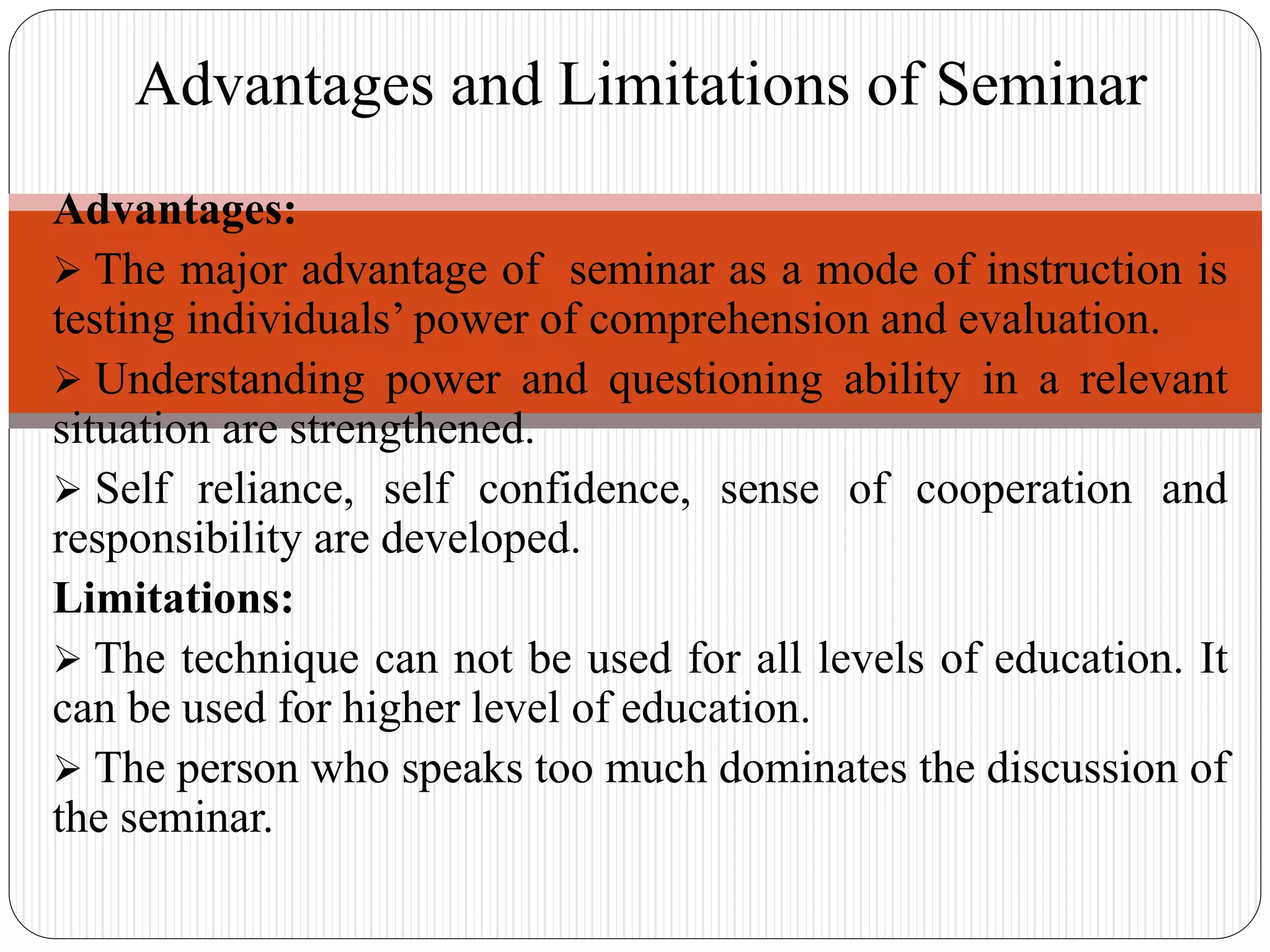
Advantages:
 The major advantage of seminar as a mode of instruction is
testing individuals’ power of comprehension and evaluation.
 Understanding power and questioning ability in a relevant
situation are strengthened.
 Self reliance, self confidence, sense of cooperation and
responsibility are developed.
Limitations:
 The technique can not be used for all levels of education. It
can be used for higher level of education.
 The person who speaks too much dominates the discussion of
the seminar.
Advantages and Limitations of Seminar
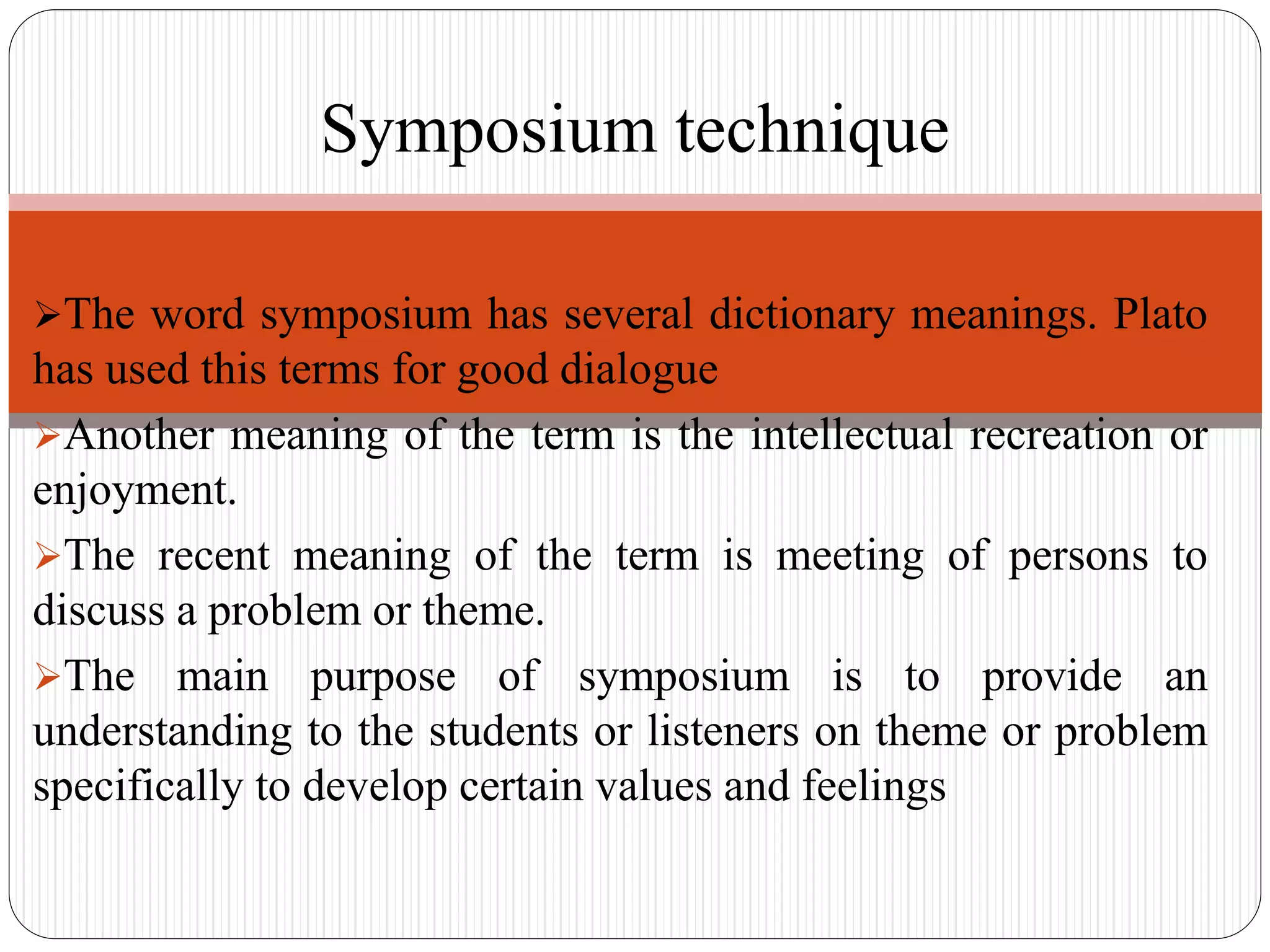
The word symposium has several dictionary meanings. Plato
has used this terms for good dialogue
Another meaning of the term is the intellectual recreation or
enjoyment.
The recent meaning of the term is meeting of persons to
discuss a problem or theme.
The main purpose of symposium is to provide an
understanding to the students or listeners on theme or problem
specifically to develop certain values and feelings
Symposium technique
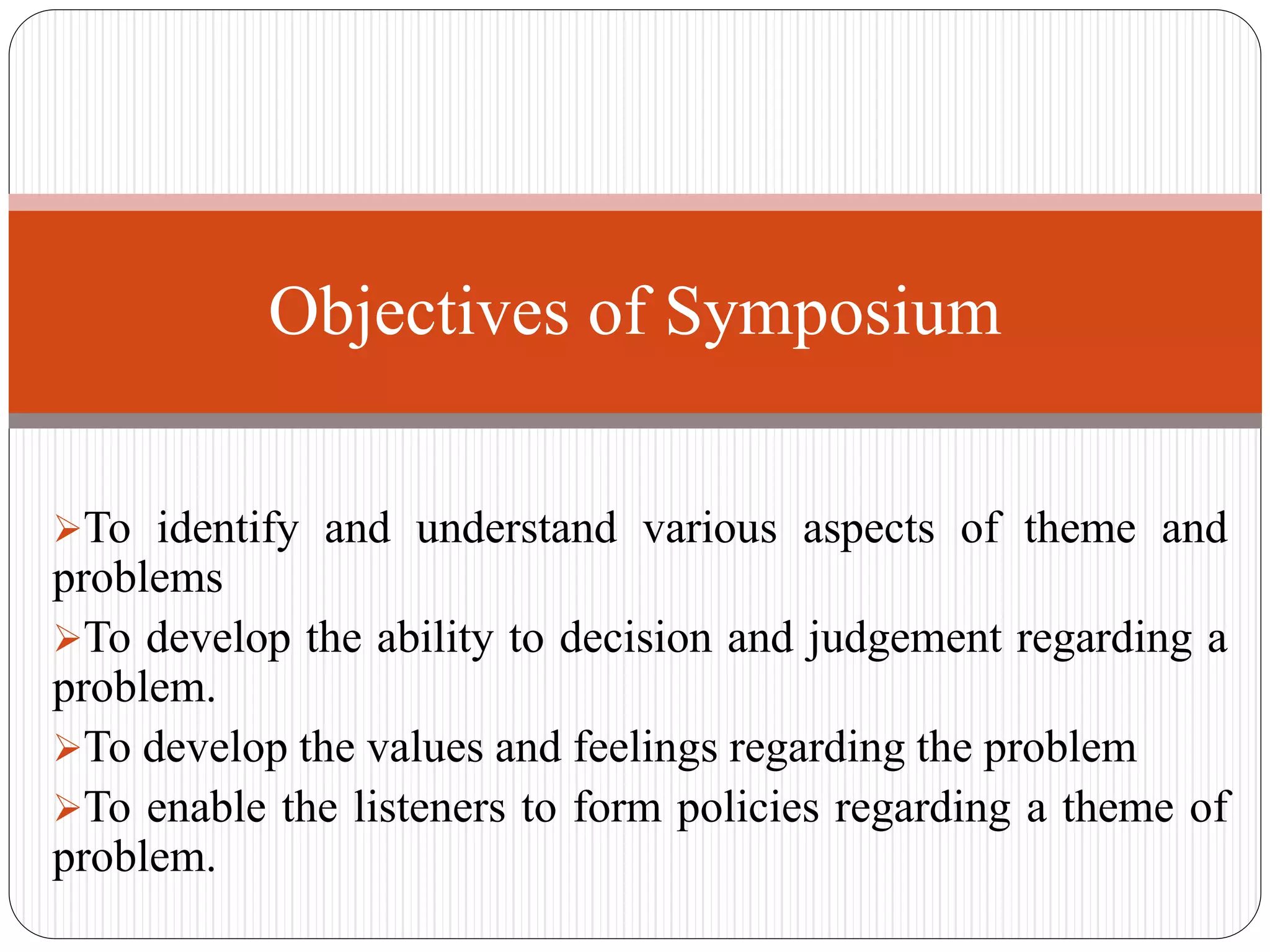
To identify and understand various aspects of theme and
problems
To develop the ability to decision and judgement regarding a
problem.
To develop the values and feelings regarding the problem
To enable the listeners to form policies regarding a theme of
problem.
Objectives of Symposium
It provides the broad understanding of topic or problem
The opportunity is provided to the listeners to take decision
about the problem.
It develop the feeling of co-operation and adjustment
 Creativity is achieved by employing the symposium
technique.
Advantages of symposium
Different aspect of theme are presented simultaneously
therefore the listeners are not able to understand the theme
correctly.
The listeners remain passive in the symposium because they
are not given opportunities to seek clarifications and put
questions.
Limitations of symposium
Workshop Technique
 The word workshop has been borrowed from
engineering.
 In workshops, persons have to do some task with their
hands to produce something
 A brief intensive course of education for a small group
emphasizing interaction and practical problem solving
OBJECTIVES
Cognitive objectives
 To solve the problems of teaching profession
 To identify the educational objectives in the present
context
 To develop an understanding regarding a theme or
problem
 Psychomotor objectives
Advantage:
•It is use to realise the higher cognitive and psychomotor
objectives
•It is used for developing and improving professional efficiency
•It develop the feeling of co-operation and group work or team
work
•The new practices and innovations of education are introduced
by workshop
Advantages of Workshop
The workshop cannot be organised for the large group
so that large number of person are trained.
Generally follow up programmes are not organised in
workshop.
The persons do not take interest in practical work or to
do something in productive form.
Limitations of Workshop
Thank You

Techniques of Higher Learning- Conference, Seminar, Symposium, Workshop

  • 1.
    I am UsmanGani Al Haque, M.Ed student of Pondicherry University, going to teach you a lesson from your paper “ Learning and Teaching” Hope you will enjoy the class Good afternoon every body
  • 2.
    Techniques of HigherLearning- Conference, Seminar, Symposium, Workshop The topic of my lesson is
  • 3.
    It is ameeting of large group, organized to discuss current problems and its specifics to provide a workable solution. The conference technique has acquired important place in different areas to discuss and solve the problem: Social, Political, Health, Religious, educational.  In the area of higher teaching-learning, the conference is one of the most important technique. The higher cognitive and effective objectives of education are achieved by employing the conference technique. Conference
  • 4.
    The objectives ofconference are usually broad to develop cognitive and affective aspects. Cognitive Objectives- The conference technique has the focus to achieve the following cognitive objectives:  To develop analysis, synthesis and evaluation or creative abilities of the participants  To develop reasoning and critical abilities.  To develop the abilities to study in depth of facts, concepts and problems, Objectives of Conference
  • 5.
    Affective Objective:  Todevelop the tendency to study a fact or concept in broader perspective  To develop the tendency to emotional balance.  To respect and tolerate anti-ideas and criticism by others  To develop the feelings of cooperation and freedom of thoughts. By participating the conference , behavioural skills and good cultural manners start developed among the participants. They are trained to present and defend ideas. They learn how to put questions and how to answer the questions and how the clarification is sought.
  • 6.
     Democratic valuesare developed among the participants.  It develops the habit of independent study and to think independently on a theme.  Ability of problem- solving is developed among the participants.  Capacity of tolerance of anti-ideas of others is also developed. Ability of expressing ideas and feelings is developed by attending a conference  Good manners for asking questions, seeking clarification, presenting own point of view and defending others ideas are developed. Advantages of Conference
  • 7.
    A conference techniquesuffers from the following limitations:  It is hard to predict attendance. Advance arrangements must be made for conference facilities and housing accommodation.  Generally the nature of topic is broad, hence discussion is confined to specific issues.  Group discussion is generally dominated by the good speakers or those who talk too much and do not give opportunities to take part in the discussions. Limitations of Conference Technique
  • 8.
     Seminar isan instructional technique of higher learning which involves paper reading on a theme and followed by the group discussion to clarify the complex aspects of the theme.  Illustration  Time given Objectives of Seminar: Cognitive Objectives:  To develop the higher cognitive abilities: analysis, synthesis and evaluation.  To develop the ability of keen observation experiences, feelings and to present them effectively.  To develop the ability to seek clarification and defend the ideas of others effectively. Seminar Techniques
  • 9.
    The following higheraspect of affective domain are developed by employing the seminar technique:  To develop the feeling of tolerance on the opposite ideas of others.  To develop the emotional stability among the participants of the seminar.  To acquire the good manners of putting questions and answering the questions of others effectively.  To develop the feelings of cooperation with other colleagues Affective Objectives of Seminar
  • 10.
    In organising aseminar the following roles are performed: 1. 1. Organizer or Instructor 2. President or Chairman or Convener of the seminar 3. Speakers of the day 4. Participants and 5. Observers Types of Seminar: On the basis of levels and organization the seminars are of four types: 1. Mini Seminar 2. Main Seminar 3. National Seminar 4. International Seminar Roles and Types of Seminar Technique
  • 11.
    Advantages:  The majoradvantage of seminar as a mode of instruction is testing individuals’ power of comprehension and evaluation.  Understanding power and questioning ability in a relevant situation are strengthened.  Self reliance, self confidence, sense of cooperation and responsibility are developed. Limitations:  The technique can not be used for all levels of education. It can be used for higher level of education.  The person who speaks too much dominates the discussion of the seminar. Advantages and Limitations of Seminar
  • 12.
    The word symposiumhas several dictionary meanings. Plato has used this terms for good dialogue Another meaning of the term is the intellectual recreation or enjoyment. The recent meaning of the term is meeting of persons to discuss a problem or theme. The main purpose of symposium is to provide an understanding to the students or listeners on theme or problem specifically to develop certain values and feelings Symposium technique
  • 13.
    To identify andunderstand various aspects of theme and problems To develop the ability to decision and judgement regarding a problem. To develop the values and feelings regarding the problem To enable the listeners to form policies regarding a theme of problem. Objectives of Symposium
  • 14.
    It provides thebroad understanding of topic or problem The opportunity is provided to the listeners to take decision about the problem. It develop the feeling of co-operation and adjustment  Creativity is achieved by employing the symposium technique. Advantages of symposium
  • 15.
    Different aspect oftheme are presented simultaneously therefore the listeners are not able to understand the theme correctly. The listeners remain passive in the symposium because they are not given opportunities to seek clarifications and put questions. Limitations of symposium
  • 16.
    Workshop Technique  Theword workshop has been borrowed from engineering.  In workshops, persons have to do some task with their hands to produce something  A brief intensive course of education for a small group emphasizing interaction and practical problem solving OBJECTIVES Cognitive objectives  To solve the problems of teaching profession  To identify the educational objectives in the present context  To develop an understanding regarding a theme or problem  Psychomotor objectives
  • 17.
    Advantage: •It is useto realise the higher cognitive and psychomotor objectives •It is used for developing and improving professional efficiency •It develop the feeling of co-operation and group work or team work •The new practices and innovations of education are introduced by workshop Advantages of Workshop
  • 18.
    The workshop cannotbe organised for the large group so that large number of person are trained. Generally follow up programmes are not organised in workshop. The persons do not take interest in practical work or to do something in productive form. Limitations of Workshop
  • 19.