

Evaluation
INTRODUCTION
.    Evaluation, the final step of the nursing
    process, is crucial to determine whether, after
    application of the nursing process, the client’s
    condition or well-being improves. The nurse
    applies all that is known about a client and the
    client’s condition, as well as experience with
    previous clients, to evaluate whether nursing
    care was effective.       The nurse conducts
    evaluation measures to determine if expected
    outcomes       are met, not the          nursing
    interventions.
The expected outcomes are the standards
against which the nurse judges if goals have
been met and thus if care is successful.
Providing health care in a
timely, competent, and cost-effective
manner is complex and challenging. The
evaluation process will determine the
effectiveness of care, make necessary
modifications, and to continuously ensure
favorable client outcomes.
DEFINITION


Evaluation is defined as the judgment of the
 effectiveness of nursing care to meet client
 goals; in this phase nurse compare the client
 behavioral responses with predetermined
 client goals and outcome criteria.

                              {CRAVEN 1996}
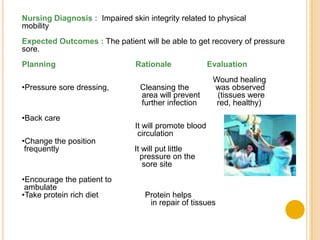
Nursing Diagnosis : Impaired skin integrity related to physical
mobility
Expected Outcomes : The patient will be able to get recovery of pressure
sore.
Planning                       Rationale               Evaluation
                                                        Wound healing
•Pressure sore dressing,         Cleansing the          was observed
                                 area will prevent       (tissues were
                                 further infection       red, healthy)
•Back care
                               It will promote blood
                                circulation
•Change the position
 frequently                    It will put little
                                 pressure on the
                                  sore site
•Encourage the patient to
 ambulate
•Take protein rich diet           Protein helps
                                   in repair of tissues
PURPOSES

1.   Determine client’s behavioral response to nursing
     interventions.
2.    Compare the client’s response with predetermined
     outcome criteria.
3.   Appraise the extent to which client’s goals were
     attained.
4. Assess the collaboration of client and health care team
      members.
5. Identify the errors in the plan of care.
6. Monitor the quality of nursing care.
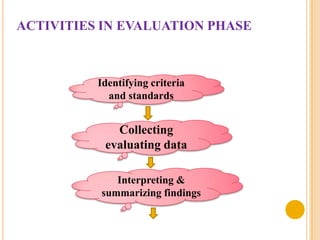
ACTIVITIES IN EVALUATION PHASE


          Identifying criteria
            and standards


             Collecting
           evaluating data

             Interpreting &
          summarizing findings
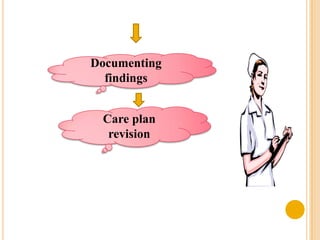
Documenting
  findings


 Care plan
  revision
• Identifying criteria and standard
       Nurses evaluate the nursing care by knowing
what to look for. A client’s goals & expected
outcome give the objective criteria needed a
client’s response to care.
• Collecting Evaluative Data
         Evaluating a client’s response to nursing
care requires the use of evaluative
measures, which are simply assessment, skill &
techniques, (Eg. Auscultation of lung
sounds, observation of client’s skill
performance, discussion of the client’s
feeling, and inspection of the skin.)
              Infact, evaluative measures are the
same as assessment measures, but nurses perform
them at the time of care when they
make, decission about the client’s status and
progress.
• Interpreting & Summarizing Findings
          Using evidence, nurses make judgement
about a client condition. To develop clinical
judgement, match the result of evaluative measures
with expected outcomes to determine if a client’s
status is improving or not.
 1.   Examine the goal statement to identify the exact
      desired client behavior or response.

 2. Assess the client for the presence of that behavior
     or response.
3. Compare the established outcome criteria with
   the behavior or response.
4. Judge the degree of agreement between
    outcome criteria and the behavior or response.

5.        If there is no agreement (or only partial
     agreement ) between the outcome criteria and
     the behavior or response, what is/are the
     barriers? Why did they not agree?.
•Documenting Findings:
         Documentation and reporting are an important
part of evaluation. Written nursing process
notes, assessment flow sheets and information shared
between nurses during changes of shift reports
communicate a client’s progress toward meeting
expected outcomes and goals for the nursing plan of
care.
•Care Plan Revision:
       Evaluate expected outcomes and
determine if the goals of care have been met
       Then decide the need to adjust the plan
of care. If goal met successfully, discontinue
that portion of the care plan.
COMPONENTS OF EVALUATION
1.   Collecting the data related to the desired
     outcomes
2.   Comparing the data with outcomes
3.   Relating nursing activities to outcomes
4.   Drawing conclusion about problem status
5.   Continuing, modifying, or terminating the
     nursing care plan
Collecting the data:
               The nurse collects the data so that
conclusion can be drawn about whether goals
have been met. It is usually necessary to collect
both subjective & objective data. Data must be
recorded concisely and accurately to facilitate the
next part of the evaluating process.
Comparing the data with outcomes:
             If the first part of the evaluation
process has been carried out effectively , it is
relatively simple to determine whether a desired
outcome has been met. Both the nurse and client
play an active role in comparing the client’s
actual responses with the desired outcomes.
Relating nursing activities to outcomes
                  The third aspect of the
evaluating process is determined whether the
nursing activities had any relation to the
outcome.
Drawing conclusion about problem status:
           The nurse uses the judgement about
goal achievement to determine whether the
care plan was effective in resolving, reducing
or preventing client problems. When goals
have been met the nurse can draw one the
following conclusions about the status of the
client’s problem.
•The actual problem stated in the nursing diagnosis
has been resolved , or the potential problem is being
prevented and the risk factors no longer exist. In
these instances , the nurse documents that the goals
have been met and discontinues the care for the
problem.
• The potential problem is being prevented, but the
risk factors still present. In this case , the nurse keeps
the problem on the care plan.
• The actual problem still exists even though some
goals are being met. In this case the nursing
interventions must be continued.
Continuing , modifying , or terminating
the nursing care plan:
     After drawing conclusion about the
status of the client’s problems , the nurse
modifies the care plan as indicated. Whether
or not goals were met, a number of decision
need to be made about
continuing, modifying or terminating
nursing care for each problem.
Before making individual
modification, the nurse must first determine
why the plan as a whole was not completely
effective. This require a review of the entire
plan.
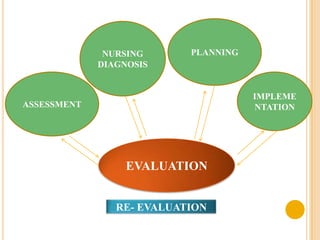
NURSING      PLANNING
             DIAGNOSIS


                                      IMPLEME
ASSESSMENT                            NTATION


                  EVALUATION


                RE- EVALUATION
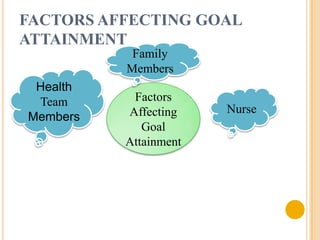
FACTORS AFFECTING GOAL
ATTAINMENT
           Family
          Members
 Health
 Team      Factors
          Affecting    Nurse
Members
             Goal
          Attainment
EVALUATION SKILL REQUIRED FOR
NURSES
1. Nurse must know the hospital
   policies, procedure and protocols of
   interventions and recording.

2. Nurse must have up to date knowledge
   and information of many subject.
3. Nurse must have intellectual and technical
   skill to monitor the effectiveness of nursing
   interventions.
4. Nurse must have knowledge and skill of
   collecting subjective data and objective
   data.
THANK YOU

nursing process Evaluation

  • 1.
  • 2.
    INTRODUCTION . Evaluation, the final step of the nursing process, is crucial to determine whether, after application of the nursing process, the client’s condition or well-being improves. The nurse applies all that is known about a client and the client’s condition, as well as experience with previous clients, to evaluate whether nursing care was effective. The nurse conducts evaluation measures to determine if expected outcomes are met, not the nursing interventions.
  • 3.
    The expected outcomesare the standards against which the nurse judges if goals have been met and thus if care is successful. Providing health care in a timely, competent, and cost-effective manner is complex and challenging. The evaluation process will determine the effectiveness of care, make necessary modifications, and to continuously ensure favorable client outcomes.
  • 4.
    DEFINITION Evaluation is definedas the judgment of the effectiveness of nursing care to meet client goals; in this phase nurse compare the client behavioral responses with predetermined client goals and outcome criteria. {CRAVEN 1996}
  • 5.
    Nursing Diagnosis :Impaired skin integrity related to physical mobility Expected Outcomes : The patient will be able to get recovery of pressure sore. Planning Rationale Evaluation Wound healing •Pressure sore dressing, Cleansing the was observed area will prevent (tissues were further infection red, healthy) •Back care It will promote blood circulation •Change the position frequently It will put little pressure on the sore site •Encourage the patient to ambulate •Take protein rich diet Protein helps in repair of tissues
  • 6.
    PURPOSES 1. Determine client’s behavioral response to nursing interventions. 2. Compare the client’s response with predetermined outcome criteria. 3. Appraise the extent to which client’s goals were attained.
  • 7.
    4. Assess thecollaboration of client and health care team members. 5. Identify the errors in the plan of care. 6. Monitor the quality of nursing care.
  • 8.
    ACTIVITIES IN EVALUATIONPHASE Identifying criteria and standards Collecting evaluating data Interpreting & summarizing findings
  • 9.
    Documenting findings Care plan revision
  • 10.
    • Identifying criteriaand standard Nurses evaluate the nursing care by knowing what to look for. A client’s goals & expected outcome give the objective criteria needed a client’s response to care.
  • 11.
    • Collecting EvaluativeData Evaluating a client’s response to nursing care requires the use of evaluative measures, which are simply assessment, skill & techniques, (Eg. Auscultation of lung sounds, observation of client’s skill performance, discussion of the client’s feeling, and inspection of the skin.) Infact, evaluative measures are the same as assessment measures, but nurses perform them at the time of care when they make, decission about the client’s status and progress.
  • 12.
    • Interpreting &Summarizing Findings Using evidence, nurses make judgement about a client condition. To develop clinical judgement, match the result of evaluative measures with expected outcomes to determine if a client’s status is improving or not. 1. Examine the goal statement to identify the exact desired client behavior or response. 2. Assess the client for the presence of that behavior or response.
  • 13.
    3. Compare theestablished outcome criteria with the behavior or response. 4. Judge the degree of agreement between outcome criteria and the behavior or response. 5. If there is no agreement (or only partial agreement ) between the outcome criteria and the behavior or response, what is/are the barriers? Why did they not agree?.
  • 14.
    •Documenting Findings: Documentation and reporting are an important part of evaluation. Written nursing process notes, assessment flow sheets and information shared between nurses during changes of shift reports communicate a client’s progress toward meeting expected outcomes and goals for the nursing plan of care.
  • 15.
    •Care Plan Revision: Evaluate expected outcomes and determine if the goals of care have been met Then decide the need to adjust the plan of care. If goal met successfully, discontinue that portion of the care plan.
  • 16.
    COMPONENTS OF EVALUATION 1. Collecting the data related to the desired outcomes 2. Comparing the data with outcomes 3. Relating nursing activities to outcomes 4. Drawing conclusion about problem status 5. Continuing, modifying, or terminating the nursing care plan
  • 17.
    Collecting the data: The nurse collects the data so that conclusion can be drawn about whether goals have been met. It is usually necessary to collect both subjective & objective data. Data must be recorded concisely and accurately to facilitate the next part of the evaluating process.
  • 18.
    Comparing the datawith outcomes: If the first part of the evaluation process has been carried out effectively , it is relatively simple to determine whether a desired outcome has been met. Both the nurse and client play an active role in comparing the client’s actual responses with the desired outcomes.
  • 19.
    Relating nursing activitiesto outcomes The third aspect of the evaluating process is determined whether the nursing activities had any relation to the outcome.
  • 20.
    Drawing conclusion aboutproblem status: The nurse uses the judgement about goal achievement to determine whether the care plan was effective in resolving, reducing or preventing client problems. When goals have been met the nurse can draw one the following conclusions about the status of the client’s problem.
  • 21.
    •The actual problemstated in the nursing diagnosis has been resolved , or the potential problem is being prevented and the risk factors no longer exist. In these instances , the nurse documents that the goals have been met and discontinues the care for the problem. • The potential problem is being prevented, but the risk factors still present. In this case , the nurse keeps the problem on the care plan. • The actual problem still exists even though some goals are being met. In this case the nursing interventions must be continued.
  • 22.
    Continuing , modifying, or terminating the nursing care plan: After drawing conclusion about the status of the client’s problems , the nurse modifies the care plan as indicated. Whether or not goals were met, a number of decision need to be made about continuing, modifying or terminating nursing care for each problem.
  • 23.
    Before making individual modification,the nurse must first determine why the plan as a whole was not completely effective. This require a review of the entire plan.
  • 24.
    NURSING PLANNING DIAGNOSIS IMPLEME ASSESSMENT NTATION EVALUATION RE- EVALUATION
  • 25.
    FACTORS AFFECTING GOAL ATTAINMENT Family Members Health Team Factors Affecting Nurse Members Goal Attainment
  • 26.
    EVALUATION SKILL REQUIREDFOR NURSES 1. Nurse must know the hospital policies, procedure and protocols of interventions and recording. 2. Nurse must have up to date knowledge and information of many subject.
  • 27.
    3. Nurse musthave intellectual and technical skill to monitor the effectiveness of nursing interventions. 4. Nurse must have knowledge and skill of collecting subjective data and objective data.
  • 28.