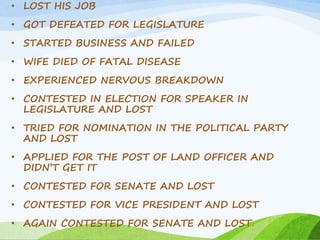






• LOST HIS JOB 
• GOT DEFEATED FOR LEGISLATURE 
• STARTED BUSINESS AND FAILED 
• WIFE DIED OF FATAL DISEASE 
• EXPERIENCED NERVOUS BREAKDOWN 
• CONTESTED IN ELECTION FOR SPEAKER IN 
LEGISLATURE AND LOST 
• TRIED FOR NOMINATION IN THE POLITICAL PARTY 
AND LOST 
• APPLIED FOR THE POST OF LAND OFFICER AND 
DIDN’T GET IT 
• CONTESTED FOR SENATE AND LOST 
• CONTESTED FOR VICE PRESIDENT AND LOST 
• AGAIN CONTESTED FOR SENATE AND LOST.
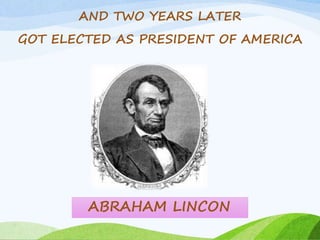
AND TWO YEARS LATER 
GOT ELECTED AS PRESIDENT OF AMERICA 
ABRAHAM LINCON
• Definition of attitude 
• Hypothetical construct of attitude 
• Definition of attitude scale 
• Components of attitude 
• Attitude scale 
• Purpose of attitude scale 
• Measurement of attitude 
• Types of attitude scale 
• Advantages and disadvantages of attitude scale 
• Problems and limitation of attitude testing.
• Critical incidence technique 
• Meaning C.I.T 
• Definition 
• Areas of C.I.T. 
• Use of Critical incidence as a strategy 
• Critical incidence record and report 
• Criteria for using critical incidence technique 
• How to record C.I.T. 
• Characteristic to be observed 
• Advantages and disadvantages
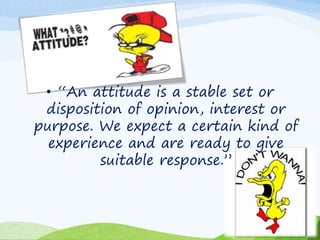
• “An attitude is a stable set or 
disposition of opinion, interest or 
purpose. We expect a certain kind of 
experience and are ready to give 
suitable response.”
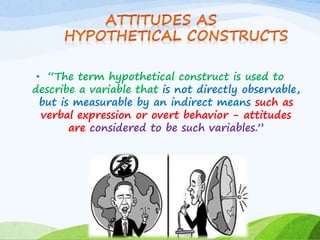
• “The term hypothetical construct is used to 
describe a variable that is not directly observable, 
but is measurable by an indirect means such as 
verbal expression or overt behavior - attitudes 
are considered to be such variables.”
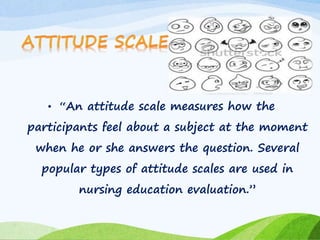
• “An attitude scale measures how the 
participants feel about a subject at the moment 
when he or she answers the question. Several 
popular types of attitude scales are used in 
nursing education evaluation.”
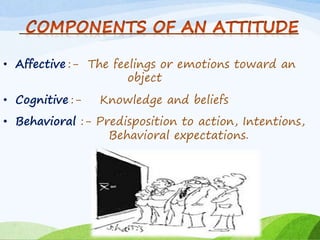
• Affective :- The feelings or emotions toward an 
object 
• Cognitive :- Knowledge and beliefs 
• Behavioral :- Predisposition to action, Intentions, 
Behavioral expectations.
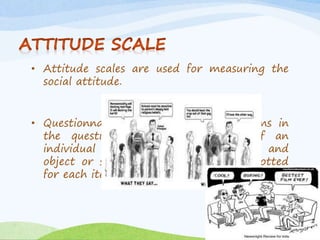
• Attitude scales are used for measuring the 
social attitude. 
• Questionnaire is prepared, by the items in 
the questionnaire is the attitude of an 
individual towards a matter thing, and 
object or system and score will be allotted 
for each item.
• We will ask the individual to express his responses; 
he is assigned a score which indicates the position. 
• Some relevant and indirect statements will also be 
used to reveal the attitude 
• The scales also specify the crucial shades of opinions.
• To know the extent to which desirable attitude have 
been developed in the students. 
• To enable the students to develop desirable attitude. 
• To help the teachers in good teaching 
• To help teachers understand students 
• To help students in their care plans
Measurement of attitude must include several 
dimension if it is to be useful.
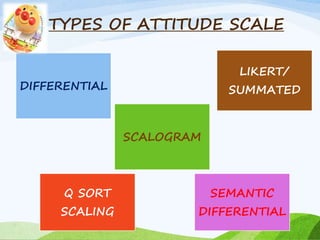
TYPES OF ATTITUDE SCALE 
DIFFERENTIAL 
SCALOGRAM 
LIKERT/ 
SUMMATED 
Q SORT 
SCALING 
SEMANTIC 
DIFFERENTIAL
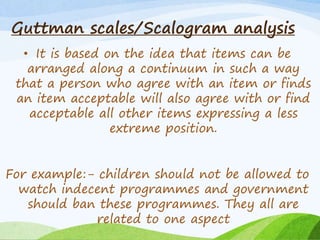
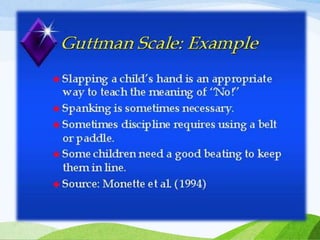
Guttman scales/Scalogram analysis 
• It is based on the idea that items can be 
arranged along a continuum in such a way 
that a person who agree with an item or finds 
an item acceptable will also agree with or find 
acceptable all other items expressing a less 
extreme position. 
For example:- children should not be allowed to 
watch indecent programmes and government 
should ban these programmes. They all are 
related to one aspect
• In this scale each score represents a unique set of 
responses and therefore the total score of every 
individual is obtained. This scale takes a lot of time and 
effort in development. 
• They are very commonly used in political science, 
anthropology, public opinion, research and psychology.
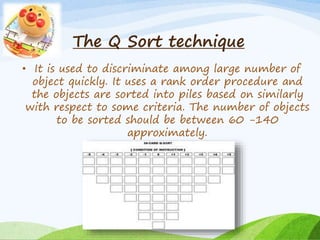
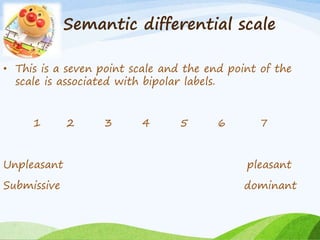
The Q Sort technique 
• It is used to discriminate among large number of 
object quickly. It uses a rank order procedure and 
the objects are sorted into piles based on similarly 
with respect to some criteria. The number of objects 
to be sorted should be between 60 -140 
approximately.
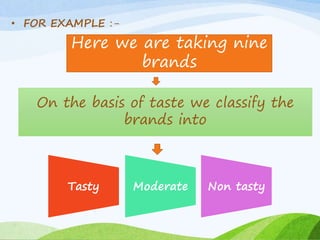
• FOR EXAMPLE :- 
Here we are taking nine 
brands 
On the basis of taste we classify the 
brands into 
Tasty Moderate Non tasty
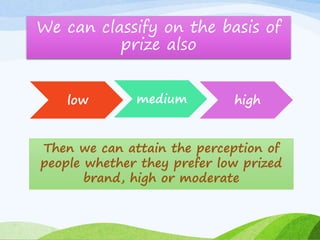
We can classify on the basis of 
prize also 
low medium high 
Then we can attain the perception of 
people whether they prefer low prized 
brand, high or moderate
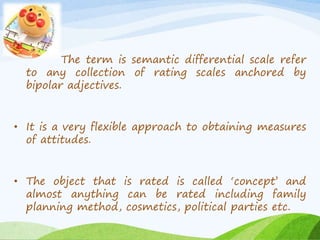
Semantic differential scale 
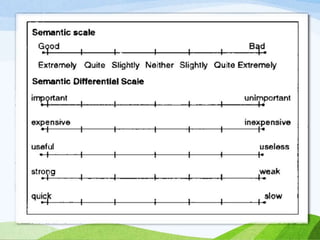
• This is a seven point scale and the end point of the 
scale is associated with bipolar labels. 
1 2 3 4 5 6 7 
Unpleasant pleasant 
Submissive dominant
The term is semantic differential scale refer 
to any collection of rating scales anchored by 
bipolar adjectives. 
• It is a very flexible approach to obtaining measures 
of attitudes. 
• The object that is rated is called ‘concept’ and 
almost anything can be rated including family 
planning method, cosmetics, political parties etc.
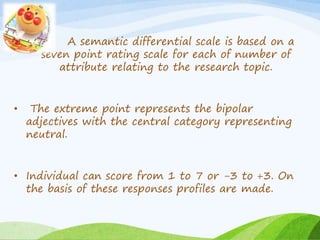
• A semantic differential scale is based on a 
seven point rating scale for each of number of 
attribute relating to the research topic. 
• The extreme point represents the bipolar 
adjectives with the central category representing 
neutral. 
• Individual can score from 1 to 7 or -3 to +3. On 
the basis of these responses profiles are made.
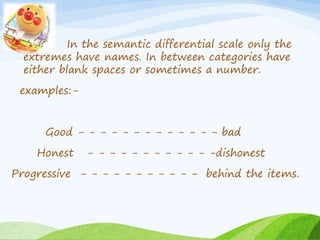
In the semantic differential scale only the 
extremes have names. In between categories have 
either blank spaces or sometimes a number. 
examples:- 
Good - - - - - - - - - - - - - bad 
Honest - - - - - - - - - - - -dishonest 
Progressive - - - - - - - - - - - behind the items.
Advantages of semantic 
differential scale 
• Simplicity 
• Easy 
• Too fast to administer 
• Highly versatile, 
• Reliable and 
• Generally valid
Problems in attitude testing 
• Attitude is a complex affair which cannot be wholly 
described by any single numerical index 
• Peoples attitude are subject to change 
• It is also difficult to get valid responses 
• The scores of the individual generally concentrate in 
the middle 
• Discrepancies between verbally expressed attitude and 
overt behaviour have 
• also been noted in a number of series 
• Every observation of overt behaviour may not always 
provide an accurate index 
• of attitude.
Limitation of attitude scale 
• An individual may express socially acceptable 
opinion and conceal his real attitude 
• An individual himself may not clearly aware of his 
real attitude. 
• Any individual may never have been confronted 
with a real situation to discover what his real 
attitude towards scientific phenomena.
Attitude is revealed through the behaviour of 
the individual. But behavior itself is not always a 
true indication of attitude 
• Observation of behaviour may not always be 
possible when a large sample is under study 
• Social customs or the desire for social approval 
may make man kinds of behaviour mere 
formalities which are quite unrelated to the inner 
feelings of an individual. 
•
CRITICAL 
INCIDENCE 
TEHNIQUE
MEANING 
• The critical and the steps which are useful 
for analyzing of the event is known as 
critical incidence technique. 
• The description of incident should be 
explained in detail, what a student did or 
said that made a teacher to believe, that he 
really understand something or failed to 
understand it.
DEFINITION 
• “The critical incident technique ´as one that makes a 
significant differences in the outcome of an activity. 
It may be the positive factors that contribute 
towards the cause of behaviour or it may be the 
negative factors that interfere with the completion 
of the assignment.” 
- Fivers and Gosnell,
AREAS OF C.I.T 
It is a flexible method that usually relies on five 
major areas:- 
Determining and reviewing the 
incidence, 
Fact finding which involves collecting 
the details of the incident from the 
participants. 
To identify the issues.
Afterwards a decision can be made 
on how to resolve the issues based 
on various possible solutions 
Evaluation, which will determine if 
the solution that was selected will 
solve the root cause of the situation 
and will cause no further problems.
USE AND APPLICATION 
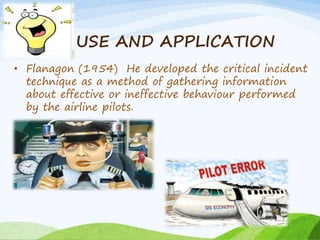
• Flanagon (1954) He developed the critical incident 
technique as a method of gathering information 
about effective or ineffective behaviour performed 
by the airline pilots.
• 
• Flanagan, Gosnell, Fivars used it in order to 
develop categorization for assessing student 
nurse performance
• Cormack (1983) The way in which he use 
the technique as a means of examining the 
role of the psychiatric nurse
• Rinon (1979) Used it to elicit the nurses 
psychological role in caring for patients 
during rehabilitation
• Benner (1984) adapted its used to explore 
the shift from novice to expert practitioner 
through the identification of competencies of 
nurses at different levels of skill attainment
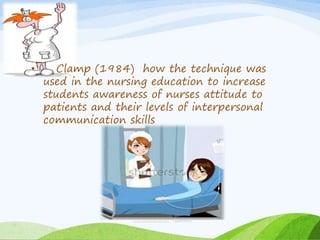
• Clamp (1984) how the technique was 
used in the nursing education to increase 
students awareness of nurses attitude to 
patients and their levels of interpersonal 
communication skills
Critical Incidence 
Report/Record
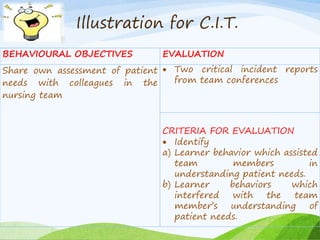
Illustration for C.I.T. 
BEHAVIOURAL OBJECTIVES EVALUATION 
Share own assessment of patient 
needs with colleagues in the 
nursing team 
 Two critical incident reports 
from team conferences 
CRITERIA FOR EVALUATION 
 Identify 
a) Learner behavior which assisted 
team members in 
understanding patient needs. 
b) Learner behaviors which 
interfered with the team 
member’s understanding of 
patient needs.
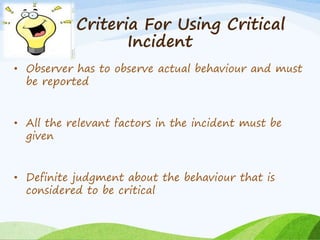
Criteria For Using Critical 
Incident 
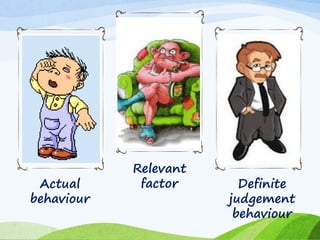
• Observer has to observe actual behaviour and must 
be reported 
• All the relevant factors in the incident must be 
given 
• Definite judgment about the behaviour that is 
considered to be critical
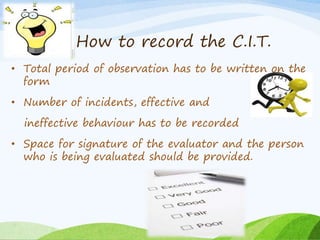
How to record the C.I.T. 
• Total period of observation has to be written on the 
form 
• Number of incidents, effective and 
ineffective behaviour has to be recorded 
• Space for signature of the evaluator and the person 
who is being evaluated should be provided.
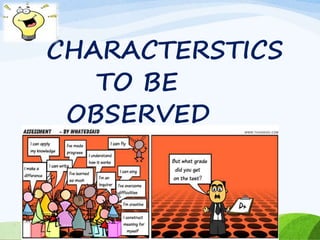
CHARACTERSTICS 
TO BE 
OBSERVED
Actual 
behaviour 
Relevant 
factor Definite 
judgement 
behaviour
ADVANTAGES 
• Flexible method that can be used to improve 
multiuser system 
• Identifies even rare events 
• Useful when problem occurs but the causes and 
security are not known 
• Inexpensive and provide rich information
CONT….. 
• Can be using questionnaires or interviews 
• Data is collected from the respondents 
perspective and in his/her own words 
• Does not force the respondents into any given 
framework 
• Identifies even rare events that might be missed 
by other methods which only focus on common 
and everyday events
DISADVANTAGES 
• critical incidents often relay on memory, incidents 
may even go unreported. 
• The method has a built in bias towards incidents 
that happened recently, since these are easier to 
recall.
SUMMARY
BIBLIOGRAPHY 
• Bhatia &Bhatia (2006)μA text book of educational 
psychologyμ published by doaba house , Delhi , Page No: 
561-569. 
• Boring ,Langfeld ,weld ,μfoundations of psychologyμ 
published by Asia publishing house, Bombay, Page no 
560-588. 
• Cliford .T. Morgon (1999) ´Introduction to 
Psychologyμ7th edition ,published by Tata Mc Graco hill 
Publishing company limited .Newdelhi. Page no 384- 
390. 
• Kamala Bhatia (2000) ´The principles and methods of 
teaching μpublished by doaba house,Delhi, Page no 440. 
• B.N. Panda (1999) ´Advanced educational Psychology 
μpublished by Discovery publishing house, 
Newdelhi.page.no 109
Attitude scale and critical incident technique

Attitude scale and critical incident technique

  • 1.
    • LOST HISJOB • GOT DEFEATED FOR LEGISLATURE • STARTED BUSINESS AND FAILED • WIFE DIED OF FATAL DISEASE • EXPERIENCED NERVOUS BREAKDOWN • CONTESTED IN ELECTION FOR SPEAKER IN LEGISLATURE AND LOST • TRIED FOR NOMINATION IN THE POLITICAL PARTY AND LOST • APPLIED FOR THE POST OF LAND OFFICER AND DIDN’T GET IT • CONTESTED FOR SENATE AND LOST • CONTESTED FOR VICE PRESIDENT AND LOST • AGAIN CONTESTED FOR SENATE AND LOST.
  • 2.
    AND TWO YEARSLATER GOT ELECTED AS PRESIDENT OF AMERICA ABRAHAM LINCON
  • 5.
    • Definition ofattitude • Hypothetical construct of attitude • Definition of attitude scale • Components of attitude • Attitude scale • Purpose of attitude scale • Measurement of attitude • Types of attitude scale • Advantages and disadvantages of attitude scale • Problems and limitation of attitude testing.
  • 6.
    • Critical incidencetechnique • Meaning C.I.T • Definition • Areas of C.I.T. • Use of Critical incidence as a strategy • Critical incidence record and report • Criteria for using critical incidence technique • How to record C.I.T. • Characteristic to be observed • Advantages and disadvantages
  • 7.
    • “An attitudeis a stable set or disposition of opinion, interest or purpose. We expect a certain kind of experience and are ready to give suitable response.”
  • 8.
    • “The termhypothetical construct is used to describe a variable that is not directly observable, but is measurable by an indirect means such as verbal expression or overt behavior - attitudes are considered to be such variables.”
  • 9.
    • “An attitudescale measures how the participants feel about a subject at the moment when he or she answers the question. Several popular types of attitude scales are used in nursing education evaluation.”
  • 10.
    • Affective :-The feelings or emotions toward an object • Cognitive :- Knowledge and beliefs • Behavioral :- Predisposition to action, Intentions, Behavioral expectations.
  • 11.
    • Attitude scalesare used for measuring the social attitude. • Questionnaire is prepared, by the items in the questionnaire is the attitude of an individual towards a matter thing, and object or system and score will be allotted for each item.
  • 12.
    • We willask the individual to express his responses; he is assigned a score which indicates the position. • Some relevant and indirect statements will also be used to reveal the attitude • The scales also specify the crucial shades of opinions.
  • 13.
    • To knowthe extent to which desirable attitude have been developed in the students. • To enable the students to develop desirable attitude. • To help the teachers in good teaching • To help teachers understand students • To help students in their care plans
  • 14.
    Measurement of attitudemust include several dimension if it is to be useful.
  • 15.
    TYPES OF ATTITUDESCALE DIFFERENTIAL SCALOGRAM LIKERT/ SUMMATED Q SORT SCALING SEMANTIC DIFFERENTIAL
  • 16.
    Guttman scales/Scalogram analysis • It is based on the idea that items can be arranged along a continuum in such a way that a person who agree with an item or finds an item acceptable will also agree with or find acceptable all other items expressing a less extreme position. For example:- children should not be allowed to watch indecent programmes and government should ban these programmes. They all are related to one aspect
  • 18.
    • In thisscale each score represents a unique set of responses and therefore the total score of every individual is obtained. This scale takes a lot of time and effort in development. • They are very commonly used in political science, anthropology, public opinion, research and psychology.
  • 19.
    The Q Sorttechnique • It is used to discriminate among large number of object quickly. It uses a rank order procedure and the objects are sorted into piles based on similarly with respect to some criteria. The number of objects to be sorted should be between 60 -140 approximately.
  • 20.
    • FOR EXAMPLE:- Here we are taking nine brands On the basis of taste we classify the brands into Tasty Moderate Non tasty
  • 21.
    We can classifyon the basis of prize also low medium high Then we can attain the perception of people whether they prefer low prized brand, high or moderate
  • 23.
    Semantic differential scale • This is a seven point scale and the end point of the scale is associated with bipolar labels. 1 2 3 4 5 6 7 Unpleasant pleasant Submissive dominant
  • 24.
    The term issemantic differential scale refer to any collection of rating scales anchored by bipolar adjectives. • It is a very flexible approach to obtaining measures of attitudes. • The object that is rated is called ‘concept’ and almost anything can be rated including family planning method, cosmetics, political parties etc.
  • 25.
    • A semanticdifferential scale is based on a seven point rating scale for each of number of attribute relating to the research topic. • The extreme point represents the bipolar adjectives with the central category representing neutral. • Individual can score from 1 to 7 or -3 to +3. On the basis of these responses profiles are made.
  • 26.
    In the semanticdifferential scale only the extremes have names. In between categories have either blank spaces or sometimes a number. examples:- Good - - - - - - - - - - - - - bad Honest - - - - - - - - - - - -dishonest Progressive - - - - - - - - - - - behind the items.
  • 28.
    Advantages of semantic differential scale • Simplicity • Easy • Too fast to administer • Highly versatile, • Reliable and • Generally valid
  • 29.
    Problems in attitudetesting • Attitude is a complex affair which cannot be wholly described by any single numerical index • Peoples attitude are subject to change • It is also difficult to get valid responses • The scores of the individual generally concentrate in the middle • Discrepancies between verbally expressed attitude and overt behaviour have • also been noted in a number of series • Every observation of overt behaviour may not always provide an accurate index • of attitude.
  • 30.
    Limitation of attitudescale • An individual may express socially acceptable opinion and conceal his real attitude • An individual himself may not clearly aware of his real attitude. • Any individual may never have been confronted with a real situation to discover what his real attitude towards scientific phenomena.
  • 31.
    Attitude is revealedthrough the behaviour of the individual. But behavior itself is not always a true indication of attitude • Observation of behaviour may not always be possible when a large sample is under study • Social customs or the desire for social approval may make man kinds of behaviour mere formalities which are quite unrelated to the inner feelings of an individual. •
  • 32.
  • 33.
    MEANING • Thecritical and the steps which are useful for analyzing of the event is known as critical incidence technique. • The description of incident should be explained in detail, what a student did or said that made a teacher to believe, that he really understand something or failed to understand it.
  • 34.
    DEFINITION • “Thecritical incident technique ´as one that makes a significant differences in the outcome of an activity. It may be the positive factors that contribute towards the cause of behaviour or it may be the negative factors that interfere with the completion of the assignment.” - Fivers and Gosnell,
  • 35.
    AREAS OF C.I.T It is a flexible method that usually relies on five major areas:- Determining and reviewing the incidence, Fact finding which involves collecting the details of the incident from the participants. To identify the issues.
  • 36.
    Afterwards a decisioncan be made on how to resolve the issues based on various possible solutions Evaluation, which will determine if the solution that was selected will solve the root cause of the situation and will cause no further problems.
  • 37.
    USE AND APPLICATION • Flanagon (1954) He developed the critical incident technique as a method of gathering information about effective or ineffective behaviour performed by the airline pilots.
  • 38.
    • • Flanagan,Gosnell, Fivars used it in order to develop categorization for assessing student nurse performance
  • 39.
    • Cormack (1983)The way in which he use the technique as a means of examining the role of the psychiatric nurse
  • 40.
    • Rinon (1979)Used it to elicit the nurses psychological role in caring for patients during rehabilitation
  • 41.
    • Benner (1984)adapted its used to explore the shift from novice to expert practitioner through the identification of competencies of nurses at different levels of skill attainment
  • 42.
    • Clamp (1984)how the technique was used in the nursing education to increase students awareness of nurses attitude to patients and their levels of interpersonal communication skills
  • 43.
  • 44.
    Illustration for C.I.T. BEHAVIOURAL OBJECTIVES EVALUATION Share own assessment of patient needs with colleagues in the nursing team  Two critical incident reports from team conferences CRITERIA FOR EVALUATION  Identify a) Learner behavior which assisted team members in understanding patient needs. b) Learner behaviors which interfered with the team member’s understanding of patient needs.
  • 45.
    Criteria For UsingCritical Incident • Observer has to observe actual behaviour and must be reported • All the relevant factors in the incident must be given • Definite judgment about the behaviour that is considered to be critical
  • 46.
    How to recordthe C.I.T. • Total period of observation has to be written on the form • Number of incidents, effective and ineffective behaviour has to be recorded • Space for signature of the evaluator and the person who is being evaluated should be provided.
  • 47.
  • 48.
    Actual behaviour Relevant factor Definite judgement behaviour
  • 49.
    ADVANTAGES • Flexiblemethod that can be used to improve multiuser system • Identifies even rare events • Useful when problem occurs but the causes and security are not known • Inexpensive and provide rich information
  • 50.
    CONT….. • Canbe using questionnaires or interviews • Data is collected from the respondents perspective and in his/her own words • Does not force the respondents into any given framework • Identifies even rare events that might be missed by other methods which only focus on common and everyday events
  • 51.
    DISADVANTAGES • criticalincidents often relay on memory, incidents may even go unreported. • The method has a built in bias towards incidents that happened recently, since these are easier to recall.
  • 52.
  • 53.
    BIBLIOGRAPHY • Bhatia&Bhatia (2006)μA text book of educational psychologyμ published by doaba house , Delhi , Page No: 561-569. • Boring ,Langfeld ,weld ,μfoundations of psychologyμ published by Asia publishing house, Bombay, Page no 560-588. • Cliford .T. Morgon (1999) ´Introduction to Psychologyμ7th edition ,published by Tata Mc Graco hill Publishing company limited .Newdelhi. Page no 384- 390. • Kamala Bhatia (2000) ´The principles and methods of teaching μpublished by doaba house,Delhi, Page no 440. • B.N. Panda (1999) ´Advanced educational Psychology μpublished by Discovery publishing house, Newdelhi.page.no 109