Dr Rajesh G Konnur
Professor
KHFH
Groups
 A gathering of people is a group.
- when its members are collectively conscious of
their existence as a group;
- when they believe it satisfies their needs;
- when they share aims, are interdependent, like to
join in group activities , and want to remain with
in group activities, and want to remain with the group.
- Though groups occur in many forms and sizes, there
seems to be a set of characteristics fairly common to them
all.
Characteristics of groups
• A definable membership.
• Group consciousness.
• A sense of shared purpose.
• Interdependence.
• Interaction.
• Ability to work as a single unit.
(John Adair 1989 ‘Effective team building’ London, Gower)
Roles
 Task – based roles.
 Personal attributes , styles & preferences.
• “A tendency to behave, contribute and interrelate with others in a
particular way”
(Belbin)
• Everybody has a preferred role.
• People are likely to take on more than one role.
• Group roles are not personality types; they are clusters of characteristics:
• Role orientation
-Action
- shaper, implementer, completer finisher
• People
• chair/co-ordinator, team worker, resource investigator
• Cerebral
- plant, monitor/evaluator, specialist
• General group roles
- Group building & maintenance
- Group task
Effective groups
 Contain a balanced range of members whose strengths
complement each other.
• Are not small or too large.
• Members take time to form a ‘group’.
• Members are clear about their own role and that of others.
• Members understand and abide by a set of mutually
agreed ground rules.
• Share out the tasks fairly.
• Are organized & self disciplined.
• Tackle problems within the group effectively.
Methods of Teaching
 Demonstration
 Panel discussion
 Symposium
 Seminar
 Lecture
 Role Play
 Field work
 Project work
lecture
 Lectures are the oldest method of learning in
medicine and allied subjects.
 Simple , economical , commonly used, one way
method.
 Chalk and talk.
 The main purposes of lectures are
- Coverage of a topic or theme,
-Understanding of processes and phenomena
- Motivation
 Coverage =>the most common,
the most common weakness
 Lectures can be boring and, worse, useless
- lectures can induce passivity =>as learning
is passive.
 Prevents thinking.
Demonstration
 Demonstration is method of presentation of skill which
shows how a particular procedure is performed.
Demonstration
Verbal + Live Display / Use of
apparatus
Explanation
TECHNIQUE OF DEMONSTRATION
 The demonstration involve three steps as
follows:-
- PLANNING
- PERFORMING
- EVALUATION
Advantages :
 1. The demonstration method follows a systematic
procedure.
 2. The use of expensive equipment and
machines will be maximized.
 3. Possible wastage of time, effort and
resources will be avoided since the demonstration
is supposed to be well- planned in advance.
 4. It will not result to trial and error learning
as what happens with unplanned learning
activities.
 5. The findings are reliable and accurate since the
procedure has been tried before.
 6. The value of confidence is developed
among the demonstrators for such hands-on
demonstration.
 7. Curiosity and keen observing ability are
instilled among the observers.
Disadvantages
Practice may be limited due to cost of
supplies & equipments.
• Increased faculty workload involved in
supervision of students practices time.
• Limited to small group.
• High instructor/student ratio require 10:1.
Panel Discussion
 INTRODUCTION
- The panel method, originated by professor Harry A.
Overstreet is a discussion in which a few persons (the
panel) who are qualified to talk about the topic carry
over a conversation and discuss the given problem in
front of an audience. The purpose of the panel is to
reproduce the features of a small group discussion for
the benefit of a larger group.
Definitions
• A panel of experts is set up to discuss a topic that
cannot be easily resolved by just one or two persons.
• It is a discussion in which few persons(the panel) carry
on conversation in front of the audience.
Procedure of Panel Discussion
 A panel discussion consists of four types of persons. It
means four roles are played .
- Instructor
- Moderator
- Panelists and
- Audience
Limitations
The followings are the limitations of panel discussion:
 There are chances to deviate from the theme at time of
discussion hence the purpose the panel discussion is
not achieved.
 Some members dominate the discussion and not
provide the opportunities to participate others in
discussion.
 If panelists belong to different groups, it may not
create appropriate learning situations.
Symposium
Definition:
 “Symposium consists of a set of program of prepared
speeches followed by audience discussion”.
 “Symposium is a technique in which two or more
person under the direction of a chairperson presents
several speeches, which give several aspect of one person”.
Characteristics
The symposium has the following main characteristics:-
 It provides the broad understandings of a topic or a
problem.
 The opportunity is provided to the listeners to take decision
about the Problem.
 It is used for higher classes to specific theme and problem.
 It develops the feeling of co-operation and adjustment. The
objectives as synthesis and evaluation are achieved by
employing the symposium.
 It provides the different views on the topic of the symposium.
Limitations :
 The chairman has no control over the speakers.
 There is a probability of repetition of the conduct.
 The different aspect of theme is presented simultaneously.
 The listeners remain passive in the symposium.
 The discussion and presentation of the theme is not
summarized at the end.
 This technique is employed to achieve the higher objectives
of
cognitive domain but affective are not empathized properly.
Disadvantages :
 Inadequate opportunity for all the students to
participate actively.
 The speeches are limited to 15-20 minutes.
 Limited audience participation.
 Question and answer limited to 3 or 4 minutes.
 Possibility of overlapping the subjects.
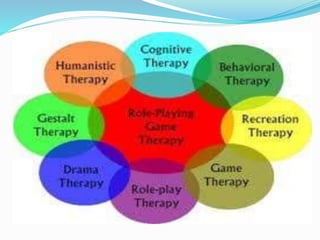
Role Play
Definitions :
 Role play is an educational method in which people
spontaneously act out problems of human relations
and analyze the enactment with the observers.
 Role playing is a discussion technique that makes
possible to get maximum participation of a group
through citing out an example of some problem or idea
under discussion.
Types :
1. SOCIO DRAMA.
2. PSYCHO DRAMA
Purposes:
 To present inter personal problems.
 To provide emotional and affective stimulus for solving
problems.
 To provide awareness about social & psychological issues.
 To develop a situation for analysis.
 To prevent alternative courses of action.
 To prepare for meeting future situations. To develop an
understanding of others points of view.
 To convey information to develop specific skills.
PRINCIPLES:
 Role play is based on the philosophy that meanings
are in people an not in words or symbols.
 If philosophy is accurate, one must in the first place
share the meanings, then clarify our understanding
of each other’s meanings & finally if necessary
change our meanings.
 Role play has to do with the self concept.
 The self concept is best changed through direct
involvement in a realistic & life related problem
situation rather than hearing about such situations
from others.
 Creating a teaching situations that lead to change of
self concept requires a distinct organization pattern.
 Role play should be flexible.
 A role play should be a stimulant to think & should
not be an escape from discipline or learning.
 There is no single best method of selecting the
characteristics ; the group may do the assigning.
 It requires rehearsal as an important feature to
produce effective outcome & for audience to help
interpret their roles.
 Role play should be done for a brief period so that
the attention of audience may be captured
effectively.
 Enough time should be allowed for discussion &
analysis of the situation.
 Role play evaluates the teacher & participants
through discussions or follow up as to specific
individual behaviour or sequence of group
actions.
Steps in role –Play:
 1. PLANNING PHASE.
 2. IMPLEMENTATION PHASE.
 3. EVALUATION PHASE
Disadvantages :
 Role playing is a means and not an end.
• It requires expert guidance and leadership.
• Participants may sometimes feel threatened.
Filed Work :
 The “field” : “ any arena or zone within a subject where
supervised learning can take place via first hand
experience , outside the constraints of the four- walls
classroom setting”. ( Maskall & Stokes 2009).
Examples:
- Site visits
- Exhibitions & conferences
- Museums & galleries
- Observational visits – e.g. visiting to Cancer Hospital.
Benefits of Field Work :
 Students can visit places they may not normally see.
 Real-world engagement rather than idealized textbook.
 Develops certain skills effectively:
 observation, analysis, enquiry, teamwork, leadership
responsibility.
 Facilitates more relaxed interaction between students &
staff; development of cohort.
Thanks a lot.

Group teaching aku

  • 1.
    Dr Rajesh GKonnur Professor KHFH
  • 2.
    Groups  A gatheringof people is a group. - when its members are collectively conscious of their existence as a group; - when they believe it satisfies their needs; - when they share aims, are interdependent, like to join in group activities , and want to remain with in group activities, and want to remain with the group. - Though groups occur in many forms and sizes, there seems to be a set of characteristics fairly common to them all.
  • 3.
    Characteristics of groups •A definable membership. • Group consciousness. • A sense of shared purpose. • Interdependence. • Interaction. • Ability to work as a single unit. (John Adair 1989 ‘Effective team building’ London, Gower)
  • 4.
    Roles  Task –based roles.  Personal attributes , styles & preferences. • “A tendency to behave, contribute and interrelate with others in a particular way” (Belbin) • Everybody has a preferred role. • People are likely to take on more than one role. • Group roles are not personality types; they are clusters of characteristics: • Role orientation -Action - shaper, implementer, completer finisher • People • chair/co-ordinator, team worker, resource investigator • Cerebral - plant, monitor/evaluator, specialist • General group roles - Group building & maintenance - Group task
  • 5.
    Effective groups  Containa balanced range of members whose strengths complement each other. • Are not small or too large. • Members take time to form a ‘group’. • Members are clear about their own role and that of others. • Members understand and abide by a set of mutually agreed ground rules. • Share out the tasks fairly. • Are organized & self disciplined. • Tackle problems within the group effectively.
  • 6.
    Methods of Teaching Demonstration  Panel discussion  Symposium  Seminar  Lecture  Role Play  Field work  Project work
  • 7.
    lecture  Lectures arethe oldest method of learning in medicine and allied subjects.  Simple , economical , commonly used, one way method.  Chalk and talk.  The main purposes of lectures are - Coverage of a topic or theme, -Understanding of processes and phenomena - Motivation
  • 8.
     Coverage =>themost common, the most common weakness  Lectures can be boring and, worse, useless - lectures can induce passivity =>as learning is passive.  Prevents thinking.
  • 10.
    Demonstration  Demonstration ismethod of presentation of skill which shows how a particular procedure is performed. Demonstration Verbal + Live Display / Use of apparatus Explanation
  • 11.
    TECHNIQUE OF DEMONSTRATION The demonstration involve three steps as follows:- - PLANNING - PERFORMING - EVALUATION
  • 12.
    Advantages :  1.The demonstration method follows a systematic procedure.  2. The use of expensive equipment and machines will be maximized.  3. Possible wastage of time, effort and resources will be avoided since the demonstration is supposed to be well- planned in advance.
  • 13.
     4. Itwill not result to trial and error learning as what happens with unplanned learning activities.  5. The findings are reliable and accurate since the procedure has been tried before.  6. The value of confidence is developed among the demonstrators for such hands-on demonstration.  7. Curiosity and keen observing ability are instilled among the observers.
  • 14.
    Disadvantages Practice may belimited due to cost of supplies & equipments. • Increased faculty workload involved in supervision of students practices time. • Limited to small group. • High instructor/student ratio require 10:1.
  • 15.
    Panel Discussion  INTRODUCTION -The panel method, originated by professor Harry A. Overstreet is a discussion in which a few persons (the panel) who are qualified to talk about the topic carry over a conversation and discuss the given problem in front of an audience. The purpose of the panel is to reproduce the features of a small group discussion for the benefit of a larger group.
  • 16.
    Definitions • A panelof experts is set up to discuss a topic that cannot be easily resolved by just one or two persons. • It is a discussion in which few persons(the panel) carry on conversation in front of the audience.
  • 17.
    Procedure of PanelDiscussion  A panel discussion consists of four types of persons. It means four roles are played . - Instructor - Moderator - Panelists and - Audience
  • 18.
    Limitations The followings arethe limitations of panel discussion:  There are chances to deviate from the theme at time of discussion hence the purpose the panel discussion is not achieved.  Some members dominate the discussion and not provide the opportunities to participate others in discussion.  If panelists belong to different groups, it may not create appropriate learning situations.
  • 19.
    Symposium Definition:  “Symposium consistsof a set of program of prepared speeches followed by audience discussion”.  “Symposium is a technique in which two or more person under the direction of a chairperson presents several speeches, which give several aspect of one person”.
  • 20.
    Characteristics The symposium hasthe following main characteristics:-  It provides the broad understandings of a topic or a problem.  The opportunity is provided to the listeners to take decision about the Problem.  It is used for higher classes to specific theme and problem.  It develops the feeling of co-operation and adjustment. The objectives as synthesis and evaluation are achieved by employing the symposium.  It provides the different views on the topic of the symposium.
  • 21.
    Limitations :  Thechairman has no control over the speakers.  There is a probability of repetition of the conduct.  The different aspect of theme is presented simultaneously.  The listeners remain passive in the symposium.  The discussion and presentation of the theme is not summarized at the end.  This technique is employed to achieve the higher objectives of cognitive domain but affective are not empathized properly.
  • 22.
    Disadvantages :  Inadequateopportunity for all the students to participate actively.  The speeches are limited to 15-20 minutes.  Limited audience participation.  Question and answer limited to 3 or 4 minutes.  Possibility of overlapping the subjects.
  • 23.
  • 24.
    Definitions :  Roleplay is an educational method in which people spontaneously act out problems of human relations and analyze the enactment with the observers.  Role playing is a discussion technique that makes possible to get maximum participation of a group through citing out an example of some problem or idea under discussion.
  • 25.
    Types : 1. SOCIODRAMA. 2. PSYCHO DRAMA
  • 26.
    Purposes:  To presentinter personal problems.  To provide emotional and affective stimulus for solving problems.  To provide awareness about social & psychological issues.  To develop a situation for analysis.  To prevent alternative courses of action.  To prepare for meeting future situations. To develop an understanding of others points of view.  To convey information to develop specific skills.
  • 27.
    PRINCIPLES:  Role playis based on the philosophy that meanings are in people an not in words or symbols.  If philosophy is accurate, one must in the first place share the meanings, then clarify our understanding of each other’s meanings & finally if necessary change our meanings.  Role play has to do with the self concept.  The self concept is best changed through direct involvement in a realistic & life related problem situation rather than hearing about such situations from others.
  • 28.
     Creating ateaching situations that lead to change of self concept requires a distinct organization pattern.  Role play should be flexible.  A role play should be a stimulant to think & should not be an escape from discipline or learning.  There is no single best method of selecting the characteristics ; the group may do the assigning.  It requires rehearsal as an important feature to produce effective outcome & for audience to help interpret their roles.
  • 29.
     Role playshould be done for a brief period so that the attention of audience may be captured effectively.  Enough time should be allowed for discussion & analysis of the situation.  Role play evaluates the teacher & participants through discussions or follow up as to specific individual behaviour or sequence of group actions.
  • 30.
    Steps in role–Play:  1. PLANNING PHASE.  2. IMPLEMENTATION PHASE.  3. EVALUATION PHASE
  • 32.
    Disadvantages :  Roleplaying is a means and not an end. • It requires expert guidance and leadership. • Participants may sometimes feel threatened.
  • 33.
    Filed Work : The “field” : “ any arena or zone within a subject where supervised learning can take place via first hand experience , outside the constraints of the four- walls classroom setting”. ( Maskall & Stokes 2009). Examples: - Site visits - Exhibitions & conferences - Museums & galleries - Observational visits – e.g. visiting to Cancer Hospital.
  • 34.
    Benefits of FieldWork :  Students can visit places they may not normally see.  Real-world engagement rather than idealized textbook.  Develops certain skills effectively:  observation, analysis, enquiry, teamwork, leadership responsibility.  Facilitates more relaxed interaction between students & staff; development of cohort.
  • 35.