OCULAR TRAUMA
20th August 2020
DR M SAQUIB
Vice Principal
MBBS,MS , FSCEH DELHI,FHVDESAI PUNE,
EX REGISTRARA JNMCH,AMU
CONSULTANT OPHTHALMOLOGIST
HOD D/O OPHTHALMOLOGY
G.S .MEDICAL COLLEGE
Founder sec: MEDICS India ,
Mail-dms2k5@gmail.com , 9634123800
TRAUMA
EYE LID TRAUMA
Laceration
Periocular Haematoma
ORBITAL FRACTURE
Blow out orbital fractures
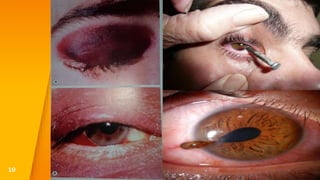
GLOBE TRAUMA
Blunt Trauma
Penetrating Trauma
Foreign Body
Shaken baby Syndrome
CHEMICAL INJURIES2
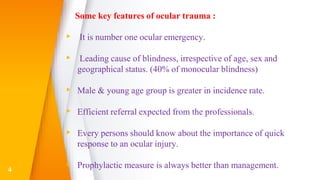
â–¸ The eye is protected from
direct injury by lids, eyelashes
and the projecting margins of
the orbit. Nevertheless, it can
be injured in a variety of ways;
by chemicals, heat, radiation
and mechanical trauma
3
Some key features of ocular trauma :
â–¸ It is number one ocular emergency.
â–¸ Leading cause of blindness, irrespective of age, sex and
geographical status. (40% of monocular blindness)
â–¸ Male & young age group is greater in incidence rate.
â–¸ Efficient referral expected from the professionals.
â–¸ Every persons should know about the importance of quick
response to an ocular injury.
â–¸ Prophylactic measure is always better than management.4
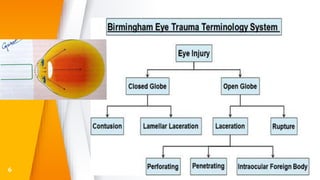
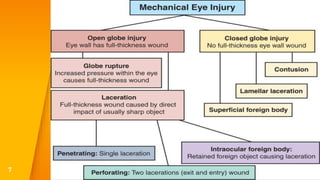
Etiological Classification -1.Accidental.2.Self inflicted. 3. Occupational
â–¸ Uniform classification based on primary evaluation;
Mechanical trauma to the eye are of two types:
▸ 1. Open globe injuries – full thickness defect of eye
coats.
▸ 2. Closed globe injuries – injuries without full
thickness of eye coats.
5
6
7
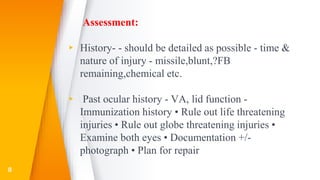
Assessment:
â–¸ History- - should be detailed as possible - time &
nature of injury - missile,blunt,?FB
remaining,chemical etc.
â–¸ Past ocular history - VA, lid function -
Immunization history • Rule out life threatening
injuries • Rule out globe threatening injuries •
Examine both eyes • Documentation +/-
photograph • Plan for repair
8
9
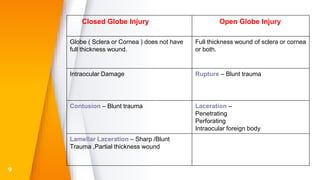
Closed Globe Injury Open Globe Injury
Globe ( Sclera or Cornea ) does not have
full thickness wound.
Full thickness wound of sclera or cornea
or both.
Intraocular Damage Rupture – Blunt trauma
Contusion – Blunt trauma Laceration –
Penetrating
Perforating
Intraocular foreign body
Lamellar Laceration – Sharp /Blunt
Trauma ,Partial thickness wound
10
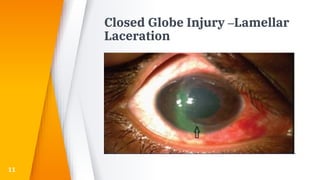
Closed Globe Injury –Lamellar
Laceration
11
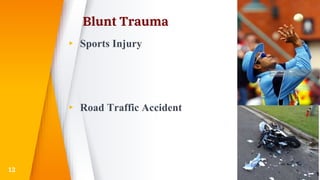
Blunt Trauma
â–¸ Sports Injury
â–¸ Road Traffic Accident
12
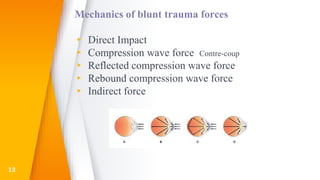
Mechanics of blunt trauma forces
â–¸ Direct Impact
â–¸ Compression wave force Contre-coup
â–¸ Reflected compression wave force
â–¸ Rebound compression wave force
â–¸ Indirect force
13
Mechanism of damage
â–¸ Tearing
â–¸ Damage to tissue cells
â–¸ Vascular Damage
â–¸ Trophic changes- Nerve supply damage
â–¸ Delayed complication
14
Effects Of Contusion And Concussion Injury
15
Ocular Tissue
Involved
Clinical Manifestation
Orbit Blow out fracture of Medial wall /Floor ,Orbital Haematoma ,Carotid cavernous
Fistula
Eyelids Haematoma ,Avulsion of lower lid
Conjuctiva Subconjuctival Haemorhage
Anterior Uvea Hyphema ,Iris sphincter tear , Iridodialysis ,Angle recession ,Cyclodialysis
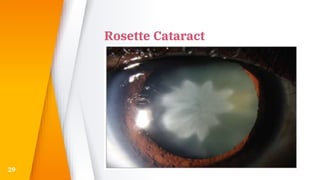
Lens Rosette cataract ,Subluxation of lens ,Rupture of Anterior or Posterior Capsule
Sclera Rupture ,Limbus or behind insertion of rectus ,Lamellar laceration
Vitreous Haemorhage
Choroid /Retina Choroid Rupture ,Suprachoroidal haemorhage ,RETINA: Haemorhage,Oedema
,Dialysis ,Detachment ,Commotio Retina
Optic nerve Optic Nerve Avulsion ,Haemorhage
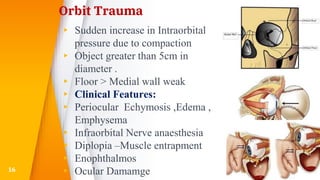
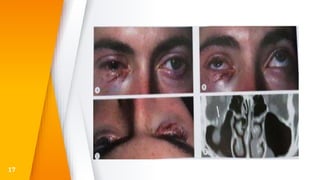
Orbit Trauma
â–¸ Sudden increase in Intraorbital
pressure due to compaction
â–¸ Object greater than 5cm in
diameter .
â–¸ Floor > Medial wall weak
â–¸ Clinical Features:
â–¸ Periocular Echymosis ,Edema ,
Emphysema
â–¸ Infraorbital Nerve anaesthesia
▸ Diplopia –Muscle entrapment
â–¸ Enophthalmos
â–¸ Ocular Damamge16
17
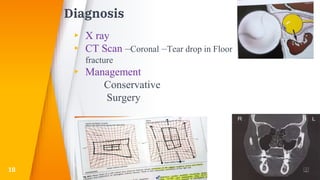
Diagnosis
â–¸ X ray
▸ CT Scan –Coronal –Tear drop in Floor
fracture
â–¸ Management
Conservative
Surgery
18
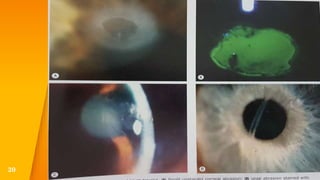
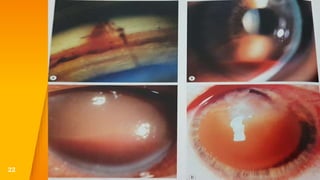
Closed Globe Injury –Cornea
â–¸ Simple Corneal Abrasion
â–¸ Recurrent Corneal abrasion
â–¸ Lamellar corneal laceration
â–¸ Corneal oedema
â–¸ Blood staining of cornea
19
20
Closed Globe Injury –Anterior chamber
▸ Traumatic Hyphema – Blood in AC .
â–¸ Injury to Iris or cilliary body veseles .
â–¸ Treatment :
Conservative – IOP control
Surgical treatment –Drainage
â–¸ Exudates in AC due to uveitis
21
22
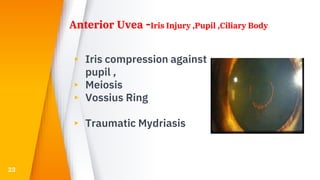
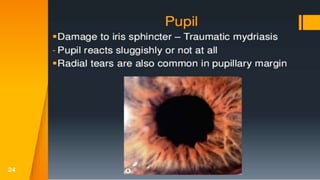
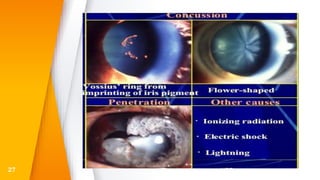
Anterior Uvea -Iris Injury ,Pupil ,Ciliary Body
â–¸ Iris compression against
pupil ,
â–¸ Meiosis
â–¸ Vossius Ring
â–¸ Traumatic Mydriasis
23
24
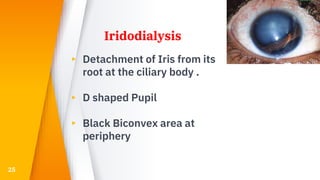
Iridodialysis
â–¸ Detachment of Iris from its
root at the ciliary body .
â–¸ D shaped Pupil
â–¸ Black Biconvex area at
periphery
25
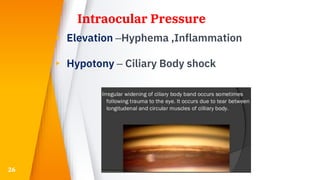
Intraocular Pressure
▸ Elevation –Hyphema ,Inflammation
▸ Hypotony – Ciliary Body shock
26
27
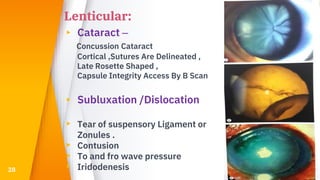
Lenticular:
▸ Cataract –
Concussion Cataract
Cortical ,Sutures Are Delineated ,
Late Rosette Shaped ,
Capsule Integrity Access By B Scan
â–¸ Subluxation /Dislocation
â–¸ Tear of suspensory Ligament or
Zonules .
â–¸ Contusion
â–¸ To and fro wave pressure
â–¸ Iridodenesis28
Rosette Cataract
29
Eyelid trauma
Periocular Haematoma : - Generally innocuous but
it is very important to exclude
â–¸ 1. Trauma to the globe or orbit
â–¸ 2. Orbital roof fracture
â–¸ 3. Basal skull fracture
30
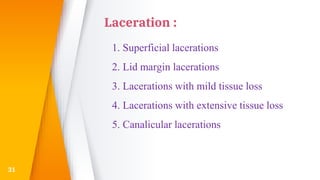
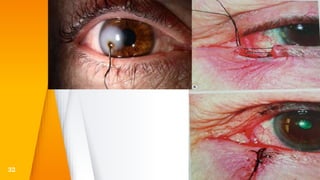
Laceration :
1. Superficial lacerations
2. Lid margin lacerations
3. Lacerations with mild tissue loss
4. Lacerations with extensive tissue loss
5. Canalicular lacerations
31
32
33

Ocular Trauma

  • 1.
    OCULAR TRAUMA 20th August2020 DR M SAQUIB Vice Principal MBBS,MS , FSCEH DELHI,FHVDESAI PUNE, EX REGISTRARA JNMCH,AMU CONSULTANT OPHTHALMOLOGIST HOD D/O OPHTHALMOLOGY G.S .MEDICAL COLLEGE Founder sec: MEDICS India , Mail-dms2k5@gmail.com , 9634123800
  • 2.
    TRAUMA EYE LID TRAUMA Laceration PeriocularHaematoma ORBITAL FRACTURE Blow out orbital fractures GLOBE TRAUMA Blunt Trauma Penetrating Trauma Foreign Body Shaken baby Syndrome CHEMICAL INJURIES2
  • 3.
    â–¸ The eyeis protected from direct injury by lids, eyelashes and the projecting margins of the orbit. Nevertheless, it can be injured in a variety of ways; by chemicals, heat, radiation and mechanical trauma 3
  • 4.
    Some key featuresof ocular trauma : â–¸ It is number one ocular emergency. â–¸ Leading cause of blindness, irrespective of age, sex and geographical status. (40% of monocular blindness) â–¸ Male & young age group is greater in incidence rate. â–¸ Efficient referral expected from the professionals. â–¸ Every persons should know about the importance of quick response to an ocular injury. â–¸ Prophylactic measure is always better than management.4
  • 5.
    Etiological Classification -1.Accidental.2.Selfinflicted. 3. Occupational ▸ Uniform classification based on primary evaluation; Mechanical trauma to the eye are of two types: ▸ 1. Open globe injuries – full thickness defect of eye coats. ▸ 2. Closed globe injuries – injuries without full thickness of eye coats. 5
  • 6.
  • 7.
  • 8.
    Assessment: ▸ History- -should be detailed as possible - time & nature of injury - missile,blunt,?FB remaining,chemical etc. ▸ Past ocular history - VA, lid function - Immunization history • Rule out life threatening injuries • Rule out globe threatening injuries • Examine both eyes • Documentation +/- photograph • Plan for repair 8
  • 9.
    9 Closed Globe InjuryOpen Globe Injury Globe ( Sclera or Cornea ) does not have full thickness wound. Full thickness wound of sclera or cornea or both. Intraocular Damage Rupture – Blunt trauma Contusion – Blunt trauma Laceration – Penetrating Perforating Intraocular foreign body Lamellar Laceration – Sharp /Blunt Trauma ,Partial thickness wound
  • 10.
  • 11.
    Closed Globe Injury–Lamellar Laceration 11
  • 12.
    Blunt Trauma â–¸ SportsInjury â–¸ Road Traffic Accident 12
  • 13.
    Mechanics of blunttrauma forces â–¸ Direct Impact â–¸ Compression wave force Contre-coup â–¸ Reflected compression wave force â–¸ Rebound compression wave force â–¸ Indirect force 13
  • 14.
    Mechanism of damage â–¸Tearing â–¸ Damage to tissue cells â–¸ Vascular Damage â–¸ Trophic changes- Nerve supply damage â–¸ Delayed complication 14
  • 15.
    Effects Of ContusionAnd Concussion Injury 15 Ocular Tissue Involved Clinical Manifestation Orbit Blow out fracture of Medial wall /Floor ,Orbital Haematoma ,Carotid cavernous Fistula Eyelids Haematoma ,Avulsion of lower lid Conjuctiva Subconjuctival Haemorhage Anterior Uvea Hyphema ,Iris sphincter tear , Iridodialysis ,Angle recession ,Cyclodialysis Lens Rosette cataract ,Subluxation of lens ,Rupture of Anterior or Posterior Capsule Sclera Rupture ,Limbus or behind insertion of rectus ,Lamellar laceration Vitreous Haemorhage Choroid /Retina Choroid Rupture ,Suprachoroidal haemorhage ,RETINA: Haemorhage,Oedema ,Dialysis ,Detachment ,Commotio Retina Optic nerve Optic Nerve Avulsion ,Haemorhage
  • 16.
    Orbit Trauma ▸ Suddenincrease in Intraorbital pressure due to compaction ▸ Object greater than 5cm in diameter . ▸ Floor > Medial wall weak ▸ Clinical Features: ▸ Periocular Echymosis ,Edema , Emphysema ▸ Infraorbital Nerve anaesthesia ▸ Diplopia –Muscle entrapment ▸ Enophthalmos ▸ Ocular Damamge16
  • 17.
  • 18.
    Diagnosis ▸ X ray ▸CT Scan –Coronal –Tear drop in Floor fracture ▸ Management Conservative Surgery 18
  • 19.
    Closed Globe Injury–Cornea ▸ Simple Corneal Abrasion ▸ Recurrent Corneal abrasion ▸ Lamellar corneal laceration ▸ Corneal oedema ▸ Blood staining of cornea 19
  • 20.
  • 21.
    Closed Globe Injury–Anterior chamber ▸ Traumatic Hyphema – Blood in AC . ▸ Injury to Iris or cilliary body veseles . ▸ Treatment : Conservative – IOP control Surgical treatment –Drainage ▸ Exudates in AC due to uveitis 21
  • 22.
  • 23.
    Anterior Uvea -IrisInjury ,Pupil ,Ciliary Body â–¸ Iris compression against pupil , â–¸ Meiosis â–¸ Vossius Ring â–¸ Traumatic Mydriasis 23
  • 24.
  • 25.
    Iridodialysis â–¸ Detachment ofIris from its root at the ciliary body . â–¸ D shaped Pupil â–¸ Black Biconvex area at periphery 25
  • 26.
    Intraocular Pressure ▸ Elevation–Hyphema ,Inflammation ▸ Hypotony – Ciliary Body shock 26
  • 27.
  • 28.
    Lenticular: ▸ Cataract – ConcussionCataract Cortical ,Sutures Are Delineated , Late Rosette Shaped , Capsule Integrity Access By B Scan ▸ Subluxation /Dislocation ▸ Tear of suspensory Ligament or Zonules . ▸ Contusion ▸ To and fro wave pressure ▸ Iridodenesis28
  • 29.
  • 30.
    Eyelid trauma Periocular Haematoma: - Generally innocuous but it is very important to exclude â–¸ 1. Trauma to the globe or orbit â–¸ 2. Orbital roof fracture â–¸ 3. Basal skull fracture 30
  • 31.
    Laceration : 1. Superficiallacerations 2. Lid margin lacerations 3. Lacerations with mild tissue loss 4. Lacerations with extensive tissue loss 5. Canalicular lacerations 31
  • 32.
  • 33.