1
WELCOME
Submitted to:-
 Dr. A. K. Singh
 Assistant Professor, Dept. of GPB
 S. D. A. U., S. K. Nagar
 Dr. N. N. Prajapati
 Assistant Research Scientist, C. C. I.,
 S. D. A. U., S. K. Nagar
Submitted by:-
Vaghela Gauravrajsinh K
M.Sc. (Agri.)
Reg.no:-04-AGRMA-01840-2018
S. D. A. U., S. K. Nagar
Symmetric & Asymmetric Hybrid and Cybrid
PLANT TISSUE CULTURE &
GENETIC TRANSFORMATION
Somatic Hybridization
Development of hybrid plants through the fusion of somatic protoplasts
of two different plant species/varieties is called somatic hybridization.
This is a non conventional genetic procedure involving fusion between
isolated protoplast under in vitro condition and subsequent development
of their product (heterokaryon) to a hybrid plant.
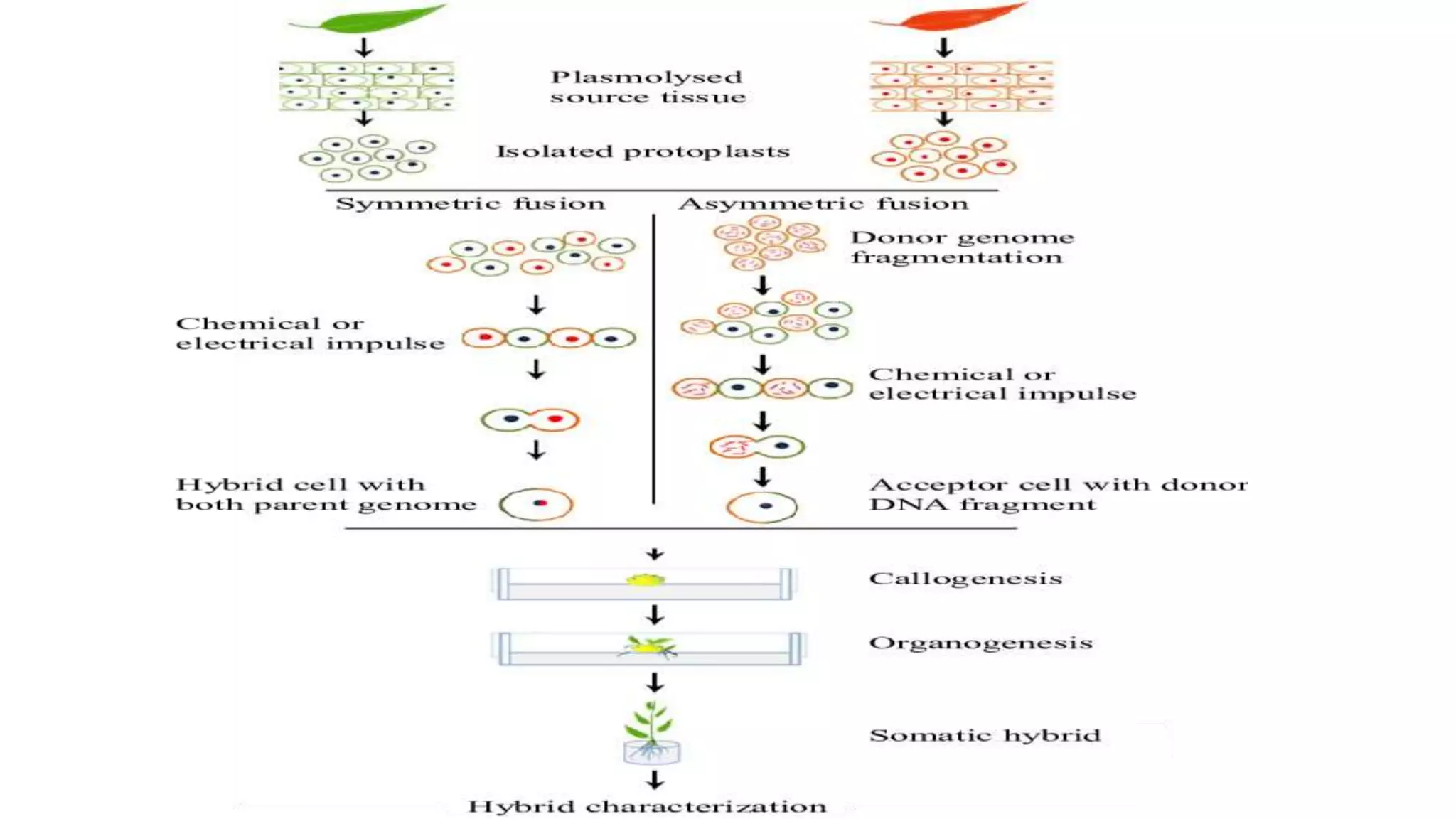
Symmetric hybrids: These contain the somatic chromosome of both the parental
species. These are very significant as they show all the properties exhibited by
parent species.
Asymmetric hybrids: These are those hybrids which preserve the genetic
material of one parent organism. The chromosome content of other parent species
is lost.
Symmetric Hybrids
Some somatic hybrid plants retain the full or nearly full somatic complements of
the two parental species these are called symmetric hybrids.
Such hybrids provide unique opportunities for synthesizing novel species, which
may be of theoretical and/or practical interest.
Frequently, somatic hybrids between distantly related sexually incompatible
species are sterile, precluding their incorporation into a breeding programme.
This may be circumvented by producing 3n somatic hybrids by fusing somatic
(2n) cells of one species with haploid (n) cells of the other species; such 3n plants
may be expected to be partially fertile.
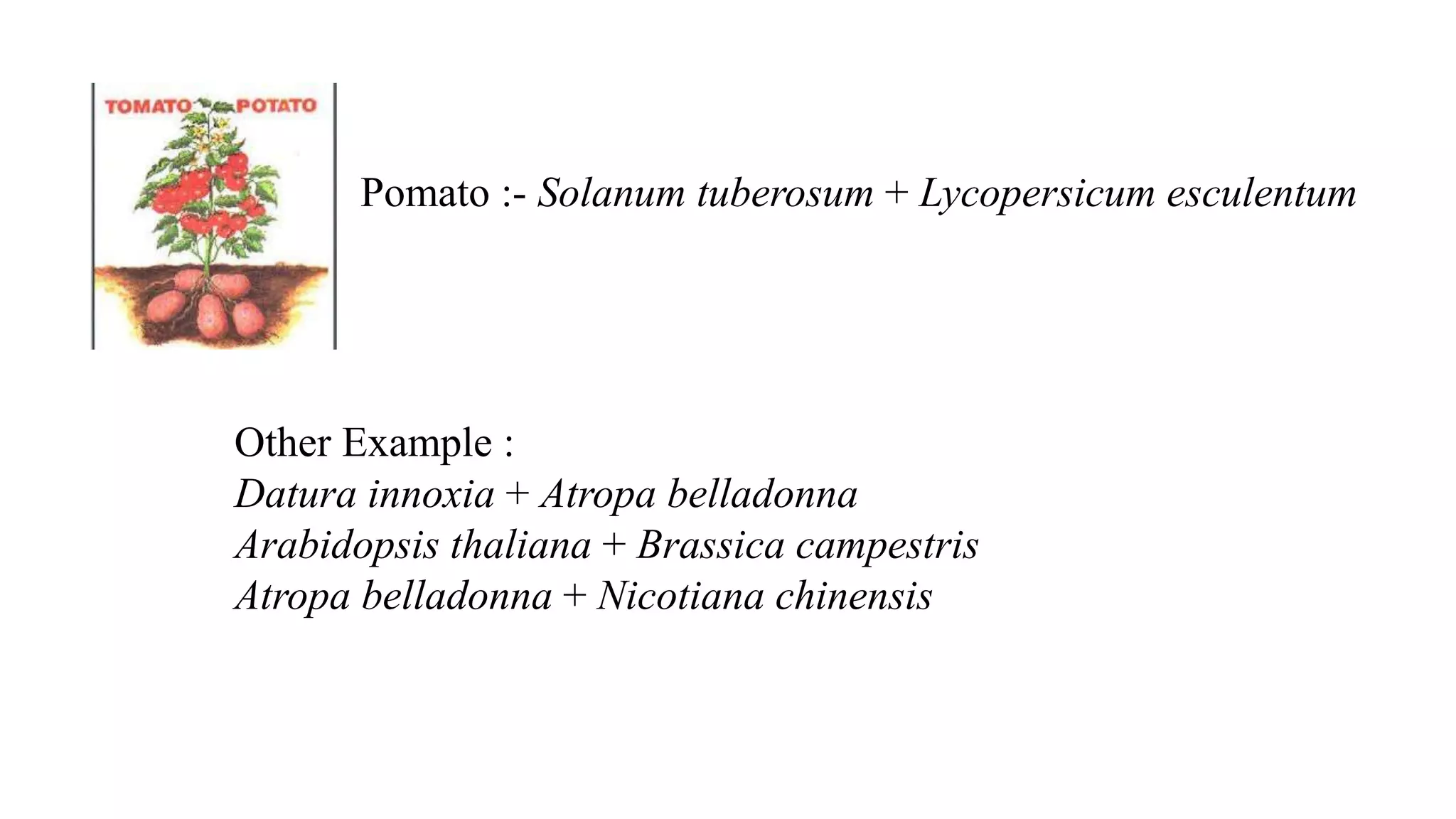
Pomato :- Solanum tuberosum + Lycopersicum esculentum
Other Example :
Datura innoxia + Atropa belladonna
Arabidopsis thaliana + Brassica campestris
Atropa belladonna + Nicotiana chinensis
Asymmetric Hybrid
Many somatic hybrids exhibit the full somatic complement of one parental
species, while all or nearly all chromosomes of other parental species are lost
during the preceding mitotic divisions; such hybrids are referred to as
asymmetric hybrids.
The available evidence suggests that such hybrids are likely to show a limited
introgression of chromosome segments from the eliminated genome(s) due to
drastically enhanced chromosomal aberrations and/or mitotic crossing over in
vitro.
Asymmetric hybrids can be obtained even from those combinations, which
normally produce symmetric approach: Protoplast of one of the parental species
are irradiated with a suitable dose of X-rays or gamma rays to induce extensive
chromosome breakage.
Example :-
Daucus carota + Aegopodium podagraria
Daucus carota + Oryza sativa
Daucus carota + Petroselinum Hortense
Hyoscyamus muticus + Nicotiana tabacum
D. Innoxia + Physalis minima
Nicotiana tabacum + Daucus carota
CYBRID
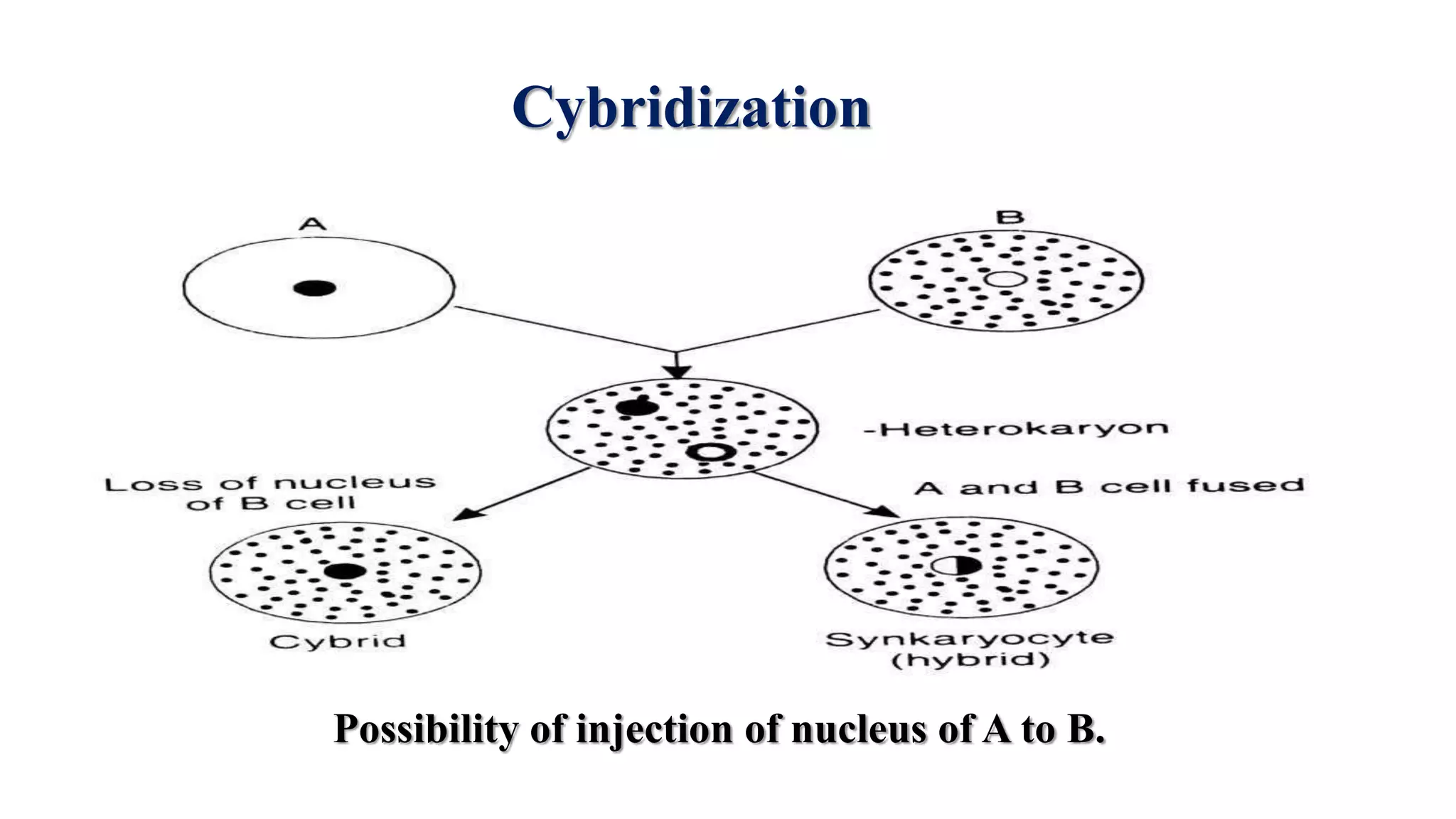
Cybrid – cytoplasmic hybrid.
Cybrids are cells or plants containing nucleus of one species but cytoplasm
from both the parental species.
Cybridization – production of somatic cybrid.
The process of protoplast fusion resulting in the development of cybrid is
known as cybridization.
HISTORY
In 1892 Klercker was the first to isolate protoplast from Stratiotes aloides
using mechanical method.
Cocking in 1960 was the first to report the isolation of protoplast from tomato
root tips using concentrated solutions of cellulase from the fungus
Myrothecium verrucosa.
Enzymes for protoplast isolation was first employed by Takebe and his co
workers in 1968.
Kao and Michayluk in 1974 first proposed PEG for fusion of protoplast.
Gleba 1979 fused tobacco protoplast which produced a cybrid.
Melchers and Labib in 1974 fused protoplast of two haploid light sensitive
lines of Nicotiana tabacum.
Kao and Wetter in 1976 isolated cell cybrids of Glycine max and Nicotiana
glauca .
Pental and Cocking proposed that triploids could be produced by fusing
protoplast isolated from microspores at the tetrad stage (n) of a species with
protoplast isolated from the somatic cells of other species.
Pirrie and Power synthesized triploids by fusing microspore protoplast of
Nicotiana glutinosa with somatic cell protoplast of Nicotiana tabacum.
NEED FOR CYBRIDS
Production of full hybrids through protoplasts fusion of distantly
related plants – unrealistic- wide spread instability of the two
dissimilar genomes in common cytoplasm.
Undesirable –exhibit structural and developmental abnormalities.
Partial genome transfer – fusion of normal protoplasts of the recipient
with enucleated protoplasts of the donor-cybridization.
ADVANTAGES
• Two different parental genomes that cannot reproduce sexually (asexual or sterile)
are recombined.
• Overcomes sexual incompatibility barriers.
• Used in study of cytoplasmic genes & their activities- plant breeding experiments.
• To transfer cytoplasmic male sterility (tomato , tobacco).
• To transfer antibiotic resistance character(tobacco).
• To transfer herbicide resistance (brassica).
• Used in mitochondrial research.
Cybridization
Possibility of injection of nucleus of A to B.
Aims of cybridization
To obtain biological information on intra- and intergeneric transfer of
organelles.
 To combine cytoplasm gene of one species to anther species which have
nucleus with cytoplasm.
 This is also a way for those species which don’t perform to sexual
reproduction with each other, so this way provided to facilitate to make a
desire species with combination of both species.
Benefits
1. Transfer of plasma genes of one species to nuclear background of another
species.
2. Production of wide range of genetic variations, sexually incompatible
combinations.
3. Useful for sterile plants.
4. Mitochondrial gene also combined with chloroplast gens of another
species.
5. Plants like medicinal plant, crop plants, sterile pants, or many other
valuable species also included in this.
Recent Examples of Cybrids
Production and molecular characterization of potential seedless cybrid
plants between pollen sterile Satsuma mandarin and two
seedy Citrus cultivars
Cai, XD., Fu, J., Deng, XX. et al. Plant Cell Tissue Organ Culture (2007) 90:
275. https://doi.org/10.1007/s11240-007-9266-8
Cytoplasmic male sterility (CMS) is known to be controlled by mitochondrial
genome in higher plants including Satsuma mandarin (Citrus unshiu Marc.).
Citrus symmetric fusion experiments often produce diploid cybrids possessing
nuclear DNA from the mesophyll parent and mitochondrial DNA (mtDNA)
from the embryogenic callus parent. Therefore, it is possible to transfer CMS
from Satsuma mandarin as callus parent to seedy citrus cultivars as leaf one by
somatic cybridization.
Investigation of Nicotiana tabacum (+) N. suaveolens cybrids with
carpelloid stamens
John T.Fitter Mark, R.Thomas ChenNiu Ray, J.Rose (2005) Investigation
of Nicotiana tabacum (+) N. suaveolenscybrids with carpelloid stamens
Journal of Plant Physiology Volume 162, Issue 2, Pages 225-235
To investigate cytoplasmic effects on homeotic floral morphology, Nioctiana
tabacum and N. suaveolens protoplasts were fused and cybrids obtained to
contrast with the sexual alloplasmic line Nta(sua)S. Nta(sua)S contains the
nucleus of N. tabacum and cytoplasm of N. suaveolens while cybrids derive
from fused cells where the cytoplasms can interact.
Introduction of transformed chloroplasts from tobacco into petunia by
asymmetric cell fusion
Sigeno, A., Hayashi, S., Terachi, T. et al. Plant Cell Rep (2009) 28: 1633.
https://doi.org/10.1007/s00299-009-0763-6
An efficient regeneration system from the protoplasts of both the parents,
and effectiveness of selection for the aadA gene with spectinomycin were
established before the cell fusion.
The results indicate the success in intergeneric transfer of transformed
plastids of tobacco into petunia.
Production and molecular characterization of diploid and tetraploid
somatic cybrid plants between male sterile Satsuma mandarin and seedy
sweet orange cultivars
Xiao, SX., Biswas, M.K., Li, MY. et al. Plant Cell Tiss Organ Cult (2014) 116:
81. https://doi.org/10.1007/s11240-013-0384-1
Symmetric somatic hybridization provides a new strategy for citrus seedless
breeding by creating cybrids transferring mitochondrial DNA (mtDNA)
controlled cytoplasmic male sterility (CMS) from the callus parent Satsuma
mandarin (C. unshiu Marc.) to seedy cultivars.
PROTOPLAST ELECTROFUSION BETWEEN COMMON WHEAT
(Triticum aestivum L.) AND ITALIAN RYEGRASS (Lolium
multiflorum LAM.) AND REGENERATION OF MATURE CYBRIDS
T. M. GE, X. H. LIN, F. L. QIN, S. W. YU, and Y. J. YU (2006) In Vitro
Cellular & Developmental Biology - Plant 42(2):179-187.
https://doi.org/10.1079/IVP2005742
Reference
Singh. B. D. Biotechnology Expanding Horizons. Kalyani Publishers, New
Delhi. p. p - 311-318.

Symmetric & Asymmetric Hybrid and Cybrid

  • 1.
  • 2.
    Submitted to:-  Dr.A. K. Singh  Assistant Professor, Dept. of GPB  S. D. A. U., S. K. Nagar  Dr. N. N. Prajapati  Assistant Research Scientist, C. C. I.,  S. D. A. U., S. K. Nagar Submitted by:- Vaghela Gauravrajsinh K M.Sc. (Agri.) Reg.no:-04-AGRMA-01840-2018 S. D. A. U., S. K. Nagar Symmetric & Asymmetric Hybrid and Cybrid PLANT TISSUE CULTURE & GENETIC TRANSFORMATION
  • 3.
    Somatic Hybridization Development ofhybrid plants through the fusion of somatic protoplasts of two different plant species/varieties is called somatic hybridization. This is a non conventional genetic procedure involving fusion between isolated protoplast under in vitro condition and subsequent development of their product (heterokaryon) to a hybrid plant.
  • 4.
    Symmetric hybrids: Thesecontain the somatic chromosome of both the parental species. These are very significant as they show all the properties exhibited by parent species. Asymmetric hybrids: These are those hybrids which preserve the genetic material of one parent organism. The chromosome content of other parent species is lost.
  • 5.
    Symmetric Hybrids Some somatichybrid plants retain the full or nearly full somatic complements of the two parental species these are called symmetric hybrids. Such hybrids provide unique opportunities for synthesizing novel species, which may be of theoretical and/or practical interest. Frequently, somatic hybrids between distantly related sexually incompatible species are sterile, precluding their incorporation into a breeding programme. This may be circumvented by producing 3n somatic hybrids by fusing somatic (2n) cells of one species with haploid (n) cells of the other species; such 3n plants may be expected to be partially fertile.
  • 6.
    Pomato :- Solanumtuberosum + Lycopersicum esculentum Other Example : Datura innoxia + Atropa belladonna Arabidopsis thaliana + Brassica campestris Atropa belladonna + Nicotiana chinensis
  • 7.
    Asymmetric Hybrid Many somatichybrids exhibit the full somatic complement of one parental species, while all or nearly all chromosomes of other parental species are lost during the preceding mitotic divisions; such hybrids are referred to as asymmetric hybrids. The available evidence suggests that such hybrids are likely to show a limited introgression of chromosome segments from the eliminated genome(s) due to drastically enhanced chromosomal aberrations and/or mitotic crossing over in vitro. Asymmetric hybrids can be obtained even from those combinations, which normally produce symmetric approach: Protoplast of one of the parental species are irradiated with a suitable dose of X-rays or gamma rays to induce extensive chromosome breakage.
  • 8.
    Example :- Daucus carota+ Aegopodium podagraria Daucus carota + Oryza sativa Daucus carota + Petroselinum Hortense Hyoscyamus muticus + Nicotiana tabacum D. Innoxia + Physalis minima Nicotiana tabacum + Daucus carota
  • 10.
    CYBRID Cybrid – cytoplasmichybrid. Cybrids are cells or plants containing nucleus of one species but cytoplasm from both the parental species. Cybridization – production of somatic cybrid. The process of protoplast fusion resulting in the development of cybrid is known as cybridization.
  • 11.
    HISTORY In 1892 Klerckerwas the first to isolate protoplast from Stratiotes aloides using mechanical method. Cocking in 1960 was the first to report the isolation of protoplast from tomato root tips using concentrated solutions of cellulase from the fungus Myrothecium verrucosa. Enzymes for protoplast isolation was first employed by Takebe and his co workers in 1968. Kao and Michayluk in 1974 first proposed PEG for fusion of protoplast. Gleba 1979 fused tobacco protoplast which produced a cybrid.
  • 12.
    Melchers and Labibin 1974 fused protoplast of two haploid light sensitive lines of Nicotiana tabacum. Kao and Wetter in 1976 isolated cell cybrids of Glycine max and Nicotiana glauca . Pental and Cocking proposed that triploids could be produced by fusing protoplast isolated from microspores at the tetrad stage (n) of a species with protoplast isolated from the somatic cells of other species. Pirrie and Power synthesized triploids by fusing microspore protoplast of Nicotiana glutinosa with somatic cell protoplast of Nicotiana tabacum.
  • 13.
    NEED FOR CYBRIDS Productionof full hybrids through protoplasts fusion of distantly related plants – unrealistic- wide spread instability of the two dissimilar genomes in common cytoplasm. Undesirable –exhibit structural and developmental abnormalities. Partial genome transfer – fusion of normal protoplasts of the recipient with enucleated protoplasts of the donor-cybridization.
  • 14.
    ADVANTAGES • Two differentparental genomes that cannot reproduce sexually (asexual or sterile) are recombined. • Overcomes sexual incompatibility barriers. • Used in study of cytoplasmic genes & their activities- plant breeding experiments. • To transfer cytoplasmic male sterility (tomato , tobacco). • To transfer antibiotic resistance character(tobacco). • To transfer herbicide resistance (brassica). • Used in mitochondrial research.
  • 15.
  • 16.
    Aims of cybridization Toobtain biological information on intra- and intergeneric transfer of organelles.  To combine cytoplasm gene of one species to anther species which have nucleus with cytoplasm.  This is also a way for those species which don’t perform to sexual reproduction with each other, so this way provided to facilitate to make a desire species with combination of both species.
  • 17.
    Benefits 1. Transfer ofplasma genes of one species to nuclear background of another species. 2. Production of wide range of genetic variations, sexually incompatible combinations. 3. Useful for sterile plants. 4. Mitochondrial gene also combined with chloroplast gens of another species. 5. Plants like medicinal plant, crop plants, sterile pants, or many other valuable species also included in this.
  • 18.
  • 19.
    Production and molecularcharacterization of potential seedless cybrid plants between pollen sterile Satsuma mandarin and two seedy Citrus cultivars Cai, XD., Fu, J., Deng, XX. et al. Plant Cell Tissue Organ Culture (2007) 90: 275. https://doi.org/10.1007/s11240-007-9266-8 Cytoplasmic male sterility (CMS) is known to be controlled by mitochondrial genome in higher plants including Satsuma mandarin (Citrus unshiu Marc.). Citrus symmetric fusion experiments often produce diploid cybrids possessing nuclear DNA from the mesophyll parent and mitochondrial DNA (mtDNA) from the embryogenic callus parent. Therefore, it is possible to transfer CMS from Satsuma mandarin as callus parent to seedy citrus cultivars as leaf one by somatic cybridization.
  • 20.
    Investigation of Nicotianatabacum (+) N. suaveolens cybrids with carpelloid stamens John T.Fitter Mark, R.Thomas ChenNiu Ray, J.Rose (2005) Investigation of Nicotiana tabacum (+) N. suaveolenscybrids with carpelloid stamens Journal of Plant Physiology Volume 162, Issue 2, Pages 225-235 To investigate cytoplasmic effects on homeotic floral morphology, Nioctiana tabacum and N. suaveolens protoplasts were fused and cybrids obtained to contrast with the sexual alloplasmic line Nta(sua)S. Nta(sua)S contains the nucleus of N. tabacum and cytoplasm of N. suaveolens while cybrids derive from fused cells where the cytoplasms can interact.
  • 21.
    Introduction of transformedchloroplasts from tobacco into petunia by asymmetric cell fusion Sigeno, A., Hayashi, S., Terachi, T. et al. Plant Cell Rep (2009) 28: 1633. https://doi.org/10.1007/s00299-009-0763-6 An efficient regeneration system from the protoplasts of both the parents, and effectiveness of selection for the aadA gene with spectinomycin were established before the cell fusion. The results indicate the success in intergeneric transfer of transformed plastids of tobacco into petunia.
  • 22.
    Production and molecularcharacterization of diploid and tetraploid somatic cybrid plants between male sterile Satsuma mandarin and seedy sweet orange cultivars Xiao, SX., Biswas, M.K., Li, MY. et al. Plant Cell Tiss Organ Cult (2014) 116: 81. https://doi.org/10.1007/s11240-013-0384-1 Symmetric somatic hybridization provides a new strategy for citrus seedless breeding by creating cybrids transferring mitochondrial DNA (mtDNA) controlled cytoplasmic male sterility (CMS) from the callus parent Satsuma mandarin (C. unshiu Marc.) to seedy cultivars.
  • 23.
    PROTOPLAST ELECTROFUSION BETWEENCOMMON WHEAT (Triticum aestivum L.) AND ITALIAN RYEGRASS (Lolium multiflorum LAM.) AND REGENERATION OF MATURE CYBRIDS T. M. GE, X. H. LIN, F. L. QIN, S. W. YU, and Y. J. YU (2006) In Vitro Cellular & Developmental Biology - Plant 42(2):179-187. https://doi.org/10.1079/IVP2005742
  • 24.
    Reference Singh. B. D.Biotechnology Expanding Horizons. Kalyani Publishers, New Delhi. p. p - 311-318.