Presented by : Dr. Nidhi Mahendru
Assistant Professor
Dept of Biotechnology
GNKC,YNR
Somatic Hybridization
Somatic hybridization broadly involves in
vitro fusion of isolated protoplasts to form a
hybrid cell and its subsequent development to
form a hybrid plant.
Protoplasts provide a novel opportunity to
create cells with new genetic constitution.
Protoplast fusion is a wonderful approach to
overcome sexual incompatibility between
different species of plants.
Somatic hybridization involves the
following aspects:
A. Fusion of protoplasts
B. Selection of hybrid cells
C. Identification of hybrid plants.
A. Fusion of Protoplasts:
Isolated protoplasts are devoid of cell
walls, therefore, in vitro fusion becomes
relatively easy. There are no barriers of
incompatibility (at interspecific, inter-
generic or even at inter-kingdom levels)
for the protoplast fusion.
two different
Protoplast fusion of
genomes can be achieved by
spontaneous, mechanical, or induced
fusion methods.
Spontaneous fusion:
Enzymatic degradation of cell walls leads to fusion
of the adjoining protoplasts to form homokaryons.
These fused cells may sometimes contain high
number of nuclei (2-40).
This is mainly because
subsequent dissolution
of expansion and
of plasmodermal
connections between cells.
The frequency of homokaryon formation is likely
to be high in protoplasts isolated from dividing
cultured cells.
Spontaneously fused protoplasts, however, cannot
regenerate into whole plants, except undergoing a
few cell divisions.
Mechanical fusion:
The protoplasts can be pushed together
mechanically to fuse. Protoplasts of Lilium
and Trillium in enzyme solutions can be
fused by gentle trapping in a depression
slide.
Mechanical fusion may damage
protoplasts by causing injuries.
Induced fusion:
Freshly isolated protoplasts can be fused
by induction. There are several fusion-
inducing agents which are collectively
referred to as fusogens e.g. NaN03, high
pH/Ca2+, polyethylene glycol, polyvinyl
alcohol, lysozyme, concavalin A, dextran,
dextran sulfate, fatty acids and esters,
electro fusion
Fusion of protoplasts
The fusion of protoplasts involves three
phases namely agglutination, plasma
membrane fusion and formation of
heterokaryons.
1. Agglutination (adhesion):
When two protoplasts are in close contact
with each other, adhesion occurs.
Agglutination can be induced by fusogens
e.g. PEG, high pH and high Ca2+.
2. Plasma membrane fusion:
Protoplast membranes get fused at
localized sites at the points of adhesion.
This leads to the formation of cytoplasmic
bridges between protoplasts.
The plasma membrane fusion can be
increased by high pH and high Ca2+, high
temperature and PEC
3. Formation of heterokaryons:
The fused protoplasts get rounded as a result of
cytoplasmic bridges leading to the formation of
spherical homokaryon or heterokaryon.
B. Selection of Hybrid Cells:
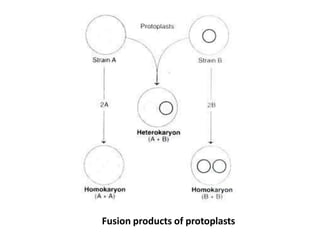
About 20-25% of the protoplasts are actually
involved in the fusion. After the fusion process,
the protoplast population consists of a
heterogenous mixture of un-fused chloroplasts,
homokaryons and heterokaryons.
Fusion products of protoplasts
It is, therefore, necessary to select the
hybrid cells (heterokaryons). The
commonly used methods employed for
the selection of
visual
hybrid cells are
and cytometric
biochemical,
methods.
C. Identification of Hybrid (Cells)
Plants:
The development of hybrid cells followed
by the generation of hybrid plants requires
a clear proof of genetic contribution from
both the parental protoplasts.
Some of the commonly used approaches
for the identification of hybrid plants are:
Molecular techniques:
Recent developments in molecular biology
have improved the understanding of
genetic constitution of somatic plant
hybrids.
1.Differences in the restriction patterns of
chloroplast and mitochondrial DNAs.
2.Molecular markers such as RFLP
, AFLP
,
RAPD and microsatellites.
3. PCR technology.
Chromosome number in somatic hybrids:
The chromosome number in the somatic
hybrids is generally more than the total
number of both of the parental
protoplasts.
Wide variations are reported which may
be due to the following reasons:
1. Fusion of more than two protoplasts.
2. Irregularities in mitotic cell divisions.
3.In fusogen or electro-induced fusions, about
one third of the fusions occur between more
than two protoplasts.
4.Differences in the status of protoplasts
(actively dividing or quiescent) from the two
species of plants result in formation of
asymmetric hybrids.
5.Asymmetric hybrids may be due to unequal
replication of DNA in the fusing protoplasts.
6.Protoplast isolation and culture may also lead
to somaclonal variations, and thus variations in
chromosome number.
Symmetric hybrids:
If the chromosome number in the hybrid
is the sum of the chromosomes of the two
parental protoplasts, the hybrid is said to be
symmetric.
Symmetric hybrids between incompatible
species are usually sterile. This may be due
to production of 3n hybrids by fusing 2n of
one species with n of another species.
Asymmetric hybrids
Asymmetric hybrids have abnormal or wide
variations in the chromosome number than
the exact total of two species. These hybrids
are usually formatted with full somatic
complement of one parental species while
all or nearly all of the chromosomes of
other parental species are lost during
mitotic divisions.
Cybrids:
The cytoplasmic hybrids where the nucleus is
derived from only one parent and the cytoplasm
is derived from both the parents are referred to
as cybrids.
The phenomenon of formation of cybrids is
regarded as cybridization.
are produced
Normally, cybrids
protoplasts from two phytogenetically
when
distinct
species are fused.
Genetically, cybrids are hybrids only for
cytoplasmic traits.
Hybrids and Somatic Incompatibility:
Many a times, production of full-pledged
hybrids through fusion of protoplasts of
distantly related higher plant species is
rather difficult due to instability of the two
dissimilar genomes in a common
cytoplasm. This phenomenon is referred to
as somatic incompatibility.
Hybrids formed despite somatic
incompatibility may exhibit structural and
developmental abnormalities. Several
generations may be required to eliminate
the undesirable to this
genes. Due
limitation in somatic hybridization,
cybridization involving protoplast fusion for
partial genome transfer is gaining
importance in recent years.
Methodology of Cybridization:
A diagrammatic representation of the
formation of hybrids and cybrids is
given
Hybridization and Cybridization
As the formation of heterokaryon occurs
during hybridization, the nuclei can be
one
stimulated to segregate
protoplast contributes to
so that
the cytoplasm
while the other contributes nucleus alone
(or both nucleus and cytoplasm). In this way
cybridization can be achieved.
Genetic recombination in Asexual or Sterile
Plants:
There are many plants that cannot reproduce
sexually. Somatic hybridization is a novel
approach through which two parental genomes
of a sexual or sterile plants can be brought
together. Thus, by fusing parental protoplasts,
fertile diploids and polyploidy can be produced.
Overcoming
incompatibility:
Barriers of Sexual
crossing between
Sexual
species
genus
(interspecific)
(inter-generic)
two different
and two different
is impossible by
conventional breeding methods. Somatic
hybridization overcomes the sexual
incompatibility barriers.
Fusion between protoplasts
(Solanum tuberosum)
(Lycopersicon esculentum)
of potato
and tomato
has created
pomato (Solanopersicon, a new genus).
2. Interspecific of four different
species of rice
fusion
(Oryza brachyantha, O.
elchngeri, O. officinalis and O. perrieri)
could be done to improve the crop.
Applications of Cybrids:
Cybridization is a wonderful technique wherein
the desired cytoplasm can be transferred in a
single step. Cybrids are important for the
transfer of cytoplasmic male sterility (CMS),
antibiotic and herbicide resistance in
agriculturally useful plants.
Some of the genetic traits in certain plants are
cytoplasmically controlled. This includes some
types of male sterility, resistance to certain
antibiotics and herbicides.
Cybrids of Brassica raphanus that
contain nucleus of B. napus,
chloroplasts of atrazinc resistant B.
campestris and male sterility from
Raphanus sativas have been
developed.
Applications of Somatic hybridization
This technique has opened new possibilities for the in
vitro genetic manipulation of plants to improve the
crops.
1. Disease resistance:
Several interspecific and inter-generic hybrids with
disease resistance have been created. Many disease
resistance genes (e.g., tobacco mosaic virus, potato
virus X, club rot disease) could be successfully
transferred from one species to another.
For example, resistance has been introduced in
tomato against diseases such as TMV, spotted wilt virus
and insect pests.
2. Environmental tolerance:
The genes responsible for the tolerance of
cold, frost and salt could be successfully
introduced through somatic hybridization,
e.g., introduction of cold tolerance gene in
tomato.
3. Quality characters:
Somatic hybrids for the production of high
nicotine content, and low erucic acid have
been developed.
4. Cytoplasmic male sterility:
A modification of hybridization in the form
of cybridization has made it possible to
transfer cytoplasmic male sterility.
5.Somatic hybridization has helped to study the
cytoplasmic genes and their functions helpful in
plant breeding programmes.
6.Protoplast fusion will help in the combination
of mitochondria and chloroplasts to result in a
unique nuclear-cytoplasmic genetic
combination.
7.Somatic hybridization can be done in plants
that are still in juvenile phase.
8.Protoplast transformation (with traits like
nitrogen fixation by incorporating exogenous
DNA) followed by somatic hybridization will yield
innovative plants.
Limitations of Somatic Hybridization:
There are several problems and limitations
associated with somatic hybridization.
1. Somatic, hybridization does not always
produce plants that give fertile and visible
seeds.
2. Regenerated plants obtained from somatic
hybridization are often variable due to
somaclonal variations, chromosomal
elimination, organelle segregation etc.
3. Protoplast culture is frequently
associated with genetic instability.
4.Protoplast fusion between different
species/genus is easy, but the production
of viable somatic hybrids is not possible in
all instances.
5.Some of the somatic hybrids,
particularly when produced by the fusion
of taxonomically different partners, are
unbalanced and not viable.
6. There are limitations in the selection
methods of hybrids, as many of them are not
efficient.
7. There is
expression
no certainty as regards the
of any specific character in
somatic hybridization.
8. Somatic hybridization between two
diploids results in the formation of an
amphidiploid which is not favourable. For this
reason, haploid protoplasts are
recommended in somatic hybridization.

somatic hybrid.pptx

  • 1.
    Presented by :Dr. Nidhi Mahendru Assistant Professor Dept of Biotechnology GNKC,YNR
  • 2.
    Somatic Hybridization Somatic hybridizationbroadly involves in vitro fusion of isolated protoplasts to form a hybrid cell and its subsequent development to form a hybrid plant. Protoplasts provide a novel opportunity to create cells with new genetic constitution. Protoplast fusion is a wonderful approach to overcome sexual incompatibility between different species of plants.
  • 3.
    Somatic hybridization involvesthe following aspects: A. Fusion of protoplasts B. Selection of hybrid cells C. Identification of hybrid plants.
  • 4.
    A. Fusion ofProtoplasts: Isolated protoplasts are devoid of cell walls, therefore, in vitro fusion becomes relatively easy. There are no barriers of incompatibility (at interspecific, inter- generic or even at inter-kingdom levels) for the protoplast fusion. two different Protoplast fusion of genomes can be achieved by spontaneous, mechanical, or induced fusion methods.
  • 5.
    Spontaneous fusion: Enzymatic degradationof cell walls leads to fusion of the adjoining protoplasts to form homokaryons. These fused cells may sometimes contain high number of nuclei (2-40). This is mainly because subsequent dissolution of expansion and of plasmodermal connections between cells. The frequency of homokaryon formation is likely to be high in protoplasts isolated from dividing cultured cells. Spontaneously fused protoplasts, however, cannot regenerate into whole plants, except undergoing a few cell divisions.
  • 6.
    Mechanical fusion: The protoplastscan be pushed together mechanically to fuse. Protoplasts of Lilium and Trillium in enzyme solutions can be fused by gentle trapping in a depression slide. Mechanical fusion may damage protoplasts by causing injuries.
  • 7.
    Induced fusion: Freshly isolatedprotoplasts can be fused by induction. There are several fusion- inducing agents which are collectively referred to as fusogens e.g. NaN03, high pH/Ca2+, polyethylene glycol, polyvinyl alcohol, lysozyme, concavalin A, dextran, dextran sulfate, fatty acids and esters, electro fusion
  • 8.
  • 9.
    The fusion ofprotoplasts involves three phases namely agglutination, plasma membrane fusion and formation of heterokaryons. 1. Agglutination (adhesion): When two protoplasts are in close contact with each other, adhesion occurs. Agglutination can be induced by fusogens e.g. PEG, high pH and high Ca2+.
  • 10.
    2. Plasma membranefusion: Protoplast membranes get fused at localized sites at the points of adhesion. This leads to the formation of cytoplasmic bridges between protoplasts. The plasma membrane fusion can be increased by high pH and high Ca2+, high temperature and PEC
  • 11.
    3. Formation ofheterokaryons: The fused protoplasts get rounded as a result of cytoplasmic bridges leading to the formation of spherical homokaryon or heterokaryon. B. Selection of Hybrid Cells: About 20-25% of the protoplasts are actually involved in the fusion. After the fusion process, the protoplast population consists of a heterogenous mixture of un-fused chloroplasts, homokaryons and heterokaryons.
  • 12.
    Fusion products ofprotoplasts
  • 13.
    It is, therefore,necessary to select the hybrid cells (heterokaryons). The commonly used methods employed for the selection of visual hybrid cells are and cytometric biochemical, methods.
  • 14.
    C. Identification ofHybrid (Cells) Plants: The development of hybrid cells followed by the generation of hybrid plants requires a clear proof of genetic contribution from both the parental protoplasts. Some of the commonly used approaches for the identification of hybrid plants are:
  • 15.
    Molecular techniques: Recent developmentsin molecular biology have improved the understanding of genetic constitution of somatic plant hybrids. 1.Differences in the restriction patterns of chloroplast and mitochondrial DNAs. 2.Molecular markers such as RFLP , AFLP , RAPD and microsatellites. 3. PCR technology.
  • 16.
    Chromosome number insomatic hybrids: The chromosome number in the somatic hybrids is generally more than the total number of both of the parental protoplasts. Wide variations are reported which may be due to the following reasons: 1. Fusion of more than two protoplasts. 2. Irregularities in mitotic cell divisions.
  • 17.
    3.In fusogen orelectro-induced fusions, about one third of the fusions occur between more than two protoplasts. 4.Differences in the status of protoplasts (actively dividing or quiescent) from the two species of plants result in formation of asymmetric hybrids. 5.Asymmetric hybrids may be due to unequal replication of DNA in the fusing protoplasts. 6.Protoplast isolation and culture may also lead to somaclonal variations, and thus variations in chromosome number.
  • 18.
    Symmetric hybrids: If thechromosome number in the hybrid is the sum of the chromosomes of the two parental protoplasts, the hybrid is said to be symmetric. Symmetric hybrids between incompatible species are usually sterile. This may be due to production of 3n hybrids by fusing 2n of one species with n of another species.
  • 19.
    Asymmetric hybrids Asymmetric hybridshave abnormal or wide variations in the chromosome number than the exact total of two species. These hybrids are usually formatted with full somatic complement of one parental species while all or nearly all of the chromosomes of other parental species are lost during mitotic divisions.
  • 20.
    Cybrids: The cytoplasmic hybridswhere the nucleus is derived from only one parent and the cytoplasm is derived from both the parents are referred to as cybrids. The phenomenon of formation of cybrids is regarded as cybridization. are produced Normally, cybrids protoplasts from two phytogenetically when distinct species are fused. Genetically, cybrids are hybrids only for cytoplasmic traits.
  • 21.
    Hybrids and SomaticIncompatibility: Many a times, production of full-pledged hybrids through fusion of protoplasts of distantly related higher plant species is rather difficult due to instability of the two dissimilar genomes in a common cytoplasm. This phenomenon is referred to as somatic incompatibility.
  • 22.
    Hybrids formed despitesomatic incompatibility may exhibit structural and developmental abnormalities. Several generations may be required to eliminate the undesirable to this genes. Due limitation in somatic hybridization, cybridization involving protoplast fusion for partial genome transfer is gaining importance in recent years.
  • 23.
    Methodology of Cybridization: Adiagrammatic representation of the formation of hybrids and cybrids is given
  • 25.
    Hybridization and Cybridization Asthe formation of heterokaryon occurs during hybridization, the nuclei can be one stimulated to segregate protoplast contributes to so that the cytoplasm while the other contributes nucleus alone (or both nucleus and cytoplasm). In this way cybridization can be achieved.
  • 26.
    Genetic recombination inAsexual or Sterile Plants: There are many plants that cannot reproduce sexually. Somatic hybridization is a novel approach through which two parental genomes of a sexual or sterile plants can be brought together. Thus, by fusing parental protoplasts, fertile diploids and polyploidy can be produced.
  • 27.
    Overcoming incompatibility: Barriers of Sexual crossingbetween Sexual species genus (interspecific) (inter-generic) two different and two different is impossible by conventional breeding methods. Somatic hybridization overcomes the sexual incompatibility barriers.
  • 28.
    Fusion between protoplasts (Solanumtuberosum) (Lycopersicon esculentum) of potato and tomato has created pomato (Solanopersicon, a new genus). 2. Interspecific of four different species of rice fusion (Oryza brachyantha, O. elchngeri, O. officinalis and O. perrieri) could be done to improve the crop.
  • 29.
    Applications of Cybrids: Cybridizationis a wonderful technique wherein the desired cytoplasm can be transferred in a single step. Cybrids are important for the transfer of cytoplasmic male sterility (CMS), antibiotic and herbicide resistance in agriculturally useful plants. Some of the genetic traits in certain plants are cytoplasmically controlled. This includes some types of male sterility, resistance to certain antibiotics and herbicides.
  • 30.
    Cybrids of Brassicaraphanus that contain nucleus of B. napus, chloroplasts of atrazinc resistant B. campestris and male sterility from Raphanus sativas have been developed.
  • 31.
    Applications of Somatichybridization This technique has opened new possibilities for the in vitro genetic manipulation of plants to improve the crops. 1. Disease resistance: Several interspecific and inter-generic hybrids with disease resistance have been created. Many disease resistance genes (e.g., tobacco mosaic virus, potato virus X, club rot disease) could be successfully transferred from one species to another. For example, resistance has been introduced in tomato against diseases such as TMV, spotted wilt virus and insect pests.
  • 32.
    2. Environmental tolerance: Thegenes responsible for the tolerance of cold, frost and salt could be successfully introduced through somatic hybridization, e.g., introduction of cold tolerance gene in tomato. 3. Quality characters: Somatic hybrids for the production of high nicotine content, and low erucic acid have been developed.
  • 33.
    4. Cytoplasmic malesterility: A modification of hybridization in the form of cybridization has made it possible to transfer cytoplasmic male sterility.
  • 34.
    5.Somatic hybridization hashelped to study the cytoplasmic genes and their functions helpful in plant breeding programmes. 6.Protoplast fusion will help in the combination of mitochondria and chloroplasts to result in a unique nuclear-cytoplasmic genetic combination. 7.Somatic hybridization can be done in plants that are still in juvenile phase. 8.Protoplast transformation (with traits like nitrogen fixation by incorporating exogenous DNA) followed by somatic hybridization will yield innovative plants.
  • 35.
    Limitations of SomaticHybridization: There are several problems and limitations associated with somatic hybridization. 1. Somatic, hybridization does not always produce plants that give fertile and visible seeds. 2. Regenerated plants obtained from somatic hybridization are often variable due to somaclonal variations, chromosomal elimination, organelle segregation etc.
  • 36.
    3. Protoplast cultureis frequently associated with genetic instability. 4.Protoplast fusion between different species/genus is easy, but the production of viable somatic hybrids is not possible in all instances. 5.Some of the somatic hybrids, particularly when produced by the fusion of taxonomically different partners, are unbalanced and not viable.
  • 37.
    6. There arelimitations in the selection methods of hybrids, as many of them are not efficient. 7. There is expression no certainty as regards the of any specific character in somatic hybridization. 8. Somatic hybridization between two diploids results in the formation of an amphidiploid which is not favourable. For this reason, haploid protoplasts are recommended in somatic hybridization.