indrajaydelvadiya@gmail.com
9033332413
Somatic hybridization
Somatic hybridiztion refers to crossing of crop plants
though fusion of somatic cell.
The fusion of somatic cell takes place through protoplasts.
Protoplast is a plant, bacterial or fungal cell that had its
cell wall completely or partially removed using either
mechanical or enzymatic means.
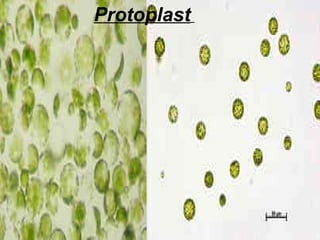
Protoplast = cell- cell wall
Protoplast are plant cell with the plasma membrane
but without the cell wall. Protoplast allow the fusion of
similar or different species and the fused product can
generate into the whole plant.
Feature of somatic hybrid.
In which sexual process is bypassed.
This method essential for regeneration of somatic hybrid in
whole plant.
In this method there is equal contribution of cytoplasam
from both parents.
For regenration of protoplast specific nutrient medium is
used which differs from species to species.
Hybridization between two diploid species leads to
production of allotetraploid hybrid, whereas sexual fusion
between two diploid species leads to production of diploid
hybrid.
It overcome the barrier of cross incompatibility and permit
the hybridization between any two plant species whether
they are related or unrelated.
Types of somatic hybrid:-
1.Inter specific hybrid
2.Intra generic hybrid
3.Intertribal hybrid
• Symmetrical hybrid
• Asymmetrical hybrid
• Cybrids
1. Interspecific hybrids :- hybrid between two different
species of the same genus are referred to as interspecific
hybrids.such hybrid have been obtained in tobacco
,potato, carrot, datura etc.somatic hybrid have been
obtained in sexually compatible as well as incompatible
species of tobacco and incompatible species of datura.
2. Intergeneric hybrid:- hybrid between two different
genera of the same family are known as intergeneric
hybrid. somatic intergeneric hybrid have been obtained
between tobacco + tomato , potato + tomato , datura +
atropa belladonna and several other species.
3. Intertribal hybrids :- hybrids between plants of two
different tribes are called Intertribal hybrids .
 Based on combination of chromosome and cytoplasam
from parent species , somatic hybrid are of three type.
 Symmetrical hybrids:- Those somatic hybrid plants or
cells that contain all chromosomes of both the species
involved in the fusion are referred to as symmetrical
hybrid.
Ex ., tobacco , carrot.
 Asymmetrical hybrids :- Those somatic hybrid plants or
cells that contain complement somatic compliment of
one species and only a part of somatic compliment of
Ex., tobacco , potato.
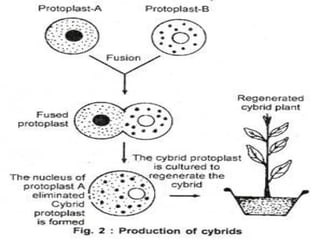
Cybrids :- Those somatic hybrid that involve normal
protoplast of one species and nucleus less protoplast of
another species are known as cybrids . Such hybrids
are useful in transfer of CMS from one species to other.
Cybrids are produced in variable frequencies in normal
protoplast fusion experiments due to one of the following:-
I. Fusion of normal protoplast of one species with an
enucleated protoplast of the other species.
II.Elimination of the nucleus of one species from anormal
heterokaryon.
3. Gradual elimination of the chromosomes of one species
from a hybrid cell during the subsequent divisions.
Cybrids may be produced in relatively high frequency by
i. Irradiating protoplast of one species prior to fusion in order
to inactivate their nuclei,
ii.By preparing enucleate protoplast of one species and
fusing that with normal protoplast of other species.
Steps in somatic hybridization-
1.Isolation of protoplast .
2.Fusion of protoplast .
3.Selection of hybrid cell.
4.Regeneration of plants from hybrid tissue .
5.Culture of hybrid cell. And characterization of hybrid
plants.
Protoplast
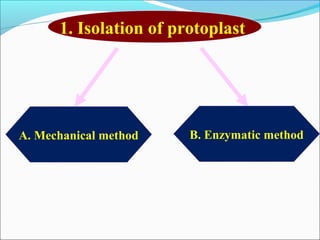
1. Isolation of protoplast
A. Mechanical method B. Enzymatic method
1. Isolation of Protoplast-
In 1892, Klercker first isolate protoplast by plasmolysing
and subsequently slicing the tissue.
In 1960, Cocking demonstrate the enzymatic isolation of a
large number of protoplast from cells of higher plants. (by
using concentrated solution of cellulase enzyme)
In 1968, Tkebe et al first employed the commercial
preparation of the enzyme for protoplast isolation. (using
macerozyme and cellulase).
Protoplast are plant cell with the plasma membrane but
without the cell wall. Protoplast allow the fusion of similar or
different species and the fused product can generate into
the whole plant.
Protoplast can be isolated from almost all plant parts viz
namely roots, leaves, tubers, root nodules, fruits,
endosperms, pollen mother cells, pollen, pollen tetrad,
embryogenic or non-embryogenic suspension culture.
More recently viable protoplast have been isolated from
male and female gametes.
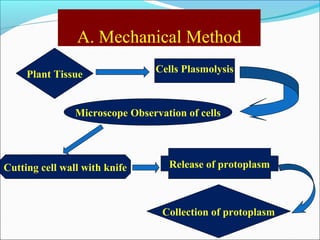
A. Mechanical Method
Plant Tissue
Collection of protoplasm
Cells Plasmolysis
Microscope Observation of cells
Cutting cell wall with knife Release of protoplasm
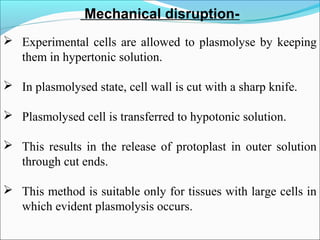
Mechanical disruption-
 Experimental cells are allowed to plasmolyse by keeping
them in hypertonic solution.
 In plasmolysed state, cell wall is cut with a sharp knife.
 Plasmolysed cell is transferred to hypotonic solution.
 This results in the release of protoplast in outer solution
through cut ends.
 This method is suitable only for tissues with large cells in
which evident plasmolysis occurs.
Limitation
 Used for vacuolated cells like onion bulb scale,
radish and beet root tissues
 Low yield of protoplast
 Laborious and tedious process
 Low protoplast viability
Material reqirement:-
Plant leaves
13% Mannitol
CPW salt solution
Enzyme solutions
 Macerase and Cellulase
Petri plate/ glass tubes
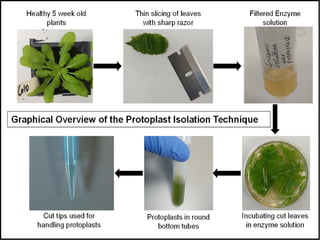
Enzymatic method:-
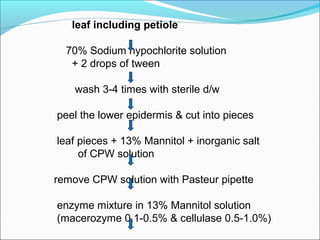
leaf including petiole
70% Sodium hypochlorite solution
+ 2 drops of tween
wash 3-4 times with sterile d/w
peel the lower epidermis & cut into pieces
leaf pieces + 13% Mannitol + inorganic salt
of CPW solution
remove CPW solution with Pasteur pipette
enzyme mixture in 13% Mannitol solution
(macerozyme 0.1-0.5% & cellulase 0.5-1.0%)
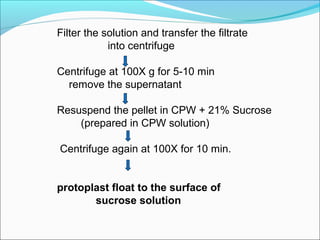
Filter the solution and transfer the filtrate
into centrifuge
Centrifuge at 100X g for 5-10 min
remove the supernatant
Resuspend the pellet in CPW + 21% Sucrose
(prepared in CPW solution)
Centrifuge again at 100X for 10 min.
protoplast float to the surface of
sucrose solution
Advantages
 Used for variety of tissues and organs including leaves,
petioles, fruits, roots, coleoptiles, hypocotyls, stem, shoot
apices, embryo microspores
 Mesophyll tissue - most suitable source
 High yield of protoplast
 Easy to perform
 More protoplast viability
2.Protoplast fusion
Two things are essential for protoplast fusion technology;
protoplast must be isolated in large quantities and isolated
protoplast s should have the ability to regenerate in to new
plants. Crop plants in which protoplast can be isolated from
mesophyll cells and callus culture are given below.
Mesophyll cells :- tobacco , datura , rapeseed , field pea ,
french bean, cowpea.
Callus cell :- carrot ,sugarcane, barley, rice , wheat ,
soyabean , cotton.
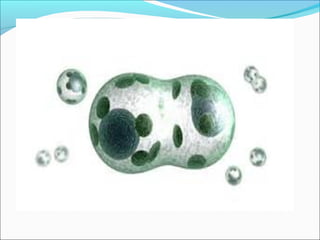
Steps of protoplast fusion
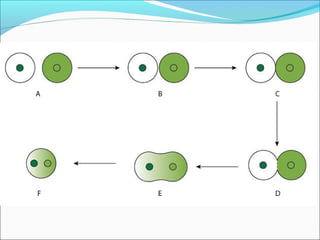
Plasma membranes of two or more protoplast come in to
contact.
Fusion of membrain at small localized regions making
bridge between protoplast.
Extension of cytoplasmic bridges and rounding off of the
protoplast forming spherical homokaryons or hetrokaryons.
After fusion mixing of the cytoplasam of two cells occurs.
There is equal cytoplasmic contribution from both
parent.the culture requirement of protoplast are similar two
those single cells.
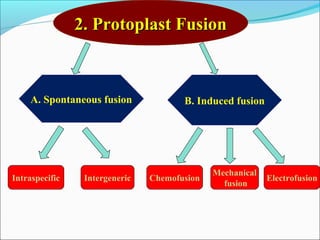
2. Protoplast Fusion2. Protoplast Fusion
A. Spontaneous fusion B. Induced fusion
Intraspecific Intergeneric Electrofusion
Mechanical
fusion
Chemofusion
A. Spontanious fusion-
 Protoplast fuse spontaneously during isolation
process mainly due to physical contact
 Intraspecific
 Intergeneric
Intraspecific protoplast fusion
Intraspecific protoplast fusion is the cross between the
same species.
This technique offers the only way of carrying out crosses
and genetic analysis.
Interspecific protoplast fusion
Interspecific protoplast fusion is the crosses between two
different species.
Interspecific protoplast fusions are of much importance in
the area where new products are to be produced.
Due to new genetic set up many noval secondary
metabolites such as, antibiotics may be produced.
B. Induced fusion
Chemofusion:-
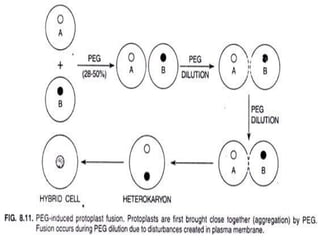
chemical method involves treatment of protoplast with
polyethylene glycol(PEG) .
 This induces agglutination of the protoplast and their
fusion occure after dilution of PEG with a solution
containing high concentration of calcium ions at high Ph.
The frequency of fusion varies from 1 to 20% depending
upon cell type and fusion condition employed.
 Mechanical fusion:-
 Physical fusion of protoplasts under microscope by using
micromanipulator and perfusion micropipette.
 Electro fusion:
 Fusion induced by electrical stimulationFusion of
protoplasts of pearl chain is induced by the application
of high strength electric field (100kv m-1
) for few microsec.
3.Selection of hybrid :-
After fusion , there is mixture of parental type ,
homokaryons and hetrokeryons .
 Union of porotoplast of the same specie s leads to the
development of homokaryons .
 Union between protoplast of two different species gives rise
to hetrokaryons .
Generally , desired fusion product represent less than 10% of
the fusion mixture .
 Various method are used for identificaton of hetrokaryons
or desired fusion products.
Hybrid cell can be identify by hybrid vigour at the callus
stage by morphology.
Which is often intermidiate between the parents .
RFLP and PCR can be used for identification of hybrid cell.
4.Culture of hybrid cell and
characterization
Hybrid cells are culture in a medium which is highly
enriched with organic compound .
 Growth hormones such as auxins and cytokinins are always
required in the culture medium .
MS medium with suitable modification is used for cultured
hybrid cells.
In culture medium , protoplast regenerate a new cell wall
within 2-4 days and cell division starts within 2-7 days
depending upon the plant species.
Plants are regenerate from hybrid tissue . Regenerated
hybrid plants are characterised for highly heritable
character such as shape , size and colour of leaf , flower,
5.Uses
1. Overcome cross incompatibility:- it permit gene
transfer between distantly related species and unrelated
species . Thus, it is a power ful tool for modification and
genetic improvement of polygenic character.
2. Permits modification of cytoplasmic gene:- hybrid
contain of a mixture of two fusion partners. Thus
modification of chloroplast and mitochondrial DNA is
possible by this method.
3. Production of somatic hybrid.
5. Production of allotetra ploid:- somatic hybrid contain
diploid chromosome complements of both the parent
species. Thus it is useful in production of allotetraploid
plants in a single step.
6. Conservation of heterosis :- In somatic hybrids,
segregation does not occur. Therefor , heterosis can be easily
conserved in such crosses.
6. Development of transgenic hybrid:- genetic
transformation of hybrid cell lead to development of
transgenic hybrids.
7. Transfer of CMS:-- it is also used for transfer of CMS from
6.Limitations
It is used only those species only where regeneration of
plants is possible from protoplast. i.e., protoplast are
totipotent.
 It is fertile between closely related species. In other word
interspecific somatic hybrid are generally fertile and
intergeneric somatic hybrid are useally sterile.
Interspecific somatic hybrids are mostly polyploid and
often contain many unwanted traits derived from the wild
species .several backcross with cultivated species are
required to eliminate undesirable character.
Generally, intergeneric and intertriabal hybrids exhibit high
degree of sterility and can not be backcross with the
cultivated with the cultivated species.
7.Achievements
Protoplast of sexually sterile (haploid, triploid,
aneuploid) can be fused to produce fertile diploid plant.
It overcome the sexually incompatibility barrier.
Disease resistant or insect resistant plant production.
Enhance the productivity of crops.
Monoclonal antibody production.
Intertribal hybrids have been developed between
Brassica + Arabidopsis and Brassica + Lesquerella
fendleri.
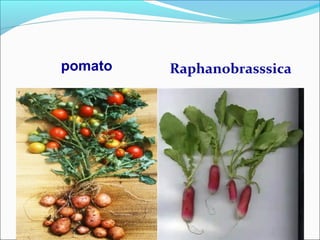
Two new crops . Viz., pomato(potato+tomato) and
Raphanobrasssica ( Raphanus sativus+ brassica oleracea )
have been developed by somatic hybridization. However ,
both have combination of undesirable character.
Cybrid are provide these unique opportunities:-
i. Transfer of plasmagene of species in to nucleur background
of another species in a single generation even in,
ii.Sexually incompatible combinatio
iii.Recovery of recombination between the parental
mitochondrial or chloroplast DNA.
Cybrid hybrid allow to the mitochondria of one species to
be combined with the choloroplast of the other species
involved in the fusion.
As a result most of the cybrid plants contain mitochondria
of only one of the two fusion parents. the same is true for
the choloroplast as well.
Some of the cybrid plats contain mitochondria from one
fusion parents and choloroplast from the other parent.
This feature has been used to correct the deficiency of
cholorosis at the low temparature due to the cytoplasmic
male sterility of B. napus (transferred from radish).
pomato Raphanobrasssica
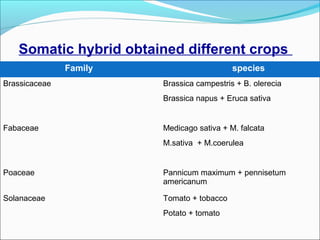
Somatic hybrid obtained different crops
Family species
Brassicaceae Brassica campestris + B. olerecia
Brassica napus + Eruca sativa
Fabaceae Medicago sativa + M. falcata
M.sativa + M.coerulea
Poaceae Pannicum maximum + pennisetum
americanum
Solanaceae Tomato + tobacco
Potato + tomato
REFRANCE
1. Name of book:- Essential Of Plant Breeding.
& Plant breeding: Principles and Methods.
2.Authour:- Phundan Singh & B.D.Singh.
3.Publisher :- Kalyani Publishers.
4.Page No. :- 262 - 268.
& 819-823.
Protoplast isolation and fusion

Protoplast isolation and fusion

  • 1.
  • 2.
    Somatic hybridization Somatic hybridiztionrefers to crossing of crop plants though fusion of somatic cell. The fusion of somatic cell takes place through protoplasts. Protoplast is a plant, bacterial or fungal cell that had its cell wall completely or partially removed using either mechanical or enzymatic means. Protoplast = cell- cell wall Protoplast are plant cell with the plasma membrane but without the cell wall. Protoplast allow the fusion of similar or different species and the fused product can generate into the whole plant.
  • 3.
    Feature of somatichybrid. In which sexual process is bypassed. This method essential for regeneration of somatic hybrid in whole plant. In this method there is equal contribution of cytoplasam from both parents. For regenration of protoplast specific nutrient medium is used which differs from species to species. Hybridization between two diploid species leads to production of allotetraploid hybrid, whereas sexual fusion between two diploid species leads to production of diploid hybrid.
  • 4.
    It overcome thebarrier of cross incompatibility and permit the hybridization between any two plant species whether they are related or unrelated. Types of somatic hybrid:- 1.Inter specific hybrid 2.Intra generic hybrid 3.Intertribal hybrid • Symmetrical hybrid • Asymmetrical hybrid • Cybrids
  • 5.
    1. Interspecific hybrids:- hybrid between two different species of the same genus are referred to as interspecific hybrids.such hybrid have been obtained in tobacco ,potato, carrot, datura etc.somatic hybrid have been obtained in sexually compatible as well as incompatible species of tobacco and incompatible species of datura. 2. Intergeneric hybrid:- hybrid between two different genera of the same family are known as intergeneric hybrid. somatic intergeneric hybrid have been obtained between tobacco + tomato , potato + tomato , datura + atropa belladonna and several other species.
  • 6.
    3. Intertribal hybrids:- hybrids between plants of two different tribes are called Intertribal hybrids .  Based on combination of chromosome and cytoplasam from parent species , somatic hybrid are of three type.  Symmetrical hybrids:- Those somatic hybrid plants or cells that contain all chromosomes of both the species involved in the fusion are referred to as symmetrical hybrid. Ex ., tobacco , carrot.  Asymmetrical hybrids :- Those somatic hybrid plants or cells that contain complement somatic compliment of one species and only a part of somatic compliment of
  • 7.
    Ex., tobacco ,potato. Cybrids :- Those somatic hybrid that involve normal protoplast of one species and nucleus less protoplast of another species are known as cybrids . Such hybrids are useful in transfer of CMS from one species to other. Cybrids are produced in variable frequencies in normal protoplast fusion experiments due to one of the following:- I. Fusion of normal protoplast of one species with an enucleated protoplast of the other species. II.Elimination of the nucleus of one species from anormal heterokaryon.
  • 8.
    3. Gradual eliminationof the chromosomes of one species from a hybrid cell during the subsequent divisions. Cybrids may be produced in relatively high frequency by i. Irradiating protoplast of one species prior to fusion in order to inactivate their nuclei, ii.By preparing enucleate protoplast of one species and fusing that with normal protoplast of other species.
  • 10.
    Steps in somatichybridization- 1.Isolation of protoplast . 2.Fusion of protoplast . 3.Selection of hybrid cell. 4.Regeneration of plants from hybrid tissue . 5.Culture of hybrid cell. And characterization of hybrid plants.
  • 11.
  • 12.
    1. Isolation ofprotoplast A. Mechanical method B. Enzymatic method
  • 13.
    1. Isolation ofProtoplast- In 1892, Klercker first isolate protoplast by plasmolysing and subsequently slicing the tissue. In 1960, Cocking demonstrate the enzymatic isolation of a large number of protoplast from cells of higher plants. (by using concentrated solution of cellulase enzyme) In 1968, Tkebe et al first employed the commercial preparation of the enzyme for protoplast isolation. (using macerozyme and cellulase).
  • 14.
    Protoplast are plantcell with the plasma membrane but without the cell wall. Protoplast allow the fusion of similar or different species and the fused product can generate into the whole plant. Protoplast can be isolated from almost all plant parts viz namely roots, leaves, tubers, root nodules, fruits, endosperms, pollen mother cells, pollen, pollen tetrad, embryogenic or non-embryogenic suspension culture. More recently viable protoplast have been isolated from male and female gametes.
  • 16.
    A. Mechanical Method PlantTissue Collection of protoplasm Cells Plasmolysis Microscope Observation of cells Cutting cell wall with knife Release of protoplasm
  • 17.
    Mechanical disruption-  Experimentalcells are allowed to plasmolyse by keeping them in hypertonic solution.  In plasmolysed state, cell wall is cut with a sharp knife.  Plasmolysed cell is transferred to hypotonic solution.  This results in the release of protoplast in outer solution through cut ends.  This method is suitable only for tissues with large cells in which evident plasmolysis occurs.
  • 18.
    Limitation  Used forvacuolated cells like onion bulb scale, radish and beet root tissues  Low yield of protoplast  Laborious and tedious process  Low protoplast viability
  • 19.
    Material reqirement:- Plant leaves 13%Mannitol CPW salt solution Enzyme solutions  Macerase and Cellulase Petri plate/ glass tubes Enzymatic method:-
  • 20.
    leaf including petiole 70%Sodium hypochlorite solution + 2 drops of tween wash 3-4 times with sterile d/w peel the lower epidermis & cut into pieces leaf pieces + 13% Mannitol + inorganic salt of CPW solution remove CPW solution with Pasteur pipette enzyme mixture in 13% Mannitol solution (macerozyme 0.1-0.5% & cellulase 0.5-1.0%)
  • 21.
    Filter the solutionand transfer the filtrate into centrifuge Centrifuge at 100X g for 5-10 min remove the supernatant Resuspend the pellet in CPW + 21% Sucrose (prepared in CPW solution) Centrifuge again at 100X for 10 min. protoplast float to the surface of sucrose solution
  • 22.
    Advantages  Used forvariety of tissues and organs including leaves, petioles, fruits, roots, coleoptiles, hypocotyls, stem, shoot apices, embryo microspores  Mesophyll tissue - most suitable source  High yield of protoplast  Easy to perform  More protoplast viability
  • 23.
    2.Protoplast fusion Two thingsare essential for protoplast fusion technology; protoplast must be isolated in large quantities and isolated protoplast s should have the ability to regenerate in to new plants. Crop plants in which protoplast can be isolated from mesophyll cells and callus culture are given below. Mesophyll cells :- tobacco , datura , rapeseed , field pea , french bean, cowpea. Callus cell :- carrot ,sugarcane, barley, rice , wheat , soyabean , cotton.
  • 25.
    Steps of protoplastfusion Plasma membranes of two or more protoplast come in to contact. Fusion of membrain at small localized regions making bridge between protoplast. Extension of cytoplasmic bridges and rounding off of the protoplast forming spherical homokaryons or hetrokaryons. After fusion mixing of the cytoplasam of two cells occurs. There is equal cytoplasmic contribution from both parent.the culture requirement of protoplast are similar two those single cells.
  • 27.
    2. Protoplast Fusion2.Protoplast Fusion A. Spontaneous fusion B. Induced fusion Intraspecific Intergeneric Electrofusion Mechanical fusion Chemofusion
  • 28.
    A. Spontanious fusion- Protoplast fuse spontaneously during isolation process mainly due to physical contact  Intraspecific  Intergeneric
  • 29.
    Intraspecific protoplast fusion Intraspecificprotoplast fusion is the cross between the same species. This technique offers the only way of carrying out crosses and genetic analysis. Interspecific protoplast fusion Interspecific protoplast fusion is the crosses between two different species. Interspecific protoplast fusions are of much importance in the area where new products are to be produced. Due to new genetic set up many noval secondary metabolites such as, antibiotics may be produced.
  • 30.
    B. Induced fusion Chemofusion:- chemicalmethod involves treatment of protoplast with polyethylene glycol(PEG) .  This induces agglutination of the protoplast and their fusion occure after dilution of PEG with a solution containing high concentration of calcium ions at high Ph. The frequency of fusion varies from 1 to 20% depending upon cell type and fusion condition employed.
  • 32.
     Mechanical fusion:- Physical fusion of protoplasts under microscope by using micromanipulator and perfusion micropipette.  Electro fusion:  Fusion induced by electrical stimulationFusion of protoplasts of pearl chain is induced by the application of high strength electric field (100kv m-1 ) for few microsec.
  • 33.
    3.Selection of hybrid:- After fusion , there is mixture of parental type , homokaryons and hetrokeryons .  Union of porotoplast of the same specie s leads to the development of homokaryons .  Union between protoplast of two different species gives rise to hetrokaryons . Generally , desired fusion product represent less than 10% of the fusion mixture .
  • 34.
     Various methodare used for identificaton of hetrokaryons or desired fusion products. Hybrid cell can be identify by hybrid vigour at the callus stage by morphology. Which is often intermidiate between the parents . RFLP and PCR can be used for identification of hybrid cell.
  • 35.
    4.Culture of hybridcell and characterization Hybrid cells are culture in a medium which is highly enriched with organic compound .  Growth hormones such as auxins and cytokinins are always required in the culture medium . MS medium with suitable modification is used for cultured hybrid cells. In culture medium , protoplast regenerate a new cell wall within 2-4 days and cell division starts within 2-7 days depending upon the plant species. Plants are regenerate from hybrid tissue . Regenerated hybrid plants are characterised for highly heritable character such as shape , size and colour of leaf , flower,
  • 36.
    5.Uses 1. Overcome crossincompatibility:- it permit gene transfer between distantly related species and unrelated species . Thus, it is a power ful tool for modification and genetic improvement of polygenic character. 2. Permits modification of cytoplasmic gene:- hybrid contain of a mixture of two fusion partners. Thus modification of chloroplast and mitochondrial DNA is possible by this method. 3. Production of somatic hybrid.
  • 37.
    5. Production ofallotetra ploid:- somatic hybrid contain diploid chromosome complements of both the parent species. Thus it is useful in production of allotetraploid plants in a single step. 6. Conservation of heterosis :- In somatic hybrids, segregation does not occur. Therefor , heterosis can be easily conserved in such crosses. 6. Development of transgenic hybrid:- genetic transformation of hybrid cell lead to development of transgenic hybrids. 7. Transfer of CMS:-- it is also used for transfer of CMS from
  • 38.
    6.Limitations It is usedonly those species only where regeneration of plants is possible from protoplast. i.e., protoplast are totipotent.  It is fertile between closely related species. In other word interspecific somatic hybrid are generally fertile and intergeneric somatic hybrid are useally sterile. Interspecific somatic hybrids are mostly polyploid and often contain many unwanted traits derived from the wild species .several backcross with cultivated species are required to eliminate undesirable character.
  • 39.
    Generally, intergeneric andintertriabal hybrids exhibit high degree of sterility and can not be backcross with the cultivated with the cultivated species.
  • 40.
    7.Achievements Protoplast of sexuallysterile (haploid, triploid, aneuploid) can be fused to produce fertile diploid plant. It overcome the sexually incompatibility barrier. Disease resistant or insect resistant plant production. Enhance the productivity of crops. Monoclonal antibody production. Intertribal hybrids have been developed between Brassica + Arabidopsis and Brassica + Lesquerella fendleri.
  • 41.
    Two new crops. Viz., pomato(potato+tomato) and Raphanobrasssica ( Raphanus sativus+ brassica oleracea ) have been developed by somatic hybridization. However , both have combination of undesirable character. Cybrid are provide these unique opportunities:- i. Transfer of plasmagene of species in to nucleur background of another species in a single generation even in, ii.Sexually incompatible combinatio iii.Recovery of recombination between the parental mitochondrial or chloroplast DNA.
  • 42.
    Cybrid hybrid allowto the mitochondria of one species to be combined with the choloroplast of the other species involved in the fusion. As a result most of the cybrid plants contain mitochondria of only one of the two fusion parents. the same is true for the choloroplast as well. Some of the cybrid plats contain mitochondria from one fusion parents and choloroplast from the other parent. This feature has been used to correct the deficiency of cholorosis at the low temparature due to the cytoplasmic male sterility of B. napus (transferred from radish).
  • 43.
  • 44.
    Somatic hybrid obtaineddifferent crops Family species Brassicaceae Brassica campestris + B. olerecia Brassica napus + Eruca sativa Fabaceae Medicago sativa + M. falcata M.sativa + M.coerulea Poaceae Pannicum maximum + pennisetum americanum Solanaceae Tomato + tobacco Potato + tomato
  • 45.
    REFRANCE 1. Name ofbook:- Essential Of Plant Breeding. & Plant breeding: Principles and Methods. 2.Authour:- Phundan Singh & B.D.Singh. 3.Publisher :- Kalyani Publishers. 4.Page No. :- 262 - 268. & 819-823.