


WELCOME
SOMATIC HYBRIDIZATION
Introduction
Development of hybrid plants through the fusion of
somatic protoplasts of two different plant species/varieties is
called somatic hybridization
History
 Hanstein introduced the term ‘Protoplast’.
 The isolation of protoplasts was first achieved by Klercker (1892) on
plasmolysed cells.
 Cooking (1960) for the first time isolated the protoplasts of plant tissues by
using cell wall degrading enzymes viz., cellulase, hemicellulase, pectinase,
and protease extracted from a saprophytic fungus Trichoderma viride &
Myrothecium verrucaria.
 First achievement in protoplast fusion by Power (1970)
Protoplast
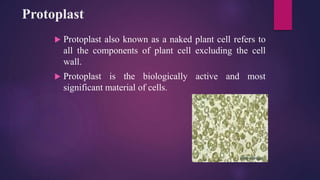
 Protoplast also known as a naked plant cell refers to
all the components of plant cell excluding the cell
wall.
 Protoplast is the biologically active and most
significant material of cells.
 Plant cell wall acts as physical barrier and protects
cytoplasm from microbial invasion and environmental
stress.
 It consists of a complex mixture of cellulose,
hemicellulose, pectin, lignin, lipids, protein,
 For dissolution of different components of the cell wall it
is essential to have the respective enzymes.
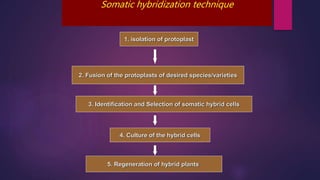
Somatic hybridization technique
1. isolation of protoplast
2. Fusion of the protoplasts of desired species/varieties
3. Identification and Selection of somatic hybrid cells
4. Culture of the hybrid cells
5. Regeneration of hybrid plants
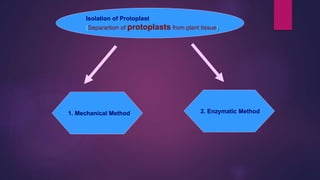
Isolation of Protoplast
(Separartion of protoplasts from plant tissue)
1. Mechanical Method 2. Enzymatic Method
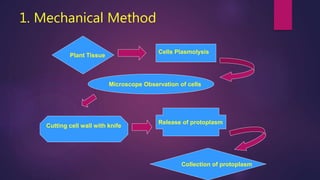
1. Mechanical Method
Plant Tissue
Collection of protoplasm
Cells Plasmolysis
Microscope Observation of cells
Cutting cell wall with knife
Release of protoplasm
1. Mechanical Method
 Used for vacuolated cells like onion bulb scale, radish
and beet root tissues
 Low yield of protoplast
 Laborious and tedious process
 Low protoplast viability
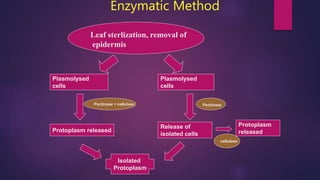
Enzymatic Method
Leaf sterlization, removal of
epidermis
Plasmolysed
cells
Plasmolysed
cells
Pectinase + cellulase Pectinase
Protoplasm released
Release of
isolated cells
cellulase
Protoplasm
released
Isolated
Protoplasm
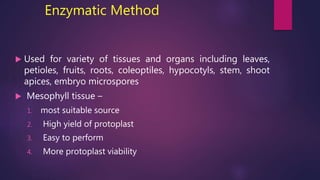
Enzymatic Method
 Used for variety of tissues and organs including leaves,
petioles, fruits, roots, coleoptiles, hypocotyls, stem, shoot
apices, embryo microspores
 Mesophyll tissue –
1. most suitable source
2. High yield of protoplast
3. Easy to perform
4. More protoplast viability
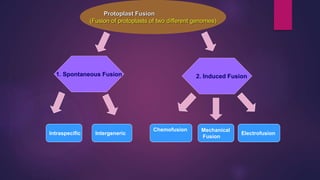
Protoplast Fusion
(Fusion of protoplasts of two different genomes)
1. Spontaneous Fusion 2. Induced Fusion
Intraspecific Intergeneric Electrofusion
Mechanical
Fusion
Chemofusion
Spontaneous Fusion
 Protoplast fuse spontaneously during isolation process mainly due to
physical contact
• Intraspecific
• Interspecific
Intraspecific protoplast fusion
 Intraspecific protoplast fusion is the cross between the same
species in an individual which involves the isogenic strains or
the non-isogenic ones.
 The true value of protoplast fusion as a mean for establishing
parasexual crosses has been realized so far in a few fungi. For
example, in Cephalosporium acremonium.
 This technique offers the only way of carrying out crosses and
genetic analysis.
Interspecific protoplast fusion
 Interspecific protoplast fusion is the crosses between two different
species.
 Interspecific protoplast fusions are of much importance in the area
where new products are to be produced. Due to new genetic set up
many noval secondary metabolites such as, antibiotics, phenolics.,
 Some of the examples where interspecific hybrids were produced
through protoplast fusion are:
- S. cerevisiae x S. fermentali,
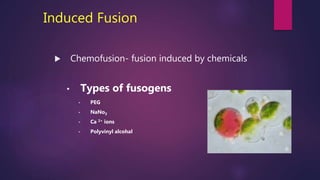
Induced Fusion
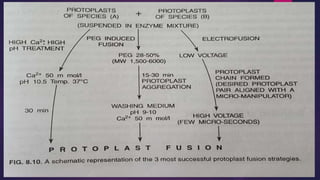
 Chemofusion- fusion induced by chemicals
• Types of fusogens
• PEG
• NaNo3
• Ca 2+ ions
• Polyvinyl alcohal
(i) NaNO3 Treatment:
 Isolated protoplasts are suspended in mixture of 5.5%
NaCO3 and 10% sucrose soln. and incubated in a water bath at
35°C for 5 min. and centrifuged for 5 min. at 200 x g, following
centrifugation the supernatant is decanted and the pellet is
incubated at 30°C for 30 min.
 During this period most of the protoplasts undergo cell fusion.
After sometimes these are washed with osmoticum and then
plated properly in culture medium.
(ii) Calcium Ions at High pH:
 Here the isolated protoplasts are incubated in a solution of
osmoticum containing 0.05 M CaCl2 at pH 10.5 (using 0.05 µ
glycine— NaOH buffer) and at temperature 37°C.
 Aggregation of protoplasts generally takes place at once and
fusion occurs within 10 mins.
 After this treatment, 20-50% of the protoplasts have been
found to be involved in fusion.
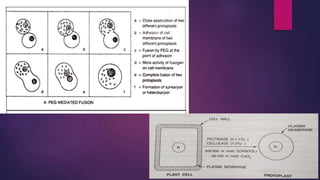
(iii) PEG Treatment:
 PEG has been found to be used as a fusogen in most of the successful
cases of protoplast fusion. 1 ml of protoplast suspension is equally
mixed with 1 ml of 28-56% PEG (1500-6000 MW) solution. The tube is
then allowed to settle for 10 min to 40 min at room temperature.
 Both the mol. wt. and the conc. of PEG used is critical in inducing
successful fusions. After PEG treatment the elution of fusogen is done
by using high pH/Ca++ containing solution which is most effective in
enhancing the fusion frequency and survivability of protoplasts
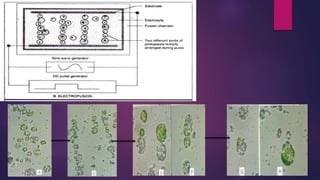
(iv) Electro-fusion:
 Protoplasts are placed into a small cell culture containing electrodes
and a potential difference is applied due to which protoplasts line up
between the electrodes. In this fusion method, two step procedures is
followed:
 Pearl chain of protoplasts is formed by low strength electric field (10kv
m-1)
 Fusion of protoplasts of pearl chain is induced by the application of
high strength electric field (100kv m-1) for few microsec
 Heterokaryons produced by this electro-fusion divide normally in
culture medium and have the capability of regenerating the plantlet
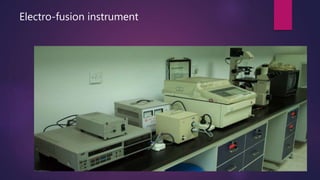
Electro-fusion instrument
Identification and Selection of somatic
hybrid cells
 Hybrid identification- Based on difference between the
parental cells and hybrid cell with respect to
• Pigmentation
• Cytoplasmic markers
• Fluorochromes like FITC (fluoroscein isothiocyanate) and RITC (Rhodamine
isothiocyanate) are used for labelling of hybrid cells
• Presence of chloroplast
• Nuclear staining
• Heterokaryon is stained by carbol-fuschin, aceto-carmine or aceto-orcein
stain
Hybrid Selection
(Several markers are used )
• Genetic complementation
• Phytotoxins
• Specific amino acid
• Auxin autotrophy
• Antibiotics
• Auxotrophic and metabolic mutants
• Chromosomal analysis
• Herbicides
Culture of the hybrid cells
Hybrid cells are cultured on suitable medium provided
with the appropriate culture conditions.
Regeneration of hybrid plants
 Plants are regenerated into whole plant.
 Plants are induced to regenerate from hybrid calli
 These hybrid plants must be at least partially fertile,
in addition to having some useful property, to be of
any use in breeding schemes.
Advantages of somatic hybridization
 Production of novel interspecific and intergeneric
hybrid
 Pomato (Hybrid of potato and tomato)
 Production of fertile diploids and polypoids from
sexually sterile haploids, triploids and aneuploids
 Transfer gene for disease resistance, abiotic stress
resistance, herbicide resistance and many other
quality characters
Advantages of somatic hybridization
 Production of heterozygous lines in the single species
which cannot be propagated by vegetative means
 Studies on the fate of plasma genes
 Production of unique hybrids of nucleus and
cytoplasm
Limitations of Somatic hybridization
 Poor regeneration of hybrid plants
 Non-viability of fused products
 Not successful in all plants.
 Production of unfavorable hybrids
 Lack of an efficient method for selection of hybrids
 No confirmation of expression of particular trait in somatic
hybrids
Cybrids
 are cells or plants containing nucleus of one species but
cytoplasm from both the parental species.
 Cybridization – production of somatic cybrid. The process of
protoplast fusion resulting in the development of cybrid is
known as cybridization.
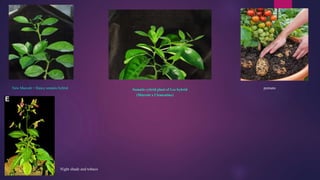
New Murcott + Dancy somatic hybrid Somatic cybrid plant of Lee hybrid
(Murcott x Clementine)
pomato
Night shade and tobaco
Refrence
 SINGH, B. D., (2011), biotechecnology, 2nd edition, kalyanyani
pub.
 SINGH, B. D., (2011), plant breeding: principles and methods,
kalyanyani pub.
 RAJ, A., (2016), Protoplast fusion and somatic hybridization |
biotechnology.
 http://slideshare,in
Thank you

Somatic hybridization faizy

  • 1.
  • 2.
  • 3.
    Introduction Development of hybridplants through the fusion of somatic protoplasts of two different plant species/varieties is called somatic hybridization
  • 4.
    History  Hanstein introducedthe term ‘Protoplast’.  The isolation of protoplasts was first achieved by Klercker (1892) on plasmolysed cells.  Cooking (1960) for the first time isolated the protoplasts of plant tissues by using cell wall degrading enzymes viz., cellulase, hemicellulase, pectinase, and protease extracted from a saprophytic fungus Trichoderma viride & Myrothecium verrucaria.  First achievement in protoplast fusion by Power (1970)
  • 5.
    Protoplast  Protoplast alsoknown as a naked plant cell refers to all the components of plant cell excluding the cell wall.  Protoplast is the biologically active and most significant material of cells.
  • 6.
     Plant cellwall acts as physical barrier and protects cytoplasm from microbial invasion and environmental stress.  It consists of a complex mixture of cellulose, hemicellulose, pectin, lignin, lipids, protein,  For dissolution of different components of the cell wall it is essential to have the respective enzymes.
  • 7.
    Somatic hybridization technique 1.isolation of protoplast 2. Fusion of the protoplasts of desired species/varieties 3. Identification and Selection of somatic hybrid cells 4. Culture of the hybrid cells 5. Regeneration of hybrid plants
  • 8.
    Isolation of Protoplast (Separartionof protoplasts from plant tissue) 1. Mechanical Method 2. Enzymatic Method
  • 9.
    1. Mechanical Method PlantTissue Collection of protoplasm Cells Plasmolysis Microscope Observation of cells Cutting cell wall with knife Release of protoplasm
  • 10.
    1. Mechanical Method Used for vacuolated cells like onion bulb scale, radish and beet root tissues  Low yield of protoplast  Laborious and tedious process  Low protoplast viability
  • 11.
    Enzymatic Method Leaf sterlization,removal of epidermis Plasmolysed cells Plasmolysed cells Pectinase + cellulase Pectinase Protoplasm released Release of isolated cells cellulase Protoplasm released Isolated Protoplasm
  • 12.
    Enzymatic Method  Usedfor variety of tissues and organs including leaves, petioles, fruits, roots, coleoptiles, hypocotyls, stem, shoot apices, embryo microspores  Mesophyll tissue – 1. most suitable source 2. High yield of protoplast 3. Easy to perform 4. More protoplast viability
  • 13.
    Protoplast Fusion (Fusion ofprotoplasts of two different genomes) 1. Spontaneous Fusion 2. Induced Fusion Intraspecific Intergeneric Electrofusion Mechanical Fusion Chemofusion
  • 14.
    Spontaneous Fusion  Protoplastfuse spontaneously during isolation process mainly due to physical contact • Intraspecific • Interspecific
  • 15.
    Intraspecific protoplast fusion Intraspecific protoplast fusion is the cross between the same species in an individual which involves the isogenic strains or the non-isogenic ones.  The true value of protoplast fusion as a mean for establishing parasexual crosses has been realized so far in a few fungi. For example, in Cephalosporium acremonium.  This technique offers the only way of carrying out crosses and genetic analysis.
  • 16.
    Interspecific protoplast fusion Interspecific protoplast fusion is the crosses between two different species.  Interspecific protoplast fusions are of much importance in the area where new products are to be produced. Due to new genetic set up many noval secondary metabolites such as, antibiotics, phenolics.,  Some of the examples where interspecific hybrids were produced through protoplast fusion are: - S. cerevisiae x S. fermentali,
  • 17.
    Induced Fusion  Chemofusion-fusion induced by chemicals • Types of fusogens • PEG • NaNo3 • Ca 2+ ions • Polyvinyl alcohal
  • 18.
    (i) NaNO3 Treatment: Isolated protoplasts are suspended in mixture of 5.5% NaCO3 and 10% sucrose soln. and incubated in a water bath at 35°C for 5 min. and centrifuged for 5 min. at 200 x g, following centrifugation the supernatant is decanted and the pellet is incubated at 30°C for 30 min.  During this period most of the protoplasts undergo cell fusion. After sometimes these are washed with osmoticum and then plated properly in culture medium.
  • 19.
    (ii) Calcium Ionsat High pH:  Here the isolated protoplasts are incubated in a solution of osmoticum containing 0.05 M CaCl2 at pH 10.5 (using 0.05 µ glycine— NaOH buffer) and at temperature 37°C.  Aggregation of protoplasts generally takes place at once and fusion occurs within 10 mins.  After this treatment, 20-50% of the protoplasts have been found to be involved in fusion.
  • 20.
    (iii) PEG Treatment: PEG has been found to be used as a fusogen in most of the successful cases of protoplast fusion. 1 ml of protoplast suspension is equally mixed with 1 ml of 28-56% PEG (1500-6000 MW) solution. The tube is then allowed to settle for 10 min to 40 min at room temperature.  Both the mol. wt. and the conc. of PEG used is critical in inducing successful fusions. After PEG treatment the elution of fusogen is done by using high pH/Ca++ containing solution which is most effective in enhancing the fusion frequency and survivability of protoplasts
  • 22.
    (iv) Electro-fusion:  Protoplastsare placed into a small cell culture containing electrodes and a potential difference is applied due to which protoplasts line up between the electrodes. In this fusion method, two step procedures is followed:  Pearl chain of protoplasts is formed by low strength electric field (10kv m-1)  Fusion of protoplasts of pearl chain is induced by the application of high strength electric field (100kv m-1) for few microsec  Heterokaryons produced by this electro-fusion divide normally in culture medium and have the capability of regenerating the plantlet
  • 24.
  • 26.
    Identification and Selectionof somatic hybrid cells  Hybrid identification- Based on difference between the parental cells and hybrid cell with respect to • Pigmentation • Cytoplasmic markers • Fluorochromes like FITC (fluoroscein isothiocyanate) and RITC (Rhodamine isothiocyanate) are used for labelling of hybrid cells • Presence of chloroplast • Nuclear staining • Heterokaryon is stained by carbol-fuschin, aceto-carmine or aceto-orcein stain
  • 27.
    Hybrid Selection (Several markersare used ) • Genetic complementation • Phytotoxins • Specific amino acid • Auxin autotrophy • Antibiotics • Auxotrophic and metabolic mutants • Chromosomal analysis • Herbicides
  • 28.
    Culture of thehybrid cells Hybrid cells are cultured on suitable medium provided with the appropriate culture conditions.
  • 29.
    Regeneration of hybridplants  Plants are regenerated into whole plant.  Plants are induced to regenerate from hybrid calli  These hybrid plants must be at least partially fertile, in addition to having some useful property, to be of any use in breeding schemes.
  • 30.
    Advantages of somatichybridization  Production of novel interspecific and intergeneric hybrid  Pomato (Hybrid of potato and tomato)  Production of fertile diploids and polypoids from sexually sterile haploids, triploids and aneuploids  Transfer gene for disease resistance, abiotic stress resistance, herbicide resistance and many other quality characters
  • 31.
    Advantages of somatichybridization  Production of heterozygous lines in the single species which cannot be propagated by vegetative means  Studies on the fate of plasma genes  Production of unique hybrids of nucleus and cytoplasm
  • 32.
    Limitations of Somatichybridization  Poor regeneration of hybrid plants  Non-viability of fused products  Not successful in all plants.  Production of unfavorable hybrids  Lack of an efficient method for selection of hybrids  No confirmation of expression of particular trait in somatic hybrids
  • 33.
    Cybrids  are cellsor plants containing nucleus of one species but cytoplasm from both the parental species.  Cybridization – production of somatic cybrid. The process of protoplast fusion resulting in the development of cybrid is known as cybridization.
  • 34.
    New Murcott +Dancy somatic hybrid Somatic cybrid plant of Lee hybrid (Murcott x Clementine) pomato Night shade and tobaco
  • 35.
    Refrence  SINGH, B.D., (2011), biotechecnology, 2nd edition, kalyanyani pub.  SINGH, B. D., (2011), plant breeding: principles and methods, kalyanyani pub.  RAJ, A., (2016), Protoplast fusion and somatic hybridization | biotechnology.  http://slideshare,in
  • 36.