SUSTAINABLE DEVELOPMENT –– AA CCRRIITTIICCAALL 
EENNVVIIRROONNMMEENNTTAALL AAPPPPRRAAIISSAALL 
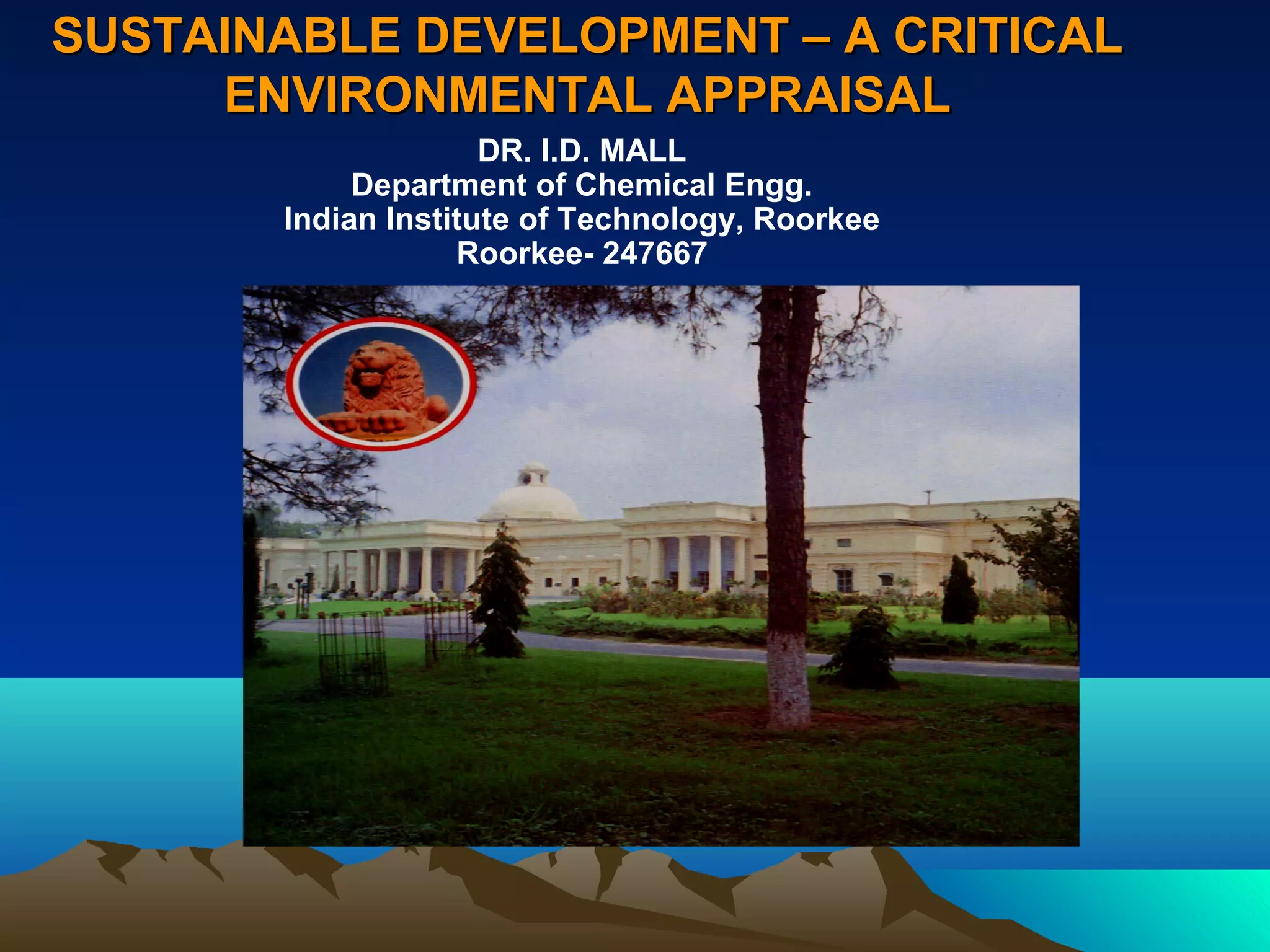
DR. I.D. MALL 
Department of Chemical Engg. 
Indian Institute of Technology, Roorkee 
Roorkee- 247667
SUSTAINABLE DEVELOPMENT –– AA CCRRIITTIICCAALL 
EENNVVIIRROONNMMEENNTTAALL AAPPPPRRAAIISSAALL 
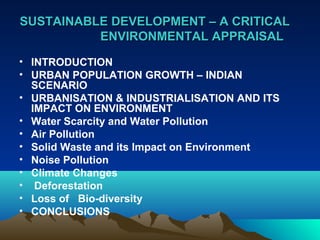
• INTRODUCTION 
• URBAN POPULATION GROWTH – INDIAN 
SCENARIO 
• URBANISATION & INDUSTRIALISATION AND ITS 
IMPACT ON ENVIRONMENT 
• Water Scarcity and Water Pollution 
• Air Pollution 
• Solid Waste and its Impact on Environment 
• Noise Pollution 
• Climate Changes 
• Deforestation 
• Loss of Bio-diversity 
• CONCLUSIONS
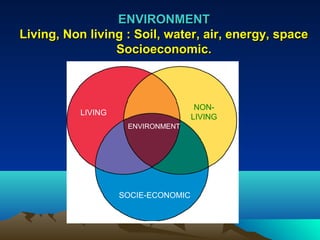
EENNVVIIRROONNMMEENNTT 
LLiivviinngg,, NNoonn lliivviinngg :: SSooiill,, wwaatteerr,, aaiirr,, eenneerrggyy,, ssppaaccee 
SSoocciiooeeccoonnoommiicc.. 
LIVING NON-LIVING 
ENVIRONMENT 
SOCIE-ECONOMIC
According to Hindu mythology, the gods once decided to 
churn the sea (Samudra Manthan) to obtain the pot of 
nectar of immortality (amrut). While churning, along with 
various unique precious things, a stream of poison was 
released and it started damaging and destroying the 
environment. Unless this problem was solved, it was not 
possible to obtain the amrut. When no other god showed 
willingness to handle the poison, Lord Shiva volunteered. He 
drank the whole stream of poison. But if He gulps down, He 
will invite death and hence He stops the poison in His throat. 
Thereafter, Lord Shiva is also known as Neelkanth (blue 
throat). Thus Lord Shiva showed the way to process the 
elements damaging environment and pioneered the concept 
of 'Sustainable Development'.
ORIGIN OOFF TTHHEE SSUUSSTTAAIINNAABBIILLIITTYY CCOONNCCEEPPTT 
• The Rio Declaration on Environment and 
Development 
• The Convention of Climate Change 
• Convention on Biological Diversity 
• Conservation and Sustainable Development of All 
Types of Forests (Forests Principles program).
FFAACCTTOORRSS IINNFFLLUUEENNCCIINNGG SSUUSSTTAAIINNAABBIILLIITTYY 
Sustainability is 
• Safe 
• Universally accepted 
• Stable 
• Technology that benefits all 
• Antipollution 
• Improvement in quality of life 
• Nontoxic 
• Awareness 
• Beautiful 
• Indigenous knowledge 
• Least-cost production 
• Income 
• Total quality 
• Youth
CCAARRRRYYIINNGG CCAAPPAACCIITTYY 
• The number of people the earth can support 
• Biological: maximum limits of global food 
production 
• Cultural: quality of life, the environment, 
future generations 
• Cultural carrying capacity: the size of a 
population that can live in a long-term, 
sustained balance with the environment at a 
reasonable quality of life with land
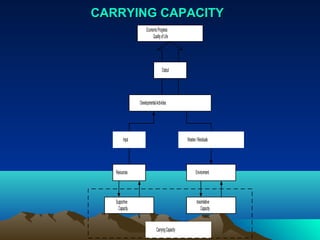
CCAARRRRYYIINNGG CCAAPPAACCIITTYY 
Economic Progress 
Quality of Life 
Output 
Developmental Activities 
Input Wastes / Residuals 
Resources Environment 
Assimilative 
Capacity 
Supportive 
Capacity 
Carrying Capacity
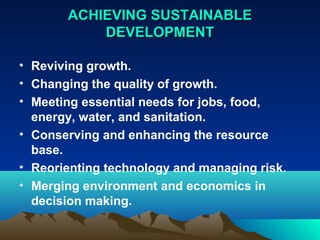
AACCHHIIEEVVIINNGG SSUUSSTTAAIINNAABBLLEE 
DDEEVVEELLOOPPMMEENNTT 
• Reviving growth. 
• Changing the quality of growth. 
• Meeting essential needs for jobs, food, 
energy, water, and sanitation. 
• Conserving and enhancing the resource 
base. 
• Reorienting technology and managing risk. 
• Merging environment and economics in 
decision making.
Mahatma Gandhi [when asked if, after 
independence, India would attain British 
standards of living]: “It took Britain half the 
resources of the planet to achieve its 
prosperity; how many planets will a 
country like India require?”
INTRODUCTION ccoonnttiinnuueedd.... 
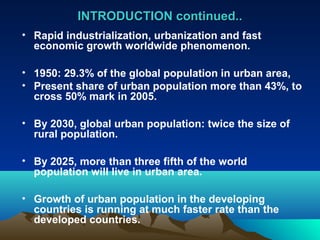
• Rapid industrialization, urbanization and fast 
economic growth worldwide phenomenon. 
• 1950: 29.3% of the global population in urban area, 
• Present share of urban population more than 43%, to 
cross 50% mark in 2005. 
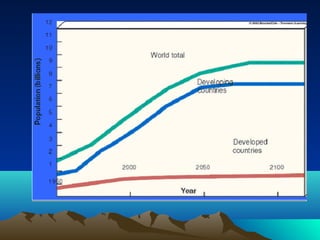
• By 2030, global urban population: twice the size of 
rural population. 
• By 2025, more than three fifth of the world 
population will live in urban area. 
• Growth of urban population in the developing 
countries is running at much faster rate than the 
developed countries.
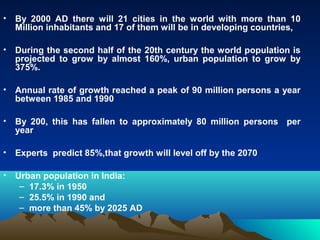
• By 2000 AD there will 21 cities in the world with more than 10 
Million inhabitants and 17 of them will be in developing countries, 
• During the second half of the 20th century the world population is 
projected to grow by almost 160%, urban population to grow by 
375%. 
• Annual rate of growth reached a peak of 90 million persons a year 
between 1985 and 1990 
• By 200, this has fallen to approximately 80 million persons per 
year 
• Experts predict 85%,that growth will level off by the 2070 
• Urban population in India: 
– 17.3% in 1950 
– 25.5% in 1990 and 
– more than 45% by 2025 AD
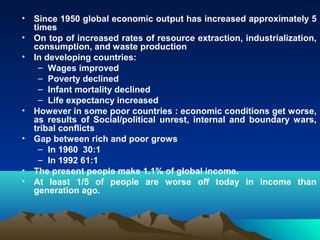
• Since 1950 global economic output has increased approximately 5 
times 
• On top of increased rates of resource extraction, industrialization, 
consumption, and waste production 
• In developing countries: 
– Wages improved 
– Poverty declined 
– Infant mortality declined 
– Life expectancy increased 
• However in some poor countries : economic conditions get worse, 
as results of Social/political unrest, internal and boundary wars, 
tribal conflicts 
• Gap between rich and poor grows 
– In 1960 30:1 
– In 1992 61:1 
• The present people make 1.1% of global income. 
• At least 1/5 of people are worse off today in income than 
generation ago.
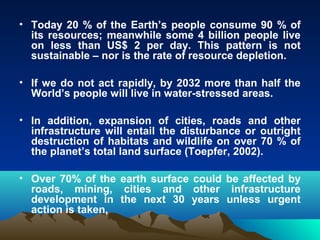
• Today 20 % of the Earth’s people consume 90 % of 
its resources; meanwhile some 4 billion people live 
on less than US$ 2 per day. This pattern is not 
sustainable – nor is the rate of resource depletion. 
• If we do not act rapidly, by 2032 more than half the 
World’s people will live in water-stressed areas. 
• In addition, expansion of cities, roads and other 
infrastructure will entail the disturbance or outright 
destruction of habitats and wildlife on over 70 % of 
the planet’s total land surface (Toepfer, 2002). 
• Over 70% of the earth surface could be affected by 
roads, mining, cities and other infrastructure 
development in the next 30 years unless urgent 
action is taken,
• Automobile pollution is major concern in cities all 
over the world. 
• Loss of biodiversity and climatic changes due to 
large scale deforestation is another major problem 
of urbanization and industrialization. 
• The CO2 level in the atmosphere is increasing, 
causing the earth’s temperature to rise and leading 
to the melting of polar ice caps and glaciers 
• The number of forest fires is also increasing around 
the world. 
• Rivers are running dry. 
• China in 1972 the yellow river did not reach the sea 
for the first time in the history 
• 1977: it did not reach the sea during 226 days 
• Situation in many rivers in India is also alarming
•Plants and animal are taking strong a strong hit; they 
are desperately trying to adapt, but too many will not 
make it 
•Poverty erodes human capital; 
•There are stark social inequities. 20% world population 
accounts for 80% of total consumption 
•Nearly half of the world population( an estimated 2.8 
billion people) lives in less than two dollars a day 
•Modern society has introduced or increased human 
exposure to thousands of chemicals in the environment
Fast growing unplanned and indiscriminate 
urbanization: Cause of recent ecological 
imbalances 
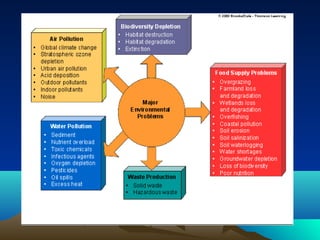
MAJOR ENVIRONMENTAL CRISIS WHICH MANKIND IS 
FACING DUE TO URBAN AND INDUSTRIAL 
DEVELOPMENT ARE: 
• Large scale contamination of water and air. 
• Deforestation 
• Increase in urban slums 
• Generation of huge solid waste consisting of hazardous material. 
• Water scarcity and ground water depletion. 
• Global warming 
• Greenhouse effect 
• Ozone layer depletion
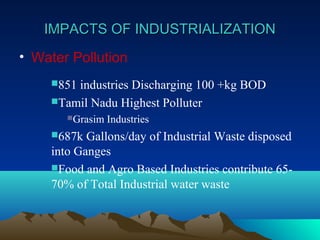
IIMMPPAACCTTSS OOFF IINNDDUUSSTTRRIIAALLIIZZAATTIIOONN 
• Water Pollution 
851 industries Discharging 100 +kg BOD 
Tamil Nadu Highest Polluter 
Grasim Industries 
687k Gallons/day of Industrial Waste disposed 
into Ganges 
Food and Agro Based Industries contribute 65- 
70% of Total Industrial water waste
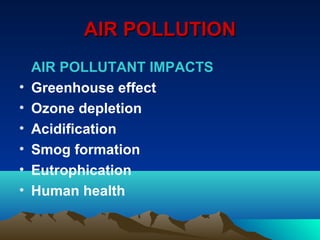
AAIIRR PPOOLLLLUUTTIIOONN 
AIR POLLUTANT IMPACTS 
• Greenhouse effect 
• Ozone depletion 
• Acidification 
• Smog formation 
• Eutrophication 
• Human health
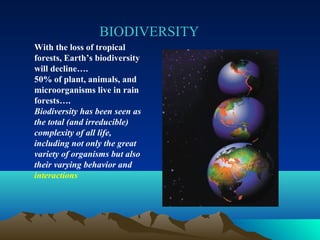
BIODIVERSITY 
With the loss of tropical 
forests, Earth’s biodiversity 
will decline…. 
50% of plant, animals, and 
microorganisms live in rain 
forests…. 
Biodiversity has been seen as 
the total (and irreducible) 
complexity of all life, 
including not only the great 
variety of organisms but also 
their varying behavior and 
interactions
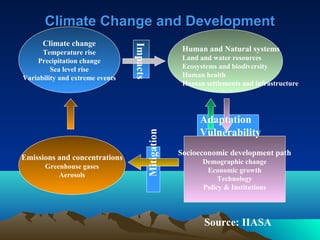
Climate CChhaannggee aanndd DDeevveellooppmmeenntt 
Socioeconomic development path 
Demographic change 
Economic growth 
Technology 
Policy & Institutions 
Climate change 
Temperature rise 
Precipitation change 
Sea level rise 
Variability and extreme events 
Human and Natural systems 
Land and water resources 
Ecosystems and biodiversity 
Human health 
Human settlements and infrastructure 
Emissions and concentrations 
Greenhouse gases 
Aerosols 
Impacts 
Mitigation 
Adaptation 
Vulnerability 
Source: IIASA
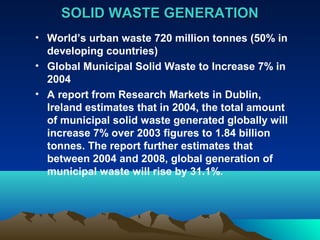
SSOOLLIIDD WWAASSTTEE GGEENNEERRAATTIIOONN 
• World’s urban waste 720 million tonnes (50% in 
developing countries) 
• Global Municipal Solid Waste to Increase 7% in 
2004 
• A report from Research Markets in Dublin, 
Ireland estimates that in 2004, the total amount 
of municipal solid waste generated globally will 
increase 7% over 2003 figures to 1.84 billion 
tonnes. The report further estimates that 
between 2004 and 2008, global generation of 
municipal waste will rise by 31.1%.
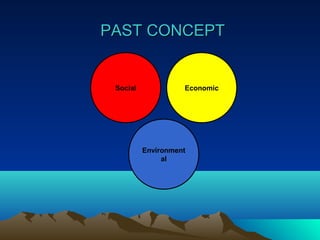
PPAASSTT CCOONNCCEEPPTT 
Social Economic 
Environment 
al
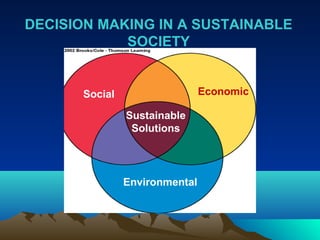
DECISION MAKING IN A SUSTAINABLE 
SOCIETY 
Social Economic 
Sustainable 
Solutions 
Environmental
WHY RREE--BBUUIILLDDIINNGG NNAATTUURRAALL RREESSOOUURRCCEESS 
IISS UURRGGEENNTT?? -- EEXXAAMMPPLLEE OOFF IINNDDIIAA 
• GDP loss due to environmental damage exceeds 10% per year 
(the case of the US is perhaps worse according to the 
organisation Redefining Progress) 
• 11-26% loss of agricultural output due to soil degradation 
• Annual growth of forest only 88 / cubic mtrs as against 139 - 
235 cubic mtrs possible. 
• 23 known species extinct, indicative of threat to rich bio-diversity. 
• 2.5 million people dying prematurely each year due to air 
pollution 
• Water quality in most most major rivers of India far below 
acceptable level
CCOONNCCLLUUSSIIOONNSS 
FOUR CRITICAL FACTORS 
• POPULATION- HOW TO CONTROL? 
• TECCHGNOLOGY- HELP OR HINDRANCE? 
• CONSUMERISATION- CAN WE ALL HAVE THE RESOURCES 
WE WANT ? 
• LAND USE- IS THERE ENOUGH? 
ENVIRONMENTAL GOALS 
• CLIMATE PROTECTION THROUGH CONTROL OF CO2 
EMISSION 
• PRESERVATION OF NATURAL RESOURCES AND 
RESOPONSIBLE USE OF ALTERNATIVE FUELS AND RAW 
MATERIALS 
• CONTROL AND REDUCTION OF ATMOSPHERIC EMISSIONS 
AND DISCHARGES 
• LAND SCAPE PROTECTION
“Nature is essence of 
civilisation, to preserve 
it in its pristine glory and 
magnificence becomes 
our priority”

SUSTAINABLE DEVELOPMENT – A CRITICAL ENVIRONMENTAL APPRAISAL

  • 1.
    SUSTAINABLE DEVELOPMENT ––AA CCRRIITTIICCAALL EENNVVIIRROONNMMEENNTTAALL AAPPPPRRAAIISSAALL DR. I.D. MALL Department of Chemical Engg. Indian Institute of Technology, Roorkee Roorkee- 247667
  • 2.
    SUSTAINABLE DEVELOPMENT ––AA CCRRIITTIICCAALL EENNVVIIRROONNMMEENNTTAALL AAPPPPRRAAIISSAALL • INTRODUCTION • URBAN POPULATION GROWTH – INDIAN SCENARIO • URBANISATION & INDUSTRIALISATION AND ITS IMPACT ON ENVIRONMENT • Water Scarcity and Water Pollution • Air Pollution • Solid Waste and its Impact on Environment • Noise Pollution • Climate Changes • Deforestation • Loss of Bio-diversity • CONCLUSIONS
  • 3.
    EENNVVIIRROONNMMEENNTT LLiivviinngg,, NNoonnlliivviinngg :: SSooiill,, wwaatteerr,, aaiirr,, eenneerrggyy,, ssppaaccee SSoocciiooeeccoonnoommiicc.. LIVING NON-LIVING ENVIRONMENT SOCIE-ECONOMIC
  • 5.
    According to Hindumythology, the gods once decided to churn the sea (Samudra Manthan) to obtain the pot of nectar of immortality (amrut). While churning, along with various unique precious things, a stream of poison was released and it started damaging and destroying the environment. Unless this problem was solved, it was not possible to obtain the amrut. When no other god showed willingness to handle the poison, Lord Shiva volunteered. He drank the whole stream of poison. But if He gulps down, He will invite death and hence He stops the poison in His throat. Thereafter, Lord Shiva is also known as Neelkanth (blue throat). Thus Lord Shiva showed the way to process the elements damaging environment and pioneered the concept of 'Sustainable Development'.
  • 6.
    ORIGIN OOFF TTHHEESSUUSSTTAAIINNAABBIILLIITTYY CCOONNCCEEPPTT • The Rio Declaration on Environment and Development • The Convention of Climate Change • Convention on Biological Diversity • Conservation and Sustainable Development of All Types of Forests (Forests Principles program).
  • 7.
    FFAACCTTOORRSS IINNFFLLUUEENNCCIINNGG SSUUSSTTAAIINNAABBIILLIITTYY Sustainability is • Safe • Universally accepted • Stable • Technology that benefits all • Antipollution • Improvement in quality of life • Nontoxic • Awareness • Beautiful • Indigenous knowledge • Least-cost production • Income • Total quality • Youth
  • 8.
    CCAARRRRYYIINNGG CCAAPPAACCIITTYY •The number of people the earth can support • Biological: maximum limits of global food production • Cultural: quality of life, the environment, future generations • Cultural carrying capacity: the size of a population that can live in a long-term, sustained balance with the environment at a reasonable quality of life with land
  • 9.
    CCAARRRRYYIINNGG CCAAPPAACCIITTYY EconomicProgress Quality of Life Output Developmental Activities Input Wastes / Residuals Resources Environment Assimilative Capacity Supportive Capacity Carrying Capacity
  • 10.
    AACCHHIIEEVVIINNGG SSUUSSTTAAIINNAABBLLEE DDEEVVEELLOOPPMMEENNTT • Reviving growth. • Changing the quality of growth. • Meeting essential needs for jobs, food, energy, water, and sanitation. • Conserving and enhancing the resource base. • Reorienting technology and managing risk. • Merging environment and economics in decision making.
  • 11.
    Mahatma Gandhi [whenasked if, after independence, India would attain British standards of living]: “It took Britain half the resources of the planet to achieve its prosperity; how many planets will a country like India require?”
  • 12.
    INTRODUCTION ccoonnttiinnuueedd.... •Rapid industrialization, urbanization and fast economic growth worldwide phenomenon. • 1950: 29.3% of the global population in urban area, • Present share of urban population more than 43%, to cross 50% mark in 2005. • By 2030, global urban population: twice the size of rural population. • By 2025, more than three fifth of the world population will live in urban area. • Growth of urban population in the developing countries is running at much faster rate than the developed countries.
  • 13.
    • By 2000AD there will 21 cities in the world with more than 10 Million inhabitants and 17 of them will be in developing countries, • During the second half of the 20th century the world population is projected to grow by almost 160%, urban population to grow by 375%. • Annual rate of growth reached a peak of 90 million persons a year between 1985 and 1990 • By 200, this has fallen to approximately 80 million persons per year • Experts predict 85%,that growth will level off by the 2070 • Urban population in India: – 17.3% in 1950 – 25.5% in 1990 and – more than 45% by 2025 AD
  • 14.
    • Since 1950global economic output has increased approximately 5 times • On top of increased rates of resource extraction, industrialization, consumption, and waste production • In developing countries: – Wages improved – Poverty declined – Infant mortality declined – Life expectancy increased • However in some poor countries : economic conditions get worse, as results of Social/political unrest, internal and boundary wars, tribal conflicts • Gap between rich and poor grows – In 1960 30:1 – In 1992 61:1 • The present people make 1.1% of global income. • At least 1/5 of people are worse off today in income than generation ago.
  • 15.
    • Today 20% of the Earth’s people consume 90 % of its resources; meanwhile some 4 billion people live on less than US$ 2 per day. This pattern is not sustainable – nor is the rate of resource depletion. • If we do not act rapidly, by 2032 more than half the World’s people will live in water-stressed areas. • In addition, expansion of cities, roads and other infrastructure will entail the disturbance or outright destruction of habitats and wildlife on over 70 % of the planet’s total land surface (Toepfer, 2002). • Over 70% of the earth surface could be affected by roads, mining, cities and other infrastructure development in the next 30 years unless urgent action is taken,
  • 17.
    • Automobile pollutionis major concern in cities all over the world. • Loss of biodiversity and climatic changes due to large scale deforestation is another major problem of urbanization and industrialization. • The CO2 level in the atmosphere is increasing, causing the earth’s temperature to rise and leading to the melting of polar ice caps and glaciers • The number of forest fires is also increasing around the world. • Rivers are running dry. • China in 1972 the yellow river did not reach the sea for the first time in the history • 1977: it did not reach the sea during 226 days • Situation in many rivers in India is also alarming
  • 18.
    •Plants and animalare taking strong a strong hit; they are desperately trying to adapt, but too many will not make it •Poverty erodes human capital; •There are stark social inequities. 20% world population accounts for 80% of total consumption •Nearly half of the world population( an estimated 2.8 billion people) lives in less than two dollars a day •Modern society has introduced or increased human exposure to thousands of chemicals in the environment
  • 19.
    Fast growing unplannedand indiscriminate urbanization: Cause of recent ecological imbalances MAJOR ENVIRONMENTAL CRISIS WHICH MANKIND IS FACING DUE TO URBAN AND INDUSTRIAL DEVELOPMENT ARE: • Large scale contamination of water and air. • Deforestation • Increase in urban slums • Generation of huge solid waste consisting of hazardous material. • Water scarcity and ground water depletion. • Global warming • Greenhouse effect • Ozone layer depletion
  • 21.
    IIMMPPAACCTTSS OOFF IINNDDUUSSTTRRIIAALLIIZZAATTIIOONN • Water Pollution 851 industries Discharging 100 +kg BOD Tamil Nadu Highest Polluter Grasim Industries 687k Gallons/day of Industrial Waste disposed into Ganges Food and Agro Based Industries contribute 65- 70% of Total Industrial water waste
  • 22.
    AAIIRR PPOOLLLLUUTTIIOONN AIRPOLLUTANT IMPACTS • Greenhouse effect • Ozone depletion • Acidification • Smog formation • Eutrophication • Human health
  • 23.
    BIODIVERSITY With theloss of tropical forests, Earth’s biodiversity will decline…. 50% of plant, animals, and microorganisms live in rain forests…. Biodiversity has been seen as the total (and irreducible) complexity of all life, including not only the great variety of organisms but also their varying behavior and interactions
  • 24.
    Climate CChhaannggee aannddDDeevveellooppmmeenntt Socioeconomic development path Demographic change Economic growth Technology Policy & Institutions Climate change Temperature rise Precipitation change Sea level rise Variability and extreme events Human and Natural systems Land and water resources Ecosystems and biodiversity Human health Human settlements and infrastructure Emissions and concentrations Greenhouse gases Aerosols Impacts Mitigation Adaptation Vulnerability Source: IIASA
  • 25.
    SSOOLLIIDD WWAASSTTEE GGEENNEERRAATTIIOONN • World’s urban waste 720 million tonnes (50% in developing countries) • Global Municipal Solid Waste to Increase 7% in 2004 • A report from Research Markets in Dublin, Ireland estimates that in 2004, the total amount of municipal solid waste generated globally will increase 7% over 2003 figures to 1.84 billion tonnes. The report further estimates that between 2004 and 2008, global generation of municipal waste will rise by 31.1%.
  • 26.
    PPAASSTT CCOONNCCEEPPTT SocialEconomic Environment al
  • 27.
    DECISION MAKING INA SUSTAINABLE SOCIETY Social Economic Sustainable Solutions Environmental
  • 28.
    WHY RREE--BBUUIILLDDIINNGG NNAATTUURRAALLRREESSOOUURRCCEESS IISS UURRGGEENNTT?? -- EEXXAAMMPPLLEE OOFF IINNDDIIAA • GDP loss due to environmental damage exceeds 10% per year (the case of the US is perhaps worse according to the organisation Redefining Progress) • 11-26% loss of agricultural output due to soil degradation • Annual growth of forest only 88 / cubic mtrs as against 139 - 235 cubic mtrs possible. • 23 known species extinct, indicative of threat to rich bio-diversity. • 2.5 million people dying prematurely each year due to air pollution • Water quality in most most major rivers of India far below acceptable level
  • 29.
    CCOONNCCLLUUSSIIOONNSS FOUR CRITICALFACTORS • POPULATION- HOW TO CONTROL? • TECCHGNOLOGY- HELP OR HINDRANCE? • CONSUMERISATION- CAN WE ALL HAVE THE RESOURCES WE WANT ? • LAND USE- IS THERE ENOUGH? ENVIRONMENTAL GOALS • CLIMATE PROTECTION THROUGH CONTROL OF CO2 EMISSION • PRESERVATION OF NATURAL RESOURCES AND RESOPONSIBLE USE OF ALTERNATIVE FUELS AND RAW MATERIALS • CONTROL AND REDUCTION OF ATMOSPHERIC EMISSIONS AND DISCHARGES • LAND SCAPE PROTECTION
  • 30.
    “Nature is essenceof civilisation, to preserve it in its pristine glory and magnificence becomes our priority”