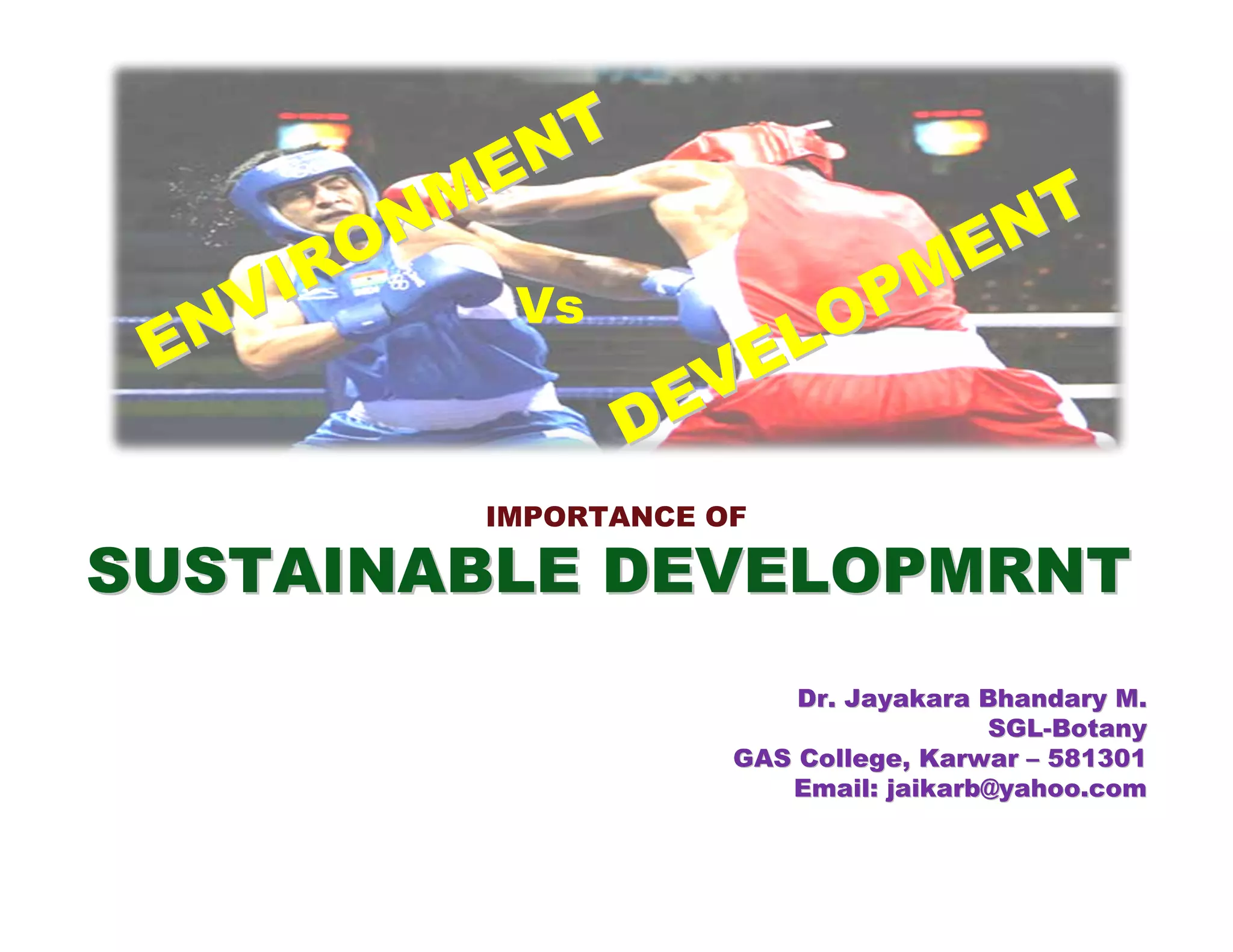
E NT
          N M                     T
       RO                     MEN
     I
 EN
   V          Vs           OP
                      V EL
                    DE
            IMPORTANCE OF

SUSTAINABLE DEVELOPMRNT
                            Dr. Jayakara Bhandary M.
                                         SGL-Botany
                        GAS College, Karwar – 581301
                           Email: jaikarb@yahoo.com
WHAT IS DEVELOPMENT…?


Enabling the community to meet
everyone’s basic human needs for
food security, housing, health,
clean water and fuel.

It should lead to a dynamic, just
and prosperous Society
WHAT IS ENVIRONMENT…?
Environment means everything surrounding
us, including something that is tangible
(objects) and intangible (culture, belief,and
norm) which associate to each other as
cycle of system.

                       Everything that surround us.
  Includes Flora (vegetation) and Fauna (animals
                                       and insects),
            consists of: AIR, SOIL and WATER
DEVELOPMENT ACHIEVEMENTS..
           BIG DAMS…

More than 4,000 large dams of over 15 metres
height .
Spent about 919 billion rupees.
Played an important role in increasing farm
productivity, power generation and industrial
water supply.


          (Report by World Commission on Big Dams)
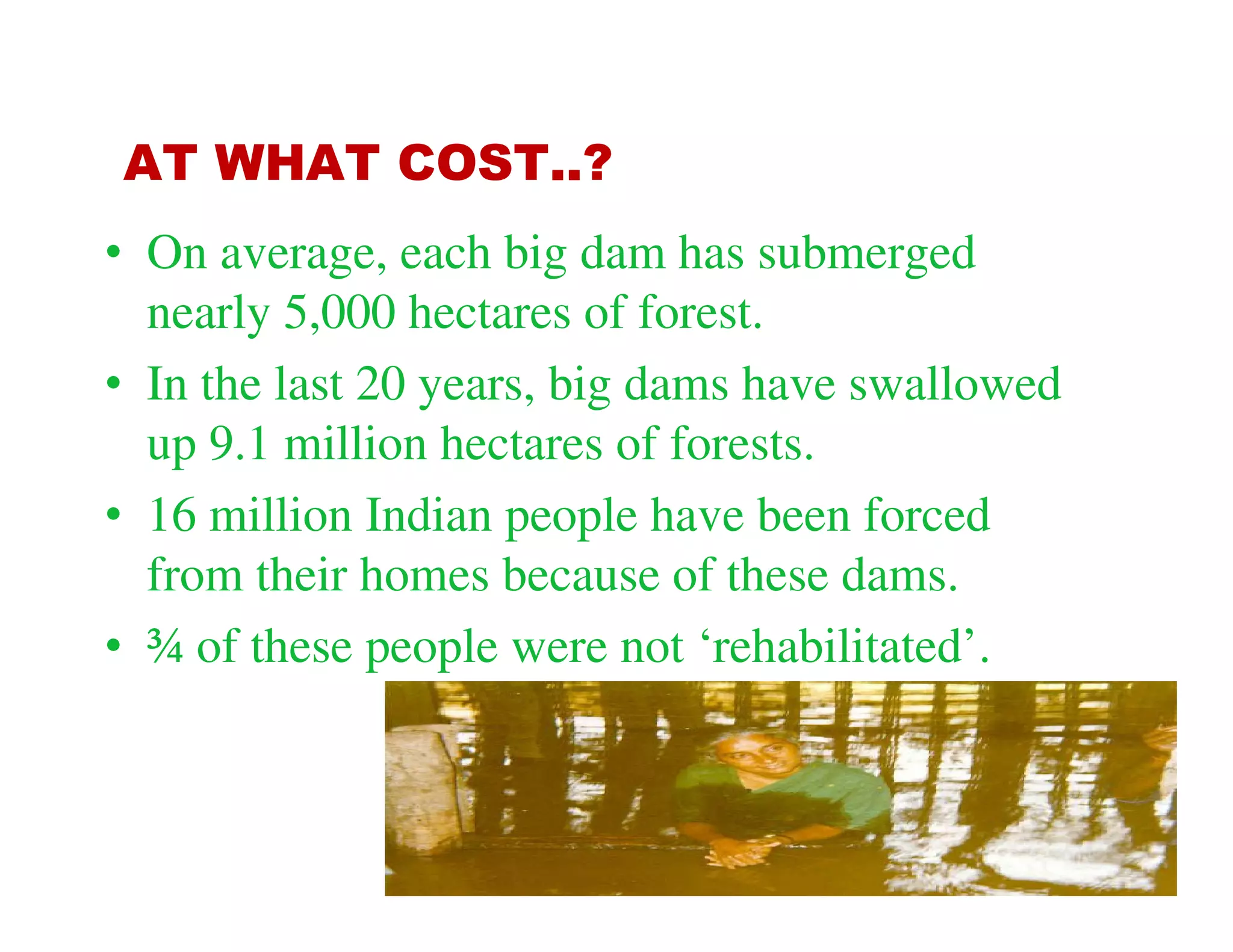
AT WHAT COST..?
• On average, each big dam has submerged
  nearly 5,000 hectares of forest.
• In the last 20 years, big dams have swallowed
  up 9.1 million hectares of forests.
• 16 million Indian people have been forced
  from their homes because of these dams.
• ¾ of these people were not ‘rehabilitated’.
GREEN REVOLUTION……..

• 4-5fold increase in food production.
• Yield of wheat increased from 2 to 6 metric
  tons per hectare.
• Cereal and calorie availability per person
  increased by nearly 30%
• Eliminated the threat of starvation of
  exploding population.
GREEN REVOLUTION..
• Per capita incomes doubled in Asia between
  1970 - 1995.
• Poverty declined from 3 out of every 5 Asians in
  1975 to less than 1 in 3 by 1995.
• The number of poor fell from 1.15 billion in
  1975 to 825 million in 1995 despite a 60 %
  increase in population.
• In India, the % of rural Poor was 50 – 65% in
  1960s.
• Declined to about 1/3 of the rural population by
  1993.
     (Report by International Food Policy Research Institute, USA, 2003)
AT WHAT COST…?

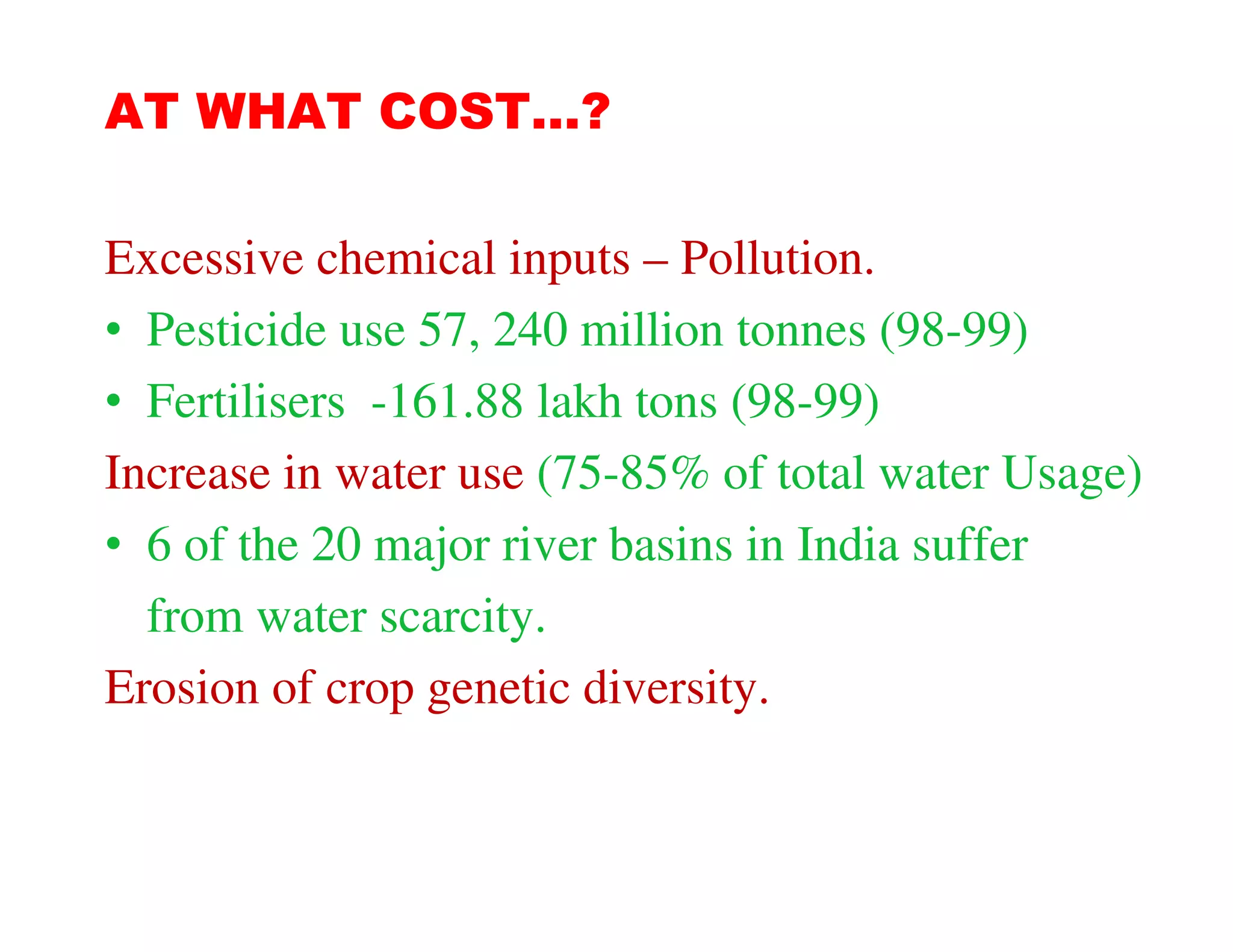
Excessive chemical inputs – Pollution.
• Pesticide use 57, 240 million tonnes (98-99)
• Fertilisers -161.88 lakh tons (98-99)
Increase in water use (75-85% of total water Usage)
• 6 of the 20 major river basins in India suffer
  from water scarcity.
Erosion of crop genetic diversity.
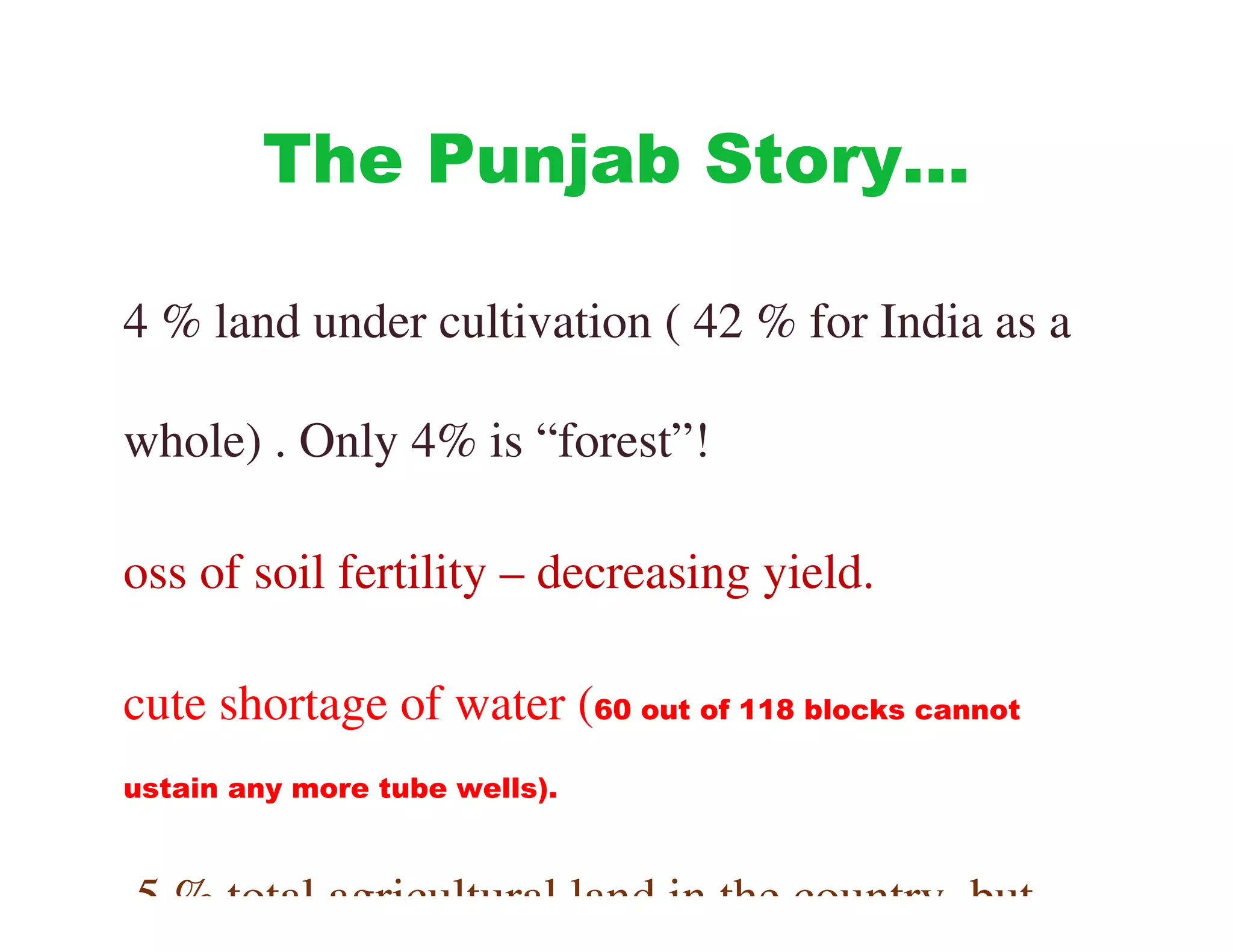
The Punjab Story…

4 % land under cultivation ( 42 % for India as a

whole) . Only 4% is “forest”!

oss of soil fertility – decreasing yield.

cute shortage of water (60 out of 118 blocks cannot
ustain any more tube wells).


.5 % total agricultural land in the country, but
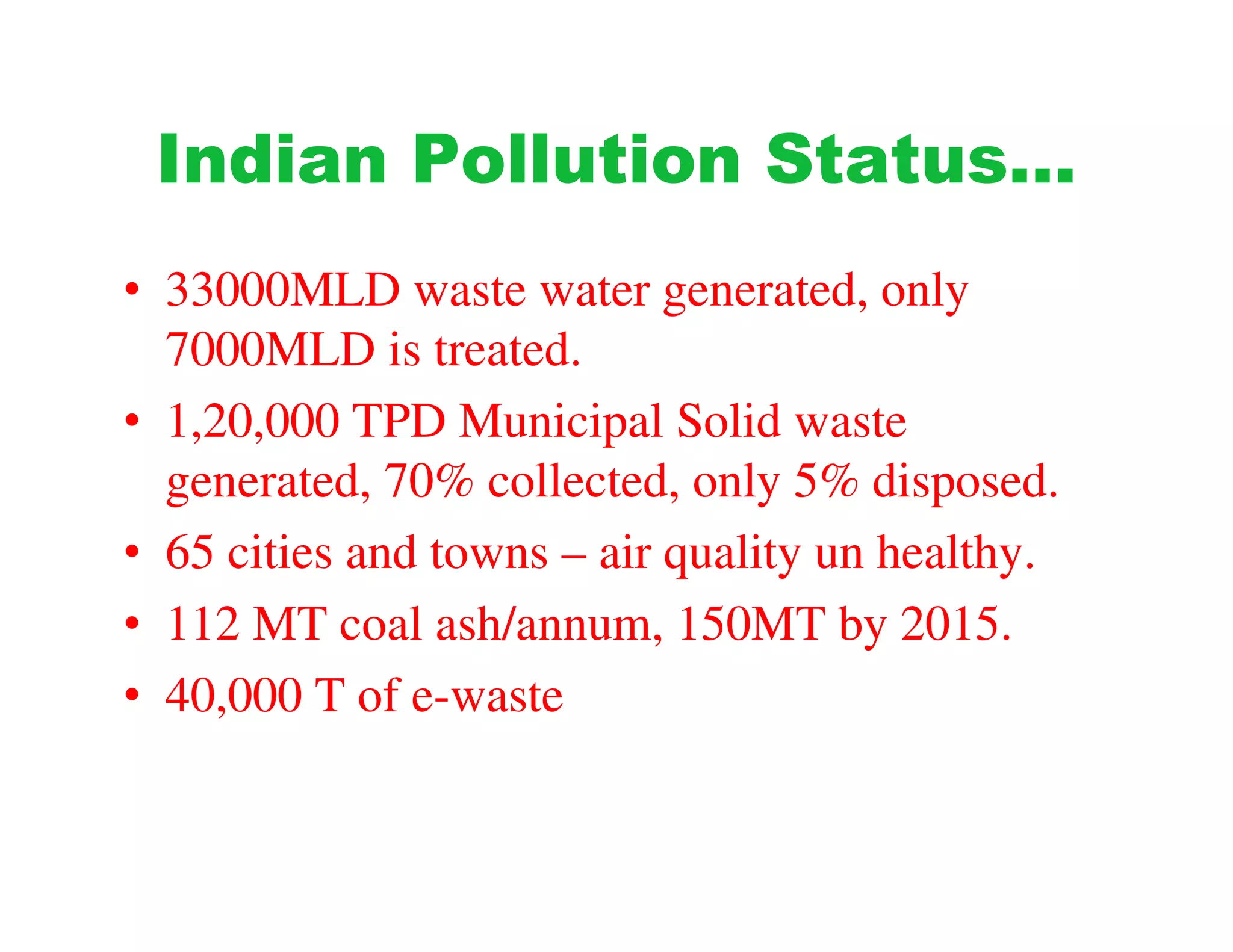
Indian Pollution Status…
• 33000MLD waste water generated, only
  7000MLD is treated.
• 1,20,000 TPD Municipal Solid waste
  generated, 70% collected, only 5% disposed.
• 65 cities and towns – air quality un healthy.
• 112 MT coal ash/annum, 150MT by 2015.
• 40,000 T of e-waste
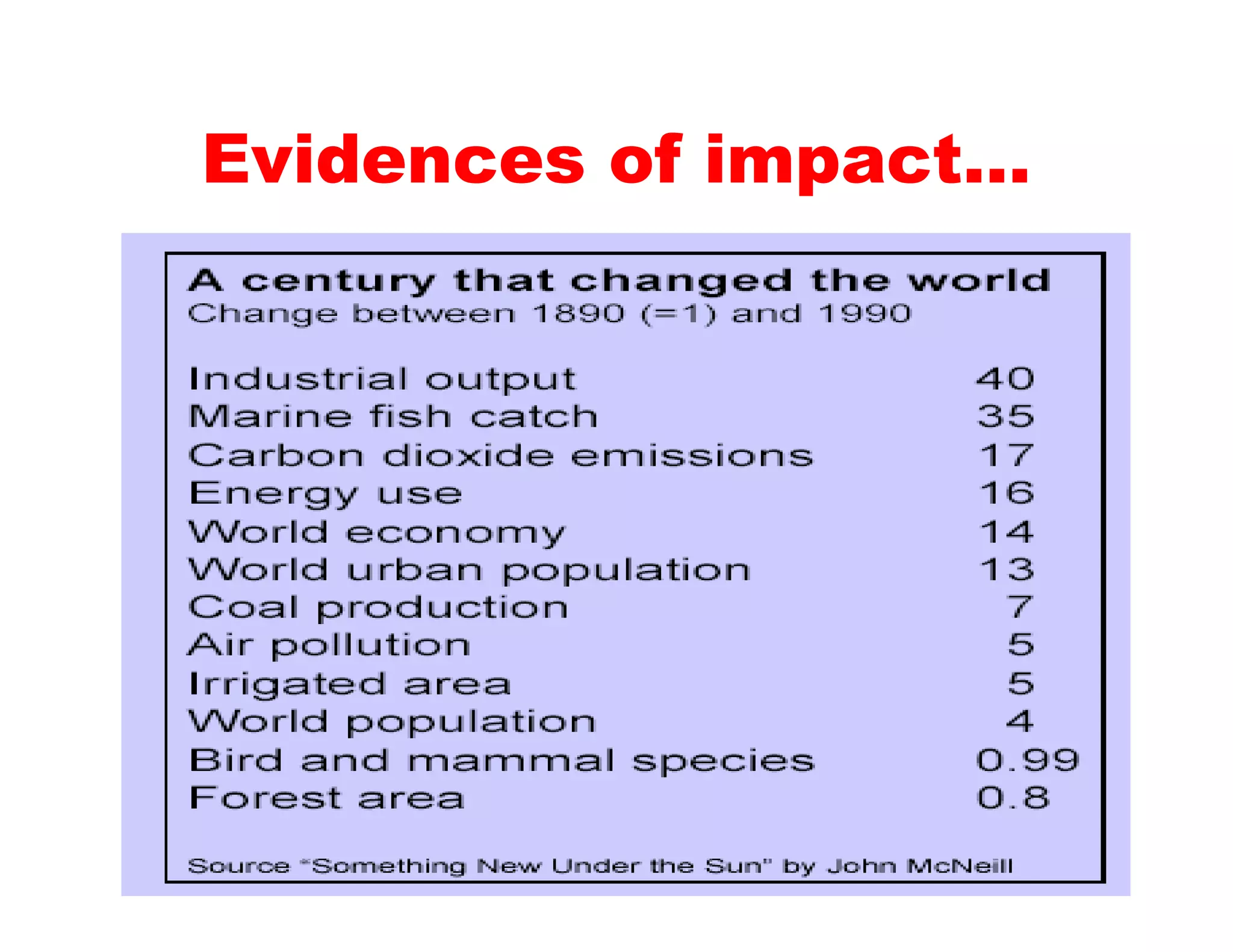
Evidences of impact…
How many earths needed to support
     developmental consumption of
resources, at the present rate? (by 2050)

Energy      - 8
            Minerals – 2
                Metals - 7
                    Land - 1.5
                         Wood – 3.5

Mclaren et al 1998
Tomorrow’s World, Earthscan, London
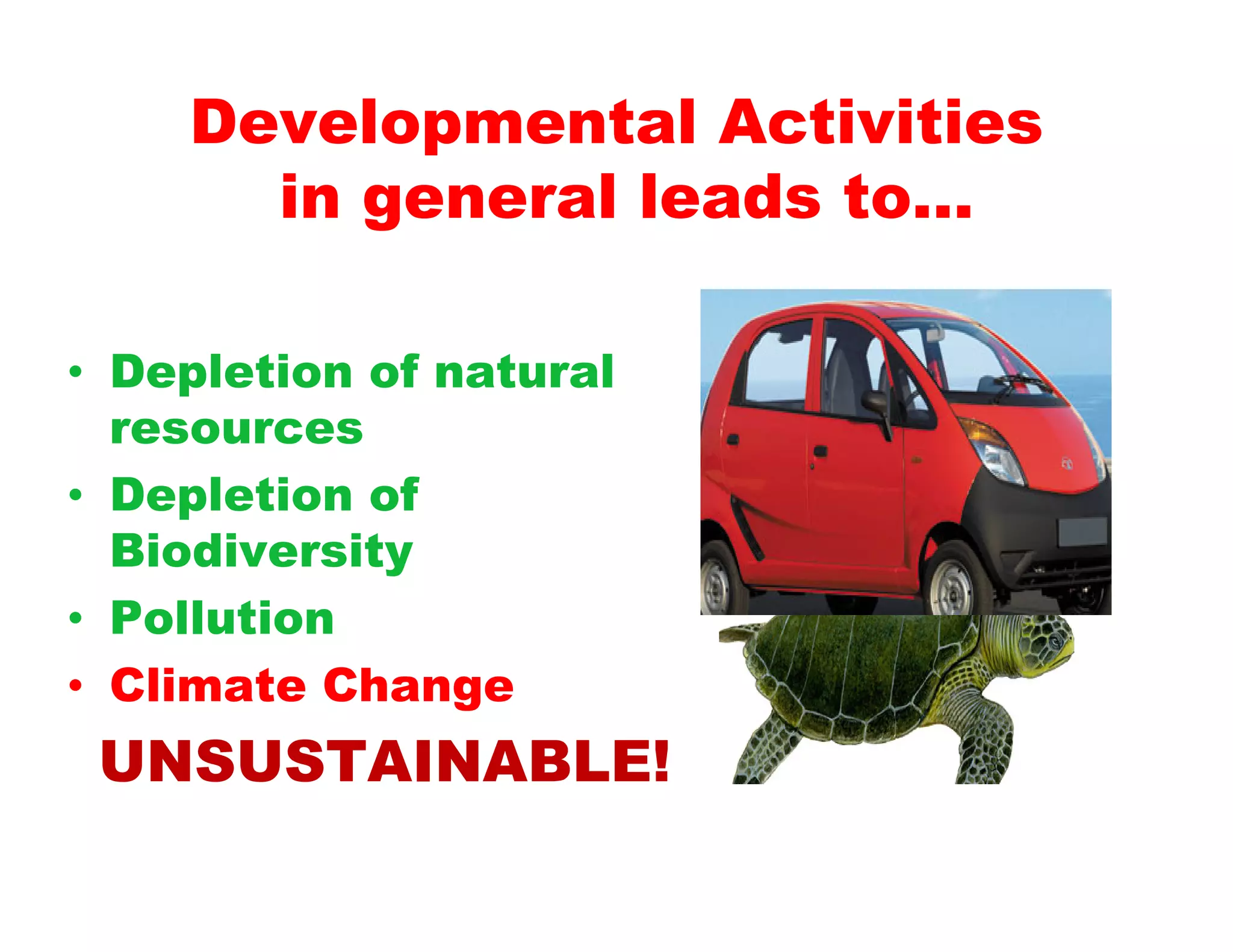
Developmental Activities
      in general leads to…

• Depletion of natural
  resources
• Depletion of
  Biodiversity
• Pollution
• Climate Change
 UNSUSTAINABLE!
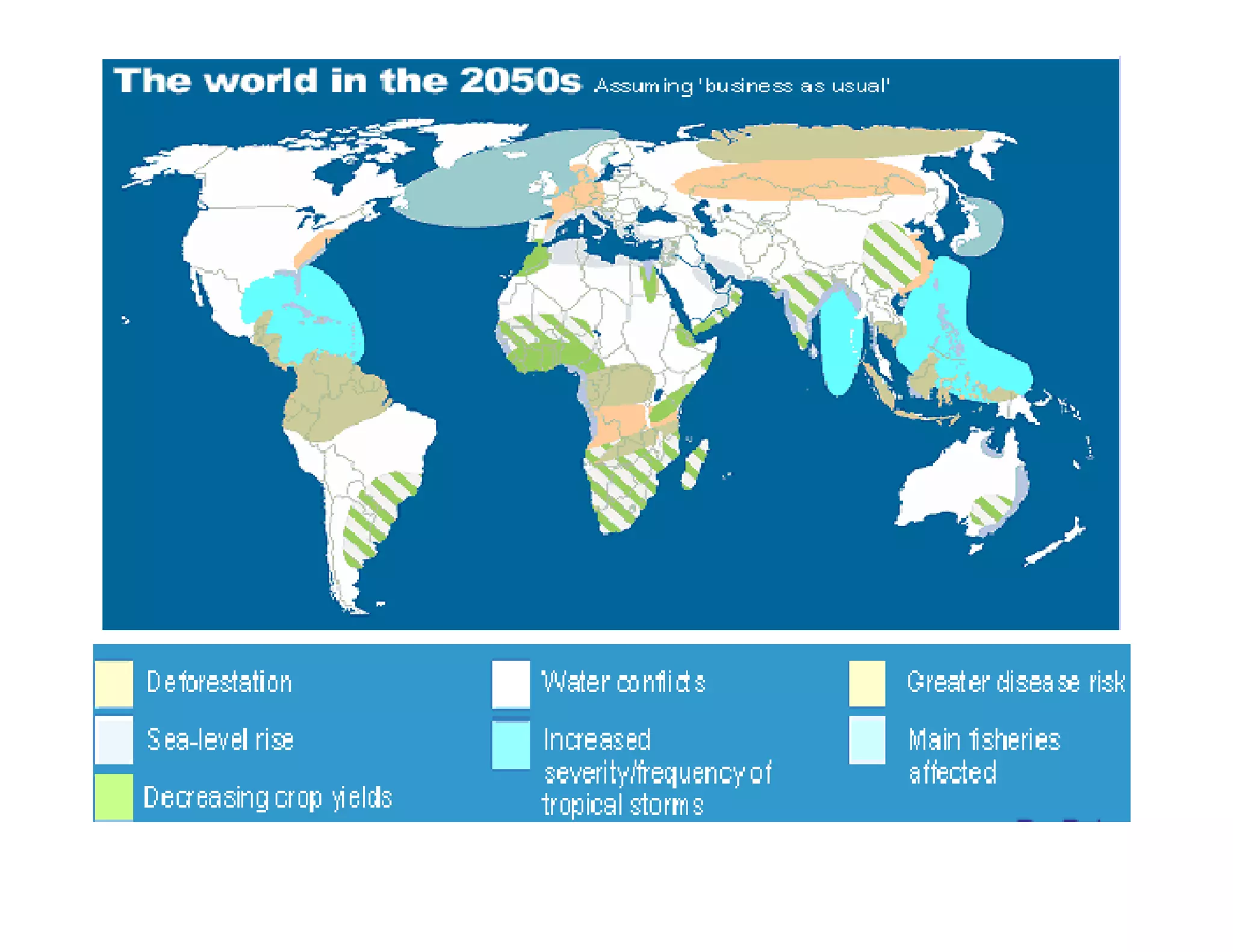
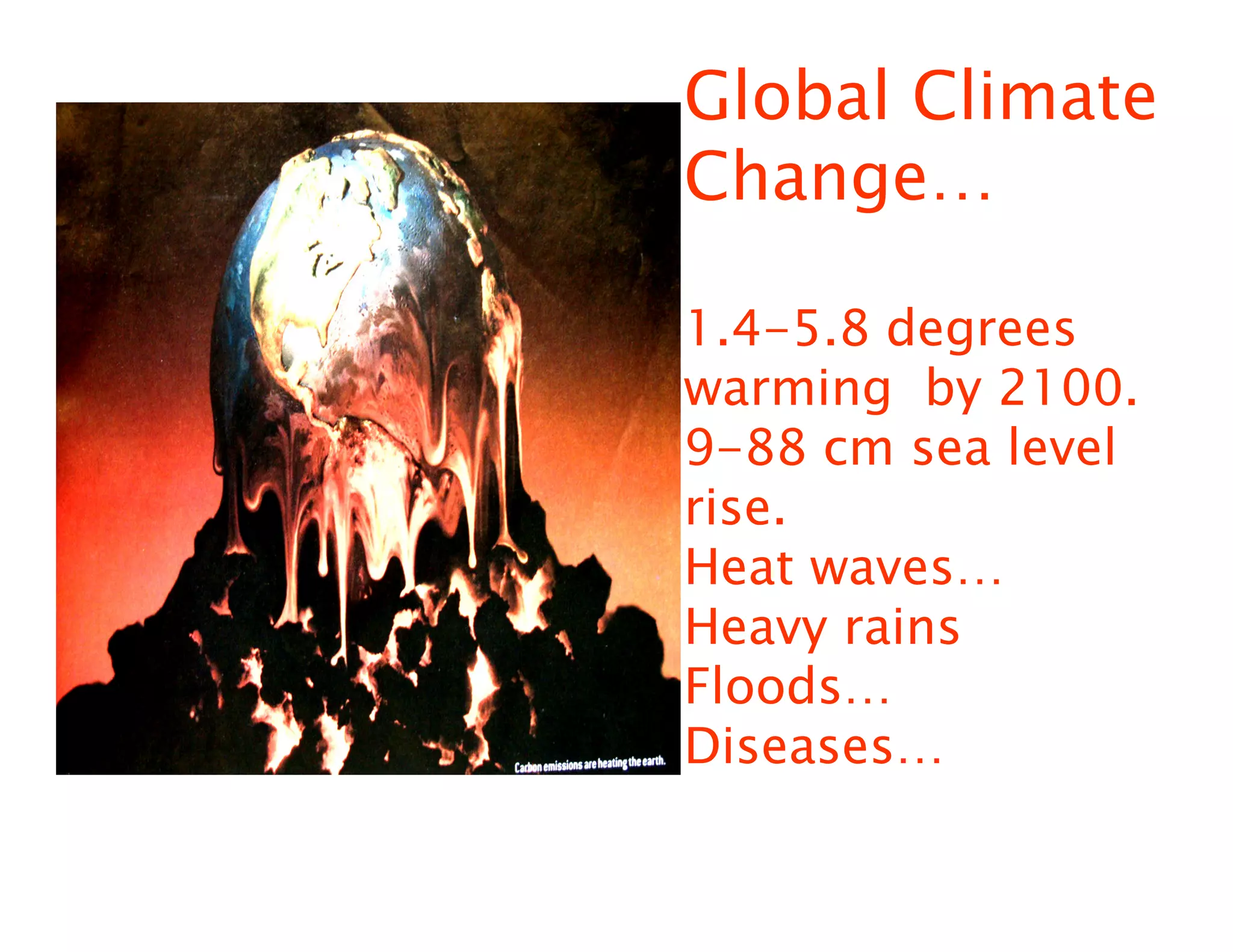
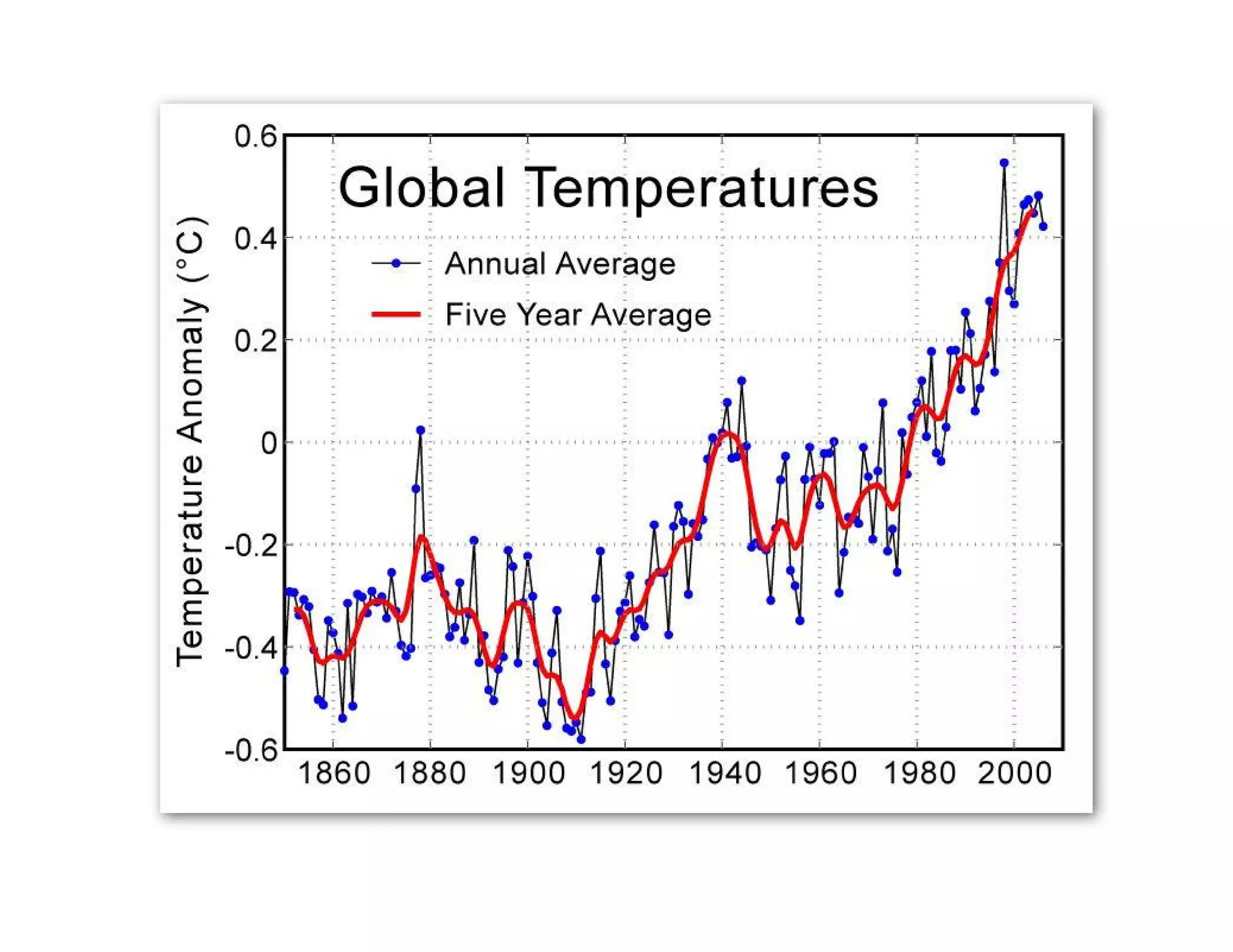
Global Climate
Change…

1.4-5.8 degrees
warming by 2100.
9-88 cm sea level
rise.
Heat waves…
Heavy rains
Floods…
Diseases…
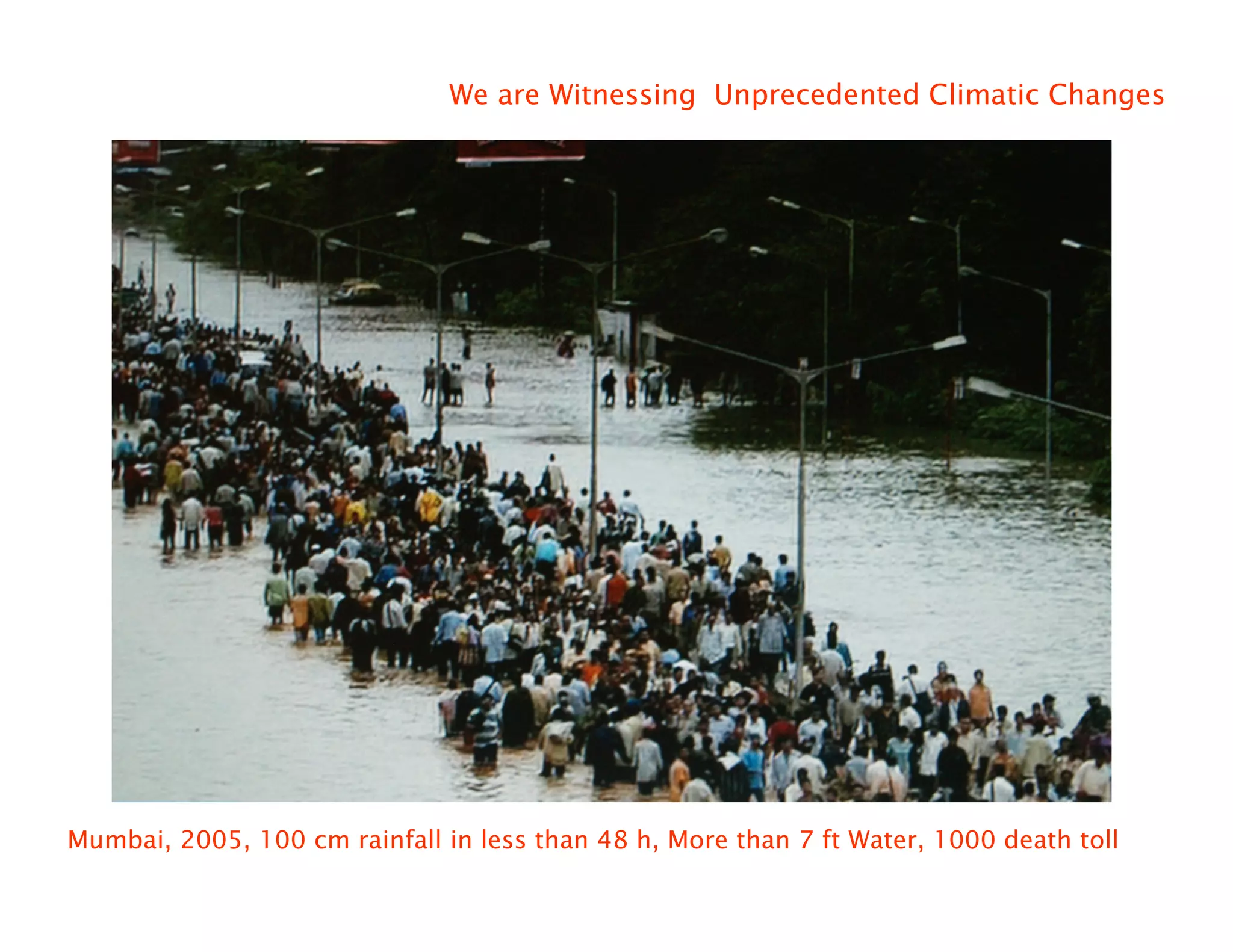
We are Witnessing Unprecedented Climatic Changes


Mumbai, 2005, 100 cm rainfall in less than 48 h, More than 7 ft Water, 1000 death toll
• Over the period of 1995-2004, a total of 2,500
  million people were affected by disasters, with
  losses of 890,000 dead and costs of US$ 570
  billion. Most disasters (75%) are related to
  weather extremes that climate change is
  expected to exacerbate.
• The 2003 European heat wave — involving
  temperatures that were 18°F (10°C) above the
  30-year average, killed 21,000 to 35,000
  people in five countries.
Diseases.. DENGUE
• The number of months with average
  temperatures higher than 18C and the
  degree of urbanization were found to
  correlate with increasing risk of dengue
  fever (Wu et al, 2009). Temperature affects
  insect survival time and habitats as well as
  maturation and infective periods, and
  higher temperatures shorten the incubation
  period and viral development rate.
Development Vs Environment –
          The Debate

Taking care of        We have already wasted
millions of people    and destroyed vast
who are starving at   amounts of natural
present is more       resources, and in so
important than        doing have put earth at
saving natural        risk. We must preserve
resources.            the earth for our children
                      and grand children.
Development Vs Environment –
        The Debate

•Developed Vs Developing countries


•Rich Vs Poor


•Progress Vs Stagnation
INSPIRING VOICES…….
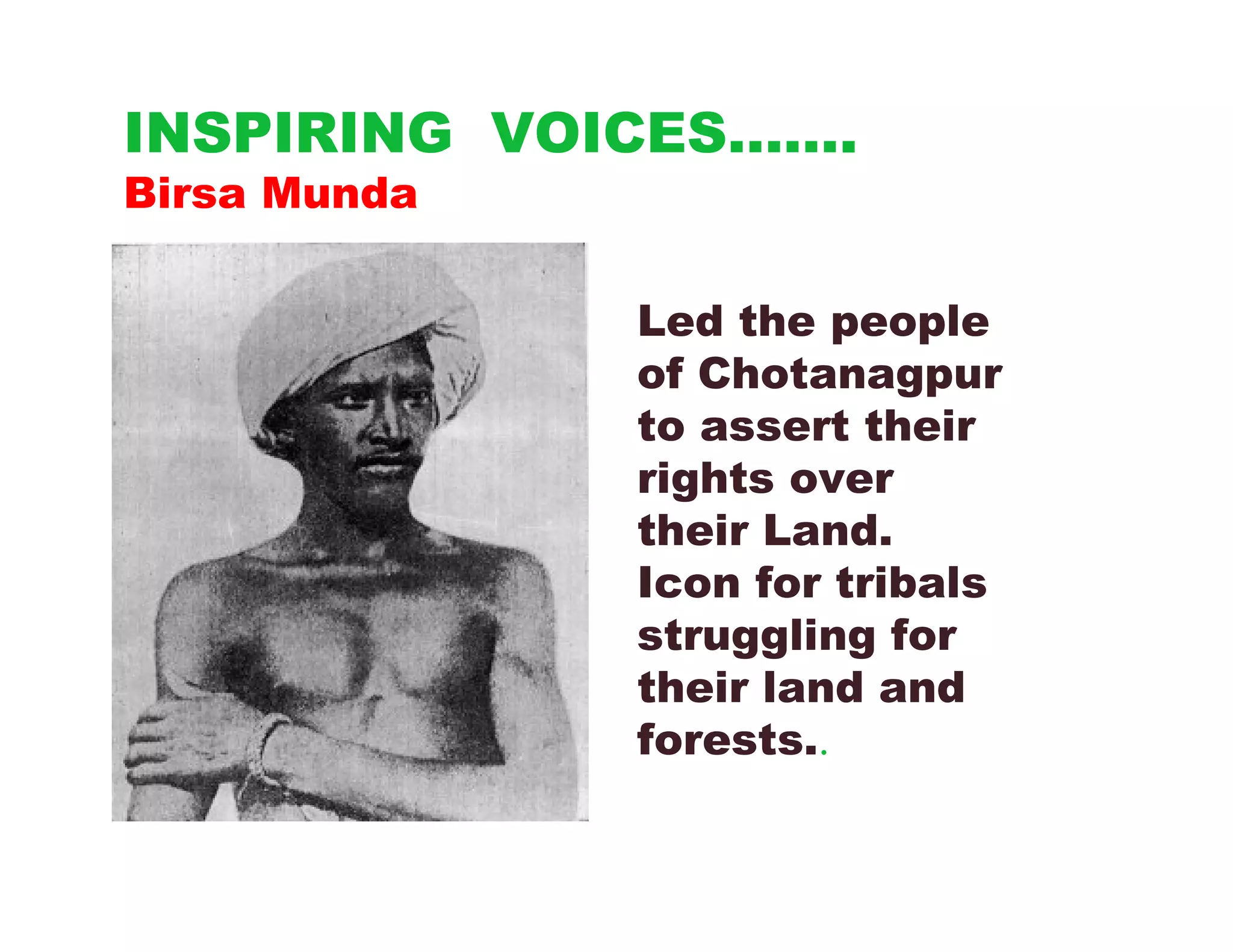
Birsa Munda

              Led the people
              of Chotanagpur
              to assert their
              rights over
              their Land.
              Icon for tribals
              struggling for
              their land and
              forests..
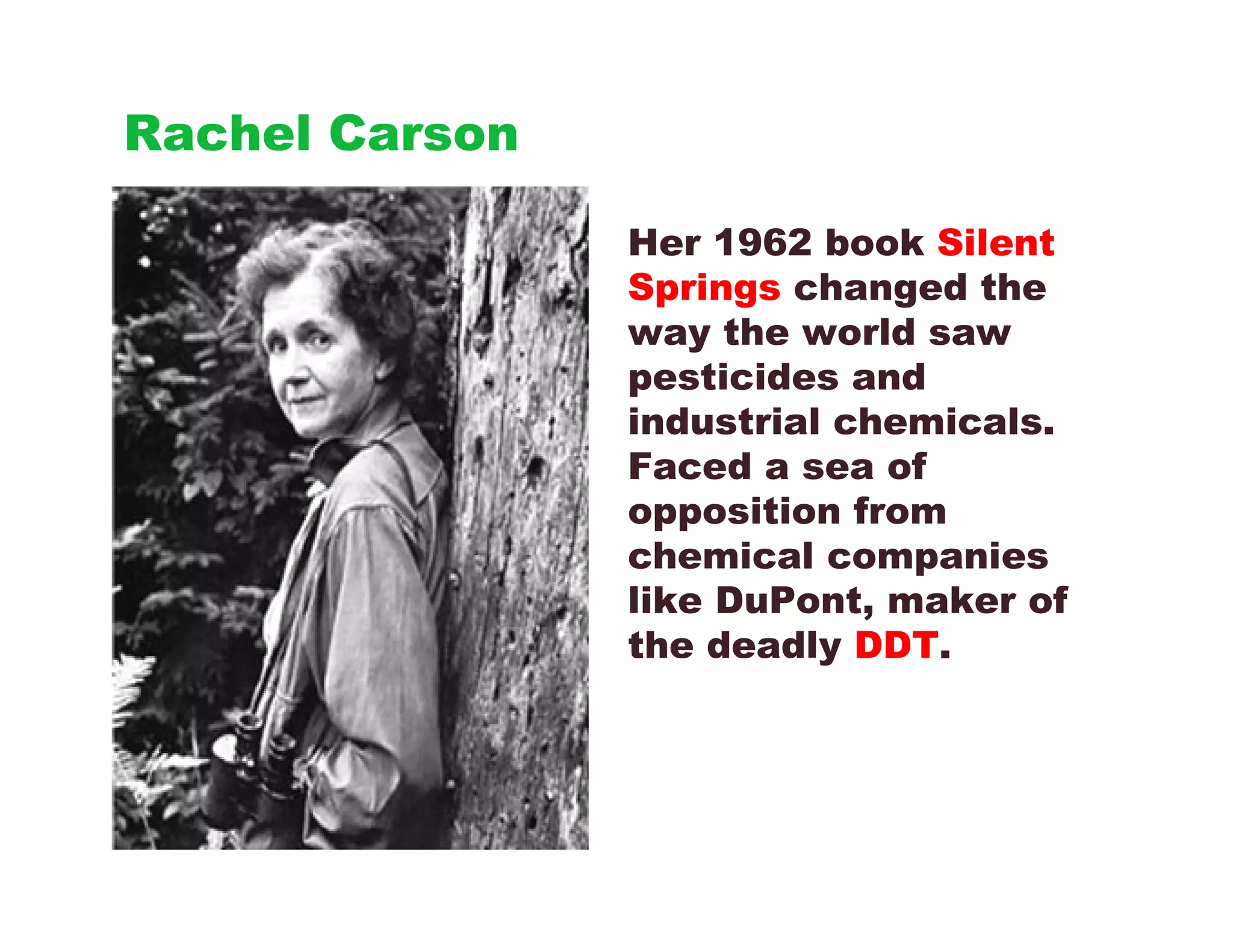
Rachel Carson

                Her 1962 book Silent
                Springs changed the
                way the world saw
                pesticides and
                industrial chemicals.
                Faced a sea of
                opposition from
                chemical companies
                like DuPont, maker of
                the deadly DDT.
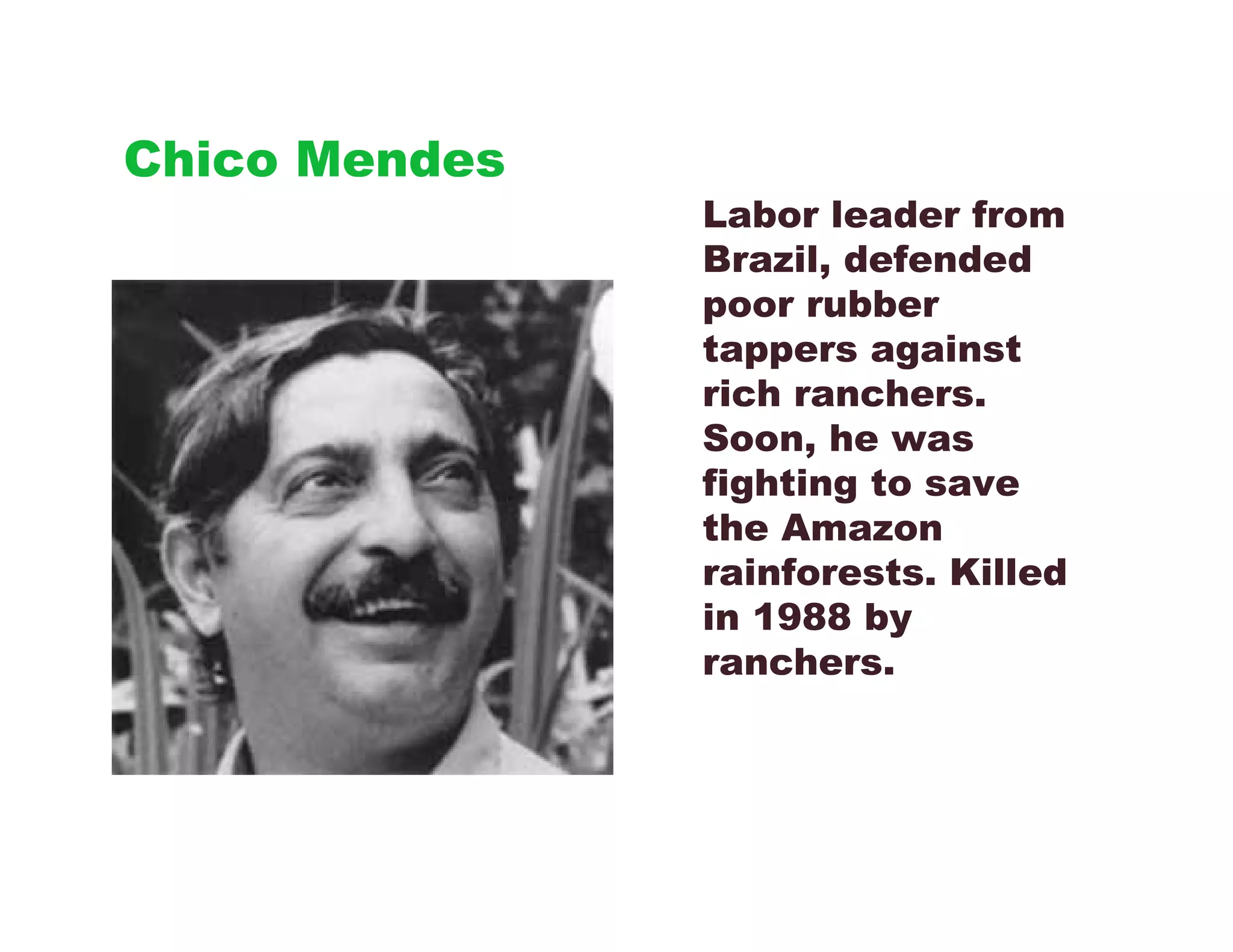
Chico Mendes
               Labor leader from
               Brazil, defended
               poor rubber
               tappers against
               rich ranchers.
               Soon, he was
               fighting to save
               the Amazon
               rainforests. Killed
               in 1988 by
               ranchers.
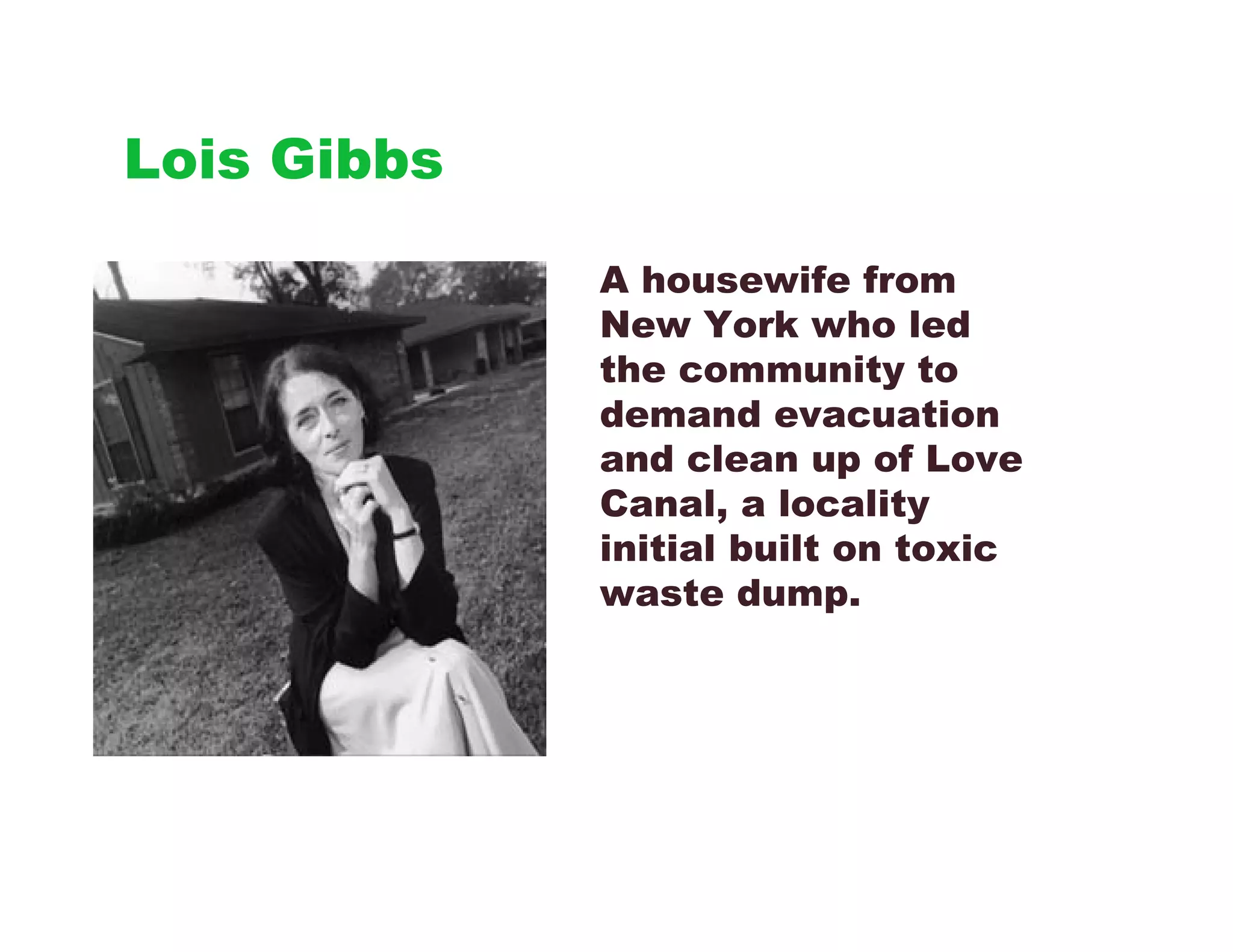
Lois Gibbs

             A housewife from
             New York who led
             the community to
             demand evacuation
             and clean up of Love
             Canal, a locality
             initial built on toxic
             waste dump.
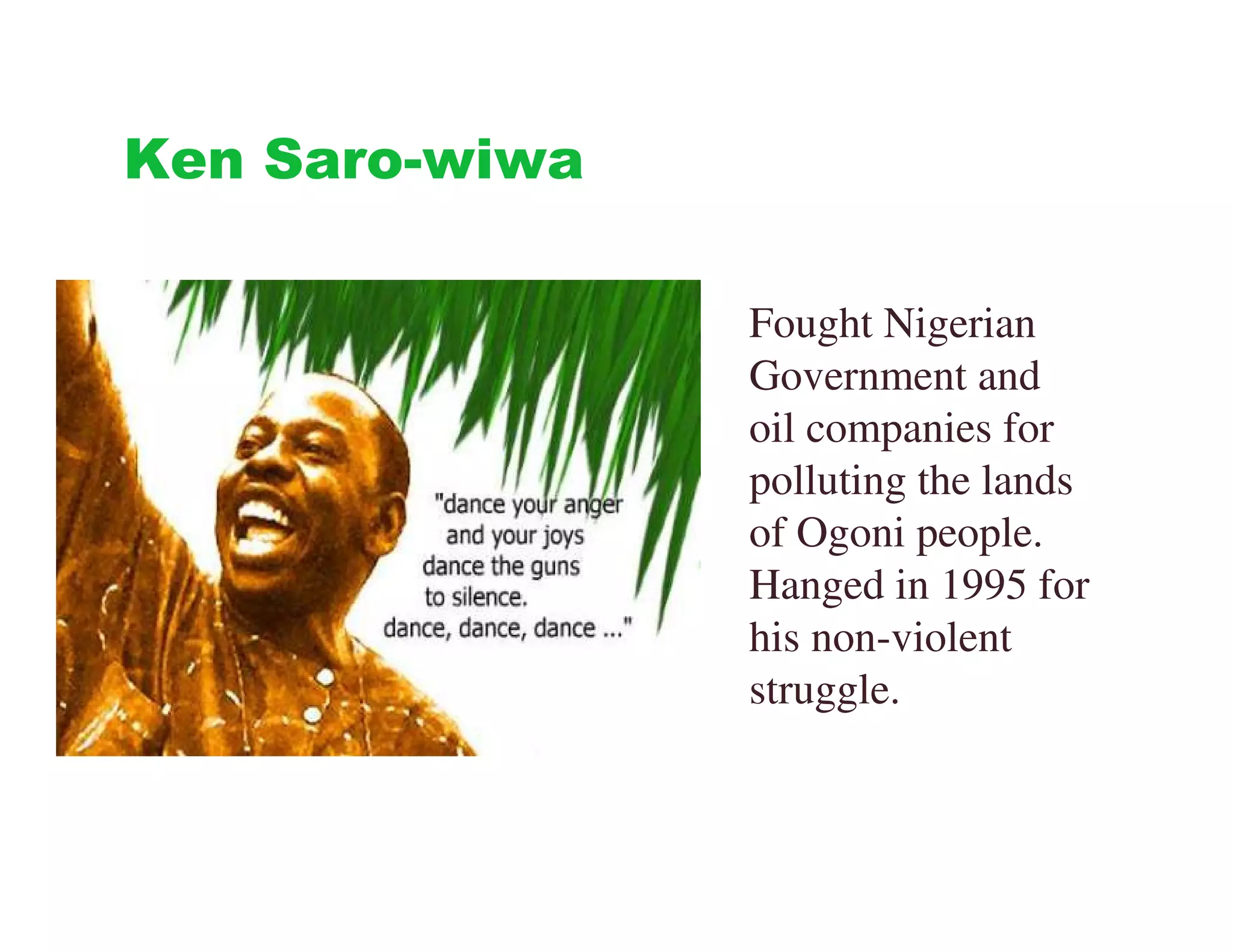
Ken Saro-wiwa

                Fought Nigerian
                Government and
                oil companies for
                polluting the lands
                of Ogoni people.
                Hanged in 1995 for
                his non-violent
                struggle.
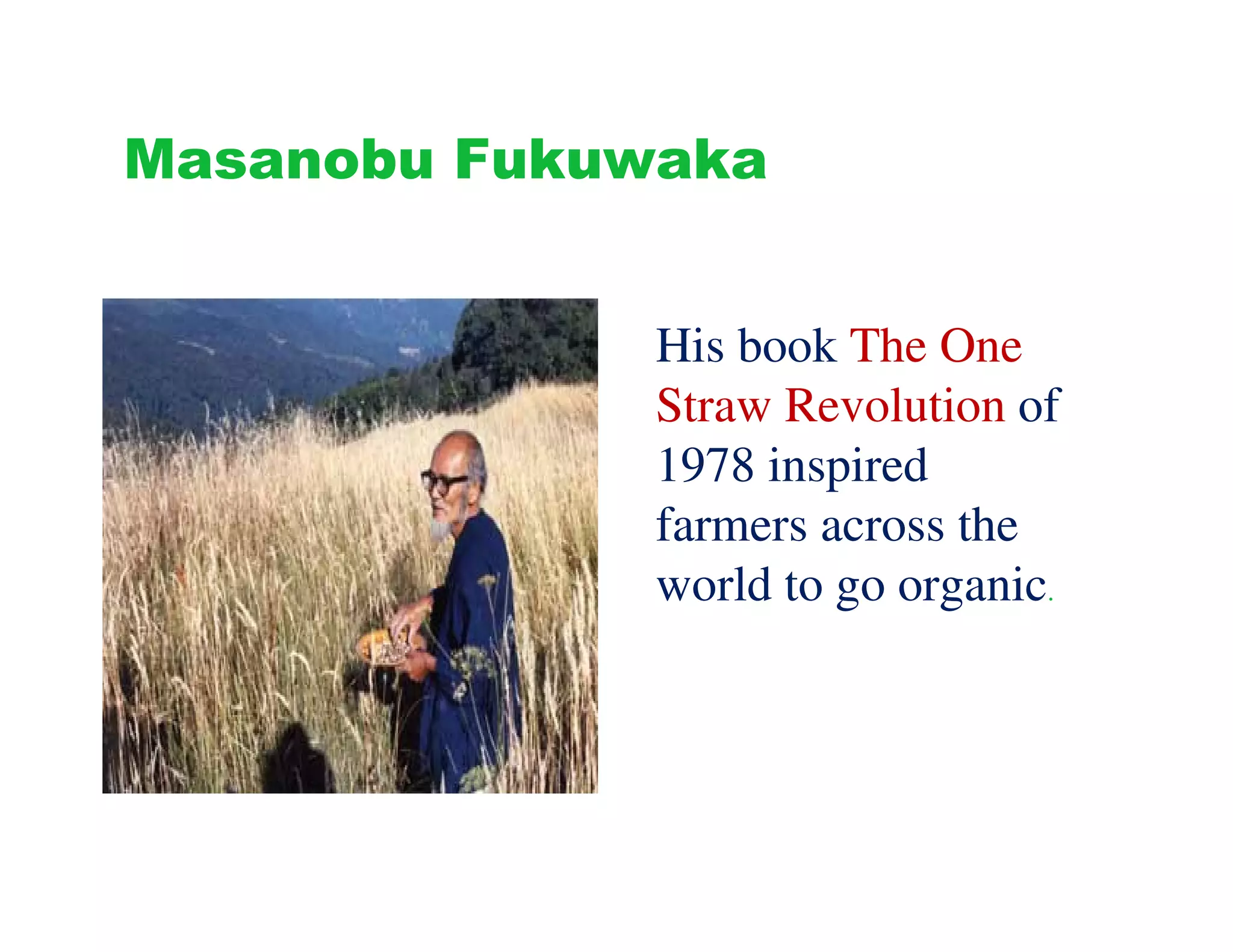
Masanobu Fukuwaka


              His book The One
              Straw Revolution of
              1978 inspired
              farmers across the
              world to go organic.
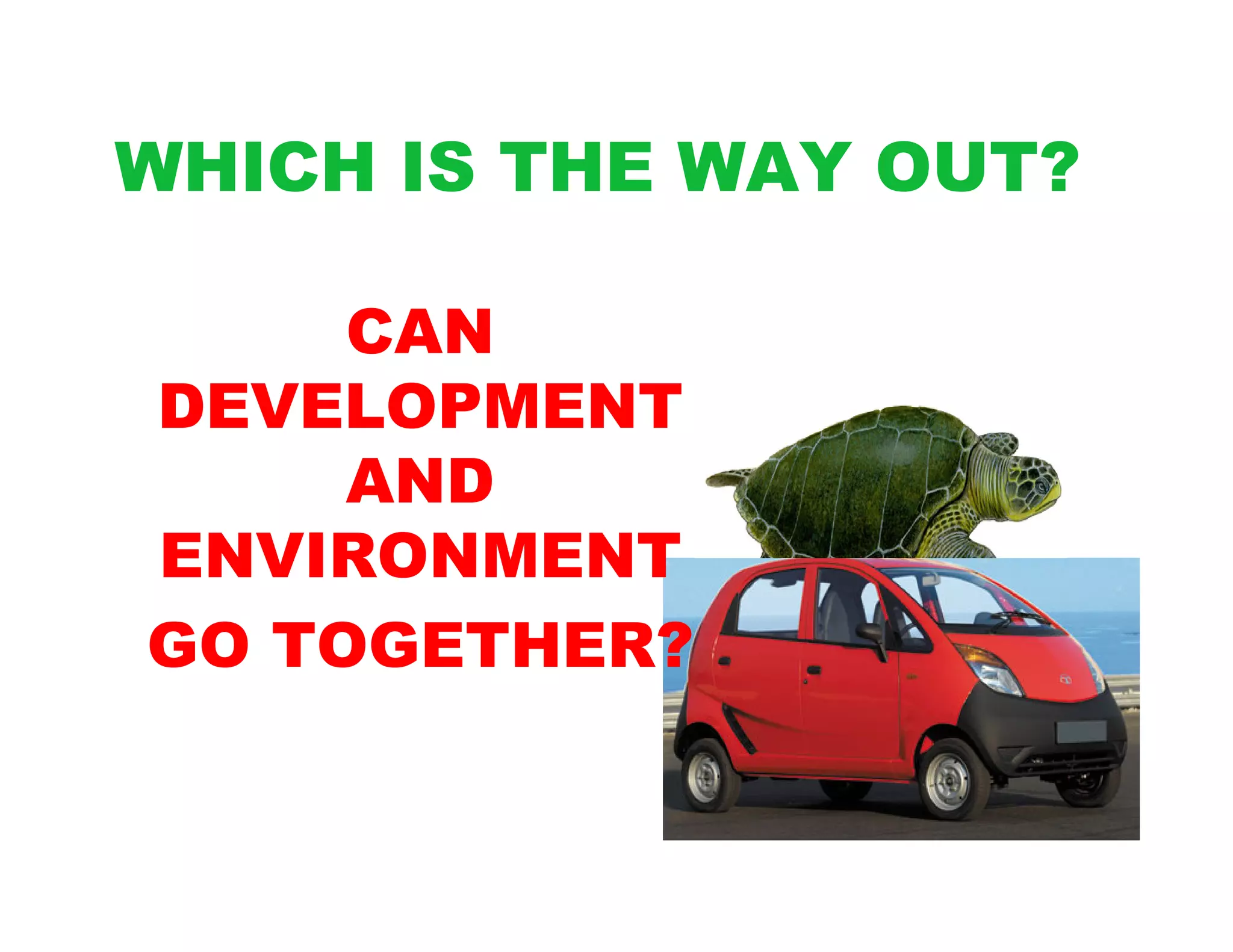
WHICH IS THE WAY OUT?

     CAN
DEVELOPMENT
     AND
ENVIRONMENT
GO TOGETHER?
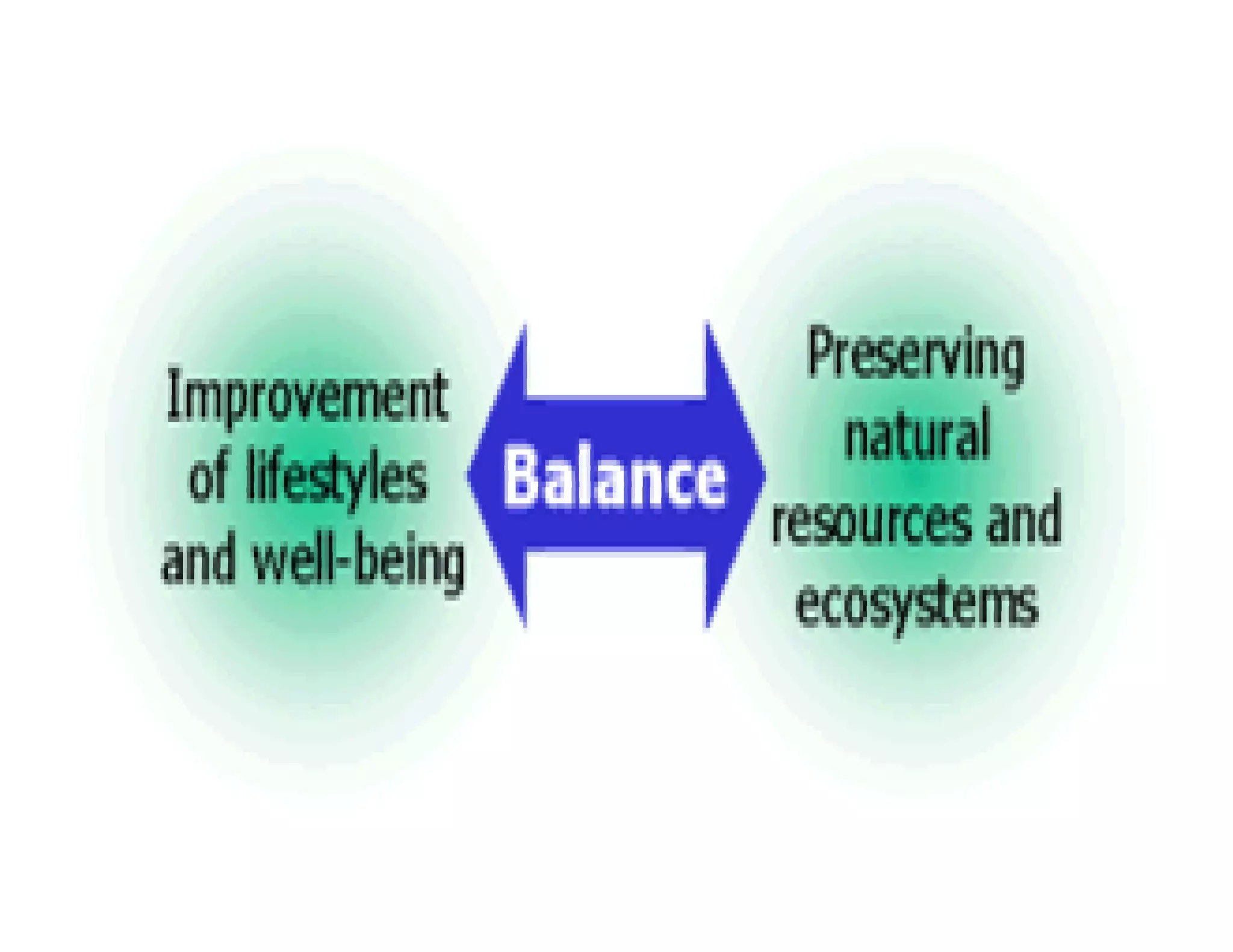
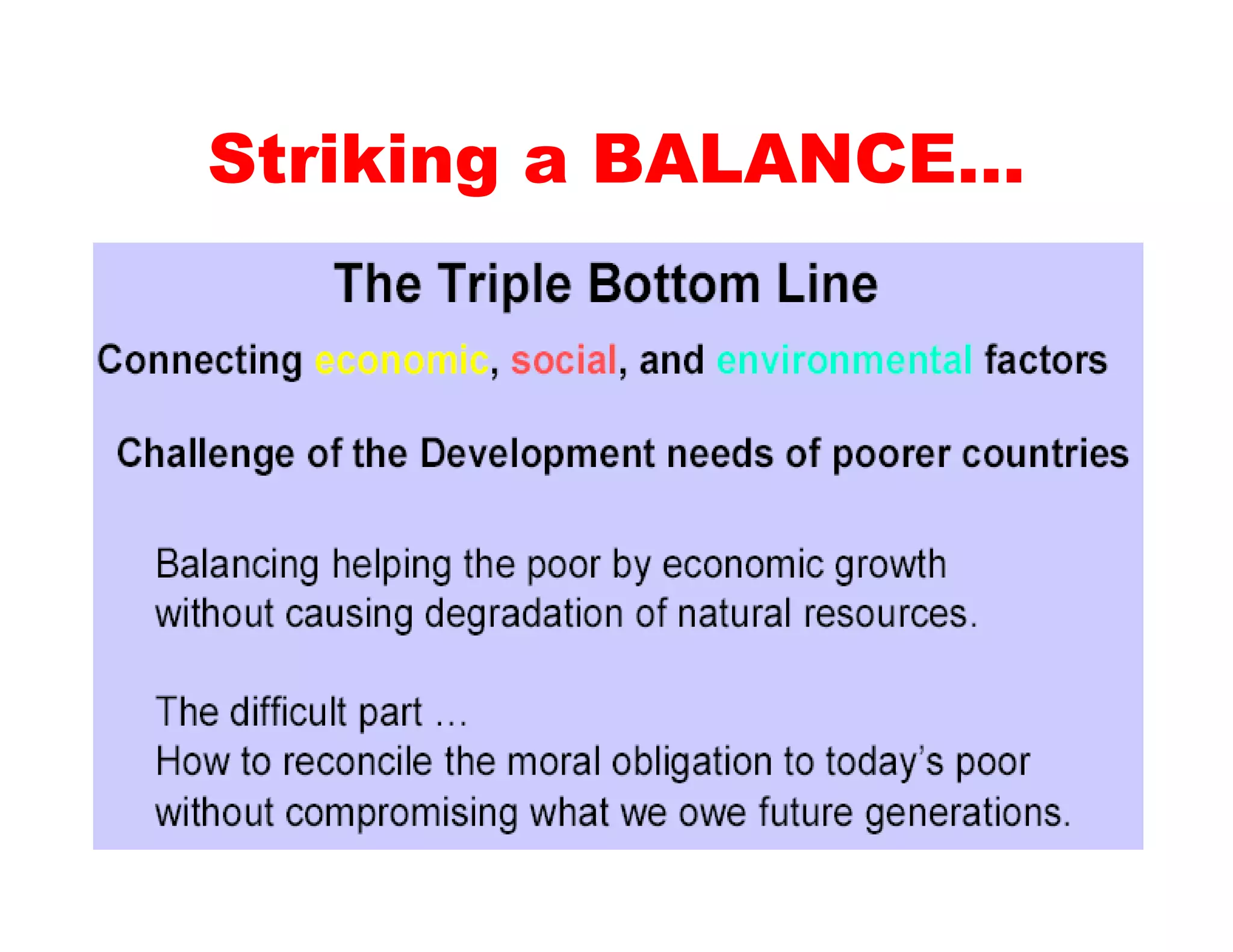
Striking a BALANCE…
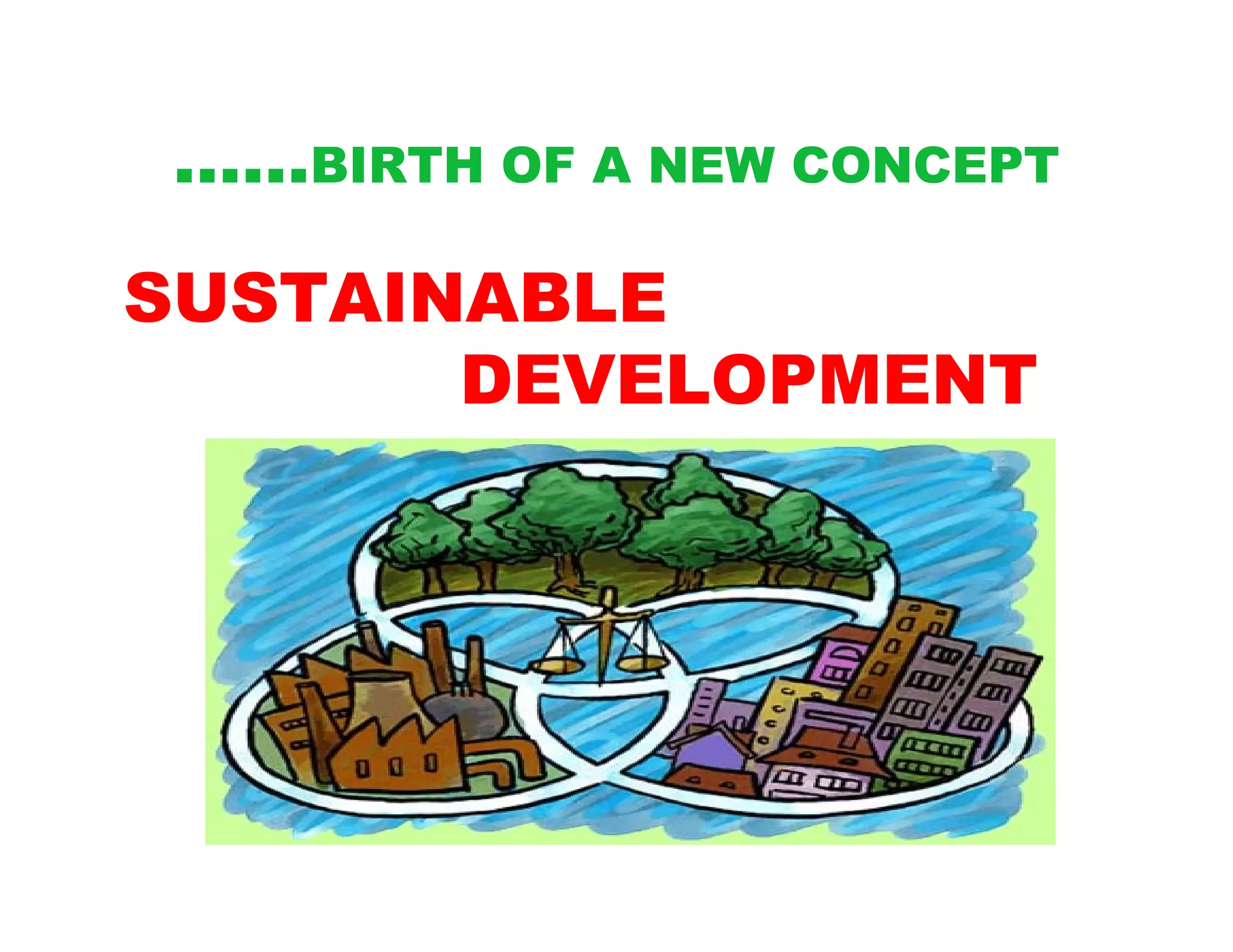
……BIRTH OF A NEW CONCEPT

SUSTAINABLE
       DEVELOPMENT
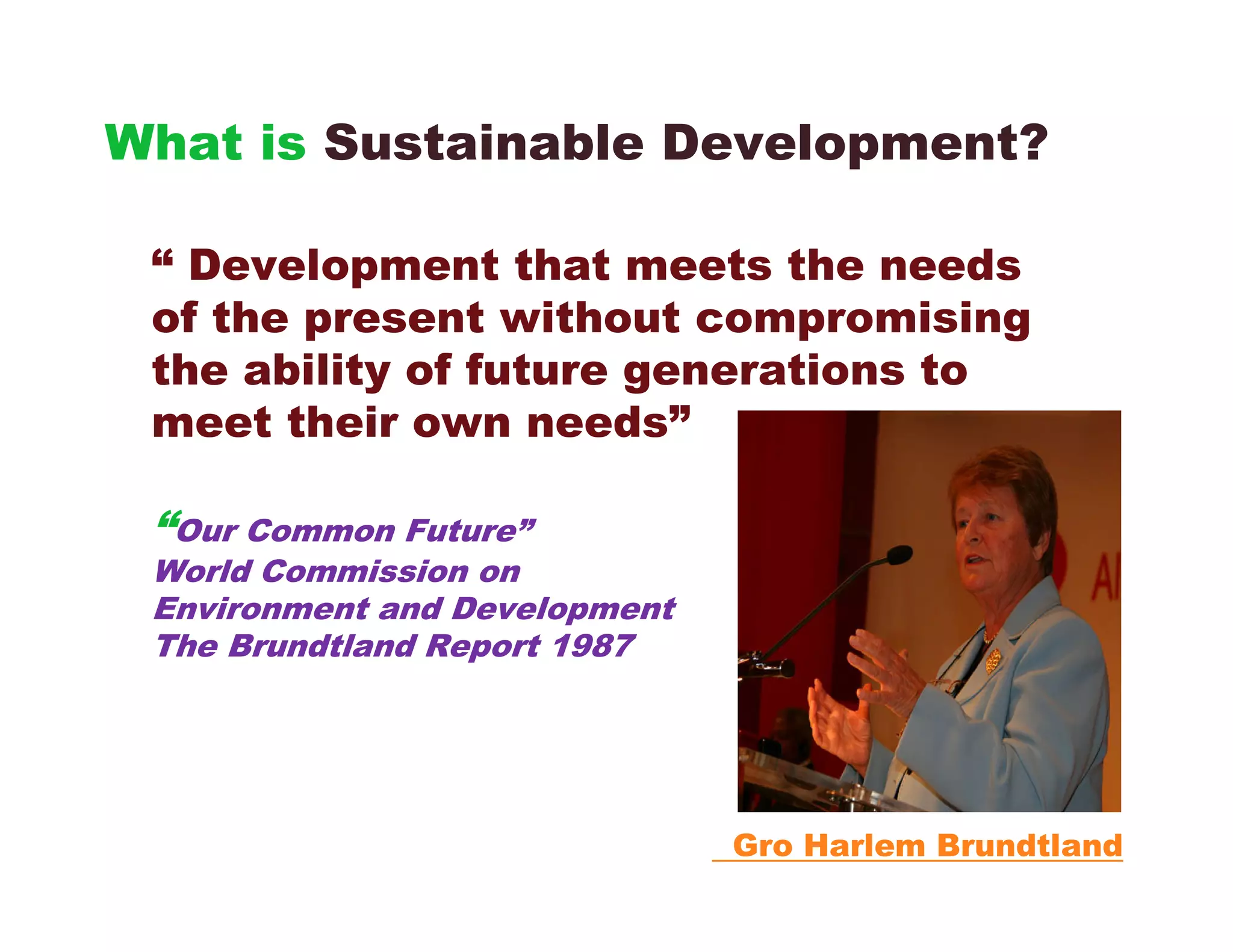
What is Sustainable Development?

 “ Development that meets the needs
 of the present without compromising
 the ability of future generations to
 meet their own needs”

 “Our Common Future”
 World Commission on
 Environment and Development
 The Brundtland Report 1987


                               Gro Harlem Brundtland
“ Sustainable development is a dynamic process,
which enables all people to realise their potential
And to improve their quality of life in ways
which simultaneously protect and enhance the
Earth’s life support systems”
Forum for the Future
OBJECTIVES…
Sustainable development has three
Overarching objectives and essential
requirements:
     Poverty reduction;
     Changing unsustainable patterns of
     production and consumption;
     Protecting and managing the
     natural resource base of economic
     and social development.
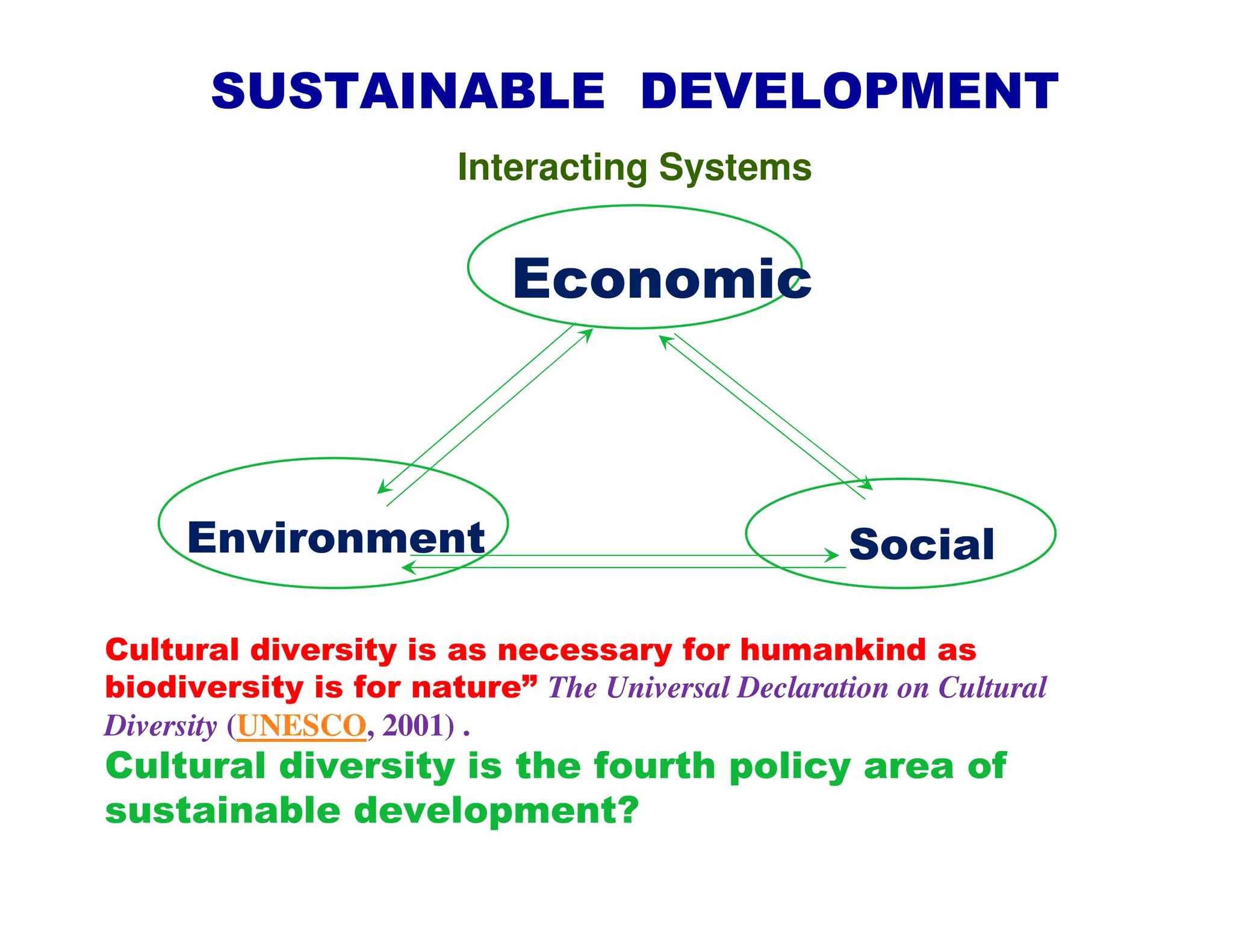
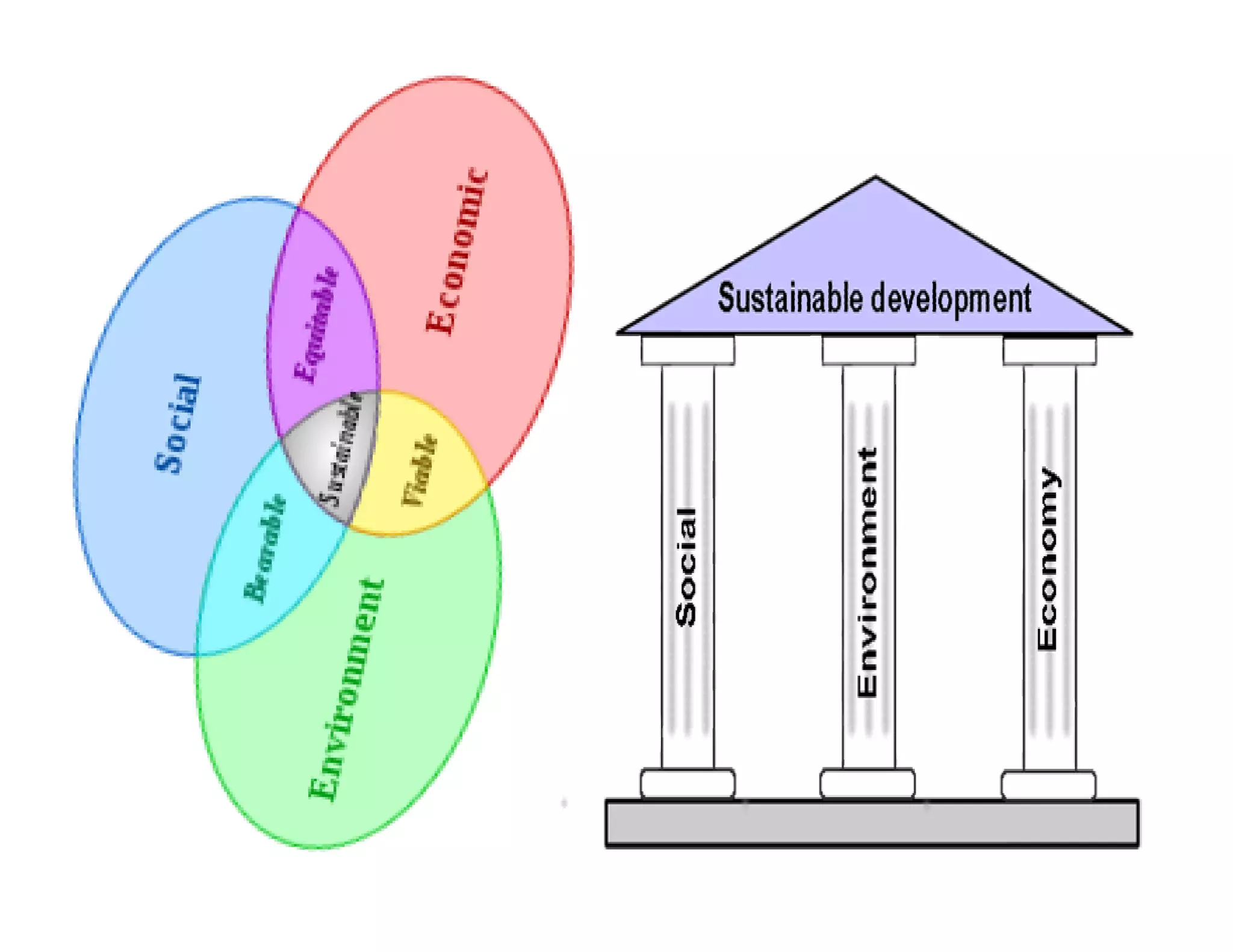
SUSTAINABLE DEVELOPMENT
                        Interacting Systems


                            Economic


     Environment                                   Social

Cultural diversity is as necessary for humankind as
biodiversity is for nature” The Universal Declaration on Cultural
Diversity (UNESCO, 2001) .
Cultural diversity is the fourth policy area of
sustainable development?
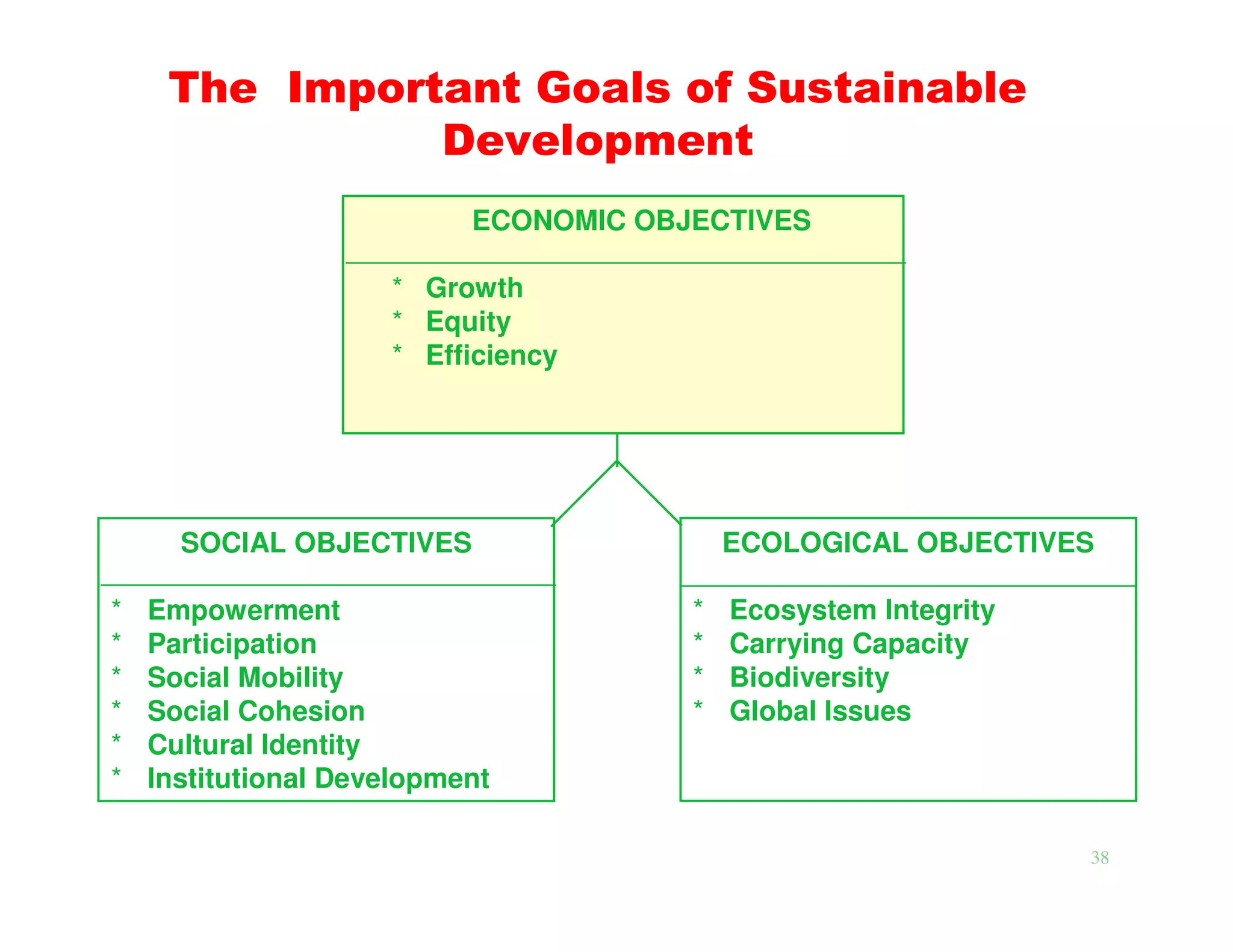
The Important Goals of Sustainable
               Development
                           ECONOMIC OBJECTIVES

                     * Growth
                     * Equity
                     * Efficiency


      SOCIAL OBJECTIVES                    ECOLOGICAL OBJECTIVES

*   Empowerment                        *   Ecosystem Integrity
*   Participation                      *   Carrying Capacity
*   Social Mobility                    *   Biodiversity
*   Social Cohesion                    *   Global Issues
*   Cultural Identity
*   Institutional Development

                                                                 38
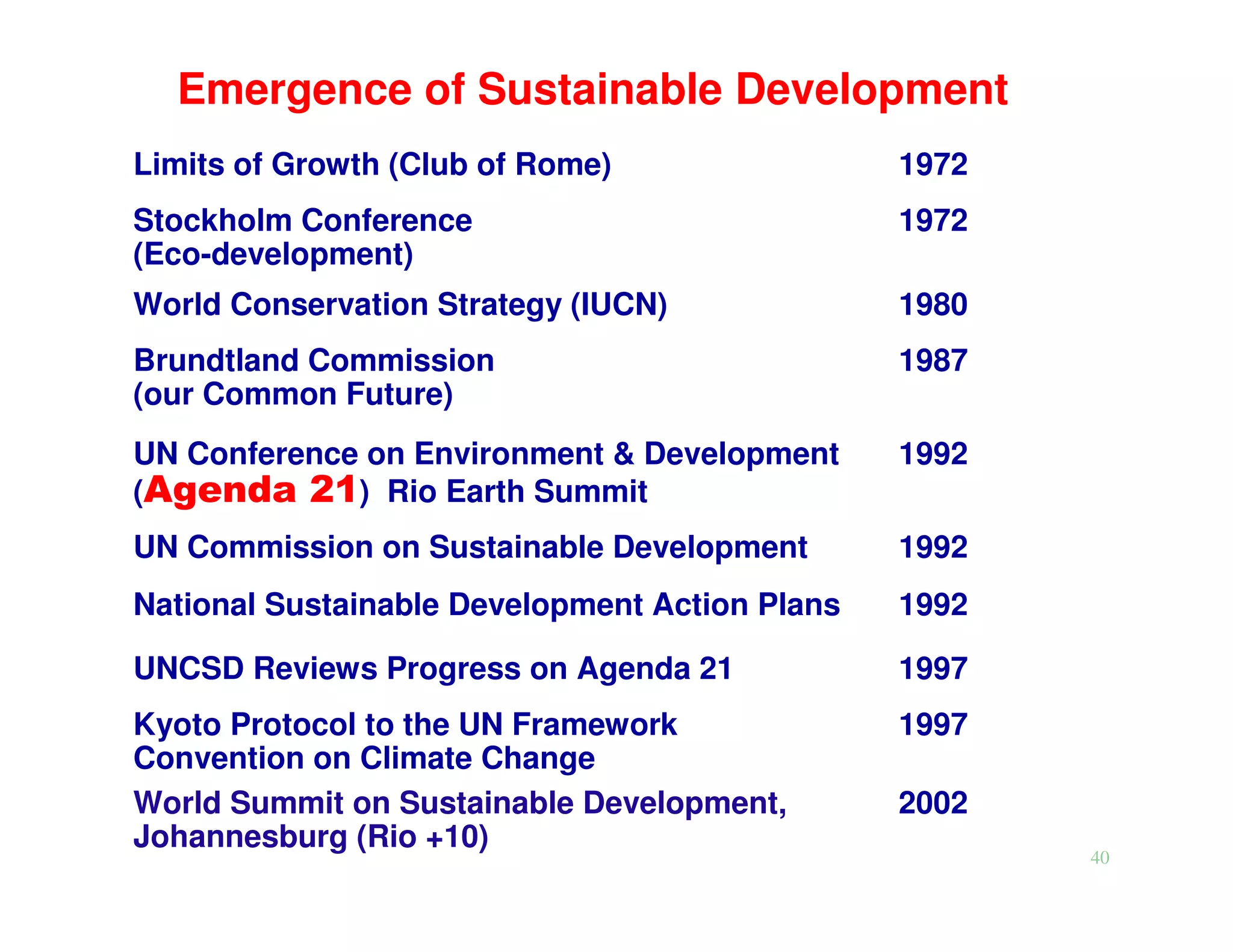
Emergence of Sustainable Development
Limits of Growth (Club of Rome)                 1972
Stockholm Conference                            1972
(Eco-development)
World Conservation Strategy (IUCN)              1980
Brundtland Commission                           1987
(our Common Future)
UN Conference on Environment & Development      1992
(Agenda 21) Rio Earth Summit
UN Commission on Sustainable Development        1992
National Sustainable Development Action Plans   1992

UNCSD Reviews Progress on Agenda 21             1997
Kyoto Protocol to the UN Framework              1997
Convention on Climate Change
World Summit on Sustainable Development,        2002
Johannesburg (Rio +10)
                                                       40
AGENDA 21
       Action Plan/ Blueprint for Sustainable Development
                    (40 chapters, 300 pages)
 (Global Agreement on Sustainable Development)
• A comprehensive plan of action to be taken up
  globally, nationally and locally by organizations of
  the United Nations System and Governments in
  areas of human impacts on the environment.
• Agreed to at the Rio de Janeiro Summit in 1992.
• Strongly reaffirmed at the World Summit on
  Sustainable Development (WSSD) held in
  Johannesburg, South Africa, 2002
• A 21 recognises National
  governments as the main role
  actors.
• Main focus on Local/Regional
  governments.
• Promotion of participation at
  grassroots levels.
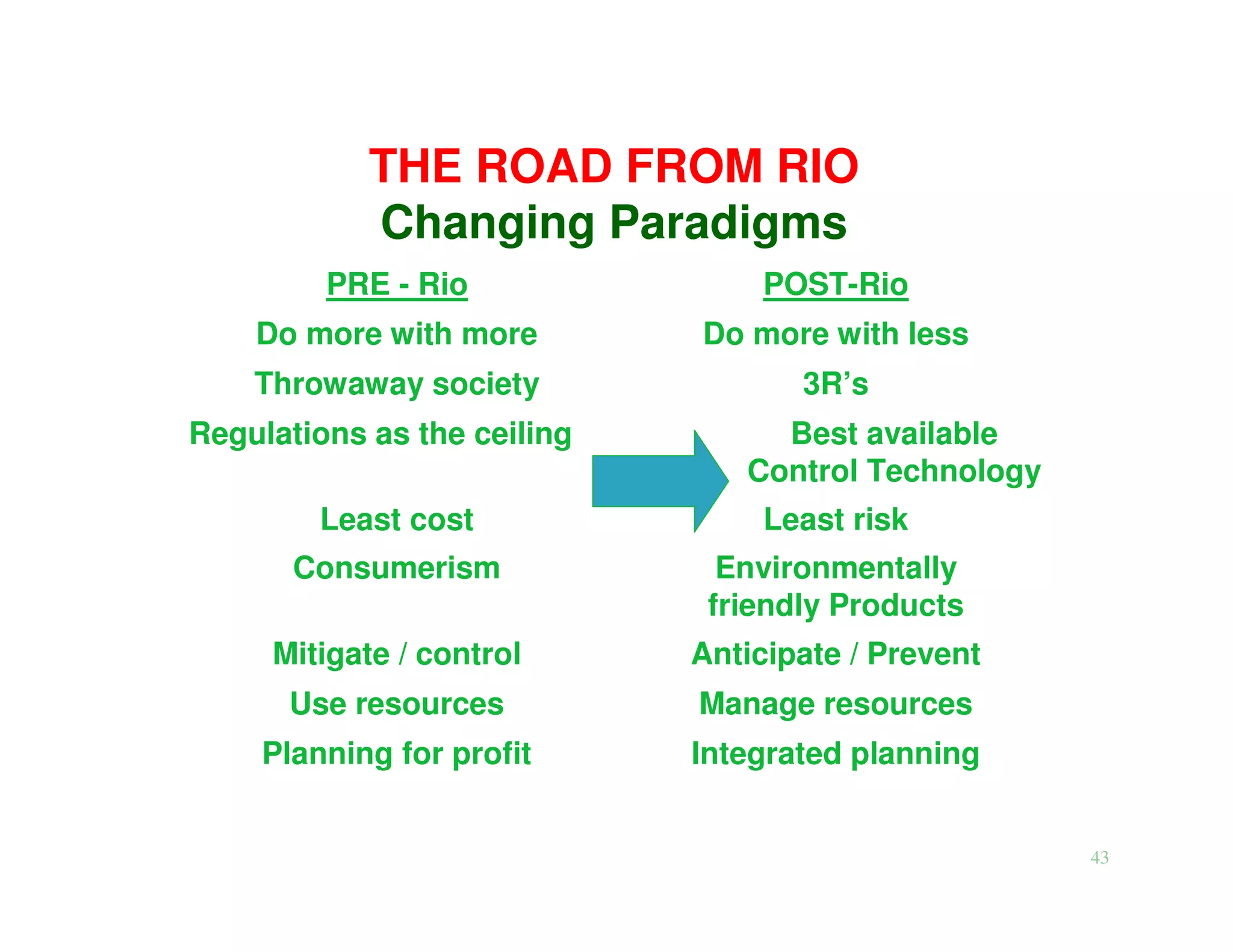
THE ROAD FROM RIO
            Changing Paradigms
         PRE - Rio               POST-Rio
    Do more with more        Do more with less
    Throwaway society               3R’s
Regulations as the ceiling        Best available
                                Control Technology
        Least cost               Least risk
       Consumerism             Environmentally
                              friendly Products
     Mitigate / control      Anticipate / Prevent
      Use resources          Manage resources
    Planning for profit      Integrated planning


                                                     43
Targets for Sustainable
            Development in India
• Reduction of poverty by 15 percentage points by 2012 (
  21.8% in 2004-5)
• Reduction in population growth between 2001 and
  2011 to 16.2% (21.34% in 2001)
• Increase in literacy rate to 75% by 2012 (65.2%
  in 2002)
• Reduction of Infant Mortality Rate (IMR) to 28 by
  2012 (72 at 2002)
• Reduction of Maternal Mortality Rate (MMR) to 1
  by 2012 (3 in 2002)
• Increase in forest cover to 33% by 2012 (20.60 % or
  67.71 million hectares - 2008)
• Cleaning of major polluted rivers by by 2012
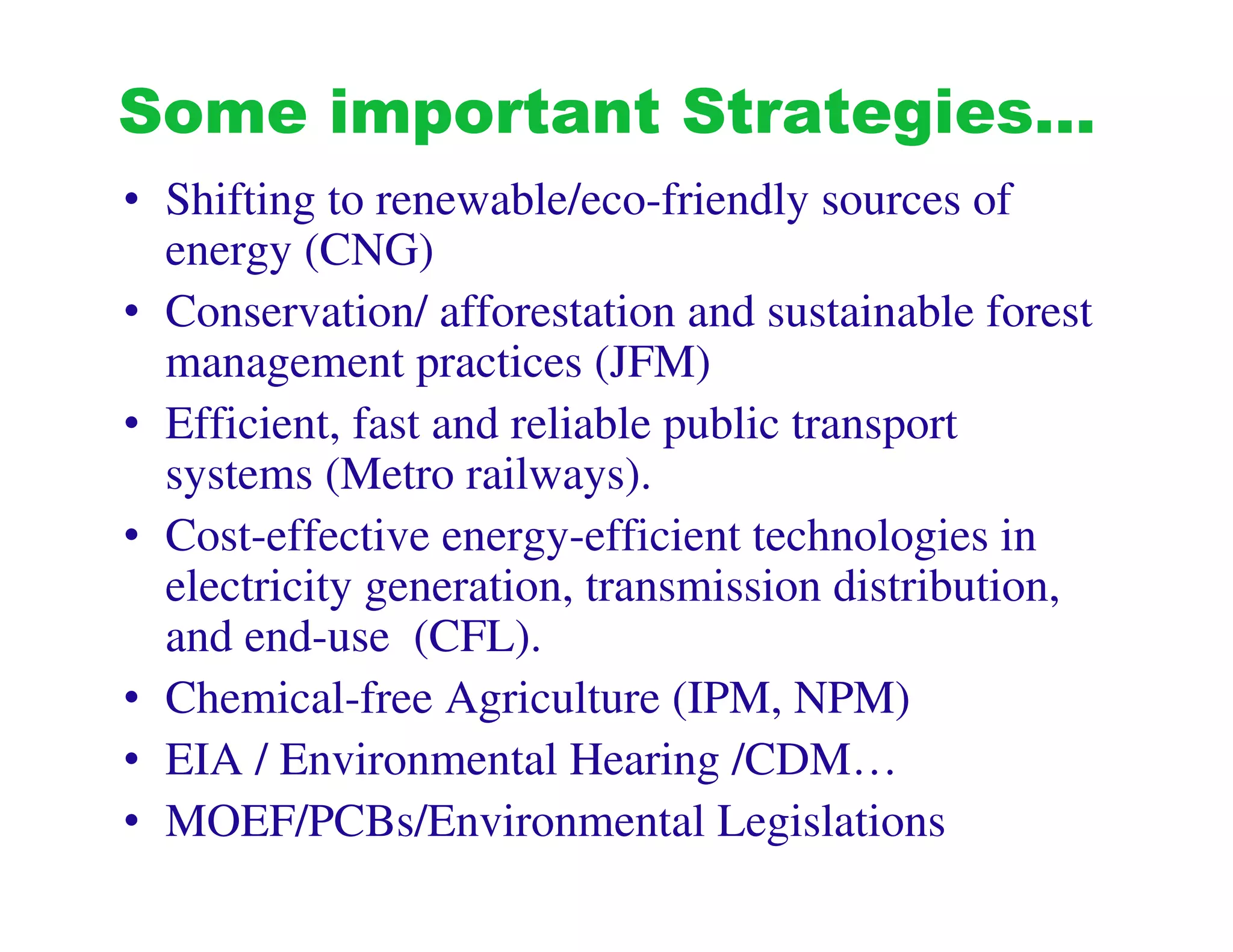
Some important Strategies…
• Shifting to renewable/eco-friendly sources of
  energy (CNG)
• Conservation/ afforestation and sustainable forest
  management practices (JFM)
• Efficient, fast and reliable public transport
  systems (Metro railways).
• Cost-effective energy-efficient technologies in
  electricity generation, transmission distribution,
  and end-use (CFL).
• Chemical-free Agriculture (IPM, NPM)
• EIA / Environmental Hearing /CDM…
• MOEF/PCBs/Environmental Legislations
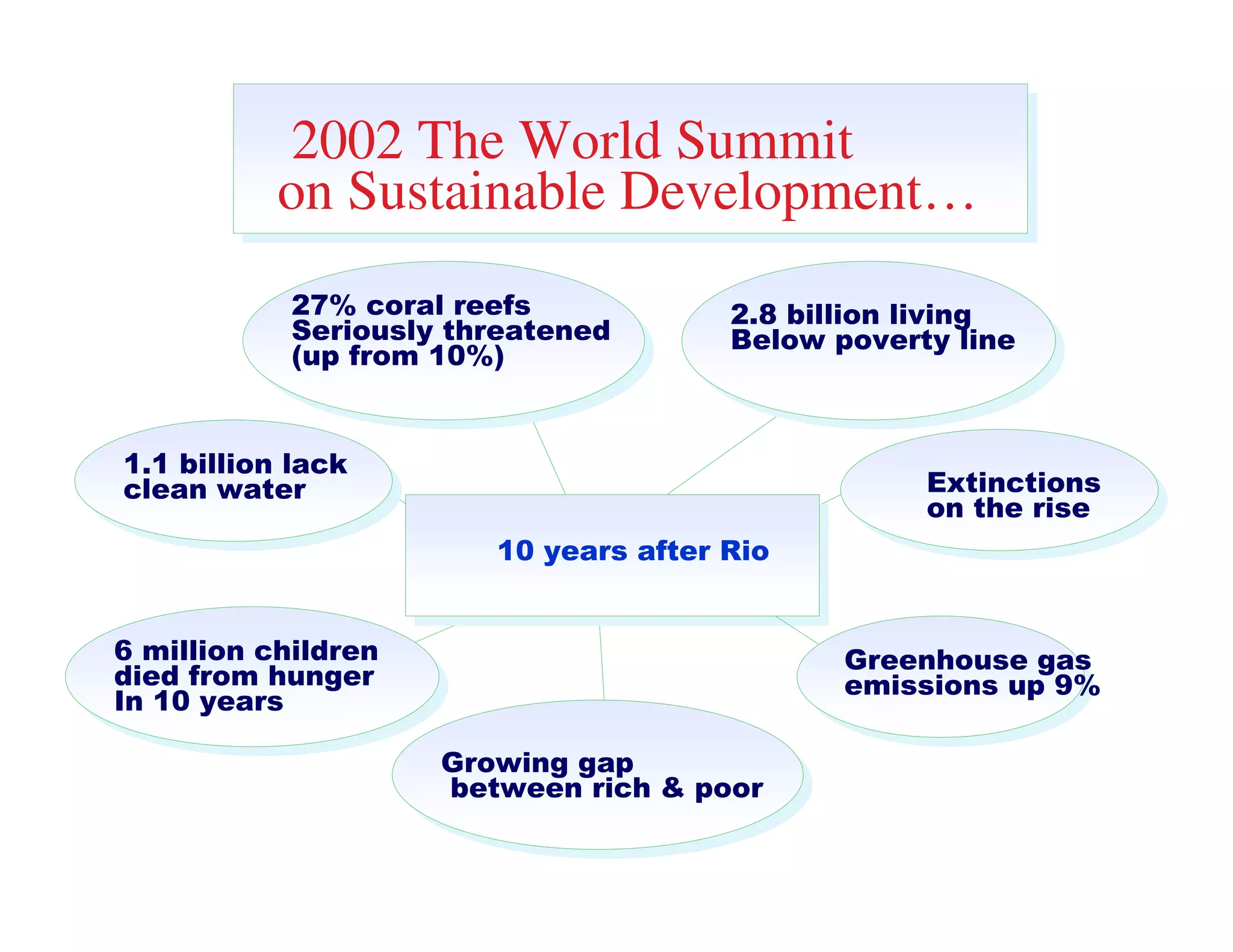
2002 The World Summit
           on Sustainable Development…
            27% coral reefs            2.8 billion living
            Seriously threatened       Below poverty line
            (up from 10%)


1.1 billion lack
clean water                                        Extinctions
                                                   on the rise
                        10 years after Rio


6 million children                            Greenhouse gas
died from hunger                              emissions up 9%
In 10 years

                     Growing gap
                     between rich & poor
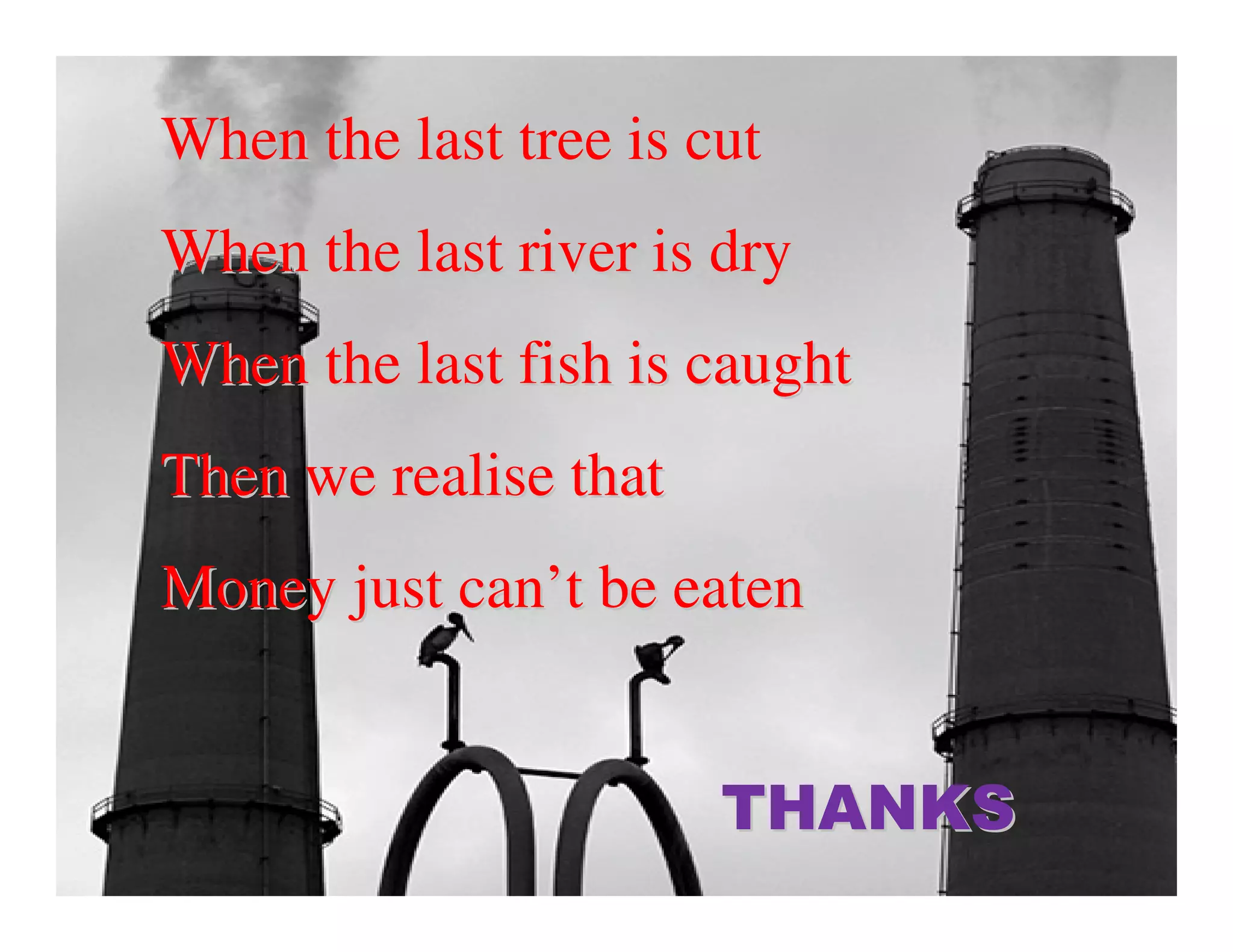
When the last tree is cut
When the last river is dry
When the last fish is caught
Then we realise that
Money just can’t be eaten


                       THANKS

Sustainable Development

  • 1.
    E NT N M T RO MEN I EN V Vs OP V EL DE IMPORTANCE OF SUSTAINABLE DEVELOPMRNT Dr. Jayakara Bhandary M. SGL-Botany GAS College, Karwar – 581301 Email: jaikarb@yahoo.com
  • 3.
    WHAT IS DEVELOPMENT…? Enablingthe community to meet everyone’s basic human needs for food security, housing, health, clean water and fuel. It should lead to a dynamic, just and prosperous Society
  • 4.
    WHAT IS ENVIRONMENT…? Environmentmeans everything surrounding us, including something that is tangible (objects) and intangible (culture, belief,and norm) which associate to each other as cycle of system. Everything that surround us. Includes Flora (vegetation) and Fauna (animals and insects), consists of: AIR, SOIL and WATER
  • 5.
    DEVELOPMENT ACHIEVEMENTS.. BIG DAMS… More than 4,000 large dams of over 15 metres height . Spent about 919 billion rupees. Played an important role in increasing farm productivity, power generation and industrial water supply. (Report by World Commission on Big Dams)
  • 6.
    AT WHAT COST..? •On average, each big dam has submerged nearly 5,000 hectares of forest. • In the last 20 years, big dams have swallowed up 9.1 million hectares of forests. • 16 million Indian people have been forced from their homes because of these dams. • ¾ of these people were not ‘rehabilitated’.
  • 7.
    GREEN REVOLUTION…….. • 4-5foldincrease in food production. • Yield of wheat increased from 2 to 6 metric tons per hectare. • Cereal and calorie availability per person increased by nearly 30% • Eliminated the threat of starvation of exploding population.
  • 8.
    GREEN REVOLUTION.. • Percapita incomes doubled in Asia between 1970 - 1995. • Poverty declined from 3 out of every 5 Asians in 1975 to less than 1 in 3 by 1995. • The number of poor fell from 1.15 billion in 1975 to 825 million in 1995 despite a 60 % increase in population. • In India, the % of rural Poor was 50 – 65% in 1960s. • Declined to about 1/3 of the rural population by 1993. (Report by International Food Policy Research Institute, USA, 2003)
  • 9.
    AT WHAT COST…? Excessivechemical inputs – Pollution. • Pesticide use 57, 240 million tonnes (98-99) • Fertilisers -161.88 lakh tons (98-99) Increase in water use (75-85% of total water Usage) • 6 of the 20 major river basins in India suffer from water scarcity. Erosion of crop genetic diversity.
  • 10.
    The Punjab Story… 4% land under cultivation ( 42 % for India as a whole) . Only 4% is “forest”! oss of soil fertility – decreasing yield. cute shortage of water (60 out of 118 blocks cannot ustain any more tube wells). .5 % total agricultural land in the country, but
  • 11.
    Indian Pollution Status… •33000MLD waste water generated, only 7000MLD is treated. • 1,20,000 TPD Municipal Solid waste generated, 70% collected, only 5% disposed. • 65 cities and towns – air quality un healthy. • 112 MT coal ash/annum, 150MT by 2015. • 40,000 T of e-waste
  • 13.
  • 14.
    How many earthsneeded to support developmental consumption of resources, at the present rate? (by 2050) Energy - 8 Minerals – 2 Metals - 7 Land - 1.5 Wood – 3.5 Mclaren et al 1998 Tomorrow’s World, Earthscan, London
  • 15.
    Developmental Activities in general leads to… • Depletion of natural resources • Depletion of Biodiversity • Pollution • Climate Change UNSUSTAINABLE!
  • 16.
    Global Climate Change… 1.4-5.8 degrees warmingby 2100. 9-88 cm sea level rise. Heat waves… Heavy rains Floods… Diseases…
  • 18.
    We are WitnessingUnprecedented Climatic Changes Mumbai, 2005, 100 cm rainfall in less than 48 h, More than 7 ft Water, 1000 death toll
  • 19.
    • Over theperiod of 1995-2004, a total of 2,500 million people were affected by disasters, with losses of 890,000 dead and costs of US$ 570 billion. Most disasters (75%) are related to weather extremes that climate change is expected to exacerbate. • The 2003 European heat wave — involving temperatures that were 18°F (10°C) above the 30-year average, killed 21,000 to 35,000 people in five countries.
  • 20.
    Diseases.. DENGUE • Thenumber of months with average temperatures higher than 18C and the degree of urbanization were found to correlate with increasing risk of dengue fever (Wu et al, 2009). Temperature affects insect survival time and habitats as well as maturation and infective periods, and higher temperatures shorten the incubation period and viral development rate.
  • 21.
    Development Vs Environment– The Debate Taking care of We have already wasted millions of people and destroyed vast who are starving at amounts of natural present is more resources, and in so important than doing have put earth at saving natural risk. We must preserve resources. the earth for our children and grand children.
  • 22.
    Development Vs Environment– The Debate •Developed Vs Developing countries •Rich Vs Poor •Progress Vs Stagnation
  • 23.
    INSPIRING VOICES……. Birsa Munda Led the people of Chotanagpur to assert their rights over their Land. Icon for tribals struggling for their land and forests..
  • 24.
    Rachel Carson Her 1962 book Silent Springs changed the way the world saw pesticides and industrial chemicals. Faced a sea of opposition from chemical companies like DuPont, maker of the deadly DDT.
  • 25.
    Chico Mendes Labor leader from Brazil, defended poor rubber tappers against rich ranchers. Soon, he was fighting to save the Amazon rainforests. Killed in 1988 by ranchers.
  • 26.
    Lois Gibbs A housewife from New York who led the community to demand evacuation and clean up of Love Canal, a locality initial built on toxic waste dump.
  • 27.
    Ken Saro-wiwa Fought Nigerian Government and oil companies for polluting the lands of Ogoni people. Hanged in 1995 for his non-violent struggle.
  • 28.
    Masanobu Fukuwaka His book The One Straw Revolution of 1978 inspired farmers across the world to go organic.
  • 29.
    WHICH IS THEWAY OUT? CAN DEVELOPMENT AND ENVIRONMENT GO TOGETHER?
  • 31.
  • 32.
    ……BIRTH OF ANEW CONCEPT SUSTAINABLE DEVELOPMENT
  • 33.
    What is SustainableDevelopment? “ Development that meets the needs of the present without compromising the ability of future generations to meet their own needs” “Our Common Future” World Commission on Environment and Development The Brundtland Report 1987 Gro Harlem Brundtland
  • 34.
    “ Sustainable developmentis a dynamic process, which enables all people to realise their potential And to improve their quality of life in ways which simultaneously protect and enhance the Earth’s life support systems” Forum for the Future
  • 35.
    OBJECTIVES… Sustainable development hasthree Overarching objectives and essential requirements: Poverty reduction; Changing unsustainable patterns of production and consumption; Protecting and managing the natural resource base of economic and social development.
  • 36.
    SUSTAINABLE DEVELOPMENT Interacting Systems Economic Environment Social Cultural diversity is as necessary for humankind as biodiversity is for nature” The Universal Declaration on Cultural Diversity (UNESCO, 2001) . Cultural diversity is the fourth policy area of sustainable development?
  • 38.
    The Important Goalsof Sustainable Development ECONOMIC OBJECTIVES * Growth * Equity * Efficiency SOCIAL OBJECTIVES ECOLOGICAL OBJECTIVES * Empowerment * Ecosystem Integrity * Participation * Carrying Capacity * Social Mobility * Biodiversity * Social Cohesion * Global Issues * Cultural Identity * Institutional Development 38
  • 40.
    Emergence of SustainableDevelopment Limits of Growth (Club of Rome) 1972 Stockholm Conference 1972 (Eco-development) World Conservation Strategy (IUCN) 1980 Brundtland Commission 1987 (our Common Future) UN Conference on Environment & Development 1992 (Agenda 21) Rio Earth Summit UN Commission on Sustainable Development 1992 National Sustainable Development Action Plans 1992 UNCSD Reviews Progress on Agenda 21 1997 Kyoto Protocol to the UN Framework 1997 Convention on Climate Change World Summit on Sustainable Development, 2002 Johannesburg (Rio +10) 40
  • 41.
    AGENDA 21 Action Plan/ Blueprint for Sustainable Development (40 chapters, 300 pages) (Global Agreement on Sustainable Development) • A comprehensive plan of action to be taken up globally, nationally and locally by organizations of the United Nations System and Governments in areas of human impacts on the environment. • Agreed to at the Rio de Janeiro Summit in 1992. • Strongly reaffirmed at the World Summit on Sustainable Development (WSSD) held in Johannesburg, South Africa, 2002
  • 42.
    • A 21recognises National governments as the main role actors. • Main focus on Local/Regional governments. • Promotion of participation at grassroots levels.
  • 43.
    THE ROAD FROMRIO Changing Paradigms PRE - Rio POST-Rio Do more with more Do more with less Throwaway society 3R’s Regulations as the ceiling Best available Control Technology Least cost Least risk Consumerism Environmentally friendly Products Mitigate / control Anticipate / Prevent Use resources Manage resources Planning for profit Integrated planning 43
  • 44.
    Targets for Sustainable Development in India • Reduction of poverty by 15 percentage points by 2012 ( 21.8% in 2004-5) • Reduction in population growth between 2001 and 2011 to 16.2% (21.34% in 2001) • Increase in literacy rate to 75% by 2012 (65.2% in 2002) • Reduction of Infant Mortality Rate (IMR) to 28 by 2012 (72 at 2002) • Reduction of Maternal Mortality Rate (MMR) to 1 by 2012 (3 in 2002) • Increase in forest cover to 33% by 2012 (20.60 % or 67.71 million hectares - 2008) • Cleaning of major polluted rivers by by 2012
  • 45.
    Some important Strategies… •Shifting to renewable/eco-friendly sources of energy (CNG) • Conservation/ afforestation and sustainable forest management practices (JFM) • Efficient, fast and reliable public transport systems (Metro railways). • Cost-effective energy-efficient technologies in electricity generation, transmission distribution, and end-use (CFL). • Chemical-free Agriculture (IPM, NPM) • EIA / Environmental Hearing /CDM… • MOEF/PCBs/Environmental Legislations
  • 46.
    2002 The WorldSummit on Sustainable Development… 27% coral reefs 2.8 billion living Seriously threatened Below poverty line (up from 10%) 1.1 billion lack clean water Extinctions on the rise 10 years after Rio 6 million children Greenhouse gas died from hunger emissions up 9% In 10 years Growing gap between rich & poor
  • 47.
    When the lasttree is cut When the last river is dry When the last fish is caught Then we realise that Money just can’t be eaten THANKS