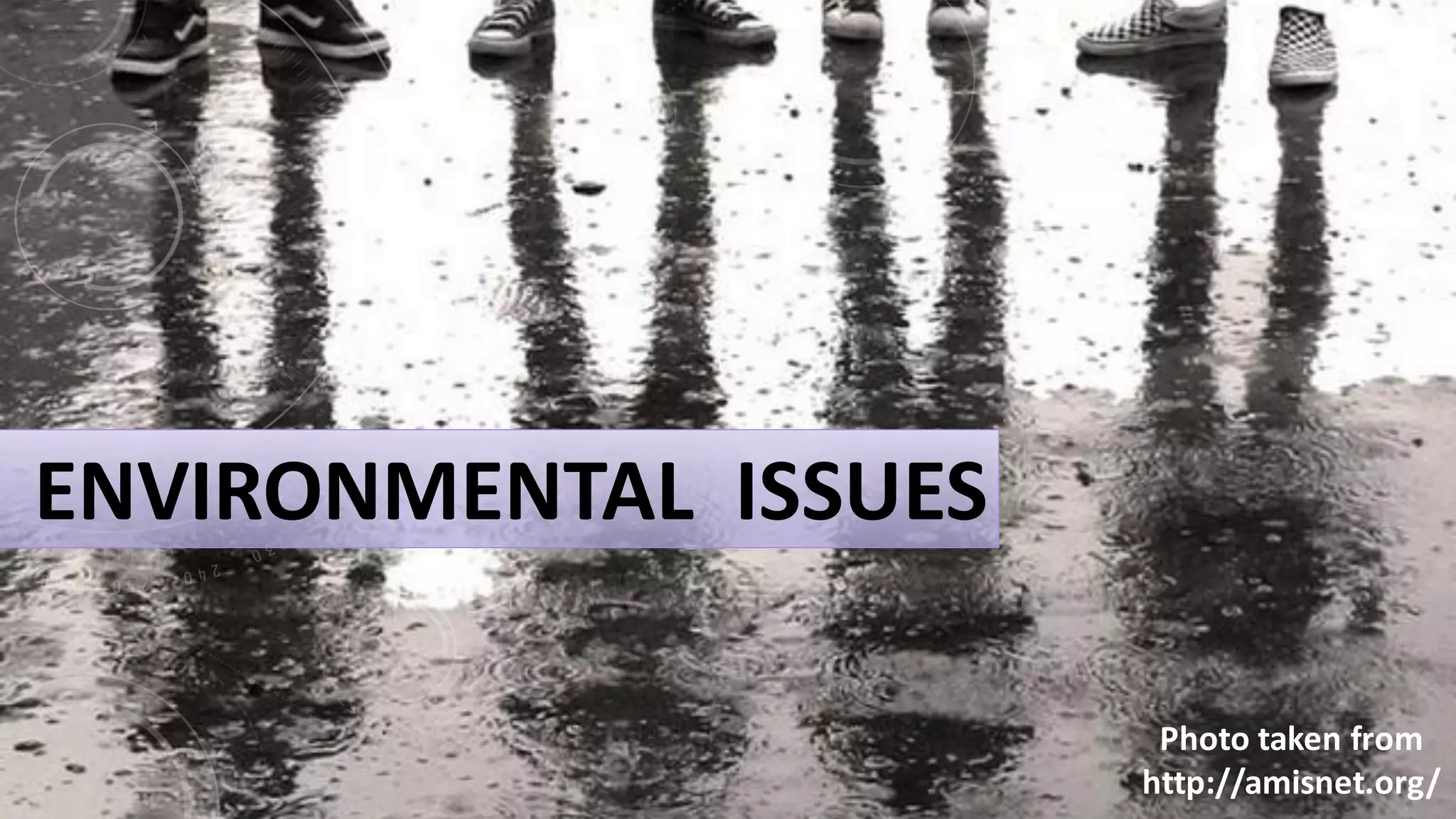
ENVIRONMENTAL ISSUES
Photo taken from
http://amisnet.org/
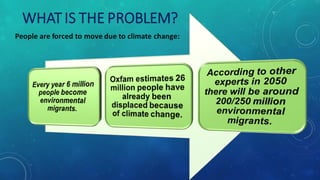
WHAT IS THE PROBLEM?
People are forced to move due to climate change:
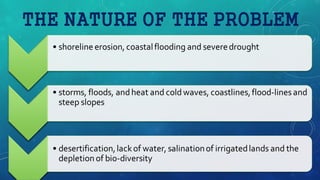
THE NATURE OF THE PROBLEM
• shoreline erosion, coastalflooding and severedrought
• storms, floods, andheat and coldwaves, coastlines,flood-linesand
steep slopes
• desertification,lackof water, salinationof irrigatedlands and the
depletion of bio-diversity
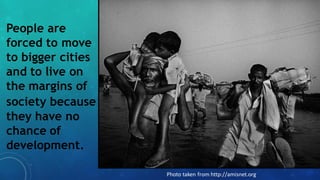
People are
forced to move
to bigger cities
and to live on
the margins of
society because
they have no
chance of
development.
Photo taken from http://amisnet.org
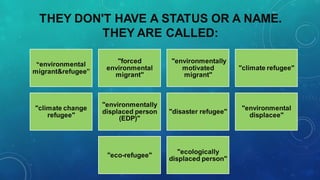
THEY DON'T HAVE A STATUS OR A NAME.
THEY ARE CALLED:
“environmental
migrant&refugee”
"forced
environmental
migrant"
"environmentally
motivated
migrant"
"climate refugee"
"climate change
refugee"
"environmentally
displaced person
(EDP)"
"disaster refugee"
"environmental
displacee"
"eco-refugee"
"ecologically
displaced person"
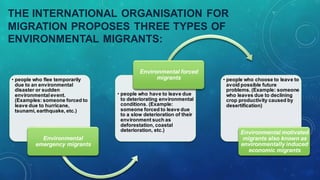
THE INTERNATIONAL ORGANISATION FOR
MIGRATION PROPOSES THREE TYPES OF
ENVIRONMENTAL MIGRANTS:
• people who flee temporarily
due to an environmental
disaster or sudden
environmentalevent.
(Examples: someone forced to
leave due to hurricane,
tsunami, earthquake, etc.)
Environmental
emergency migrants
• people who have to leave due
to deteriorating environmental
conditions. (Example:
someone forced to leave due
to a slow deterioration of their
environment such as
deforestation, coastal
deterioration, etc.)
Environmental forced
migrants • people who choose to leave to
avoid possible future
problems. (Example: someone
who leaves due to declining
crop productivity caused by
desertification)
Environmental motivated
migrants also known as
environmentally induced
economic migrants
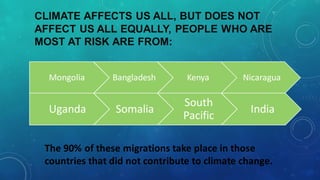
CLIMATE AFFECTS US ALL, BUT DOES NOT
AFFECT US ALL EQUALLY, PEOPLE WHO ARE
MOST AT RISK ARE FROM:
Mongolia Bangladesh Kenya Nicaragua
Uganda Somalia
South
Pacific
India
The 90% of these migrations take place in those
countries that did not contribute to climate change.
WHAT CAN WE DO?
• They currently have no adequate recognition in international law,
so their status should be legally recognised.
• We should reduce pollution, so we should introduce a kind of
economy that is able to respect the surrounding environment.
• A 2012 Asian Development Bank study says: "To reduce migration
compelled by worsening environmental conditions, and to
strengthen resilience of at-risk communities, governments should
adopt polices and commit financing to social protection,
livelihoods development, basic urban infrastructure development,
and disaster risk management."

Environmental Issues

  • 1.
    ENVIRONMENTAL ISSUES Photo takenfrom http://amisnet.org/
  • 2.
    WHAT IS THEPROBLEM? People are forced to move due to climate change:
  • 3.
    THE NATURE OFTHE PROBLEM • shoreline erosion, coastalflooding and severedrought • storms, floods, andheat and coldwaves, coastlines,flood-linesand steep slopes • desertification,lackof water, salinationof irrigatedlands and the depletion of bio-diversity
  • 4.
    People are forced tomove to bigger cities and to live on the margins of society because they have no chance of development. Photo taken from http://amisnet.org
  • 5.
    THEY DON'T HAVEA STATUS OR A NAME. THEY ARE CALLED: “environmental migrant&refugee” "forced environmental migrant" "environmentally motivated migrant" "climate refugee" "climate change refugee" "environmentally displaced person (EDP)" "disaster refugee" "environmental displacee" "eco-refugee" "ecologically displaced person"
  • 6.
    THE INTERNATIONAL ORGANISATIONFOR MIGRATION PROPOSES THREE TYPES OF ENVIRONMENTAL MIGRANTS: • people who flee temporarily due to an environmental disaster or sudden environmentalevent. (Examples: someone forced to leave due to hurricane, tsunami, earthquake, etc.) Environmental emergency migrants • people who have to leave due to deteriorating environmental conditions. (Example: someone forced to leave due to a slow deterioration of their environment such as deforestation, coastal deterioration, etc.) Environmental forced migrants • people who choose to leave to avoid possible future problems. (Example: someone who leaves due to declining crop productivity caused by desertification) Environmental motivated migrants also known as environmentally induced economic migrants
  • 7.
    CLIMATE AFFECTS USALL, BUT DOES NOT AFFECT US ALL EQUALLY, PEOPLE WHO ARE MOST AT RISK ARE FROM: Mongolia Bangladesh Kenya Nicaragua Uganda Somalia South Pacific India The 90% of these migrations take place in those countries that did not contribute to climate change.
  • 8.
    WHAT CAN WEDO? • They currently have no adequate recognition in international law, so their status should be legally recognised. • We should reduce pollution, so we should introduce a kind of economy that is able to respect the surrounding environment. • A 2012 Asian Development Bank study says: "To reduce migration compelled by worsening environmental conditions, and to strengthen resilience of at-risk communities, governments should adopt polices and commit financing to social protection, livelihoods development, basic urban infrastructure development, and disaster risk management."