Human Population Growth and the EnvironmentExplosive  Population GrowthLimited Natural ResourcesIncreasing Environmental StressSustainable Use?
“Efforts to slow down 				population growth, to reduce 		poverty, to achieve economic progress, to improve environmental protection, and to reduce unsustainable consumption and production patterns are mutually reinforcing. Slower population growth has in many countries increased those countries’ ability to attack poverty, protect and repair the environment, and build the base for future sustainable development.”								 -IDCP
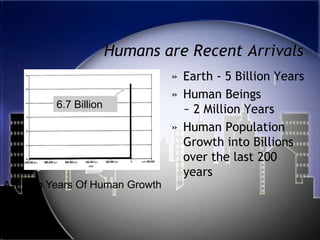
Humans are Recent ArrivalsEarth - 5 Billion YearsHuman Beings               ~ 2 Million YearsHuman Population Growth into Billions      over the last 200 years6.7 BillionA Million Years Of Human Growth (1)
A Closer Look (1)12,000 years200 Million by 1 A.D.2,000 Years1 Billion in 1800The Industrial Revolution1 Billion200 million
Three Technological Eras (2)
What’s Behind Population GrowthIndustrial RevolutionGrowth of Cities and InfrastructureWaterEnergyTransportationIncreased ProductivityBetter NutritionBetter SanitationMedicineThree Factors FertilityInfant MortalityLongevityAnimal Domestication and Agriculture
Total Fertility TrendsAt 1990 fertility rates: population would grow to 110 billion by 2100
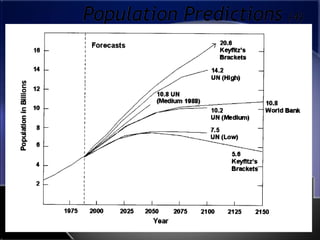
Population Predictions (4)
Population May OvershootScenario - current population trend, doubled resources (5)
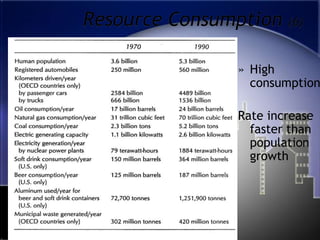
Resource Consumption (6)High consumptionRate increase faster than population growth
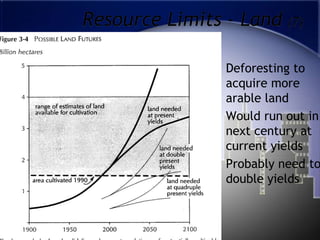
Resource Limits - Land (7)Deforesting to acquire more arable landWould run out in next century at current yieldsProbably need to double yields
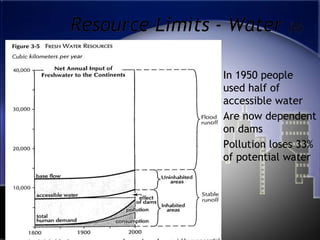
Resource Limits - Water (8)In 1950 people used half of accessible waterAre now dependent on damsPollution loses 33% of potential water
				Since the 1950s, 			global demand for water has 		tripled. 		Groundwater quantity and quality are declining due to over-pumping, runoff from fertilizers and pesticides, and leaking of industrial waste. 		Half a billion people live in countries defined as waterstressed or water-scarce; 		By 2025, that figure is expected to surge to between 2.4 billion and 3.4 billion.  - - UNFPA
Energy Consumption (9)Energy growth very high last fifty yearsMostly hydrocarbon fuelsNonrenewable resource consumption and climate change issues
 Fossil Fuel Reserves (9)
Economics and Resources (11)The poorest 20% of the world share less of the wealth84.7% of global income1.4Poorest 20%Richest 20%
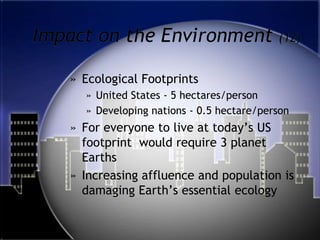
Impact on the Environment (12)Ecological FootprintsUnited States - 5 hectares/personDeveloping nations - 0.5 hectare/personFor everyone to live at today’s US footprint  would require 3 planet EarthsIncreasing affluence and population is damaging Earth’s essential ecology
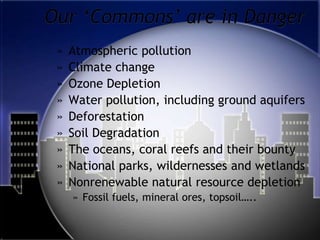
Our ‘Commons’ are in DangerAtmospheric pollution Climate changeOzone DepletionWater pollution, including ground aquifersDeforestationSoil DegradationThe oceans, coral reefs and their bountyNational parks, wildernesses and wetlandsNonrenewable natural resource depletionFossil fuels, mineral ores, topsoil…..
Biodiversity is in Danger (13)Humanity has spawned a species extinction to rival the 5 great extinctions of 65 - 440 million years agoRecovery times from the great extinctions took 10’s of millions of yearsBiodiversity is essential to life on Earth and holds untold treasures for the future
Global Warming0.6°C rise in last 100 years
					“Accumulation of 				greenhouse gases in the 			atmosphere, including carbon dioxide, 	is tied to rising and extreme change in 		temperatures, and more severe storms.	The sea level has risen an estimated 10-20 centimetres, largely as a result of melting ice masses and the expansion of oceans linked to regional and global warming. 		Small island nations and low-lying cities and 	farming areas face severe flooding.” -UNFDP
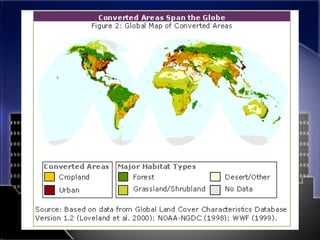
“Farmers, ranchers, loggers, and developers have cleared about half the world’s original forest cover, and another 30 per cent is degraded or fragmented.”-UNFPA-Bryant et al.  1997
“Over the last half century, land degradation has reduced cropland by an estimated 13 percent and pasture by 4 percent.” - UNFPA
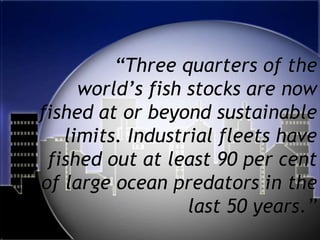
		“Three quarters of the world’s fish stocks are now fished at or beyond sustainable limits. Industrial fleets have fished out at least 90 per cent of large ocean predators in the last 50 years.”
Technology’s RolesDetailed information and understanding of what is occurringSensors, data processing, computers, models, predictions, communication, information…Alternate technologies that mitigate and eliminate deleterious effectsEnergy, water, transportation, communication…Sustainable Development
Engineers are vital Developing and applying the means by which to measure, analyze and predict future conditionsthe technologies by which to mitigate and eliminate undesired effectsDescribing, explaining and communicatingTo policy makersTo the non-technical publicCreating the framework for a sustainable environment
SummaryMajor increases are occurring in human population and affluence. Major stresses result in our society, natural environment, and ecology.Technology and engineering are central to the creation and the mitigation of problems.Predicting the future is difficult (17). The next twenty five to fifty years will be decisive.
References1. Cohen, Joel, How Many People Can The Earth Support?, W. W. Norton & Co., New York, 1995, p79-82.2. Kates, Robert, Population, technology, and the human environment: A thread through time, Technological Trajectories and the Human Environment, J Ausubel and H.D.Langford, Eds., National Academy Press, Washington, D.C., 1997, page 38 (concept credited to Deevey, E., The human population, Scientific American, 203, no.9 (September) 1960, pages 194-204.)3. Cohen, op. cit., p139.4. Kates, op cit., p50-51.5. Meadows, Donella H.. et al, Beyond the Limits, Chelsea Green Publishing Co., White River Junction, Vermont, 1992, p128-140.6. Meadows, op. cit., p7.
References, continued7. Meadows, op cit., Chapter 3, The Limits: Sources and Sinks, p51.8. Meadows, op cit., Chapter 3, The Limits: Sources and Sinks, p55.9. Meadows, op cit., Chapter 3, The Limits: Sources and Sinks, p67-8.10. Ausubel, J, and H.D.Langford, Eds., Technological Trajectories and the Human Environment, National Academy Press, Washington, D.C., 1997, p21 and 8611. Cohen, op. cit., p52.12. Wilson, Edward O., Foreword to 1999 edition, The Diversity of Life, W.W.Norton & Co., New York, 1992. 13. Wilson, E.O.,The Diversity of Life, W.W.Norton & Co., New York, 1992.14..Meadows, op. cit, p92-96.15. National Research Council, Reconciling Observations of Global Temperature Change, National Academy Press, Washington D.C., 200016. Dunn, Seth, Decarbonizing the energy economy in Brown, Lester et al, State of the World,W.W.Norton & Co., New York, 2001,  page 8517. Cerf, Christopher, and Victor Navansky, The Experts Speak, Pantheon Books, New York, 1984, revised 2000.

Human Population and the Environment

  • 1.
    Human Population Growthand the EnvironmentExplosive Population GrowthLimited Natural ResourcesIncreasing Environmental StressSustainable Use?
  • 2.
    “Efforts to slowdown population growth, to reduce poverty, to achieve economic progress, to improve environmental protection, and to reduce unsustainable consumption and production patterns are mutually reinforcing. Slower population growth has in many countries increased those countries’ ability to attack poverty, protect and repair the environment, and build the base for future sustainable development.” -IDCP
  • 3.
    Humans are RecentArrivalsEarth - 5 Billion YearsHuman Beings ~ 2 Million YearsHuman Population Growth into Billions over the last 200 years6.7 BillionA Million Years Of Human Growth (1)
  • 4.
    A Closer Look(1)12,000 years200 Million by 1 A.D.2,000 Years1 Billion in 1800The Industrial Revolution1 Billion200 million
  • 5.
  • 6.
    What’s Behind PopulationGrowthIndustrial RevolutionGrowth of Cities and InfrastructureWaterEnergyTransportationIncreased ProductivityBetter NutritionBetter SanitationMedicineThree Factors FertilityInfant MortalityLongevityAnimal Domestication and Agriculture
  • 7.
    Total Fertility TrendsAt1990 fertility rates: population would grow to 110 billion by 2100
  • 8.
  • 9.
    Population May OvershootScenario- current population trend, doubled resources (5)
  • 10.
    Resource Consumption (6)HighconsumptionRate increase faster than population growth
  • 11.
    Resource Limits -Land (7)Deforesting to acquire more arable landWould run out in next century at current yieldsProbably need to double yields
  • 12.
    Resource Limits -Water (8)In 1950 people used half of accessible waterAre now dependent on damsPollution loses 33% of potential water
  • 13.
    Since the 1950s, global demand for water has tripled. Groundwater quantity and quality are declining due to over-pumping, runoff from fertilizers and pesticides, and leaking of industrial waste. Half a billion people live in countries defined as waterstressed or water-scarce; By 2025, that figure is expected to surge to between 2.4 billion and 3.4 billion. - - UNFPA
  • 14.
    Energy Consumption (9)Energygrowth very high last fifty yearsMostly hydrocarbon fuelsNonrenewable resource consumption and climate change issues
  • 15.
    Fossil FuelReserves (9)
  • 16.
    Economics and Resources(11)The poorest 20% of the world share less of the wealth84.7% of global income1.4Poorest 20%Richest 20%
  • 17.
    Impact on theEnvironment (12)Ecological FootprintsUnited States - 5 hectares/personDeveloping nations - 0.5 hectare/personFor everyone to live at today’s US footprint would require 3 planet EarthsIncreasing affluence and population is damaging Earth’s essential ecology
  • 18.
    Our ‘Commons’ arein DangerAtmospheric pollution Climate changeOzone DepletionWater pollution, including ground aquifersDeforestationSoil DegradationThe oceans, coral reefs and their bountyNational parks, wildernesses and wetlandsNonrenewable natural resource depletionFossil fuels, mineral ores, topsoil…..
  • 19.
    Biodiversity is inDanger (13)Humanity has spawned a species extinction to rival the 5 great extinctions of 65 - 440 million years agoRecovery times from the great extinctions took 10’s of millions of yearsBiodiversity is essential to life on Earth and holds untold treasures for the future
  • 20.
    Global Warming0.6°C risein last 100 years
  • 21.
    “Accumulation of greenhousegases in the atmosphere, including carbon dioxide, is tied to rising and extreme change in temperatures, and more severe storms. The sea level has risen an estimated 10-20 centimetres, largely as a result of melting ice masses and the expansion of oceans linked to regional and global warming. Small island nations and low-lying cities and farming areas face severe flooding.” -UNFDP
  • 22.
    “Farmers, ranchers, loggers,and developers have cleared about half the world’s original forest cover, and another 30 per cent is degraded or fragmented.”-UNFPA-Bryant et al. 1997
  • 23.
    “Over the lasthalf century, land degradation has reduced cropland by an estimated 13 percent and pasture by 4 percent.” - UNFPA
  • 26.
    “Three quarters ofthe world’s fish stocks are now fished at or beyond sustainable limits. Industrial fleets have fished out at least 90 per cent of large ocean predators in the last 50 years.”
  • 27.
    Technology’s RolesDetailed informationand understanding of what is occurringSensors, data processing, computers, models, predictions, communication, information…Alternate technologies that mitigate and eliminate deleterious effectsEnergy, water, transportation, communication…Sustainable Development
  • 28.
    Engineers are vitalDeveloping and applying the means by which to measure, analyze and predict future conditionsthe technologies by which to mitigate and eliminate undesired effectsDescribing, explaining and communicatingTo policy makersTo the non-technical publicCreating the framework for a sustainable environment
  • 29.
    SummaryMajor increases areoccurring in human population and affluence. Major stresses result in our society, natural environment, and ecology.Technology and engineering are central to the creation and the mitigation of problems.Predicting the future is difficult (17). The next twenty five to fifty years will be decisive.
  • 30.
    References1. Cohen, Joel,How Many People Can The Earth Support?, W. W. Norton & Co., New York, 1995, p79-82.2. Kates, Robert, Population, technology, and the human environment: A thread through time, Technological Trajectories and the Human Environment, J Ausubel and H.D.Langford, Eds., National Academy Press, Washington, D.C., 1997, page 38 (concept credited to Deevey, E., The human population, Scientific American, 203, no.9 (September) 1960, pages 194-204.)3. Cohen, op. cit., p139.4. Kates, op cit., p50-51.5. Meadows, Donella H.. et al, Beyond the Limits, Chelsea Green Publishing Co., White River Junction, Vermont, 1992, p128-140.6. Meadows, op. cit., p7.
  • 31.
    References, continued7. Meadows,op cit., Chapter 3, The Limits: Sources and Sinks, p51.8. Meadows, op cit., Chapter 3, The Limits: Sources and Sinks, p55.9. Meadows, op cit., Chapter 3, The Limits: Sources and Sinks, p67-8.10. Ausubel, J, and H.D.Langford, Eds., Technological Trajectories and the Human Environment, National Academy Press, Washington, D.C., 1997, p21 and 8611. Cohen, op. cit., p52.12. Wilson, Edward O., Foreword to 1999 edition, The Diversity of Life, W.W.Norton & Co., New York, 1992. 13. Wilson, E.O.,The Diversity of Life, W.W.Norton & Co., New York, 1992.14..Meadows, op. cit, p92-96.15. National Research Council, Reconciling Observations of Global Temperature Change, National Academy Press, Washington D.C., 200016. Dunn, Seth, Decarbonizing the energy economy in Brown, Lester et al, State of the World,W.W.Norton & Co., New York, 2001, page 8517. Cerf, Christopher, and Victor Navansky, The Experts Speak, Pantheon Books, New York, 1984, revised 2000.