Topic: Storage and Quality control
SURBHI SHARMA
17BPH097
PARENTRALS
Introduction
• Parentral is a route of administration wherein a drug is administered in the patient by any means
other then mouth and alimentary canal .They are injected through the skin or mucous membrane in
the internal compartments of body.
• Parentrals are generally injections which are sterile products i.e. the dosage form is free from viable
microbes.
• For the products labeled as ‘sterile products’, the storage of the product governs the sterility of the
product. Storage of these sterile product plays a key role in deciding the shelf life or stability of the
drug.
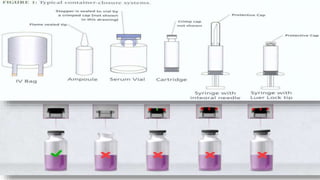
• Various containers and closure systems are used for the storage of parentral products. Container
and closure system refers to entirety of packaging components that together contain and protect
the product. A Packaging component means any single part of container and closure system.
Typical components are containers(e.g. ampules,vials and bottles),container liners, closures(e.g.
screw caps, stoppers),stopper overseal and container inner seals
Containers
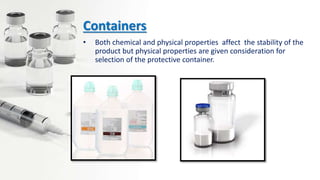
• Both chemical and physical properties affect the stability of the
product but physical properties are given consideration for
selection of the protective container.
• PLASTIC CONTAINERS: This type of container contains thermoplastic polymer which melts at
high temperature. Polypropylene and copolymer polyethylene are two of the main polymers
used in parentral products. A new group of polymers polyolefin have led to the development
of bottles that are rigid enough to hold their shape during processing but can collapse under
atmospheric pressure as outflow of solution occurs during intravenous administration
Advantages:
1) They are light in weight.
2) They are unbreakable.
3) When they contain additives, they are less toxic and less reactive.
Disadvantages:
1) Plastic degradation is possible.
2) Leaching is a problem.
3) Tissue toxicity is a big problem due to higher concentration of additives.
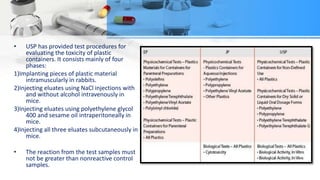
• USP has provided test procedures for
evaluating the toxicity of plastic
containers. It consists mainly of four
phases:
1)Implanting pieces of plastic material
intramuscularly in rabbits.
2)Injecting eluates using NaCl injections with
and without alcohol intravenously in
mice.
3)Injecting eluates using polyethylene glycol
400 and sesame oil intraperitoneally in
mice.
4)Injecting all three eluates subcutaneously in
mice.
• The reaction from the test samples must
not be greater than nonreactive control
samples.
GLASS CONTAINERS: Glass is still the most preferred type of material for parentral products .Two
main types of glass are soda-lime and borosilicate. Silicon dioxide is chemically resistant and so it is
also used as a glass material, but it is brittle and can only be melted/molded at high temperature.
Advantages:
1) They protect light sensitive products from degradation by UV rays.
2) The physical dimensions of glass container may be varied.
3) Viscous and dry liquids both can be filled in glass ampuls.
4) Ampuls, cartridge and vials are made from blow molding. The have greater strength ,less
distortion and uniform thickness.
Disadvantages:
1) They are more prone to break .
2) Traces of iron oxide may lead to leaching.
Closures Selection
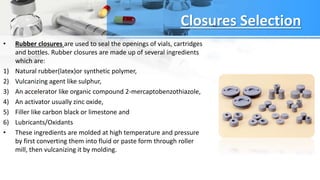
• Rubber closures are used to seal the openings of vials, cartridges
and bottles. Rubber closures are made up of several ingredients
which are:
1) Natural rubber(latex)or synthetic polymer,
2) Vulcanizing agent like sulphur,
3) An accelerator like organic compound 2-mercaptobenzothiazole,
4) An activator usually zinc oxide,
5) Filler like carbon black or limestone and
6) Lubricants/Oxidants
• These ingredients are molded at high temperature and pressure
by first converting them into fluid or paste form through roller
mill, then vulcanizing it by molding.
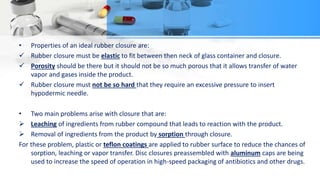
• Properties of an ideal rubber closure are:
 Rubber closure must be elastic to fit between then neck of glass container and closure.
 Porosity should be there but it should not be so much porous that it allows transfer of water
vapor and gases inside the product.
 Rubber closure must not be so hard that they require an excessive pressure to insert
hypodermic needle.
• Two main problems arise with closure that are:
 Leaching of ingredients from rubber compound that leads to reaction with the product.
 Removal of ingredients from the product by sorption through closure.
For these problem, plastic or teflon coatings are applied to rubber surface to reduce the chances of
sorption, leaching or vapor transfer. Disc closures preassembled with aluminum caps are being
used to increase the speed of operation in high-speed packaging of antibiotics and other drugs.
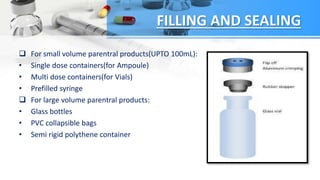
FILLING AND SEALING
 For small volume parentral products(UPTO 100mL):
• Single dose containers(for Ampoule)
• Multi dose containers(for Vials)
• Prefilled syringe
 For large volume parentral products:
• Glass bottles
• PVC collapsible bags
• Semi rigid polythene container
AMPOULE
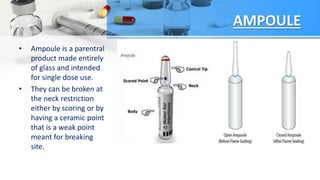
• Ampoule is a parentral
product made entirely
of glass and intended
for single dose use.
• They can be broken at
the neck restriction
either by scoring or by
having a ceramic point
that is a weak point
meant for breaking
site.
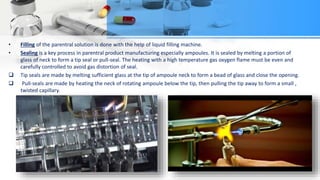
• Filling of the parentral solution is done with the help of liquid filling machine.
• Sealing is a key process in parentral product manufacturing especially ampoules. It is sealed by melting a portion of
glass of neck to form a tip seal or pull-seal. The heating with a high temperature gas oxygen flame must be even and
carefully controlled to avoid gas distortion of seal.
 Tip seals are made by melting sufficient glass at the tip of ampoule neck to form a bead of glass and close the opening.
 Pull-seals are made by heating the neck of rotating ampoule below the tip, then pulling the tip away to form a small ,
twisted capillary.
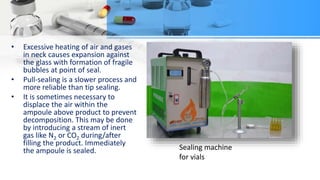
• Excessive heating of air and gases
in neck causes expansion against
the glass with formation of fragile
bubbles at point of seal.
• Pull-sealing is a slower process and
more reliable than tip sealing.
• It is sometimes necessary to
displace the air within the
ampoule above product to prevent
decomposition. This may be done
by introducing a stream of inert
gas like N2 or CO2 during/after
filling the product. Immediately
the ampoule is sealed. Sealing machine
for vials
VIALS
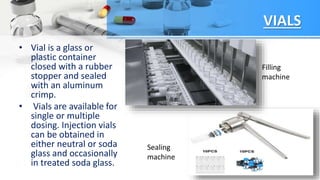
• Vial is a glass or
plastic container
closed with a rubber
stopper and sealed
with an aluminum
crimp.
• Vials are available for
single or multiple
dosing. Injection vials
can be obtained in
either neutral or soda
glass and occasionally
in treated soda glass.
Sealing
machine
Filling
machine
INFUSION FLUID
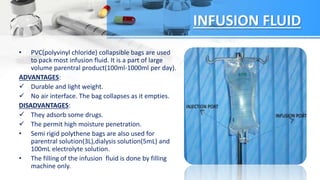
• PVC(polyvinyl chloride) collapsible bags are used
to pack most infusion fluid. It is a part of large
volume parentral product(100ml-1000ml per day).
ADVANTAGES:
 Durable and light weight.
 No air interface. The bag collapses as it empties.
DISADVANTAGES:
 They adsorb some drugs.
 The permit high moisture penetration.
• Semi rigid polythene bags are also used for
parentral solution(3L),dialysis solution(5mL) and
100mL electrolyte solution.
• The filling of the infusion fluid is done by filling
machine only.
QUALITY CONTROL(QC)
• Quality control involves testing of units and determining if they are within the specifications for the final product.
• The purpose of the testing is to determine any needs for corrective actions in the manufacturing process.
1.In-Process QC:
 Conductivity measurement
 Volume filled
 Temperature for heat sterilized product
 Environmental control tests
 Visual inspection
2.Finished product QC:
 Leaker test
 Clarity test
 Pyrogen test
 Sterility test
 Content uniformity test
LEAKER TEST
• It is employed to detect incompletely sealed ampoule so that they may be
discarded.This is used to test the packaging integrity.
a)Visual Inspection: This is the easiest method and used for large volume Parentrals.
 ADVANTAGE: Simple and Inexpensive
 DISADVANTAGE: It is less sensitive. Sensitivity can be increased by application of
vacuum/pressure.
a)Bubble Test: The test package is submerged in liquid. Pressure is applied on
container and it is observed for bubbles. Generation of differential positive
pressure of 3p.s.i inside the vial and observation of any leakage using magnifying
glass within maximum test time of 15 minutes. Surfactant can be used for
immersion of test package.
 ADVANTAGE: Simple and Inexpensive. Location of leaks can be observed.
 DISADVANTAGE: It is less sensitive and it is a qualitative process.
c)Dye Test:
 The test container is immersed in dye bath.
 Vacuum or pressure is applied for sometime.
 Container is removed from dye bath and washed. The
container is then observed for the presence of dye either
visually or by UV spectroscopy.
 The test is used widely in the industry for ampoules.
 ADVANTAGE: Simple and Inexpensive.
 DISADVANTAGE: Qualitative, destructive and slow.
d)Vacuum Ionization:
 It is useful for detection of leakage in vials and bottle
sealed under vacuum(lyophilized product).
 High voltage, high frequency is applied to vials for residual
gas to glow.
 Blue glow indicates vacuum while purple indicates no
vacuum.
Leaker Test Apparatus
CLARITY TEST
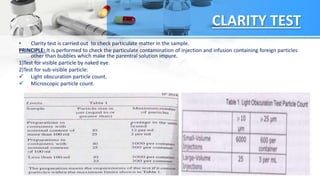
• Clarity test is carried out to check particulate matter in the sample.
PRINCIPLE: It is performed to check the particulate contamination of injection and infusion containing foreign particles
other than bubbles which make the parentral solution impure.
1)Test for visible particle by naked eye.
2)Test for sub-visible particle:
 Light obscuration particle count.
 Microscopic particle count.
PYROGEN TEST
• Pyrogen are fever producing substances. During
processing Pyrogen may come from water, excipients or
active constituents from the equipment.
• Parentral solutions are officially tested for the presence
of pyrogens by biological test in which “FEVER” response
of rabbits is used as criteria.
a) In-vivo test(rabbit test)
b) In-vitro test(Limulus Amoebocyte Lysate test)
UNIFORMITY OF CONTENTS
• The test for uniformity of content is based upon assay of individual
contents of active constituent. The result is matched with the standard
limits with reference to average sample content.
• METHOD(TEST A):
 Using a suitable analytical method, determine individual content of active
substance of 10 dosage units.
 The preparation passes if individual content is between 85%-115% of
average content.
 The preparation fails if one individual content is outside the limit of 75%-
125%.
 If one individual content is within the limit of 75%-125% but outside 85%-
115%,determine the individual content of another 20 dosage.
REFERENCES
 Lachman/Lieberman’s ”The Theory and Practice of Industrial Pharmacy”.
 https://www.sciencedirect.com/topics/chemistry/parenteral
 https://www.google.com/search?biw=1366&bih=657&tbm=isch&sa=1&ei=OdlkXdW2C8OR9QOZ0L
bYDg&q=ampoules+sealing&oq=ampoules+sealing&gs_l=.3...48204.50999..51581...1.0..0.393.2079
.0j3j5j1......0....1..gws-wiz-
img.......0j0i8i30j0i30j0i24.7OVYj_bjD0A&ved=0ahUKEwiVt8OcwaLkAhXDSH0KHRmoDesQ4dUDCAY
&uact=5#imgrc=SOG8qdSdTd5sCM:
 https://www.google.com/search?q=usp+limits+for+large+volume+infusion&source=lnms&tbm=isc
h&sa=X&ved=0ahUKEwj0rMac8qLkAhXn6nMBHeInBsAQ_AUIESgB&biw=1366&bih=657#c=qmOyJs
WPw7ofcM:
 http://apps.who.int/phint/pdf/b/6.2.1.5.Parenteral-preparations.pdf
 https://www.pharmoutsourcing.com/Featured-Articles/331618-Parenteral-Preparations-
Challenges-in-Formulations/
 https://www.slideshare.net/surajprajan/quality-control-tests-for-parenterals-ppt
Parentrals (industrial pharmacy)

Parentrals (industrial pharmacy)

  • 1.
    Topic: Storage andQuality control SURBHI SHARMA 17BPH097 PARENTRALS
  • 2.
    Introduction • Parentral isa route of administration wherein a drug is administered in the patient by any means other then mouth and alimentary canal .They are injected through the skin or mucous membrane in the internal compartments of body. • Parentrals are generally injections which are sterile products i.e. the dosage form is free from viable microbes. • For the products labeled as ‘sterile products’, the storage of the product governs the sterility of the product. Storage of these sterile product plays a key role in deciding the shelf life or stability of the drug. • Various containers and closure systems are used for the storage of parentral products. Container and closure system refers to entirety of packaging components that together contain and protect the product. A Packaging component means any single part of container and closure system. Typical components are containers(e.g. ampules,vials and bottles),container liners, closures(e.g. screw caps, stoppers),stopper overseal and container inner seals
  • 3.
    Containers • Both chemicaland physical properties affect the stability of the product but physical properties are given consideration for selection of the protective container.
  • 4.
    • PLASTIC CONTAINERS:This type of container contains thermoplastic polymer which melts at high temperature. Polypropylene and copolymer polyethylene are two of the main polymers used in parentral products. A new group of polymers polyolefin have led to the development of bottles that are rigid enough to hold their shape during processing but can collapse under atmospheric pressure as outflow of solution occurs during intravenous administration Advantages: 1) They are light in weight. 2) They are unbreakable. 3) When they contain additives, they are less toxic and less reactive. Disadvantages: 1) Plastic degradation is possible. 2) Leaching is a problem. 3) Tissue toxicity is a big problem due to higher concentration of additives.
  • 5.
    • USP hasprovided test procedures for evaluating the toxicity of plastic containers. It consists mainly of four phases: 1)Implanting pieces of plastic material intramuscularly in rabbits. 2)Injecting eluates using NaCl injections with and without alcohol intravenously in mice. 3)Injecting eluates using polyethylene glycol 400 and sesame oil intraperitoneally in mice. 4)Injecting all three eluates subcutaneously in mice. • The reaction from the test samples must not be greater than nonreactive control samples.
  • 6.
    GLASS CONTAINERS: Glassis still the most preferred type of material for parentral products .Two main types of glass are soda-lime and borosilicate. Silicon dioxide is chemically resistant and so it is also used as a glass material, but it is brittle and can only be melted/molded at high temperature.
  • 7.
    Advantages: 1) They protectlight sensitive products from degradation by UV rays. 2) The physical dimensions of glass container may be varied. 3) Viscous and dry liquids both can be filled in glass ampuls. 4) Ampuls, cartridge and vials are made from blow molding. The have greater strength ,less distortion and uniform thickness. Disadvantages: 1) They are more prone to break . 2) Traces of iron oxide may lead to leaching.
  • 8.
    Closures Selection • Rubberclosures are used to seal the openings of vials, cartridges and bottles. Rubber closures are made up of several ingredients which are: 1) Natural rubber(latex)or synthetic polymer, 2) Vulcanizing agent like sulphur, 3) An accelerator like organic compound 2-mercaptobenzothiazole, 4) An activator usually zinc oxide, 5) Filler like carbon black or limestone and 6) Lubricants/Oxidants • These ingredients are molded at high temperature and pressure by first converting them into fluid or paste form through roller mill, then vulcanizing it by molding.
  • 9.
    • Properties ofan ideal rubber closure are:  Rubber closure must be elastic to fit between then neck of glass container and closure.  Porosity should be there but it should not be so much porous that it allows transfer of water vapor and gases inside the product.  Rubber closure must not be so hard that they require an excessive pressure to insert hypodermic needle. • Two main problems arise with closure that are:  Leaching of ingredients from rubber compound that leads to reaction with the product.  Removal of ingredients from the product by sorption through closure. For these problem, plastic or teflon coatings are applied to rubber surface to reduce the chances of sorption, leaching or vapor transfer. Disc closures preassembled with aluminum caps are being used to increase the speed of operation in high-speed packaging of antibiotics and other drugs.
  • 11.
    FILLING AND SEALING For small volume parentral products(UPTO 100mL): • Single dose containers(for Ampoule) • Multi dose containers(for Vials) • Prefilled syringe  For large volume parentral products: • Glass bottles • PVC collapsible bags • Semi rigid polythene container
  • 12.
    AMPOULE • Ampoule isa parentral product made entirely of glass and intended for single dose use. • They can be broken at the neck restriction either by scoring or by having a ceramic point that is a weak point meant for breaking site.
  • 13.
    • Filling ofthe parentral solution is done with the help of liquid filling machine. • Sealing is a key process in parentral product manufacturing especially ampoules. It is sealed by melting a portion of glass of neck to form a tip seal or pull-seal. The heating with a high temperature gas oxygen flame must be even and carefully controlled to avoid gas distortion of seal.  Tip seals are made by melting sufficient glass at the tip of ampoule neck to form a bead of glass and close the opening.  Pull-seals are made by heating the neck of rotating ampoule below the tip, then pulling the tip away to form a small , twisted capillary.
  • 14.
    • Excessive heatingof air and gases in neck causes expansion against the glass with formation of fragile bubbles at point of seal. • Pull-sealing is a slower process and more reliable than tip sealing. • It is sometimes necessary to displace the air within the ampoule above product to prevent decomposition. This may be done by introducing a stream of inert gas like N2 or CO2 during/after filling the product. Immediately the ampoule is sealed. Sealing machine for vials
  • 15.
    VIALS • Vial isa glass or plastic container closed with a rubber stopper and sealed with an aluminum crimp. • Vials are available for single or multiple dosing. Injection vials can be obtained in either neutral or soda glass and occasionally in treated soda glass. Sealing machine Filling machine
  • 17.
    INFUSION FLUID • PVC(polyvinylchloride) collapsible bags are used to pack most infusion fluid. It is a part of large volume parentral product(100ml-1000ml per day). ADVANTAGES:  Durable and light weight.  No air interface. The bag collapses as it empties. DISADVANTAGES:  They adsorb some drugs.  The permit high moisture penetration. • Semi rigid polythene bags are also used for parentral solution(3L),dialysis solution(5mL) and 100mL electrolyte solution. • The filling of the infusion fluid is done by filling machine only.
  • 18.
    QUALITY CONTROL(QC) • Qualitycontrol involves testing of units and determining if they are within the specifications for the final product. • The purpose of the testing is to determine any needs for corrective actions in the manufacturing process. 1.In-Process QC:  Conductivity measurement  Volume filled  Temperature for heat sterilized product  Environmental control tests  Visual inspection 2.Finished product QC:  Leaker test  Clarity test  Pyrogen test  Sterility test  Content uniformity test
  • 19.
    LEAKER TEST • Itis employed to detect incompletely sealed ampoule so that they may be discarded.This is used to test the packaging integrity. a)Visual Inspection: This is the easiest method and used for large volume Parentrals.  ADVANTAGE: Simple and Inexpensive  DISADVANTAGE: It is less sensitive. Sensitivity can be increased by application of vacuum/pressure. a)Bubble Test: The test package is submerged in liquid. Pressure is applied on container and it is observed for bubbles. Generation of differential positive pressure of 3p.s.i inside the vial and observation of any leakage using magnifying glass within maximum test time of 15 minutes. Surfactant can be used for immersion of test package.  ADVANTAGE: Simple and Inexpensive. Location of leaks can be observed.  DISADVANTAGE: It is less sensitive and it is a qualitative process.
  • 20.
    c)Dye Test:  Thetest container is immersed in dye bath.  Vacuum or pressure is applied for sometime.  Container is removed from dye bath and washed. The container is then observed for the presence of dye either visually or by UV spectroscopy.  The test is used widely in the industry for ampoules.  ADVANTAGE: Simple and Inexpensive.  DISADVANTAGE: Qualitative, destructive and slow. d)Vacuum Ionization:  It is useful for detection of leakage in vials and bottle sealed under vacuum(lyophilized product).  High voltage, high frequency is applied to vials for residual gas to glow.  Blue glow indicates vacuum while purple indicates no vacuum. Leaker Test Apparatus
  • 21.
    CLARITY TEST • Claritytest is carried out to check particulate matter in the sample. PRINCIPLE: It is performed to check the particulate contamination of injection and infusion containing foreign particles other than bubbles which make the parentral solution impure. 1)Test for visible particle by naked eye. 2)Test for sub-visible particle:  Light obscuration particle count.  Microscopic particle count.
  • 22.
    PYROGEN TEST • Pyrogenare fever producing substances. During processing Pyrogen may come from water, excipients or active constituents from the equipment. • Parentral solutions are officially tested for the presence of pyrogens by biological test in which “FEVER” response of rabbits is used as criteria. a) In-vivo test(rabbit test) b) In-vitro test(Limulus Amoebocyte Lysate test)
  • 23.
    UNIFORMITY OF CONTENTS •The test for uniformity of content is based upon assay of individual contents of active constituent. The result is matched with the standard limits with reference to average sample content. • METHOD(TEST A):  Using a suitable analytical method, determine individual content of active substance of 10 dosage units.  The preparation passes if individual content is between 85%-115% of average content.  The preparation fails if one individual content is outside the limit of 75%- 125%.  If one individual content is within the limit of 75%-125% but outside 85%- 115%,determine the individual content of another 20 dosage.
  • 24.
    REFERENCES  Lachman/Lieberman’s ”TheTheory and Practice of Industrial Pharmacy”.  https://www.sciencedirect.com/topics/chemistry/parenteral  https://www.google.com/search?biw=1366&bih=657&tbm=isch&sa=1&ei=OdlkXdW2C8OR9QOZ0L bYDg&q=ampoules+sealing&oq=ampoules+sealing&gs_l=.3...48204.50999..51581...1.0..0.393.2079 .0j3j5j1......0....1..gws-wiz- img.......0j0i8i30j0i30j0i24.7OVYj_bjD0A&ved=0ahUKEwiVt8OcwaLkAhXDSH0KHRmoDesQ4dUDCAY &uact=5#imgrc=SOG8qdSdTd5sCM:  https://www.google.com/search?q=usp+limits+for+large+volume+infusion&source=lnms&tbm=isc h&sa=X&ved=0ahUKEwj0rMac8qLkAhXn6nMBHeInBsAQ_AUIESgB&biw=1366&bih=657#c=qmOyJs WPw7ofcM:  http://apps.who.int/phint/pdf/b/6.2.1.5.Parenteral-preparations.pdf  https://www.pharmoutsourcing.com/Featured-Articles/331618-Parenteral-Preparations- Challenges-in-Formulations/  https://www.slideshare.net/surajprajan/quality-control-tests-for-parenterals-ppt