Technical Engineering College
Civil Engineering Department
Surveying
Distance Measurement & Chain Surveying
Prepared by Part -1-
Asst. Prof. Salar K. Hussein
Assistant Lecturer Mr. Kamal Y. Abdullah
Asst.Lecturer. Dilveen H. Omar
1
2021-2022
Contents
• Introduction About Surveying.
• Primary Division Of Surveying
• Classification Of Surveying
• Distance Measurement And Chain Surveying
• Principle Of Surveying
• Types Of Tapes Based On The Materials Used
• Erecting And Dropping A Perpendicular
• Obstacle In Chain Survey
• Types Of Errors
• Corrections of Tape
• Off –Sets
• Ranging
• Conclusion .
• Homework And Next Lecture .
• References. 1
Definition of Surveying:
• It is defined as a science of making measurements on the earth’s
surface, determining the figure and dimensions of the earth, and
representing terrain in the form of plans and maps.
Or
• Surveying also defined as the science of determining the position, in
three dimensions, of natural and man-made features on or beneath the
surface of the Earth. These features may be represented in analogue
form as a contoured map, plan or chart, or in digital form such as a
digital ground model (DGM).
3
Types of Surveying
1. Plane Surveying
2. Geodetic Survey
3. Cadastral surveying
4. Aerial Surveying
5. Hydro graphic Surveying (Hydro-Survey)
6. Topographical Survey
7. Engineering Survey
4
Primary division of Surveying
1-plane surveying
• In plane surveying relatively small areas are involved and the
area under consideration is taken to be a horizontal plane.
It is divided into three branches.
i. Cadastral surveying .
ii. Topographical surveying .
iii. Engineering surveying .
5
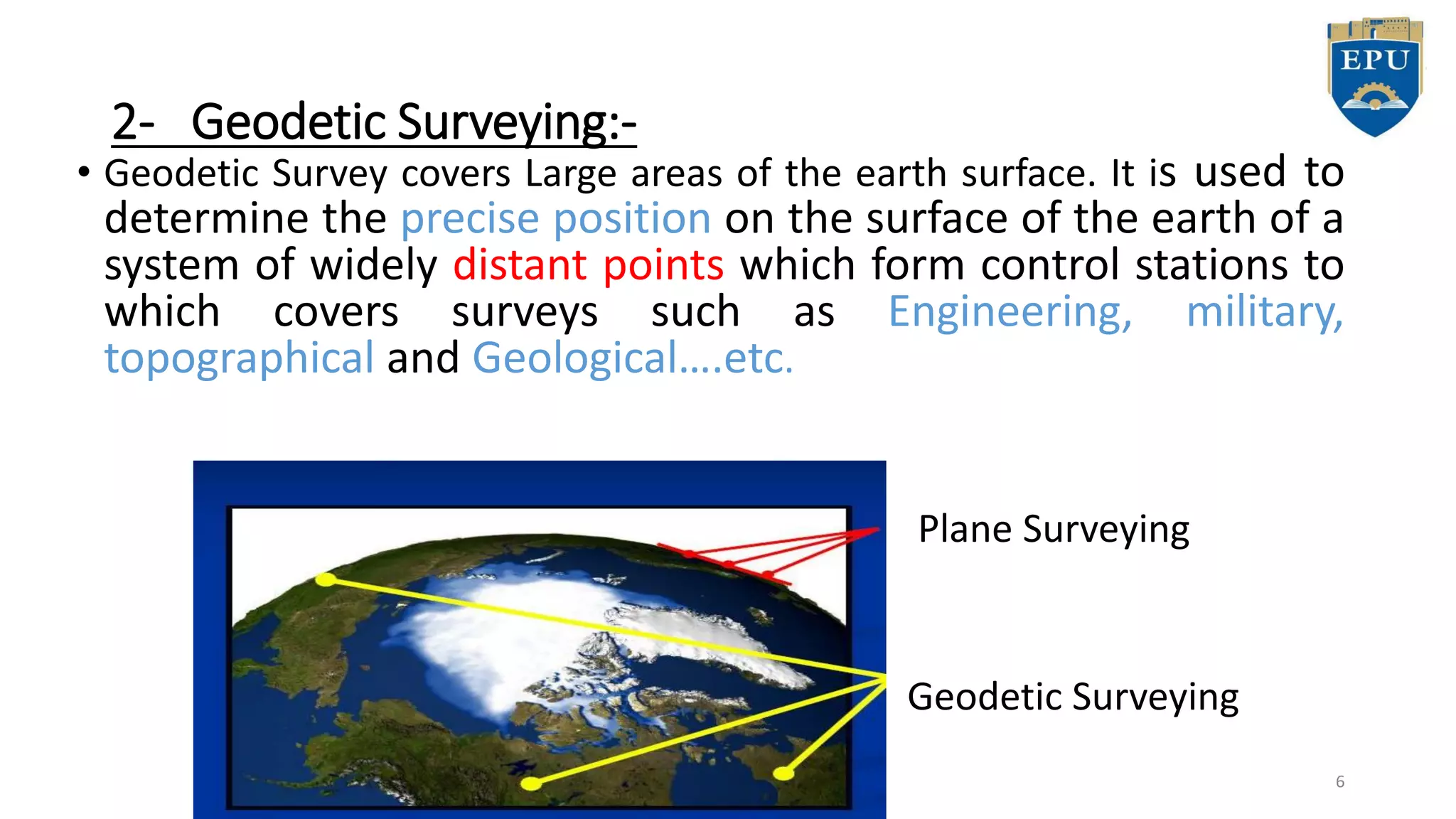
2- Geodetic Surveying:-
• Geodetic Survey covers Large areas of the earth surface. It is used to
determine the precise position on the surface of the earth of a
system of widely distant points which form control stations to
which covers surveys such as Engineering, military,
topographical and Geological….etc.
Plane Surveying
Geodetic Surveying
6
3-Cadastral surveying
• These are surveys undertaken to define and record the
boundary of properties, on one hand and
• On the other hand, Marks (BM) to define Boundaries,
corner or line points and little account may be taken of the
topographical features.
7
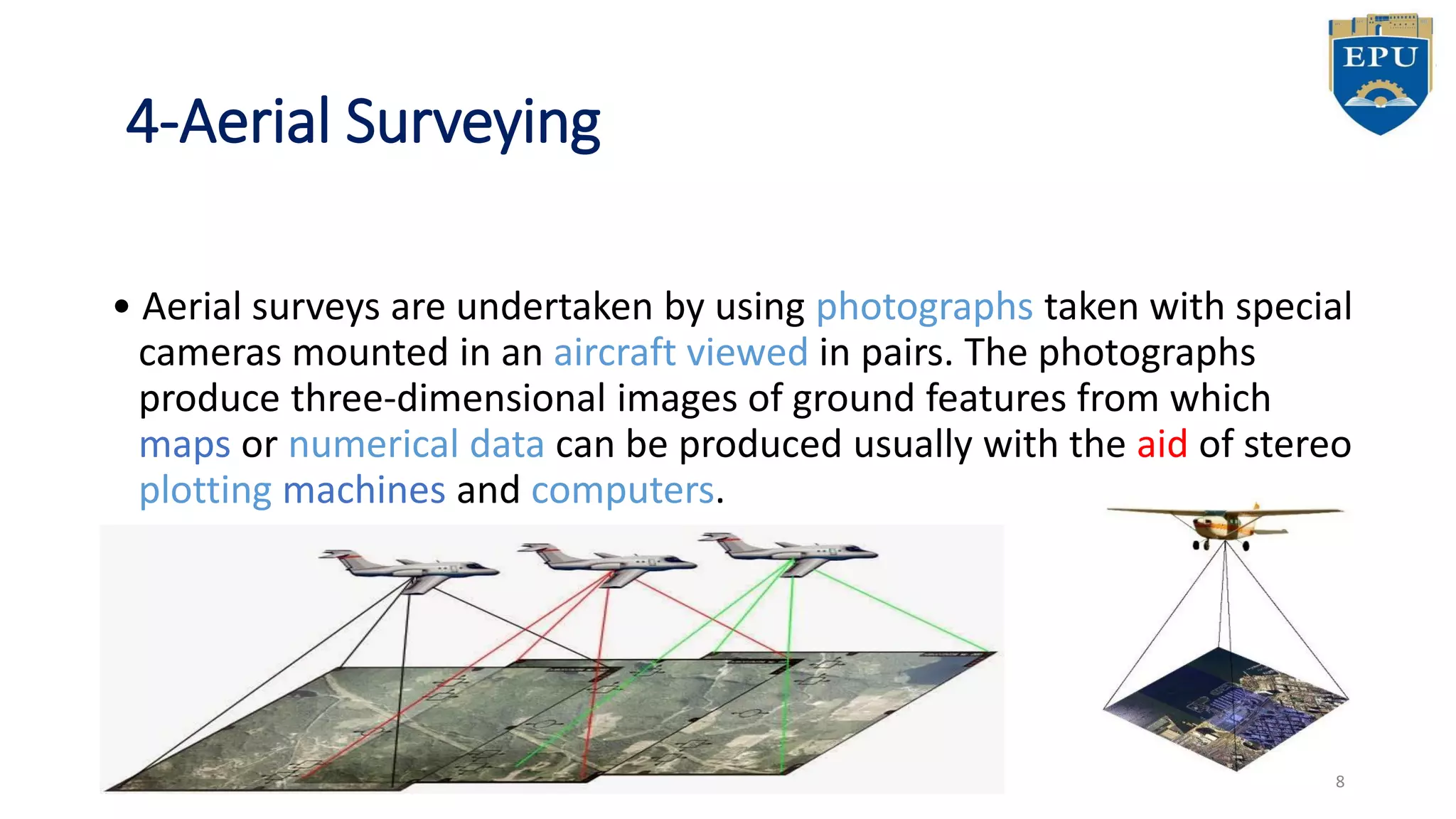
4-Aerial Surveying
• Aerial surveys are undertaken by using photographs taken with special
cameras mounted in an aircraft viewed in pairs. The photographs
produce three-dimensional images of ground features from which
maps or numerical data can be produced usually with the aid of stereo
plotting machines and computers.
8
5-Hydrographic Surveying (Hydro-Survey
• Hydro survey is undertaken to gather information in the marine
environment such as mapping out the coast lines and sea bed in
order to produce navigational charts
9
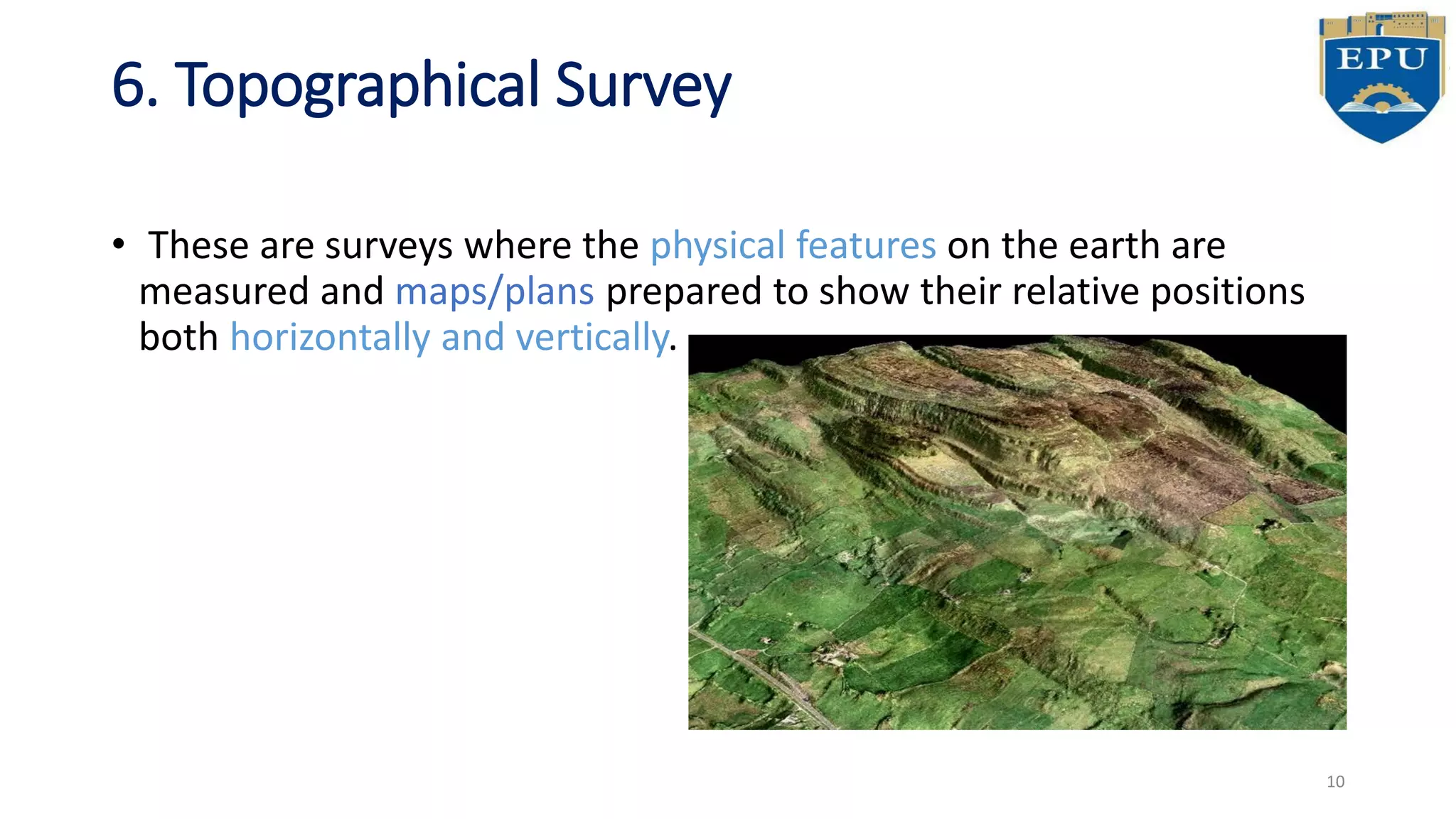
6. Topographical Survey
• These are surveys where the physical features on the earth are
measured and maps/plans prepared to show their relative positions
both horizontally and vertically.
10
7-Engineering Survey
• These are surveys undertaken to provide special information for
construction of Civil Engineering and building projects, highway and
railway design.
• The survey supply details for a particular engineering schemes and
could include setting out of the work on the ground and dimensional
control on such schemes.
11
Reconnaissance.
• This is preliminary survey of the land to be surveyed. It may be either
1-Ground reconnaissance 2- Aerial reconnaissance survey.
Objectives of Reconnaissance
1. To ascertain the possibility of building or constructing route or track
through the area.
2. To choose the best one or more routes and record them on a map
3. To estimate probable cost, and draft a report.
12
Classification of Surveying:
1- Classification based on the instruments used:
A. Chain Surveying.
B. Compass Surveying.
C. Theodolite Surveying.
D. Tachometric Surveying .
E. Trigonometric Surveying.
F. Total station and GPS.
G. Photogrammetric and Aerial Surveying.
H. Plan Table .
13
2- According to the method used:
i. Traversing .
ii. Triangulation .
iii. Tacheometric.
iv. Trigonometric.
3- According to the Purpose of surveying:
i. Engineering survey.
ii. Military survey.
iii. Geological survey .
iv. Topographical survey.
14
Chain and Tape Survey
• Introduction
Chain survey is the simplest method of surveying. In this survey only
measurements are taken in the field, and the rest work, such as plotting
calculation are done in the office. This is most suitably adapted to small
plane areas with very few details. If carefully done, it gives quite
accurate results.
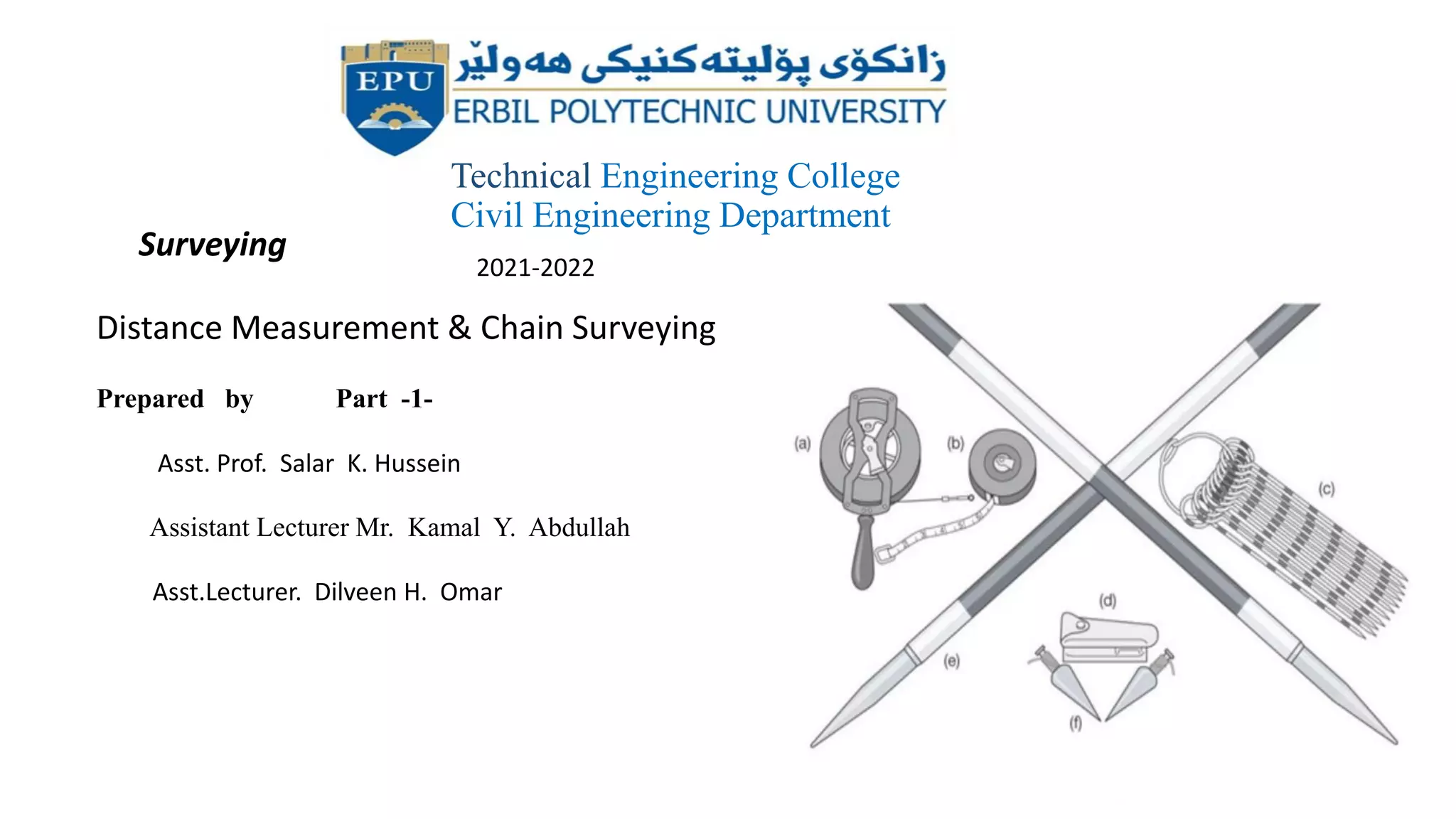
The necessary requirements(tools) for field work are:
1-chain, 2-tape, 3-ranging rod, and 4- arrows(Pin).
15
Length& Distance Measurements.
16
• Length :is the dimension between two points over the limited surface,
and is considered as one of the major axis of (3D). three dimensions
(length, width, & height).
• Distance: is the dimension between two points in the space (3D).
Distance Measurement and Chain Surveying:
• There are different methods of making a measurement of length or
distance. required in surveying. The method, which is used, must
always suit the type of different and accuracy required.
• In general there are two methods:
1- Direct methods of measuring lengths
2- Indirect methods of measuring distances
17
1-Direct Method
• Is dispersed into approximate and accurate methods, which include
the use of
• 1- pacing,
• 2- chain,
• 3- tape .
• 4- measuring wheel
• 5- car odometer,
18
2-Indirect method:
Which are divided into Optical distance measurement (ODM), and Electronic
distance measurement (EDM). This methods make use of optical systems for
relating a short known distance to the angle is subtends at the distance to be
determined. These are
1-Tachometry
2- Trigonometry
3- Sub-tense method. The methods are Substance bar,
4-Theodolite, instrument )Stadia(,
5-Electronic distance measurement (EDM)
6-Total Station,
7- GPS .
8- Laser distance meter
19
Measurements
There are two kinds of measurements used in plane surveying.
*Linear measurements
*Angular measurements
1. Linear measurements:-
Linear measurements may be divided into
Horizontal distances: -
The distances taken along a horizontal plane between the two
points are known as horizontal distances.
Vertical distances: -
The distances measured in vertical plane are called as vertical
distances. They are also known as levels. 20
2. Angular Measurements
Angular measurements.
i) Horizontal angles: - Angles measured along the horizontal plane are
known as horizontal angles.
ii) Vertical angles: - Angles measured in vertical plane are known as
vertical angles.
21
Instruments used in Chain Surveying
1) Chains
2) Tapes
3) Arrows
4) Ranging Rods.
5) Pegs
6) Plumb- bob
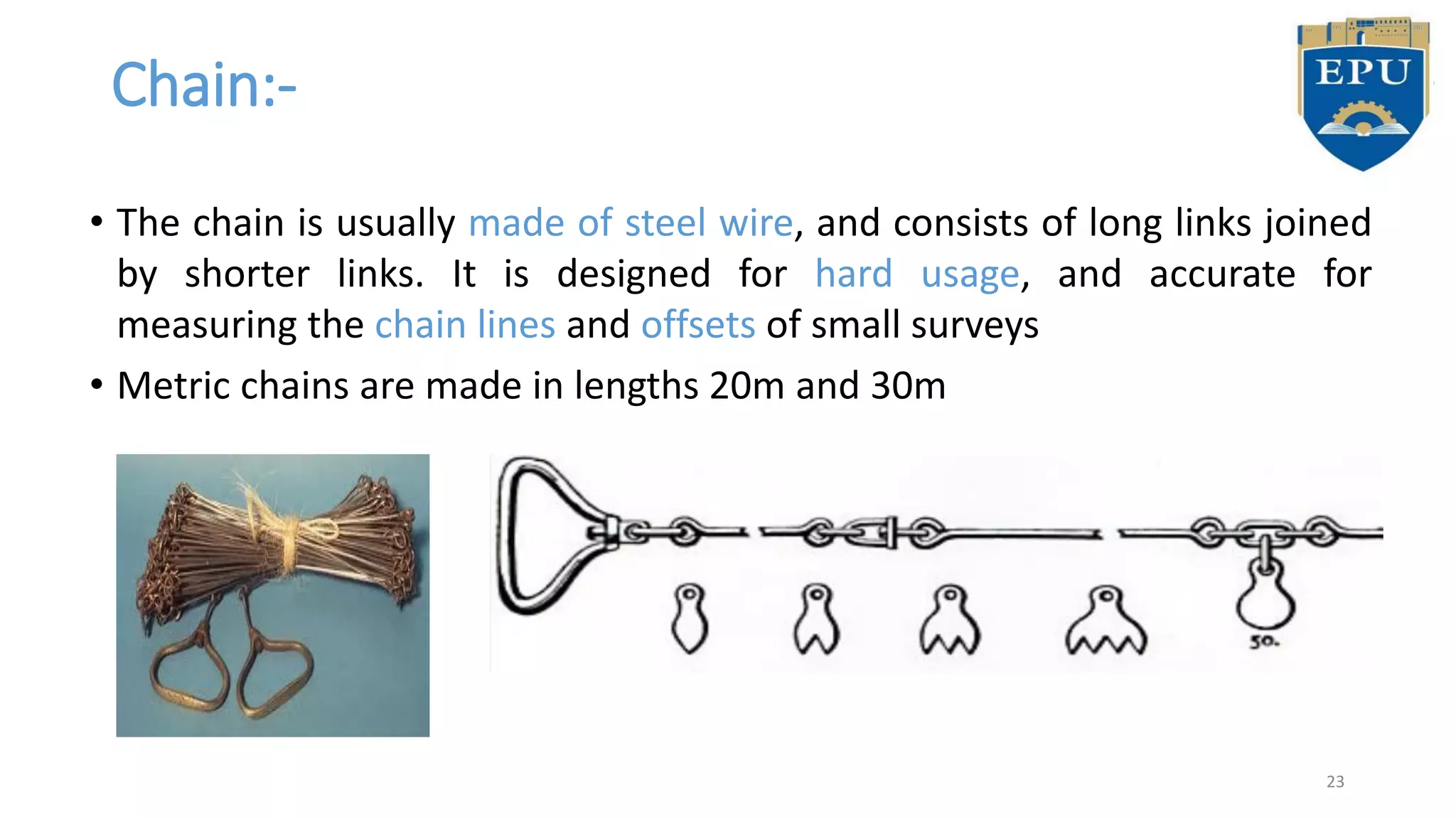
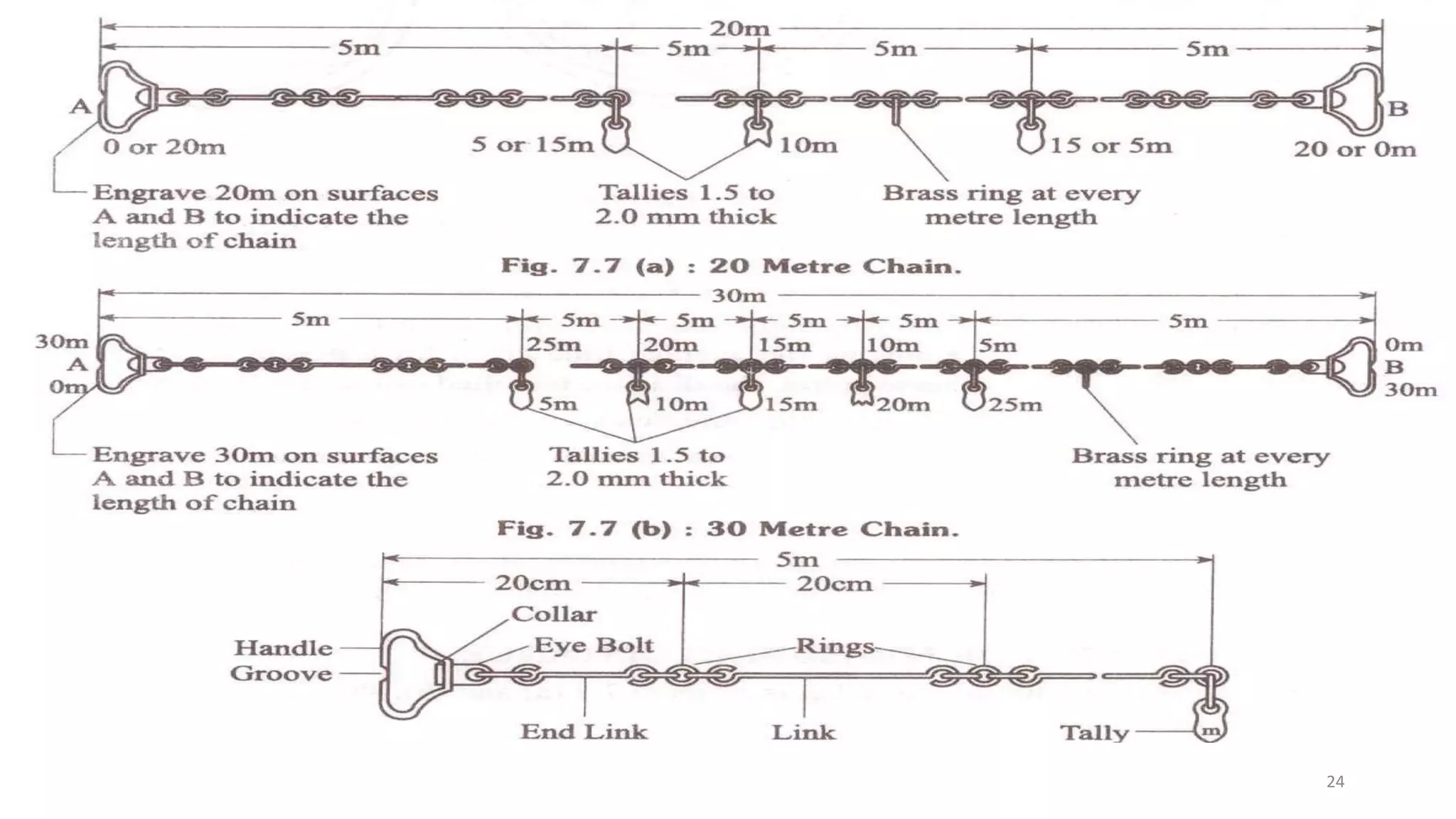
Chain:-
• The chain is usually made of steel wire, and consists of long links joined
by shorter links. It is designed for hard usage, and accurate for
measuring the chain lines and offsets of small surveys
• Metric chains are made in lengths 20m and 30m
23
24
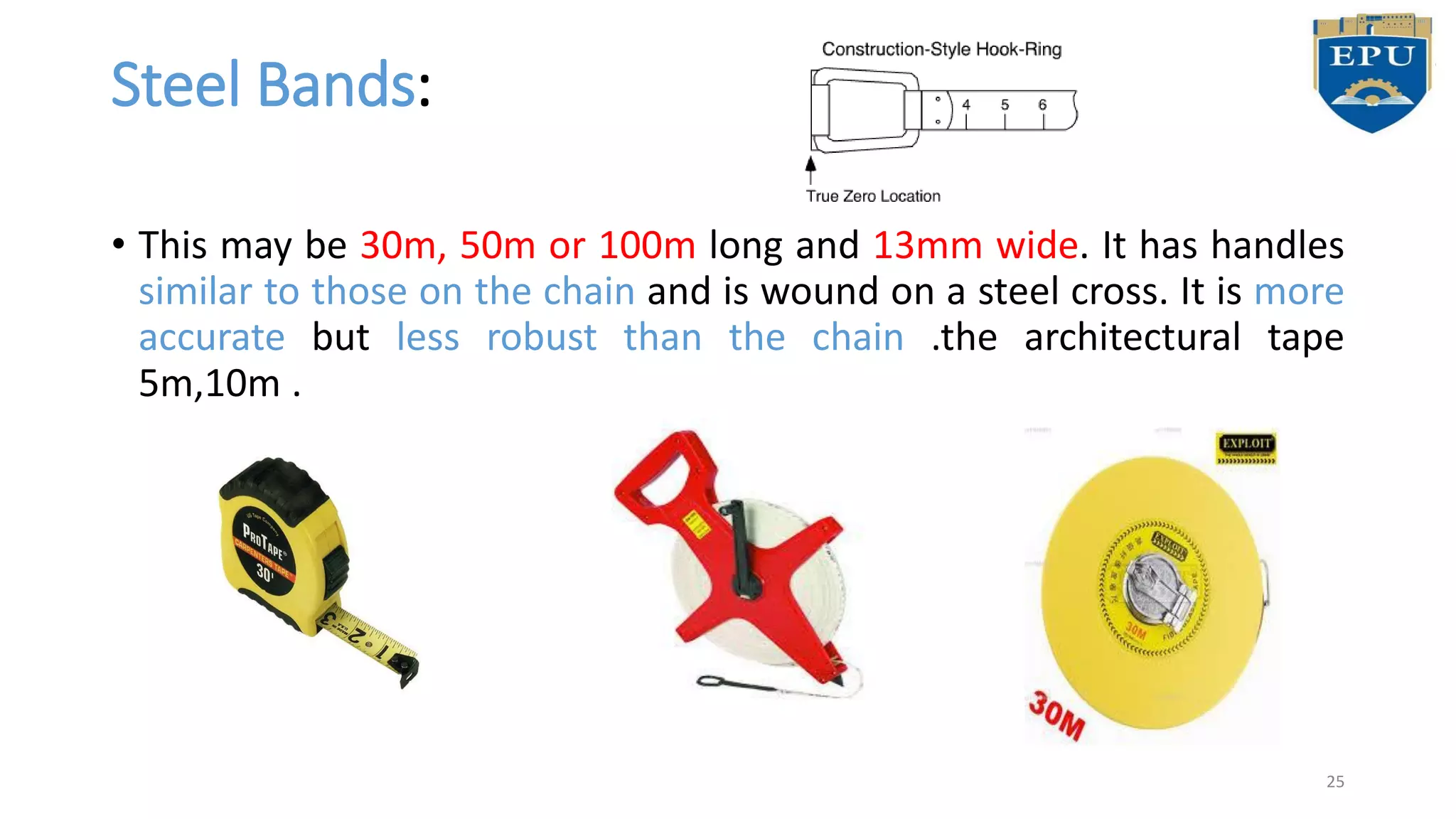
Steel Bands:
• This may be 30m, 50m or 100m long and 13mm wide. It has handles
similar to those on the chain and is wound on a steel cross. It is more
accurate but less robust than the chain .the architectural tape
5m,10m .
25
Types of tapes based on the materials used:
1-) Metallic (Fiber glass)
2- Steel tape
3- Linen Tape .
4- Invar tape
5- Pocket steel tape
6- Digital measuring tape
7- Rolling tape
• Fiber Glass Tapes: These are much stronger than lines and will
• not stretch in use
• Steel tapes: These are much more accurate, and are usually used for setting out
buildings and structural steel works. Steel tapes are available in various lengths
up to 100m (20m and 30m being the most common) encased in steel or plastic
boxes
26
Pegs
• Pegs are made of wood 50mm x 50mm and some convenient length.
They are used for points which are required to be permanently
marked, such as intersection points of survey lines.
pins
27
28
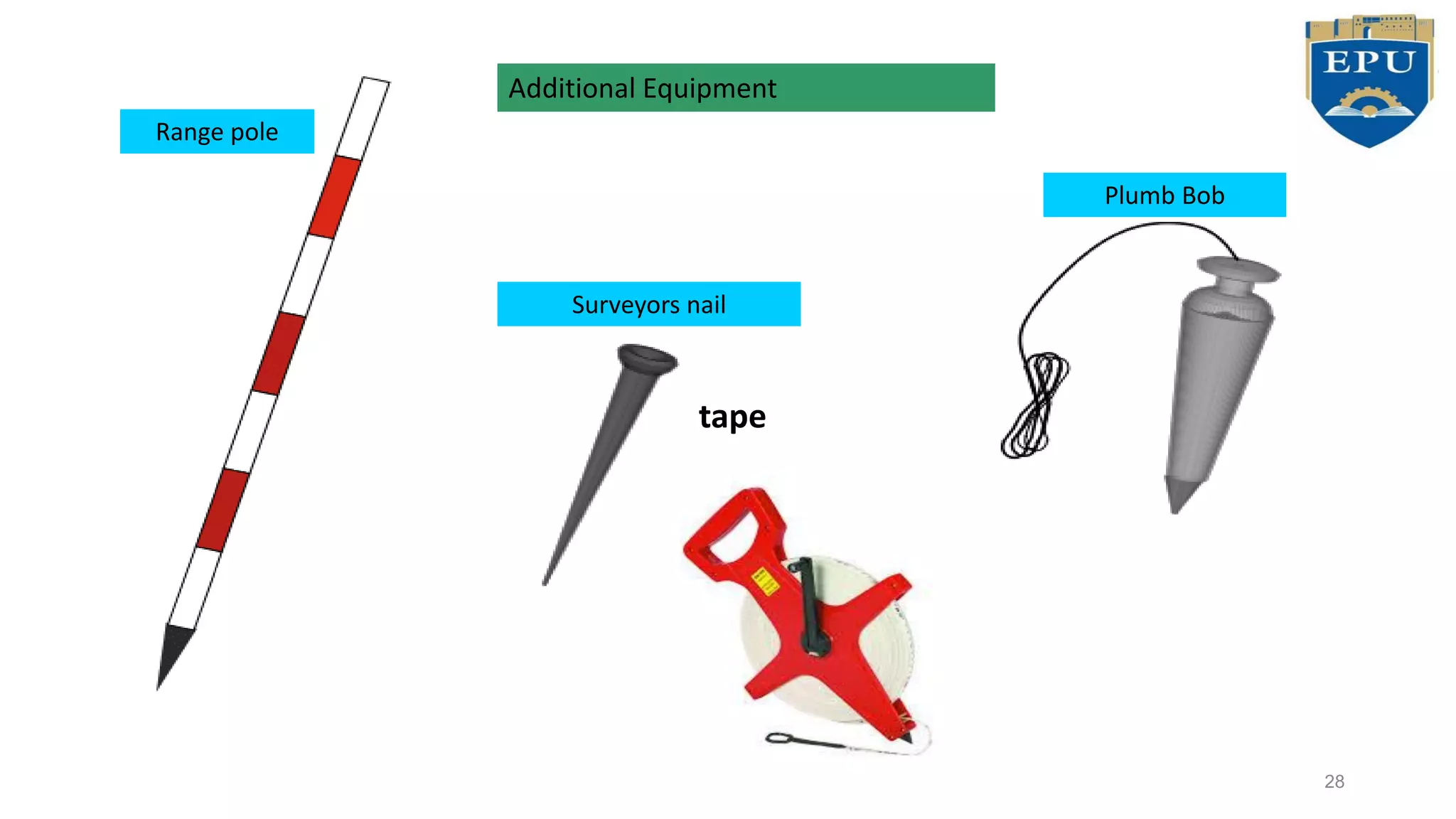
Range pole
Surveyors nail
Plumb Bob
Additional Equipment
tape
Ranging Rod or( Range pole)
• Ranging rods are 2 to 3 m in length.
• Used for ranging some intermediate points on the survey line.
• Painted with alternate bands of black and white or red and white
colours.
• With length of each equalising 20 cm.
29
Plumb-Bob
• Used to transfer points on ground.
• Used for fixing instrument exactly over the stations.
Optical Square:
• This instrument is used for setting out lines at right angle to main
chain line. It is used where greater accuracy is required. There are two
types of optical square, one using two mirrors and the other a prism.
• The mirror method is constructed based on the fact that a ray of light
is reflected from a mirror at the same angle as that at which it strikes
the mirror.
• The prism square method is a simplified form of optical square
consisting of a single prism. It is used in the same way as the mirror
square, but is more accurate.
31
MEASURING WHEEL
• Distance Measuring Wheels are excellent tools for measuring
long distances in a hurry. They are great for estimating paving
jobs, building lot sizes,, and other uses when a large distance
measurement is needed quickly. To use, simply reset the
counter,
• place the wheel at the point you want to start measuring,
• and roll in a straight direction to the stopping point, then read
the counter
32
Laser distance meter
Easy, quick and accurate measurements
33
Laser Distance meter is a fast, high accuracy
laser distance meter designed for indoor and
outdoor use. has the longest range of all the
Quick Measure distance meters – up to 650 feet
(200 m). A large backlit LCD is easy to see in all
conditions.
Technical Engineering College
Civil Engineering Department
Surveying
Distance Measurement & Chain Surveying
Prepared by Part -2-
Asst. Prof. Salar Khudhur Hussein
Assistant Lecturer Mr. Kamal Y. Abdullah
Asst.Lecturer. Dilveen H. Omar
34
2022-2021
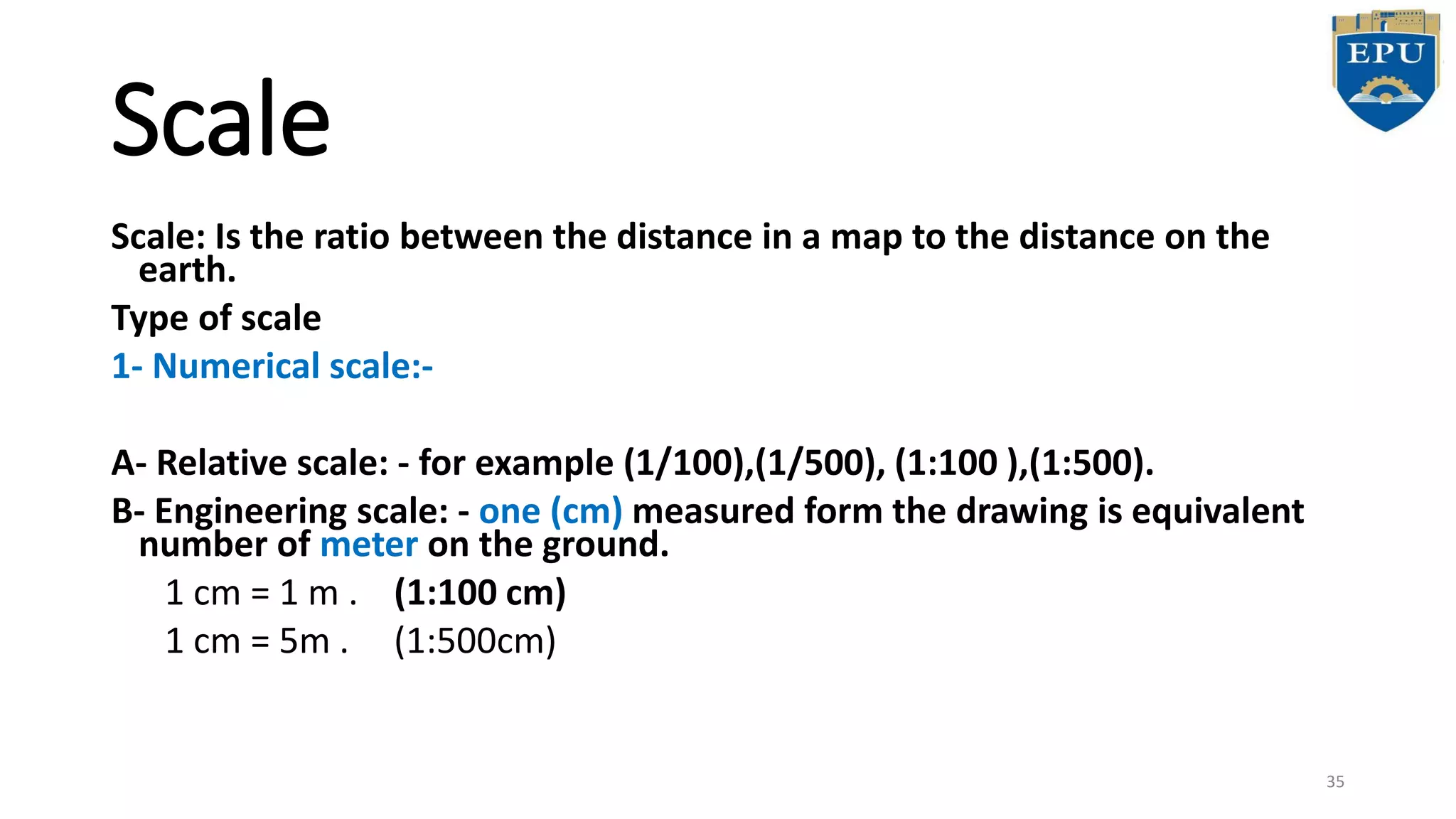
Scale
Scale: Is the ratio between the distance in a map to the distance on the
earth.
Type of scale
1- Numerical scale:-
A- Relative scale: - for example (1/100),(1/500), (1:100 ),(1:500).
B- Engineering scale: - one (cm) measured form the drawing is equivalent
number of meter on the ground.
1 cm = 1 m . (1:100 cm)
1 cm = 5m . (1:500cm)
35
Principle of Surveying:
1- To locate a point by measuring from two reference points:
a) Measure( AC and BC) to locate C tape or chain (TS)
36
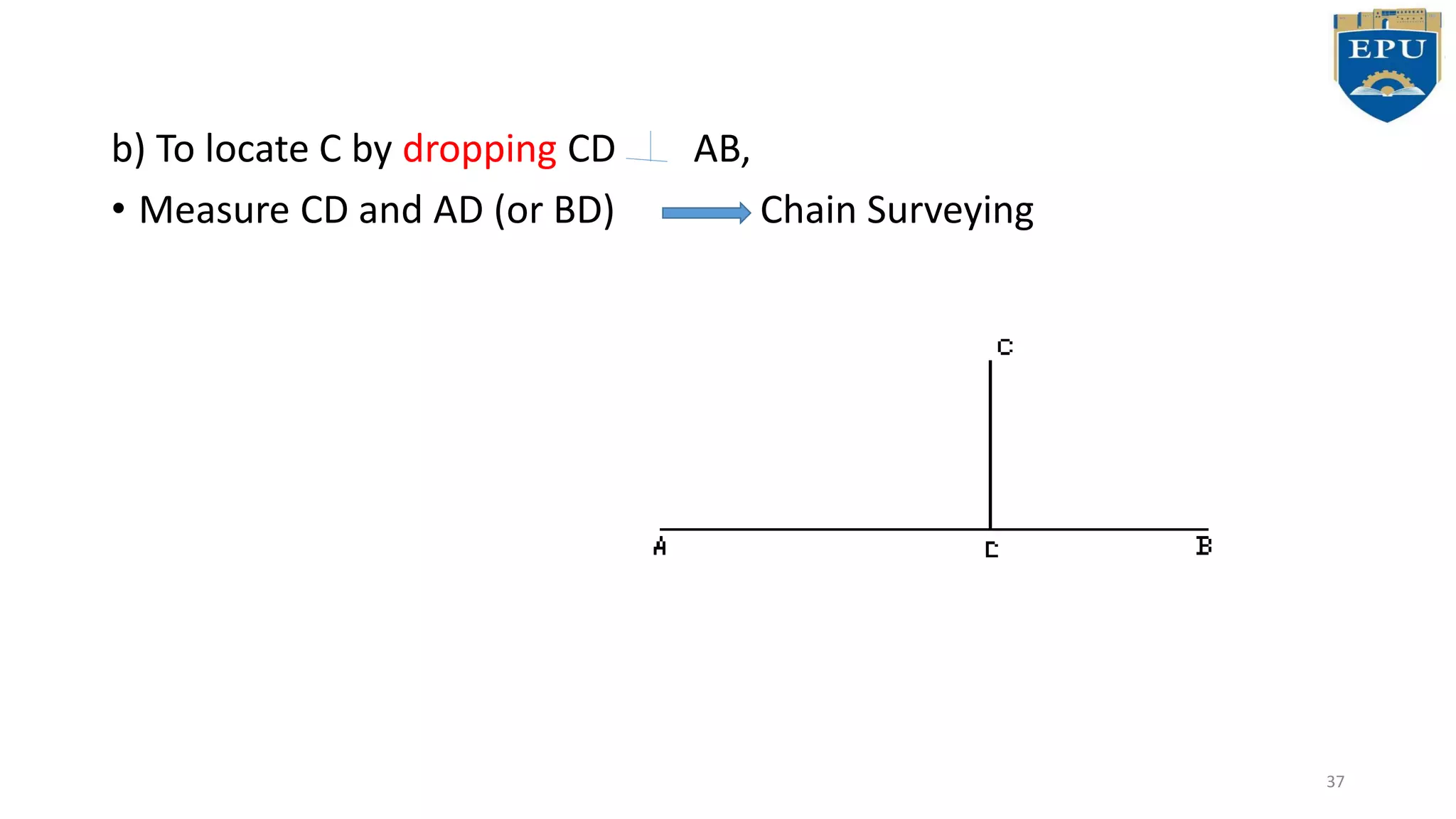
b) To locate C by dropping CD AB,
• Measure CD and AD (or BD) Chain Surveying
37
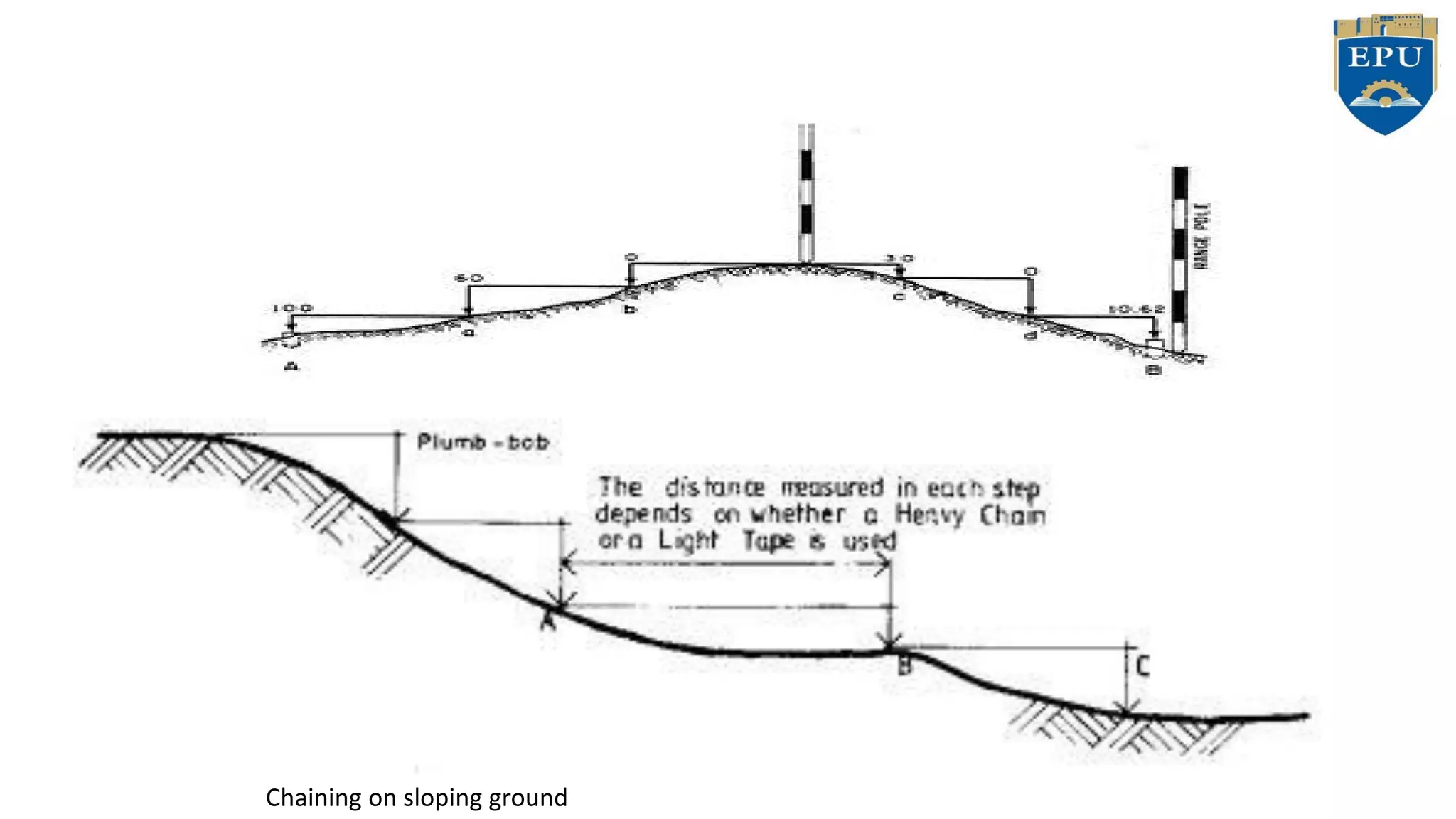
Chain surveying (“stepping”)
Uneven Grounds
w
x
y
z
c
b
a
Chaining on sloping ground
2- To work from whole to part ( coordinates )
• The first step in surveying is to establish
• (control point ) B.M
• (these point where coordinates are known).
• These points are fixed by triangulation or traversing.
• If the control points are to be established by triangulation,
the area to be surveyed is divided in to large triangles by
very accurate surveys.
• These large triangles are then divided in to small triangles
by less accurate survey, this method is followed to control
errors.
40
Procedure in tape & offset surveying
• Tape & offset surveying
consists in measuring with the tape the length of a series of
straight lines. Thus there are two basic procedures which
need to be known at this stage are :
1- The measurement or ranging of line
2- The setting out of the right angles in connection with offsets.
41
Chain Surveying
• This is the simplest and oldest form of land surveying of an area
• using linear measurements only. It can be defined as the process of taking
direct measurement.
• Equipments (tools) Used In Chain Surveying
• These equipments can be divided:
(i) Those used for linear measurement. (Chain,, linear tape)
(ii) Those used for slope angle measurement and for measuring right angle
(clinomater, cross staff, optical squares)
(iii) Other items (Ranging rods or, arrows, pegs etc).
42
• Setting out right angles:
The operation is often required in connection with the measurement of
offsets. And There are two cases to consider, which are
1) dropping a perpendicular from a point to a line,
2) setting out a line at right angles to the survey line from a given point
on the steel band.
1) Optical square: it may held in the hand or prop on a short range
Poole.
2) Pythagoras: theorem (3,4,5 rule or any multiple thereof,
3) For short offset, the tape is swung with its zero as centre a bout the
point and the minimum reading at which it crosses the band is
noted.
43
1- Dropping a perpendicular from a point to a survey line:
Dropping perpendicular by
specifying the shortest distance.
Dropping perpendicular by
drawing the curve from circle.
44
2- (Erecting perpendicular) setting out a line) at right angles to the
survey line from a given point
Erecting perpendicular by drawing the
triangle with two equal legs.
Apply Pythagoras triangle by( 3:4:5)
45
3- Find the height of the objects (Buildings, Tower …):
• Specify the two point on the earth (A, B) on the same line with object.
put the range at point B, and put another shorter one at A that points
D, E, and F on the same line.
• Measure the distances AB, and AC.
• Calculate DH by equation:
•
𝑬𝑮
𝑫𝑯
=
𝑭𝑮
𝑭𝑯
• Height of object = DH + Height of range (AF)
46
4- Measure the angle between two lines:
• Choose point D on the AB line.
• Setting a perpendicular from D on AB line, encounter AC line at E.
• Measure the distances AD, and DE.
• Calculate the angle α from an equation:
• 𝜶 = 𝐭𝐚𝐧−𝟏 𝑬𝑫
𝑨𝑫
47
5- Measure the angle between two lines:
• Take the two equal distance (AD, AE) on the lines AB, and AC
respectively.
• Measure the length of line (DE).
• Calculate angle α from an equation:
• 𝐬𝐢𝐧 Τ
𝜶
𝟐 =
𝑫𝑬
𝟐 (𝑨𝑫)
48
6- Install the internal angles by using the perimeter of triangle:
• Measure the lengths of the triangle (A’, B’, and C’) by tape.
• The angle α by using cosine rule:
• 𝜶 = 𝐜𝐨𝐬−𝟏 𝑩′𝟐+ 𝑪′𝟐−𝑨′𝟐
𝟐 𝑩′ (𝑪′)
• Or by using perimeter rule:
• 𝐬𝐢𝐧 Τ
𝜶
𝟐
𝟐
=
𝑷−𝑩′ +(𝑷−𝑪′)
𝑩′ (𝑪′)
• Where:
• 𝑷 = Τ
𝟏
𝟐 𝒑𝒆𝒓𝒊𝒎𝒆𝒕𝒆𝒓 = ൗ
(𝑨′+𝑩′+𝑪′)
𝟐
49
7- Setting out the area by( using long distances):
a- Reconnaissance operation: This may be done by observing the position,
which to be surveyed and getting the information by drawing, specify the
form, and public site by using Google Earth
50
b- Select the traverse from the survey points over the external
perimeter within away (to see each point the back and front points)
and apply the ratio of length of polygon, then fix the points by (pins or
nails)
51
c- Measure the length of lines between each points by tape twice
(forward and backward).
52
d- Measure the network lines by making the triangles to make sure the
lengths of traversing between each point are correct,
(for check) and it may be find by drawing the traverse by Auto-Cad to
check the measured lengths
53
E- Offsetting : this may be done by taking the known points that are
existed on the both sides of lines, in a way to spread the tape between
traverse lines and set the known points.
by using one of the following methods: (Offsets or Ties method)
54
f- Take the data in the note book then draw and obtain the specific
sheet:
55
Errors
• there are three types of errors:
1- Mistake.
2- Systematic errors.
3- Accidental errors.
1- Mistake:
A rise from inattention, inexperience, or careless-ness (neglected).
These may have a very serious effect on the final results. It can get rid of it
by Check and Repeat.
2- Systematic errors:
Are those which persist (continue) and have a regular effect .
(e.g. length of tape 10 mm more or less).
3- Accidental errors:
includes all unavoidable errors such asg
1- weather, 2-temperature 3-curvature, 4-refraction.
56
1-Ranging Obstacles
2-Measure Obstacles
3-Ranging and Measuring Obstacles
Ranging has two methods:
1- By eye
2- By theodolite
57
Type Obstacles in Chaining
Ranging for chain surveying:
• Mainly the errors taken place due to not ranging the direction in an accurate
way. In order to range accurately Eye or Theodolite are used.
• In plane area divide the area into sections and then measure and range by
using the third range pole. However, in slope areas four range poles are
required.
• Obstacles in ranging when there is a hill between two main points.
58
Types of errors in chain surveying:
1- Bad ranging
2- Bad straightening
3- Non-horizontality
4- Sag
5- Careless holding and marking
6- Variation of temperature
7- Displacement of arrows (Pins)
8- Variation of Pull
9- Mis counting chain length
59
10- miss reading
11- Errors in booking
12- Errors in length of chain
• Some errors can be avoided such as errors number
(1, 2,3,5,7,9,10,11 and 12). Moreover, the errors in length of chain
should be checked before using it.
However, the errors number (4, 6, and 8) can be corrected with using
calculations.
• In order to make sure that the length of tape is correct, compare with
another tape with the same length or measure the length with the
same length of tape.
60
Type of Tape Corrections:
1. Corrections for temperature (Ct)
2. Corrections for sag (Cs)
3. Corrections for slope (C)
4. Corrections for pull (Cp)
5. Corrections for absolute length (Ca)
Chain and Tape Corrections:
1- Correction for Temperature (CT)
• CT=L x ΔT xα
• Where:
CT= Correction for temperature (m)
L= length of tape
α= coefficient of expansion
ΔT= T-To
T= the temperature of the tape in the field (o C).
To=Actual temperature under which the tape manufactured
(Standardized) (o C).
62
2- Correction for Sag (CS)
• In sagging the measured length will be too large.
• Cs=−
𝑊2𝑥𝐿3
24𝑥𝐹2 , Drop=
𝑊𝑥𝐿2
8𝑥𝐹
• W=weight of tape per unit length (kg/m)
• L= length of tape (length on one step)
• F= pull applied at ends of tape or the tensile force applied at the end
of tape in (kg)
• Cs= Sag correction (m)
63
3- Correction for Slope (C)
• C= L x (1- cos 𝜃)
• =2Lx sin2(
𝜃
2
) (if the angle is given)
Or
• C=
ℎ2
2𝐿
+
ℎ4
8𝐿3
4- Correction for Pull (Cp)
• Cp=
𝑃−𝑃° 𝑥𝐿
𝐴𝐸
• Where:
• A= Area of cross-section (cm2)
• E= Modulus of elasticity (kg/cm2)
• P= Pull applied during measurement (kg)
• Po= Pull applied during manufacturing (kg)
• L= length of measurement.
64
65
66
• Ultimately, we can compute the true length:
• LT = Lf+ C
• Where, C= Total corrections.
• LT = Lf+ (Cs +Cp + CT+ CL)Note:
• The C value can be determined for a part and then multiplying by the
number of parts after that C value can be taken for the remained parts with
using the remained length and then summating. Or C value can be
determined for the whole distance directly with utilising the overall length.
• The summation of (Cs, Cp, CT, and CL) is the total C value to summate with
total length in order to obtain the correct length.
• In correction of sag (Cs) cannot be found with total length, but the length
take part by part and then summate all the length so that to get the
correction for the entire length.
67
Summary
• The main kinds and principles of surveying.
• Definition of Surveying.
• Learn the main parts of surveying and its definition.
• Classification of surveying.
• Place the points from the base line & from whole to part by Control
point.
• Getting familiar with the main errors that occurred in surveying.
68
References
1. James R. Wirsing and Roy H. Worshing “Introductory surveying” Schaum’s outline
series in engineering” Mc Grow Hill Book Company.
2. Barry F. Kavanogh “ Surveying Principles and application”, 7th edition, Parson
principle hall, parson edition. Inc, upper Saddle River, New Jersey, Columbus , Ohio,
2006
3. kamal.Yaseen (2017). "Surveying with GNSS and Total Station- A Comparative
Study" M.Sc. Thesis, Erbil Polytechnic University, Technical Engineering College, Iraq,
Erbil.
4. Late David Clarck “ Plan and Geodetic surveying” sixth edition constable and
company ltd, London WC2 2001.
5. S. K. Hussain, “Text book of Surveying”, India 2000.
Thanks for all
70

Distance Measurement & Chain Surveying

  • 1.
    Technical Engineering College CivilEngineering Department Surveying Distance Measurement & Chain Surveying Prepared by Part -1- Asst. Prof. Salar K. Hussein Assistant Lecturer Mr. Kamal Y. Abdullah Asst.Lecturer. Dilveen H. Omar 1 2021-2022
  • 2.
    Contents • Introduction AboutSurveying. • Primary Division Of Surveying • Classification Of Surveying • Distance Measurement And Chain Surveying • Principle Of Surveying • Types Of Tapes Based On The Materials Used • Erecting And Dropping A Perpendicular • Obstacle In Chain Survey • Types Of Errors • Corrections of Tape • Off –Sets • Ranging • Conclusion . • Homework And Next Lecture . • References. 1
  • 3.
    Definition of Surveying: •It is defined as a science of making measurements on the earth’s surface, determining the figure and dimensions of the earth, and representing terrain in the form of plans and maps. Or • Surveying also defined as the science of determining the position, in three dimensions, of natural and man-made features on or beneath the surface of the Earth. These features may be represented in analogue form as a contoured map, plan or chart, or in digital form such as a digital ground model (DGM). 3
  • 4.
    Types of Surveying 1.Plane Surveying 2. Geodetic Survey 3. Cadastral surveying 4. Aerial Surveying 5. Hydro graphic Surveying (Hydro-Survey) 6. Topographical Survey 7. Engineering Survey 4
  • 5.
    Primary division ofSurveying 1-plane surveying • In plane surveying relatively small areas are involved and the area under consideration is taken to be a horizontal plane. It is divided into three branches. i. Cadastral surveying . ii. Topographical surveying . iii. Engineering surveying . 5
  • 6.
    2- Geodetic Surveying:- •Geodetic Survey covers Large areas of the earth surface. It is used to determine the precise position on the surface of the earth of a system of widely distant points which form control stations to which covers surveys such as Engineering, military, topographical and Geological….etc. Plane Surveying Geodetic Surveying 6
  • 7.
    3-Cadastral surveying • Theseare surveys undertaken to define and record the boundary of properties, on one hand and • On the other hand, Marks (BM) to define Boundaries, corner or line points and little account may be taken of the topographical features. 7
  • 8.
    4-Aerial Surveying • Aerialsurveys are undertaken by using photographs taken with special cameras mounted in an aircraft viewed in pairs. The photographs produce three-dimensional images of ground features from which maps or numerical data can be produced usually with the aid of stereo plotting machines and computers. 8
  • 9.
    5-Hydrographic Surveying (Hydro-Survey •Hydro survey is undertaken to gather information in the marine environment such as mapping out the coast lines and sea bed in order to produce navigational charts 9
  • 10.
    6. Topographical Survey •These are surveys where the physical features on the earth are measured and maps/plans prepared to show their relative positions both horizontally and vertically. 10
  • 11.
    7-Engineering Survey • Theseare surveys undertaken to provide special information for construction of Civil Engineering and building projects, highway and railway design. • The survey supply details for a particular engineering schemes and could include setting out of the work on the ground and dimensional control on such schemes. 11
  • 12.
    Reconnaissance. • This ispreliminary survey of the land to be surveyed. It may be either 1-Ground reconnaissance 2- Aerial reconnaissance survey. Objectives of Reconnaissance 1. To ascertain the possibility of building or constructing route or track through the area. 2. To choose the best one or more routes and record them on a map 3. To estimate probable cost, and draft a report. 12
  • 13.
    Classification of Surveying: 1-Classification based on the instruments used: A. Chain Surveying. B. Compass Surveying. C. Theodolite Surveying. D. Tachometric Surveying . E. Trigonometric Surveying. F. Total station and GPS. G. Photogrammetric and Aerial Surveying. H. Plan Table . 13
  • 14.
    2- According tothe method used: i. Traversing . ii. Triangulation . iii. Tacheometric. iv. Trigonometric. 3- According to the Purpose of surveying: i. Engineering survey. ii. Military survey. iii. Geological survey . iv. Topographical survey. 14
  • 15.
    Chain and TapeSurvey • Introduction Chain survey is the simplest method of surveying. In this survey only measurements are taken in the field, and the rest work, such as plotting calculation are done in the office. This is most suitably adapted to small plane areas with very few details. If carefully done, it gives quite accurate results. The necessary requirements(tools) for field work are: 1-chain, 2-tape, 3-ranging rod, and 4- arrows(Pin). 15
  • 16.
    Length& Distance Measurements. 16 •Length :is the dimension between two points over the limited surface, and is considered as one of the major axis of (3D). three dimensions (length, width, & height). • Distance: is the dimension between two points in the space (3D).
  • 17.
    Distance Measurement andChain Surveying: • There are different methods of making a measurement of length or distance. required in surveying. The method, which is used, must always suit the type of different and accuracy required. • In general there are two methods: 1- Direct methods of measuring lengths 2- Indirect methods of measuring distances 17
  • 18.
    1-Direct Method • Isdispersed into approximate and accurate methods, which include the use of • 1- pacing, • 2- chain, • 3- tape . • 4- measuring wheel • 5- car odometer, 18
  • 19.
    2-Indirect method: Which aredivided into Optical distance measurement (ODM), and Electronic distance measurement (EDM). This methods make use of optical systems for relating a short known distance to the angle is subtends at the distance to be determined. These are 1-Tachometry 2- Trigonometry 3- Sub-tense method. The methods are Substance bar, 4-Theodolite, instrument )Stadia(, 5-Electronic distance measurement (EDM) 6-Total Station, 7- GPS . 8- Laser distance meter 19
  • 20.
    Measurements There are twokinds of measurements used in plane surveying. *Linear measurements *Angular measurements 1. Linear measurements:- Linear measurements may be divided into Horizontal distances: - The distances taken along a horizontal plane between the two points are known as horizontal distances. Vertical distances: - The distances measured in vertical plane are called as vertical distances. They are also known as levels. 20
  • 21.
    2. Angular Measurements Angularmeasurements. i) Horizontal angles: - Angles measured along the horizontal plane are known as horizontal angles. ii) Vertical angles: - Angles measured in vertical plane are known as vertical angles. 21
  • 22.
    Instruments used inChain Surveying 1) Chains 2) Tapes 3) Arrows 4) Ranging Rods. 5) Pegs 6) Plumb- bob
  • 23.
    Chain:- • The chainis usually made of steel wire, and consists of long links joined by shorter links. It is designed for hard usage, and accurate for measuring the chain lines and offsets of small surveys • Metric chains are made in lengths 20m and 30m 23
  • 24.
  • 25.
    Steel Bands: • Thismay be 30m, 50m or 100m long and 13mm wide. It has handles similar to those on the chain and is wound on a steel cross. It is more accurate but less robust than the chain .the architectural tape 5m,10m . 25
  • 26.
    Types of tapesbased on the materials used: 1-) Metallic (Fiber glass) 2- Steel tape 3- Linen Tape . 4- Invar tape 5- Pocket steel tape 6- Digital measuring tape 7- Rolling tape • Fiber Glass Tapes: These are much stronger than lines and will • not stretch in use • Steel tapes: These are much more accurate, and are usually used for setting out buildings and structural steel works. Steel tapes are available in various lengths up to 100m (20m and 30m being the most common) encased in steel or plastic boxes 26
  • 27.
    Pegs • Pegs aremade of wood 50mm x 50mm and some convenient length. They are used for points which are required to be permanently marked, such as intersection points of survey lines. pins 27
  • 28.
    28 Range pole Surveyors nail PlumbBob Additional Equipment tape
  • 29.
    Ranging Rod or(Range pole) • Ranging rods are 2 to 3 m in length. • Used for ranging some intermediate points on the survey line. • Painted with alternate bands of black and white or red and white colours. • With length of each equalising 20 cm. 29
  • 30.
    Plumb-Bob • Used totransfer points on ground. • Used for fixing instrument exactly over the stations.
  • 31.
    Optical Square: • Thisinstrument is used for setting out lines at right angle to main chain line. It is used where greater accuracy is required. There are two types of optical square, one using two mirrors and the other a prism. • The mirror method is constructed based on the fact that a ray of light is reflected from a mirror at the same angle as that at which it strikes the mirror. • The prism square method is a simplified form of optical square consisting of a single prism. It is used in the same way as the mirror square, but is more accurate. 31
  • 32.
    MEASURING WHEEL • DistanceMeasuring Wheels are excellent tools for measuring long distances in a hurry. They are great for estimating paving jobs, building lot sizes,, and other uses when a large distance measurement is needed quickly. To use, simply reset the counter, • place the wheel at the point you want to start measuring, • and roll in a straight direction to the stopping point, then read the counter 32
  • 33.
    Laser distance meter Easy,quick and accurate measurements 33 Laser Distance meter is a fast, high accuracy laser distance meter designed for indoor and outdoor use. has the longest range of all the Quick Measure distance meters – up to 650 feet (200 m). A large backlit LCD is easy to see in all conditions.
  • 34.
    Technical Engineering College CivilEngineering Department Surveying Distance Measurement & Chain Surveying Prepared by Part -2- Asst. Prof. Salar Khudhur Hussein Assistant Lecturer Mr. Kamal Y. Abdullah Asst.Lecturer. Dilveen H. Omar 34 2022-2021
  • 35.
    Scale Scale: Is theratio between the distance in a map to the distance on the earth. Type of scale 1- Numerical scale:- A- Relative scale: - for example (1/100),(1/500), (1:100 ),(1:500). B- Engineering scale: - one (cm) measured form the drawing is equivalent number of meter on the ground. 1 cm = 1 m . (1:100 cm) 1 cm = 5m . (1:500cm) 35
  • 36.
    Principle of Surveying: 1-To locate a point by measuring from two reference points: a) Measure( AC and BC) to locate C tape or chain (TS) 36
  • 37.
    b) To locateC by dropping CD AB, • Measure CD and AD (or BD) Chain Surveying 37
  • 38.
  • 39.
  • 40.
    2- To workfrom whole to part ( coordinates ) • The first step in surveying is to establish • (control point ) B.M • (these point where coordinates are known). • These points are fixed by triangulation or traversing. • If the control points are to be established by triangulation, the area to be surveyed is divided in to large triangles by very accurate surveys. • These large triangles are then divided in to small triangles by less accurate survey, this method is followed to control errors. 40
  • 41.
    Procedure in tape& offset surveying • Tape & offset surveying consists in measuring with the tape the length of a series of straight lines. Thus there are two basic procedures which need to be known at this stage are : 1- The measurement or ranging of line 2- The setting out of the right angles in connection with offsets. 41
  • 42.
    Chain Surveying • Thisis the simplest and oldest form of land surveying of an area • using linear measurements only. It can be defined as the process of taking direct measurement. • Equipments (tools) Used In Chain Surveying • These equipments can be divided: (i) Those used for linear measurement. (Chain,, linear tape) (ii) Those used for slope angle measurement and for measuring right angle (clinomater, cross staff, optical squares) (iii) Other items (Ranging rods or, arrows, pegs etc). 42
  • 43.
    • Setting outright angles: The operation is often required in connection with the measurement of offsets. And There are two cases to consider, which are 1) dropping a perpendicular from a point to a line, 2) setting out a line at right angles to the survey line from a given point on the steel band. 1) Optical square: it may held in the hand or prop on a short range Poole. 2) Pythagoras: theorem (3,4,5 rule or any multiple thereof, 3) For short offset, the tape is swung with its zero as centre a bout the point and the minimum reading at which it crosses the band is noted. 43
  • 44.
    1- Dropping aperpendicular from a point to a survey line: Dropping perpendicular by specifying the shortest distance. Dropping perpendicular by drawing the curve from circle. 44
  • 45.
    2- (Erecting perpendicular)setting out a line) at right angles to the survey line from a given point Erecting perpendicular by drawing the triangle with two equal legs. Apply Pythagoras triangle by( 3:4:5) 45
  • 46.
    3- Find theheight of the objects (Buildings, Tower …): • Specify the two point on the earth (A, B) on the same line with object. put the range at point B, and put another shorter one at A that points D, E, and F on the same line. • Measure the distances AB, and AC. • Calculate DH by equation: • 𝑬𝑮 𝑫𝑯 = 𝑭𝑮 𝑭𝑯 • Height of object = DH + Height of range (AF) 46
  • 47.
    4- Measure theangle between two lines: • Choose point D on the AB line. • Setting a perpendicular from D on AB line, encounter AC line at E. • Measure the distances AD, and DE. • Calculate the angle α from an equation: • 𝜶 = 𝐭𝐚𝐧−𝟏 𝑬𝑫 𝑨𝑫 47
  • 48.
    5- Measure theangle between two lines: • Take the two equal distance (AD, AE) on the lines AB, and AC respectively. • Measure the length of line (DE). • Calculate angle α from an equation: • 𝐬𝐢𝐧 Τ 𝜶 𝟐 = 𝑫𝑬 𝟐 (𝑨𝑫) 48
  • 49.
    6- Install theinternal angles by using the perimeter of triangle: • Measure the lengths of the triangle (A’, B’, and C’) by tape. • The angle α by using cosine rule: • 𝜶 = 𝐜𝐨𝐬−𝟏 𝑩′𝟐+ 𝑪′𝟐−𝑨′𝟐 𝟐 𝑩′ (𝑪′) • Or by using perimeter rule: • 𝐬𝐢𝐧 Τ 𝜶 𝟐 𝟐 = 𝑷−𝑩′ +(𝑷−𝑪′) 𝑩′ (𝑪′) • Where: • 𝑷 = Τ 𝟏 𝟐 𝒑𝒆𝒓𝒊𝒎𝒆𝒕𝒆𝒓 = ൗ (𝑨′+𝑩′+𝑪′) 𝟐 49
  • 50.
    7- Setting outthe area by( using long distances): a- Reconnaissance operation: This may be done by observing the position, which to be surveyed and getting the information by drawing, specify the form, and public site by using Google Earth 50
  • 51.
    b- Select thetraverse from the survey points over the external perimeter within away (to see each point the back and front points) and apply the ratio of length of polygon, then fix the points by (pins or nails) 51
  • 52.
    c- Measure thelength of lines between each points by tape twice (forward and backward). 52
  • 53.
    d- Measure thenetwork lines by making the triangles to make sure the lengths of traversing between each point are correct, (for check) and it may be find by drawing the traverse by Auto-Cad to check the measured lengths 53
  • 54.
    E- Offsetting :this may be done by taking the known points that are existed on the both sides of lines, in a way to spread the tape between traverse lines and set the known points. by using one of the following methods: (Offsets or Ties method) 54
  • 55.
    f- Take thedata in the note book then draw and obtain the specific sheet: 55
  • 56.
    Errors • there arethree types of errors: 1- Mistake. 2- Systematic errors. 3- Accidental errors. 1- Mistake: A rise from inattention, inexperience, or careless-ness (neglected). These may have a very serious effect on the final results. It can get rid of it by Check and Repeat. 2- Systematic errors: Are those which persist (continue) and have a regular effect . (e.g. length of tape 10 mm more or less). 3- Accidental errors: includes all unavoidable errors such asg 1- weather, 2-temperature 3-curvature, 4-refraction. 56
  • 57.
    1-Ranging Obstacles 2-Measure Obstacles 3-Rangingand Measuring Obstacles Ranging has two methods: 1- By eye 2- By theodolite 57 Type Obstacles in Chaining
  • 58.
    Ranging for chainsurveying: • Mainly the errors taken place due to not ranging the direction in an accurate way. In order to range accurately Eye or Theodolite are used. • In plane area divide the area into sections and then measure and range by using the third range pole. However, in slope areas four range poles are required. • Obstacles in ranging when there is a hill between two main points. 58
  • 59.
    Types of errorsin chain surveying: 1- Bad ranging 2- Bad straightening 3- Non-horizontality 4- Sag 5- Careless holding and marking 6- Variation of temperature 7- Displacement of arrows (Pins) 8- Variation of Pull 9- Mis counting chain length 59
  • 60.
    10- miss reading 11-Errors in booking 12- Errors in length of chain • Some errors can be avoided such as errors number (1, 2,3,5,7,9,10,11 and 12). Moreover, the errors in length of chain should be checked before using it. However, the errors number (4, 6, and 8) can be corrected with using calculations. • In order to make sure that the length of tape is correct, compare with another tape with the same length or measure the length with the same length of tape. 60
  • 61.
    Type of TapeCorrections: 1. Corrections for temperature (Ct) 2. Corrections for sag (Cs) 3. Corrections for slope (C) 4. Corrections for pull (Cp) 5. Corrections for absolute length (Ca)
  • 62.
    Chain and TapeCorrections: 1- Correction for Temperature (CT) • CT=L x ΔT xα • Where: CT= Correction for temperature (m) L= length of tape α= coefficient of expansion ΔT= T-To T= the temperature of the tape in the field (o C). To=Actual temperature under which the tape manufactured (Standardized) (o C). 62
  • 63.
    2- Correction forSag (CS) • In sagging the measured length will be too large. • Cs=− 𝑊2𝑥𝐿3 24𝑥𝐹2 , Drop= 𝑊𝑥𝐿2 8𝑥𝐹 • W=weight of tape per unit length (kg/m) • L= length of tape (length on one step) • F= pull applied at ends of tape or the tensile force applied at the end of tape in (kg) • Cs= Sag correction (m) 63
  • 64.
    3- Correction forSlope (C) • C= L x (1- cos 𝜃) • =2Lx sin2( 𝜃 2 ) (if the angle is given) Or • C= ℎ2 2𝐿 + ℎ4 8𝐿3 4- Correction for Pull (Cp) • Cp= 𝑃−𝑃° 𝑥𝐿 𝐴𝐸 • Where: • A= Area of cross-section (cm2) • E= Modulus of elasticity (kg/cm2) • P= Pull applied during measurement (kg) • Po= Pull applied during manufacturing (kg) • L= length of measurement. 64
  • 65.
  • 66.
  • 67.
    • Ultimately, wecan compute the true length: • LT = Lf+ C • Where, C= Total corrections. • LT = Lf+ (Cs +Cp + CT+ CL)Note: • The C value can be determined for a part and then multiplying by the number of parts after that C value can be taken for the remained parts with using the remained length and then summating. Or C value can be determined for the whole distance directly with utilising the overall length. • The summation of (Cs, Cp, CT, and CL) is the total C value to summate with total length in order to obtain the correct length. • In correction of sag (Cs) cannot be found with total length, but the length take part by part and then summate all the length so that to get the correction for the entire length. 67
  • 68.
    Summary • The mainkinds and principles of surveying. • Definition of Surveying. • Learn the main parts of surveying and its definition. • Classification of surveying. • Place the points from the base line & from whole to part by Control point. • Getting familiar with the main errors that occurred in surveying. 68
  • 69.
    References 1. James R.Wirsing and Roy H. Worshing “Introductory surveying” Schaum’s outline series in engineering” Mc Grow Hill Book Company. 2. Barry F. Kavanogh “ Surveying Principles and application”, 7th edition, Parson principle hall, parson edition. Inc, upper Saddle River, New Jersey, Columbus , Ohio, 2006 3. kamal.Yaseen (2017). "Surveying with GNSS and Total Station- A Comparative Study" M.Sc. Thesis, Erbil Polytechnic University, Technical Engineering College, Iraq, Erbil. 4. Late David Clarck “ Plan and Geodetic surveying” sixth edition constable and company ltd, London WC2 2001. 5. S. K. Hussain, “Text book of Surveying”, India 2000.
  • 70.