1.Decision Making – selecting method, equipment and final
point locations.
2.Fieldwork & Data Collection – making measurements and
recording data in the field.
3.Computing & Data Processing – preparing calculations based
upon the recorded data to determine locations in a useable
form.
4.Mapping or Data Representation – plotting data to produce a
map, plot, or chart in the proper form.
5. Stakeout – locating and establishing monuments or stakes in
the proper locations in the field.
1. The object of surveying is to prepare a map or
plan to show the relative positions of the
objects on the surface of the earth.
2. The map or
plan is drawn to some suitable scale. It also
shows boundaries of districts, states, and
co.
3. It also includes details of
different engineering features such as
buildings, roads, railways, dams, canals etc.
untries too.
 Ruling principle of survey is :
i) “ to work from whole to part”. For surveying
Establish control points with high precision by use of Triangulation
and precise levelling. Area is further divided into triangle,
which are surveyed with less accuracy.
ii) to fix the position of new stations by at least two
independent processes – By linear and Angular
Classification
1. Plane surveying
2. Geodetic surveying
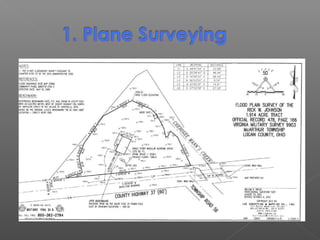
 The shape of the earth is spherical. Thus the surface
is obviously curved. But in plane surveying the
curvature of earth is not taken into account.
 This is because plane surveying is carried out over
a small area, so the surface of the earth is
considered as a plane. The degree of accuracy
required in this type of surveying is completely low.
Plane surveying is done on an area of less than 250
sq.km.
 In geodetic surveying the curvature of the earth is taken into
consideration. It is extended over a large area greater than
250 sq.km. The line joining any two points considered as a
curved line.
 Very refined methods and instruments are used in this type of
surveying. In this method very high precision or accuracy is
required.
 Survey can be classified on different
bases:
1. Based on instrument:
 Chain Survey
 Compass survey
 Plane Table survey
 Theodolite survey
 Tacheometric Survey
 Photographic survey
 Triangulation Survey
 Traverse Survey
 Geological survey
 Mine survey
 Archeological Survey
 Military survey
 Marine survey
 Land Survey
 Astronomical survey
1.Photogrammetry – mapping utilizing data obtained by
camera or other sensors carried in airplanes or
satellites.
2.Boundary Surveying – establishing property corners,
boundaries, and areas of land parcels.
3.Control Surveying – establish a network of horizontal
and vertical monuments that serve as a reference
framework for other survey projects.
4.Engineering Surveying – providing points and
elevations for the building Civil Engineering
projects.
5. Topographic Surveying – collecting data and
preparing maps showing the locations of
natural man-made features and elevations of
points of the ground for multiple uses.
6. Route Surveys – topographic and other
surveys for long – narrow projects associated
with Civil Engineering projects.
› Highways, railroads, pipelines, and
transmission lines.
6. Hydrographic Surveying – mapping of
shorelines and the bottom of bodies of water.
› Also known as bathymetric surveying.
 The principle of surveying is traversing;
which involves a series of lines which are
connected
1. Cylindrical metal
box
2. Pivot
3. Lifting pin and
lifting liver
4. Magnetic Needle
5. Graduated Ring
6. Prism
7. Object vane
8. Eye Vane
9. Glass Cover
10. Sun Glasses
11. Reflecting Mirror
12. Spring Brake or
Brake Pin
 The various instruments used in the compass survey are :
 Prismatic compass
 Tape
 Ranging rods
 Tripod
 Arrows
 Plumb Bob
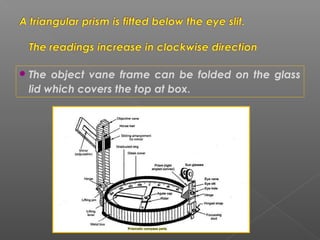
• Prismatic Compass comprises of a magnetic
needle attached to the circular ring made up of
aluminum.
• The needle is on the pivot and will orient itself in the
magnetic meridian
• The line of sight is defined by the objective vane
and the eye slit, both attached to the compass
box.
The object vane frame can be folded on the glass
lid which covers the top at box.
 The following are the adjustments usually
necessary in the prismatic compass:
• Centering
• Leveling
• Focusing the prism.
  
CENTERING:
 The center of the compass is placed vertically over the station point by
dropping a small piece of stone below the center of the compass, it falls on
the top of the peg marking that station.
LEVELLING:
 By means of ball and socket arrangement the Compass is then leveled the
graduated ring swings quite freely. It may be tested by rolling a round pencil
on the compass box.
FOCUSSING THE PRISM :
 The prism attachment is slid up or down focusing till the readings are seen to
be sharp and clear
 The bearing of a line is the horizontal angle which it makes with
 a reference line(meridian).
 • Depending upon the meridian , there are four type of bearings
 they are as follows:
 1) True Bearing: The true bearing of a line is the horizontal
 angle between the true meridian and the survey line. The true
 bearing is measured from the true north in the clockwise
 direction.
 • 2) Magnetic Bearing: the magnetic bearing of a line is the
 horizontal angle which the line makes with the magnetic north.
 • 3) Grid Bearing: The grid bearing of a line is the horizontal
 angle which the line makes with the grid meridian.
 • 4) Arbitrary Bearing: The arbitrary baring of a line is the
 horizontal angle which the line makes with the arbitrary
 meridian.
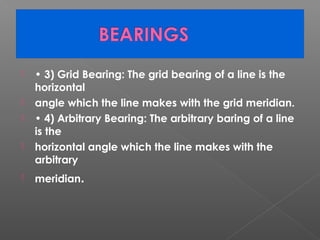
 • 3) Grid Bearing: The grid bearing of a line is the
horizontal
 angle which the line makes with the grid meridian.
 • 4) Arbitrary Bearing: The arbitrary baring of a line
is the
 horizontal angle which the line makes with the
arbitrary
 meridian.
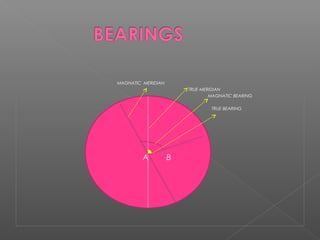
MAGNATIC MERIDIAN
TRUE MERIDIAN
MAGNATIC BEARING
TRUE BEARING
A B
 • The bearing are designated in the
following two system:-
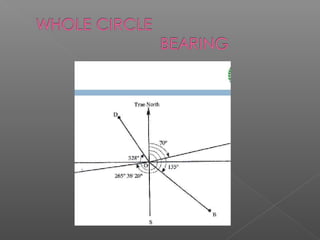
 • 1) Whole Circle Bearing System.(W.C.B)
 • 2) Quadrantal Bearing System.(Q.B)
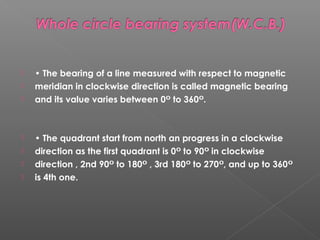
 • The bearing of a line measured with respect to magnetic
 meridian in clockwise direction is called magnetic bearing
 and its value varies between 0 to 360 .ᴼ ᴼ
 • The quadrant start from north an progress in a clockwise
 direction as the first quadrant is 0 to 90 in clockwiseᴼ ᴼ
 direction , 2nd 90 to 180 , 3rd 180 to 270 , and up to 360ᴼ ᴼ ᴼ ᴼ ᴼ
 is 4th one.
 • In this system, the bearing of survey lines are
measured wrt
 to north line or south line which ever is the nearest
to the
 given survey line and either in clockwise direction
or in anti
 clockwise direction.
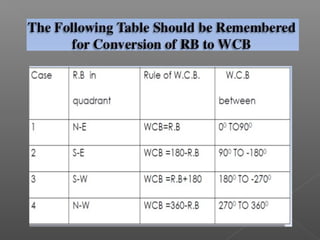
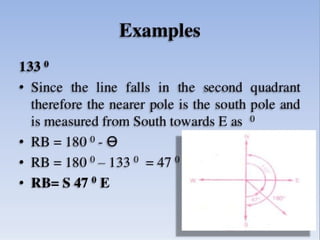
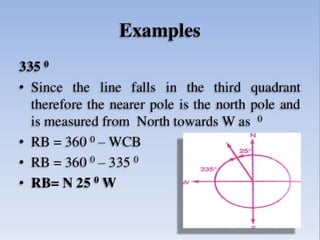
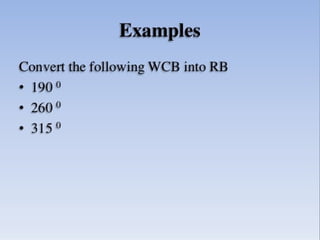
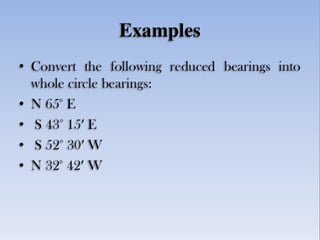
 •When the whole circle bearing is converted into
Quadrantal
 bearing , it is termed as “REDUCED BEARING”.
 • Thus , the reduced bearing is similar to the
Quadrantal
 bearing.
 • Its values lies between 0 to 90 , but the quadrantᴼ ᴼ
should be
 mentioned for proper designation
 •When the whole circle bearing is converted into
Quadrantal
 bearing , it is termed as “REDUCED BEARING”.
 • Thus , the reduced bearing is similar to the
Quadrantal
 bearing.
 • Its values lies between 0 to 90 , but the quadrantᴼ ᴼ
should be
 mentioned for proper designation
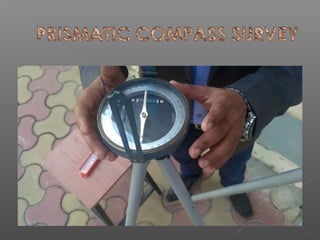
Surveying & prismatic compass survey

Surveying & prismatic compass survey

  • 3.
    1.Decision Making –selecting method, equipment and final point locations. 2.Fieldwork & Data Collection – making measurements and recording data in the field. 3.Computing & Data Processing – preparing calculations based upon the recorded data to determine locations in a useable form. 4.Mapping or Data Representation – plotting data to produce a map, plot, or chart in the proper form. 5. Stakeout – locating and establishing monuments or stakes in the proper locations in the field.
  • 5.
    1. The objectof surveying is to prepare a map or plan to show the relative positions of the objects on the surface of the earth. 2. The map or plan is drawn to some suitable scale. It also shows boundaries of districts, states, and co. 3. It also includes details of different engineering features such as buildings, roads, railways, dams, canals etc. untries too.
  • 8.
     Ruling principleof survey is : i) “ to work from whole to part”. For surveying Establish control points with high precision by use of Triangulation and precise levelling. Area is further divided into triangle, which are surveyed with less accuracy. ii) to fix the position of new stations by at least two independent processes – By linear and Angular
  • 9.
  • 10.
    1. Plane surveying 2.Geodetic surveying
  • 11.
     The shapeof the earth is spherical. Thus the surface is obviously curved. But in plane surveying the curvature of earth is not taken into account.  This is because plane surveying is carried out over a small area, so the surface of the earth is considered as a plane. The degree of accuracy required in this type of surveying is completely low. Plane surveying is done on an area of less than 250 sq.km.
  • 13.
     In geodeticsurveying the curvature of the earth is taken into consideration. It is extended over a large area greater than 250 sq.km. The line joining any two points considered as a curved line.  Very refined methods and instruments are used in this type of surveying. In this method very high precision or accuracy is required.
  • 15.
     Survey canbe classified on different bases: 1. Based on instrument:  Chain Survey  Compass survey  Plane Table survey  Theodolite survey  Tacheometric Survey  Photographic survey
  • 16.
  • 17.
     Geological survey Mine survey  Archeological Survey  Military survey
  • 18.
     Marine survey Land Survey  Astronomical survey
  • 19.
    1.Photogrammetry – mappingutilizing data obtained by camera or other sensors carried in airplanes or satellites. 2.Boundary Surveying – establishing property corners, boundaries, and areas of land parcels. 3.Control Surveying – establish a network of horizontal and vertical monuments that serve as a reference framework for other survey projects. 4.Engineering Surveying – providing points and elevations for the building Civil Engineering projects.
  • 20.
    5. Topographic Surveying– collecting data and preparing maps showing the locations of natural man-made features and elevations of points of the ground for multiple uses. 6. Route Surveys – topographic and other surveys for long – narrow projects associated with Civil Engineering projects. › Highways, railroads, pipelines, and transmission lines. 6. Hydrographic Surveying – mapping of shorelines and the bottom of bodies of water. › Also known as bathymetric surveying.
  • 22.
     The principleof surveying is traversing; which involves a series of lines which are connected
  • 23.
    1. Cylindrical metal box 2.Pivot 3. Lifting pin and lifting liver 4. Magnetic Needle 5. Graduated Ring 6. Prism 7. Object vane 8. Eye Vane 9. Glass Cover 10. Sun Glasses 11. Reflecting Mirror 12. Spring Brake or Brake Pin
  • 25.
     The variousinstruments used in the compass survey are :  Prismatic compass  Tape  Ranging rods  Tripod  Arrows  Plumb Bob
  • 26.
    • Prismatic Compasscomprises of a magnetic needle attached to the circular ring made up of aluminum. • The needle is on the pivot and will orient itself in the magnetic meridian • The line of sight is defined by the objective vane and the eye slit, both attached to the compass box.
  • 27.
    The object vaneframe can be folded on the glass lid which covers the top at box.
  • 29.
     The followingare the adjustments usually necessary in the prismatic compass: • Centering • Leveling • Focusing the prism.   
  • 31.
    CENTERING:  The centerof the compass is placed vertically over the station point by dropping a small piece of stone below the center of the compass, it falls on the top of the peg marking that station. LEVELLING:  By means of ball and socket arrangement the Compass is then leveled the graduated ring swings quite freely. It may be tested by rolling a round pencil on the compass box. FOCUSSING THE PRISM :  The prism attachment is slid up or down focusing till the readings are seen to be sharp and clear
  • 32.
     The bearingof a line is the horizontal angle which it makes with  a reference line(meridian).  • Depending upon the meridian , there are four type of bearings  they are as follows:  1) True Bearing: The true bearing of a line is the horizontal  angle between the true meridian and the survey line. The true  bearing is measured from the true north in the clockwise  direction.  • 2) Magnetic Bearing: the magnetic bearing of a line is the  horizontal angle which the line makes with the magnetic north.  • 3) Grid Bearing: The grid bearing of a line is the horizontal  angle which the line makes with the grid meridian.  • 4) Arbitrary Bearing: The arbitrary baring of a line is the  horizontal angle which the line makes with the arbitrary  meridian.
  • 33.
     • 3)Grid Bearing: The grid bearing of a line is the horizontal  angle which the line makes with the grid meridian.  • 4) Arbitrary Bearing: The arbitrary baring of a line is the  horizontal angle which the line makes with the arbitrary  meridian.
  • 34.
  • 35.
     • Thebearing are designated in the following two system:-  • 1) Whole Circle Bearing System.(W.C.B)  • 2) Quadrantal Bearing System.(Q.B)
  • 36.
     • Thebearing of a line measured with respect to magnetic  meridian in clockwise direction is called magnetic bearing  and its value varies between 0 to 360 .ᴼ ᴼ  • The quadrant start from north an progress in a clockwise  direction as the first quadrant is 0 to 90 in clockwiseᴼ ᴼ  direction , 2nd 90 to 180 , 3rd 180 to 270 , and up to 360ᴼ ᴼ ᴼ ᴼ ᴼ  is 4th one.
  • 38.
     • Inthis system, the bearing of survey lines are measured wrt  to north line or south line which ever is the nearest to the  given survey line and either in clockwise direction or in anti  clockwise direction.
  • 39.
     •When thewhole circle bearing is converted into Quadrantal  bearing , it is termed as “REDUCED BEARING”.  • Thus , the reduced bearing is similar to the Quadrantal  bearing.  • Its values lies between 0 to 90 , but the quadrantᴼ ᴼ should be  mentioned for proper designation
  • 40.
     •When thewhole circle bearing is converted into Quadrantal  bearing , it is termed as “REDUCED BEARING”.  • Thus , the reduced bearing is similar to the Quadrantal  bearing.  • Its values lies between 0 to 90 , but the quadrantᴼ ᴼ should be  mentioned for proper designation