CHAIN SURVEYING
BY
SATHYAN CIVIL
SURVEYING
 Surveying is the process of determining relative positions of
Different objects on the surface of the earth by measuring horizontal
distances between them and preparing a map to any suitable scale.
 Survey is performed to prepare a map of relative positions on
surface of the earth. It shows the natural feature of a country such
as towns, villages, roads, railways, etc. They may also include details
of different engineering works such as bridge, canal, dam etc.
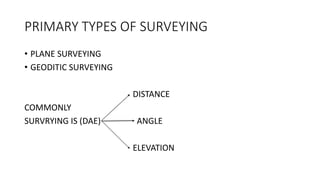
PRIMARY TYPES OF SURVEYING
• PLANE SURVEYING
• GEODITIC SURVEYING
DISTANCE
COMMONLY
SURVRYING IS (DAE) ANGLE
ELEVATION
TYPES OF SURVEYING BASED ON
INSTRUMENT:-
• CHAIN survey
• COMPASS survey
• PLANE TABLE survey
• THEODOLITE survey
• TOTAL STATION survey
• GIS/GPS Survey
INSTRUMENTS IN CHAIN SURVEYING
CHAIN
ARROW
PEGS
RANGING ROD
OFFSET ROD
PLUMB BOB
Cross staff
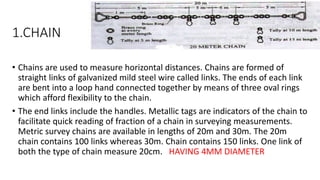
1.CHAIN
• Chains are used to measure horizontal distances. Chains are formed of
straight links of galvanized mild steel wire called links. The ends of each link
are bent into a loop hand connected together by means of three oval rings
which afford flexibility to the chain.
• The end links include the handles. Metallic tags are indicators of the chain to
facilitate quick reading of fraction of a chain in surveying measurements.
Metric survey chains are available in lengths of 20m and 30m. The 20m
chain contains 100 links whereas 30m. Chain contains 150 links. One link of
both the type of chain measure 20cm. HAVING 4MM DIAMETER
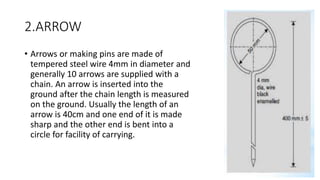
2.ARROW
• Arrows or making pins are made of
tempered steel wire 4mm in diameter and
generally 10 arrows are supplied with a
chain. An arrow is inserted into the
ground after the chain length is measured
on the ground. Usually the length of an
arrow is 40cm and one end of it is made
sharp and the other end is bent into a
circle for facility of carrying.
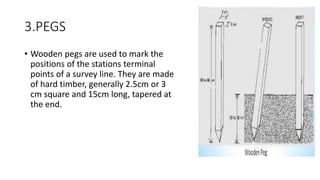
3.PEGS
• Wooden pegs are used to mark the
positions of the stations terminal
points of a survey line. They are made
of hard timber, generally 2.5cm or 3
cm square and 15cm long, tapered at
the end.
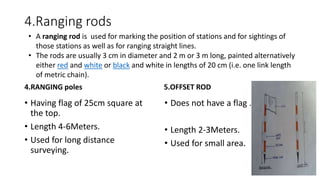
4.Ranging rods
4.RANGING poles
• Having flag of 25cm square at
the top.
• Length 4-6Meters.
• Used for long distance
surveying.
5.OFFSET ROD
• Does not have a flag .
• Length 2-3Meters.
• Used for small area.
• A ranging rod is used for marking the position of stations and for sightings of
those stations as well as for ranging straight lines.
• The rods are usually 3 cm in diameter and 2 m or 3 m long, painted alternatively
either red and white or black and white in lengths of 20 cm (i.e. one link length
of metric chain).
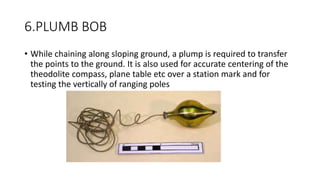
6.PLUMB BOB
• While chaining along sloping ground, a plump is required to transfer
the points to the ground. It is also used for accurate centering of the
theodolite compass, plane table etc over a station mark and for
testing the vertically of ranging poles
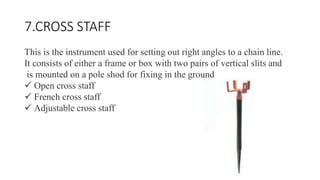
7.CROSS STAFF
This is the instrument used for setting out right angles to a chain line.
It consists of either a frame or box with two pairs of vertical slits and
is mounted on a pole shod for fixing in the ground
 Open cross staff
 French cross staff
 Adjustable cross staff
THANK
U

Chain surveying

  • 1.
  • 2.
    SURVEYING  Surveying isthe process of determining relative positions of Different objects on the surface of the earth by measuring horizontal distances between them and preparing a map to any suitable scale.  Survey is performed to prepare a map of relative positions on surface of the earth. It shows the natural feature of a country such as towns, villages, roads, railways, etc. They may also include details of different engineering works such as bridge, canal, dam etc.
  • 3.
    PRIMARY TYPES OFSURVEYING • PLANE SURVEYING • GEODITIC SURVEYING DISTANCE COMMONLY SURVRYING IS (DAE) ANGLE ELEVATION
  • 4.
    TYPES OF SURVEYINGBASED ON INSTRUMENT:- • CHAIN survey • COMPASS survey • PLANE TABLE survey • THEODOLITE survey • TOTAL STATION survey • GIS/GPS Survey
  • 5.
    INSTRUMENTS IN CHAINSURVEYING CHAIN ARROW PEGS RANGING ROD OFFSET ROD PLUMB BOB Cross staff
  • 6.
    1.CHAIN • Chains areused to measure horizontal distances. Chains are formed of straight links of galvanized mild steel wire called links. The ends of each link are bent into a loop hand connected together by means of three oval rings which afford flexibility to the chain. • The end links include the handles. Metallic tags are indicators of the chain to facilitate quick reading of fraction of a chain in surveying measurements. Metric survey chains are available in lengths of 20m and 30m. The 20m chain contains 100 links whereas 30m. Chain contains 150 links. One link of both the type of chain measure 20cm. HAVING 4MM DIAMETER
  • 7.
    2.ARROW • Arrows ormaking pins are made of tempered steel wire 4mm in diameter and generally 10 arrows are supplied with a chain. An arrow is inserted into the ground after the chain length is measured on the ground. Usually the length of an arrow is 40cm and one end of it is made sharp and the other end is bent into a circle for facility of carrying.
  • 8.
    3.PEGS • Wooden pegsare used to mark the positions of the stations terminal points of a survey line. They are made of hard timber, generally 2.5cm or 3 cm square and 15cm long, tapered at the end.
  • 9.
    4.Ranging rods 4.RANGING poles •Having flag of 25cm square at the top. • Length 4-6Meters. • Used for long distance surveying. 5.OFFSET ROD • Does not have a flag . • Length 2-3Meters. • Used for small area. • A ranging rod is used for marking the position of stations and for sightings of those stations as well as for ranging straight lines. • The rods are usually 3 cm in diameter and 2 m or 3 m long, painted alternatively either red and white or black and white in lengths of 20 cm (i.e. one link length of metric chain).
  • 10.
    6.PLUMB BOB • Whilechaining along sloping ground, a plump is required to transfer the points to the ground. It is also used for accurate centering of the theodolite compass, plane table etc over a station mark and for testing the vertically of ranging poles
  • 11.
    7.CROSS STAFF This isthe instrument used for setting out right angles to a chain line. It consists of either a frame or box with two pairs of vertical slits and is mounted on a pole shod for fixing in the ground  Open cross staff  French cross staff  Adjustable cross staff
  • 12.