Traverse/Compass surveying
Muhammad Salaha Uddin,
Assistant Professor
Department of Urban and Regional Planning, 
KUET
Introduction
The Traversing consists of using a variety of
instrument combinations to create polar vector
inspace, that is 'lines' with a magnitude(distance)
and direction (bearing).
These vectors are generally contiguous and create a
polygon which conforms to various mathematical
and geometrical rules.
The equipment used generally consists of something
to determine direction like a compass or theodolite,
and something to determine distance like a tape or
Electromagnetic Distance Meter (EDM).
Function of Traverse
Traverses are normally performed around a
parcel of land so that features on the surface
or the boundary dimensions can be
determined.
A traverse provides a simple network of
'known' points that can be used to derive other
information.
Types of Traverse
There are two types of traverse used in
survey.These are
Open traverse, and
Closed traverse.
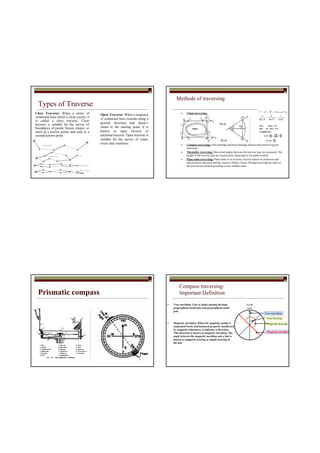
Types of Traverse
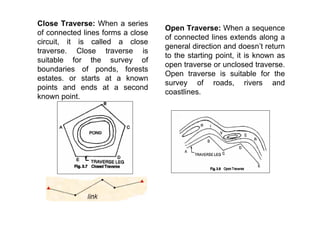
Close Traverse: When a series of
connected lines forms a close circuit, it
is called a close traverse. Close
traverse is suitable for the survey of
boundaries of ponds, forests estates. or
starts at a known points and ends at a
second known point.
Open Traverse: When a sequence
of connected lines extends along a
general direction and doesn’t
return to the starting point, it is
known as open traverse or
unclosed traverse. Open traverse is
suitable for the survey of roads,
rivers and coastlines.
Methods of traversing
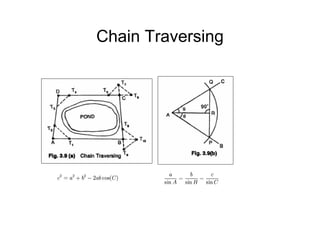
Chain traversing:
Compass traversing: Fore bearings and back bearings between the traverse leg are
measured
Theodolite traversing: Horizontal angles between the traverse legs are measured. The
length of the traverse legs are measured by chain/tape or by stadia method
Plane table traversing: Plane table is set at every traverse station in clockwise and
anticlockwise direction and the circuit is finally closed. During traversing the sides of
the traverse are plotted according to any suitable scale.
15 m
15 m
Prismatic compass
Compass traversing:
Important Definition
True meridian: Line or plane passing through
geographical north pole and geographical south
pole
Magnetic meridian: When the magnetic needle is
suspended freely and balanced properly, unaffected
by magnetic substances, it indicates a direction.
This direction is known as magnetic meridian. The
angle between the magnetic meridian and a line is
known as magnetic bearing or simple bearing of
the line.
North
pole
True meridian
Magnetic meridian
True bearing
Magnetic bearing
Terms
Arbitrary meridian: Convenient direction is assumed as a meridian.
Grid meridian: Sometimes for preparing a map some authoritative agencies assume
several lines parallel to the true meridian for a particular zone these lines are termed
as grid meridian.
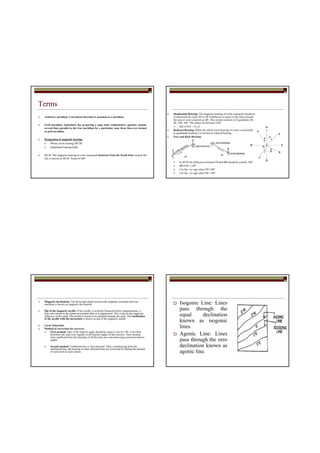
Designation of magnetic bearing
Whole circle bearing (WCB)
Quadrantal bearing (QB)
WCB: The magnetic bearing of a line measured clockwise from the North Pole towards the
line is known as WCB. Varies 0-360°
Quadrantal Bearing: The magnetic bearing of a line measured clockwise
or anticlockwise from NP or SP (whichever is nearer to the line) towards
the east or west is known as QB. This system consists of 4-quadrants NE,
SE, NW, SW. The values lie between 0-90°
QB of OA = N a E
Reduced Bearing: When the whole circle bearing of a line is converted
to quadrantal bearing it is termed as reduced bearing.
Fore and Back Bearing:
In WCB the difference between FB and BB should be exactly 180°
BB=FB+/-180°
Use the +ve sign when FB<180°
Use the –ve sign when FB> 180°
Magnetic declination: The horizontal angle between the magnetic meridian and true
meridian is known as magnetic declination.
Dip of the magnetic needle: If the needle is perfectly balanced before magnetisation, it
does not remain in the balanced position after it is magnetised. This is due to the magnetic
influence of the earth. The needle is found to be inclined towards the pole. This inclination
of the needle with the horizontal is known as dip of the magnetic needle.
Local Attraction
Method of correction for traverse:
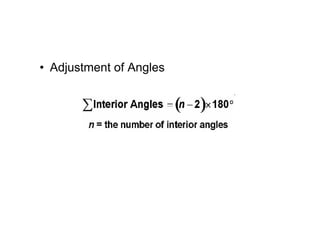
First method: Sum of the interior angle should be equal to (2n-4) x 90. if not than
distribute the total error equally to all interior angles of the traverse. Then starting
from unaffected line the bearings of all the lines are corrected using corrected interior
angles.
Second method: Unaffected line is first detected. Then, commencing from the
unaffected line, the bearing of other affected lines are corrected by finding the amount
of correction at each station.
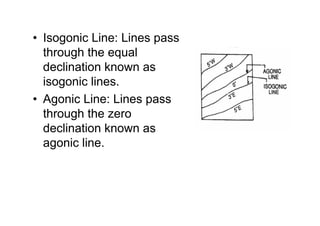
Isogonic Line: Lines
pass through the
equal declination
known as isogonic
lines.
Agonic Line: Lines
pass through the zero
declination known as
agonic line.
Vaiation of Magnetic Declination
1.Secular Variation: After every 100 years or so magnetic
meridian swings from one direction to the opposite direction
and hence declination varies.
2.Annual Variation: Magnetic declination varies due to the
rotation of the earth. The amount of variation is about 1to 2
minutes
3.Diurnal Variation: Magnetic declination varies due to rotation
of its earth on its own axis. The amount of variation 3 to 12
minutes.
4.Irregular Variation: Variation due to some natural causes such
as earth quake, volcanic erruptions and so on. The variation is
known as “Irregular Variation”
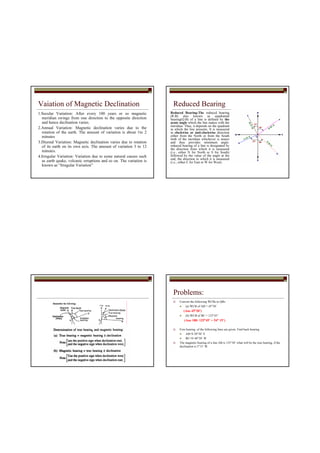
Reduced Bearing
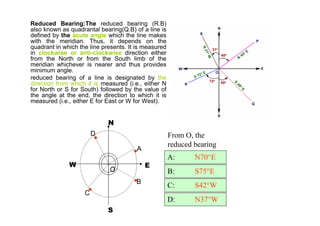
Reduced Bearing:The reduced bearing
(R.B) also known as quadrantal
bearing(Q.B) of a line is defined by the
acute angle which the line makes with the
meridian. Thus, it depends on the quadrant
in which the line presents. It is measured
in clockwise or anti-clockwise direction
either from the North or from the South
limb of the meridian whichever is nearer
and thus provides minimum angle.
reduced bearing of a line is designated by
the direction from which it is measured
(i.e., either N for North or S for South)
followed by the value of the angle at the
end, the direction to which it is measured
(i.e., either E for East or W for West).
Problems:
Convert the following WCBs to QBs
(a) WCB of AB = 45°30’
(Ans 45°30’)
(b) WCB of BC = 125°45’
(Ans 180- 125°45’ = 54° 15’)
Fore bearing of the following lines are given. Find back bearing
AB=S 30°30’ E
BC=N 40°30’ W
The magnetic bearing of a line AB is 135°30’ what will be the true bearing, if the
declination is 5°15’ W.
Problem
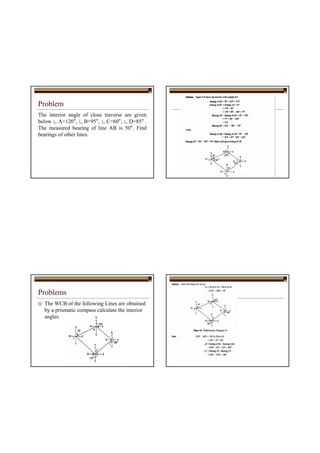
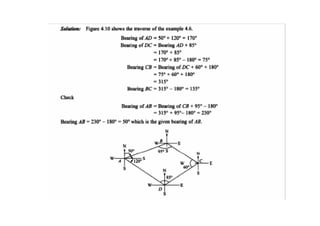
The interior angle of close traverse are given
below ∟A=120°, ∟B=95°, ∟C=60°, ∟D=85° .
The measured bearing of line AB is 50°. Find
bearings of other lines.
Problems
The WCB of the following Lines are obtained
by a prismatic compass calculate the interior
angles
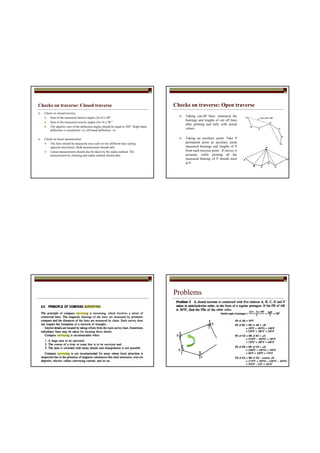
Checks on traverse: Closed traverse
Check on closed traverse:
Sum of the measured interior angles (2n-4) x 90°
Sum of the measured exterior angles (2n+4) x 90 °
The algebric sum of the deflection angles should be equal to 360°. Right hand
deflection is considered +ve, left hand deflection –ve
Check on linear measurement
The lines should be measured once each on two different days (along
opposite directions). Both measurement should tally.
Linear measurement should also be taken by the stadia method. The
measurement by chaining and stadia method should tally.
Checks on traverse: Open traverse
Taking cut-off lines: measured the
bearings and lengths of cut off lines
after plotting and tally with actual
values.
Taking an auxiliary point: Take P
permanent point as auxiliary point
measured bearings and lengths of P
from each traverse point. If survey is
accurate, while plotting all the
measured bearing of P should meet
at P.
Problems
Contd…
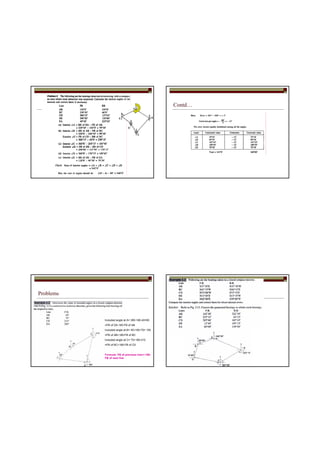
Problems
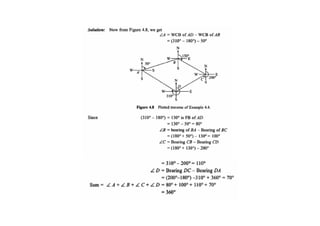
Included angle at A= 280-180-40=60
=FB of DA-180-FB of AB
Included angle at B= 40+180-70= 150
=FB of AB+180-FB of BC
Included angle at C= 70+180-210
=FB of BC+180-FB of CD
Formula: FB of previous line+/-180-
FB of next line
Traverse Survey
Prepared and Presented By-
Muhammad Salaha uddin
Lecture, Department of Urban and Regional Planning
Khulna University of Engineering and Technology (KUET)
E-mail:msupavel@mail.kuet.ac.bd/muhammad.uddin@mail.polimi.it
Introduction
The Traversing consists of using a variety of
instrument combinations to create polar vector in
space, that is 'lines' with a magnitude
(distance) and direction (bearing).
These vectors are generally contiguous and
create a polygon which conforms to various
mathematical and geometrical rules.
The equipment used generally consists of
something to determine direction like a compass or
theodolite, and something to determine distance
like a tape or Electromagnetic Distance Meter
(EDM).
Function of Traverse
• Traverses are normally performed around
a parcel of land so that features on the
surface or the boundary dimensions can
be determined.
• A traverse provides a simple network of
'known' points that can be used to derive
other information.
Types of Traverse
• There are two types of traverse used in
survey.
• These are open traverse, and closed
traverse.
Close Traverse: When a series
of connected lines forms a close
circuit, it is called a close
traverse. Close traverse is
suitable for the survey of
boundaries of ponds, forests
estates. or starts at a known
points and ends at a second
known point.
Open Traverse: When a sequence
of connected lines extends along a
general direction and doesn’t return
to the starting point, it is known as
open traverse or unclosed traverse.
Open traverse is suitable for the
survey of roads, rivers and
coastlines.
Methods of Traversing
Traverse Survey may be Conducted by the
following methods:
1. Chain Traversing (by chain angle)
2. Compass Traversing (by free neddle)
3. Theodolite Traversing (by fast needle)
4. Plane Table Traversing (by plane table)
Chain Traversing
Compass Traversing
• In this method, the fore and back bearings
of the traverse legs are measured by
prismatic compass and the sides of the
traverse by chain or tape. Then the
observed bearings are verified and
necessray corrections for local attraction
are applied. In this method closing errors
may occured when traverse is plotted.
Theodolite Traversing
• In such traversing the horizontal angles
between the traverse legs are measured
by theodolite. The lengths of the legs are
measured by chain or by employing the
stadia method. The magnetic bearings of
the other sides are calculated. The
independent coordinates of all the traverse
stations then found out. This method is
very accurate.
Plane Table Traversing
In this method a plane table is set at every
traverse station in the clockwise or
anticlockwise direction, and circuit is finally
closed. During traversing, the sides of the
traverse are plotted according to any
suitable scale. At the end of the work, any
closing error which may occur is adjusted
graphically.
Terms
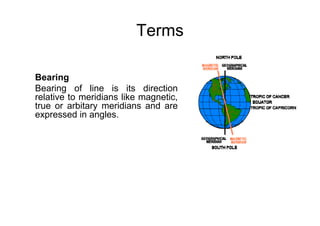
Bearing
Bearing of line is its direction
relative to meridians like magnetic,
true or arbitary meridians and are
expressed in angles.
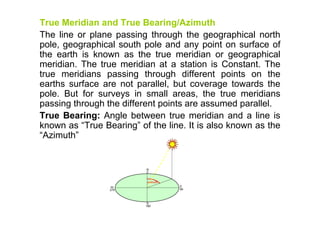
True Meridian and True Bearing/Azimuth
The line or plane passing through the geographical north
pole, geographical south pole and any point on surface of
the earth is known as the true meridian or geographical
meridian. The true meridian at a station is Constant. The
true meridians passing through different points on the
earths surface are not parallel, but coverage towards the
pole. But for surveys in small areas, the true meridians
passing through the different points are assumed parallel.
True Bearing: Angle between true meridian and a line is
known as “True Bearing” of the line. It is also known as the
“Azimuth”
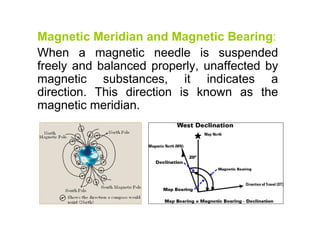
Magnetic Meridian and Magnetic Bearing:
When a magnetic needle is suspended
freely and balanced properly, unaffected by
magnetic substances, it indicates a
direction. This direction is known as the
magnetic meridian.
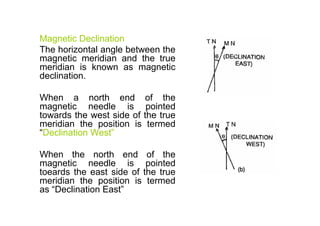
Magnetic Declination
The horizontal angle between the
magnetic meridian and the true
meridian is known as magnetic
declination.
When a north end of the
magnetic needle is pointed
towards the west side of the true
meridian the position is termed
“Declination West”
When the north end of the
magnetic needle is pointed
toeards the east side of the true
meridian the position is termed
as “Declination East”
• Isogonic Line: Lines pass
through the equal
declination known as
isogonic lines.
• Agonic Line: Lines pass
through the zero
declination known as
agonic line.
Variation of Magnetic Declination
1.Secular Variation: After every 100 years or so magnetic
meridian swings from one direction to the opposite
direction and hence declination varies.
2.Annual Variation: Magnetic declination varies due to the
rotation of the earth. The amount of variation is about 1
to 2 minutes
3.Diurnal Variation: Magnetic declination varies due to
rotation of its earth on its own axis. The amount of
variation 3 to 12 minutes.
4.Irregular Variation: Variation due to some natural causes
such as earth quake, volcanic erruptions and so on. The
variation is known as “Irregular Variation”
•Arbitary Meridian: Sometimes for the survey
of a small area, a convenient direction is
assumed as a meridian, known as arbitary
meridian.
The angle between arbitary meridian and a
line is known as arbitary bearing of the line.
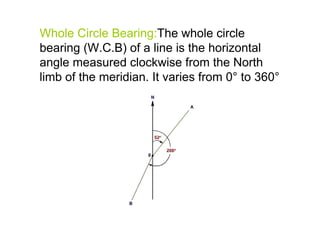
Whole Circle Bearing:The whole circle
bearing (W.C.B) of a line is the horizontal
angle measured clockwise from the North
limb of the meridian. It varies from 0° to 360°
Reduced Bearing:The reduced bearing (R.B)
also known as quadrantal bearing(Q.B) of a line is
defined by the acute angle which the line makes
with the meridian. Thus, it depends on the
quadrant in which the line presents. It is measured
in clockwise or anti-clockwise direction either
from the North or from the South limb of the
meridian whichever is nearer and thus provides
minimum angle.
reduced bearing of a line is designated by the
direction from which it is measured (i.e., either N
for North or S for South) followed by the value of
the angle at the end, the direction to which it is
measured (i.e., either E for East or W for West).
E
S
W
N
A
O
B
C
D From O, the
reduced bearing
of:A: N70°E
B: S75°E
C: S42°W
D: N37°W
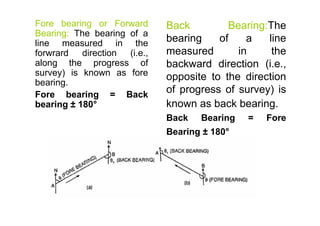
Fore bearing or Forward
Bearing: The bearing of a
line measured in the
forwrard direction (i.e.,
along the progress of
survey) is known as fore
bearing.
Fore bearing = Back
bearing ± 180°
Back Bearing:The
bearing of a line
measured in the
backward direction (i.e.,
opposite to the direction
of progress of survey) is
known as back bearing.
Back Bearing = Fore
Bearing ± 180°
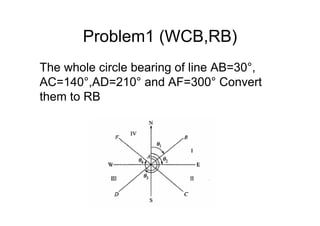
Problem1 (WCB,RB)
The whole circle bearing of line AB=30°,
AC=140°,AD=210° and AF=300° Convert
them to RB
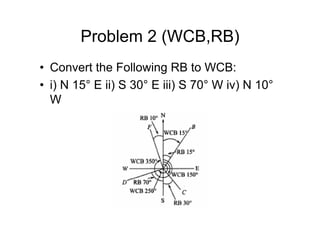
Problem 2 (WCB,RB)
• Convert the Following RB to WCB:
• i) N 15° E ii) S 30° E iii) S 70° W iv) N 10°
W
Problem 3 (FB,BB)
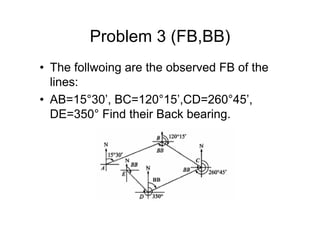
• The follwoing are the observed FB of the
lines:
• AB=15°30’, BC=120°15’,CD=260°45’,
DE=350° Find their Back bearing.
Problem 4
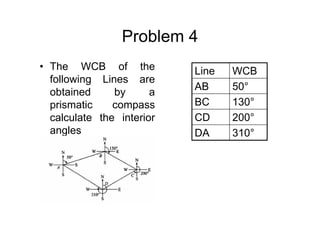
• The WCB of the
following Lines are
obtained by a
prismatic compass
calculate the interior
angles 310°DA
200°CD
130°BC
50°AB
WCBLine
Problem 5
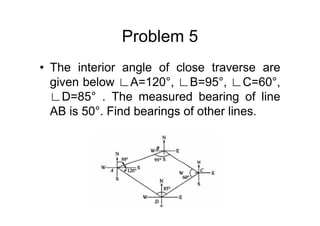
• The interior angle of close traverse are
given below ∟A=120°, ∟B=95°, ∟C=60°,
∟D=85° . The measured bearing of line
AB is 50°. Find bearings of other lines.
TRAVERSE CALCULATIONS
PROCEDURE FOR TRAVERSE
CALCULATIONS (BOWDITCH
ANALYTICAL METHOD)
•Adjust angles or directions
•Determine bearings or azimuths
•Calculate and adjust latitudes and
departures
•Calculate rectangular coordinates
• Adjustment of Angles
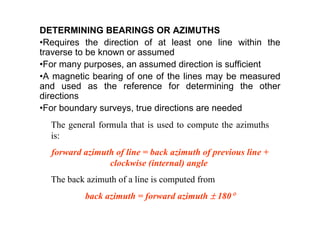
DETERMINING BEARINGS OR AZIMUTHS
•Requires the direction of at least one line within the
traverse to be known or assumed
•For many purposes, an assumed direction is sufficient
•A magnetic bearing of one of the lines may be measured
and used as the reference for determining the other
directions
•For boundary surveys, true directions are needed
The general formula that is used to compute the azimuths
is:
forward azimuth of line = back azimuth of previous line +
clockwise (internal) angle
The back azimuth of a line is computed from
back azimuth = forward azimuth ± 180°
DETERMINING BEARINGS OR AZIMUTHS
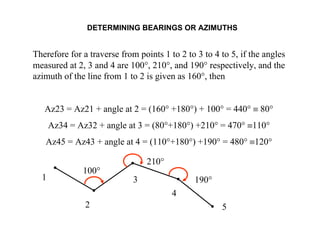
Therefore for a traverse from points 1 to 2 to 3 to 4 to 5, if the angles
measured at 2, 3 and 4 are 100°, 210°, and 190° respectively, and the
azimuth of the line from 1 to 2 is given as 160°, then
Az23 = Az21 + angle at 2 = (160° +180°) + 100° = 440° ≡ 80°
Az34 = Az32 + angle at 3 = (80°+180°) +210° = 470° ≡110°
Az45 = Az43 + angle at 4 = (110°+180°) +190° = 480° ≡120°
1
2
3
4
5
100°
210°
190°
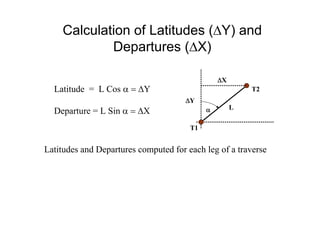
Latitude = L Cos α = ΔY
Departure = L Sin α = ΔX
T1
T2
ΔY
ΔX
Lα
Latitudes and Departures computed for each leg of a traverse
Calculation of Latitudes (ΔY) and
Departures (ΔX)
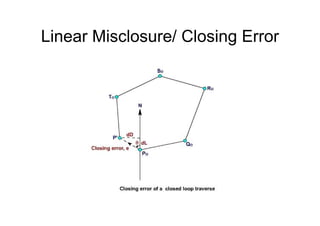
Linear Misclosure/Closing Error
LinearLinear misclosuremisclosure = [(departure misclosure)= [(departure misclosure)22
+ (latitude misclosure)+ (latitude misclosure)2]1/22]1/2
Linear Misclosure/ Closing Error
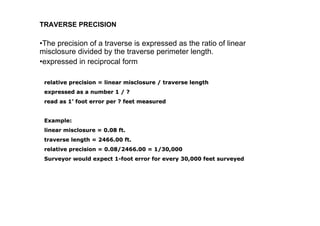
TRAVERSE PRECISION
•The precision of a traverse is expressed as the ratio of linear
misclosure divided by the traverse perimeter length.
•expressed in reciprocal form
relative precision = linearrelative precision = linear misclosuremisclosure / traverse length/ traverse length
expressed as a number 1 / ?expressed as a number 1 / ?
read as 1read as 1’’ foot error per ? feet measuredfoot error per ? feet measured
Example:Example:
linearlinear misclosuremisclosure = 0.08 ft.= 0.08 ft.
traverse length = 2466.00 ft.traverse length = 2466.00 ft.
relative precision = 0.08/2466.00 = 1/30,000relative precision = 0.08/2466.00 = 1/30,000
Surveyor would expect 1Surveyor would expect 1--foot error for every 30,000 feet surveyedfoot error for every 30,000 feet surveyed
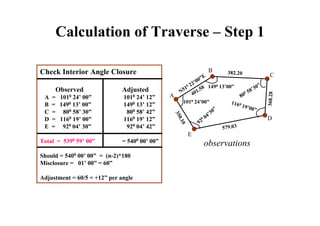
Calculation of Traverse – Step 1
N51
0 22’00”E
1010 24’00”
1490 13’00”
80
0 58’30”
1160
19’00”
92
0 04’30”
579.03
350.10
401.58
382.20
368.28
A
B
C
D
E
Check Interior Angle Closure
Observed Adjusted
A = 1010 24’ 00” 1010 24’ 12”
B = 1490 13’ 00” 1490 13’ 12”
C = 800 58’ 30” 800 58’ 42”
D = 1160 19’ 00” 1160 19’ 12”
E = 920 04’ 30” 920 04’ 42”
Total = 5390 59’ 00” = 5400 00’ 00”
Should = 5400 00’ 00” = (n-2)*180
Misclosure = 01’ 00” = 60”
Adjustment = 60/5 = +12” per angle
observations
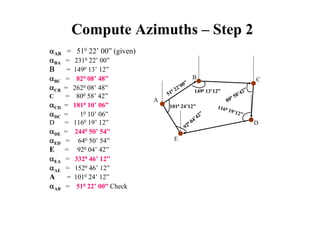
Compute Azimuths – Step 2
αAB = 510 22’ 00” (given)
αBA = 2310 22’ 00”
Β = 1490 13’ 12”
αBC = 820 08’ 48”
αCB = 2620 08’ 48”
C = 800 58’ 42”
αCD = 1810 10’ 06”
αDC = 10 10’ 06”
D = 1160 19’ 12”
αDE = 2440 50’ 54”
αED = 640 50’ 54”
E = 920 04’ 42”
αEA = 3320 46’ 12”
αAE = 1520 46’ 12”
A = 1010 24’ 12”
αAB = 510 22’ 00” Check
51
0 22’00”
1010 24’12”
1490 13’12”
80
0 58’42”
1160
19’12”
92
0 04’42”
B C
D
E
A
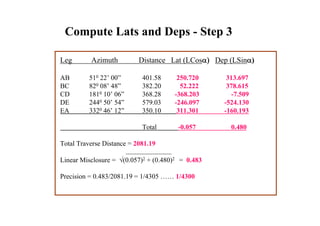
Compute Lats and Deps - Step 3
Leg Azimuth Distance Lat (LCosα) Dep (LSinα)
AB 510 22’ 00” 401.58 250.720 313.697
BC 820 08’ 48” 382.20 52.222 378.615
CD 1810 10’ 06” 368.28 -368.203 -7.509
DE 2440 50’ 54” 579.03 -246.097 -524.130
EA 3320 46’ 12” 350.10 311.301 -160.193
Total -0.057 0.480
Total Traverse Distance = 2081.19
Linear Misclosure = √(0.057)2 + (0.480)2 = 0.483
Precision = 0.483/2081.19 = 1/4305 …… 1/4300
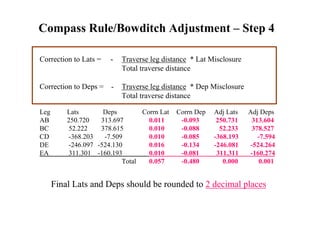
Compass Rule/Bowditch Adjustment – Step 4
Correction to Lats = - Traverse leg distance * Lat Misclosure
Total traverse distance
Correction to Deps = - Traverse leg distance * Dep Misclosure
Total traverse distance
Leg Lats Deps Corrn Lat Corrn Dep Adj Lats Adj Deps
AB 250.720 313.697 0.011 -0.093 250.731 313.604
BC 52.222 378.615 0.010 -0.088 52.233 378.527
CD -368.203 -7.509 0.010 -0.085 -368.193 -7.594
DE -246.097 -524.130 0.016 -0.134 -246.081 -524.264
EA 311.301 -160.193 0.010 -0.081 311.311 -160.274
Total 0.057 -0.480 0.000 0.001
Final Lats and Deps should be rounded to 2 decimal places
Bowditch Graphical Method
For rough surveys or traverse of small area, adjustment can also be carried out
graphically. In this method of balancing, the locations and thus the coordinates
of the stations are adjusted directly. Thus, the amount of correction at any
station is proportional to its distance from the initial station .
Let Po Qo Ro So To P' is the graphical plot of a closed-loop traverse PQRSTP.
The observed length and direction of traverse sides are such that it fails to get
balanced and is depicted in its graphical presentation by an amount Po P'.
Thus, the closing error of the traverse is Po P' (Figure 1). The error Po P' is to
be distributed to all the sides of the traverse in such a way that the traverse
gets closed i.e., P' gets coincides with Po in its plot. This is carried out by
shifting the positions of the station graphically. In order to obtain the length and
direction of shifting of the plotted position of stations, first a straight line is
required to be drawn, at some scale, representing the perimeter of the plotted
traverse. In this case, a horizontal line Po P' is drawn [Figure 3]. Mark the
traverse stations on this line such as Qo, Ro, So and To in such a way that
distance between them represent the length of the traverse sides at the chosen
scale. At the terminating end of the line i.e., at P', a line P' P a is drawn parallel
to the correction for closure and length equal to the amount of error as depicted
in the plot of traverse. Now, join Po to Pa and draw lines parallel to P' Pa at
points Qo, Ro, So and To. The length and direction of Qo Qa, Ro Ra, So Sa
and To Ta represent the length and direction of errors at Qo, Ro, So and To
respectively. So, shifting equal to Qo Qa , Ro Ra, So Sa and To Ta and in the
same direction are applied as correction to the positions of stations Qo, Ro, So
and To respectively. These shifting provide the corrected positions of the
stations as to Qa, Ra, Sa,Ta and Pa. Joining these corrected positions of the
stations provide the adjusted traverse Pa Qa Ra, Sa Ta [Figure 2].
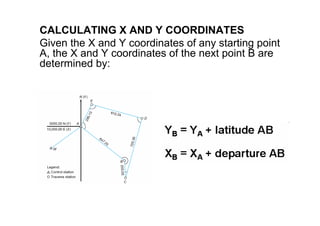
CALCULATING X AND Y COORDINATES
Given the X and Y coordinates of any starting point
A, the X and Y coordinates of the next point B are
determined by:
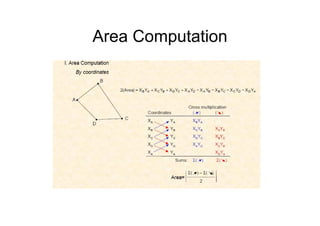
Area Computation
Simpson’s Rule
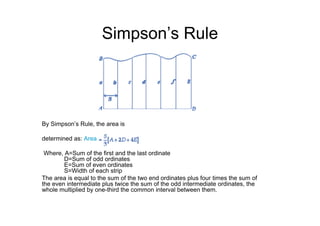
By Simpson’s Rule, the area is
determined as: Area
Where, A=Sum of the first and the last ordinate
D=Sum of odd ordinates
E=Sum of even ordinates
S=Width of each strip
The area is equal to the sum of the two end ordinates plus four times the sum of
the even intermediate plus twice the sum of the odd intermediate ordinates, the
whole multiplied by one-third the common interval between them.
Mid-Ordinate Rule
Area = ([O1+O2+O3+ .....+ On]*L)/n
(O1 +O2 + O3 + .....+ On)*d
Where:
L = length of baseline
n = number of equal parts, the baseline is divided
d = common distance between the ordinates
Average Ordinate Rule
Area = [(O1+ O2+ O3+ .... + On)*L]/(n+1)
• L = length of baseline
• n = number of equal parts (the baseline divided)
• d = common distance
Trapezoidal Rule
• Area = [(O1+ On)/2+ O2+ .... + On-1]*d
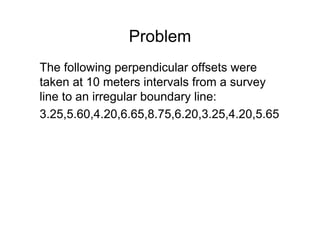
Problem
The following perpendicular offsets were
taken at 10 meters intervals from a survey
line to an irregular boundary line:
3.25,5.60,4.20,6.65,8.75,6.20,3.25,4.20,5.65
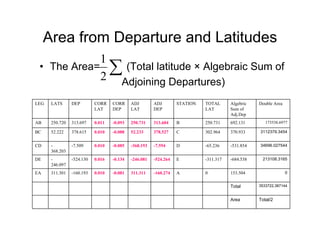
Area from Departure and Latitudes
• The Area= (Total latitude × Algebraic Sum of
Adjoining Departures)
∑2
1
Total/2Area
3533722,387144Total
0153.5040A-160.274311.311-0.0810.010-160.193311.301EA
213108.3165-684.538-311.317E-524.264-246.081-0.1340.016-524.130-
246.097
DE
34696.027544-531.854-65.236D-7.594-368.193-0.0850.010-7.509-
368.203
CD
3112379.3454370.933302.964C378.52752.233-0.0880.010378.61552.222BC
173538.6977692.131250.731B313.604250.731-0.0930.011313.697250.720AB
Double AreaAlgebric
Sum of
Adj.Dep
TOTAL
LAT
STATIONADJ
DEP
ADJ
LAT
CORR
DEP
CORR
LAT
DEPLATSLEG

1392741020 traverse survey

  • 1.
    Traverse/Compass surveying Muhammad Salaha Uddin, Assistant Professor Departmentof Urban and Regional Planning,  KUET Introduction The Traversing consists of using a variety of instrument combinations to create polar vector inspace, that is 'lines' with a magnitude(distance) and direction (bearing). These vectors are generally contiguous and create a polygon which conforms to various mathematical and geometrical rules. The equipment used generally consists of something to determine direction like a compass or theodolite, and something to determine distance like a tape or Electromagnetic Distance Meter (EDM). Function of Traverse Traverses are normally performed around a parcel of land so that features on the surface or the boundary dimensions can be determined. A traverse provides a simple network of 'known' points that can be used to derive other information. Types of Traverse There are two types of traverse used in survey.These are Open traverse, and Closed traverse.
  • 2.
    Types of Traverse CloseTraverse: When a series of connected lines forms a close circuit, it is called a close traverse. Close traverse is suitable for the survey of boundaries of ponds, forests estates. or starts at a known points and ends at a second known point. Open Traverse: When a sequence of connected lines extends along a general direction and doesn’t return to the starting point, it is known as open traverse or unclosed traverse. Open traverse is suitable for the survey of roads, rivers and coastlines. Methods of traversing Chain traversing: Compass traversing: Fore bearings and back bearings between the traverse leg are measured Theodolite traversing: Horizontal angles between the traverse legs are measured. The length of the traverse legs are measured by chain/tape or by stadia method Plane table traversing: Plane table is set at every traverse station in clockwise and anticlockwise direction and the circuit is finally closed. During traversing the sides of the traverse are plotted according to any suitable scale. 15 m 15 m Prismatic compass Compass traversing: Important Definition True meridian: Line or plane passing through geographical north pole and geographical south pole Magnetic meridian: When the magnetic needle is suspended freely and balanced properly, unaffected by magnetic substances, it indicates a direction. This direction is known as magnetic meridian. The angle between the magnetic meridian and a line is known as magnetic bearing or simple bearing of the line. North pole True meridian Magnetic meridian True bearing Magnetic bearing
  • 3.
    Terms Arbitrary meridian: Convenientdirection is assumed as a meridian. Grid meridian: Sometimes for preparing a map some authoritative agencies assume several lines parallel to the true meridian for a particular zone these lines are termed as grid meridian. Designation of magnetic bearing Whole circle bearing (WCB) Quadrantal bearing (QB) WCB: The magnetic bearing of a line measured clockwise from the North Pole towards the line is known as WCB. Varies 0-360° Quadrantal Bearing: The magnetic bearing of a line measured clockwise or anticlockwise from NP or SP (whichever is nearer to the line) towards the east or west is known as QB. This system consists of 4-quadrants NE, SE, NW, SW. The values lie between 0-90° QB of OA = N a E Reduced Bearing: When the whole circle bearing of a line is converted to quadrantal bearing it is termed as reduced bearing. Fore and Back Bearing: In WCB the difference between FB and BB should be exactly 180° BB=FB+/-180° Use the +ve sign when FB<180° Use the –ve sign when FB> 180° Magnetic declination: The horizontal angle between the magnetic meridian and true meridian is known as magnetic declination. Dip of the magnetic needle: If the needle is perfectly balanced before magnetisation, it does not remain in the balanced position after it is magnetised. This is due to the magnetic influence of the earth. The needle is found to be inclined towards the pole. This inclination of the needle with the horizontal is known as dip of the magnetic needle. Local Attraction Method of correction for traverse: First method: Sum of the interior angle should be equal to (2n-4) x 90. if not than distribute the total error equally to all interior angles of the traverse. Then starting from unaffected line the bearings of all the lines are corrected using corrected interior angles. Second method: Unaffected line is first detected. Then, commencing from the unaffected line, the bearing of other affected lines are corrected by finding the amount of correction at each station. Isogonic Line: Lines pass through the equal declination known as isogonic lines. Agonic Line: Lines pass through the zero declination known as agonic line.
  • 4.
    Vaiation of MagneticDeclination 1.Secular Variation: After every 100 years or so magnetic meridian swings from one direction to the opposite direction and hence declination varies. 2.Annual Variation: Magnetic declination varies due to the rotation of the earth. The amount of variation is about 1to 2 minutes 3.Diurnal Variation: Magnetic declination varies due to rotation of its earth on its own axis. The amount of variation 3 to 12 minutes. 4.Irregular Variation: Variation due to some natural causes such as earth quake, volcanic erruptions and so on. The variation is known as “Irregular Variation” Reduced Bearing Reduced Bearing:The reduced bearing (R.B) also known as quadrantal bearing(Q.B) of a line is defined by the acute angle which the line makes with the meridian. Thus, it depends on the quadrant in which the line presents. It is measured in clockwise or anti-clockwise direction either from the North or from the South limb of the meridian whichever is nearer and thus provides minimum angle. reduced bearing of a line is designated by the direction from which it is measured (i.e., either N for North or S for South) followed by the value of the angle at the end, the direction to which it is measured (i.e., either E for East or W for West). Problems: Convert the following WCBs to QBs (a) WCB of AB = 45°30’ (Ans 45°30’) (b) WCB of BC = 125°45’ (Ans 180- 125°45’ = 54° 15’) Fore bearing of the following lines are given. Find back bearing AB=S 30°30’ E BC=N 40°30’ W The magnetic bearing of a line AB is 135°30’ what will be the true bearing, if the declination is 5°15’ W.
  • 5.
    Problem The interior angleof close traverse are given below ∟A=120°, ∟B=95°, ∟C=60°, ∟D=85° . The measured bearing of line AB is 50°. Find bearings of other lines. Problems The WCB of the following Lines are obtained by a prismatic compass calculate the interior angles
  • 6.
    Checks on traverse:Closed traverse Check on closed traverse: Sum of the measured interior angles (2n-4) x 90° Sum of the measured exterior angles (2n+4) x 90 ° The algebric sum of the deflection angles should be equal to 360°. Right hand deflection is considered +ve, left hand deflection –ve Check on linear measurement The lines should be measured once each on two different days (along opposite directions). Both measurement should tally. Linear measurement should also be taken by the stadia method. The measurement by chaining and stadia method should tally. Checks on traverse: Open traverse Taking cut-off lines: measured the bearings and lengths of cut off lines after plotting and tally with actual values. Taking an auxiliary point: Take P permanent point as auxiliary point measured bearings and lengths of P from each traverse point. If survey is accurate, while plotting all the measured bearing of P should meet at P. Problems
  • 7.
    Contd… Problems Included angle atA= 280-180-40=60 =FB of DA-180-FB of AB Included angle at B= 40+180-70= 150 =FB of AB+180-FB of BC Included angle at C= 70+180-210 =FB of BC+180-FB of CD Formula: FB of previous line+/-180- FB of next line
  • 8.
    Traverse Survey Prepared andPresented By- Muhammad Salaha uddin Lecture, Department of Urban and Regional Planning Khulna University of Engineering and Technology (KUET) E-mail:msupavel@mail.kuet.ac.bd/muhammad.uddin@mail.polimi.it
  • 9.
    Introduction The Traversing consistsof using a variety of instrument combinations to create polar vector in space, that is 'lines' with a magnitude (distance) and direction (bearing). These vectors are generally contiguous and create a polygon which conforms to various mathematical and geometrical rules. The equipment used generally consists of something to determine direction like a compass or theodolite, and something to determine distance like a tape or Electromagnetic Distance Meter (EDM).
  • 10.
    Function of Traverse •Traverses are normally performed around a parcel of land so that features on the surface or the boundary dimensions can be determined. • A traverse provides a simple network of 'known' points that can be used to derive other information.
  • 11.
    Types of Traverse •There are two types of traverse used in survey. • These are open traverse, and closed traverse.
  • 12.
    Close Traverse: Whena series of connected lines forms a close circuit, it is called a close traverse. Close traverse is suitable for the survey of boundaries of ponds, forests estates. or starts at a known points and ends at a second known point. Open Traverse: When a sequence of connected lines extends along a general direction and doesn’t return to the starting point, it is known as open traverse or unclosed traverse. Open traverse is suitable for the survey of roads, rivers and coastlines.
  • 13.
    Methods of Traversing TraverseSurvey may be Conducted by the following methods: 1. Chain Traversing (by chain angle) 2. Compass Traversing (by free neddle) 3. Theodolite Traversing (by fast needle) 4. Plane Table Traversing (by plane table)
  • 14.
  • 15.
    Compass Traversing • Inthis method, the fore and back bearings of the traverse legs are measured by prismatic compass and the sides of the traverse by chain or tape. Then the observed bearings are verified and necessray corrections for local attraction are applied. In this method closing errors may occured when traverse is plotted.
  • 16.
    Theodolite Traversing • Insuch traversing the horizontal angles between the traverse legs are measured by theodolite. The lengths of the legs are measured by chain or by employing the stadia method. The magnetic bearings of the other sides are calculated. The independent coordinates of all the traverse stations then found out. This method is very accurate.
  • 17.
    Plane Table Traversing Inthis method a plane table is set at every traverse station in the clockwise or anticlockwise direction, and circuit is finally closed. During traversing, the sides of the traverse are plotted according to any suitable scale. At the end of the work, any closing error which may occur is adjusted graphically.
  • 18.
    Terms Bearing Bearing of lineis its direction relative to meridians like magnetic, true or arbitary meridians and are expressed in angles.
  • 19.
    True Meridian andTrue Bearing/Azimuth The line or plane passing through the geographical north pole, geographical south pole and any point on surface of the earth is known as the true meridian or geographical meridian. The true meridian at a station is Constant. The true meridians passing through different points on the earths surface are not parallel, but coverage towards the pole. But for surveys in small areas, the true meridians passing through the different points are assumed parallel. True Bearing: Angle between true meridian and a line is known as “True Bearing” of the line. It is also known as the “Azimuth”
  • 20.
    Magnetic Meridian andMagnetic Bearing: When a magnetic needle is suspended freely and balanced properly, unaffected by magnetic substances, it indicates a direction. This direction is known as the magnetic meridian.
  • 21.
    Magnetic Declination The horizontalangle between the magnetic meridian and the true meridian is known as magnetic declination. When a north end of the magnetic needle is pointed towards the west side of the true meridian the position is termed “Declination West” When the north end of the magnetic needle is pointed toeards the east side of the true meridian the position is termed as “Declination East”
  • 22.
    • Isogonic Line:Lines pass through the equal declination known as isogonic lines. • Agonic Line: Lines pass through the zero declination known as agonic line.
  • 23.
    Variation of MagneticDeclination 1.Secular Variation: After every 100 years or so magnetic meridian swings from one direction to the opposite direction and hence declination varies. 2.Annual Variation: Magnetic declination varies due to the rotation of the earth. The amount of variation is about 1 to 2 minutes 3.Diurnal Variation: Magnetic declination varies due to rotation of its earth on its own axis. The amount of variation 3 to 12 minutes. 4.Irregular Variation: Variation due to some natural causes such as earth quake, volcanic erruptions and so on. The variation is known as “Irregular Variation”
  • 24.
    •Arbitary Meridian: Sometimesfor the survey of a small area, a convenient direction is assumed as a meridian, known as arbitary meridian. The angle between arbitary meridian and a line is known as arbitary bearing of the line.
  • 25.
    Whole Circle Bearing:Thewhole circle bearing (W.C.B) of a line is the horizontal angle measured clockwise from the North limb of the meridian. It varies from 0° to 360°
  • 26.
    Reduced Bearing:The reducedbearing (R.B) also known as quadrantal bearing(Q.B) of a line is defined by the acute angle which the line makes with the meridian. Thus, it depends on the quadrant in which the line presents. It is measured in clockwise or anti-clockwise direction either from the North or from the South limb of the meridian whichever is nearer and thus provides minimum angle. reduced bearing of a line is designated by the direction from which it is measured (i.e., either N for North or S for South) followed by the value of the angle at the end, the direction to which it is measured (i.e., either E for East or W for West). E S W N A O B C D From O, the reduced bearing of:A: N70°E B: S75°E C: S42°W D: N37°W
  • 27.
    Fore bearing orForward Bearing: The bearing of a line measured in the forwrard direction (i.e., along the progress of survey) is known as fore bearing. Fore bearing = Back bearing ± 180° Back Bearing:The bearing of a line measured in the backward direction (i.e., opposite to the direction of progress of survey) is known as back bearing. Back Bearing = Fore Bearing ± 180°
  • 28.
    Problem1 (WCB,RB) The wholecircle bearing of line AB=30°, AC=140°,AD=210° and AF=300° Convert them to RB
  • 29.
    Problem 2 (WCB,RB) •Convert the Following RB to WCB: • i) N 15° E ii) S 30° E iii) S 70° W iv) N 10° W
  • 30.
    Problem 3 (FB,BB) •The follwoing are the observed FB of the lines: • AB=15°30’, BC=120°15’,CD=260°45’, DE=350° Find their Back bearing.
  • 31.
    Problem 4 • TheWCB of the following Lines are obtained by a prismatic compass calculate the interior angles 310°DA 200°CD 130°BC 50°AB WCBLine
  • 33.
    Problem 5 • Theinterior angle of close traverse are given below ∟A=120°, ∟B=95°, ∟C=60°, ∟D=85° . The measured bearing of line AB is 50°. Find bearings of other lines.
  • 35.
    TRAVERSE CALCULATIONS PROCEDURE FORTRAVERSE CALCULATIONS (BOWDITCH ANALYTICAL METHOD) •Adjust angles or directions •Determine bearings or azimuths •Calculate and adjust latitudes and departures •Calculate rectangular coordinates
  • 36.
  • 37.
    DETERMINING BEARINGS ORAZIMUTHS •Requires the direction of at least one line within the traverse to be known or assumed •For many purposes, an assumed direction is sufficient •A magnetic bearing of one of the lines may be measured and used as the reference for determining the other directions •For boundary surveys, true directions are needed The general formula that is used to compute the azimuths is: forward azimuth of line = back azimuth of previous line + clockwise (internal) angle The back azimuth of a line is computed from back azimuth = forward azimuth ± 180°
  • 38.
    DETERMINING BEARINGS ORAZIMUTHS Therefore for a traverse from points 1 to 2 to 3 to 4 to 5, if the angles measured at 2, 3 and 4 are 100°, 210°, and 190° respectively, and the azimuth of the line from 1 to 2 is given as 160°, then Az23 = Az21 + angle at 2 = (160° +180°) + 100° = 440° ≡ 80° Az34 = Az32 + angle at 3 = (80°+180°) +210° = 470° ≡110° Az45 = Az43 + angle at 4 = (110°+180°) +190° = 480° ≡120° 1 2 3 4 5 100° 210° 190°
  • 39.
    Latitude = LCos α = ΔY Departure = L Sin α = ΔX T1 T2 ΔY ΔX Lα Latitudes and Departures computed for each leg of a traverse Calculation of Latitudes (ΔY) and Departures (ΔX)
  • 40.
    Linear Misclosure/Closing Error LinearLinearmisclosuremisclosure = [(departure misclosure)= [(departure misclosure)22 + (latitude misclosure)+ (latitude misclosure)2]1/22]1/2
  • 41.
  • 42.
    TRAVERSE PRECISION •The precisionof a traverse is expressed as the ratio of linear misclosure divided by the traverse perimeter length. •expressed in reciprocal form relative precision = linearrelative precision = linear misclosuremisclosure / traverse length/ traverse length expressed as a number 1 / ?expressed as a number 1 / ? read as 1read as 1’’ foot error per ? feet measuredfoot error per ? feet measured Example:Example: linearlinear misclosuremisclosure = 0.08 ft.= 0.08 ft. traverse length = 2466.00 ft.traverse length = 2466.00 ft. relative precision = 0.08/2466.00 = 1/30,000relative precision = 0.08/2466.00 = 1/30,000 Surveyor would expect 1Surveyor would expect 1--foot error for every 30,000 feet surveyedfoot error for every 30,000 feet surveyed
  • 43.
    Calculation of Traverse– Step 1 N51 0 22’00”E 1010 24’00” 1490 13’00” 80 0 58’30” 1160 19’00” 92 0 04’30” 579.03 350.10 401.58 382.20 368.28 A B C D E Check Interior Angle Closure Observed Adjusted A = 1010 24’ 00” 1010 24’ 12” B = 1490 13’ 00” 1490 13’ 12” C = 800 58’ 30” 800 58’ 42” D = 1160 19’ 00” 1160 19’ 12” E = 920 04’ 30” 920 04’ 42” Total = 5390 59’ 00” = 5400 00’ 00” Should = 5400 00’ 00” = (n-2)*180 Misclosure = 01’ 00” = 60” Adjustment = 60/5 = +12” per angle observations
  • 44.
    Compute Azimuths –Step 2 αAB = 510 22’ 00” (given) αBA = 2310 22’ 00” Β = 1490 13’ 12” αBC = 820 08’ 48” αCB = 2620 08’ 48” C = 800 58’ 42” αCD = 1810 10’ 06” αDC = 10 10’ 06” D = 1160 19’ 12” αDE = 2440 50’ 54” αED = 640 50’ 54” E = 920 04’ 42” αEA = 3320 46’ 12” αAE = 1520 46’ 12” A = 1010 24’ 12” αAB = 510 22’ 00” Check 51 0 22’00” 1010 24’12” 1490 13’12” 80 0 58’42” 1160 19’12” 92 0 04’42” B C D E A
  • 45.
    Compute Lats andDeps - Step 3 Leg Azimuth Distance Lat (LCosα) Dep (LSinα) AB 510 22’ 00” 401.58 250.720 313.697 BC 820 08’ 48” 382.20 52.222 378.615 CD 1810 10’ 06” 368.28 -368.203 -7.509 DE 2440 50’ 54” 579.03 -246.097 -524.130 EA 3320 46’ 12” 350.10 311.301 -160.193 Total -0.057 0.480 Total Traverse Distance = 2081.19 Linear Misclosure = √(0.057)2 + (0.480)2 = 0.483 Precision = 0.483/2081.19 = 1/4305 …… 1/4300
  • 46.
    Compass Rule/Bowditch Adjustment– Step 4 Correction to Lats = - Traverse leg distance * Lat Misclosure Total traverse distance Correction to Deps = - Traverse leg distance * Dep Misclosure Total traverse distance Leg Lats Deps Corrn Lat Corrn Dep Adj Lats Adj Deps AB 250.720 313.697 0.011 -0.093 250.731 313.604 BC 52.222 378.615 0.010 -0.088 52.233 378.527 CD -368.203 -7.509 0.010 -0.085 -368.193 -7.594 DE -246.097 -524.130 0.016 -0.134 -246.081 -524.264 EA 311.301 -160.193 0.010 -0.081 311.311 -160.274 Total 0.057 -0.480 0.000 0.001 Final Lats and Deps should be rounded to 2 decimal places
  • 47.
    Bowditch Graphical Method Forrough surveys or traverse of small area, adjustment can also be carried out graphically. In this method of balancing, the locations and thus the coordinates of the stations are adjusted directly. Thus, the amount of correction at any station is proportional to its distance from the initial station . Let Po Qo Ro So To P' is the graphical plot of a closed-loop traverse PQRSTP. The observed length and direction of traverse sides are such that it fails to get balanced and is depicted in its graphical presentation by an amount Po P'. Thus, the closing error of the traverse is Po P' (Figure 1). The error Po P' is to be distributed to all the sides of the traverse in such a way that the traverse gets closed i.e., P' gets coincides with Po in its plot. This is carried out by shifting the positions of the station graphically. In order to obtain the length and direction of shifting of the plotted position of stations, first a straight line is required to be drawn, at some scale, representing the perimeter of the plotted traverse. In this case, a horizontal line Po P' is drawn [Figure 3]. Mark the traverse stations on this line such as Qo, Ro, So and To in such a way that distance between them represent the length of the traverse sides at the chosen scale. At the terminating end of the line i.e., at P', a line P' P a is drawn parallel to the correction for closure and length equal to the amount of error as depicted in the plot of traverse. Now, join Po to Pa and draw lines parallel to P' Pa at points Qo, Ro, So and To. The length and direction of Qo Qa, Ro Ra, So Sa and To Ta represent the length and direction of errors at Qo, Ro, So and To respectively. So, shifting equal to Qo Qa , Ro Ra, So Sa and To Ta and in the same direction are applied as correction to the positions of stations Qo, Ro, So and To respectively. These shifting provide the corrected positions of the stations as to Qa, Ra, Sa,Ta and Pa. Joining these corrected positions of the stations provide the adjusted traverse Pa Qa Ra, Sa Ta [Figure 2].
  • 48.
    CALCULATING X ANDY COORDINATES Given the X and Y coordinates of any starting point A, the X and Y coordinates of the next point B are determined by:
  • 49.
  • 50.
    Simpson’s Rule By Simpson’sRule, the area is determined as: Area Where, A=Sum of the first and the last ordinate D=Sum of odd ordinates E=Sum of even ordinates S=Width of each strip The area is equal to the sum of the two end ordinates plus four times the sum of the even intermediate plus twice the sum of the odd intermediate ordinates, the whole multiplied by one-third the common interval between them.
  • 51.
    Mid-Ordinate Rule Area =([O1+O2+O3+ .....+ On]*L)/n (O1 +O2 + O3 + .....+ On)*d Where: L = length of baseline n = number of equal parts, the baseline is divided d = common distance between the ordinates
  • 52.
    Average Ordinate Rule Area= [(O1+ O2+ O3+ .... + On)*L]/(n+1) • L = length of baseline • n = number of equal parts (the baseline divided) • d = common distance
  • 53.
    Trapezoidal Rule • Area= [(O1+ On)/2+ O2+ .... + On-1]*d
  • 54.
    Problem The following perpendicularoffsets were taken at 10 meters intervals from a survey line to an irregular boundary line: 3.25,5.60,4.20,6.65,8.75,6.20,3.25,4.20,5.65
  • 55.
    Area from Departureand Latitudes • The Area= (Total latitude × Algebraic Sum of Adjoining Departures) ∑2 1 Total/2Area 3533722,387144Total 0153.5040A-160.274311.311-0.0810.010-160.193311.301EA 213108.3165-684.538-311.317E-524.264-246.081-0.1340.016-524.130- 246.097 DE 34696.027544-531.854-65.236D-7.594-368.193-0.0850.010-7.509- 368.203 CD 3112379.3454370.933302.964C378.52752.233-0.0880.010378.61552.222BC 173538.6977692.131250.731B313.604250.731-0.0930.011313.697250.720AB Double AreaAlgebric Sum of Adj.Dep TOTAL LAT STATIONADJ DEP ADJ LAT CORR DEP CORR LAT DEPLATSLEG