SOC2002: Sociological Analysis and Research Methods LECTURE 5: Data Collection (1) Surveys and questionnaires Lecturer: Bonnie Green [email_address]
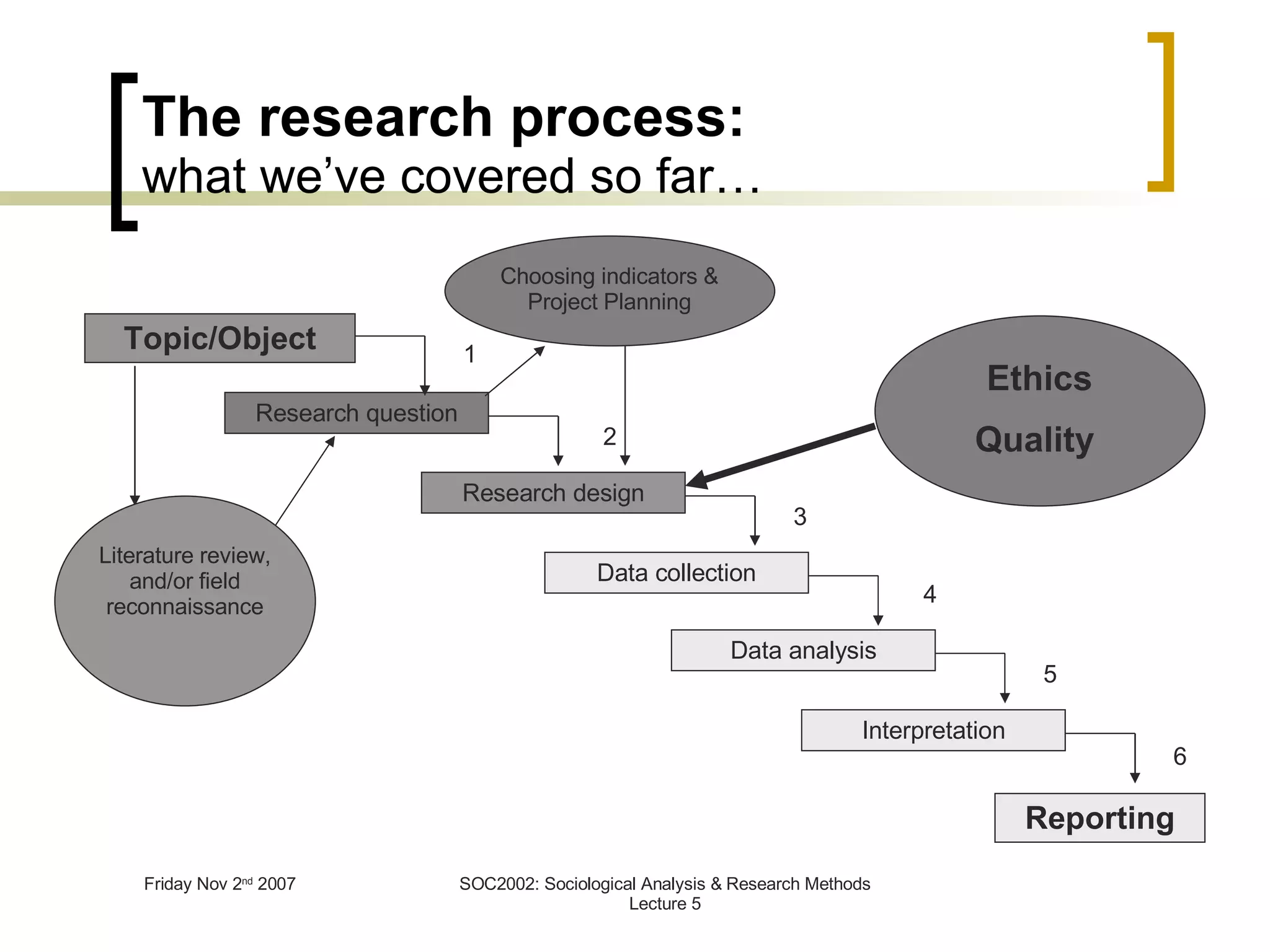
The research process: what we’ve covered so far… Reporting Topic/Object 1 2 3 4 5 6 Research question Research design Data collection Data analysis Interpretation Literature review, and/or field reconnaissance Choosing indicators & Project Planning Ethics Quality
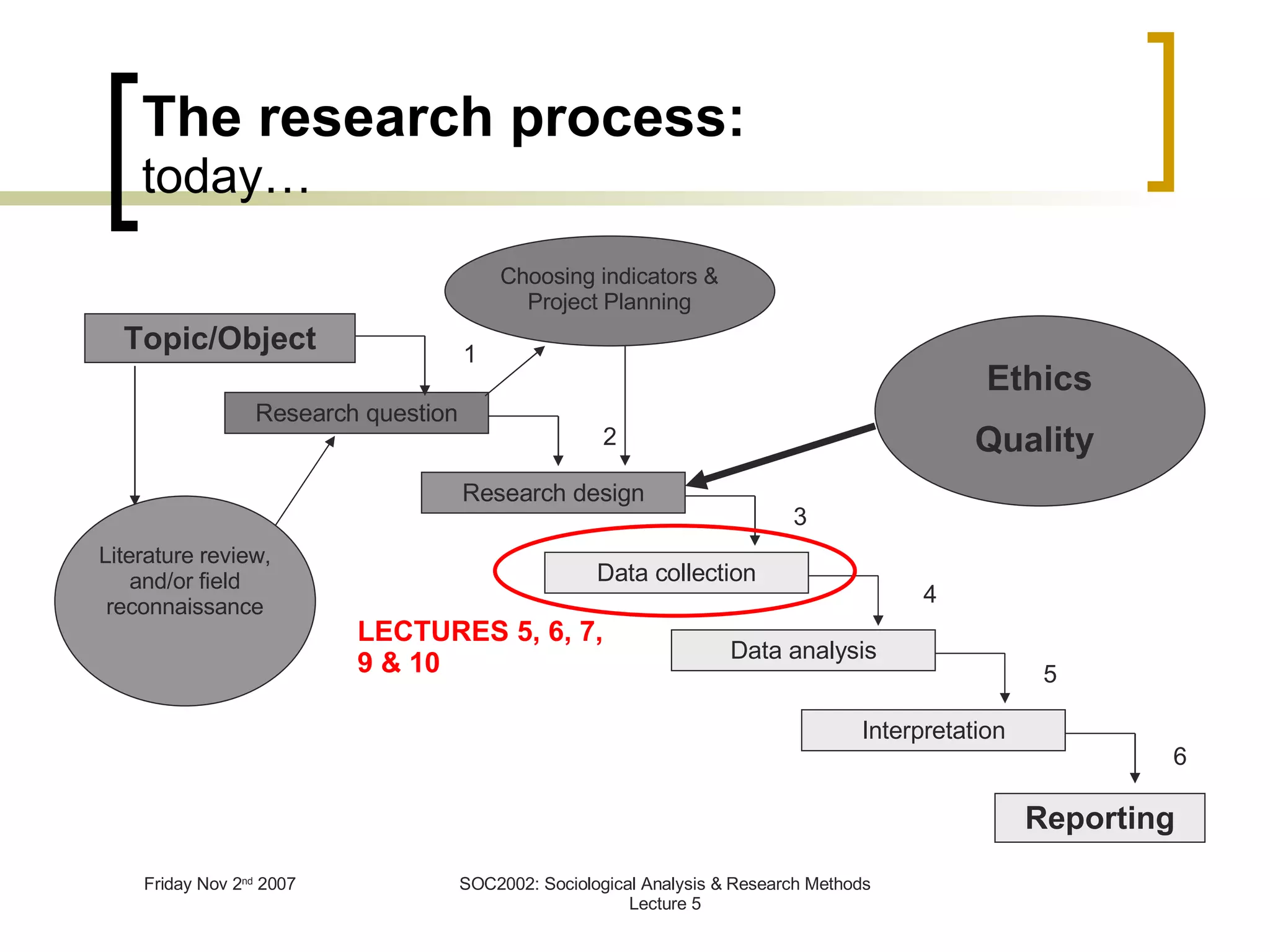
The research process: today… Reporting Topic/Object 1 2 3 4 5 6 LECTURES 5, 6, 7, 9 & 10 Research question Research design Data collection Data analysis Interpretation Literature review, and/or field reconnaissance Choosing indicators & Project Planning Ethics Quality
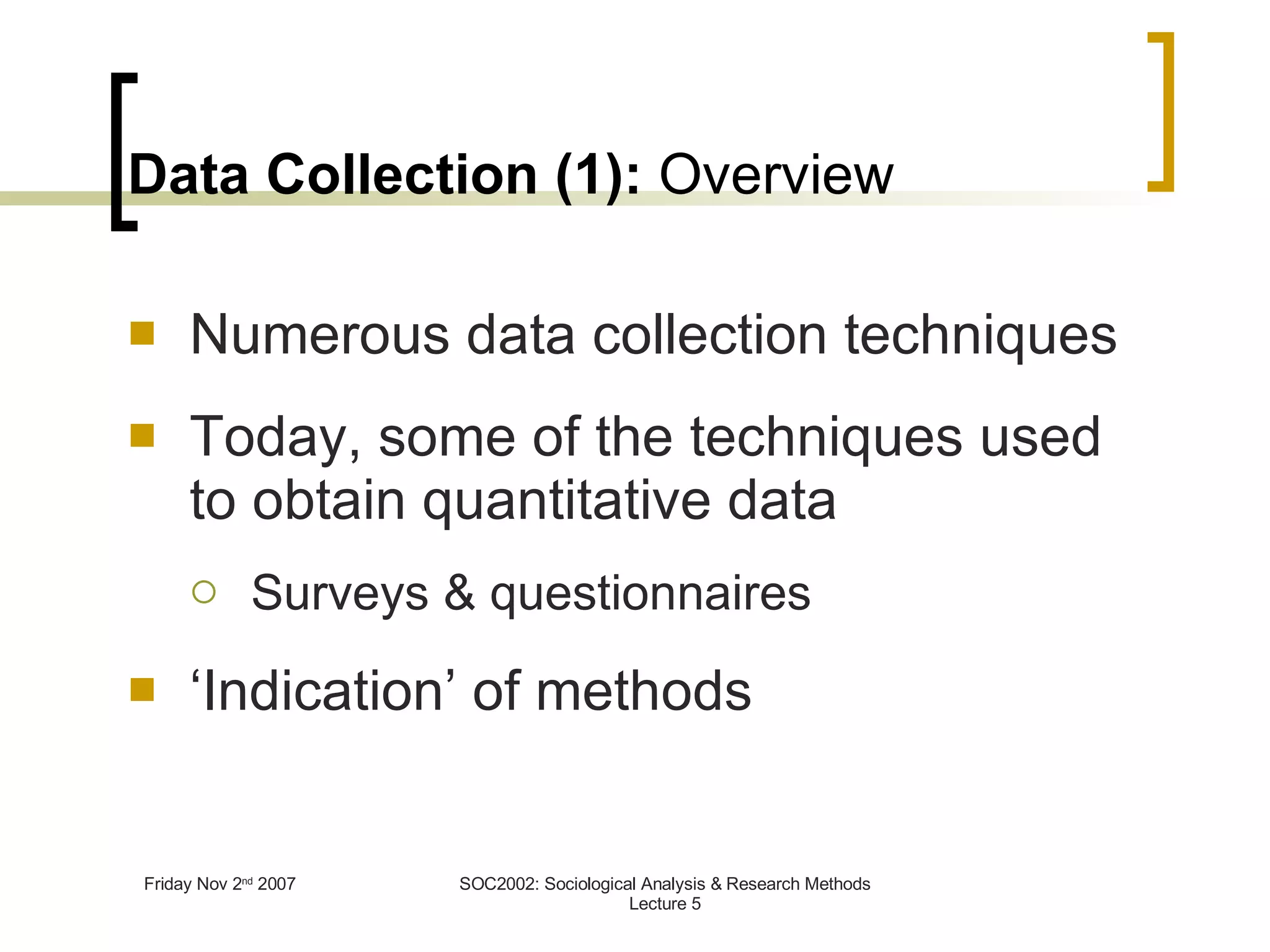
Data Collection (1):  Overview Numerous data collection techniques Today, some of the techniques used to obtain quantitative data Surveys & questionnaires ‘Indication’ of methods
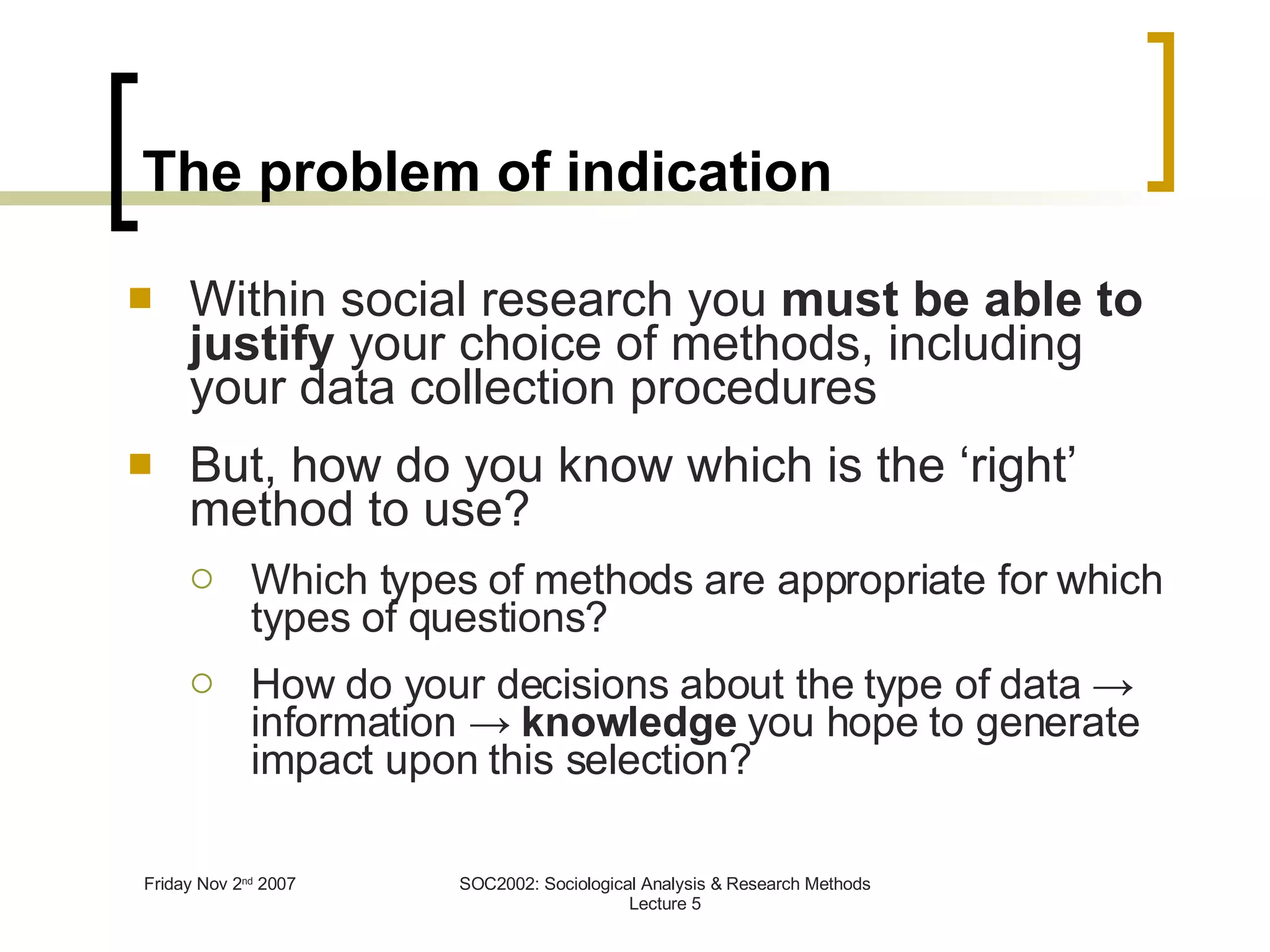
The problem of indication Within social research you  must   be able to justify  your choice of methods, including your data collection procedures But, how do you know which is the ‘right’ method to use? Which types of methods are appropriate for which types of questions? How do your decisions about the type of data -> information ->  knowledge  you hope to generate impact upon this selection?
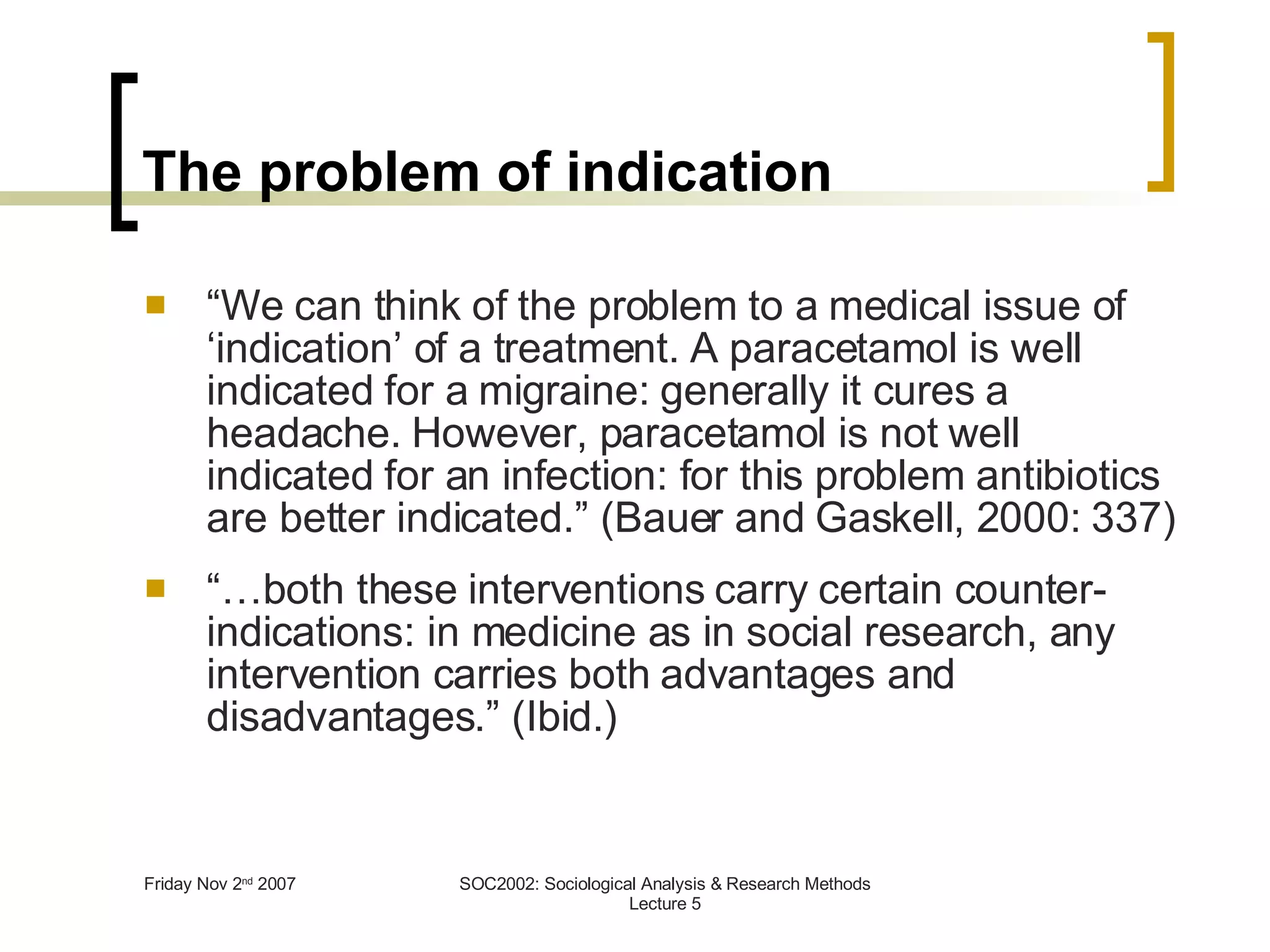
The problem of indication “ We can think of the problem to a medical issue of ‘indication’ of a treatment. A paracetamol is well indicated for a migraine: generally it cures a headache. However, paracetamol is not well indicated for an infection: for this problem antibiotics are better indicated.” (Bauer and Gaskell, 2000: 337) “… both these interventions carry certain counter-indications: in medicine as in social research, any intervention carries both advantages and disadvantages.” (Ibid.)
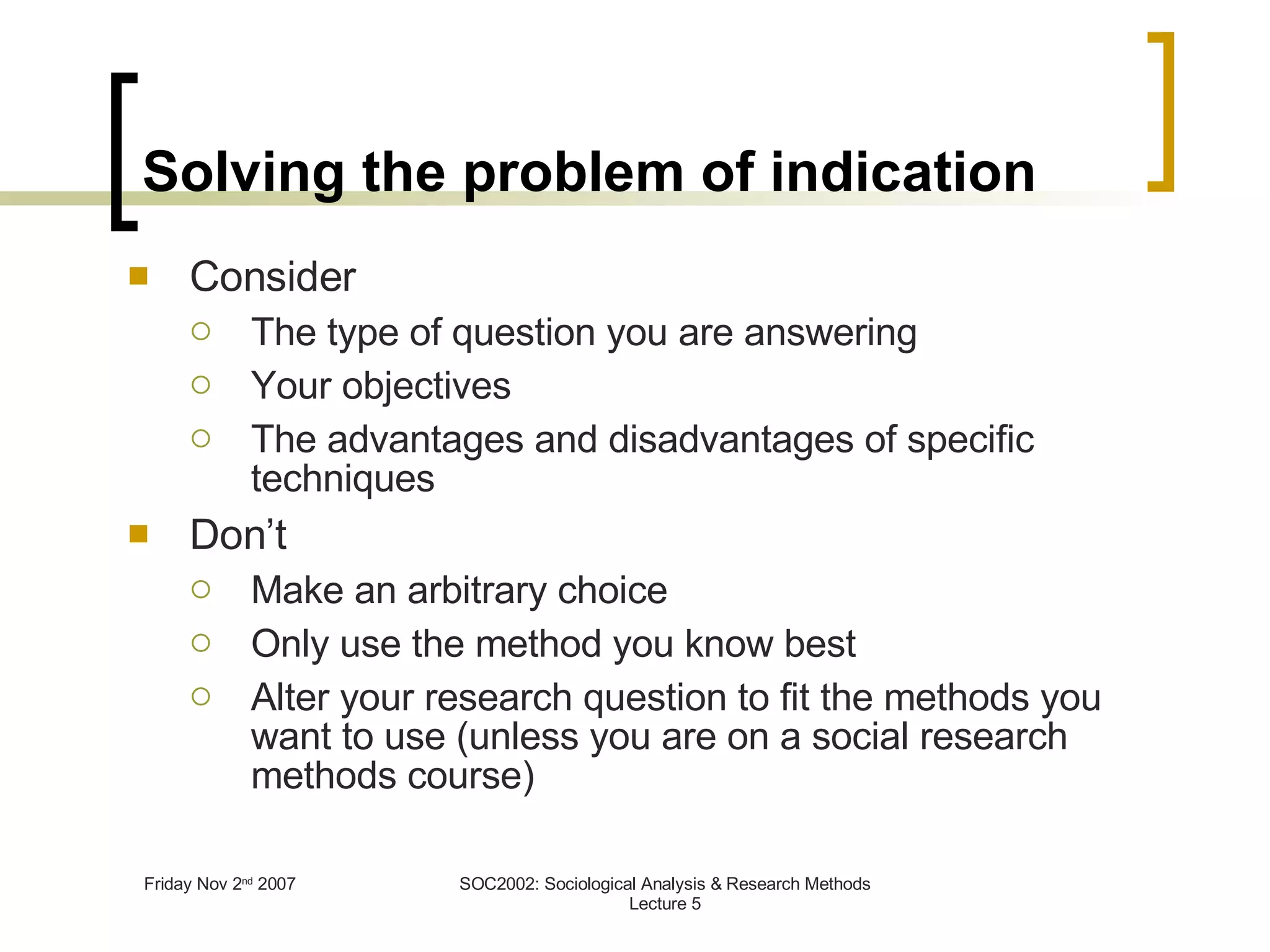
Solving the problem of indication Consider The type of question you are answering Your objectives The advantages and disadvantages of specific techniques Don’t Make an arbitrary choice Only use the method you know best Alter your research question to fit the methods you want to use (unless you are on a social research methods course)
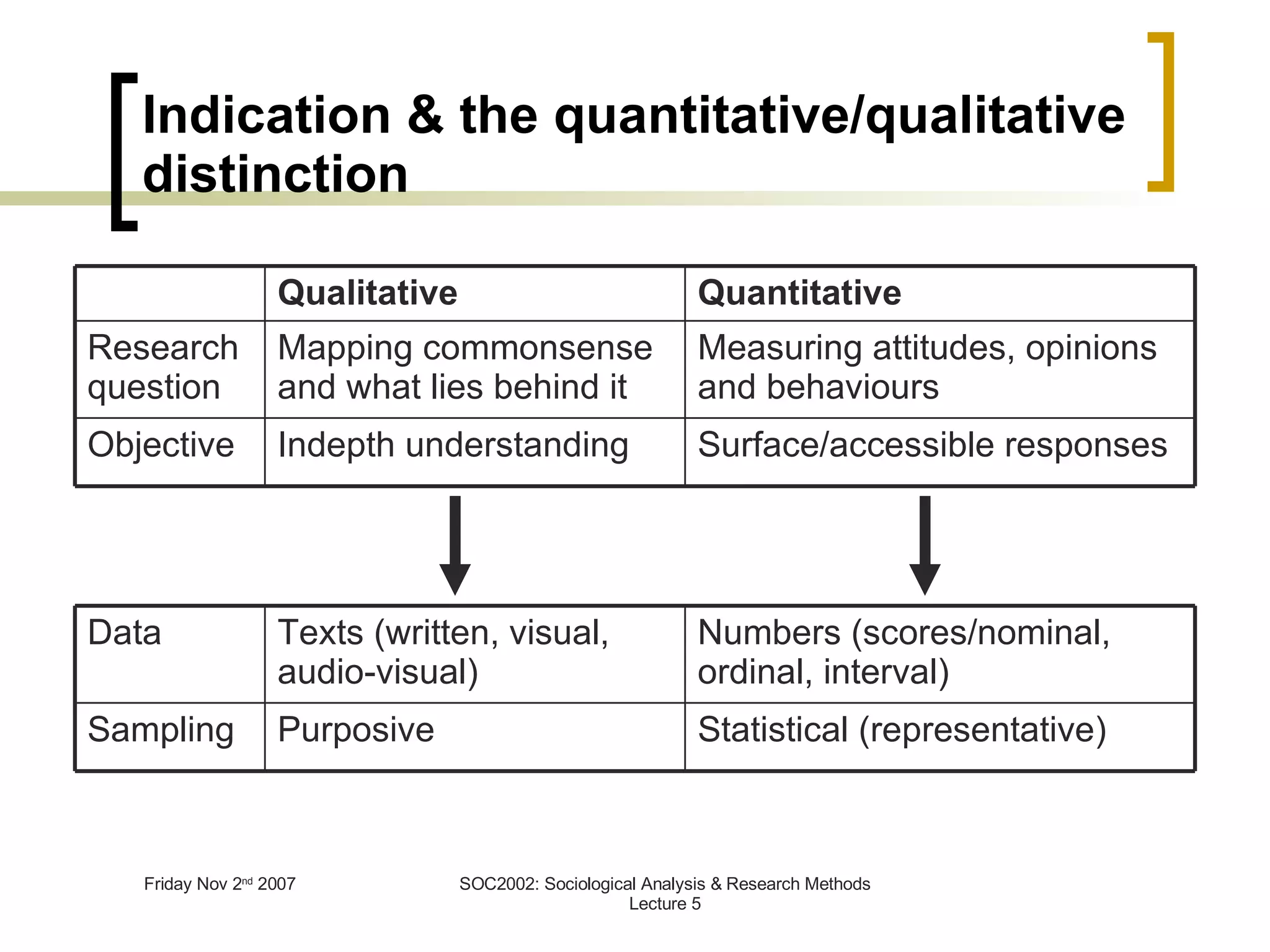
Indication & the quantitative/qualitative distinction Measuring attitudes, opinions and behaviours Mapping commonsense and what lies behind it Research question Surface/accessible responses Indepth understanding Objective Quantitative Qualitative Numbers (scores/nominal, ordinal, interval) Texts (written, visual, audio-visual) Data Statistical (representative) Purposive Sampling
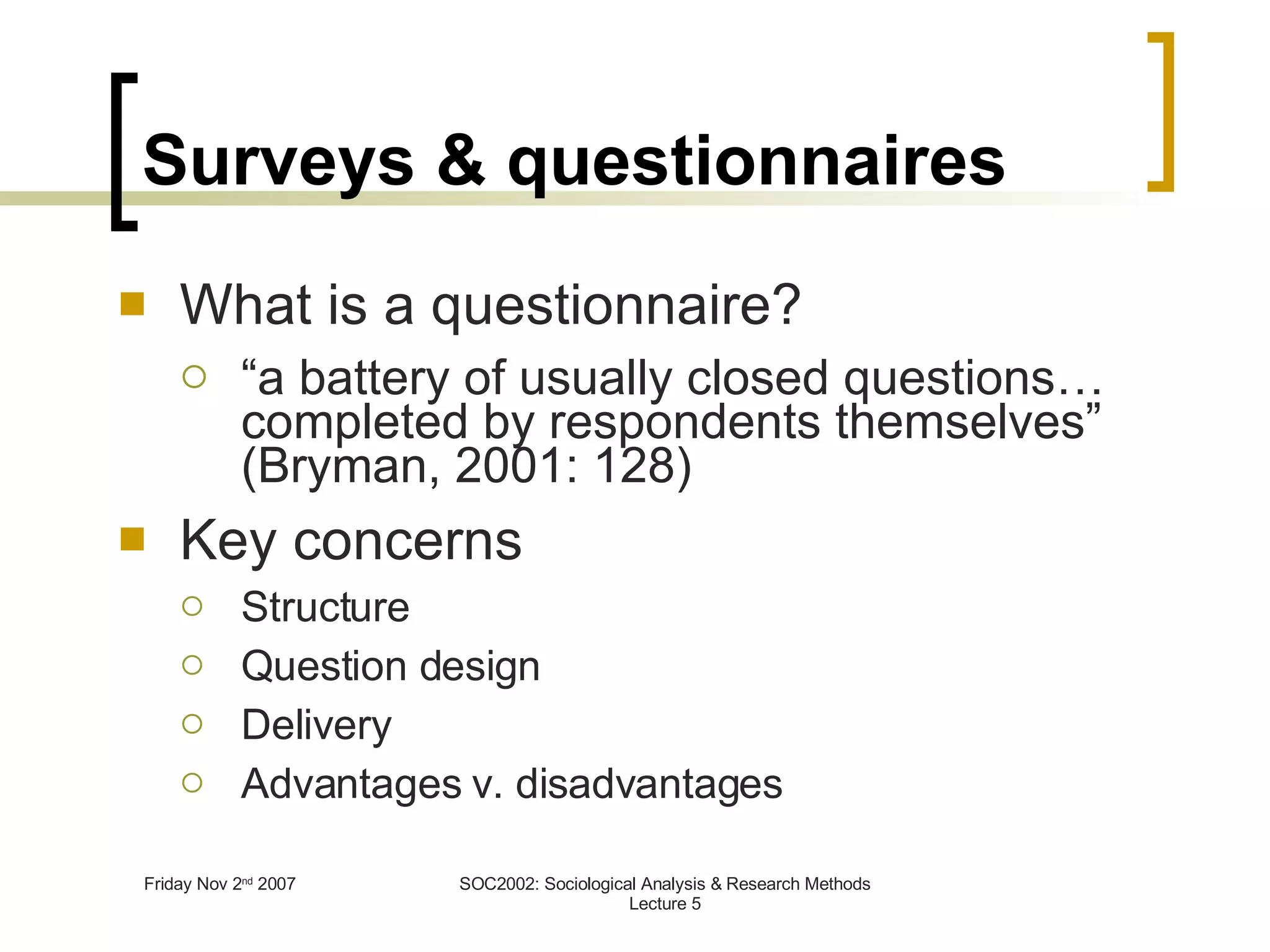
Surveys & questionnaires What is a questionnaire? “ a battery of usually closed questions…completed by respondents themselves” (Bryman, 2001: 128) Key concerns Structure Question design Delivery Advantages v. disadvantages
Surveys & questionnaires: Structure Open v. closed questions Closed questions: respondent is provided with a fixed and specified choice of possible answers and they must select the ones that apply Open questions: respondent is given the freedom to answer in their own words In general Survey questionnaires use closed questions Rarely all open questions A combination of both may be optimal?
Surveys & questionnaires: Structure Closed questions Advantages Easy to process answers Easy to compare answers for different respondents Fixed answers may clarify questions Easy to complete Reduce variability between researchers Disadvantages Loss of spontaneity Fixed choice answers can be difficult Difficult to make categories exhaustive  -> the importance of  piloting Cannot assume the same interpretation
Surveys & questionnaires: Structure Open questions Advantages Respondents answer in their own terms Allow for unusual – or  surprising  – answers  Allows for interpretation of question by respondent Exploratory Disadvantages Time consuming to administer Time consuming to process Respondents have to make more effort Increased possibility for variation between researchers
Surveys & questionnaires: Structure Overall Layout Length? Short questionnaires look quicker to do Well spaced and laid out questionnaires look more “attractive” (Dillman, 1993 In Bryman, 2001: 133) Consistent and clear presentation Use of font, line spacing, clear question/answer pairs
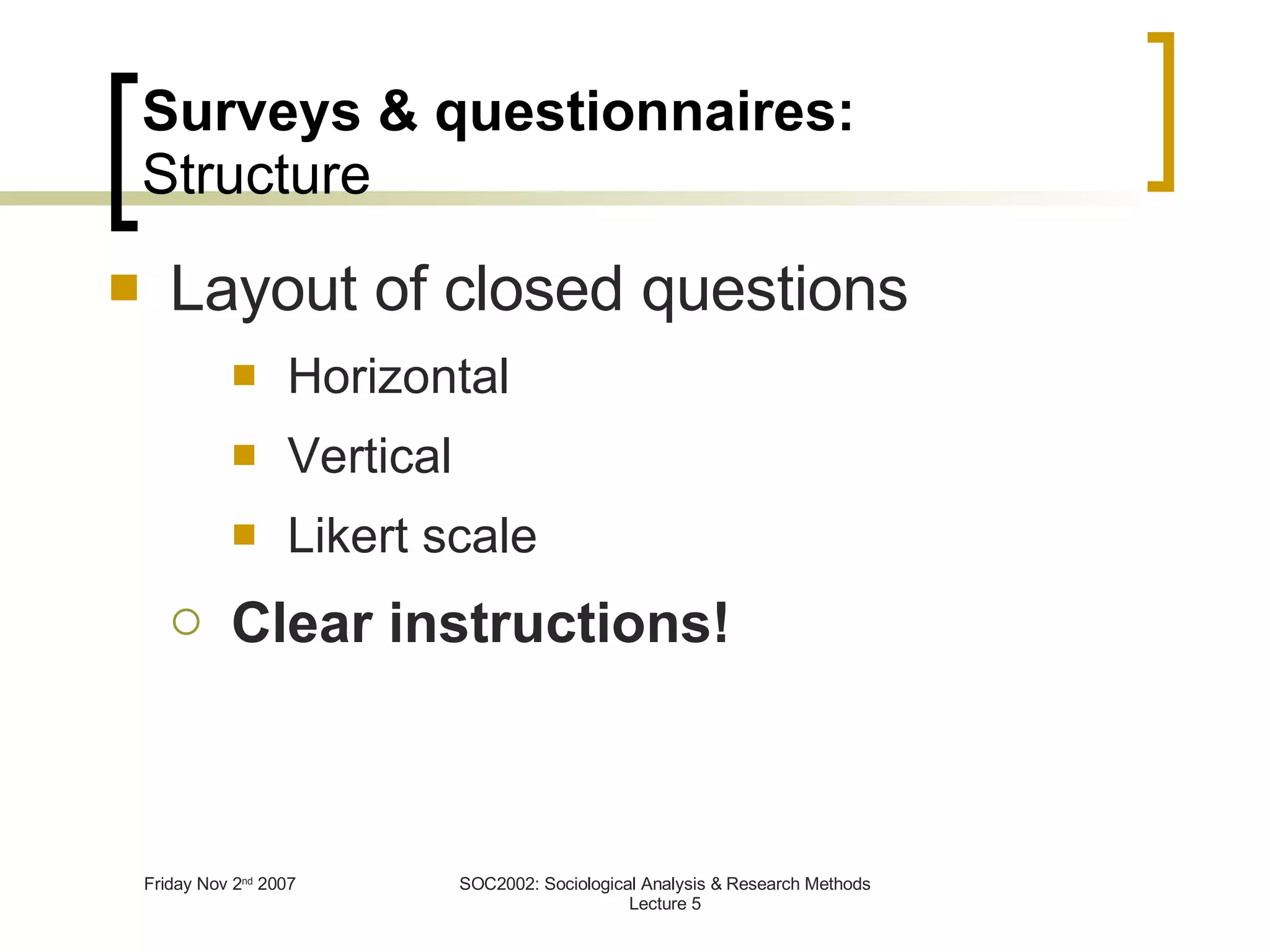
Surveys & questionnaires: Structure Layout of closed questions Horizontal Vertical Likert scale Clear instructions!
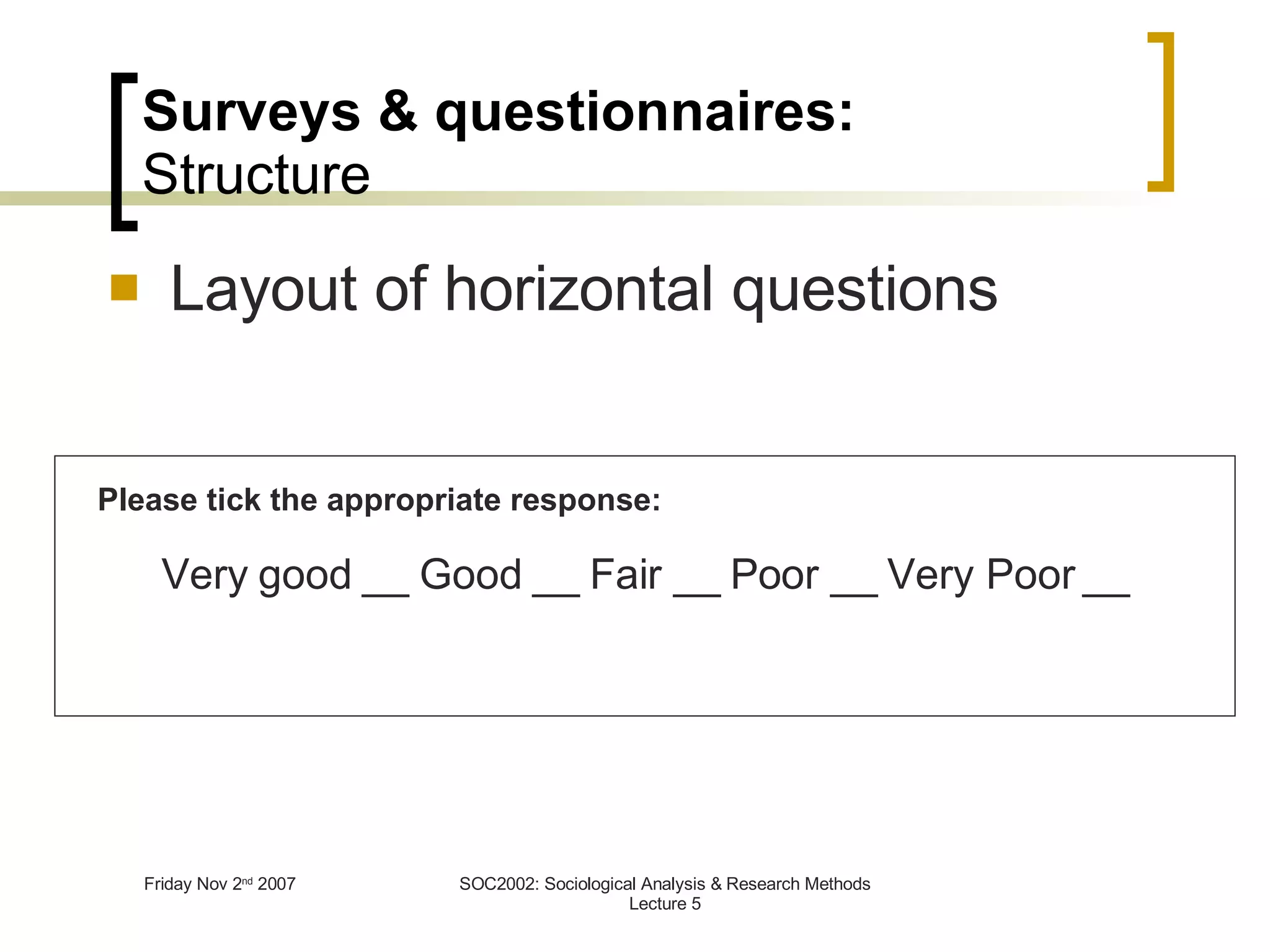
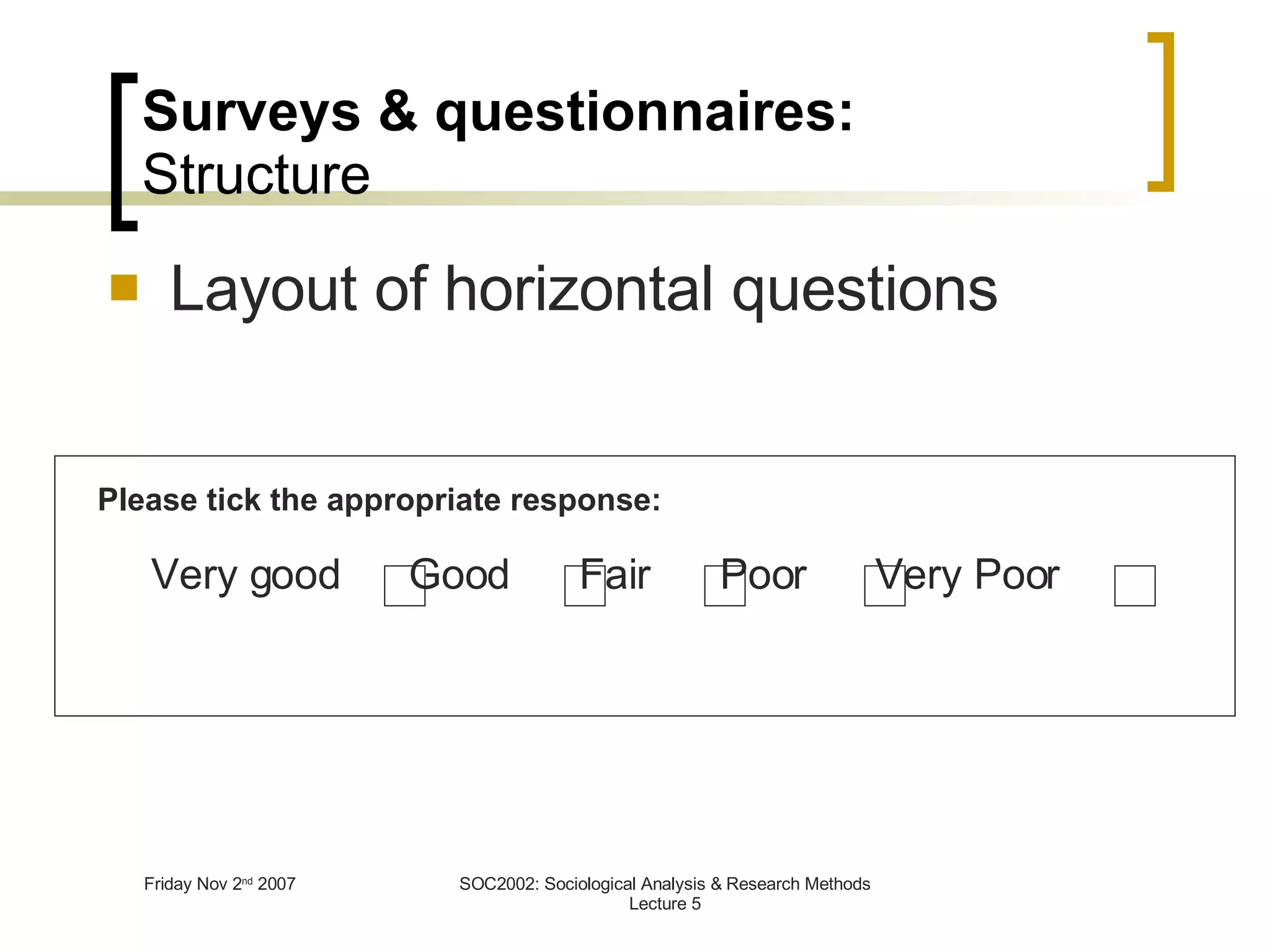
Surveys & questionnaires: Structure Layout of horizontal questions Very good __ Good __ Fair __ Poor __ Very Poor __ Please tick the appropriate response:
Layout of horizontal questions Very good  Good  Fair  Poor  Very Poor  Surveys & questionnaires: Structure Please tick the appropriate response:
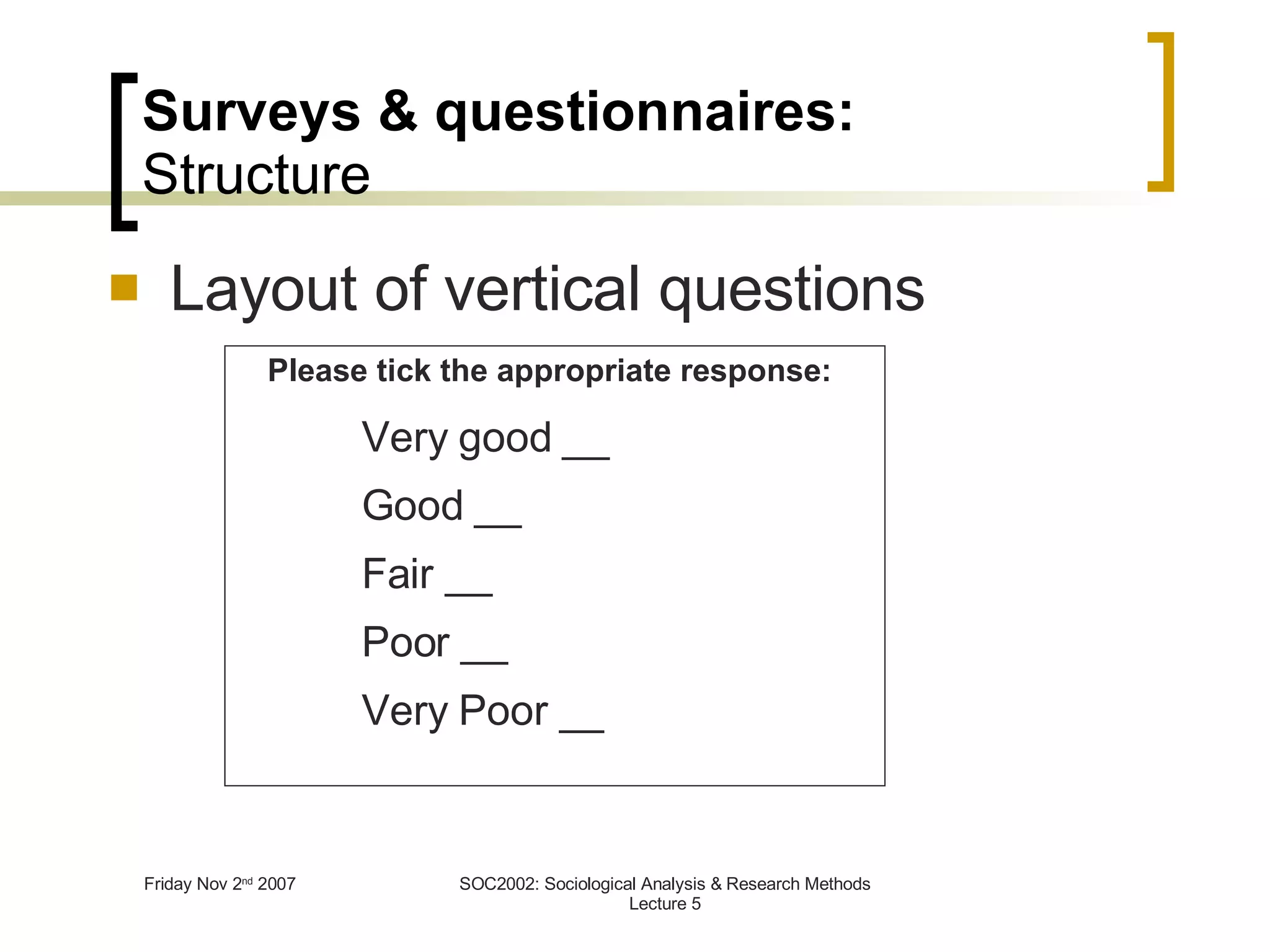
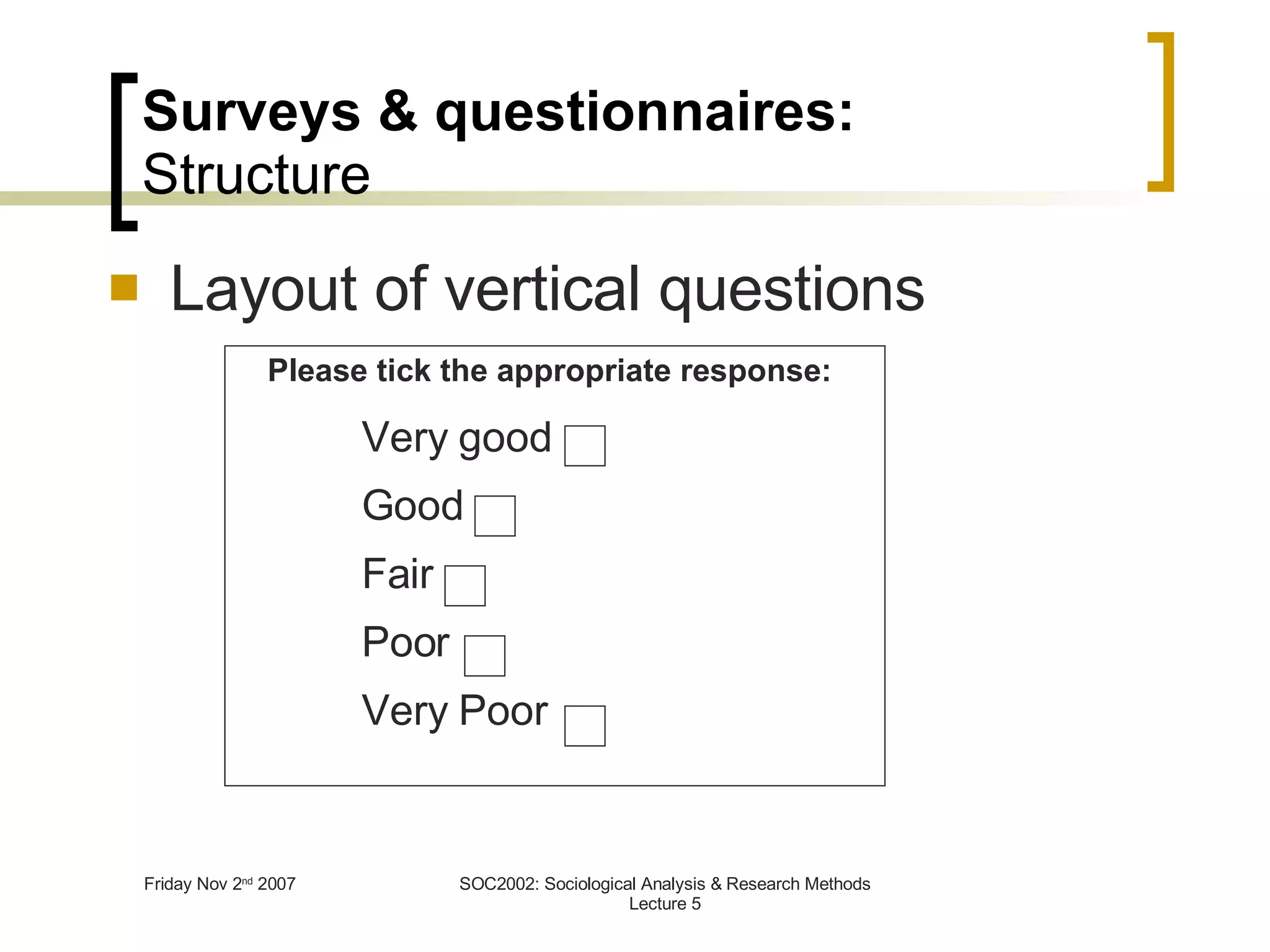
Surveys & questionnaires: Structure Layout of vertical questions Very good __ Good __ Fair __ Poor __ Very Poor __ Please tick the appropriate response:
Surveys & questionnaires: Structure Layout of vertical questions Very good Good Fair Poor Very Poor Please tick the appropriate response:
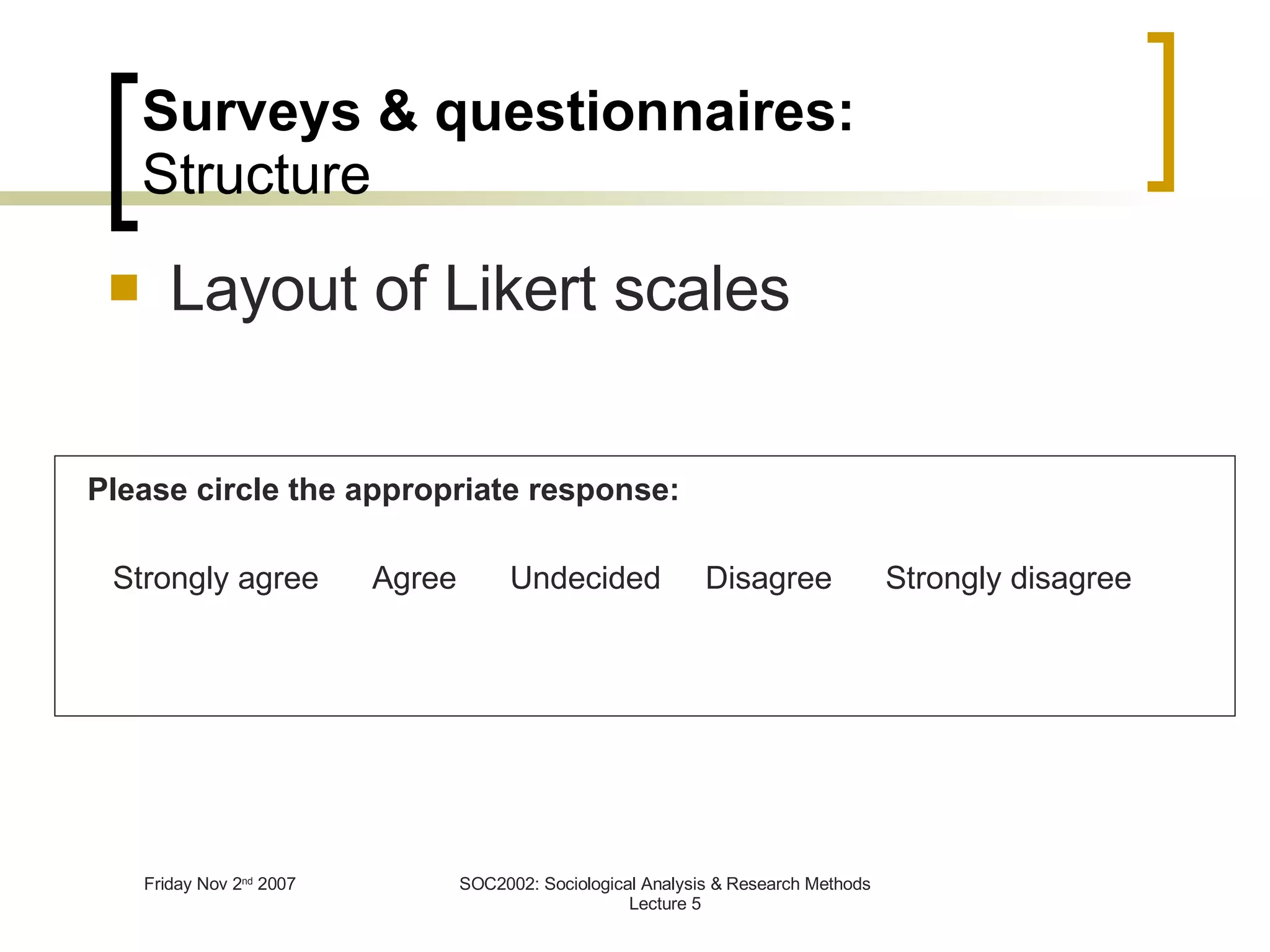
Layout of Likert scales Strongly agree  Agree  Undecided  Disagree  Strongly disagree   Surveys & questionnaires: Structure Please circle the appropriate response:
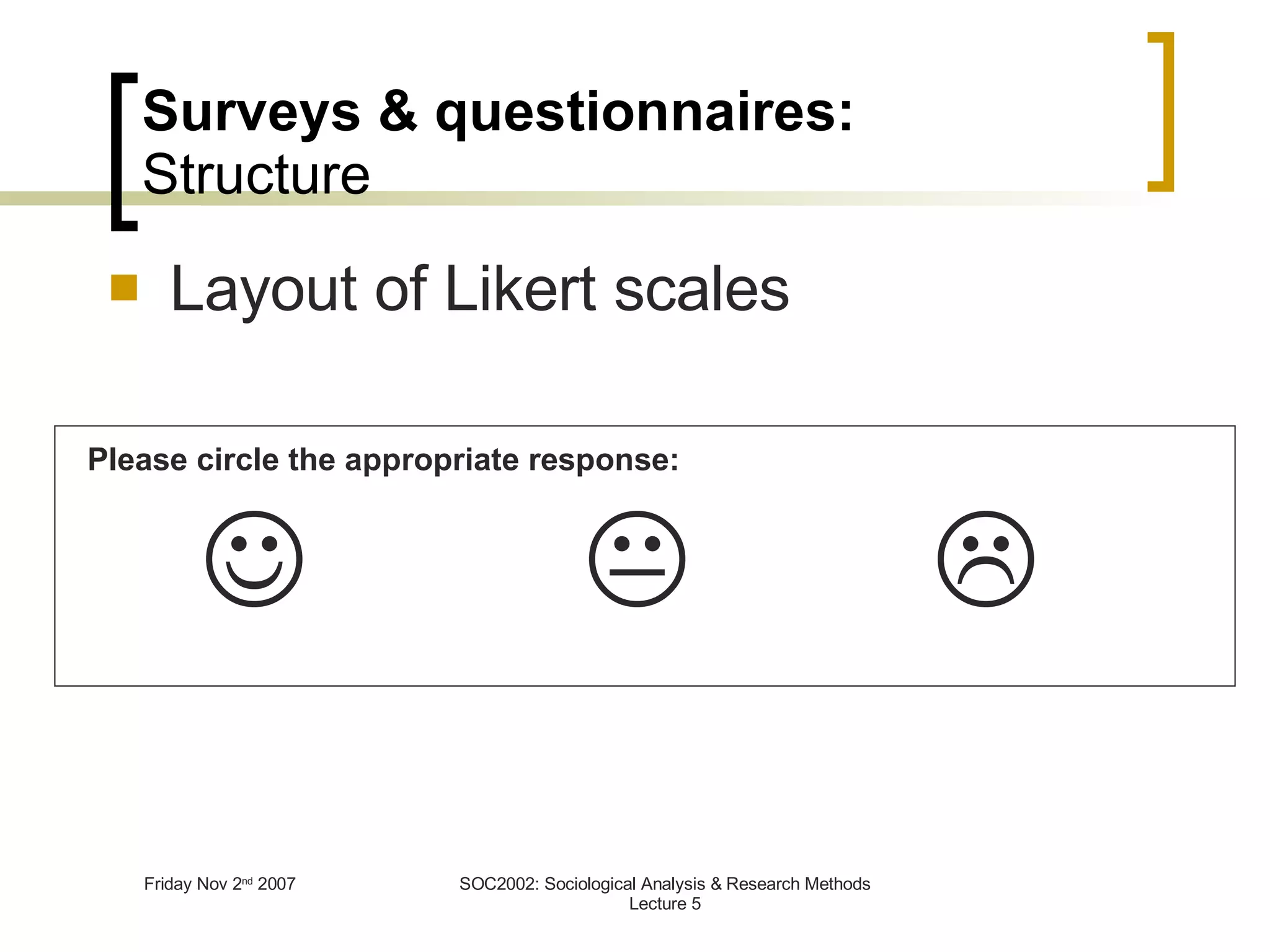
Layout of Likert scales          Surveys & questionnaires: Structure Please circle the appropriate response:
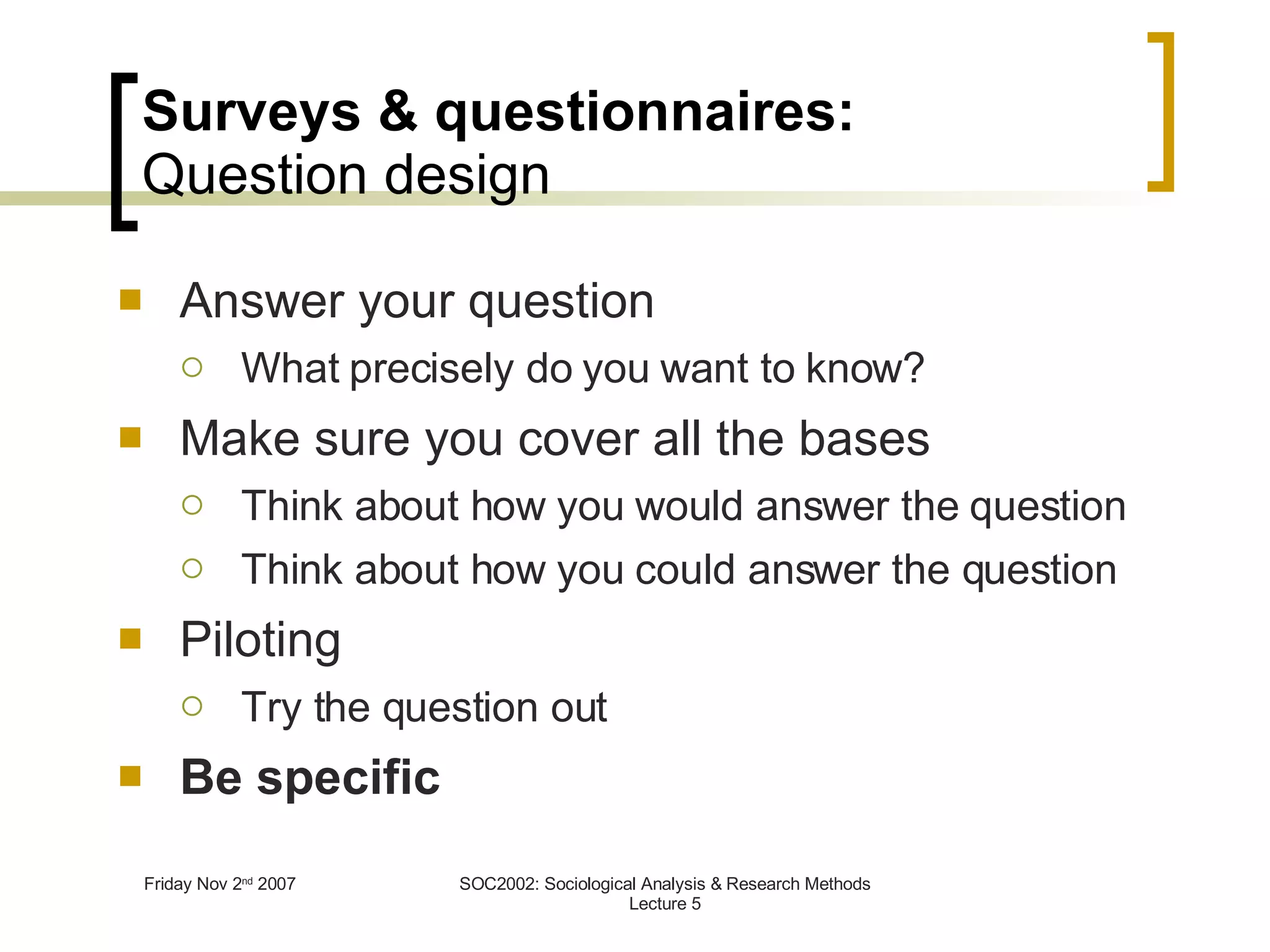
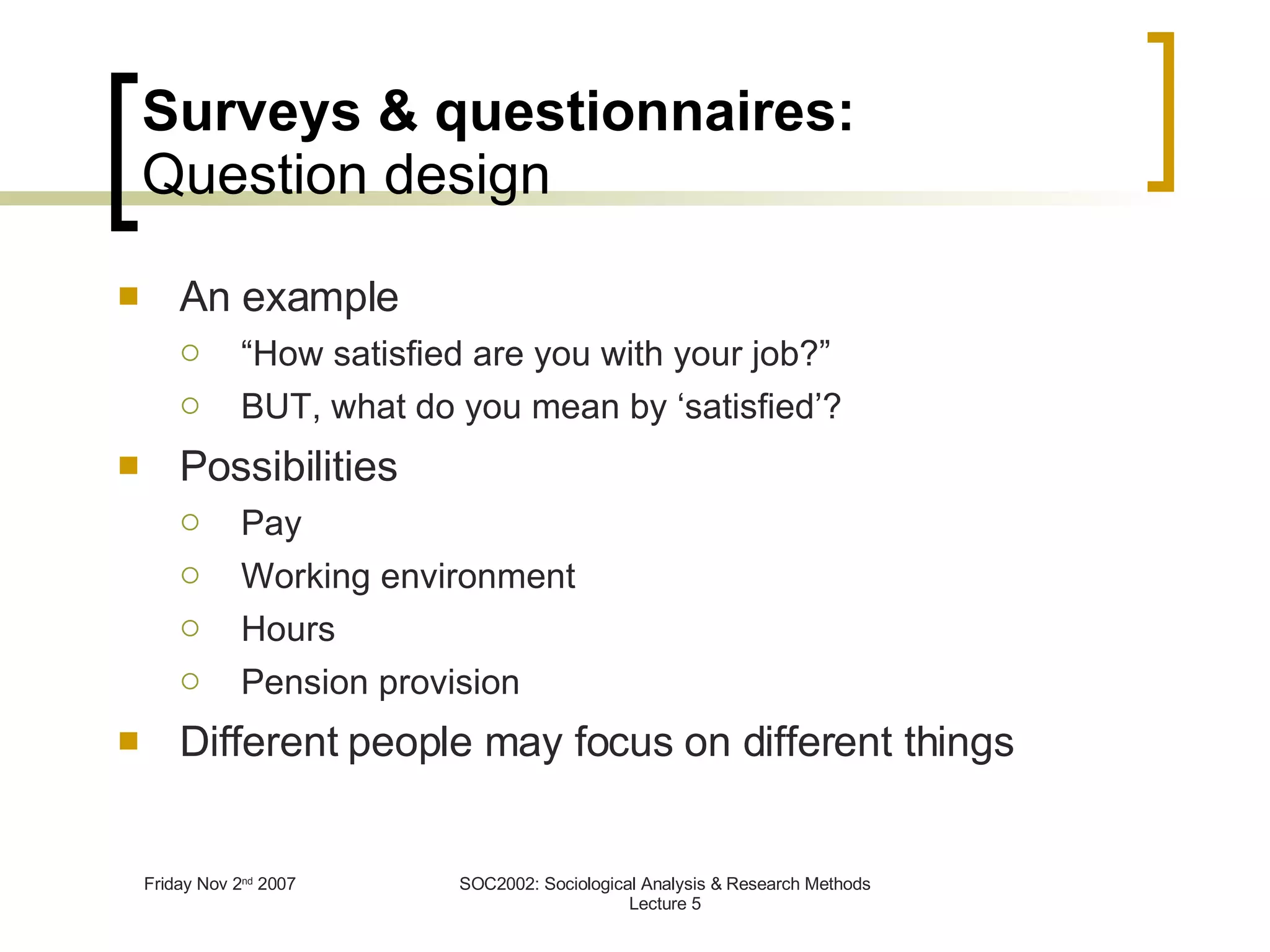
Surveys & questionnaires: Question design Answer your question What precisely do you want to know? Make sure you cover all the bases Think about how you would answer the question Think about how you could answer the question Piloting Try the question out Be specific
Surveys & questionnaires: Question design An example “ How satisfied are you with your job?” BUT, what do you mean by ‘satisfied’? Possibilities Pay Working environment Hours  Pension provision Different people may focus on different things
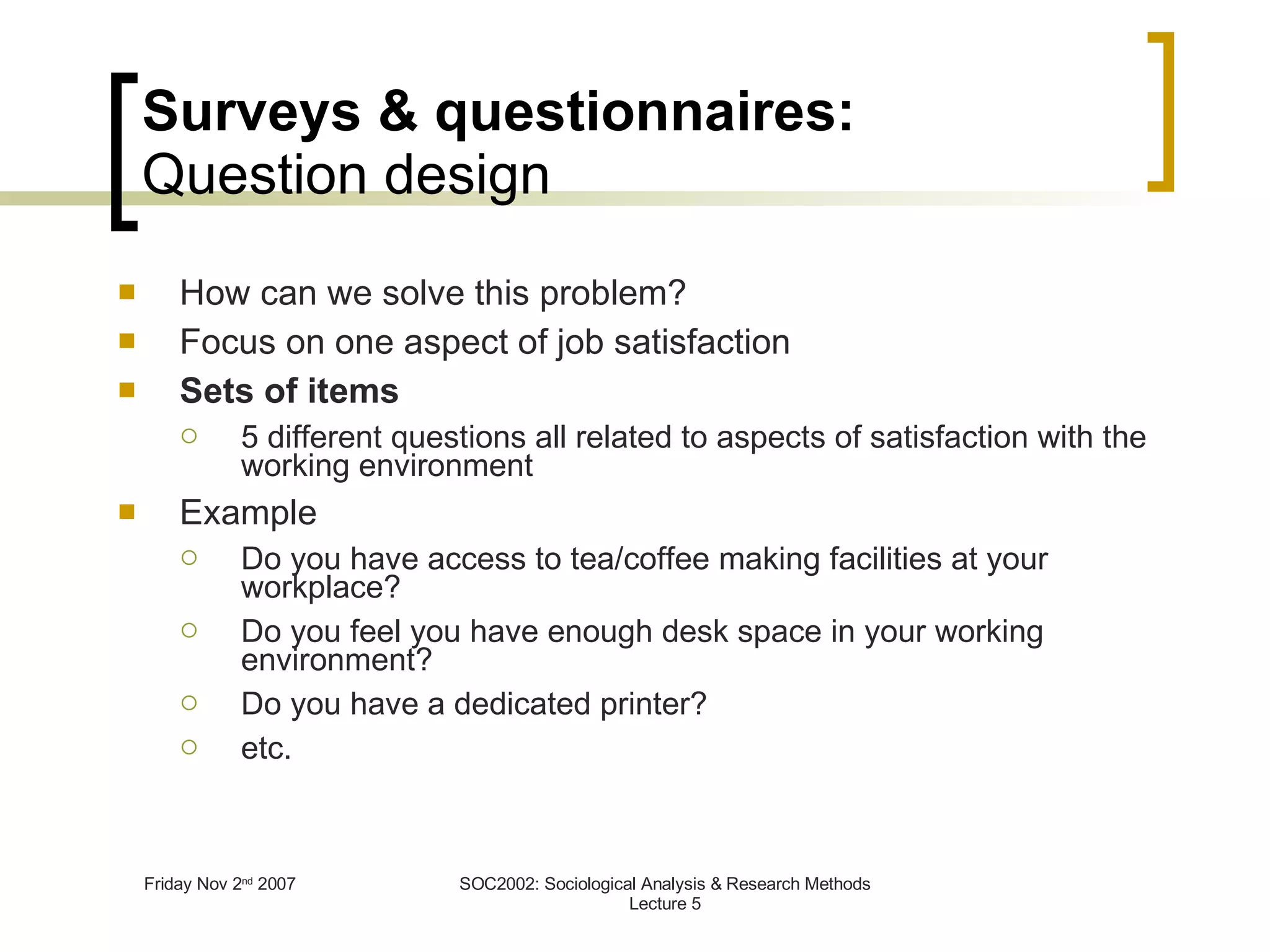
Surveys & questionnaires: Question design How can we solve this problem? Focus on one aspect of job satisfaction Sets of items 5 different questions all related to aspects of satisfaction with the working environment Example Do you have access to tea/coffee making facilities at your workplace? Do you feel you have enough desk space in your working environment? Do you have a dedicated printer? etc.
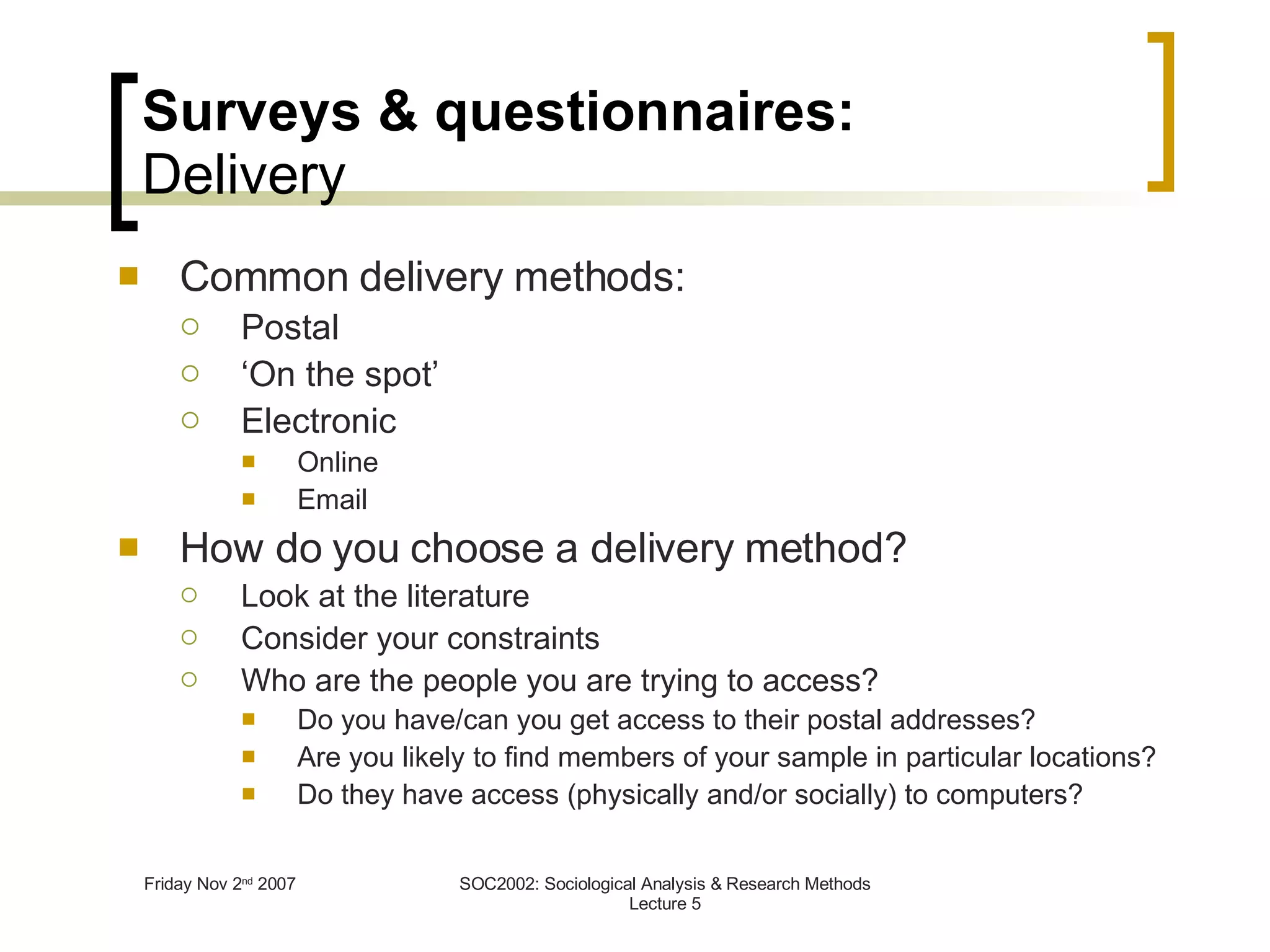
Surveys & questionnaires: Delivery Common delivery methods: Postal ‘ On the spot’ Electronic Online Email How do you choose a delivery method? Look at the literature Consider your constraints Who are the people you are trying to access? Do you have/can you get access to their postal addresses? Are you likely to find members of your sample in particular locations? Do they have access (physically and/or socially) to computers?
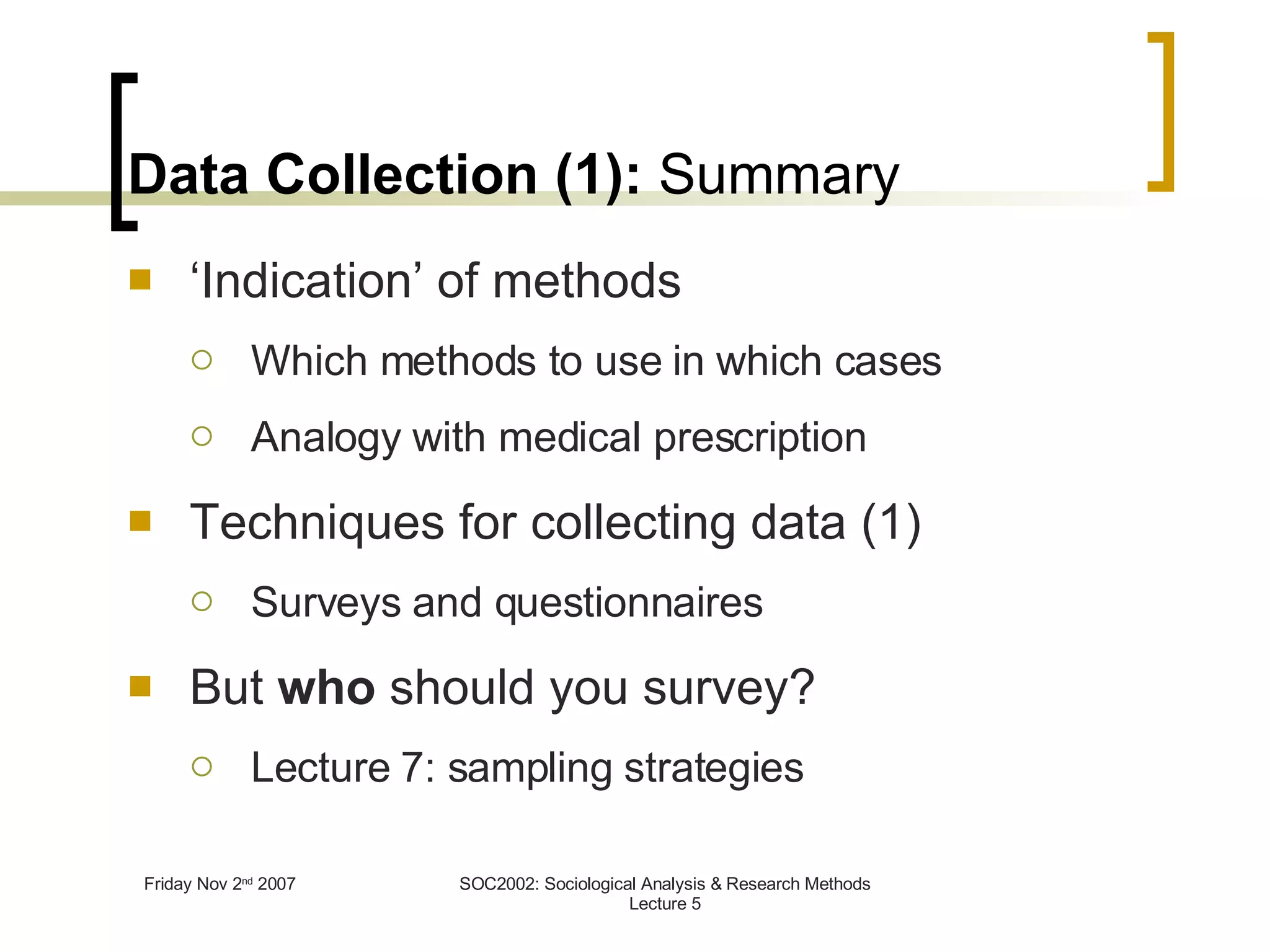
Data Collection (1):  Summary ‘ Indication’ of methods Which methods to use in which cases Analogy with medical prescription Techniques for collecting data (1) Surveys and questionnaires But  who  should you survey? Lecture 7: sampling strategies

SOC2002 Lecture 5

  • 1.
    SOC2002: Sociological Analysisand Research Methods LECTURE 5: Data Collection (1) Surveys and questionnaires Lecturer: Bonnie Green [email_address]
  • 2.
    The research process:what we’ve covered so far… Reporting Topic/Object 1 2 3 4 5 6 Research question Research design Data collection Data analysis Interpretation Literature review, and/or field reconnaissance Choosing indicators & Project Planning Ethics Quality
  • 3.
    The research process:today… Reporting Topic/Object 1 2 3 4 5 6 LECTURES 5, 6, 7, 9 & 10 Research question Research design Data collection Data analysis Interpretation Literature review, and/or field reconnaissance Choosing indicators & Project Planning Ethics Quality
  • 4.
    Data Collection (1): Overview Numerous data collection techniques Today, some of the techniques used to obtain quantitative data Surveys & questionnaires ‘Indication’ of methods
  • 5.
    The problem ofindication Within social research you must be able to justify your choice of methods, including your data collection procedures But, how do you know which is the ‘right’ method to use? Which types of methods are appropriate for which types of questions? How do your decisions about the type of data -> information -> knowledge you hope to generate impact upon this selection?
  • 6.
    The problem ofindication “ We can think of the problem to a medical issue of ‘indication’ of a treatment. A paracetamol is well indicated for a migraine: generally it cures a headache. However, paracetamol is not well indicated for an infection: for this problem antibiotics are better indicated.” (Bauer and Gaskell, 2000: 337) “… both these interventions carry certain counter-indications: in medicine as in social research, any intervention carries both advantages and disadvantages.” (Ibid.)
  • 7.
    Solving the problemof indication Consider The type of question you are answering Your objectives The advantages and disadvantages of specific techniques Don’t Make an arbitrary choice Only use the method you know best Alter your research question to fit the methods you want to use (unless you are on a social research methods course)
  • 8.
    Indication & thequantitative/qualitative distinction Measuring attitudes, opinions and behaviours Mapping commonsense and what lies behind it Research question Surface/accessible responses Indepth understanding Objective Quantitative Qualitative Numbers (scores/nominal, ordinal, interval) Texts (written, visual, audio-visual) Data Statistical (representative) Purposive Sampling
  • 9.
    Surveys & questionnairesWhat is a questionnaire? “ a battery of usually closed questions…completed by respondents themselves” (Bryman, 2001: 128) Key concerns Structure Question design Delivery Advantages v. disadvantages
  • 10.
    Surveys & questionnaires:Structure Open v. closed questions Closed questions: respondent is provided with a fixed and specified choice of possible answers and they must select the ones that apply Open questions: respondent is given the freedom to answer in their own words In general Survey questionnaires use closed questions Rarely all open questions A combination of both may be optimal?
  • 11.
    Surveys & questionnaires:Structure Closed questions Advantages Easy to process answers Easy to compare answers for different respondents Fixed answers may clarify questions Easy to complete Reduce variability between researchers Disadvantages Loss of spontaneity Fixed choice answers can be difficult Difficult to make categories exhaustive -> the importance of piloting Cannot assume the same interpretation
  • 12.
    Surveys & questionnaires:Structure Open questions Advantages Respondents answer in their own terms Allow for unusual – or surprising – answers Allows for interpretation of question by respondent Exploratory Disadvantages Time consuming to administer Time consuming to process Respondents have to make more effort Increased possibility for variation between researchers
  • 13.
    Surveys & questionnaires:Structure Overall Layout Length? Short questionnaires look quicker to do Well spaced and laid out questionnaires look more “attractive” (Dillman, 1993 In Bryman, 2001: 133) Consistent and clear presentation Use of font, line spacing, clear question/answer pairs
  • 14.
    Surveys & questionnaires:Structure Layout of closed questions Horizontal Vertical Likert scale Clear instructions!
  • 15.
    Surveys & questionnaires:Structure Layout of horizontal questions Very good __ Good __ Fair __ Poor __ Very Poor __ Please tick the appropriate response:
  • 16.
    Layout of horizontalquestions Very good Good Fair Poor Very Poor Surveys & questionnaires: Structure Please tick the appropriate response:
  • 17.
    Surveys & questionnaires:Structure Layout of vertical questions Very good __ Good __ Fair __ Poor __ Very Poor __ Please tick the appropriate response:
  • 18.
    Surveys & questionnaires:Structure Layout of vertical questions Very good Good Fair Poor Very Poor Please tick the appropriate response:
  • 19.
    Layout of Likertscales Strongly agree Agree Undecided Disagree Strongly disagree Surveys & questionnaires: Structure Please circle the appropriate response:
  • 20.
    Layout of Likertscales    Surveys & questionnaires: Structure Please circle the appropriate response:
  • 21.
    Surveys & questionnaires:Question design Answer your question What precisely do you want to know? Make sure you cover all the bases Think about how you would answer the question Think about how you could answer the question Piloting Try the question out Be specific
  • 22.
    Surveys & questionnaires:Question design An example “ How satisfied are you with your job?” BUT, what do you mean by ‘satisfied’? Possibilities Pay Working environment Hours Pension provision Different people may focus on different things
  • 23.
    Surveys & questionnaires:Question design How can we solve this problem? Focus on one aspect of job satisfaction Sets of items 5 different questions all related to aspects of satisfaction with the working environment Example Do you have access to tea/coffee making facilities at your workplace? Do you feel you have enough desk space in your working environment? Do you have a dedicated printer? etc.
  • 24.
    Surveys & questionnaires:Delivery Common delivery methods: Postal ‘ On the spot’ Electronic Online Email How do you choose a delivery method? Look at the literature Consider your constraints Who are the people you are trying to access? Do you have/can you get access to their postal addresses? Are you likely to find members of your sample in particular locations? Do they have access (physically and/or socially) to computers?
  • 25.
    Data Collection (1): Summary ‘ Indication’ of methods Which methods to use in which cases Analogy with medical prescription Techniques for collecting data (1) Surveys and questionnaires But who should you survey? Lecture 7: sampling strategies