Survey Design Workshop Inter-University Research Workshop Program Dr. James Neill Centre for Applied Psychology University of Canberra 1 February, 2011
Outline Objectives
Introductions
Logins & Resources
Research methods
Questionnaire design
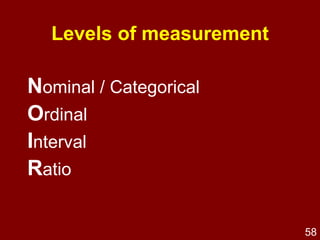
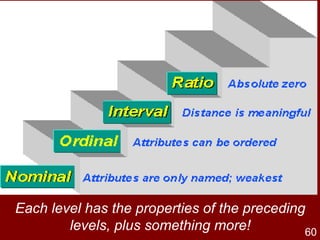
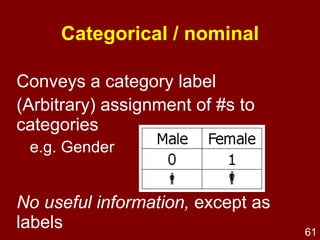
Levels of measurement
Sampling
Evaluation
Objective 1 Understand the importance of a  rigorous , step-by-step process in planning, developing & implementing  research questionnaires
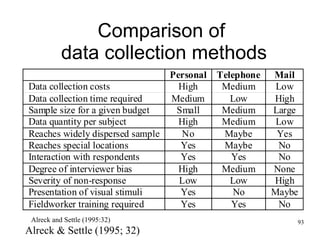
Objective 2 Consider the pros and cons of  common methods for survey administration Face-to-face interview
Telephone survey
Mail survey
Internet/mobile survey
Objective 3 Examine nuts & bolts of  questionnaire design  e.g., Question style,
Response formats,
Layout, and
Pre- and pilot testing
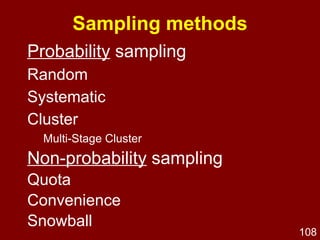
Objective 4 Consider  implementation issues   Sampling methods
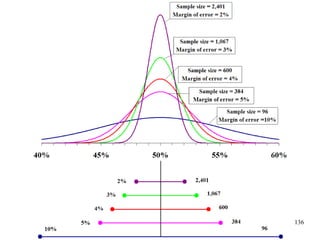
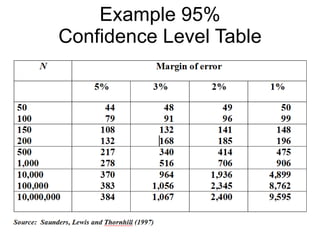
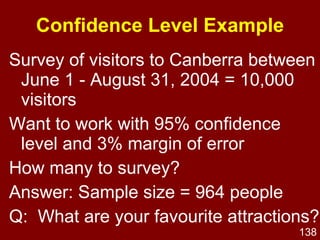
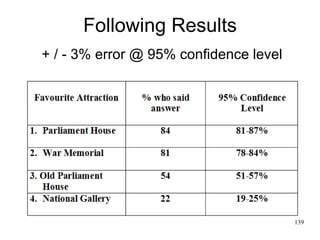
Sample size
Objective 5 Critically review   example surveys. Existing examples
Student in-progress examples with a view towards planning, drafting, and/or revising of an initial draft (pilot) survey.
Resources Survey Design Workshop Notes  (Wikiversity)
Readings
Books about surveys design and survey research (check library)
Introductions Introductions
Types of Research ( Research Methods ) There are 3 main research methods: Experimental
Quasi-experimental
Non-experimental
Types of Research -  Experimental Characterised by: Random assignment
Control over extraneous variables
Types of Research - Quasi-experimental Characterised by: Non-random assignment
Control over some extraneous variables
Groups are “naturally occuring”
Types of Research - Non-experimental Characterised by: No “groups” or “conditions” are created or used  (i.e., no full experimental or quasi-experimental groups)
Minimal control over extraneous variables
Survey Research Characteristics Surveys are widely used in  non-experimental   social science research.
Often use  interviews  or  questionnaires .
Involve real-world  samples .
Often  quantitative , but can be  qualitative .
History of Survey Research Survey research methodology  was initially developed in the 1940's – 1960's.
Since the 1980's, theories and principles evolved to create a unified perspective on the design, conduct, and evaluation of surveys.
8 Survey Research Characteristics Backstrom & Hursh-C é sar (1981, pp. 3-4) Systematic :  follows a specific set of rules, a formal and orderly logic of operations
Impartial :  selects units of the population without prejudice or preference
Representative :  includes units that together are representative of the problem under study and the population affected by it
Theory-based :  operations are guided by relevant principles of human behaviour and by mathematical laws of probability (chance).
Quantitative :  assigns numerical values to nonnumerical character
Self-monitoring :  procedures can be designed in ways that reveal any unplanned and unwanted distortions (biases) that may occur 8 Survey Research Characteristics Backstrom & Hursh-C é sar (1981, pp. 3-4)
Contemporary :  it is current, more than historical, fact-finding
Replicable :  other people using the same methods in the same ways can get essentially the same results 8 Survey Research Characteristics Backstrom & Hursh-C é sar (1981, pp. 3-4)
Advantages of  Survey-Based Research Ecological validity
Access to wide range of participants
Potentially large amounts of data
May be more ethical  (than experiments)
Disadvantages of  Survey-Based Research Lack of control  -> less internal validity
Data may be 'superficial'
Can be costly to obtain representative data
Self-report data only
Potentially low compliance rates
Example Surveys Unit Satisfaction Survey Community Library Use
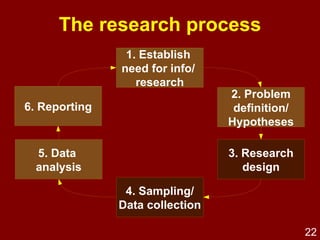
The research process 1. Establish  need for info/  research 2. Problem definition/ Hypotheses 3. Research design 4. Sampling/ Data collection 5. Data  analysis 6. Reporting
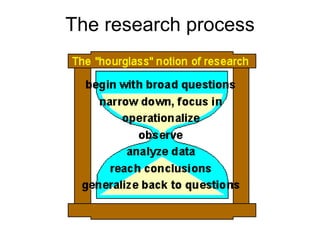
The research process
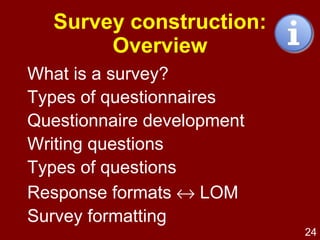
Survey construction: Overview What is a survey?
Types of questionnaires
Questionnaire development
Writing questions
Types of questions
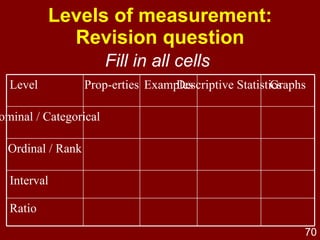
Response formats    LOM
Survey formatting
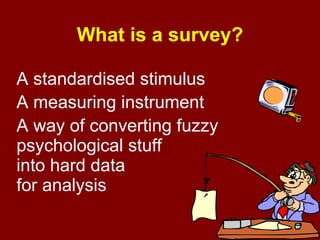
A standardised stimulus
A measuring instrument
A way of converting fuzzy psychological stuff  into hard data  for analysis What is a survey?
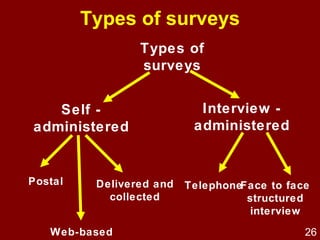
Types of surveys Types of surveys Self - administered Interview - administered Postal Delivered and collected Telephone Face to face structured interview Web-based
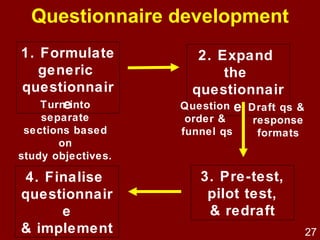
Questionnaire development 1. Formulate generic  questionnaire 2. Expand  the  questionnaire Turn into separate sections based on study objectives.   Draft qs &  response formats 4. Finalise  questionnaire & implement Question  order &  funnel qs 3. Pre-test, pilot test, & redraft
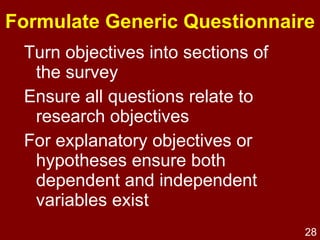
Formulate Generic Questionnaire Turn objectives into sections of the survey
Ensure all questions relate to research objectives
For explanatory objectives or hypotheses ensure both dependent and independent variables exist
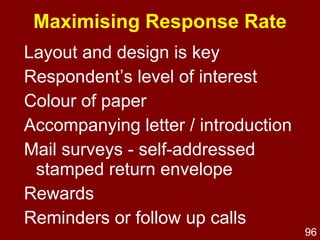
Cover Letter & Ethics Statement Introduction or cover letter: Outline details of research project and allow for ethical informed consent.
Few will read it without good prompting and being easy-to-read
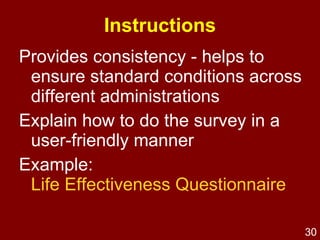
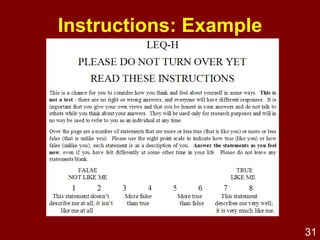
Instructions Provides consistency - helps to ensure standard conditions across different administrations
Explain how to do the survey in a user-friendly manner
Example:  Life Effectiveness Questionnaire
Instructions: Example
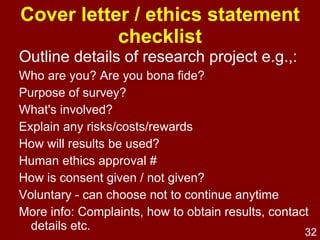
Cover letter / ethics statement checklist Outline details of research project e.g.,: Who are you? Are you bona fide?
Purpose of survey?
What's involved?
Explain any risks/costs/rewards
How will results be used?
Human ethics approval #
How is consent given / not given?
Voluntary - can choose not to continue anytime
More info: Complaints, how to obtain results, contact details etc.
Font (type, size)
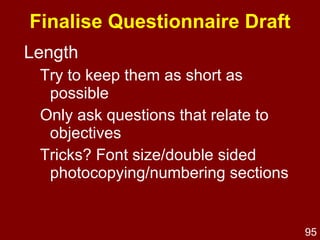
No. of pages
Margins
Double vs. single-siding
Colour, etc. Layout
Demographics single section, usually at beginning or end of questionnaire
only include relevant questions Layout
Space for comments?
Indicate the end
Say thanks! Layout
Flow/Structure Logical order of questions  (use sections)
Ask screening questions first, rather than later. Does the participant qualify for the survey? (esp. for internet surveys)
Use funneling/branching questions to move respondents through survey
Start off with easy to answer and engaging questions
More controversial questions in middle section
Expanding the Survey
Personal Information Generally, researchers put personal information at beginning of survey (if required). However, this may put off respondents, so also consider uncluding at towards end.
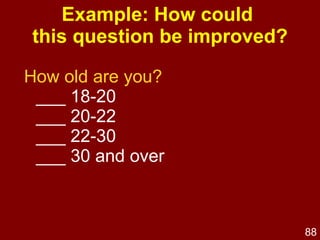
Consider response format e.g, Income in categories or ranges
Personal Information More likely to respond to personal questions for anonymous or mail surveys as opposed to face to face or telephone
Show cards for responses may help for face to face interviews
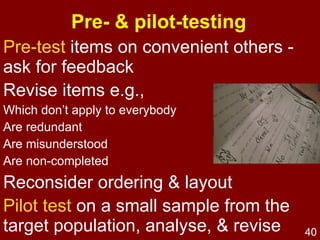
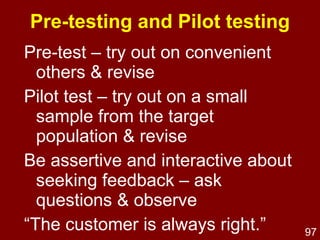
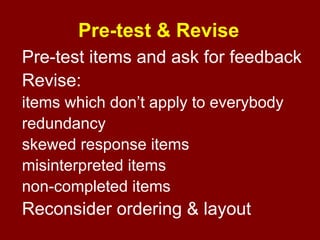
Pre- & pilot-testing Pre-test  items on convenient others - ask for feedback
Revise items e.g., Which don’t apply to everybody
Are redundant
Are misunderstood
Are non-completed Reconsider ordering & layout
Pilot test  on a small sample from the target population, analyse, & revise
Types of Questions Be able to justify and defend your  choices ...
Writing questions - Dos Define  target constructs
Check related research & questionnaires
Draft items  (for important, fuzzy constructs aim to have multiple indicators)
Pre-test & revise
Writing questions - Dos Focus directly on topic/issue
Be clear
Be brief
Avoid big words
Use simple and correct grammar
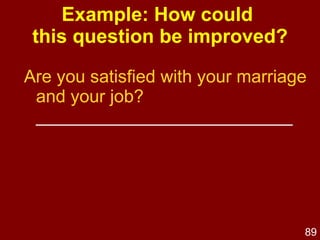
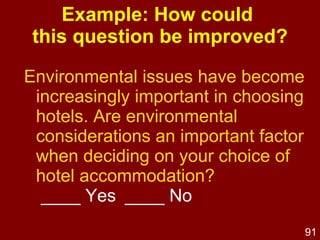
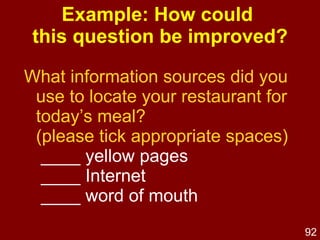
Writing questions – Don'ts Inapplicable  –  must apply to all respondents Over-demanding  –  e.g., recall of detail or time-consuming,  unnecessary questioning Ambiguous  –  meaning must be clear to all respondents Double negative  –  e.g., Do you not disapprove of tax reforms?
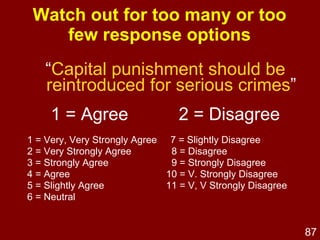
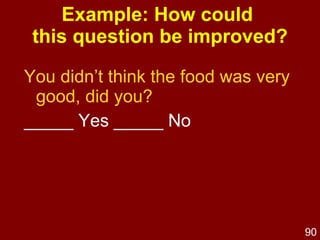
Writing questions – Don'ts Double-barrelled  -  e.g., “Do you think speed limits should be  lowered for cars & trucks?” Leading   -  e.g., “don’t you see some danger in the  new policy?” Loaded  –  e.g., “Do you advocate a lower speed limit  to save human lives?” vs “Does traffic  safety require a lower speed limit?”
Response biases Social desirability
Acquiescence yea- and nay-saying Self-serving bias
Order effects
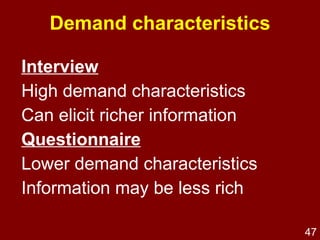
Demand characteristics Interview High demand characteristics
Can elicit richer information Questionnaire Lower demand characteristics
Information may be less rich
Types of Questions
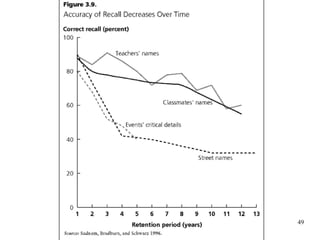
Accuracy of recall  decreases over time
Objective questions A verifiably true answer (i.e., factual information) exists for each unit.
The question could be accurately answered by an observer. e.g., How times during 2009 did you visit a G.P.?  ______
Subjective questions Asks about fuzzy personal perceptions.
There is no “true”, factual answer.
Many possible answers per unit.
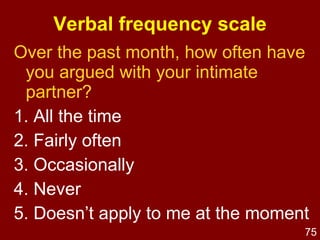
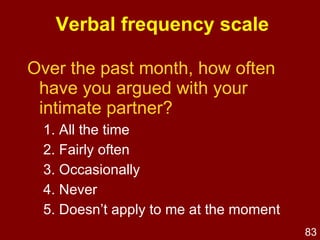
Can't be accurately answered by an observer. e.g., Think about the visits you made to a G.P. during 2010.  How well did you understand the medical advice you received? perfectly  very well reasonably  poorly  not at all
Objective vs. subjective questions Both types of questions may be appropriate; depends on the purpose of the study.
One criticism of this distinction: There is no such thing as “objective” and that  all responses  are subjective.
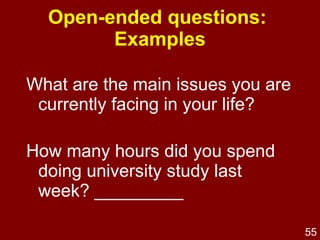
Open-ended Questions Rich information can be gathered

Survey design workshop

Editor's Notes

  • #2 Survey Design Workshop University of Canberra, ACT, Australia James T. Neill This workshop was previously presented by Dr. Brent Ritchi e – he kindly gave me a copy of his slides, which have been adapted and expanded. Image sources: Questionnaires are by James Neill (License: Public domain) Scissors are by Gracenotes - http://commons.wikimedia.org/wiki/File:Edit-cut-mod.svg - (License: - Creative Commons by SA 2.5) Further info: http://en.wikiversity.org/wiki/Survey_design/Workshop