DR. MAMOON AMEEN
`
INTRODUCTION
 The modern cochlear implant is an electronic device designed to convert environmental
sound into electrical impulses that are delivered along a multiple electrode array situated in
close proximity to the cochlear nerve.
INTRODUCTION
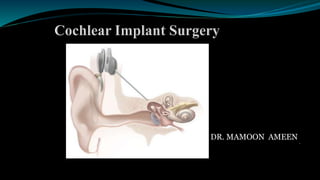
 Cochlear implants are the 1st true bionic sense organs.
 It is surgically implanted in the inner ear and activated by a device worn behind the ear.
 Cochlear Implants are not hearing aids.
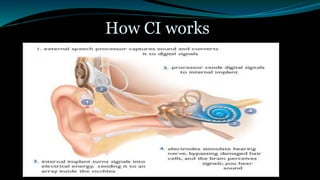
 The Concept of Cochlear Implant is to bypass the damaged hair cells and directly stimulates
the nerve of hearing, allowing individuals who are profoundly deaf to receive sound.
 patient factors are more important than the device variations.
 1957 – Djourno & Eyeries – stimulated auditory nerve directly with current & the patient
reported a clear auditory percept.
 1961 – House & Doyle – put electrodes in scala tympani of 2 profoundly deaf adults & get
a clear auditory response
 1972 – First single channel cochlear implant developed.
History of CI
History of CI
 1984 – Cochlear Corporation introduced Multichannel Cochlear Implant
System
 1990 - FDA approved age for CI 2 years and up
 1998 - FDA approved 18 months and up
 2002 - FDA approved 12 months and up
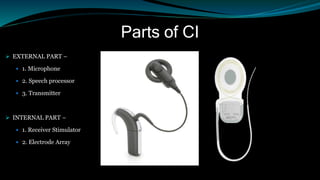
Parts of CI
 EXTERNAL PART –
 1. Microphone
 2. Speech processor
 3. Transmitter
 INTERNAL PART –
 1. Receiver Stimulator
 2. Electrode Array
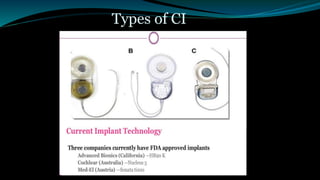
Types of CI
How CI works
COCHLEAR IMPLANT CANDIDATES
ADULTS
 Age – More than 18 yrs
 Bilateral severe to profound Sensorineural hearing loss.
 Must be Postlingual Deaf
 Little or no benefit from hearing aids.
 Sentence recognition test <50%
 No anatomical contraindication
 Lack of medical contraindication
COCHLEAR IMPLANT CANDIDATES
Children
 12 months or older
 Bilateral severe-to-profound sensorineural hearing loss with PTA of 90 dB or greater
in better ear
 No appreciable benefit with hearing aids (parent survey when <5 yo or 30% or less on
sentence recognition when >5 yo)
 Enrolled in aural/oral education program
 No medical or anatomic contraindications
 Motivated parents
COCHLEAR IMPLANT CANDIDATES
Children
 In cases of HL due to meningitis implantation should be considered before the age of
12 months.
 Auditory skills are generally assessed via parental history and administration of
validated questionnaires designed to gauge auditory-based responsiveness to speech
and sounds in a child's environment's
CONTRAINDICATION
 Deafness due to lesion in 8th nerve or brain stem
 CN 8 atresia
 Agenesis of cochlea: Michel deformity
 Active middle ear/mastoid infection
 Tympanic membrane perforation
 Severe organic brain dysfunction
 Severe mental retardation
 Psychosis
 unrealistic expectations
Absolute
WHICH EAR TO IMPLANT
 Better hearing ear
 Most recently deaf ear
 Most radiographically favorable anatomy(well pneumatized mastoid, normal facial nerve
anatomy, normal inner ear development, and patent cochlea)
 Least obstructed labyrinth
PRE-OP EVALUATION
 Detailed history and physical examination
 Collaborative effort involving patient, family, school, audiologist, speech /language
therapists and surgeons.
 Candidates must undergo audiologic testing and speech evaluation.
 Candidates are recommended to undergo a hearing aid trial to test whether hearing aids
are sufficient or an implant may be more beneficial.
PRE-OP EVALUATION
Psychological Assessment
 Performed to identify subjects who have organic brain dysfunction, mental
retardation, undetected psychosis, or unrealistic expectations.
 Information related to the family dynamics and other factors in the patient’s milieu
that may affect implant acceptance and performance are assessed
PRE-OP EVALUATION
Audiological assessment
 PTA
 Speech audiometry
 Aided audiometry
 ABR
 OAE
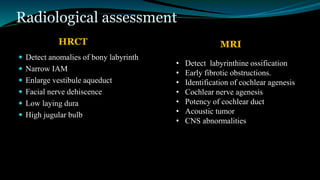
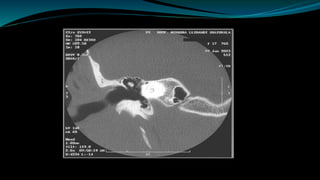
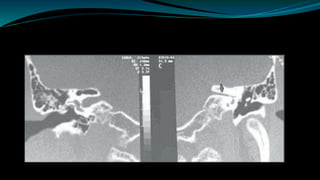
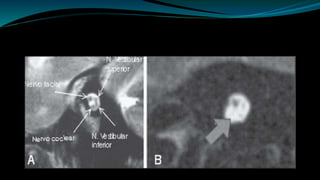
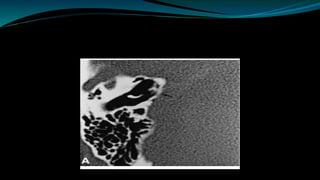
Radiological assessment
 Detect anomalies of bony labyrinth
 Narrow IAM
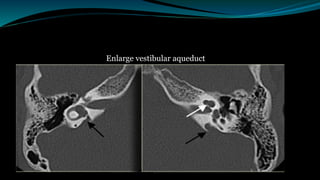
 Enlarge vestibule aqueduct
 Facial nerve dehiscence
 Low laying dura
 High jugular bulb
• Detect labyrinthine ossification
• Early fibrotic obstructions.
• Identification of cochlear agenesis
• Cochlear nerve agenesis
• Potency of cochlear duct
• Acoustic tumor
• CNS abnormalities
HRCT MRI
Enlarge vestibular aqueduct
SURGICAL PROCEDURE
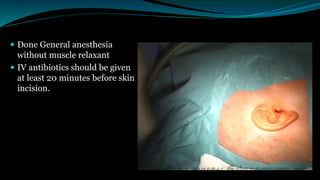
 Done General anesthesia
without muscle relaxant
 IV antibiotics should be given
at least 20 minutes before skin
incision.
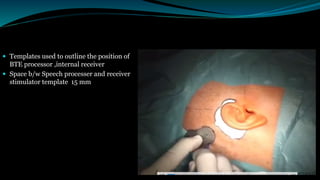
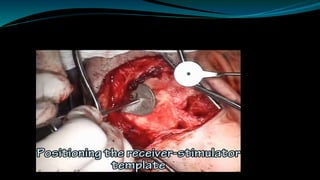
 Templates used to outline the position of
BTE processor ,internal receiver
 Space b/w Speech processer and receiver
stimulator template 15 mm
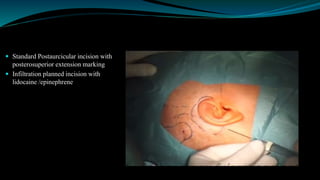
 Standard Postaurcicular incision with
posterosuperior extension marking
 Infiltration planned incision with
lidocaine /epinephrene
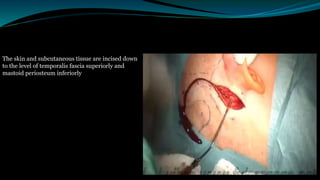
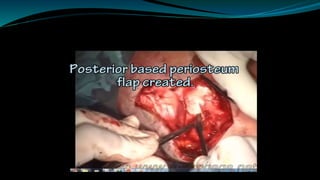
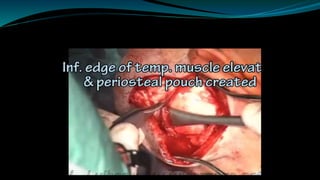
The skin and subcutaneous tissue are incised down
to the level of temporalis fascia superiorly and
mastoid periosteum inferiorly
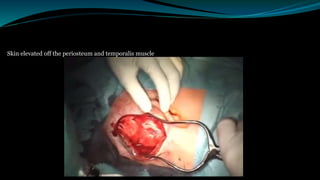
Skin elevated off the periosteum and temporalis muscle
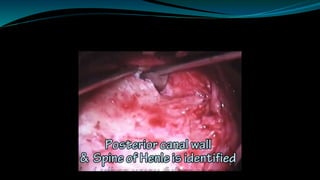
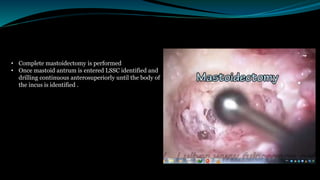
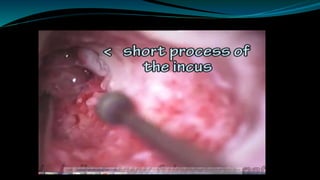
• Complete mastoidectomy is performed
• Once mastoid antrum is entered LSSC identified and
drilling continuous anterosuperiorly until the body of
the incus is identified .
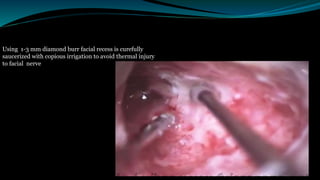
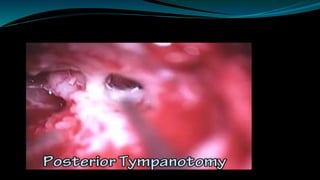
Using 1-3 mm diamond burr facial recess is curefully
saucerized with copious irrigation to avoid thermal injury
to facial nerve
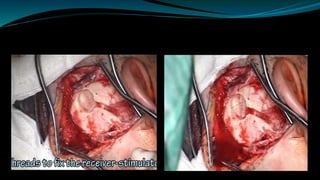
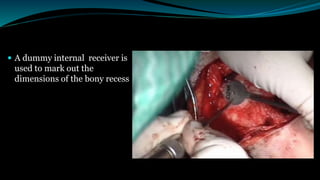
 A dummy internal receiver is
used to mark out the
dimensions of the bony recess
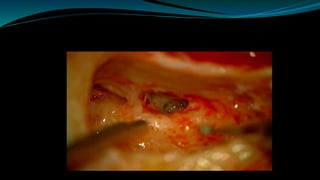
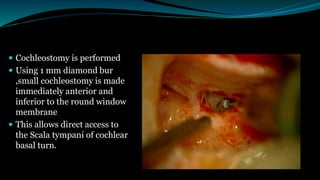
 Cochleostomy is performed
 Using 1 mm diamond bur
,small cochleostomy is made
immediately anterior and
inferior to the round window
membrane
 This allows direct access to
the Scala tympani of cochlear
basal turn.
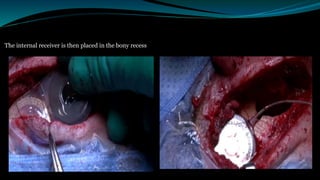
The internal receiver is then placed in the bony recess
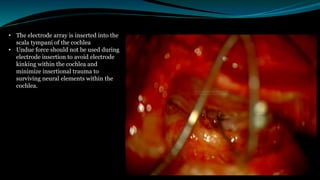
• The electrode array is inserted into the
scala tympani of the cochlea
• Undue force should not be used during
electrode insertion to avoid electrode
kinking within the cochlea and
minimize insertional trauma to
surviving neural elements within the
cochlea.
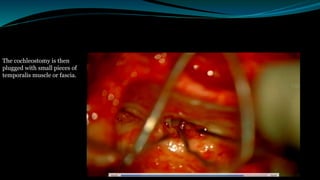
The cochleostomy is then
plugged with small pieces of
temporalis muscle or fascia.
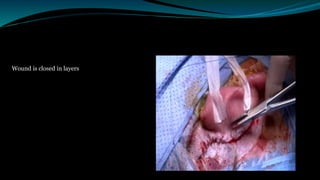
Wound is closed in layers
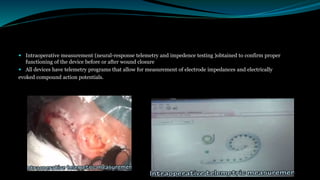
 Intraoperative measurement (neural-response telemetry and impedence testing )obtained to confirm proper
functioning of the device before or after wound closure
 All devices have telemetry programs that allow for measurement of electrode impedances and electrically
evoked compound action potentials.
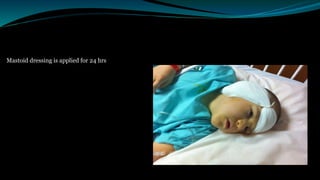
Mastoid dressing is applied for 24 hrs
POSTOPERATIVE MANAGEMENT
 Can be discharge on the day of operation
 7 days oral antibiotic
 Mastoid dressing removed on 1st POD
 Initial follow up visit 1 week
 External device fitted 4 weeks after the surgery, programming and rehabilitation begin
 Mapping involves fine tuning the speech processor and setting levels of stimulation
for each electrode, from soft to loud.
 The patient is then trained in how to interpret the sounds heard through the device.
 The length of the training varies from days to years, depending on how well the
person can interpret the sounds heard through the device.
COMPLICATIONS
Early
 Facial N. Injury
 Alteration of Taste
 Infection
 Dizziness
 Wound dehiscence / Flap Necrosis
 Early Device Failure
 CSF Leak
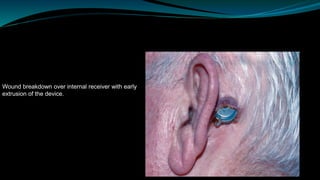
WOUND DEHISCENCE / FLAP NECROSIS
 Flap Necrosis occurs due to aggressive thinning of flap – most serious complication & require
device removal.
Wound breakdown over internal receiver with early
extrusion of the device.
CSF LEAK
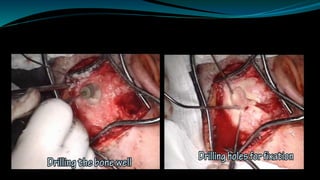
 Occurs frequently at the time of drilling tie down holes.
 Can also occur after opening of scala tympani in case of – modiolar defect. / Common
cavity deformity. GUSHERS
 Controlled by packing the common cavity with muscle.
 If still not controlled – Ear is closed by plugging the eustachian tube, filling the
middle ear & mastoid with fat and oversewing the Extn. Auditory canal.
LATE
 Extrusion / Exposure of Device
 Displacement of Electrodes
 Late device failure
 Otitis Media
 Meningitis
MENINGITIS
Cochlear implantation recipients are at high risk of developing Pneumococcal Meningitis.
Center for Disease Control made it mandatory for pneumococcal vaccination as follows
 All children < 1 yr. must receive 3 doses of Pneumococcal Conjugate (PEVNAR)
 child > 5yr should receive one dose of pneumococcal polysaccharide vaccine.
 Cochlear implant child > 2 yr who have received PEVNAR should receive one dose of pneumococcal
polysacharide vaccine.
Thank you

Cochlear implant surgery

  • 1.
  • 2.
    INTRODUCTION  The moderncochlear implant is an electronic device designed to convert environmental sound into electrical impulses that are delivered along a multiple electrode array situated in close proximity to the cochlear nerve.
  • 3.
    INTRODUCTION  Cochlear implantsare the 1st true bionic sense organs.  It is surgically implanted in the inner ear and activated by a device worn behind the ear.  Cochlear Implants are not hearing aids.  The Concept of Cochlear Implant is to bypass the damaged hair cells and directly stimulates the nerve of hearing, allowing individuals who are profoundly deaf to receive sound.  patient factors are more important than the device variations.
  • 4.
     1957 –Djourno & Eyeries – stimulated auditory nerve directly with current & the patient reported a clear auditory percept.  1961 – House & Doyle – put electrodes in scala tympani of 2 profoundly deaf adults & get a clear auditory response  1972 – First single channel cochlear implant developed. History of CI
  • 5.
    History of CI 1984 – Cochlear Corporation introduced Multichannel Cochlear Implant System  1990 - FDA approved age for CI 2 years and up  1998 - FDA approved 18 months and up  2002 - FDA approved 12 months and up
  • 6.
    Parts of CI EXTERNAL PART –  1. Microphone  2. Speech processor  3. Transmitter  INTERNAL PART –  1. Receiver Stimulator  2. Electrode Array
  • 7.
  • 8.
  • 9.
    COCHLEAR IMPLANT CANDIDATES ADULTS Age – More than 18 yrs  Bilateral severe to profound Sensorineural hearing loss.  Must be Postlingual Deaf  Little or no benefit from hearing aids.  Sentence recognition test <50%  No anatomical contraindication  Lack of medical contraindication
  • 10.
    COCHLEAR IMPLANT CANDIDATES Children 12 months or older  Bilateral severe-to-profound sensorineural hearing loss with PTA of 90 dB or greater in better ear  No appreciable benefit with hearing aids (parent survey when <5 yo or 30% or less on sentence recognition when >5 yo)  Enrolled in aural/oral education program  No medical or anatomic contraindications  Motivated parents
  • 11.
    COCHLEAR IMPLANT CANDIDATES Children In cases of HL due to meningitis implantation should be considered before the age of 12 months.  Auditory skills are generally assessed via parental history and administration of validated questionnaires designed to gauge auditory-based responsiveness to speech and sounds in a child's environment's
  • 12.
    CONTRAINDICATION  Deafness dueto lesion in 8th nerve or brain stem  CN 8 atresia  Agenesis of cochlea: Michel deformity  Active middle ear/mastoid infection  Tympanic membrane perforation  Severe organic brain dysfunction  Severe mental retardation  Psychosis  unrealistic expectations Absolute
  • 13.
    WHICH EAR TOIMPLANT  Better hearing ear  Most recently deaf ear  Most radiographically favorable anatomy(well pneumatized mastoid, normal facial nerve anatomy, normal inner ear development, and patent cochlea)  Least obstructed labyrinth
  • 14.
    PRE-OP EVALUATION  Detailedhistory and physical examination  Collaborative effort involving patient, family, school, audiologist, speech /language therapists and surgeons.  Candidates must undergo audiologic testing and speech evaluation.  Candidates are recommended to undergo a hearing aid trial to test whether hearing aids are sufficient or an implant may be more beneficial.
  • 15.
    PRE-OP EVALUATION Psychological Assessment Performed to identify subjects who have organic brain dysfunction, mental retardation, undetected psychosis, or unrealistic expectations.  Information related to the family dynamics and other factors in the patient’s milieu that may affect implant acceptance and performance are assessed
  • 16.
    PRE-OP EVALUATION Audiological assessment PTA  Speech audiometry  Aided audiometry  ABR  OAE
  • 17.
    Radiological assessment  Detectanomalies of bony labyrinth  Narrow IAM  Enlarge vestibule aqueduct  Facial nerve dehiscence  Low laying dura  High jugular bulb • Detect labyrinthine ossification • Early fibrotic obstructions. • Identification of cochlear agenesis • Cochlear nerve agenesis • Potency of cochlear duct • Acoustic tumor • CNS abnormalities HRCT MRI
  • 19.
  • 23.
  • 24.
     Done Generalanesthesia without muscle relaxant  IV antibiotics should be given at least 20 minutes before skin incision.
  • 25.
     Templates usedto outline the position of BTE processor ,internal receiver  Space b/w Speech processer and receiver stimulator template 15 mm
  • 26.
     Standard Postaurcicularincision with posterosuperior extension marking  Infiltration planned incision with lidocaine /epinephrene
  • 27.
    The skin andsubcutaneous tissue are incised down to the level of temporalis fascia superiorly and mastoid periosteum inferiorly
  • 28.
    Skin elevated offthe periosteum and temporalis muscle
  • 32.
    • Complete mastoidectomyis performed • Once mastoid antrum is entered LSSC identified and drilling continuous anterosuperiorly until the body of the incus is identified .
  • 34.
    Using 1-3 mmdiamond burr facial recess is curefully saucerized with copious irrigation to avoid thermal injury to facial nerve
  • 38.
     A dummyinternal receiver is used to mark out the dimensions of the bony recess
  • 41.
     Cochleostomy isperformed  Using 1 mm diamond bur ,small cochleostomy is made immediately anterior and inferior to the round window membrane  This allows direct access to the Scala tympani of cochlear basal turn.
  • 42.
    The internal receiveris then placed in the bony recess
  • 43.
    • The electrodearray is inserted into the scala tympani of the cochlea • Undue force should not be used during electrode insertion to avoid electrode kinking within the cochlea and minimize insertional trauma to surviving neural elements within the cochlea.
  • 45.
    The cochleostomy isthen plugged with small pieces of temporalis muscle or fascia.
  • 47.
    Wound is closedin layers
  • 49.
     Intraoperative measurement(neural-response telemetry and impedence testing )obtained to confirm proper functioning of the device before or after wound closure  All devices have telemetry programs that allow for measurement of electrode impedances and electrically evoked compound action potentials.
  • 50.
    Mastoid dressing isapplied for 24 hrs
  • 51.
    POSTOPERATIVE MANAGEMENT  Canbe discharge on the day of operation  7 days oral antibiotic  Mastoid dressing removed on 1st POD  Initial follow up visit 1 week  External device fitted 4 weeks after the surgery, programming and rehabilitation begin
  • 52.
     Mapping involvesfine tuning the speech processor and setting levels of stimulation for each electrode, from soft to loud.  The patient is then trained in how to interpret the sounds heard through the device.  The length of the training varies from days to years, depending on how well the person can interpret the sounds heard through the device.
  • 53.
  • 54.
    Early  Facial N.Injury  Alteration of Taste  Infection  Dizziness  Wound dehiscence / Flap Necrosis  Early Device Failure  CSF Leak
  • 55.
    WOUND DEHISCENCE /FLAP NECROSIS  Flap Necrosis occurs due to aggressive thinning of flap – most serious complication & require device removal.
  • 56.
    Wound breakdown overinternal receiver with early extrusion of the device.
  • 57.
    CSF LEAK  Occursfrequently at the time of drilling tie down holes.  Can also occur after opening of scala tympani in case of – modiolar defect. / Common cavity deformity. GUSHERS  Controlled by packing the common cavity with muscle.  If still not controlled – Ear is closed by plugging the eustachian tube, filling the middle ear & mastoid with fat and oversewing the Extn. Auditory canal.
  • 58.
    LATE  Extrusion /Exposure of Device  Displacement of Electrodes  Late device failure  Otitis Media  Meningitis
  • 59.
    MENINGITIS Cochlear implantation recipientsare at high risk of developing Pneumococcal Meningitis. Center for Disease Control made it mandatory for pneumococcal vaccination as follows  All children < 1 yr. must receive 3 doses of Pneumococcal Conjugate (PEVNAR)  child > 5yr should receive one dose of pneumococcal polysaccharide vaccine.  Cochlear implant child > 2 yr who have received PEVNAR should receive one dose of pneumococcal polysacharide vaccine.
  • 60.

Editor's Notes

  • #44 The electrode array is inserted into the scala tympani of the cochlea