RETROPHARYNGEAL ABSCESS
DR. NZEMEKE, ISIOMA R.
RESIDENT DOCTOR
DEPT OF ENT, LUTH
NIGERIA.
OUTLINE
• INTRODUCTION
• RELEVANT ANATOMY
• EPIDEMIOLOGY
• CLASSIFICATION
• AETIOPATHOGENESIS
• CLINICAL FEATURES
• INVESTIGATIONS
• DIFFERENTIAL DIAGNOSIS
• TREATMENT
• COMPLICATIONS
• CONCLUSION
• REFERENCES
INTRODUCTION
• Retropharyngeal abscess ia an infection of the
retropharyngeal space
• Retropharyngeal space is a potential space posterior to the
pharynx and the cervical oesophagus
• Often presents late, most times in airway obstruction
• It is life threatening,adequate care and management is
needed
• Mortality and morbidity often follows delayed or missed
diagnosis
EPIDEMIOLOGY
• Incidence is commoner in children than adults
• mostly children 2-5years, following airway infection
• Higher in males than females
• No racial predilection
• Incidence is declining -wide availability of antibiotics
-improvement in medical care
• OGB Nworgu et at (2005) UCH review 30patients within 10yrs
– M:F - 1:1
– Age- 3mths-38yrs (23pxs ˂ 5yrs)
RELEVANT ANATOMY
• Retropharyngeal space lies
posterior to the pharynx and
cervical oesophagus
• It extends from the skull base
to the level of vertebra T1 -
T4,
• Boundaries: alar fascia,
buccopharyngeal
fascia,parapharyngeal space,
carotid shealth
• Divided by a midline raphe
RELEVANT ANATOMY
• Contents
– lypmph; suprahyoid
– fats
• LYMPH NODES
– medial nodes;atrophies
– lateral nodes
• node of Rouviere;
superior most
– drains the nasal cavity,
paranasal sinuses, soft
palate,auditory canal and
middle ear
CLASSIFICATION
1. ACUTE
– Commoner in children
– Causes;
• upper respiratory infection
• trauma/foreign body impaction
2. CHRONIC
– common with tuberculosis of the cervical spine
– usually spreads from the prevertebral space
– Insidous in onset
– Mild symptoms or asymptomatic
AETIOPATHOGENESIS
• Retropharyngeal abscess is polymicrobial;
– implicatedcated in upper airway
infections;rhinosinusitis,adenioditis,tonsilitis
• Most common is group A beta-hemolytic Streptococcus.
Others;
– Staphylococcus auerus
– Fusobacterium
– Haemophilus
• Also occurs
– following direct trauma and subsequent innoculation into
the retropharyngeal space
– direct spread of infection from vertebral osteomyelitis or
discitis, tuberculosis and fracture of the spine
AETIOPATHOGENESIS
• Following infection;
– Activation of interleukins
– Release of inflammatory cells(neutrophils,
macrophages,lymphocytes)
• fever
• pain
• oedema
• celluiltis
– Phagocytosis, necrosis (liquefaction)
– Abscess formation
• In TB
• spread to lymph nodes
• spread from tubercular vertebral abscess
• The risk increases in immunocompromised state ,manultrition, poor
socioeconomic status
CLINICAL FEATURES
Acute Symptoms
– Fever
– Nasal discharge
– cough
– vomiting
– Sorethroat
– odynophagia/refusal to
feed
– dysphagia
– neck pain and swelling
– dyspnoea
– change in
voice(muffled, hot
potatoe voice)
CLINICAL FEATURES
Signs
– ill-looking and toxic
– pyrexia
– dyspnoeic
– drooling
– torticollis
– cervical
lymphadenopathy
• Inflammed and lateral
bulging of the pharyngeal
wall
CLINICAL FEATURES
Chronic
– painless lump in the throat
– dysphagia
– Cough
– weight loss
– anorexia
– chest pain
– median bulging of the posterior pharyngeal wall
INVESTIGATIONS
Specific
• Plain soft tissue lateral neck radiograph
• contrast computed tomography scan of the neck
• Magnetic resonance imaging
• Acid fast bacillus test/Mantoux test/TB QuantiFEREON
test
• Culture and sensitivity
INVESTIGATION
• Full blood count
– Leucocytosis/Leucocytopaenia
– Neutrophilia/neutropaenia
– Eosinophilia
– Lymphocytosis
– Anaemia
• Erythrocyte sedimentation rate ↑
• Serum glucose
• Retroviral screening
• Chest xray
– mediastinitis
– pneumonia
INVESTIGATION
Plain soft tissue lateral
neck radiograph
– widening of the prevertebral
soft tissue
– >1/2 and 1/3rd of the
corresponding vertebral
body in adults and children
respectively
– straightening of the cervical
spine and loss of the usual
cervical lordosis.
– pockets of gases
• Caries and calcifications of the
spine
INVESTIGATION
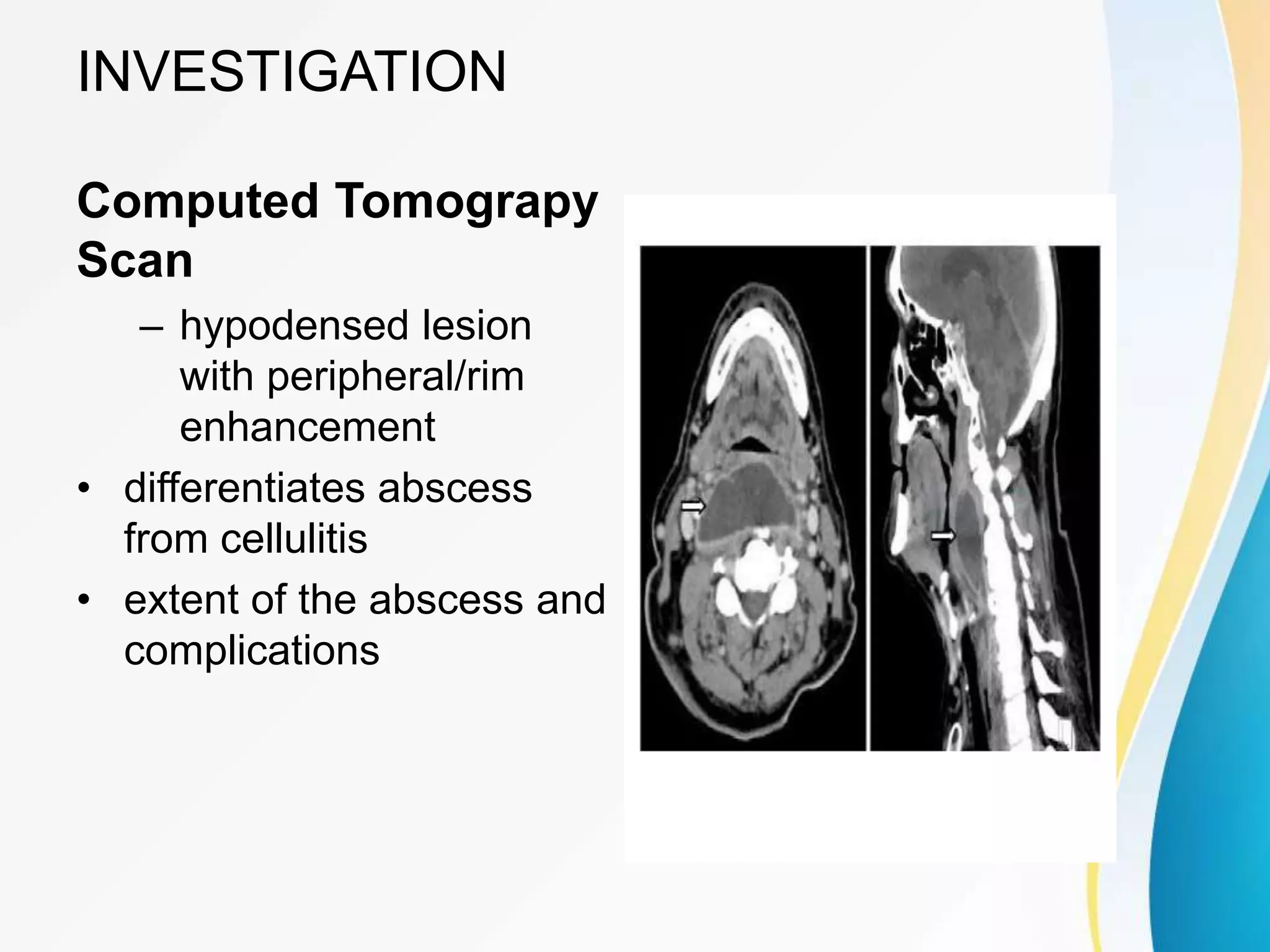
Computed Tomograpy
Scan
– hypodensed lesion
with peripheral/rim
enhancement
• differentiates abscess
from cellulitis
• extent of the abscess and
complications
DIFFERENTIAL DIAGNOSIS
• Croup
– steeple’s sign on xray
• Acute epiglottitis
– thumbs up appearance on xray
• Peritonsillar abscess
• Parapharyngeal abscess
• Odontal abscess
TREATMENT
• Multidiscipline; ENT surgeons, Anaesthestist,
paediatricians, orthopaedics/spine surgeons,
infectious disease control unit/microbiologist
• Depends on stage at presentation
• Principles/Aims of Treatment
– airway management
– drainage of abscess
– antimicrobial therapy
– prevent and manage complications
TREATMENT
• Admit/resuscitation
• Rehydrate
• Antibiotics/Antituberculosis
• Analgesics
• Surgical airway management;
– cricothyrotomy
– Tracheostomy
• Surgical drainage
TREATMENT
Approaches
– Transoral
– Transcervical(anterior or posterior)
• for large abscess
• chronic abscess
• significant inferior
• abscess across fascia planes involving
other deep neck spaces
TREATMENT
Transoral Abscess drainage
• preop blood workup
• GXM blood
• Obtain informed consent
• Usually done under general anaesthesia via
oroendotracheal tube or tracheostomy
– care must be taken to avoid rupturing the abscess
during intubation and should be done by the most
ewxperienced anaesthestist
TREATMENT
• Patient is placed in supine position with the neck
extended,shoulder roll applied, the head tilted
downwards and stabilised
• Draping
• Mouth gag is applied
• Pharynx is packed
• Antibiotic administer
TREATMENT
– Minimal decompression with needle and syringe
– Vertical incision is made at the point of most fluctuancy
– The abscess widely opened with a large clamp, the
loculi broken and the contents suctioned completely.
– Anaesthesia reversed
– Endotracheal intubation may be left in place
– Pus aspirate sent for MCS
TREATMENT
Post op care
1. Maintain nil per os
2. Airway monitor and control
3. Antibiotics
4. Analgesics
5. Iv fuid
6. Treatment of underlying conditions and oral intake
when stable
COMPLICATIONS
• Extension of infection into mediastinum other neck spaces
• Haemorrhage
• Spontaneous rupture and aspiration
• Laryngeal spasm
• pneumonia
• Septicemia
• Reaccumulation of abscess
CONCLUSION
• Retrophryngeal abscess is a life threatening conditions
requiring urgent ENT care
• prognosis is good if it is recognised and treated early
• Prompt evaluation and care are important in limiting its
fetal complications
• It is also important to manage and possibly avoid the
likely causes to minimise the risk of developing
retropharyngeal abscess
REFERENCE
• Scott-Brown’s Otorhinolaryngology, Head and Neck Surgery 7th
edition
• Textbook of Ear, Nose, Throat and Head Neck Surgery Clinical and
Practical fourth Edition
• Operative otorhinolaryngology
• SURGICAL ANATOMY OF THE HEAD AND NECK
• Introductory Head and Neck Imaging; Eugene Yu MD FRCPC
University of Toronto Canada, Lalitha Shankar MD FRCPC
University of Toronto Canada
THANK YOU
FOR
LISTENING

RETROPHARYNGEAL ABSCESS N.pptx

  • 1.
    RETROPHARYNGEAL ABSCESS DR. NZEMEKE,ISIOMA R. RESIDENT DOCTOR DEPT OF ENT, LUTH NIGERIA.
  • 2.
    OUTLINE • INTRODUCTION • RELEVANTANATOMY • EPIDEMIOLOGY • CLASSIFICATION • AETIOPATHOGENESIS • CLINICAL FEATURES • INVESTIGATIONS • DIFFERENTIAL DIAGNOSIS • TREATMENT • COMPLICATIONS • CONCLUSION • REFERENCES
  • 3.
    INTRODUCTION • Retropharyngeal abscessia an infection of the retropharyngeal space • Retropharyngeal space is a potential space posterior to the pharynx and the cervical oesophagus • Often presents late, most times in airway obstruction • It is life threatening,adequate care and management is needed • Mortality and morbidity often follows delayed or missed diagnosis
  • 4.
    EPIDEMIOLOGY • Incidence iscommoner in children than adults • mostly children 2-5years, following airway infection • Higher in males than females • No racial predilection • Incidence is declining -wide availability of antibiotics -improvement in medical care • OGB Nworgu et at (2005) UCH review 30patients within 10yrs – M:F - 1:1 – Age- 3mths-38yrs (23pxs ˂ 5yrs)
  • 5.
    RELEVANT ANATOMY • Retropharyngealspace lies posterior to the pharynx and cervical oesophagus • It extends from the skull base to the level of vertebra T1 - T4, • Boundaries: alar fascia, buccopharyngeal fascia,parapharyngeal space, carotid shealth • Divided by a midline raphe
  • 6.
    RELEVANT ANATOMY • Contents –lypmph; suprahyoid – fats • LYMPH NODES – medial nodes;atrophies – lateral nodes • node of Rouviere; superior most – drains the nasal cavity, paranasal sinuses, soft palate,auditory canal and middle ear
  • 7.
    CLASSIFICATION 1. ACUTE – Commonerin children – Causes; • upper respiratory infection • trauma/foreign body impaction 2. CHRONIC – common with tuberculosis of the cervical spine – usually spreads from the prevertebral space – Insidous in onset – Mild symptoms or asymptomatic
  • 8.
    AETIOPATHOGENESIS • Retropharyngeal abscessis polymicrobial; – implicatedcated in upper airway infections;rhinosinusitis,adenioditis,tonsilitis • Most common is group A beta-hemolytic Streptococcus. Others; – Staphylococcus auerus – Fusobacterium – Haemophilus • Also occurs – following direct trauma and subsequent innoculation into the retropharyngeal space – direct spread of infection from vertebral osteomyelitis or discitis, tuberculosis and fracture of the spine
  • 9.
    AETIOPATHOGENESIS • Following infection; –Activation of interleukins – Release of inflammatory cells(neutrophils, macrophages,lymphocytes) • fever • pain • oedema • celluiltis – Phagocytosis, necrosis (liquefaction) – Abscess formation • In TB • spread to lymph nodes • spread from tubercular vertebral abscess • The risk increases in immunocompromised state ,manultrition, poor socioeconomic status
  • 10.
    CLINICAL FEATURES Acute Symptoms –Fever – Nasal discharge – cough – vomiting – Sorethroat – odynophagia/refusal to feed – dysphagia – neck pain and swelling – dyspnoea – change in voice(muffled, hot potatoe voice)
  • 11.
    CLINICAL FEATURES Signs – ill-lookingand toxic – pyrexia – dyspnoeic – drooling – torticollis – cervical lymphadenopathy • Inflammed and lateral bulging of the pharyngeal wall
  • 12.
    CLINICAL FEATURES Chronic – painlesslump in the throat – dysphagia – Cough – weight loss – anorexia – chest pain – median bulging of the posterior pharyngeal wall
  • 13.
    INVESTIGATIONS Specific • Plain softtissue lateral neck radiograph • contrast computed tomography scan of the neck • Magnetic resonance imaging • Acid fast bacillus test/Mantoux test/TB QuantiFEREON test • Culture and sensitivity
  • 14.
    INVESTIGATION • Full bloodcount – Leucocytosis/Leucocytopaenia – Neutrophilia/neutropaenia – Eosinophilia – Lymphocytosis – Anaemia • Erythrocyte sedimentation rate ↑ • Serum glucose • Retroviral screening • Chest xray – mediastinitis – pneumonia
  • 15.
    INVESTIGATION Plain soft tissuelateral neck radiograph – widening of the prevertebral soft tissue – >1/2 and 1/3rd of the corresponding vertebral body in adults and children respectively – straightening of the cervical spine and loss of the usual cervical lordosis. – pockets of gases • Caries and calcifications of the spine
  • 16.
    INVESTIGATION Computed Tomograpy Scan – hypodensedlesion with peripheral/rim enhancement • differentiates abscess from cellulitis • extent of the abscess and complications
  • 17.
    DIFFERENTIAL DIAGNOSIS • Croup –steeple’s sign on xray • Acute epiglottitis – thumbs up appearance on xray • Peritonsillar abscess • Parapharyngeal abscess • Odontal abscess
  • 18.
    TREATMENT • Multidiscipline; ENTsurgeons, Anaesthestist, paediatricians, orthopaedics/spine surgeons, infectious disease control unit/microbiologist • Depends on stage at presentation • Principles/Aims of Treatment – airway management – drainage of abscess – antimicrobial therapy – prevent and manage complications
  • 19.
    TREATMENT • Admit/resuscitation • Rehydrate •Antibiotics/Antituberculosis • Analgesics • Surgical airway management; – cricothyrotomy – Tracheostomy • Surgical drainage
  • 20.
    TREATMENT Approaches – Transoral – Transcervical(anterioror posterior) • for large abscess • chronic abscess • significant inferior • abscess across fascia planes involving other deep neck spaces
  • 21.
    TREATMENT Transoral Abscess drainage •preop blood workup • GXM blood • Obtain informed consent • Usually done under general anaesthesia via oroendotracheal tube or tracheostomy – care must be taken to avoid rupturing the abscess during intubation and should be done by the most ewxperienced anaesthestist
  • 22.
    TREATMENT • Patient isplaced in supine position with the neck extended,shoulder roll applied, the head tilted downwards and stabilised • Draping • Mouth gag is applied • Pharynx is packed • Antibiotic administer
  • 23.
    TREATMENT – Minimal decompressionwith needle and syringe – Vertical incision is made at the point of most fluctuancy – The abscess widely opened with a large clamp, the loculi broken and the contents suctioned completely. – Anaesthesia reversed – Endotracheal intubation may be left in place – Pus aspirate sent for MCS
  • 24.
    TREATMENT Post op care 1.Maintain nil per os 2. Airway monitor and control 3. Antibiotics 4. Analgesics 5. Iv fuid 6. Treatment of underlying conditions and oral intake when stable
  • 25.
    COMPLICATIONS • Extension ofinfection into mediastinum other neck spaces • Haemorrhage • Spontaneous rupture and aspiration • Laryngeal spasm • pneumonia • Septicemia • Reaccumulation of abscess
  • 26.
    CONCLUSION • Retrophryngeal abscessis a life threatening conditions requiring urgent ENT care • prognosis is good if it is recognised and treated early • Prompt evaluation and care are important in limiting its fetal complications • It is also important to manage and possibly avoid the likely causes to minimise the risk of developing retropharyngeal abscess
  • 27.
    REFERENCE • Scott-Brown’s Otorhinolaryngology,Head and Neck Surgery 7th edition • Textbook of Ear, Nose, Throat and Head Neck Surgery Clinical and Practical fourth Edition • Operative otorhinolaryngology • SURGICAL ANATOMY OF THE HEAD AND NECK • Introductory Head and Neck Imaging; Eugene Yu MD FRCPC University of Toronto Canada, Lalitha Shankar MD FRCPC University of Toronto Canada
  • 28.