Deep neck space infections
Dr. Krishna Koirala
2020.02.10
Ludwig’s Angina
• Rapidly progressing polymicrobial cellulitis of the
submandibular space that can result in life
threatening airway compromise
• Angina - Strangling
• Mortality
– Before the advent of antibiotics : 50%
– Nowadays : 8–10%
– Most common cause of death is respiratory
compromise ( encircling of the upper airway)
• Predisposing Factors
– Dental or periodontal infection (80%)
•Poor dental hygiene (carious and abscessed teeth)
•Tooth extraction (lower molars and premolars)
– Others
•Upper respiratory infections, floor-of-mouth trauma,
mandibular fractures, sialoadenitis, peritonsillar
abscess, IV drug abuse
– Comorbid conditions
•Diabetes mellitus , malnutrition, alcoholism,
neutropenia, lupus erythematosus, aplastic anemia,
glomerulonephritis
• Causative organisms
– Group A beta-hemolytic streptococcal species
(streptococcus pyogenes)
– Alpha-hemolytic streptococcal species (streptococcus
viridans, streptococcus pneumoniae)
– Staphylococcus aureus
– Fusobacterium , Bacteroides melaninogenicus and oralis
– Peptostreptococcus, Actinomyces ,Neisseria species
– Occasional : Pseudomonas species, Escherichia coli, and
Haemophilus influenzae
Clinical Features
• Highest prevalence seen in young adults
• Pain in any involved teeth, with severe tender localized
swelling in the submandibular region
• Drooling (due to dysphagia) , halitosis, trismus , stridor ( from
laryngeal edema and elevation of the posterior tongue against
the palate)
• Fever, chills, tachycardia
• Boardlike firmness of the floor of the mouth and brawny
induration of the suprahyoid soft tissues
• Airway obstruction within hours !!
Criteria for diagnosing Ludwig's angina (Grodinsky)
- Rapidly spreading cellulitis with no specific tendency to form
abscess
- Involvement of both submaxillary and sublingual spaces,
usually bilaterally
- Spread by direct extension along facial planes and not
through lymphatics
- Involvement of muscle and fascia but not submandibular
gland or lymph nodes
- Originates in the submaxillary space with progression to
involve the sublingual space and floor of the mouth
Investigations
• Routine blood investigations
• Pus culture
• Plain radiographs to assess the
degree of soft tissue swelling
and airway obstruction
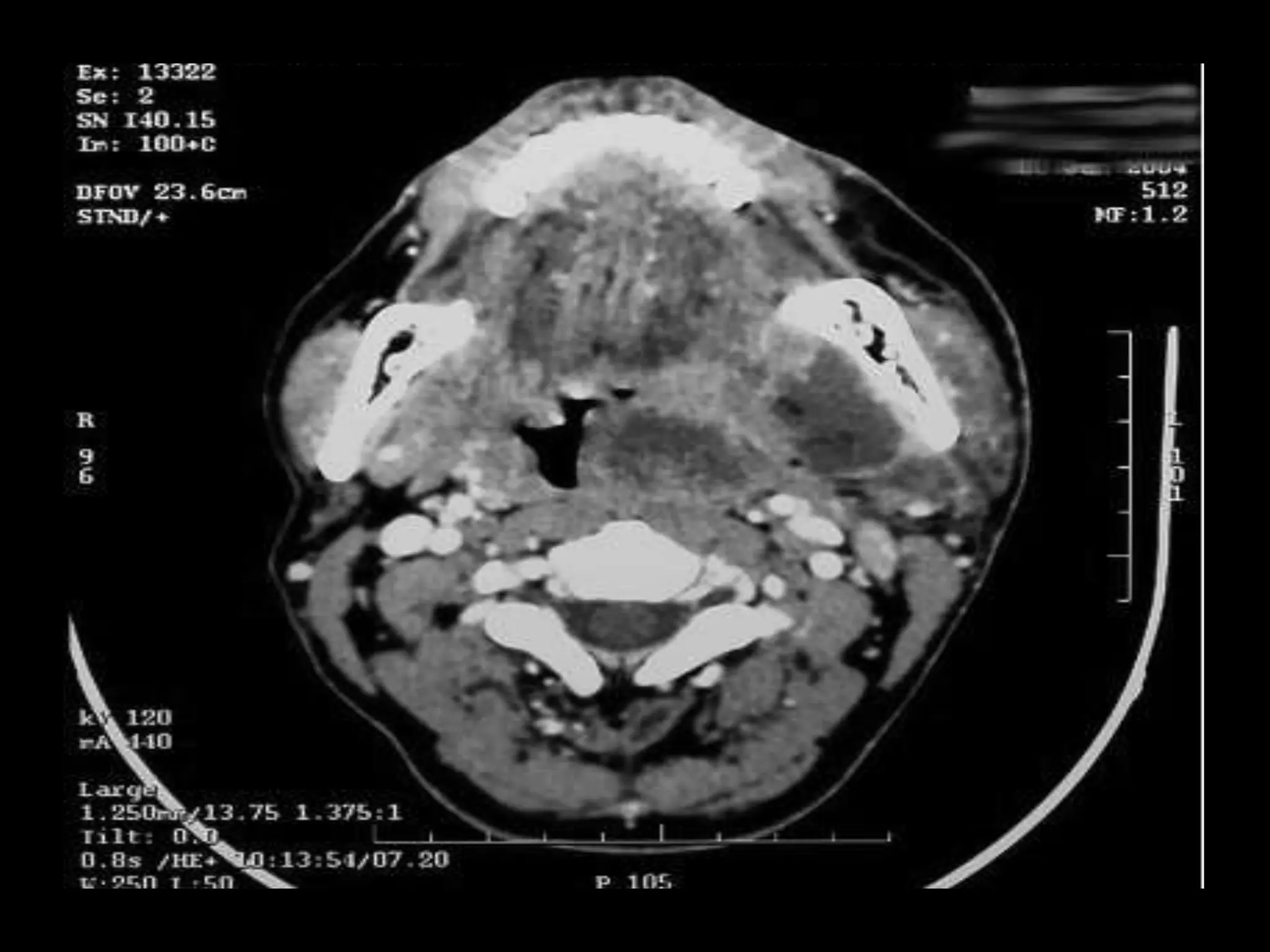
• CT - most useful imaging tool
Treatment
• Frequent assessment
– To assess the risk of progression and airway
compromise
• Empirical therapy
– High-dose intravenous antibiotics : Cefuroxime
and metronidazole
• Incision and drainage : intraoral and external
– Transverse incision across the midline from one
angle of jaw to the other  Muscles of the tongue
opened vertically Myelohyoid muscle sectioned
longitudinally
– Drains placed in all fascial spaces
• Tracheostomy to maintain an airway
Retropharyngeal Abscess
• Collection of pus in the retropharyngeal space
• Classification
– Acute
– Chronic
Acute retropharyngeal Abscess
• Common in children below 5 yrs
• Predisposing factors
–Suppuration of retropharyngeal lymph node
of Rouviere
–Penetrating FB eg. Fish bones
–Post surgical
Clinical Features
•Symptoms
–History of upper respiratory tract infection
–Dysphagia
–Difficulty in breathing, noisy breathing
–Croupy cough
–Torticollis
Signs
• Ill looking, febrile, drooling of saliva
• Hyperextension of the head
• Hot potato (muffled )voice
• Neck swelling and tenderness
• Bulge on posterior pharyngeal wall - usually unilateral
• Tracheal rock sign : pain while gently moving the
larynx and trachea from side to side
Investigations
• Complete blood count
• Plain X- Ray soft tissue neck Lateral view
– At the level of C2 : Distance from the anterior
border of the cervical vertebrae to the posterior
border of the airway : ≤ 7 mm regardless of the
patient's age
– At C6 : ≤14 mm in children younger than 15 years
and up to 22 mm in adults
• Widened prevertebral soft tissue shadow more than
normal in all ages or more than 2/3 of corresponding
cervical vertebral body signifies retropharyngeal
abscess
• CT scan of neck : Plain and contrast
– Extent of abscess, involvement of other spaces
Complications
•Secondary to mass effect
•Rupture of the abscess
•Spread of infection
Endoscopic finding of
retropharyngeal abscess
Treatment
• Adequate hydration : I.V. Fluids
• Systemic antibiotics : Ceftriaxone/metronidazole
• Incision and Drainage
– Transoral : No anesthesia, supine with head low ,
incision and suction of pus
– Transcervical : Through lateral neck incision
• Tracheostomy
Chronic Retropharyngeal abscess
• Causes
– Caries of cervical spine
– Tubercular infection of retropharyngeal LN
– Post traumatic
• Clinical Features
– Chronic discomfort in throat
– Dysphagia
– Bulge of posterior pharyngeal wall with fluctuant
swelling
Forms
• Lateral type :
– Koch's infection of the cervical lymph node
spreading to retropharyngeal nodes and forming a
cold abscess
– Seen in children below 5 years of age
– Swelling seen intra orally is classically on the sides
and not in the midline (as there is a central raphe)
– Swelling is fluctuant and with minimal signs of
inflammation
• Central type
– Pott’s tuberculous cervical spine
– Abscess present between the body of vertebra and
the prevertebral fascia
– Begins in the midline and spreads to both sides
– On oral examination there is a swelling in the
midline in the posterior pharyngeal wall, which is
fluctuant with less signs of inflammation
• Investigations
− As in acute retropharyngeal abscess
− ZN stain of the pus after aspiration
• Treatment
− IV antibiotics
− Incision and drainage : Per-oral / external
− Antitubercular chemotherapy
− Neck exploration
•Complications
–Airway obstruction
–Spread of abscess to other neck spaces
–Septicemia
–Death
Parapharyngeal Abscess
• Etiology
– Pharynx : Acute tonsillitis, peritonsillar abscess
– Teeth : Dental infections - lower last molar
– Ear : Bezold’s abscess
– Others : Parotid, retropharyngeal, submandibular
– Penetrating injuries
Clinical Features
• Fever, sore throat, odynophagia, torticollis
• Anterior Compartment
– Tonsils pushed medially
– Induration along the angle of the mandible
– Trismus
– External swelling behind the angle of jaw
• Posterior compartment
– Bulge of pharynx behind the posterior pillar
– Paralysis of IX, X, XI, XII cranial nerves and
cervical sympathetic chain
– Erode into the carotid artery or cause septic
thrombophlebitis of the internal jugular vein
(Lemierre syndrome)
Treatment
• Systemic antibiotics
–Ceftriaxone 1 gm. iv BD
–Amoxyclav 1.2 gm. iv TDS
–Metronidazole 500mg iv TDS
• Incision & drainage
–Intraoral drainage from tonsillar fossa
–External incision from the neck
Surgical approaches to Parapharyngeal Space
a) Transoral
– Small benign lesions of the prestyloid space
presenting as an oropharyngeal mass
– Problems -- limited exposure, increased risk of
tumor spillage, possibility of neurovascular injury
b) Cervical with or without mandibulotomy
– A transverse incision at the level of the hyoid bone
with removal or displacement of the
submandibular gland
– Tracheostomy necessary with this approach
- Tumors in the lower parapharyngeal space
extending to the neck
c) Cervical - parotid
– Extension of the cervical approach incision
superiorly in front of the ear
– Tumours in the midparapharyngeal space without
extension superiorly into the skull base or
posteriorly around the petrous internal carotid
artery
d) Transparotid
e) Infratemporal fossa

Deep neck space infections

  • 1.
    Deep neck spaceinfections Dr. Krishna Koirala 2020.02.10
  • 2.
    Ludwig’s Angina • Rapidlyprogressing polymicrobial cellulitis of the submandibular space that can result in life threatening airway compromise • Angina - Strangling • Mortality – Before the advent of antibiotics : 50% – Nowadays : 8–10% – Most common cause of death is respiratory compromise ( encircling of the upper airway)
  • 5.
    • Predisposing Factors –Dental or periodontal infection (80%) •Poor dental hygiene (carious and abscessed teeth) •Tooth extraction (lower molars and premolars) – Others •Upper respiratory infections, floor-of-mouth trauma, mandibular fractures, sialoadenitis, peritonsillar abscess, IV drug abuse – Comorbid conditions •Diabetes mellitus , malnutrition, alcoholism, neutropenia, lupus erythematosus, aplastic anemia, glomerulonephritis
  • 6.
    • Causative organisms –Group A beta-hemolytic streptococcal species (streptococcus pyogenes) – Alpha-hemolytic streptococcal species (streptococcus viridans, streptococcus pneumoniae) – Staphylococcus aureus – Fusobacterium , Bacteroides melaninogenicus and oralis – Peptostreptococcus, Actinomyces ,Neisseria species – Occasional : Pseudomonas species, Escherichia coli, and Haemophilus influenzae
  • 7.
    Clinical Features • Highestprevalence seen in young adults • Pain in any involved teeth, with severe tender localized swelling in the submandibular region • Drooling (due to dysphagia) , halitosis, trismus , stridor ( from laryngeal edema and elevation of the posterior tongue against the palate) • Fever, chills, tachycardia • Boardlike firmness of the floor of the mouth and brawny induration of the suprahyoid soft tissues • Airway obstruction within hours !!
  • 9.
    Criteria for diagnosingLudwig's angina (Grodinsky) - Rapidly spreading cellulitis with no specific tendency to form abscess - Involvement of both submaxillary and sublingual spaces, usually bilaterally - Spread by direct extension along facial planes and not through lymphatics - Involvement of muscle and fascia but not submandibular gland or lymph nodes - Originates in the submaxillary space with progression to involve the sublingual space and floor of the mouth
  • 10.
    Investigations • Routine bloodinvestigations • Pus culture • Plain radiographs to assess the degree of soft tissue swelling and airway obstruction • CT - most useful imaging tool
  • 11.
    Treatment • Frequent assessment –To assess the risk of progression and airway compromise • Empirical therapy – High-dose intravenous antibiotics : Cefuroxime and metronidazole
  • 12.
    • Incision anddrainage : intraoral and external – Transverse incision across the midline from one angle of jaw to the other  Muscles of the tongue opened vertically Myelohyoid muscle sectioned longitudinally – Drains placed in all fascial spaces • Tracheostomy to maintain an airway
  • 14.
    Retropharyngeal Abscess • Collectionof pus in the retropharyngeal space • Classification – Acute – Chronic
  • 15.
    Acute retropharyngeal Abscess •Common in children below 5 yrs • Predisposing factors –Suppuration of retropharyngeal lymph node of Rouviere –Penetrating FB eg. Fish bones –Post surgical
  • 16.
    Clinical Features •Symptoms –History ofupper respiratory tract infection –Dysphagia –Difficulty in breathing, noisy breathing –Croupy cough –Torticollis
  • 17.
    Signs • Ill looking,febrile, drooling of saliva • Hyperextension of the head • Hot potato (muffled )voice • Neck swelling and tenderness • Bulge on posterior pharyngeal wall - usually unilateral • Tracheal rock sign : pain while gently moving the larynx and trachea from side to side
  • 18.
    Investigations • Complete bloodcount • Plain X- Ray soft tissue neck Lateral view – At the level of C2 : Distance from the anterior border of the cervical vertebrae to the posterior border of the airway : ≤ 7 mm regardless of the patient's age – At C6 : ≤14 mm in children younger than 15 years and up to 22 mm in adults
  • 19.
    • Widened prevertebralsoft tissue shadow more than normal in all ages or more than 2/3 of corresponding cervical vertebral body signifies retropharyngeal abscess • CT scan of neck : Plain and contrast – Extent of abscess, involvement of other spaces
  • 20.
    Complications •Secondary to masseffect •Rupture of the abscess •Spread of infection
  • 21.
  • 22.
    Treatment • Adequate hydration: I.V. Fluids • Systemic antibiotics : Ceftriaxone/metronidazole • Incision and Drainage – Transoral : No anesthesia, supine with head low , incision and suction of pus – Transcervical : Through lateral neck incision • Tracheostomy
  • 24.
    Chronic Retropharyngeal abscess •Causes – Caries of cervical spine – Tubercular infection of retropharyngeal LN – Post traumatic • Clinical Features – Chronic discomfort in throat – Dysphagia – Bulge of posterior pharyngeal wall with fluctuant swelling
  • 25.
    Forms • Lateral type: – Koch's infection of the cervical lymph node spreading to retropharyngeal nodes and forming a cold abscess – Seen in children below 5 years of age – Swelling seen intra orally is classically on the sides and not in the midline (as there is a central raphe) – Swelling is fluctuant and with minimal signs of inflammation
  • 26.
    • Central type –Pott’s tuberculous cervical spine – Abscess present between the body of vertebra and the prevertebral fascia – Begins in the midline and spreads to both sides – On oral examination there is a swelling in the midline in the posterior pharyngeal wall, which is fluctuant with less signs of inflammation
  • 27.
    • Investigations − Asin acute retropharyngeal abscess − ZN stain of the pus after aspiration • Treatment − IV antibiotics − Incision and drainage : Per-oral / external − Antitubercular chemotherapy − Neck exploration
  • 28.
    •Complications –Airway obstruction –Spread ofabscess to other neck spaces –Septicemia –Death
  • 29.
    Parapharyngeal Abscess • Etiology –Pharynx : Acute tonsillitis, peritonsillar abscess – Teeth : Dental infections - lower last molar – Ear : Bezold’s abscess – Others : Parotid, retropharyngeal, submandibular – Penetrating injuries
  • 30.
    Clinical Features • Fever,sore throat, odynophagia, torticollis • Anterior Compartment – Tonsils pushed medially – Induration along the angle of the mandible – Trismus – External swelling behind the angle of jaw
  • 31.
    • Posterior compartment –Bulge of pharynx behind the posterior pillar – Paralysis of IX, X, XI, XII cranial nerves and cervical sympathetic chain – Erode into the carotid artery or cause septic thrombophlebitis of the internal jugular vein (Lemierre syndrome)
  • 35.
    Treatment • Systemic antibiotics –Ceftriaxone1 gm. iv BD –Amoxyclav 1.2 gm. iv TDS –Metronidazole 500mg iv TDS • Incision & drainage –Intraoral drainage from tonsillar fossa –External incision from the neck
  • 36.
    Surgical approaches toParapharyngeal Space a) Transoral – Small benign lesions of the prestyloid space presenting as an oropharyngeal mass – Problems -- limited exposure, increased risk of tumor spillage, possibility of neurovascular injury b) Cervical with or without mandibulotomy – A transverse incision at the level of the hyoid bone with removal or displacement of the submandibular gland – Tracheostomy necessary with this approach
  • 37.
    - Tumors inthe lower parapharyngeal space extending to the neck c) Cervical - parotid – Extension of the cervical approach incision superiorly in front of the ear – Tumours in the midparapharyngeal space without extension superiorly into the skull base or posteriorly around the petrous internal carotid artery d) Transparotid e) Infratemporal fossa