Deep neck space infection
Dr ramesh parajuli, MS
Chitwan Medical College, Bharatpur-10,
Chitwan, Nepal
Fascial layers of the neck
 Fascia is an investing fibrous tissue related to muscles &
major neck structures.
A. Superficial cervical fascia:
B. Deep cervical fascia:
1. Superficial or investing layer
2. Middle layer or visceral fascia
3. Deep layer or pre-vertebral fascia
(I)Superficial cervical fascia: encloses platysma
(II) Deep cervical fascia
(i)Investing layer: Encloses strap muscles, SCM, trapezius
Parotid &submandibular glands, carotid sheath
(ii)Middle or Visceral layer: encircles esophagus, trachea,
thyroid
(iii)Deep or pre-vertebral layer: Covers deep neck muscles i.e.
prevertebral muscles
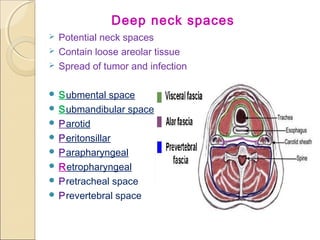
Deep neck spaces
 Potential neck spaces
 Contain loose areolar tissue
 Spread of tumor and infection
 Submental space
 Submandibular space
 Parotid
 Peritonsillar
 Parapharyngeal
 Retropharyngeal
 Pretracheal space
 Prevertebral space
Ludwig’s angina:
 Rapidly progressing cellulitis of submandibular space
(i.e. sublingual & submaxillary space)
 Mixed flora (poly-microbial)
 May result into life-threatening airway obstruction
Subdivisions of submandibular space
1. Sublingual space: above mylohyoid muscle
2. Submaxillary space: below mylohyoid muscle
Contents: Submandibular salivary gland, lymph nodes
Etiology:
1. Dental infection: 80% cases
Tooth (lower molars & premolars)
Roots of premolars lie above mylohyoid ⇒ sublingual space
infection
Roots of molars lie below mylohyoid ⇒ submaxillary space
infection
2. Injury to floor of mouth
3. Submandibular sialadenitis
Causative agentsCausative agents
Mixed aerobic & anaerobic infection
 Streptococcus pyogenes
 Streptococcus viridans
 Streptococcus pneumoniae
 Staphylococcus
 Fusobacterium
 Bacteroides
 Peptostreptococcus
Clinical featuresClinical features
 Toothache, fever, odynophagia, drooling of saliva
 Floor of mouth swelling + tongue elevation
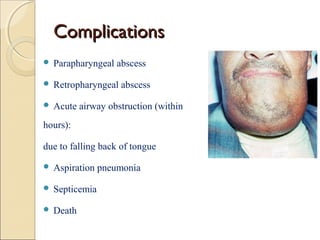
 submental swelling: Brawny induration
 Trismus
 Stridor: falling back of tongue causing upper airway obstn
 Initially cellulitis (no frank pus) ⇒ pus formation (only
at late stage)
 Parapharyngeal abscess
 Retropharyngeal abscess
 Acute airway obstruction (within
hours):
due to falling back of tongue
 Aspiration pneumonia
 Septicemia
 Death
ComplicationsComplications
Management:
1. I.V. antibiotics: Ceftriaxone + Metronidazole / Clindamycin
2. IV fluid for adequate hydration
3. Monitor vital signs regularly eg. assessment for disease
progression & airway compromise
4. Airway obstruction: Intubation / tracheostomy
5. Incision & drainage
Transverse incision from one angle of mandible to opposite angle
of mandible
Retropharyngeal space
It lies behind the pharynx
Superior: Base of skull
Inferior: Mediastinum (till tracheal bifurcation)
Anterior: Buccopharyngeal fascia
Posterior: pre-vertebral fascia
Contains lymph nodes (of Rouviere) which usually
disappear at 3-4 years of age
Retropharyngeal abscess
 Collection of pus in retropharyngeal space
 In children: Suppuration of retropharyngeal lymph
node of Rouviere from URTI
 In adults:
 Tubercular infection of retropharyngeal lymph
nodes/cervical spinepresents as posterior
pharyngeal wall swelling
Symptoms
 H/o upper respiratory tract infection
 Dysphagia / odynophagia
 Difficulty in breathing
 Neck stiffness/ torticollis
Signs
 Febrile, ill-looking, child with drooling
 Tender neck swelling
 Torticollis (twisted neck)
 Bulge on posterior pharyngeal wall
Torticollis
Widened pre-vertebral soft tissue
shadow
Air-fluid level & gas shadow
Tuberculosis of cervical spine with
retropharyngeal abscess
Complications
1. Airway obstruction:
2. Spread of abscess to other neck spaces
3. Spontaneous rupture of abscess
4. Septicemia
5. Death
Treatment
1. Broad spectrum intravenous antibiotics:
Ceftriaxone + Metronidazole
2. Incision & drainage: without anesthesia, supine with head
hanging down from the table, I & D at most bulging part
of posterior pharyngeal wall bulge, two powerful suctions
to suck out pus thus preventing aspiration
General anesthesia(GA) is contraindicated for fear of
rupture of abscess during intubationaspiration
3. Anti-tubercular therapy
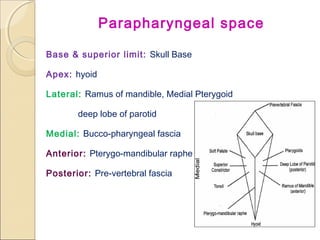
Parapharyngeal space
Base & superior limit: Skull Base
Apex: hyoid
Lateral: Ramus of mandible, Medial Pterygoid
deep lobe of parotid
Medial: Bucco-pharyngeal fascia
Anterior: Pterygo-mandibular raphe
Posterior: Pre-vertebral fascia
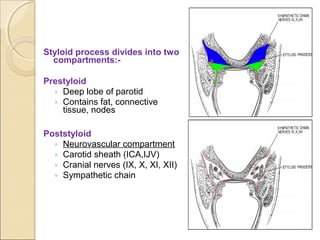
Styloid process divides into two
compartments:-
Prestyloid
◦ Deep lobe of parotid
◦ Contains fat, connective
tissue, nodes
Poststyloid
◦ Neurovascular compartment
◦ Carotid sheath (ICA,IJV)
◦ Cranial nerves (IX, X, XI, XII)
◦ Sympathetic chain
Contents of parapharyngeal space
Pre-styloid
• Deep lobe of parotid
•Lymph nodes
•Fat
•Connective tissue
Post-styloid
• Internal carotid artery
• Internal jugular vein
• Cranial nerves(IX,X,XI,XII)
• Sympathetic chain
• Lymph nodes
•Styloid process divides into two spaces
Etiology
 Pharynx: acute tonsillitis, peritonsillar abscess
 Teeth: dental infection (esp. lower last molar)
 Ear: Bezold’s abscess
 Spread from other neck abscess: parotid,
retropharyngeal, submandibular
 Penetrating neck injuries
Clinical features
1. Fever, sore throat, odynophagia, torticollis
2. Tonsils pushed medially
3. Trismus
4. Neck swelling behind angle of mandible
Management
1. IV antibiotics: Ceftriaxone + Metronidazole
2. Incision & drainage:
 Under GA with endotracheal intubation
 Horizontal incision made 3 cm below angle of mandible
 Trans-oral drainage avoided to prevent injury to carotid
artery & internal jugular vein
3. Tracheostomy for airway obstruction
Peritonsillar abscess (quinsy)
 Pus present in the peritonsillar space i.e. between tonsillar
capsule & superior pharyngeal constrictor muscle
 Causative agents: aerobic + anaerobic organisms
 Infection of Weber's gland (Minor salivary gland in supra
tonsillar fossa) → quinsy
 Following acute tonsilitis (Less commonly)
Clinical features
Symptoms: odynophagia, fever, halitosis & muffled voice
Signs:
1.Unilateral tonsil enlarged (infection in paratonsillar
spacepseudohypertrophy), pushed medially
2. Congested tonsil,tonsillar pillars, soft palate
3. Jugulo-digastric lymph node tender, enlarged
4. Trismus
Complications of quinsy
1. Parapharyngeal abscess
2. Retropharyngeal abscess
3. Laryngitis & laryngeal edema
4. Lung abscess
5. Internal jugular vein thrombosis
6. Septicemia
Management
Diagnosis: Peritonsillitis vs Peritonsillar
abscess
Needle aspiration → reveals pus i.e. quinsy
1. Broad spectum IV antibiotics:Ceftriaxone +Metronidazole
2. I.V. fluids & analgesics
3. Antiseptic mouth gargle
4. Repeated needle aspiration
5. Incision and drainage
Incision & drainage site
 Incision and drainage of quinsy:
1. I & D with quinsy forceps
2. I & D with No.11 surgical blade
3. Repeated pus aspiration with wide bore needle
Parotid abscess
 Debilitated & dehydrated pts (decreased salivary
flow)
 Causative organism: Staph. aureus, Streptococci,
Haemophilus & other organisms
 Ascending bacterial infection from oral cavity through
the duct to the gland
 Predisposing conditions: DM, Immunocompromised,
poor oro-dental hygeine
 Painful parotid region swelling
 Trismus
 Parotid massage expresses pus
from parotid duct opening
 Rx: Broad spectrum antibiotics
(Inj. Ampicillin plus cloxacillin, and
clindamycin)
 I & D: Modified Blair’s incision
Thank youThank you

Deep neck infection

  • 1.
    Deep neck spaceinfection Dr ramesh parajuli, MS Chitwan Medical College, Bharatpur-10, Chitwan, Nepal
  • 2.
    Fascial layers ofthe neck  Fascia is an investing fibrous tissue related to muscles & major neck structures. A. Superficial cervical fascia: B. Deep cervical fascia: 1. Superficial or investing layer 2. Middle layer or visceral fascia 3. Deep layer or pre-vertebral fascia
  • 3.
    (I)Superficial cervical fascia:encloses platysma (II) Deep cervical fascia (i)Investing layer: Encloses strap muscles, SCM, trapezius Parotid &submandibular glands, carotid sheath (ii)Middle or Visceral layer: encircles esophagus, trachea, thyroid (iii)Deep or pre-vertebral layer: Covers deep neck muscles i.e. prevertebral muscles
  • 5.
    Deep neck spaces Potential neck spaces  Contain loose areolar tissue  Spread of tumor and infection  Submental space  Submandibular space  Parotid  Peritonsillar  Parapharyngeal  Retropharyngeal  Pretracheal space  Prevertebral space
  • 8.
    Ludwig’s angina:  Rapidlyprogressing cellulitis of submandibular space (i.e. sublingual & submaxillary space)  Mixed flora (poly-microbial)  May result into life-threatening airway obstruction
  • 9.
    Subdivisions of submandibularspace 1. Sublingual space: above mylohyoid muscle 2. Submaxillary space: below mylohyoid muscle Contents: Submandibular salivary gland, lymph nodes
  • 10.
    Etiology: 1. Dental infection:80% cases Tooth (lower molars & premolars) Roots of premolars lie above mylohyoid ⇒ sublingual space infection Roots of molars lie below mylohyoid ⇒ submaxillary space infection 2. Injury to floor of mouth 3. Submandibular sialadenitis
  • 11.
    Causative agentsCausative agents Mixedaerobic & anaerobic infection  Streptococcus pyogenes  Streptococcus viridans  Streptococcus pneumoniae  Staphylococcus  Fusobacterium  Bacteroides  Peptostreptococcus
  • 12.
    Clinical featuresClinical features Toothache, fever, odynophagia, drooling of saliva  Floor of mouth swelling + tongue elevation  submental swelling: Brawny induration  Trismus  Stridor: falling back of tongue causing upper airway obstn  Initially cellulitis (no frank pus) ⇒ pus formation (only at late stage)
  • 13.
     Parapharyngeal abscess Retropharyngeal abscess  Acute airway obstruction (within hours): due to falling back of tongue  Aspiration pneumonia  Septicemia  Death ComplicationsComplications
  • 14.
    Management: 1. I.V. antibiotics:Ceftriaxone + Metronidazole / Clindamycin 2. IV fluid for adequate hydration 3. Monitor vital signs regularly eg. assessment for disease progression & airway compromise 4. Airway obstruction: Intubation / tracheostomy 5. Incision & drainage Transverse incision from one angle of mandible to opposite angle of mandible
  • 15.
    Retropharyngeal space It liesbehind the pharynx Superior: Base of skull Inferior: Mediastinum (till tracheal bifurcation) Anterior: Buccopharyngeal fascia Posterior: pre-vertebral fascia Contains lymph nodes (of Rouviere) which usually disappear at 3-4 years of age
  • 17.
    Retropharyngeal abscess  Collectionof pus in retropharyngeal space  In children: Suppuration of retropharyngeal lymph node of Rouviere from URTI  In adults:  Tubercular infection of retropharyngeal lymph nodes/cervical spinepresents as posterior pharyngeal wall swelling
  • 18.
    Symptoms  H/o upperrespiratory tract infection  Dysphagia / odynophagia  Difficulty in breathing  Neck stiffness/ torticollis
  • 19.
    Signs  Febrile, ill-looking,child with drooling  Tender neck swelling  Torticollis (twisted neck)  Bulge on posterior pharyngeal wall Torticollis
  • 20.
  • 21.
  • 22.
    Tuberculosis of cervicalspine with retropharyngeal abscess
  • 23.
    Complications 1. Airway obstruction: 2.Spread of abscess to other neck spaces 3. Spontaneous rupture of abscess 4. Septicemia 5. Death
  • 24.
    Treatment 1. Broad spectrumintravenous antibiotics: Ceftriaxone + Metronidazole 2. Incision & drainage: without anesthesia, supine with head hanging down from the table, I & D at most bulging part of posterior pharyngeal wall bulge, two powerful suctions to suck out pus thus preventing aspiration General anesthesia(GA) is contraindicated for fear of rupture of abscess during intubationaspiration 3. Anti-tubercular therapy
  • 25.
    Parapharyngeal space Base &superior limit: Skull Base Apex: hyoid Lateral: Ramus of mandible, Medial Pterygoid deep lobe of parotid Medial: Bucco-pharyngeal fascia Anterior: Pterygo-mandibular raphe Posterior: Pre-vertebral fascia
  • 27.
    Styloid process dividesinto two compartments:- Prestyloid ◦ Deep lobe of parotid ◦ Contains fat, connective tissue, nodes Poststyloid ◦ Neurovascular compartment ◦ Carotid sheath (ICA,IJV) ◦ Cranial nerves (IX, X, XI, XII) ◦ Sympathetic chain
  • 28.
    Contents of parapharyngealspace Pre-styloid • Deep lobe of parotid •Lymph nodes •Fat •Connective tissue Post-styloid • Internal carotid artery • Internal jugular vein • Cranial nerves(IX,X,XI,XII) • Sympathetic chain • Lymph nodes •Styloid process divides into two spaces
  • 29.
    Etiology  Pharynx: acutetonsillitis, peritonsillar abscess  Teeth: dental infection (esp. lower last molar)  Ear: Bezold’s abscess  Spread from other neck abscess: parotid, retropharyngeal, submandibular  Penetrating neck injuries
  • 30.
    Clinical features 1. Fever,sore throat, odynophagia, torticollis 2. Tonsils pushed medially 3. Trismus 4. Neck swelling behind angle of mandible
  • 31.
    Management 1. IV antibiotics:Ceftriaxone + Metronidazole 2. Incision & drainage:  Under GA with endotracheal intubation  Horizontal incision made 3 cm below angle of mandible  Trans-oral drainage avoided to prevent injury to carotid artery & internal jugular vein 3. Tracheostomy for airway obstruction
  • 32.
    Peritonsillar abscess (quinsy) Pus present in the peritonsillar space i.e. between tonsillar capsule & superior pharyngeal constrictor muscle  Causative agents: aerobic + anaerobic organisms  Infection of Weber's gland (Minor salivary gland in supra tonsillar fossa) → quinsy  Following acute tonsilitis (Less commonly)
  • 33.
    Clinical features Symptoms: odynophagia,fever, halitosis & muffled voice Signs: 1.Unilateral tonsil enlarged (infection in paratonsillar spacepseudohypertrophy), pushed medially 2. Congested tonsil,tonsillar pillars, soft palate 3. Jugulo-digastric lymph node tender, enlarged 4. Trismus
  • 34.
    Complications of quinsy 1.Parapharyngeal abscess 2. Retropharyngeal abscess 3. Laryngitis & laryngeal edema 4. Lung abscess 5. Internal jugular vein thrombosis 6. Septicemia
  • 35.
    Management Diagnosis: Peritonsillitis vsPeritonsillar abscess Needle aspiration → reveals pus i.e. quinsy 1. Broad spectum IV antibiotics:Ceftriaxone +Metronidazole 2. I.V. fluids & analgesics 3. Antiseptic mouth gargle 4. Repeated needle aspiration 5. Incision and drainage
  • 36.
  • 37.
     Incision anddrainage of quinsy: 1. I & D with quinsy forceps 2. I & D with No.11 surgical blade 3. Repeated pus aspiration with wide bore needle
  • 38.
    Parotid abscess  Debilitated& dehydrated pts (decreased salivary flow)  Causative organism: Staph. aureus, Streptococci, Haemophilus & other organisms  Ascending bacterial infection from oral cavity through the duct to the gland  Predisposing conditions: DM, Immunocompromised, poor oro-dental hygeine
  • 39.
     Painful parotidregion swelling  Trismus  Parotid massage expresses pus from parotid duct opening  Rx: Broad spectrum antibiotics (Inj. Ampicillin plus cloxacillin, and clindamycin)  I & D: Modified Blair’s incision
  • 40.