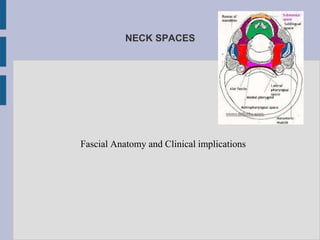
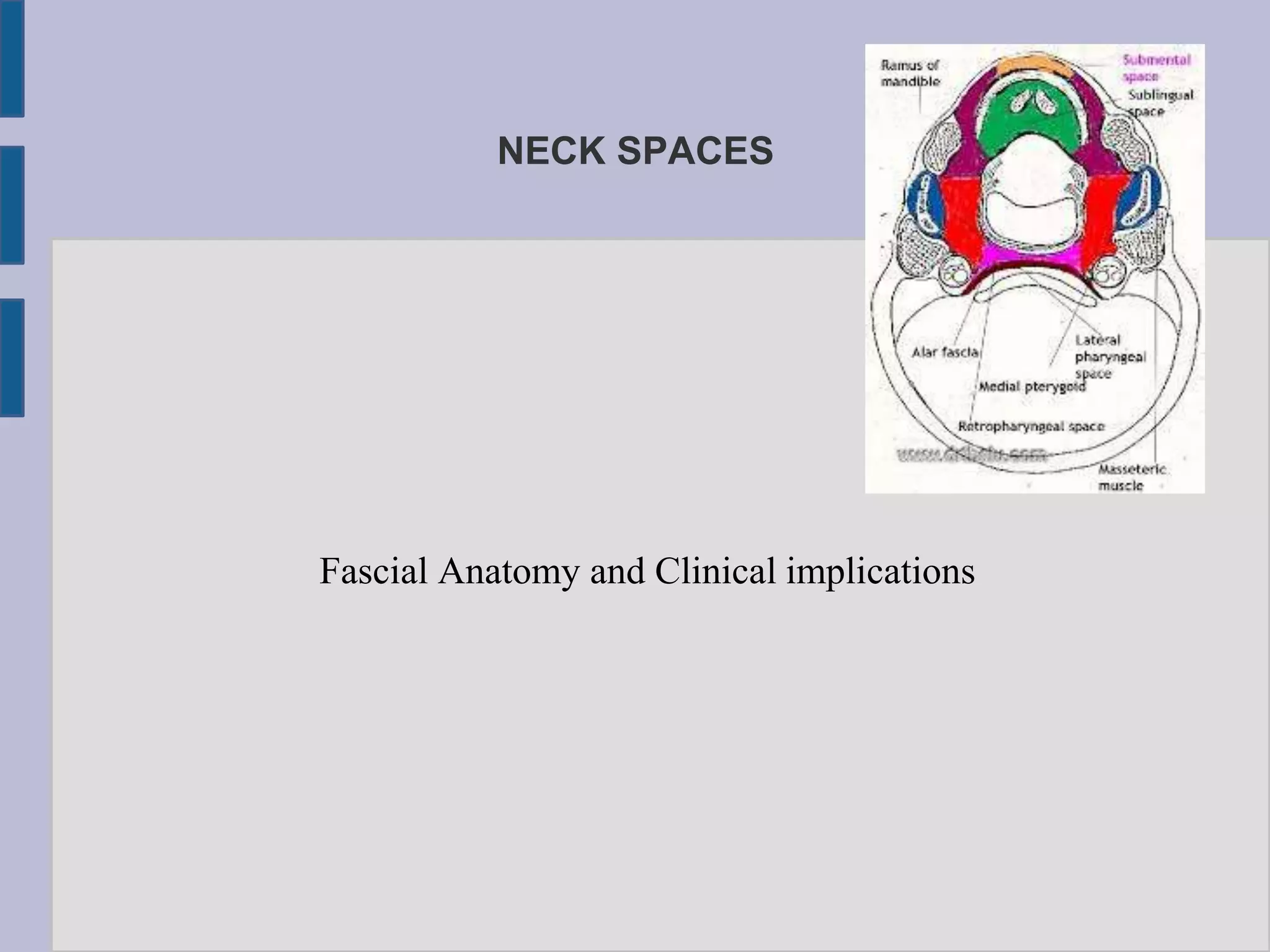
NECK SPACES
Fascial Anatomy and Clinical implications
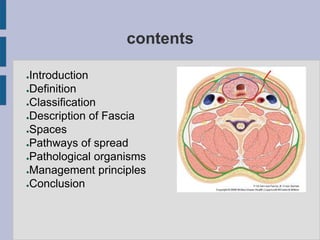
contents
โ—Introduction
โ—Definition
โ—Classification
โ—Description of Fascia
โ—Spaces
โ—Pathways of spread
โ—Pathological organisms
โ—Management principles
โ—Conclusion
Introduction
โ—The infection in orofacial region does not spread haphazardly
through the loose connective tissue, but tends to accumulate in the
potential spaces around the head and neck
โ—Many of these spaces communicate with each other
โ—Knowledge of the spaces and potential area of communication assist
with not only the management but also assist us with potential
spread points
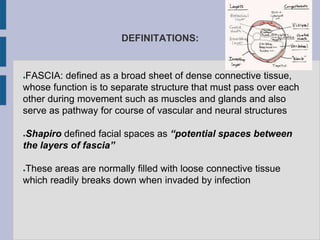
DEFINITATIONS:
โ—FASCIA: defined as a broad sheet of dense connective tissue,
whose function is to separate structure that must pass over each
other during movement such as muscles and glands and also
serve as pathway for course of vascular and neural structures
โ—Shapiro defined facial spaces as โ€œpotential spaces between
the layers of fasciaโ€
โ—These areas are normally filled with loose connective tissue
which readily breaks down when invaded by infection
Classifications:
โ— Grodinsky and Holyoke in 1938
โ— Space 1 โ€“ the potential space superficial and deep to
platysma muscle
โ— Space 2. - the space behind the anterior laryer of deep
cervical fascia
โ— Space 3 โ€“ pretracheal space lies anterior to trachea
โ— Space 3a โ€“ lincolnโ€s highway
โ— Space 4 โ€“ danger space, potential space between the alar
and prevertebral fascia
Based on Clinical significance
โ— Face: - buccal, canine, masticatory and parotid
โ— Suprahyoid: - sublingual, submandicular, lateral pharyngeal
and peritonsillar
โ— Infrahyoid: - pretracheal
โ— Spaces of total neck :- retropharyngeal, parapharyngeal and
space of carotid sheath
Based on mode of involvement
โ— Direct involvement
Primary spaces : maxillary space
Mandibular spaces
โ— Indirect imvolvement: secondary spaces
FASCIA DESCRIBED UNDER:
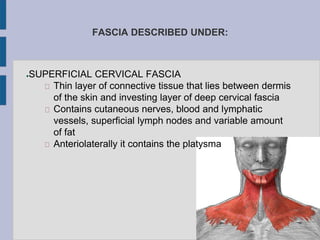
โ—SUPERFICIAL CERVICAL FASCIA
Thin layer of connective tissue that lies between dermis
of the skin and investing layer of deep cervical fascia
Contains cutaneous nerves, blood and lymphatic
vessels, superficial lymph nodes and variable amount
of fat
Anteriolaterally it contains the platysma
VISCERAL LAYER
โ— Middle layer
Muscular division โ€“ surrounds the infrahyoid strap
muscles
Visceral division envelops the pharynx, larynx,
oesophagus, trachea and the thyroid gland
Passes inferiorly into the upper mediastinum where it
is continious with the fibrous pericardium and covers
the trachea and oesophagus
Above hyoid this layer continues on the posterior
pharyngeal wall as the buccopharyngeal fascia
Primary surgical significance of this layer is it must be
divided in midline in a surgical approach to trachea or
thyroid gland
DEEP LAYER
โ— Originates from the spinous processes of the cervical
vertebra and ligamentum nuchae
โ— At the transverse process of the cervical vertebra, it divides
into an anterior alar layer and posterior prevertebral layer
โ— Alar fascia extends from base of skull to the second thoracic
vertebra
โ— Prevertebral fascia lies just anterior to the vertebral bodies
and extends the entire length of vertebral column
FASCIA
โ—Deep cervical fascia consists of FOUR fascial layers
โ—Investing or superficial or anterior layer
โ—Pretracheal or middle layer
โ—Prevertebral or posterior layer
โ—Carotid sheath
โ—These layers support the viscera, muscles, vessels and deep
lymph nodes
โ—Provide the slipperiness that allows the structures in the neck
to move and pass over one another without difficulty (e.g.
when turning the head and swallowing)
โ—Layers form natural cleavage planes, allowing seperation of
tissues during surgery
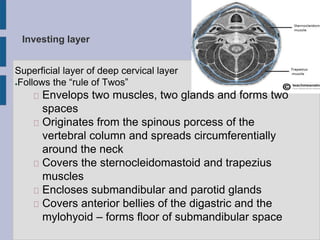
Investing layer
Superficial layer of deep cervical layer
โ—Follows the โ€œrule of Twosโ€
Envelops two muscles, two glands and forms two
spaces
Originates from the spinous porcess of the
vertebral column and spreads circumferentially
around the neck
Covers the sternocleidomastoid and trapezius
muscles
Encloses submandibular and parotid glands
Covers anterior bellies of the digastric and the
mylohyoid โ€“ forms floor of submandibular space
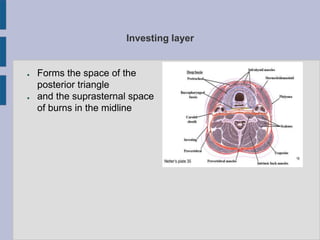
Investing layer
โ— Forms the space of the
posterior triangle
โ— and the suprasternal space
of burns in the midline
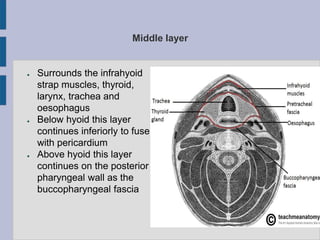
Middle layer
โ— Surrounds the infrahyoid
strap muscles, thyroid,
larynx, trachea and
oesophagus
โ— Below hyoid this layer
continues inferiorly to fuse
with pericardium
โ— Above hyoid this layer
continues on the posterior
pharyngeal wall as the
buccopharyngeal fascia
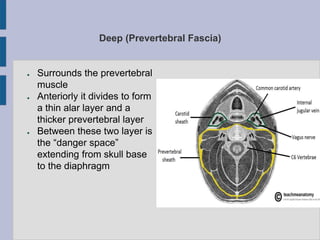
Deep (Prevertebral Fascia)
โ— Surrounds the prevertebral
muscle
โ— Anteriorly it divides to form
a thin alar layer and a
thicker prevertebral layer
โ— Between these two layer is
the โ€œdanger spaceโ€
extending from skull base
to the diaphragm
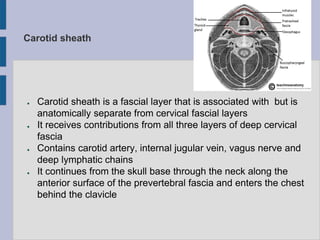
Carotid sheath
โ— Carotid sheath is a fascial layer that is associated with but is
anatomically separate from cervical fascial layers
โ— It receives contributions from all three layers of deep cervical
fascia
โ— Contains carotid artery, internal jugular vein, vagus nerve and
deep lymphatic chains
โ— It continues from the skull base through the neck along the
anterior surface of the prevertebral fascia and enters the chest
behind the clavicle
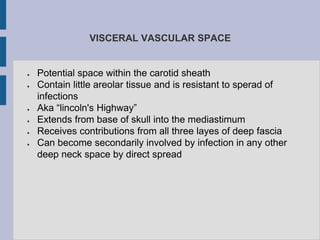
VISCERAL VASCULAR SPACE
โ— Potential space within the carotid sheath
โ— Contain little areolar tissue and is resistant to sperad of
infections
โ— Aka โ€œlincoln's Highwayโ€
โ— Extends from base of skull into the mediastimum
โ— Receives contributions from all three layes of deep fascia
โ— Can become secondarily involved by infection in any other
deep neck space by direct spread
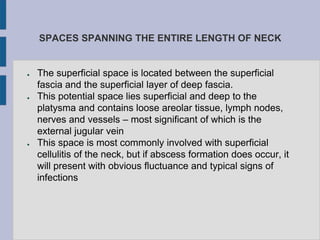
SPACES SPANNING THE ENTIRE LENGTH OF NECK
โ— The superficial space is located between the superficial
fascia and the superficial layer of deep fascia.
โ— This potential space lies superficial and deep to the
platysma and contains loose areolar tissue, lymph nodes,
nerves and vessels โ€“ most significant of which is the
external jugular vein
โ— This space is most commonly involved with superficial
cellulitis of the neck, but if abscess formation does occur, it
will present with obvious fluctuance and typical signs of
infections
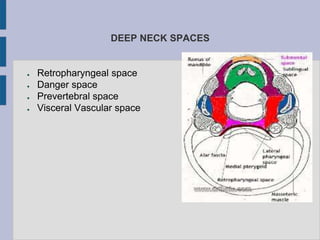
DEEP NECK SPACES
โ— Retropharyngeal space
โ— Danger space
โ— Prevertebral space
โ— Visceral Vascular space
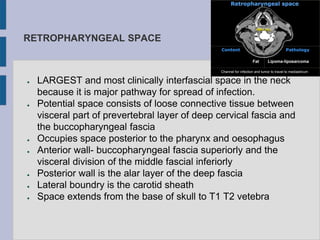
RETROPHARYNGEAL SPACE
โ— LARGEST and most clinically interfascial space in the neck
because it is major pathway for spread of infection.
โ— Potential space consists of loose connective tissue between
visceral part of prevertebral layer of deep cervical fascia and
the buccopharyngeal fascia
โ— Occupies space posterior to the pharynx and oesophagus
โ— Anterior wall- buccopharyngeal fascia superiorly and the
visceral division of the middle fascial inferiorly
โ— Posterior wall is the alar layer of the deep fascia
โ— Lateral boundry is the carotid sheath
โ— Space extends from the base of skull to T1 T2 vetebra
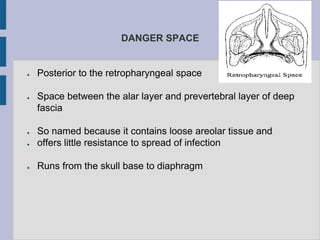
DANGER SPACE
โ— Posterior to the retropharyngeal space
โ— Space between the alar layer and prevertebral layer of deep
fascia
โ— So named because it contains loose areolar tissue and
โ— offers little resistance to spread of infection
โ— Runs from the skull base to diaphragm
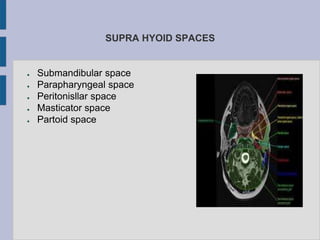
SUPRA HYOID SPACES
โ— Submandibular space
โ— Parapharyngeal space
โ— Peritonisllar space
โ— Masticator space
โ— Partoid space
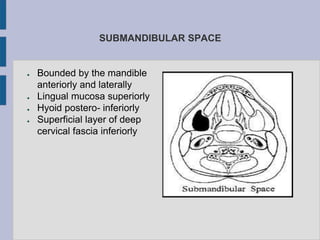
SUBMANDIBULAR SPACE
โ— Bounded by the mandible
anteriorly and laterally
โ— Lingual mucosa superiorly
โ— Hyoid postero- inferiorly
โ— Superficial layer of deep
cervical fascia inferiorly
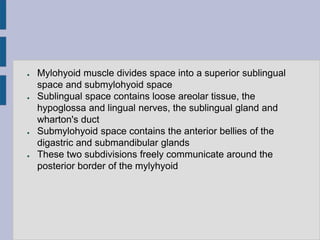
โ— Mylohyoid muscle divides space into a superior sublingual
space and submylohyoid space
โ— Sublingual space contains loose areolar tissue, the
hypoglossa and lingual nerves, the sublingual gland and
wharton's duct
โ— Submylohyoid space contains the anterior bellies of the
digastric and submandibular glands
โ— These two subdivisions freely communicate around the
posterior border of the mylyhyoid
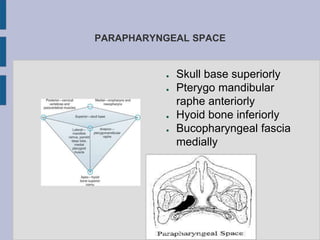
PARAPHARYNGEAL SPACE
โ— Skull base superiorly
โ— Pterygo mandibular
raphe anteriorly
โ— Hyoid bone inferiorly
โ— Bucopharyngeal fascia
medially
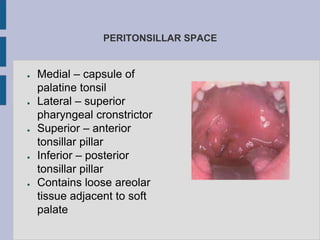
PERITONSILLAR SPACE
โ— Medial โ€“ capsule of
palatine tonsil
โ— Lateral โ€“ superior
pharyngeal cronstrictor
โ— Superior โ€“ anterior
tonsillar pillar
โ— Inferior โ€“ posterior
tonsillar pillar
โ— Contains loose areolar
tissue adjacent to soft
palate
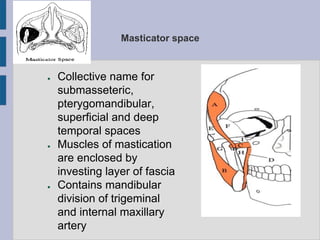
Masticator space
โ— Collective name for
submasseteric,
pterygomandibular,
superficial and deep
temporal spaces
โ— Muscles of mastication
are enclosed by
investing layer of fascia
โ— Contains mandibular
division of trigeminal
and internal maxillary
artery
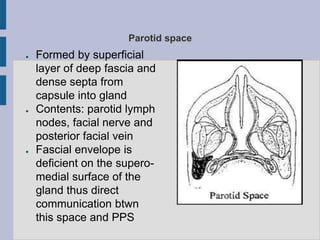
Parotid space
โ— Formed by superficial
layer of deep fascia and
dense septa from
capsule into gland
โ— Contents: parotid lymph
nodes, facial nerve and
posterior facial vein
โ— Fascial envelope is
deficient on the supero-
medial surface of the
gland thus direct
communication btwn
this space and PPS
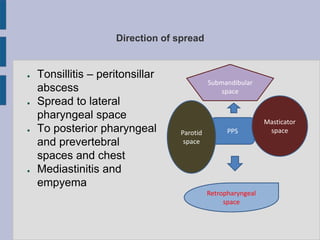
Direction of spread
โ— Tonsillitis โ€“ peritonsillar
abscess
โ— Spread to lateral
pharyngeal space
โ— To posterior pharyngeal
and prevertebral
spaces and chest
โ— Mediastinitis and
empyema
PPSParotid
space
Masticator
space
Submandibular
space
Retropharyngeal
space
Retropharyngeal abscess in children
โ— Most common deep neck abscess
โ— Retropharyngeal lymph nodes tend to involute with age
โ— Source of infections suppurative process in the nose,
nasopharynx, sinus and adenoids
โ— 96% of abscesses occur prior to 6 years of age
Common symptoms
โ— Fever
โ— Irritability
โ— Torticollis
โ— Trismus
โ— Cervical lymphadenopathy
โ— Posterior pharyngeal bulge
โ— Children often have poor
oral intake due to sore
throat initially
โ— Followed by dysphagia and
drooling
โ— Finally if not treated may
get laryngeal oedema and
respiratory distress
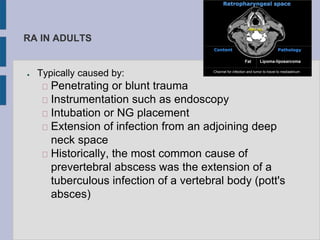
RA IN ADULTS
โ— Typically caused by:
Penetrating or blunt trauma
Instrumentation such as endoscopy
Intubation or NG placement
Extension of infection from an adjoining deep
neck space
Historically, the most common cause of
prevertebral abscess was the extension of a
tuberculous infection of a vertebral body (pott's
absces)
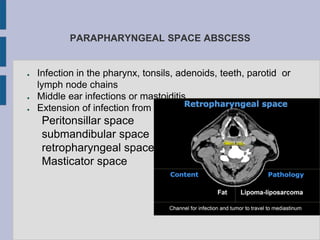
PARAPHARYNGEAL SPACE ABSCESS
โ— Infection in the pharynx, tonsils, adenoids, teeth, parotid or
lymph node chains
โ— Middle ear infections or mastoiditis
โ— Extension of infection from the nearby:
Peritonsillar space
submandibular space
retropharyngeal space
Masticator space
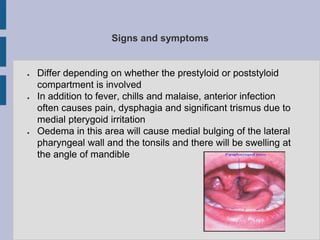
Signs and symptoms
โ— Differ depending on whether the prestyloid or poststyloid
compartment is involved
โ— In addition to fever, chills and malaise, anterior infection
often causes pain, dysphagia and significant trismus due to
medial pterygoid irritation
โ— Oedema in this area will cause medial bulging of the lateral
pharyngeal wall and the tonsils and there will be swelling at
the angle of mandible
โ— Posterior compartment infection may have no localizing
signs on examination
โ— Despite this patients do appear toxic โ€œPUOโ€
โ— Involvement of neurovascular structures in this area may
lead to neuropathies, horner's syndrome, septic internal
jugular thrombosis or carotid artery rupture
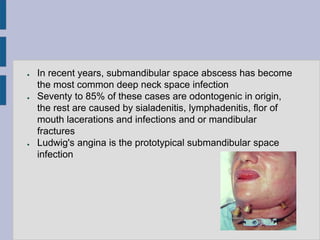
โ— In recent years, submandibular space abscess has become
the most common deep neck space infection
โ— Seventy to 85% of these cases are odontogenic in origin,
the rest are caused by sialadenitis, lymphadenitis, flor of
mouth lacerations and infections and or mandibular
fractures
โ— Ludwig's angina is the prototypical submandibular space
infection
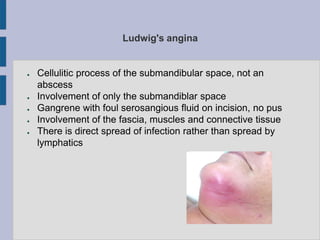
Ludwig's angina
โ— Cellulitic process of the submandibular space, not an
abscess
โ— Involvement of only the submandiblar space
โ— Gangrene with foul serosangious fluid on incision, no pus
โ— Involvement of the fascia, muscles and connective tissue
โ— There is direct spread of infection rather than spread by
lymphatics
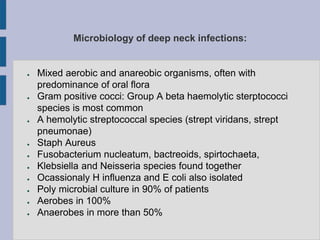
Microbiology of deep neck infections:
โ— Mixed aerobic and anareobic organisms, often with
predominance of oral flora
โ— Gram positive cocci: Group A beta haemolytic sterptococci
species is most common
โ— A hemolytic streptococcal species (strept viridans, strept
pneumonae)
โ— Staph Aureus
โ— Fusobacterium nucleatum, bactreoids, spirtochaeta,
โ— Klebsiella and Neisseria species found together
โ— Ocassionaly H influenza and E coli also isolated
โ— Poly microbial culture in 90% of patients
โ— Aerobes in 100%
โ— Anaerobes in more than 50%
Management PRINCIPLES
โ—Airway protection
โ—Appropriate antimicrobial therapy
โ—Surgical drainage
CONCLUSION
Early recognition of orofacial infection and prompt
appropriate therapy is essential
A sound knowledge of anatomy of face and neck is
necessary to predict pathways of spread of
infection and drain the spaces adequately
THANK YOU......
Deep Neck Spaces
Deep Neck Spaces
Deep Neck Spaces
Deep Neck Spaces
Deep Neck Spaces
Deep Neck Spaces
Deep Neck Spaces

Deep Neck Spaces

  • 1.
    NECK SPACES Fascial Anatomyand Clinical implications
  • 2.
    contents โ—Introduction โ—Definition โ—Classification โ—Description of Fascia โ—Spaces โ—Pathwaysof spread โ—Pathological organisms โ—Management principles โ—Conclusion
  • 3.
    Introduction โ—The infection inorofacial region does not spread haphazardly through the loose connective tissue, but tends to accumulate in the potential spaces around the head and neck โ—Many of these spaces communicate with each other โ—Knowledge of the spaces and potential area of communication assist with not only the management but also assist us with potential spread points
  • 4.
    DEFINITATIONS: โ—FASCIA: defined asa broad sheet of dense connective tissue, whose function is to separate structure that must pass over each other during movement such as muscles and glands and also serve as pathway for course of vascular and neural structures โ—Shapiro defined facial spaces as โ€œpotential spaces between the layers of fasciaโ€ โ—These areas are normally filled with loose connective tissue which readily breaks down when invaded by infection
  • 5.
    Classifications: โ— Grodinsky andHolyoke in 1938 โ— Space 1 โ€“ the potential space superficial and deep to platysma muscle โ— Space 2. - the space behind the anterior laryer of deep cervical fascia โ— Space 3 โ€“ pretracheal space lies anterior to trachea โ— Space 3a โ€“ lincolnโ€s highway โ— Space 4 โ€“ danger space, potential space between the alar and prevertebral fascia
  • 6.
    Based on Clinicalsignificance โ— Face: - buccal, canine, masticatory and parotid โ— Suprahyoid: - sublingual, submandicular, lateral pharyngeal and peritonsillar โ— Infrahyoid: - pretracheal โ— Spaces of total neck :- retropharyngeal, parapharyngeal and space of carotid sheath
  • 7.
    Based on modeof involvement โ— Direct involvement Primary spaces : maxillary space Mandibular spaces โ— Indirect imvolvement: secondary spaces
  • 8.
    FASCIA DESCRIBED UNDER: โ—SUPERFICIALCERVICAL FASCIA Thin layer of connective tissue that lies between dermis of the skin and investing layer of deep cervical fascia Contains cutaneous nerves, blood and lymphatic vessels, superficial lymph nodes and variable amount of fat Anteriolaterally it contains the platysma
  • 9.
    VISCERAL LAYER โ— Middlelayer Muscular division โ€“ surrounds the infrahyoid strap muscles Visceral division envelops the pharynx, larynx, oesophagus, trachea and the thyroid gland Passes inferiorly into the upper mediastinum where it is continious with the fibrous pericardium and covers the trachea and oesophagus Above hyoid this layer continues on the posterior pharyngeal wall as the buccopharyngeal fascia Primary surgical significance of this layer is it must be divided in midline in a surgical approach to trachea or thyroid gland
  • 10.
    DEEP LAYER โ— Originatesfrom the spinous processes of the cervical vertebra and ligamentum nuchae โ— At the transverse process of the cervical vertebra, it divides into an anterior alar layer and posterior prevertebral layer โ— Alar fascia extends from base of skull to the second thoracic vertebra โ— Prevertebral fascia lies just anterior to the vertebral bodies and extends the entire length of vertebral column
  • 11.
    FASCIA โ—Deep cervical fasciaconsists of FOUR fascial layers โ—Investing or superficial or anterior layer โ—Pretracheal or middle layer โ—Prevertebral or posterior layer โ—Carotid sheath โ—These layers support the viscera, muscles, vessels and deep lymph nodes โ—Provide the slipperiness that allows the structures in the neck to move and pass over one another without difficulty (e.g. when turning the head and swallowing) โ—Layers form natural cleavage planes, allowing seperation of tissues during surgery
  • 12.
    Investing layer Superficial layerof deep cervical layer โ—Follows the โ€œrule of Twosโ€ Envelops two muscles, two glands and forms two spaces Originates from the spinous porcess of the vertebral column and spreads circumferentially around the neck Covers the sternocleidomastoid and trapezius muscles Encloses submandibular and parotid glands Covers anterior bellies of the digastric and the mylohyoid โ€“ forms floor of submandibular space
  • 13.
    Investing layer โ— Formsthe space of the posterior triangle โ— and the suprasternal space of burns in the midline
  • 14.
    Middle layer โ— Surroundsthe infrahyoid strap muscles, thyroid, larynx, trachea and oesophagus โ— Below hyoid this layer continues inferiorly to fuse with pericardium โ— Above hyoid this layer continues on the posterior pharyngeal wall as the buccopharyngeal fascia
  • 15.
    Deep (Prevertebral Fascia) โ—Surrounds the prevertebral muscle โ— Anteriorly it divides to form a thin alar layer and a thicker prevertebral layer โ— Between these two layer is the โ€œdanger spaceโ€ extending from skull base to the diaphragm
  • 16.
    Carotid sheath โ— Carotidsheath is a fascial layer that is associated with but is anatomically separate from cervical fascial layers โ— It receives contributions from all three layers of deep cervical fascia โ— Contains carotid artery, internal jugular vein, vagus nerve and deep lymphatic chains โ— It continues from the skull base through the neck along the anterior surface of the prevertebral fascia and enters the chest behind the clavicle
  • 17.
    VISCERAL VASCULAR SPACE โ—Potential space within the carotid sheath โ— Contain little areolar tissue and is resistant to sperad of infections โ— Aka โ€œlincoln's Highwayโ€ โ— Extends from base of skull into the mediastimum โ— Receives contributions from all three layes of deep fascia โ— Can become secondarily involved by infection in any other deep neck space by direct spread
  • 18.
    SPACES SPANNING THEENTIRE LENGTH OF NECK โ— The superficial space is located between the superficial fascia and the superficial layer of deep fascia. โ— This potential space lies superficial and deep to the platysma and contains loose areolar tissue, lymph nodes, nerves and vessels โ€“ most significant of which is the external jugular vein โ— This space is most commonly involved with superficial cellulitis of the neck, but if abscess formation does occur, it will present with obvious fluctuance and typical signs of infections
  • 19.
    DEEP NECK SPACES โ—Retropharyngeal space โ— Danger space โ— Prevertebral space โ— Visceral Vascular space
  • 20.
    RETROPHARYNGEAL SPACE โ— LARGESTand most clinically interfascial space in the neck because it is major pathway for spread of infection. โ— Potential space consists of loose connective tissue between visceral part of prevertebral layer of deep cervical fascia and the buccopharyngeal fascia โ— Occupies space posterior to the pharynx and oesophagus โ— Anterior wall- buccopharyngeal fascia superiorly and the visceral division of the middle fascial inferiorly โ— Posterior wall is the alar layer of the deep fascia โ— Lateral boundry is the carotid sheath โ— Space extends from the base of skull to T1 T2 vetebra
  • 21.
    DANGER SPACE โ— Posteriorto the retropharyngeal space โ— Space between the alar layer and prevertebral layer of deep fascia โ— So named because it contains loose areolar tissue and โ— offers little resistance to spread of infection โ— Runs from the skull base to diaphragm
  • 22.
    SUPRA HYOID SPACES โ—Submandibular space โ— Parapharyngeal space โ— Peritonisllar space โ— Masticator space โ— Partoid space
  • 23.
    SUBMANDIBULAR SPACE โ— Boundedby the mandible anteriorly and laterally โ— Lingual mucosa superiorly โ— Hyoid postero- inferiorly โ— Superficial layer of deep cervical fascia inferiorly
  • 24.
    โ— Mylohyoid muscledivides space into a superior sublingual space and submylohyoid space โ— Sublingual space contains loose areolar tissue, the hypoglossa and lingual nerves, the sublingual gland and wharton's duct โ— Submylohyoid space contains the anterior bellies of the digastric and submandibular glands โ— These two subdivisions freely communicate around the posterior border of the mylyhyoid
  • 25.
    PARAPHARYNGEAL SPACE โ— Skullbase superiorly โ— Pterygo mandibular raphe anteriorly โ— Hyoid bone inferiorly โ— Bucopharyngeal fascia medially
  • 26.
    PERITONSILLAR SPACE โ— Medialโ€“ capsule of palatine tonsil โ— Lateral โ€“ superior pharyngeal cronstrictor โ— Superior โ€“ anterior tonsillar pillar โ— Inferior โ€“ posterior tonsillar pillar โ— Contains loose areolar tissue adjacent to soft palate
  • 27.
    Masticator space โ— Collectivename for submasseteric, pterygomandibular, superficial and deep temporal spaces โ— Muscles of mastication are enclosed by investing layer of fascia โ— Contains mandibular division of trigeminal and internal maxillary artery
  • 28.
    Parotid space โ— Formedby superficial layer of deep fascia and dense septa from capsule into gland โ— Contents: parotid lymph nodes, facial nerve and posterior facial vein โ— Fascial envelope is deficient on the supero- medial surface of the gland thus direct communication btwn this space and PPS
  • 29.
    Direction of spread โ—Tonsillitis โ€“ peritonsillar abscess โ— Spread to lateral pharyngeal space โ— To posterior pharyngeal and prevertebral spaces and chest โ— Mediastinitis and empyema PPSParotid space Masticator space Submandibular space Retropharyngeal space
  • 30.
    Retropharyngeal abscess inchildren โ— Most common deep neck abscess โ— Retropharyngeal lymph nodes tend to involute with age โ— Source of infections suppurative process in the nose, nasopharynx, sinus and adenoids โ— 96% of abscesses occur prior to 6 years of age
  • 31.
    Common symptoms โ— Fever โ—Irritability โ— Torticollis โ— Trismus โ— Cervical lymphadenopathy โ— Posterior pharyngeal bulge โ— Children often have poor oral intake due to sore throat initially โ— Followed by dysphagia and drooling โ— Finally if not treated may get laryngeal oedema and respiratory distress
  • 32.
    RA IN ADULTS โ—Typically caused by: Penetrating or blunt trauma Instrumentation such as endoscopy Intubation or NG placement Extension of infection from an adjoining deep neck space Historically, the most common cause of prevertebral abscess was the extension of a tuberculous infection of a vertebral body (pott's absces)
  • 33.
    PARAPHARYNGEAL SPACE ABSCESS โ—Infection in the pharynx, tonsils, adenoids, teeth, parotid or lymph node chains โ— Middle ear infections or mastoiditis โ— Extension of infection from the nearby: Peritonsillar space submandibular space retropharyngeal space Masticator space
  • 34.
    Signs and symptoms โ—Differ depending on whether the prestyloid or poststyloid compartment is involved โ— In addition to fever, chills and malaise, anterior infection often causes pain, dysphagia and significant trismus due to medial pterygoid irritation โ— Oedema in this area will cause medial bulging of the lateral pharyngeal wall and the tonsils and there will be swelling at the angle of mandible
  • 35.
    โ— Posterior compartmentinfection may have no localizing signs on examination โ— Despite this patients do appear toxic โ€œPUOโ€ โ— Involvement of neurovascular structures in this area may lead to neuropathies, horner's syndrome, septic internal jugular thrombosis or carotid artery rupture
  • 36.
    โ— In recentyears, submandibular space abscess has become the most common deep neck space infection โ— Seventy to 85% of these cases are odontogenic in origin, the rest are caused by sialadenitis, lymphadenitis, flor of mouth lacerations and infections and or mandibular fractures โ— Ludwig's angina is the prototypical submandibular space infection
  • 37.
    Ludwig's angina โ— Celluliticprocess of the submandibular space, not an abscess โ— Involvement of only the submandiblar space โ— Gangrene with foul serosangious fluid on incision, no pus โ— Involvement of the fascia, muscles and connective tissue โ— There is direct spread of infection rather than spread by lymphatics
  • 38.
    Microbiology of deepneck infections: โ— Mixed aerobic and anareobic organisms, often with predominance of oral flora โ— Gram positive cocci: Group A beta haemolytic sterptococci species is most common โ— A hemolytic streptococcal species (strept viridans, strept pneumonae) โ— Staph Aureus โ— Fusobacterium nucleatum, bactreoids, spirtochaeta, โ— Klebsiella and Neisseria species found together โ— Ocassionaly H influenza and E coli also isolated โ— Poly microbial culture in 90% of patients โ— Aerobes in 100% โ— Anaerobes in more than 50%
  • 39.
    Management PRINCIPLES โ—Airway protection โ—Appropriateantimicrobial therapy โ—Surgical drainage
  • 40.
    CONCLUSION Early recognition oforofacial infection and prompt appropriate therapy is essential A sound knowledge of anatomy of face and neck is necessary to predict pathways of spread of infection and drain the spaces adequately
  • 41.

Editor's Notes

  • #28ย A temporalis muscle B masseter muscle C lateral pterygoid D medial pterygoid E superficial temporal space f deep temporal space G submasseteric space, H pterygomandibular space I infratemporal space
  • #30ย Lateral pharyngeal space to the contents of carotid sheath, int jug vein thrombosis, subacute bacterial endocarditis, pulm emboli, carotid artery thrombosis, CVA, horner syndrome etc