Lower GIT Bleeding
Presented by:
Students no. (31-50)
Round 1
Definition
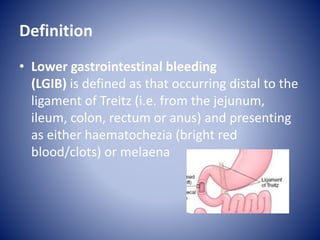
• Lower gastrointestinal bleeding
(LGIB) is defined as that occurring distal to the
ligament of Treitz (i.e. from the jejunum,
ileum, colon, rectum or anus) and presenting
as either haematochezia (bright red
blood/clots) or melaena
Epidemiology
• The incidence of LGIB is only one-fifth that of
the upper gastrointestinal tract and is
estimated to be ~24 per 100 000 adults per
year.
• Male and older patients tend to suffer from
more severe LGIB
Risk factors
• medications (e.g. NSAID, warfarin)
• recent colonoscopy with polypectomy
(postpolypectomy bleeding)
• prior abdominal/pelvic radiation (radiation
proctitis/colitis)
• prior operation
• history of alcoholism or chronic liver disease
• history of abdominal aortic anuerysm with or
without surgical repair (aortoenteric fistula)
Causes
• Diverticular disease
• enterocolitis
– infective
– Crohn’s disease
– Ulcerative colitis
– Ischemic colitis
• vascular malformation
– vascular ectasia
– Angiodysplasia
– arteriovenous malformation (AVM)
• polyp
• tumour
• Vasculitides
• Portal hypertensive enteropathy or colopathy
• Meckel diverticulum
• ulcer
• Aorto-enteric fistula
• Anal fissure
• Haemorrhoids
• Perianal fistula
Aetiology
• Although LGIB can occur at any age, specific
disease processes are distinctive for different age
groups and familiarity with this can help tailor the
diagnostic workup :
-adolescents and young adults: inflammatory bowel
diseases, polyps, Meckel’s diverticulum.
-up to 60 years: diverticula, inflammatory bowel
diseases, malignancy
-older than 60 years: arteriovenous
malformations, diverticula, malignancy
Clinical presentation
• Acute bleeding is defined as bleeding of <3 days
duration resulting in instability of vital signs,
anaemia and/or the need for blood transfusion.
• Chronic bleeding is defined as slow blood loss
over a period of several days or longer, presenting
with symptoms of occult faecal blood,
intermittent melaena or scant hematochezia.
• LGIB usually is chronic and the bleeding ceases
spontaneously (80%).
Diverticular disease
• Out-pouchings of bowel result in blind-ended
diverticulae in communication with the lumen
of the bowel.
• They most commonly occur within
the sigmoid colon, although they may be
present throughout the bowel.
Clinical presentation
• The vast majority of people with diverticulosis
are asymptomatic.
• Patients complain of intermittent left sided
abdominal pain and frequent constipation.
Symptomatic presenting features of
diverticular disease (i.e. presentation of
complicated diverticulosis) includes:
-diverticulitis
-GIT hemorrhage
Crohn’s disease
• idiopathic inflammatory bowel disease,
characterised by widespread GIT involvement
typically with skip lesions, thereby its
synonym regional enteritis, and frequently
systemic involvement
Clinical presentation
• Clinical presentation is typically with chronic
diarrhoea and recurrent abdominal pain.
• Alternatively, patients may present with one of
the many complications or extraintestinal
manifestations
-skin …
-joints …
-eyes …
-liver and biliary system …
Ulcerative colitis
• inflammatory bowel disease which
predominantly affects the colon, but also has
extraintestinal manifestations.
• Clinically patients have chronic diarrhoea
(sometimes bloody) associated with
tenesmus, pain and fever
Ischaemic colitis
• inflammation of the colon secondary
to vascular insufficiency and ischaemia.
• It sometimes considered under the same
spectrum of intestinal ischeamia.
• The severity and consequences of the
disease are highly variable.
Clinical presentation
• Presenting symptoms include abdominal pain
and bloody.
• Tenderness may be present particularly of
the left side of the abdomen.
• In severe cases where necrosis and
perforation have occurred the signs and
symptoms are those of peritonitis.
Vasculitis
• generalised inflammation of vessels.
Vasculidities carry a broad range of clinical
presentations and as a whole can involve
almost any organ system.
Pathology
• Some vasculitides are due to direct vessel
injury from an infectious agent. However a
large proportion show evidence of immune
complex related vessel wall injury.
Classification
-Takayasu arteritis
-Wegener
granulomatosis
-Henoch-
Schönlein purpura
-Churg-Strauss
syndrome
Primary
vasculitides -infection related
vasculitis
- SLE, rheumatoid
arthritis
-malignancy
related vasculitis
Secondary
vasculitides
Portal hypertensive gastropathy /
enteropathy / colopathy
• In portal hypertension, chronic portal venous
congestion leads to dilatation and ectasia of the
submucosal vessels in the stomach (portal
hypertensive gastropathy), small bowel (portal
hypertensive enteropathy) and / or large bowel
(portal hypertensive colopathy).
• This may result in upper or lower gastrointestinal
bleeding, even in the absence of varices.
• The bleeding may be acute or chronic but is most
commonly chronic low-grade GI blood loss
associated with an iron-deficiency anaemia.
Fluoroscopy
• Barium studies may show thickening of the
mucosal folds and nodular filling defects.
CT
there may be bowel wall
thickening and hyperaemia
which can mimic
enterocolitis.
Meckel diverticulum
• a type of congenital intestinal diverticulum
that occurs around the distal ileum.
• It is considered the most common structural
congenital anomaly of the gastrointestinal
tract
Clinical presentation
• A large proportion of individuals remain asymptomatic
although up to a third of them may experience clinical
symptoms.
• Clinical presentation includes:
-pain
-malaena/haematochezia
-Small bowel obstruction
-Intussuscption
-volvulus
-perforation
-Littre hernia
Angiodysplasia
• most common vascular lesion of the
gastrointestinal tract after diverticulosis, and
this condition may be asymptomatic, or it may
cause gastrointestinal (GI) bleeding.The vessel
walls are thin, with little or no smooth muscle,
and the vessels are ectatic and thin
• 77%of angiodysplasias are located in the
cecum and ascending colon
• 15% are located in the jejunum and ileum
• 8% is distributed throughout the alimentary
tract.
Clinical presentation
• maroon-colored stool, melena, or hematochezia.
• Bleeding is usually low grade, but it can be
massive in approximately 15% of patients.
• In 20-25% of bleeding episodes, only tarry stools
are passed.
• Iron deficiency anemia and stools that are
intermittently positive for occult blood can be the
only manifestations of angiodysplasia in 10-15%
of patients.
• Bleeding stops spontaneously in greater than 90%
of cases but is often recurrent.
Cancer colon
• Most cases of colon cancer begin as small,
noncancerous (benign) clumps of cells called
adenomatous polyps. Over time some of
these polyps become colon cancers.
Clinical presentation
• Bleeding per rectum
• Alternating bowel habits
• Discharge
• Tenesmus
• Intestinal obstruction
• Mass
• Systemic manifestations
polyps
• Inflammatory
• Hamartomatous
• Neoplastic
• Hyperplastic
Neoplastic polyps
Tubular
• > 85%
• Male
• Multiple
• Pedunculated
• Malignancy  5%
Villous
• 15%
• Female
• Single
• Sessile
• Malignancy  30%
Clinical presentation
• Age
• Bleeding
• Discharge
• Colics
Reference
• http://radiopaedia.org/articles/lower-gastrointestinal-bleeding
1. Ghassemi KA, Jensen DM. Lower GI bleeding: epidemiology and management. Curr
Gastroenterol Rep. 2013;15 (7): 333. doi:10.1007/s11894-013-0333-5 - Free text at
pubmed - Pubmed citation
2. Raphaeli T, Menon R. Current treatment of lower gastrointestinal hemorrhage. Clin
Colon Rectal Surg. 2012;25 (04): 219-27. doi:10.1055/s-0032-1329393 - Free text
at pubmed - Pubmed citation
3. Jang BI. Lower Gastrointestinal Bleeding: Is Urgent Colonoscopy Necessary for All
Hematochezia?. Clin Endosc. 2013;46 (5): 476-479.doi:10.5946/ce.2013.46.5.476 -
Free text at pubmed - Pubmed citation
4. Mariani G, Pauwels EK, AlSharif A et-al. Radionuclide evaluation of the lower
gastrointestinal tract. J. Nucl. Med. 2008;49 (5): 776-
87.doi:10.2967/jnumed.107.040113 - Pubmed citation
5. Geffroy Y, Rodallec MH, Boulay-Coletta I et-al. Multidetector CT angiography in
acute gastrointestinal bleeding: why, when, and how. Radiographics. 2011;31 (3):
E35-46. doi:10.1148/rg.313105206 - Pubmed citation

Lower git bleeding

  • 1.
    Lower GIT Bleeding Presentedby: Students no. (31-50) Round 1
  • 2.
    Definition • Lower gastrointestinalbleeding (LGIB) is defined as that occurring distal to the ligament of Treitz (i.e. from the jejunum, ileum, colon, rectum or anus) and presenting as either haematochezia (bright red blood/clots) or melaena
  • 3.
    Epidemiology • The incidenceof LGIB is only one-fifth that of the upper gastrointestinal tract and is estimated to be ~24 per 100 000 adults per year. • Male and older patients tend to suffer from more severe LGIB
  • 4.
    Risk factors • medications(e.g. NSAID, warfarin) • recent colonoscopy with polypectomy (postpolypectomy bleeding) • prior abdominal/pelvic radiation (radiation proctitis/colitis) • prior operation • history of alcoholism or chronic liver disease • history of abdominal aortic anuerysm with or without surgical repair (aortoenteric fistula)
  • 5.
    Causes • Diverticular disease •enterocolitis – infective – Crohn’s disease – Ulcerative colitis – Ischemic colitis • vascular malformation – vascular ectasia – Angiodysplasia – arteriovenous malformation (AVM) • polyp • tumour • Vasculitides • Portal hypertensive enteropathy or colopathy • Meckel diverticulum • ulcer • Aorto-enteric fistula • Anal fissure • Haemorrhoids • Perianal fistula
  • 6.
    Aetiology • Although LGIBcan occur at any age, specific disease processes are distinctive for different age groups and familiarity with this can help tailor the diagnostic workup : -adolescents and young adults: inflammatory bowel diseases, polyps, Meckel’s diverticulum. -up to 60 years: diverticula, inflammatory bowel diseases, malignancy -older than 60 years: arteriovenous malformations, diverticula, malignancy
  • 7.
    Clinical presentation • Acutebleeding is defined as bleeding of <3 days duration resulting in instability of vital signs, anaemia and/or the need for blood transfusion. • Chronic bleeding is defined as slow blood loss over a period of several days or longer, presenting with symptoms of occult faecal blood, intermittent melaena or scant hematochezia. • LGIB usually is chronic and the bleeding ceases spontaneously (80%).
  • 8.
    Diverticular disease • Out-pouchingsof bowel result in blind-ended diverticulae in communication with the lumen of the bowel. • They most commonly occur within the sigmoid colon, although they may be present throughout the bowel.
  • 10.
    Clinical presentation • Thevast majority of people with diverticulosis are asymptomatic. • Patients complain of intermittent left sided abdominal pain and frequent constipation. Symptomatic presenting features of diverticular disease (i.e. presentation of complicated diverticulosis) includes: -diverticulitis -GIT hemorrhage
  • 11.
    Crohn’s disease • idiopathicinflammatory bowel disease, characterised by widespread GIT involvement typically with skip lesions, thereby its synonym regional enteritis, and frequently systemic involvement
  • 13.
    Clinical presentation • Clinicalpresentation is typically with chronic diarrhoea and recurrent abdominal pain. • Alternatively, patients may present with one of the many complications or extraintestinal manifestations -skin … -joints … -eyes … -liver and biliary system …
  • 14.
    Ulcerative colitis • inflammatorybowel disease which predominantly affects the colon, but also has extraintestinal manifestations. • Clinically patients have chronic diarrhoea (sometimes bloody) associated with tenesmus, pain and fever
  • 17.
    Ischaemic colitis • inflammationof the colon secondary to vascular insufficiency and ischaemia. • It sometimes considered under the same spectrum of intestinal ischeamia. • The severity and consequences of the disease are highly variable.
  • 19.
    Clinical presentation • Presentingsymptoms include abdominal pain and bloody. • Tenderness may be present particularly of the left side of the abdomen. • In severe cases where necrosis and perforation have occurred the signs and symptoms are those of peritonitis.
  • 20.
    Vasculitis • generalised inflammationof vessels. Vasculidities carry a broad range of clinical presentations and as a whole can involve almost any organ system.
  • 21.
    Pathology • Some vasculitidesare due to direct vessel injury from an infectious agent. However a large proportion show evidence of immune complex related vessel wall injury.
  • 22.
    Classification -Takayasu arteritis -Wegener granulomatosis -Henoch- Schönlein purpura -Churg-Strauss syndrome Primary vasculitides-infection related vasculitis - SLE, rheumatoid arthritis -malignancy related vasculitis Secondary vasculitides
  • 23.
    Portal hypertensive gastropathy/ enteropathy / colopathy • In portal hypertension, chronic portal venous congestion leads to dilatation and ectasia of the submucosal vessels in the stomach (portal hypertensive gastropathy), small bowel (portal hypertensive enteropathy) and / or large bowel (portal hypertensive colopathy). • This may result in upper or lower gastrointestinal bleeding, even in the absence of varices. • The bleeding may be acute or chronic but is most commonly chronic low-grade GI blood loss associated with an iron-deficiency anaemia.
  • 24.
    Fluoroscopy • Barium studiesmay show thickening of the mucosal folds and nodular filling defects.
  • 25.
    CT there may bebowel wall thickening and hyperaemia which can mimic enterocolitis.
  • 26.
    Meckel diverticulum • atype of congenital intestinal diverticulum that occurs around the distal ileum. • It is considered the most common structural congenital anomaly of the gastrointestinal tract
  • 28.
    Clinical presentation • Alarge proportion of individuals remain asymptomatic although up to a third of them may experience clinical symptoms. • Clinical presentation includes: -pain -malaena/haematochezia -Small bowel obstruction -Intussuscption -volvulus -perforation -Littre hernia
  • 29.
    Angiodysplasia • most commonvascular lesion of the gastrointestinal tract after diverticulosis, and this condition may be asymptomatic, or it may cause gastrointestinal (GI) bleeding.The vessel walls are thin, with little or no smooth muscle, and the vessels are ectatic and thin
  • 30.
    • 77%of angiodysplasiasare located in the cecum and ascending colon • 15% are located in the jejunum and ileum • 8% is distributed throughout the alimentary tract.
  • 31.
    Clinical presentation • maroon-coloredstool, melena, or hematochezia. • Bleeding is usually low grade, but it can be massive in approximately 15% of patients. • In 20-25% of bleeding episodes, only tarry stools are passed. • Iron deficiency anemia and stools that are intermittently positive for occult blood can be the only manifestations of angiodysplasia in 10-15% of patients. • Bleeding stops spontaneously in greater than 90% of cases but is often recurrent.
  • 32.
    Cancer colon • Mostcases of colon cancer begin as small, noncancerous (benign) clumps of cells called adenomatous polyps. Over time some of these polyps become colon cancers.
  • 34.
    Clinical presentation • Bleedingper rectum • Alternating bowel habits • Discharge • Tenesmus • Intestinal obstruction • Mass • Systemic manifestations
  • 35.
  • 36.
    Neoplastic polyps Tubular • >85% • Male • Multiple • Pedunculated • Malignancy  5% Villous • 15% • Female • Single • Sessile • Malignancy  30%
  • 37.
    Clinical presentation • Age •Bleeding • Discharge • Colics
  • 38.
    Reference • http://radiopaedia.org/articles/lower-gastrointestinal-bleeding 1. GhassemiKA, Jensen DM. Lower GI bleeding: epidemiology and management. Curr Gastroenterol Rep. 2013;15 (7): 333. doi:10.1007/s11894-013-0333-5 - Free text at pubmed - Pubmed citation 2. Raphaeli T, Menon R. Current treatment of lower gastrointestinal hemorrhage. Clin Colon Rectal Surg. 2012;25 (04): 219-27. doi:10.1055/s-0032-1329393 - Free text at pubmed - Pubmed citation 3. Jang BI. Lower Gastrointestinal Bleeding: Is Urgent Colonoscopy Necessary for All Hematochezia?. Clin Endosc. 2013;46 (5): 476-479.doi:10.5946/ce.2013.46.5.476 - Free text at pubmed - Pubmed citation 4. Mariani G, Pauwels EK, AlSharif A et-al. Radionuclide evaluation of the lower gastrointestinal tract. J. Nucl. Med. 2008;49 (5): 776- 87.doi:10.2967/jnumed.107.040113 - Pubmed citation 5. Geffroy Y, Rodallec MH, Boulay-Coletta I et-al. Multidetector CT angiography in acute gastrointestinal bleeding: why, when, and how. Radiographics. 2011;31 (3): E35-46. doi:10.1148/rg.313105206 - Pubmed citation