UPPER G.I. BLEEDING
Dr. Manotosh Biswas
SR, General Surgery
AIIMSK
INTRODUCTION
 Acute G.I. hemorrhage is a common clinical problem with diverse manifestations.
 Trivial to massive/from virtually any region
 Classified by the location relative to the ligament of Treitz
 Obscure bleeding: hemorrhage that persists/recurs after negative evaluation with
endoscopy
 Occult bleeding: not apparent to the patient until symptoms related to the anemia
are manifested
 Management of these patients is frequently multidisciplinary
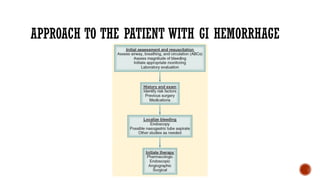
APPROACH TO THE PATIENT WITH GI HEMORRHAGE
INITIAL ASSESSMENT
 Patient’s airway and breathing take first priority
 Patient’s hemodynamic status becomes the dominant concern
 The preexisting deficits and ongoing hemorrhage
 Continuous reassessment of the patient’s circulatory status  aggressiveness of
subsequent evaluation and intervention
 Determination of severity
 >40% loss : Obtundation, agitation, & hypotension (SBP <90 mm Hg in the supine position)
associated with cool, clammy extremities
 20% to 40% loss: resting HR >100 beats/min with a decreased pulse pressure
 20% at least: postural changes - ↓ in BP of >10 mm Hg or ↑ of the pulse of >20 beats/min
RESUSCITATION
 More severe the bleeding, the more aggressive the resuscitation
 two large-bore IV lines, preferably in the antecubital fossae
 Unstable patients  2-liter bolus of crystalloid solution, usually RL
 Blood typing & cross matching, CBC, Coagulation profile, LFT
 Foley catheter
 Administering supplemental oxygen
 Blood transfusion  packed RBCs are the preferred form
 high-volume transfusion  empirically receive both FFP & platelets & calcium
HISTORY AND PHYSICAL EXAMINATION
 Preliminary assessment of the site & cause of bleeding & comorbidities
 Characteristics of the bleeding:
 Hematemesis: vomiting of blood
 Melena: passage of black, tarry, and foul-smelling stool
 Hematochezia: bright red blood from the rectum
 Demographic data
 Elderly – angiodysplasias, diverticula, ischemic colitis, and cancer
 Younger – peptic ulcers, varices, and Meckel’s diverticula
HISTORY AND PHYSICAL EXAMINATION
 Medical history
 Antecedent epigastric distress – peptic ulcer
 Antecedent vomiting – Mallory-Weiss tear
 Weight loss – malignant disease
 Liver disease – variceal bleeding
 Previous aortic surgery – aortoenteric fistula
 Medication (NSAIDs, SSRIs, warfarin, LMWH) - GI mucosal erosions
 Physical examination
 Oropharynx and nose – Local source
 Abdominal examination – to exclude masses, splenomegaly, and adenopathy
 Epigastric tenderness – gastritis or peptic ulceration
 Stigmata of liver disease - jaundice, ascites, palmar erythema, and caput medusae
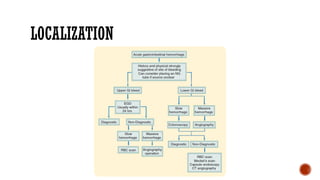
LOCALIZATION
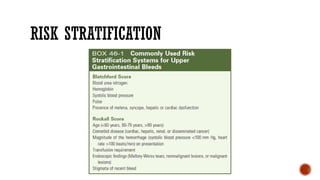
RISK STRATIFICATION
ACUTE UPPER GASTROINTESTINAL
HEMORRHAGE
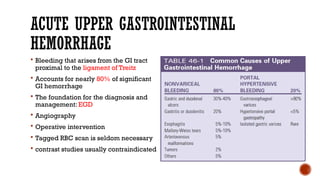
 Bleeding that arises from the GI tract
proximal to the ligament of Treitz
 Accounts for nearly 80% of significant
GI hemorrhage
 The foundation for the diagnosis and
management: EGD
 Angiography
 Operative intervention
 Tagged RBC scan is seldom necessary
 contrast studies usually contraindicated
SPECIFIC CAUSES OF
UPPER GASTROINTESTINAL
HEMORRHAGE
Nonvariceal Bleeding
PEPTIC ULCER DISEASE
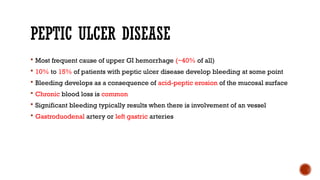
 Most frequent cause of upper GI hemorrhage (~40% of all)
 10% to 15% of patients with peptic ulcer disease develop bleeding at some point
 Bleeding develops as a consequence of acid-peptic erosion of the mucosal surface
 Chronic blood loss is common
 Significant bleeding typically results when there is involvement of an vessel
 Gastroduodenal artery or left gastric arteries
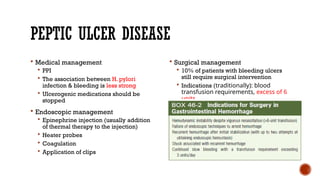
PEPTIC ULCER DISEASE
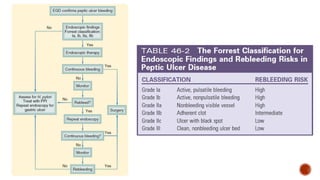
 Medical management
 PPI
 The association between H. pylori
infection & bleeding is less strong
 Ulcerogenic medications should be
stopped
 Endoscopic management
 Epinephrine injection (usually addition
of thermal therapy to the injection)
 Heater probes
 Coagulation
 Application of clips
 Surgical management
 10% of patients with bleeding ulcers
still require surgical intervention
 Indications (traditionally): blood
transfusion requirements, excess of 6
units
MALLORY-WEISS TEARS
 mucosal and submucosal tears that occur near the gastroesophageal junction
 alcoholic patients after a intense retching & vomiting following binge drinking
 forceful contraction of the abdominal wall against an unrelaxed cardia
 5% to 10% of cases of upper GI Bleeding
 diagnosed on the basis of history
 Endoscopy  retroflexion maneuver and to view the area just below the
gastroesophageal junction
 Most tears occur along the lesser curvature
 Supportive therapy  90% of bleeding episodes are self-limited
 severe ongoing bleeding  endoscopic, embolization, gastrotomy and suturing
STRESS GASTRITIS
 Appearance of multiple superficial erosions of the entire stomach
 Result from the combination of acid and pepsin injury in the context of ischemia
 Acid suppressive therapy is often successful in controlling the hemorrhage
 When this fails, consideration should be given to administration of octreotide or
vasopressin, endoscopic therapy, or even angiographic embolization
 The surgical choices included vagotomy and pyloroplasty with oversewing of the
hemorrhage or near-total gastrectomy
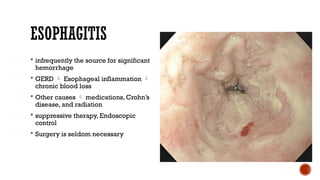
ESOPHAGITIS
 infrequently the source for significant
hemorrhage
 GERD  Esophageal inflammation 
chronic blood loss
 Other causes  medications, Crohn’s
disease, and radiation
 suppressive therapy, Endoscopic
control
 Surgery is seldom necessary
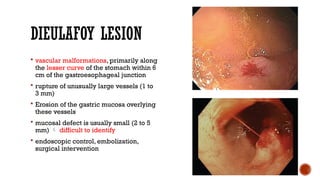
DIEULAFOY LESION
 vascular malformations, primarily along
the lesser curve of the stomach within 6
cm of the gastroesophageal junction
 rupture of unusually large vessels (1 to
3 mm)
 Erosion of the gastric mucosa overlying
these vessels
 mucosal defect is usually small (2 to 5
mm)  difficult to identify
 endoscopic control, embolization,
surgical intervention
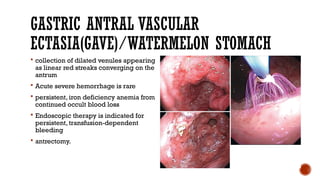
GASTRIC ANTRAL VASCULAR
ECTASIA(GAVE)/WATERMELON STOMACH
 collection of dilated venules appearing
as linear red streaks converging on the
antrum
 Acute severe hemorrhage is rare
 persistent, iron deficiency anemia from
continued occult blood loss
 Endoscopic therapy is indicated for
persistent, transfusion-dependent
bleeding
 antrectomy.
MALIGNANCY
 Associated with chronic anemia
 Hemoccult-positive stool rather than episodes of significant hemorrhage
 Ulcerative lesions that may bleed persistently
 GIST, leiomyomas, lymphomas.
 Surgical resection is indicated rather than endoscopic therapy
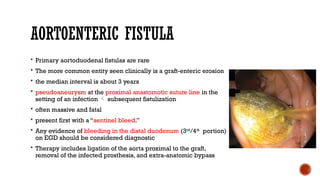
AORTOENTERIC FISTULA
 Primary aortoduodenal fistulas are rare
 The more common entity seen clinically is a graft-enteric erosion
 the median interval is about 3 years
 pseudoaneurysm at the proximal anastomotic suture line in the
setting of an infection  subsequent fistulization
 often massive and fatal
 present first with a “sentinel bleed.”
 Any evidence of bleeding in the distal duodenum (3rd
/4th
portion)
on EGD should be considered diagnostic
 Therapy includes ligation of the aorta proximal to the graft,
removal of the infected prosthesis, and extra-anatomic bypass
HEMOBILIA
 typically associated with trauma, recent instrumentation of the biliary tree, or
hepatic neoplasms
 suspected in anyone who presents with hemorrhage, right upper quadrant pain,
and jaundice (Quincke's triad)
 Endoscopy can be helpful by demonstrating blood at the ampulla
 Angiography is the diagnostic procedure of choice.
 If diagnosis is confirmed, angiographic embolization is the preferred treatment
OTHERS
Hemosuccus pancreaticus
 Bleeding is bleeding from the
pancreatic duct
 Erosion of a pancreatic pseudocyst
into the splenic artery
 Abdominal pain and hematochezia
 Angiography is diagnostic and
permits embolization, which is often
therapeutic
Iatrogenic bleeding
 follow therapeutic or diagnostic
procedures
 percutaneous transhepatic procedures
 Endoscopic sphincterotomy
 upper GI surgery
 resection and anastomosis
SPECIFIC CAUSES OF
UPPER GASTROINTESTINAL
HEMORRHAGE
Bleeding Related to Portal Hypertension
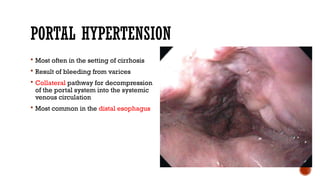
PORTAL HYPERTENSION
 Most often in the setting of cirrhosis
 Result of bleeding from varices
 Collateral pathway for decompression
of the portal system into the systemic
venous circulation
 Most common in the distal esophagus
MANAGEMENT
 Fluid resuscitation in patients with cirrhosis is a delicate balance
 Early admission to an ICU setting
 Low threshold for intubation
 Defects in coagulation are common
 Underlying sepsis
MANAGEMENT
 Medical management
 Pharmacologic therapy to reduce portal hypertension
 Vasopressin produces splanchnic vasoconstriction
(cardiac vasoconstriction)
 somatostatin or its synthetic analogue, octreotide
 Terlipressin is a newer vasopressin
 Temporary control of bleeding and allows time for
resuscitation
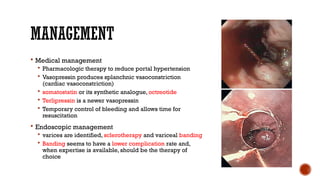
 Endoscopic management
 varices are identified, sclerotherapy and variceal banding
 Banding seems to have a lower complication rate and,
when expertise is available, should be the therapy of
choice
MANAGEMENT
 Other management
 Balloon tamponade – sengstaken-blakemore tube, the minnesota tube
 Self-expanding esophageal stents
 Emergent portal decompression – TIPS and surgical shunting
 Isolated gastric varices  due to left sided hypertension  splenectomy
 Prevention of rebleeding
 Nonselective beta blocker, such as nadolol, and an antiulcer agent, such as a PPI or
sucralfate
 Endoscopic band ligation repeated every 10 to 14 days until all varices have been
eradicated
 Elective portal decompression
 The preferred elective shunt is a selective distal splenorenal shunt
THANK
YOU

Upper Gastro Intestinal Bleeding and its managements.pptx

  • 1.
    UPPER G.I. BLEEDING Dr.Manotosh Biswas SR, General Surgery AIIMSK
  • 2.
    INTRODUCTION  Acute G.I.hemorrhage is a common clinical problem with diverse manifestations.  Trivial to massive/from virtually any region  Classified by the location relative to the ligament of Treitz  Obscure bleeding: hemorrhage that persists/recurs after negative evaluation with endoscopy  Occult bleeding: not apparent to the patient until symptoms related to the anemia are manifested  Management of these patients is frequently multidisciplinary
  • 3.
    APPROACH TO THEPATIENT WITH GI HEMORRHAGE
  • 4.
    INITIAL ASSESSMENT  Patient’sairway and breathing take first priority  Patient’s hemodynamic status becomes the dominant concern  The preexisting deficits and ongoing hemorrhage  Continuous reassessment of the patient’s circulatory status  aggressiveness of subsequent evaluation and intervention  Determination of severity  >40% loss : Obtundation, agitation, & hypotension (SBP <90 mm Hg in the supine position) associated with cool, clammy extremities  20% to 40% loss: resting HR >100 beats/min with a decreased pulse pressure  20% at least: postural changes - ↓ in BP of >10 mm Hg or ↑ of the pulse of >20 beats/min
  • 5.
    RESUSCITATION  More severethe bleeding, the more aggressive the resuscitation  two large-bore IV lines, preferably in the antecubital fossae  Unstable patients  2-liter bolus of crystalloid solution, usually RL  Blood typing & cross matching, CBC, Coagulation profile, LFT  Foley catheter  Administering supplemental oxygen  Blood transfusion  packed RBCs are the preferred form  high-volume transfusion  empirically receive both FFP & platelets & calcium
  • 6.
    HISTORY AND PHYSICALEXAMINATION  Preliminary assessment of the site & cause of bleeding & comorbidities  Characteristics of the bleeding:  Hematemesis: vomiting of blood  Melena: passage of black, tarry, and foul-smelling stool  Hematochezia: bright red blood from the rectum  Demographic data  Elderly – angiodysplasias, diverticula, ischemic colitis, and cancer  Younger – peptic ulcers, varices, and Meckel’s diverticula
  • 7.
    HISTORY AND PHYSICALEXAMINATION  Medical history  Antecedent epigastric distress – peptic ulcer  Antecedent vomiting – Mallory-Weiss tear  Weight loss – malignant disease  Liver disease – variceal bleeding  Previous aortic surgery – aortoenteric fistula  Medication (NSAIDs, SSRIs, warfarin, LMWH) - GI mucosal erosions  Physical examination  Oropharynx and nose – Local source  Abdominal examination – to exclude masses, splenomegaly, and adenopathy  Epigastric tenderness – gastritis or peptic ulceration  Stigmata of liver disease - jaundice, ascites, palmar erythema, and caput medusae
  • 8.
  • 9.
  • 10.
    ACUTE UPPER GASTROINTESTINAL HEMORRHAGE Bleeding that arises from the GI tract proximal to the ligament of Treitz  Accounts for nearly 80% of significant GI hemorrhage  The foundation for the diagnosis and management: EGD  Angiography  Operative intervention  Tagged RBC scan is seldom necessary  contrast studies usually contraindicated
  • 11.
    SPECIFIC CAUSES OF UPPERGASTROINTESTINAL HEMORRHAGE Nonvariceal Bleeding
  • 12.
    PEPTIC ULCER DISEASE Most frequent cause of upper GI hemorrhage (~40% of all)  10% to 15% of patients with peptic ulcer disease develop bleeding at some point  Bleeding develops as a consequence of acid-peptic erosion of the mucosal surface  Chronic blood loss is common  Significant bleeding typically results when there is involvement of an vessel  Gastroduodenal artery or left gastric arteries
  • 14.
    PEPTIC ULCER DISEASE Medical management  PPI  The association between H. pylori infection & bleeding is less strong  Ulcerogenic medications should be stopped  Endoscopic management  Epinephrine injection (usually addition of thermal therapy to the injection)  Heater probes  Coagulation  Application of clips  Surgical management  10% of patients with bleeding ulcers still require surgical intervention  Indications (traditionally): blood transfusion requirements, excess of 6 units
  • 15.
    MALLORY-WEISS TEARS  mucosaland submucosal tears that occur near the gastroesophageal junction  alcoholic patients after a intense retching & vomiting following binge drinking  forceful contraction of the abdominal wall against an unrelaxed cardia  5% to 10% of cases of upper GI Bleeding  diagnosed on the basis of history  Endoscopy  retroflexion maneuver and to view the area just below the gastroesophageal junction  Most tears occur along the lesser curvature  Supportive therapy  90% of bleeding episodes are self-limited  severe ongoing bleeding  endoscopic, embolization, gastrotomy and suturing
  • 16.
    STRESS GASTRITIS  Appearanceof multiple superficial erosions of the entire stomach  Result from the combination of acid and pepsin injury in the context of ischemia  Acid suppressive therapy is often successful in controlling the hemorrhage  When this fails, consideration should be given to administration of octreotide or vasopressin, endoscopic therapy, or even angiographic embolization  The surgical choices included vagotomy and pyloroplasty with oversewing of the hemorrhage or near-total gastrectomy
  • 17.
    ESOPHAGITIS  infrequently thesource for significant hemorrhage  GERD  Esophageal inflammation  chronic blood loss  Other causes  medications, Crohn’s disease, and radiation  suppressive therapy, Endoscopic control  Surgery is seldom necessary
  • 18.
    DIEULAFOY LESION  vascularmalformations, primarily along the lesser curve of the stomach within 6 cm of the gastroesophageal junction  rupture of unusually large vessels (1 to 3 mm)  Erosion of the gastric mucosa overlying these vessels  mucosal defect is usually small (2 to 5 mm)  difficult to identify  endoscopic control, embolization, surgical intervention
  • 19.
    GASTRIC ANTRAL VASCULAR ECTASIA(GAVE)/WATERMELONSTOMACH  collection of dilated venules appearing as linear red streaks converging on the antrum  Acute severe hemorrhage is rare  persistent, iron deficiency anemia from continued occult blood loss  Endoscopic therapy is indicated for persistent, transfusion-dependent bleeding  antrectomy.
  • 20.
    MALIGNANCY  Associated withchronic anemia  Hemoccult-positive stool rather than episodes of significant hemorrhage  Ulcerative lesions that may bleed persistently  GIST, leiomyomas, lymphomas.  Surgical resection is indicated rather than endoscopic therapy
  • 21.
    AORTOENTERIC FISTULA  Primaryaortoduodenal fistulas are rare  The more common entity seen clinically is a graft-enteric erosion  the median interval is about 3 years  pseudoaneurysm at the proximal anastomotic suture line in the setting of an infection  subsequent fistulization  often massive and fatal  present first with a “sentinel bleed.”  Any evidence of bleeding in the distal duodenum (3rd /4th portion) on EGD should be considered diagnostic  Therapy includes ligation of the aorta proximal to the graft, removal of the infected prosthesis, and extra-anatomic bypass
  • 22.
    HEMOBILIA  typically associatedwith trauma, recent instrumentation of the biliary tree, or hepatic neoplasms  suspected in anyone who presents with hemorrhage, right upper quadrant pain, and jaundice (Quincke's triad)  Endoscopy can be helpful by demonstrating blood at the ampulla  Angiography is the diagnostic procedure of choice.  If diagnosis is confirmed, angiographic embolization is the preferred treatment
  • 23.
    OTHERS Hemosuccus pancreaticus  Bleedingis bleeding from the pancreatic duct  Erosion of a pancreatic pseudocyst into the splenic artery  Abdominal pain and hematochezia  Angiography is diagnostic and permits embolization, which is often therapeutic Iatrogenic bleeding  follow therapeutic or diagnostic procedures  percutaneous transhepatic procedures  Endoscopic sphincterotomy  upper GI surgery  resection and anastomosis
  • 24.
    SPECIFIC CAUSES OF UPPERGASTROINTESTINAL HEMORRHAGE Bleeding Related to Portal Hypertension
  • 25.
    PORTAL HYPERTENSION  Mostoften in the setting of cirrhosis  Result of bleeding from varices  Collateral pathway for decompression of the portal system into the systemic venous circulation  Most common in the distal esophagus
  • 26.
    MANAGEMENT  Fluid resuscitationin patients with cirrhosis is a delicate balance  Early admission to an ICU setting  Low threshold for intubation  Defects in coagulation are common  Underlying sepsis
  • 27.
    MANAGEMENT  Medical management Pharmacologic therapy to reduce portal hypertension  Vasopressin produces splanchnic vasoconstriction (cardiac vasoconstriction)  somatostatin or its synthetic analogue, octreotide  Terlipressin is a newer vasopressin  Temporary control of bleeding and allows time for resuscitation  Endoscopic management  varices are identified, sclerotherapy and variceal banding  Banding seems to have a lower complication rate and, when expertise is available, should be the therapy of choice
  • 28.
    MANAGEMENT  Other management Balloon tamponade – sengstaken-blakemore tube, the minnesota tube  Self-expanding esophageal stents  Emergent portal decompression – TIPS and surgical shunting  Isolated gastric varices  due to left sided hypertension  splenectomy  Prevention of rebleeding  Nonselective beta blocker, such as nadolol, and an antiulcer agent, such as a PPI or sucralfate  Endoscopic band ligation repeated every 10 to 14 days until all varices have been eradicated  Elective portal decompression  The preferred elective shunt is a selective distal splenorenal shunt
  • 29.