Mechanical
measurement and
Metrology
Surface finish measurement
Prepared by – Navroz
Navodia
Surface texture
• The characteristic quality of an actual surface due to
small departures from its general geometrical form a
pattern or texture on the surface
• The problem is basically geometrical
• They are classified as follows
1. First order – due to inaccuracy of machine tool
2. Second order-due to vibration of any kind
3. Third order-due to characteristic property of machine
4. Fourth order-due to rupture of material
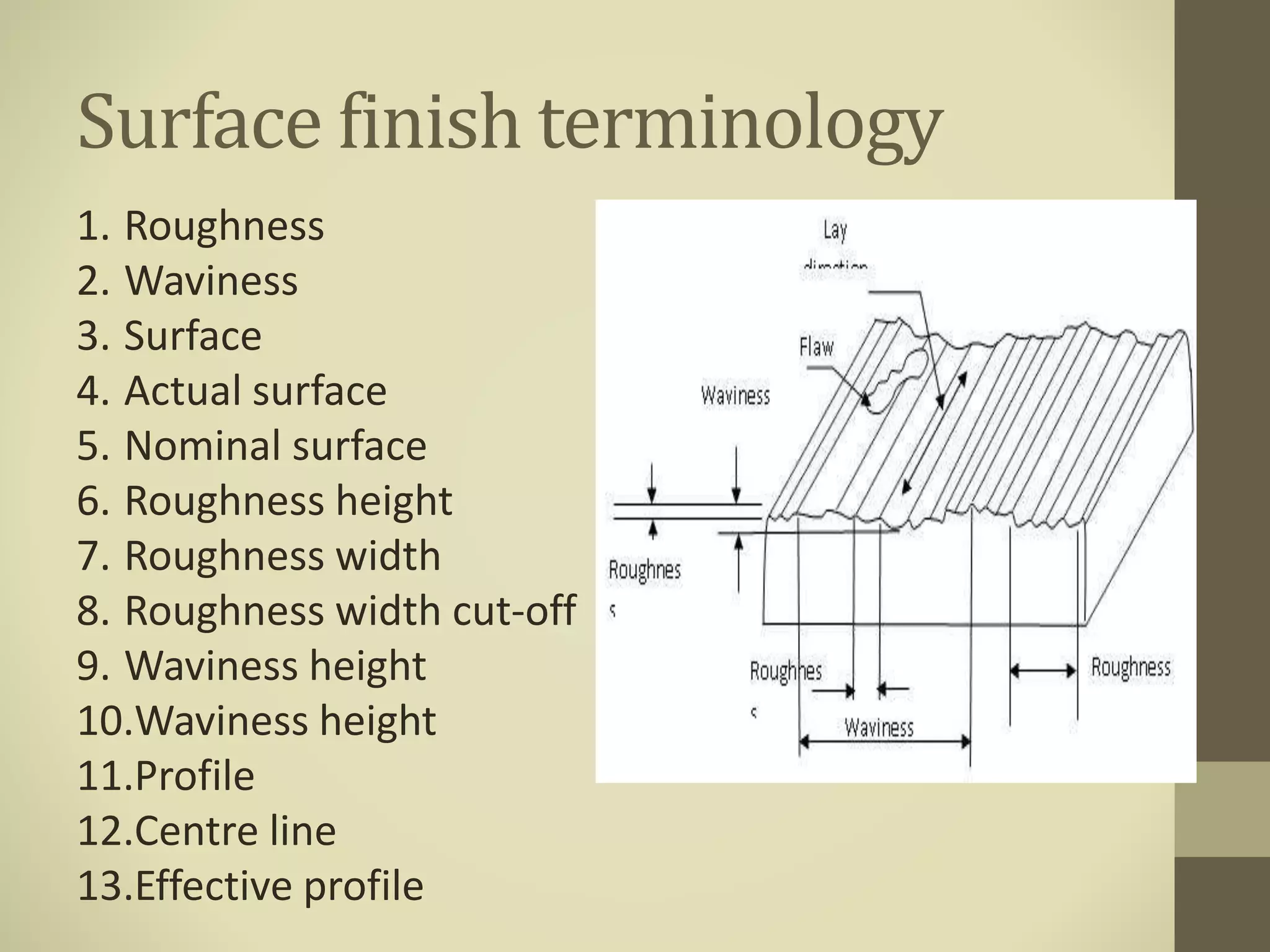
Surface finish terminology
1. Roughness
2. Waviness
3. Surface
4. Actual surface
5. Nominal surface
6. Roughness height
7. Roughness width
8. Roughness width cut-off
9. Waviness height
10.Waviness height
11.Profile
12.Centre line
13.Effective profile
Methods of measuring surface
finish
1. Surface inspection by comparison method
2. Direct instrument measurement
3. Other methods of measuring surface finish
Comparison methods
1. Touch inspection:
• In this method finger tip is moved at a speed of
25mm per second and irregularities upto 0.01mm
can be measured.
2. Visual inspection:
• Means visualizing by naked eyes and is just a
subjective evaluation.
Comparison methods
3. Scratch inspection
• Lead or babbit or plastic is moved along the surface to
be inspected.
4. Microscopic inspection
• Microscope can only measure small surface.
• Compared with a master surface.
• 5. Surface photograph
• Magnified photograph with different illumination are
taken.
Comparison methods
6. Micro interferometer
• In this method an optical face is placed on the surface
to be inspected and illuminated by a monochromatic
light and then interference band are studied by
microscope.
7. Wallace dynamometer
• It consists of a pendulum which is lifted to initial
position and allowed to swing over testing surface.
Surface smoothness is determined by friction as swing
time is a direct measure of surface finish.
Comparison methods
8. Reflected light intensity
• In this method a beam of light(known qty.) is
projected upon surface and is reflected in several
directions as beams of lesser intensity and change in
length in different directions is measured by photocell.
Direct instrument measuring
method
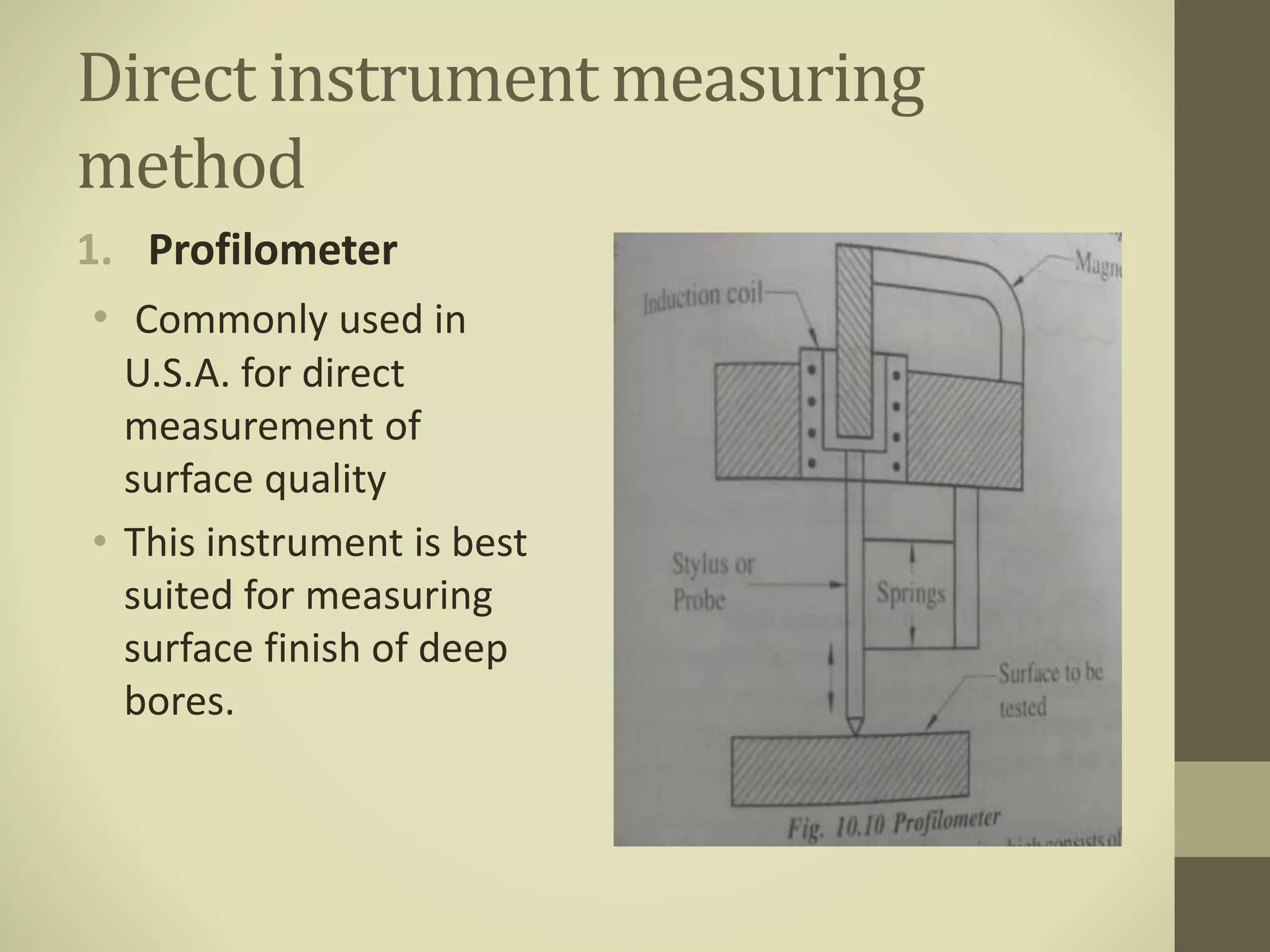
1. Profilometer
• Commonly used in
U.S.A. for direct
measurement of
surface quality
• This instrument is best
suited for measuring
surface finish of deep
bores.
Direct instrument measuring
method
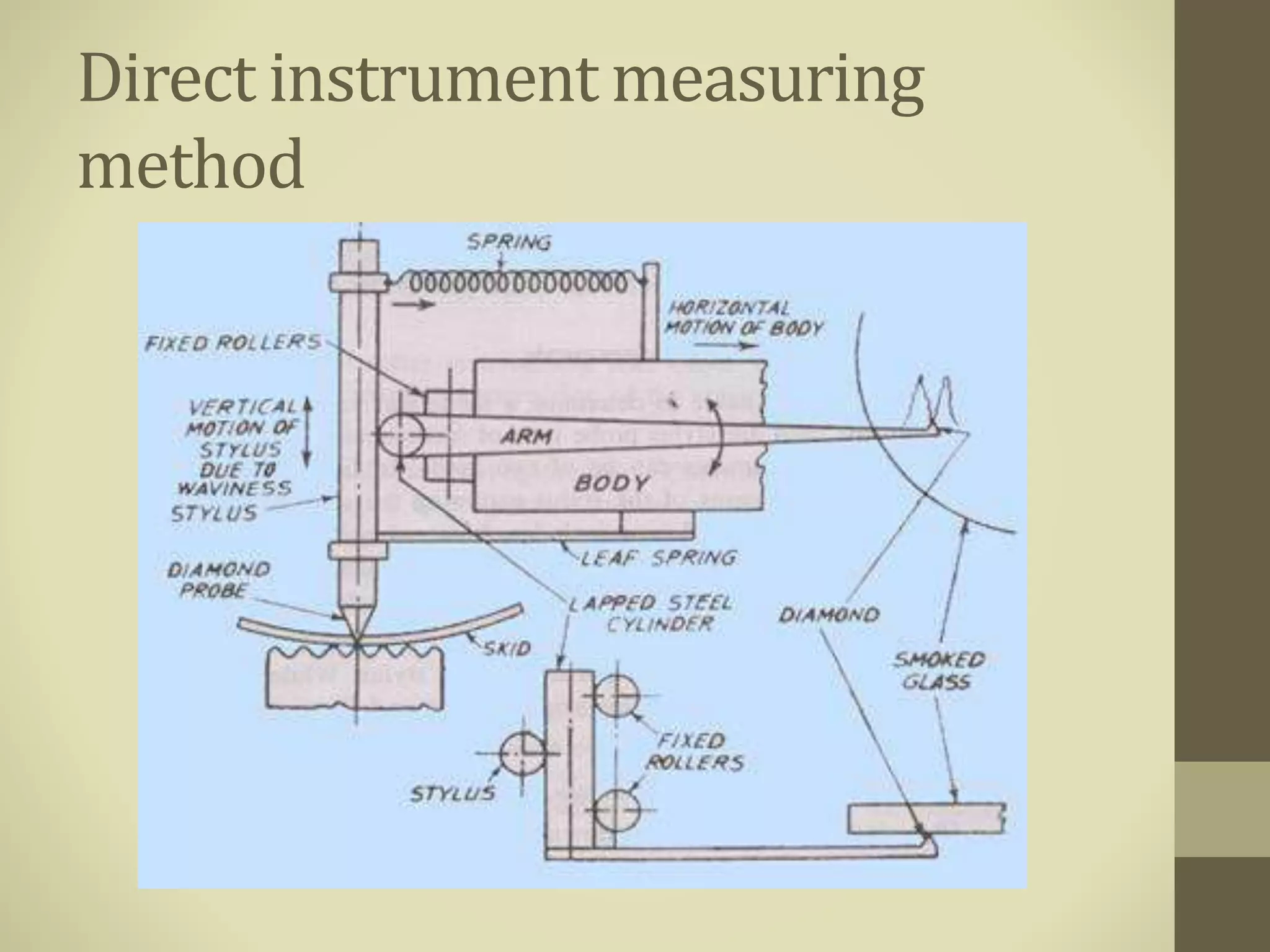
2. Tomlinson Surface Tester
• Design by Dr. Tomlinson.
• It is reliable and cheaper.
• It is slow in operation.
• Not suitable for continuous use.
• Delicate and requires great care.
Direct instrument measuring
method
Direct instrument measuring
method
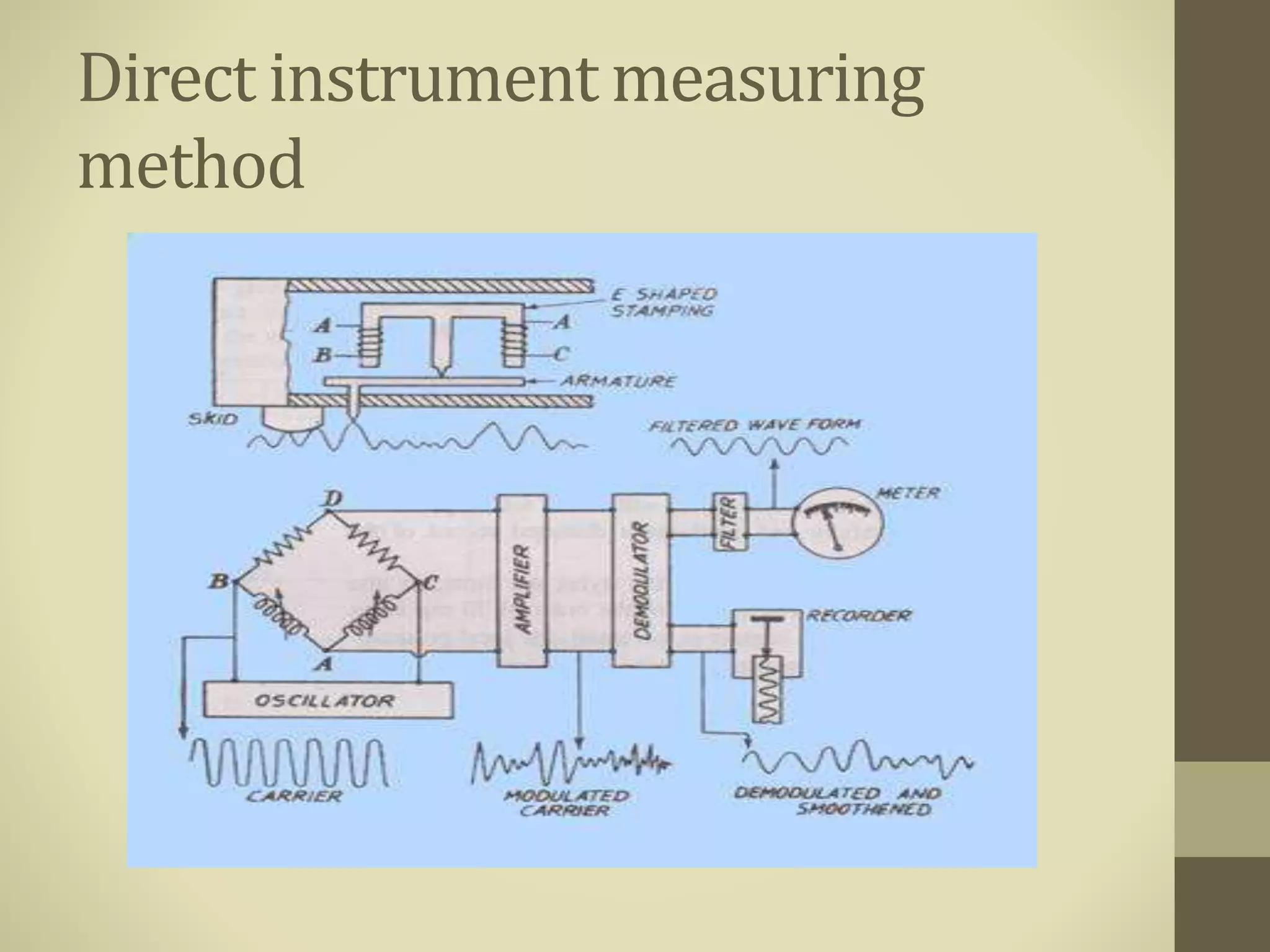
3. The Taylor-Hobson Talysurf
• The Talysurf is an electronic instrument working on
carrier modulating principle.
• Microprocessors have made available complete
statistical multi-trace systems measuring several
places over a given area and can provide standard
deviations and average over area-type readings and
define complete surface characterisation.
Direct instrument measuring
method
Direct instrument measuring
method
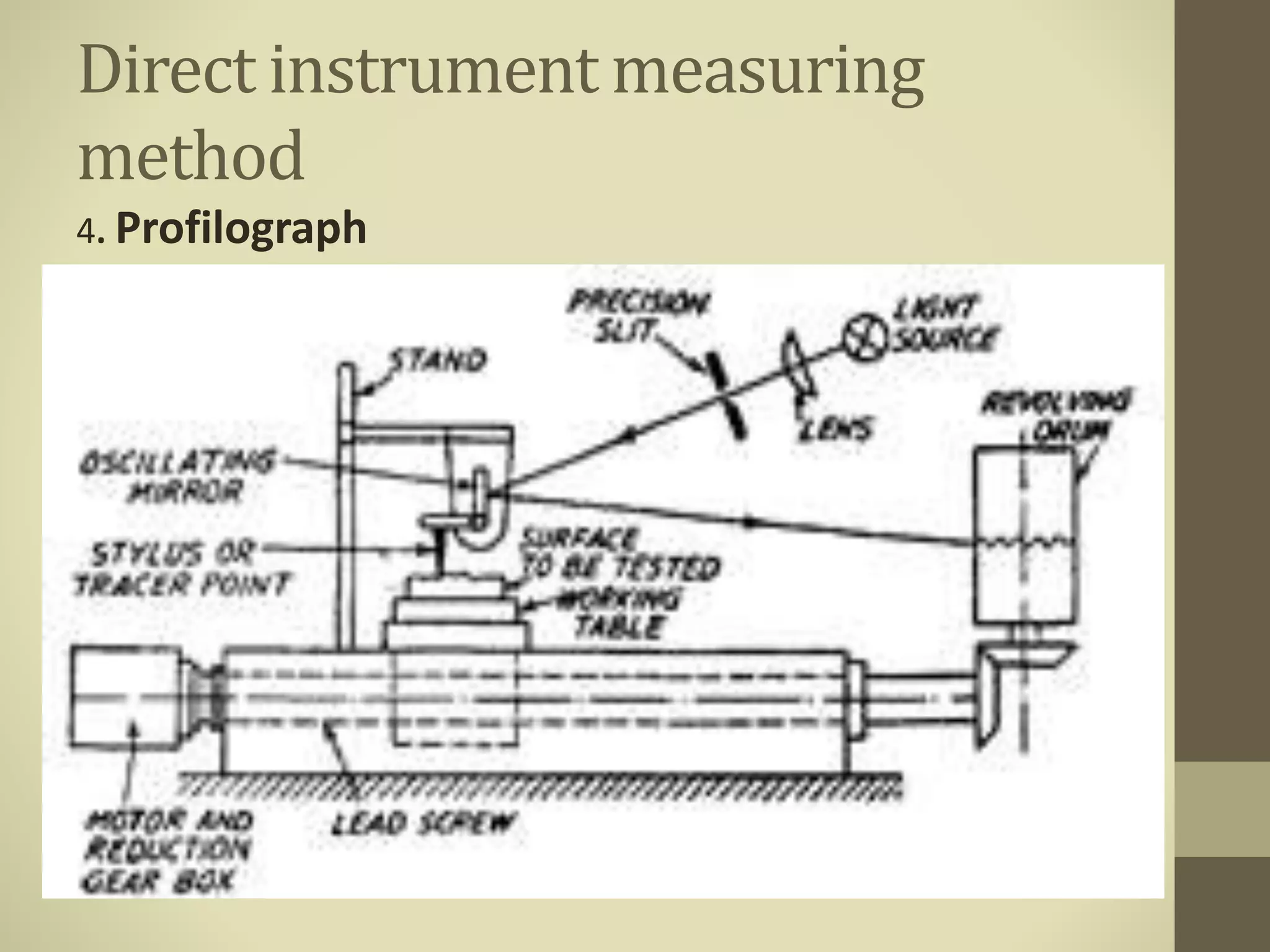
4. Profilograph
Direct instrument measuring
method
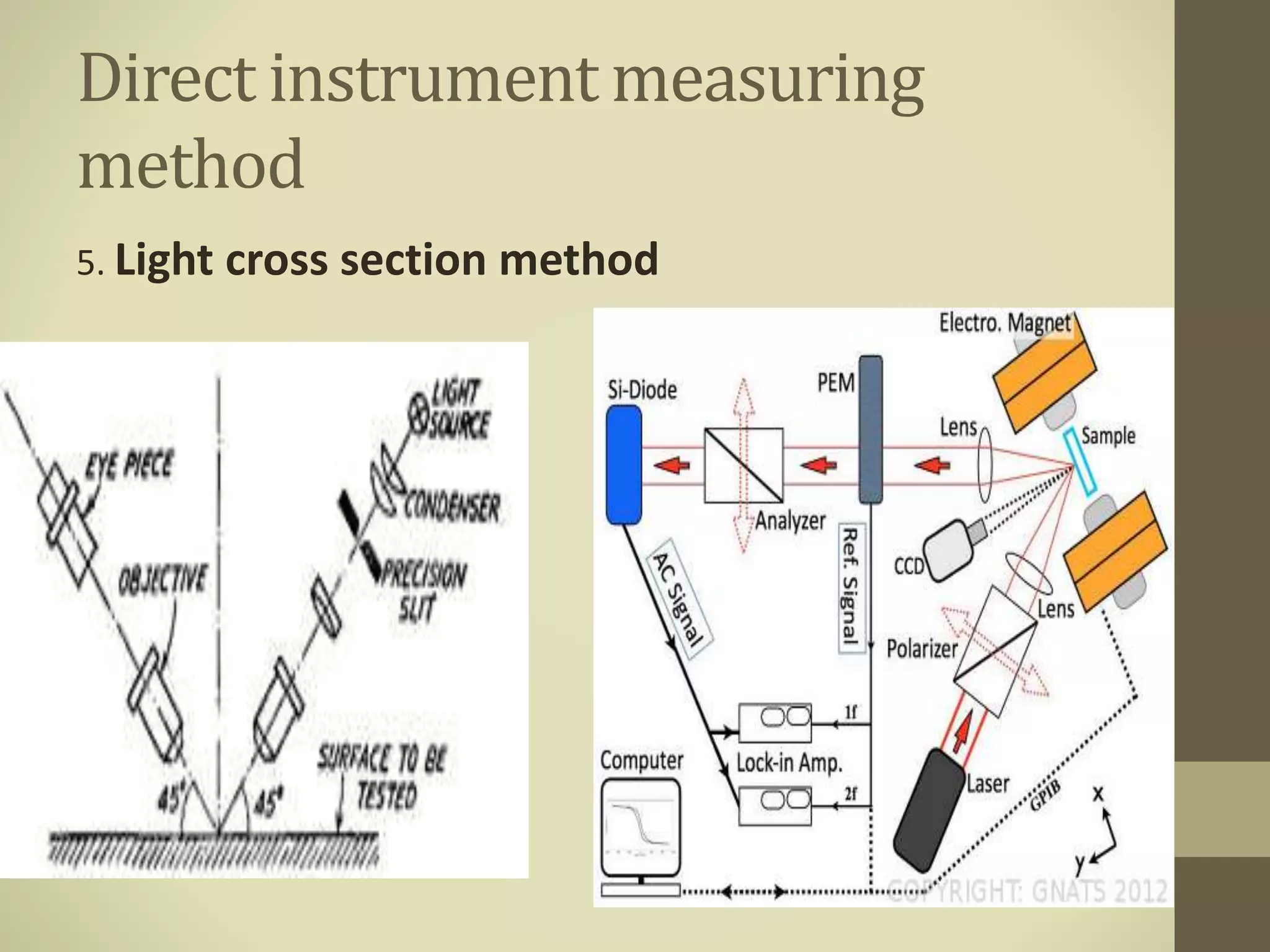
5. Light cross section method
Other methods for measuring
surface roughness
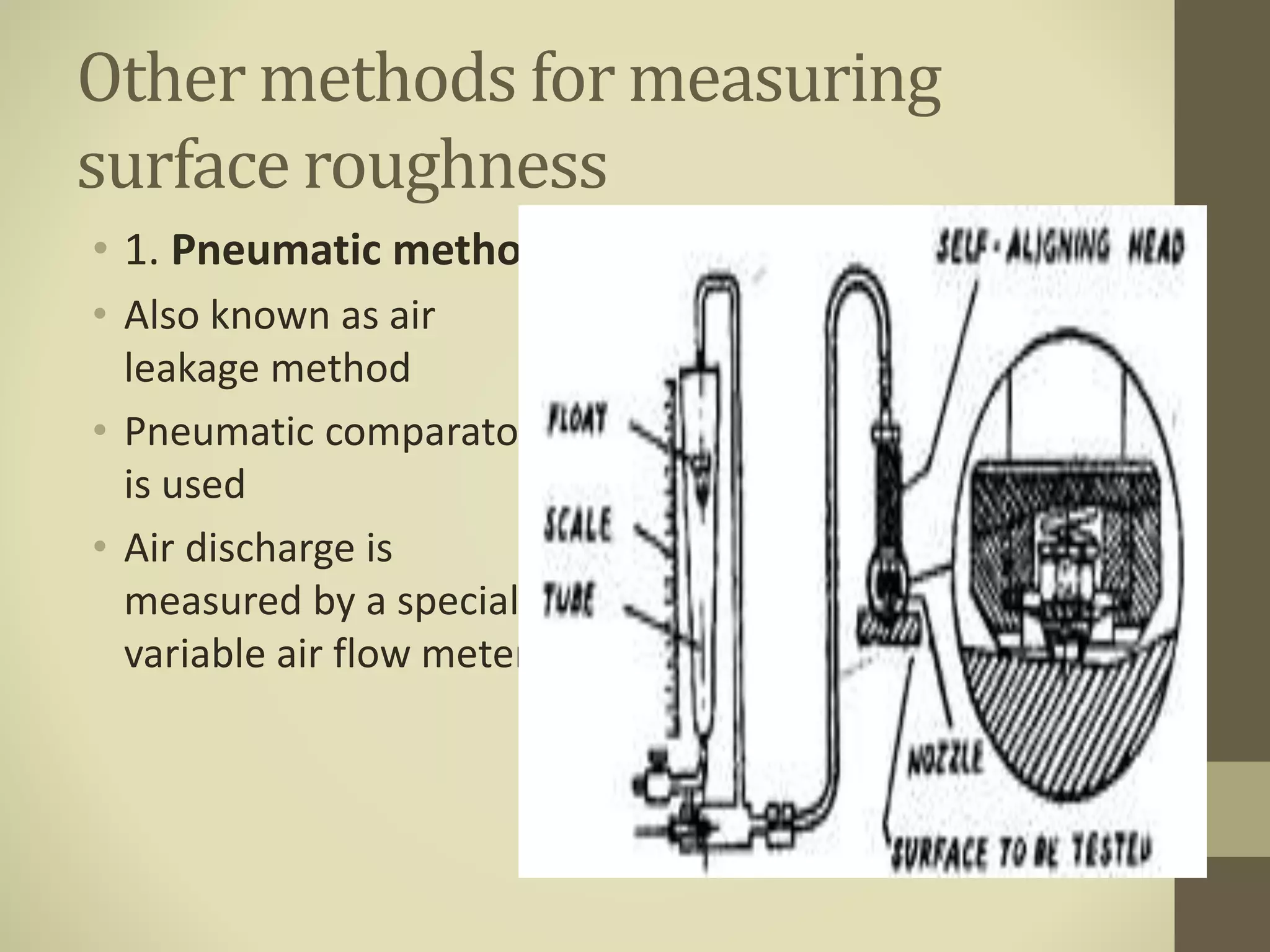
• 1. Pneumatic method
• Also known as air
leakage method
• Pneumatic comparator
is used
• Air discharge is
measured by a special
variable air flow meter
Other methods for measuring
surface roughness
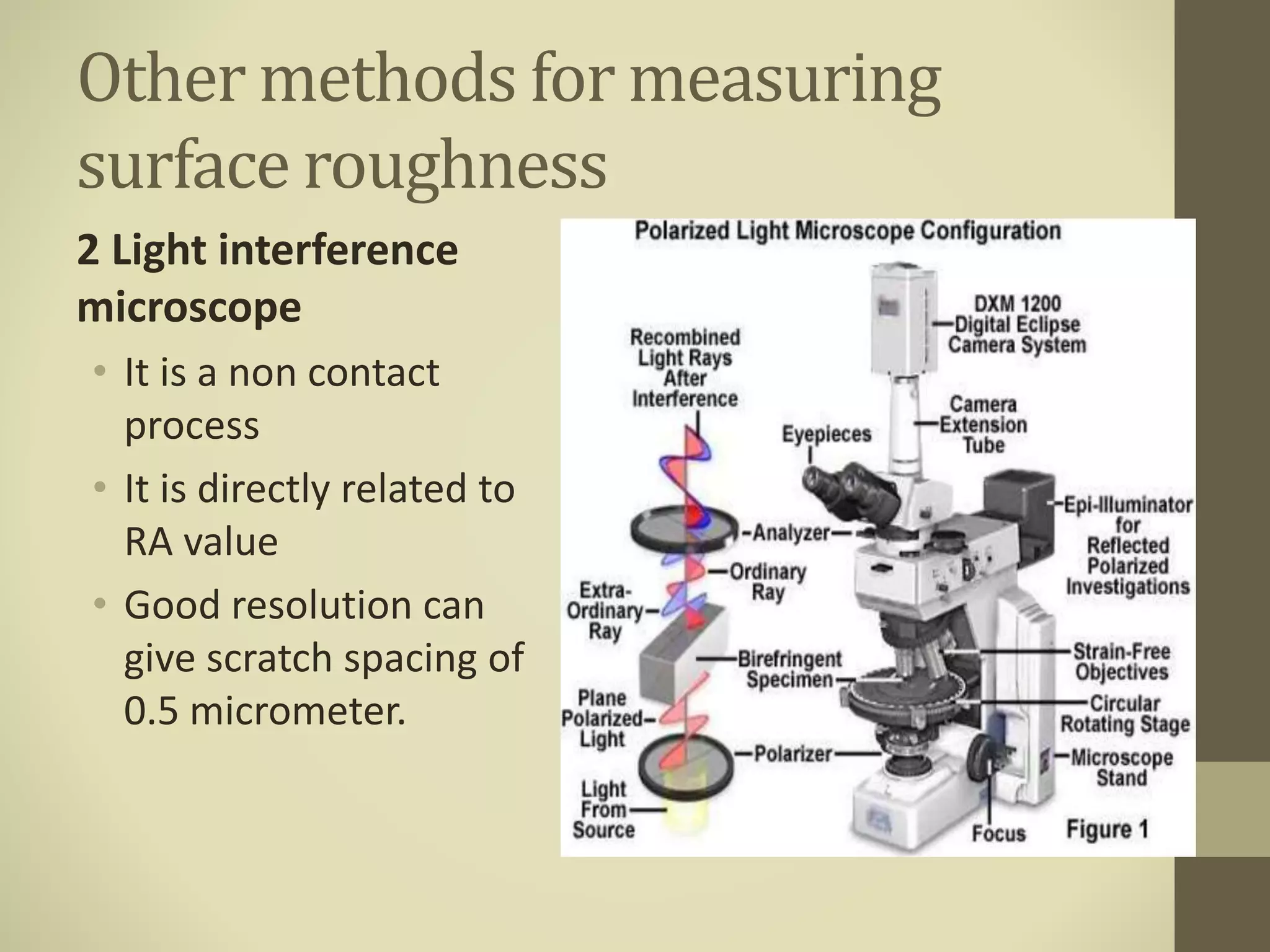
2 Light interference
microscope
• It is a non contact
process
• It is directly related to
RA value
• Good resolution can
give scratch spacing of
0.5 micrometer.
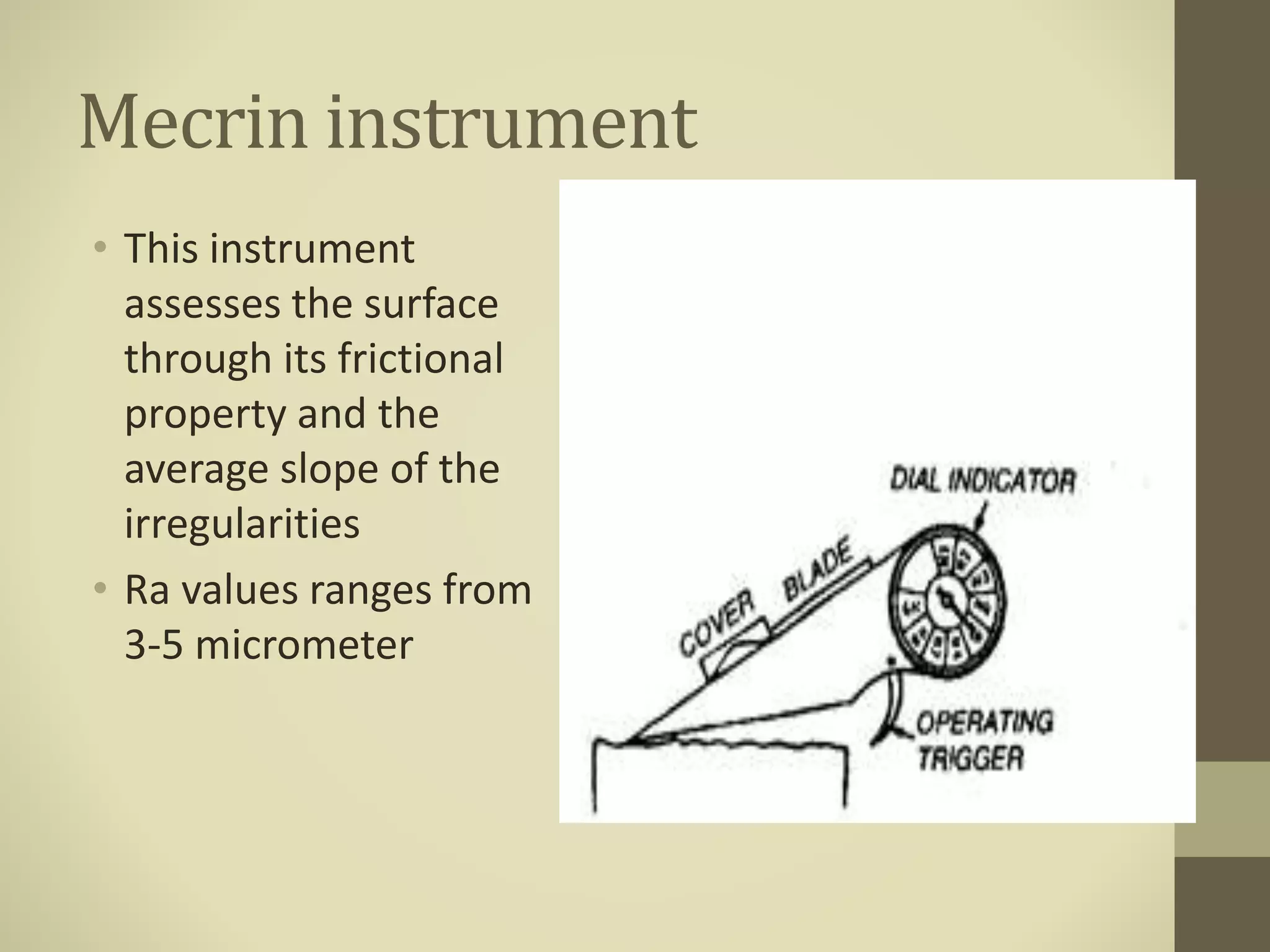
Mecrin instrument
• This instrument
assesses the surface
through its frictional
property and the
average slope of the
irregularities
• Ra values ranges from
3-5 micrometer
Adverse effect of poor surface
finish
1. Fatigue strength
• High surface finish increase fatigue strength
2. Wear resistance
• Decreases with poor surface finish
3. Corrosion resistance
• Decreases with poor surface finish
Thank you

Surface finish measurement (mechanical measurement and metrology)

  • 1.
    Mechanical measurement and Metrology Surface finishmeasurement Prepared by – Navroz Navodia
  • 2.
    Surface texture • Thecharacteristic quality of an actual surface due to small departures from its general geometrical form a pattern or texture on the surface • The problem is basically geometrical • They are classified as follows 1. First order – due to inaccuracy of machine tool 2. Second order-due to vibration of any kind 3. Third order-due to characteristic property of machine 4. Fourth order-due to rupture of material
  • 3.
    Surface finish terminology 1.Roughness 2. Waviness 3. Surface 4. Actual surface 5. Nominal surface 6. Roughness height 7. Roughness width 8. Roughness width cut-off 9. Waviness height 10.Waviness height 11.Profile 12.Centre line 13.Effective profile
  • 4.
    Methods of measuringsurface finish 1. Surface inspection by comparison method 2. Direct instrument measurement 3. Other methods of measuring surface finish
  • 5.
    Comparison methods 1. Touchinspection: • In this method finger tip is moved at a speed of 25mm per second and irregularities upto 0.01mm can be measured. 2. Visual inspection: • Means visualizing by naked eyes and is just a subjective evaluation.
  • 6.
    Comparison methods 3. Scratchinspection • Lead or babbit or plastic is moved along the surface to be inspected. 4. Microscopic inspection • Microscope can only measure small surface. • Compared with a master surface. • 5. Surface photograph • Magnified photograph with different illumination are taken.
  • 7.
    Comparison methods 6. Microinterferometer • In this method an optical face is placed on the surface to be inspected and illuminated by a monochromatic light and then interference band are studied by microscope. 7. Wallace dynamometer • It consists of a pendulum which is lifted to initial position and allowed to swing over testing surface. Surface smoothness is determined by friction as swing time is a direct measure of surface finish.
  • 8.
    Comparison methods 8. Reflectedlight intensity • In this method a beam of light(known qty.) is projected upon surface and is reflected in several directions as beams of lesser intensity and change in length in different directions is measured by photocell.
  • 9.
    Direct instrument measuring method 1.Profilometer • Commonly used in U.S.A. for direct measurement of surface quality • This instrument is best suited for measuring surface finish of deep bores.
  • 10.
    Direct instrument measuring method 2.Tomlinson Surface Tester • Design by Dr. Tomlinson. • It is reliable and cheaper. • It is slow in operation. • Not suitable for continuous use. • Delicate and requires great care.
  • 11.
  • 12.
    Direct instrument measuring method 3.The Taylor-Hobson Talysurf • The Talysurf is an electronic instrument working on carrier modulating principle. • Microprocessors have made available complete statistical multi-trace systems measuring several places over a given area and can provide standard deviations and average over area-type readings and define complete surface characterisation.
  • 13.
  • 14.
  • 15.
    Direct instrument measuring method 5.Light cross section method
  • 16.
    Other methods formeasuring surface roughness • 1. Pneumatic method • Also known as air leakage method • Pneumatic comparator is used • Air discharge is measured by a special variable air flow meter
  • 17.
    Other methods formeasuring surface roughness 2 Light interference microscope • It is a non contact process • It is directly related to RA value • Good resolution can give scratch spacing of 0.5 micrometer.
  • 18.
    Mecrin instrument • Thisinstrument assesses the surface through its frictional property and the average slope of the irregularities • Ra values ranges from 3-5 micrometer
  • 19.
    Adverse effect ofpoor surface finish 1. Fatigue strength • High surface finish increase fatigue strength 2. Wear resistance • Decreases with poor surface finish 3. Corrosion resistance • Decreases with poor surface finish
  • 20.