Deep Learning
Mohamed Loey
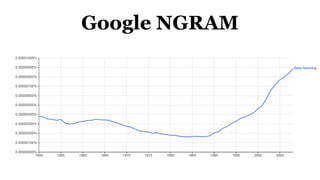
Google NGRAM
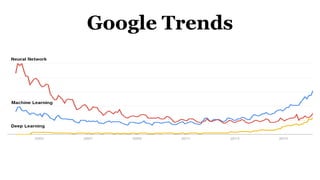
Google Trends
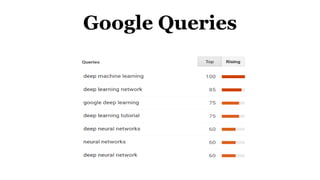
Google Queries
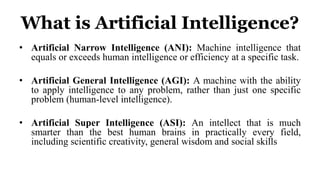
What is Artificial Intelligence?
• Artificial Narrow Intelligence (ANI): Machine intelligence that
equals or exceeds human intelligence or efficiency at a specific task.
• Artificial General Intelligence (AGI): A machine with the ability
to apply intelligence to any problem, rather than just one specific
problem (human-level intelligence).
• Artificial Super Intelligence (ASI): An intellect that is much
smarter than the best human brains in practically every field,
including scientific creativity, general wisdom and social skills
Machine Learning
• Machine Learning is a type of Artificial
Intelligence that provides computers with the
ability to learn
What is Deep Learning?
• Part of the machine learning field of learning
representations of data.
• hierarchy of multiple layers that mimic the neural
networks of our brain
• If you provide the system tons of information, it
begins to understand it and respond in useful ways.
Why we needs Deep Learning?
• SuperIntelligent Devices
• Best Solution for
– image recognition
– speech recognition
– natural language processing
– Big Data
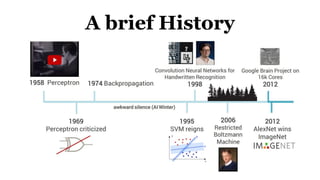
A brief History
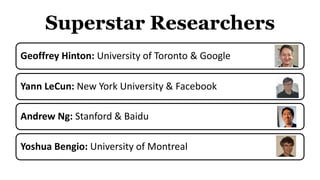
Superstar Researchers
Geoffrey Hinton: University of Toronto & Google
Yann LeCun: New York University & Facebook
Andrew Ng: Stanford & Baidu
Yoshua Bengio: University of Montreal
Superstar Companies
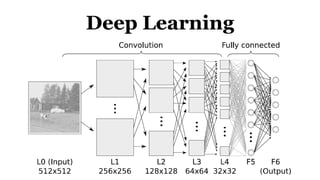
Deep Learning
Deep Learning Requirements
• Large data set with good quality
• Measurable and describable goals
• Enough computing power
• Neural Network (Brain of Human)
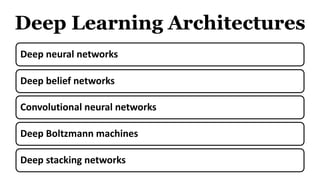
Deep Learning Architectures
Deep neural networks
Deep belief networks
Convolutional neural networks
Deep Boltzmann machines
Deep stacking networks
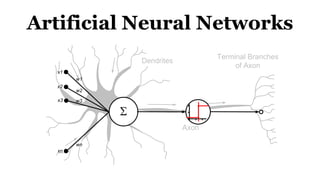
Artificial Neural Networks
Axon
Terminal Branches
of Axon
Dendrites
S
x1
x2
w1
w2
wn
xn
x3 w3
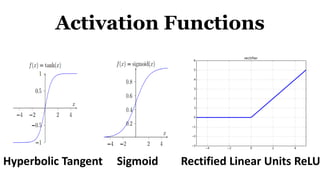
Activation Functions
Hyperbolic Tangent Sigmoid Rectified Linear Units ReLU
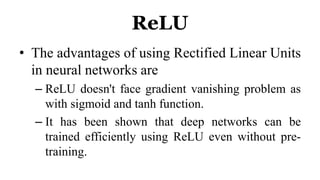
ReLU
• The advantages of using Rectified Linear Units
in neural networks are
– ReLU doesn't face gradient vanishing problem as
with sigmoid and tanh function.
– It has been shown that deep networks can be
trained efficiently using ReLU even without pre-
training.
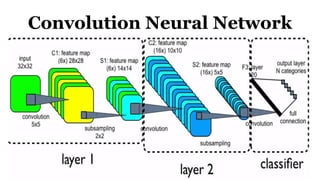
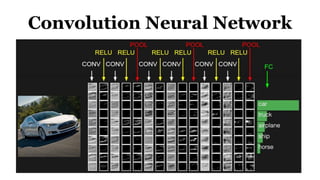
Convolution Neural Network
CNN Layers
• Convolution Layer
• Pooling Layer
• Fully-connected layer
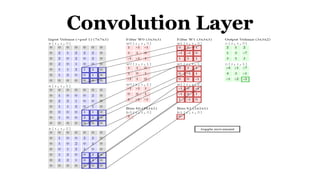
Convolution Layer
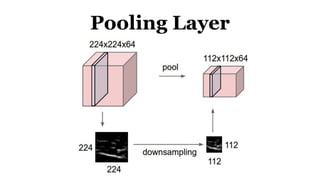
Pooling Layer
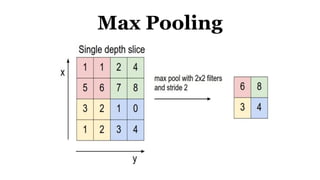
Max Pooling
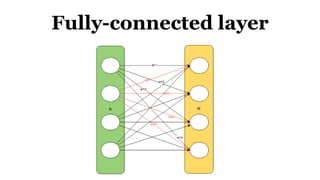
Fully-connected layer
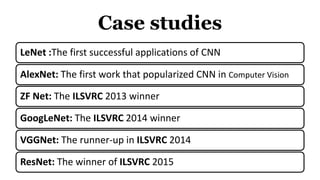
Case studies
LeNet :The first successful applications of CNN
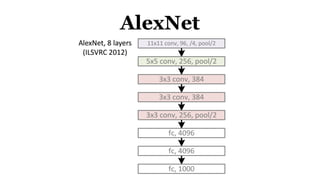
AlexNet: The first work that popularized CNN in Computer Vision
ZF Net: The ILSVRC 2013 winner
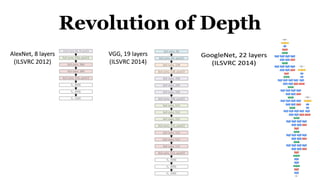
GoogLeNet: The ILSVRC 2014 winner
VGGNet: The runner-up in ILSVRC 2014
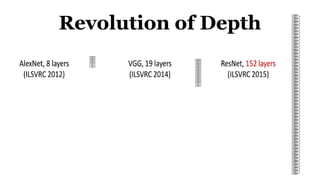
ResNet: The winner of ILSVRC 2015
AlexNet
Revolution of Depth
Revolution of Depth
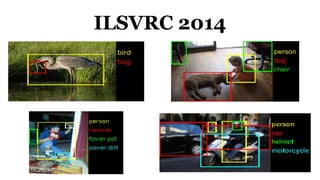
ILSVRC
• The ImageNet Large Scale Visual
Recognition Challenge (ILSVRC) evaluates
algorithms for object detection and image
classification at large scale.
ILSVRC 2014
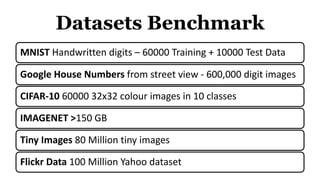
Datasets Benchmark
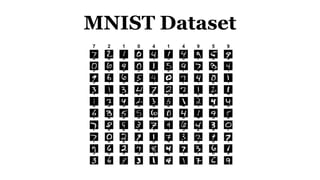
MNIST Handwritten digits – 60000 Training + 10000 Test Data
Google House Numbers from street view - 600,000 digit images
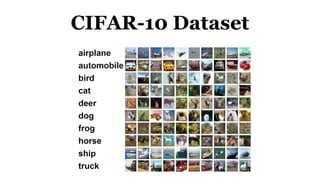
CIFAR-10 60000 32x32 colour images in 10 classes
IMAGENET >150 GB
Tiny Images 80 Million tiny images
Flickr Data 100 Million Yahoo dataset
MNIST Dataset
CIFAR-10 Dataset
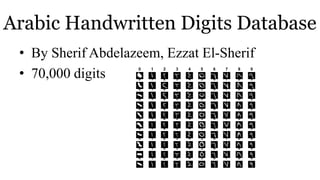
Arabic Handwritten Digits Database
• By Sherif Abdelazeem, Ezzat El-Sherif
• 70,000 digits
Summary
• Deep learning is a class of machine
learning algorithms.
• Harder problems such as video understanding ,
natural language processing and Big data will
be successfully tackled by deep learning
algorithms.
Thank U
Mohamed Loey

Deep learning