Musa Al hawamdah
 128129001011


                   1
Topics :
 Linear Support Vector Machines
  - Lagrangian (primal) formulation
  - Dual formulation
  - Discussion

 Linearly non-separable case
  - Soft-margin classification

 Nonlinear Support Vector Machines
  - Nonlinear basis functions
  - The Kernel trick
  - Mercer’s condition
  - Popular kernels

                                      2
Support Vector Machine (SVM):
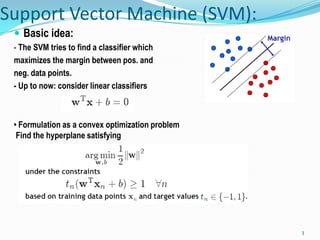
  Basic idea:
 - The SVM tries to find a classifier which
 maximizes the margin between pos. and
 neg. data points.
 - Up to now: consider linear classifiers


 • Formulation as a convex optimization problem
  Find the hyperplane satisfying


                                                  3
SVM – Primal Formulation:
  • Lagrangian primal form:


 • The solution of Lp needs to fulfill the KKT conditions
 - Necessary and sufficient conditions


                                                            4
SVM – Solution:
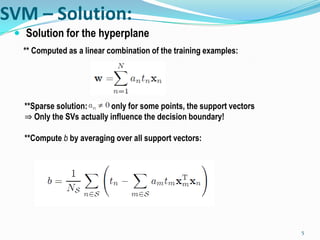
  Solution for the hyperplane
   ** Computed as a linear combination of the training examples:


   **Sparse solution:       only for some points, the support vectors
   ⇒ Only the SVs actually influence the decision boundary!

   **Compute b by averaging over all support vectors:


                                                                        5
SVM – Support Vectors:
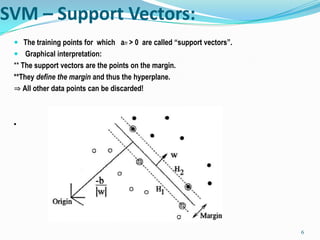
  The training points for which an > 0 are called “support vectors”.
  Graphical interpretation:
 ** The support vectors are the points on the margin.
 **They define the margin and thus the hyperplane.
 ⇒ All other data points can be discarded!


 •


                                                                        6
SVM – Discussion (Part 1):
  Linear SVM:
        Linear classifier
      Approximative implementation of the SRM principle.
      In case of separable data, the SVM produces an empirical risk of zero with minimal value of the
         VC confidence
      (i.e. a classifier minimizing the upper bound on the actual risk).
      SVMs thus have a “guaranteed” generalization capability.
      Formulation as convex optimization problem.

     ⇒ Globally optimal solution!

    Primal form formulation:
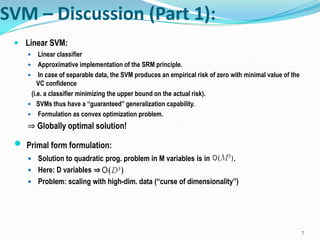
      Solution to quadratic prog. problem in M variables is in               .
      Here: D variables ⇒
      Problem: scaling with high-dim. data (“curse of dimensionality”)


                                                                                                         7
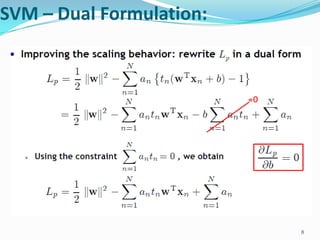
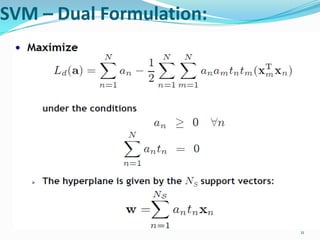
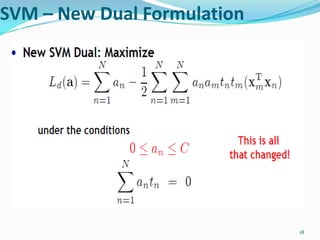
SVM – Dual Formulation:


                          8
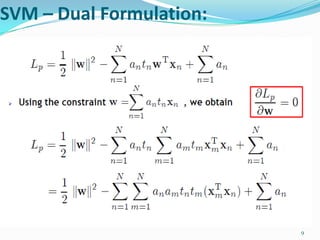
SVM – Dual Formulation:


                          9
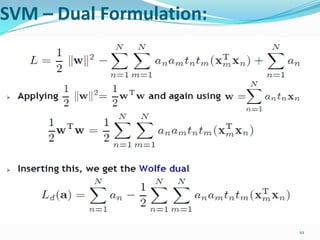
SVM – Dual Formulation:


 •


                          10
SVM – Dual Formulation:


                          11
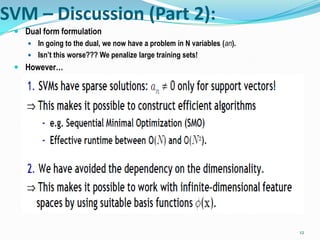
SVM – Discussion (Part 2):
  Dual form formulation
     In going to the dual, we now have a problem in N variables (an).
     Isn’t this worse??? We penalize large training sets!
  However…


                                                                         12
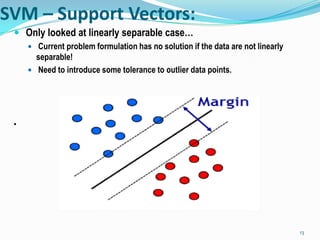
SVM – Support Vectors:
  Only looked at linearly separable case…
      Current problem formulation has no solution if the data are not linearly
       separable!
      Need to introduce some tolerance to outlier data points.


 •


                                                                                  13
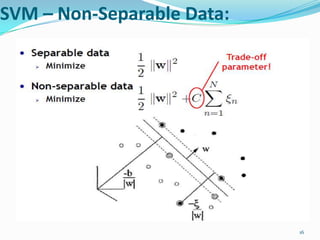
SVM – Non-Separable Data:


                            14
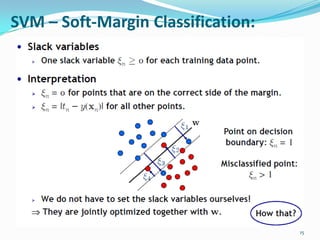
SVM – Soft-Margin Classification:


                                    15
SVM – Non-Separable Data:


                            16
SVM – New Primal Formulation:


                                17
SVM – New Dual Formulation


                             18
SVM – New Solution:


                      19
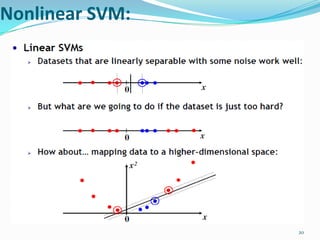
Nonlinear SVM:


                 20
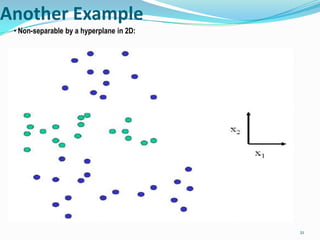
Another Example
 • Non-separable by a hyperplane in 2D:


                                          21
• Separable by a surface in 3D


                                 22
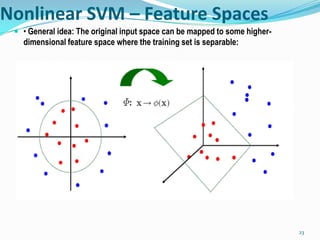
Nonlinear SVM – Feature Spaces
  • General idea: The original input space can be mapped to some higher-
   dimensional feature space where the training set is separable:


                                                                            23
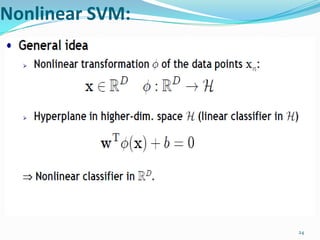
Nonlinear SVM:


                 24
What Could This Look Like?


                             25
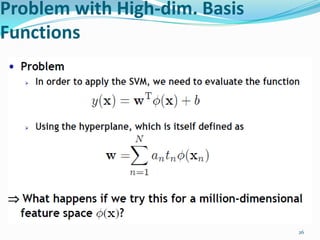
Problem with High-dim. Basis
Functions


                               26
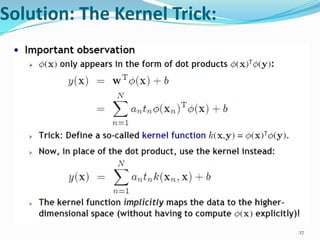
Solution: The Kernel Trick:


                              27
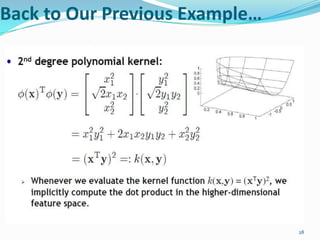
Back to Our Previous Example…


                                28
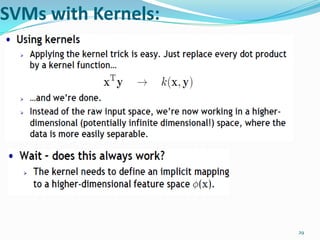
SVMs with Kernels:


                     29
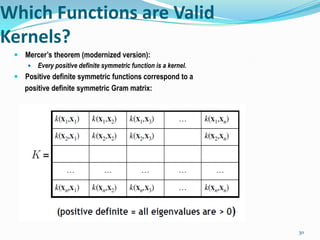
Which Functions are Valid
Kernels?
  Mercer’s theorem (modernized version):
        Every positive definite symmetric function is a kernel.
  Positive definite symmetric functions correspond to a
    positive definite symmetric Gram matrix:


                                                                   30
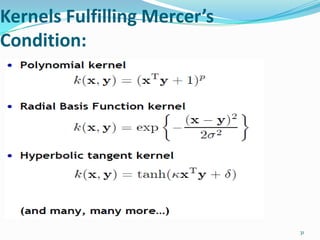
Kernels Fulfilling Mercer’s
Condition:


                              31
THANK YOU


            32

Support vector machine

  • 1.
    Musa Al hawamdah 128129001011 1
  • 2.
    Topics :  LinearSupport Vector Machines - Lagrangian (primal) formulation - Dual formulation - Discussion  Linearly non-separable case - Soft-margin classification  Nonlinear Support Vector Machines - Nonlinear basis functions - The Kernel trick - Mercer’s condition - Popular kernels 2
  • 3.
    Support Vector Machine(SVM):  Basic idea: - The SVM tries to find a classifier which maximizes the margin between pos. and neg. data points. - Up to now: consider linear classifiers • Formulation as a convex optimization problem Find the hyperplane satisfying 3
  • 4.
    SVM – PrimalFormulation:  • Lagrangian primal form: • The solution of Lp needs to fulfill the KKT conditions - Necessary and sufficient conditions 4
  • 5.
    SVM – Solution:  Solution for the hyperplane ** Computed as a linear combination of the training examples: **Sparse solution: only for some points, the support vectors ⇒ Only the SVs actually influence the decision boundary! **Compute b by averaging over all support vectors: 5
  • 6.
    SVM – SupportVectors:  The training points for which an > 0 are called “support vectors”.  Graphical interpretation: ** The support vectors are the points on the margin. **They define the margin and thus the hyperplane. ⇒ All other data points can be discarded! • 6
  • 7.
    SVM – Discussion(Part 1):  Linear SVM:  Linear classifier  Approximative implementation of the SRM principle.  In case of separable data, the SVM produces an empirical risk of zero with minimal value of the VC confidence (i.e. a classifier minimizing the upper bound on the actual risk).  SVMs thus have a “guaranteed” generalization capability.  Formulation as convex optimization problem. ⇒ Globally optimal solution!  Primal form formulation:  Solution to quadratic prog. problem in M variables is in .  Here: D variables ⇒  Problem: scaling with high-dim. data (“curse of dimensionality”) 7
  • 8.
    SVM – DualFormulation: 8
  • 9.
    SVM – DualFormulation: 9
  • 10.
    SVM – DualFormulation: • 10
  • 11.
    SVM – DualFormulation: 11
  • 12.
    SVM – Discussion(Part 2):  Dual form formulation  In going to the dual, we now have a problem in N variables (an).  Isn’t this worse??? We penalize large training sets!  However… 12
  • 13.
    SVM – SupportVectors:  Only looked at linearly separable case…  Current problem formulation has no solution if the data are not linearly separable!  Need to introduce some tolerance to outlier data points. • 13
  • 14.
  • 15.
    SVM – Soft-MarginClassification: 15
  • 16.
  • 17.
    SVM – NewPrimal Formulation: 17
  • 18.
    SVM – NewDual Formulation 18
  • 19.
    SVM – NewSolution: 19
  • 20.
  • 21.
    Another Example •Non-separable by a hyperplane in 2D: 21
  • 22.
    • Separable bya surface in 3D 22
  • 23.
    Nonlinear SVM –Feature Spaces  • General idea: The original input space can be mapped to some higher- dimensional feature space where the training set is separable: 23
  • 24.
  • 25.
    What Could ThisLook Like? 25
  • 26.
    Problem with High-dim.Basis Functions 26
  • 27.
  • 28.
    Back to OurPrevious Example… 28
  • 29.
  • 30.
    Which Functions areValid Kernels?  Mercer’s theorem (modernized version):  Every positive definite symmetric function is a kernel.  Positive definite symmetric functions correspond to a positive definite symmetric Gram matrix: 30
  • 31.
  • 32.