Support Vector Machines
History of SVM
• SVM is related to statistical learning theory [3]
• SVM was first introduced in 1992 [1]
• SVM becomes popular because of its success in handwritten digit
recognition
• 1.1% test error rate for SVM. This is the same as the error rates of a
carefully constructed neural network, LeNet 4.
• See Section 5.11 in [2] or the discussion in [3] for details
• SVM is now regarded as an important example of “kernel methods”, one
of the key area in machine learning
[1] B.E. Boser et al. A Training Algorithm for Optimal Margin Classifiers. Proceedings of the
Fifth Annual Workshop on Computational Learning Theory 5 144-152, Pittsburgh, 1992.
[2] L. Bottou et al. Comparison of classifier methods: a case study in handwritten digit
recognition. Proceedings of the 12th IAPR International Conference on Pattern
Recognition, vol. 2, pp. 77-82.
[3] V. Vapnik. The Nature of Statistical Learning Theory. 2nd edition, Springer, 1999.
What is a good Decision
Boundary?
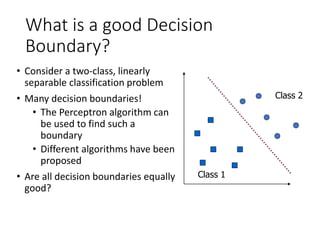
• Consider a two-class, linearly
separable classification problem
• Many decision boundaries!
• The Perceptron algorithm can
be used to find such a
boundary
• Different algorithms have been
proposed
• Are all decision boundaries equally
good?
Class 1
Class 2
Linear Classifiers
f
x
a
yest
denotes +1
denotes -1
f(x,w,b) = sign(w. x + b)
Any of these
would be fine..
..but which is
best?
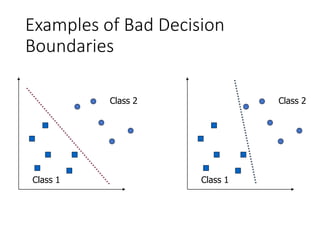
Examples of Bad Decision
Boundaries
Class 1
Class 2
Class 1
Class 2
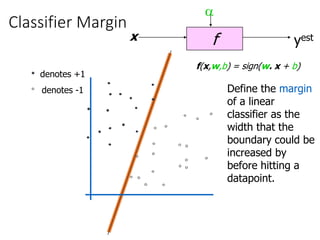
Classifier Margin
f
x
a
yest
denotes +1
denotes -1
f(x,w,b) = sign(w. x + b)
Define the margin
of a linear
classifier as the
width that the
boundary could be
increased by
before hitting a
datapoint.
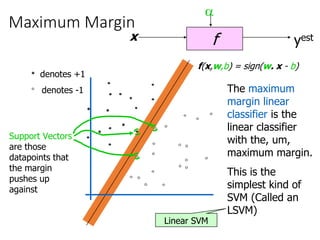
Maximum Margin
f
x
a
yest
denotes +1
denotes -1
f(x,w,b) = sign(w. x + b)
The maximum
margin linear
classifier is the
linear classifier
with the, um,
maximum margin.
This is the
simplest kind of
SVM (Called an
LSVM)
Linear SVM
Maximum Margin
f
x
a
yest
denotes +1
denotes -1
f(x,w,b) = sign(w. x - b)
The maximum
margin linear
classifier is the
linear classifier
with the, um,
maximum margin.
This is the
simplest kind of
SVM (Called an
LSVM)
Support Vectors
are those
datapoints that
the margin
pushes up
against
Linear SVM
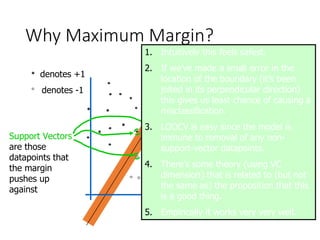
Why Maximum Margin?
denotes +1
denotes -1
f(x,w,b) = sign(w. x - b)
The maximum
margin linear
classifier is the
linear classifier
with the, um,
maximum margin.
This is the
simplest kind of
SVM (Called an
LSVM)
Support Vectors
are those
datapoints that
the margin
pushes up
against
1. Intuitively this feels safest.
2. If we’ve made a small error in the
location of the boundary (it’s been
jolted in its perpendicular direction)
this gives us least chance of causing a
misclassification.
3. LOOCV is easy since the model is
immune to removal of any non-
support-vector datapoints.
4. There’s some theory (using VC
dimension) that is related to (but not
the same as) the proposition that this
is a good thing.
5. Empirically it works very very well.
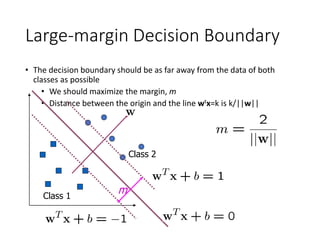
Large-margin Decision Boundary
• The decision boundary should be as far away from the data of both
classes as possible
• We should maximize the margin, m
• Distance between the origin and the line wtx=k is k/||w||
Class 1
Class 2
m
Finding the Decision Boundary
• Let {x1, ..., xn} be our data set and let yi  {1,-1} be the class label of xi
• The decision boundary should classify all points correctly 
• The decision boundary can be found by solving the following
constrained optimization problem
• This is a constrained optimization problem. Solving it requires some new
tools
Recap of Constrained
Optimization
• Suppose we want to: minimize f(x) subject to g(x) = 0
• A necessary condition for x0 to be a solution:
• a: the Lagrange multiplier
• For multiple constraints gi(x) = 0, i=1, …, m, we need a Lagrange
multiplier ai for each of the constraints
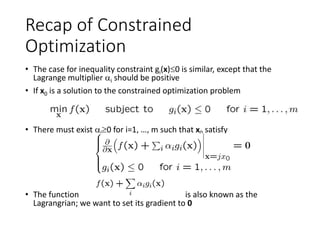
Recap of Constrained
Optimization
• The case for inequality constraint gi(x)0 is similar, except that the
Lagrange multiplier ai should be positive
• If x0 is a solution to the constrained optimization problem
• There must exist ai0 for i=1, …, m such that x0 satisfy
• The function is also known as the
Lagrangrian; we want to set its gradient to 0
Back to the Original Problem
• The Lagrangian is
• Note that ||w||2 = wTw
• Setting the gradient of w.r.t. w and b to zero, we have
The Dual Problem
• If we substitute to , we have
• Note that
• This is a function of ai only
Ready for
the kernel
trick!
The Dual Problem
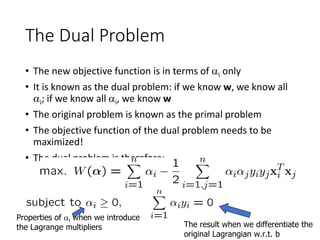
• The new objective function is in terms of ai only
• It is known as the dual problem: if we know w, we know all
ai; if we know all ai, we know w
• The original problem is known as the primal problem
• The objective function of the dual problem needs to be
maximized!
• The dual problem is therefore:
Properties of ai when we introduce
the Lagrange multipliers The result when we differentiate the
original Lagrangian w.r.t. b
The Dual Problem
• This is a quadratic programming (QP) problem
• A global maximum of ai can always be found
• w can be recovered by
a6=1.4
A Geometrical Interpretation
Class 1
Class 2
a1=0.8
a2=0
a3=0
a4=0
a5=0
a7=0
a8=0.6
a9=0
a10=0
Overlapping: Non-linearly Separable
Problems
• We allow “error” xi in classification; it is based on the output of the
discriminant function wTx+b
• xi approximates the number of misclassified samples
Class 1
Class 2
Soft Margin Hyperplane
• If we minimize ixi, xi can be computed by
• xi are “slack variables” in optimization
• Note that xi=0 if there is no error for xi
• xi is an upper bound of the number of errors
• We want to minimize
• C : tradeoff parameter between error and margin
• The optimization problem becomes
The Optimization Problem
• The dual of this new constrained optimization problem is
• w is recovered as
• This is very similar to the optimization problem in the linear separable
case, except that there is an upper bound C on ai now
• Once again, a QP solver can be used to find ai
Extension to Non-linear Decision
Boundary
• So far, we have only considered large-margin classifier with a linear
decision boundary
• How to generalize it to become nonlinear?
• Key idea: transform xi to a higher dimensional space to “make life
easier”
• Input space: the space the point xi are located
• Feature space: the space of f(xi) after transformation
• Why transform?
• Linear operation in the feature space is equivalent to non-linear
operation in input space
• Classification can become easier with a proper transformation. In
the XOR problem, for example, adding a new feature of x1x2 make
the problem linearly separable
Transforming the Data
• Computation in the feature space can be costly because it is high
dimensional
• The feature space can be infinite-dimensional!
• The kernel trick comes to rescue
f( )
f( )
f( )
f( )
f( )
f( )
f( )
f( )
f(.)
f( )
f( )
f( )
f( )
f( )
f( )
f( )
f( )
f( )
f( )
Feature space
Input space
Note: feature space is of higher dimension
than the input space in practice
The Kernel Trick
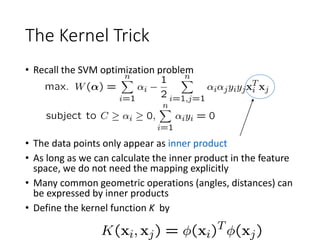
• Recall the SVM optimization problem
• The data points only appear as inner product
• As long as we can calculate the inner product in the feature
space, we do not need the mapping explicitly
• Many common geometric operations (angles, distances) can
be expressed by inner products
• Define the kernel function K by
An Example for f(.) and K(.,.)
• Suppose f(.) is given as follows
• An inner product in the feature space is
• So, if we define the kernel function as follows, there is no need to carry
out f(.) explicitly
• This use of kernel function to avoid carrying out f(.) explicitly is known
as the kernel trick
Kernel Functions
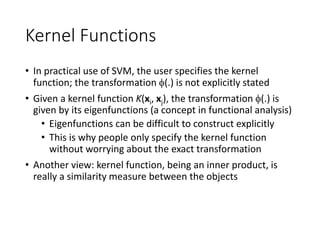
• In practical use of SVM, the user specifies the kernel
function; the transformation f(.) is not explicitly stated
• Given a kernel function K(xi, xj), the transformation f(.) is
given by its eigenfunctions (a concept in functional analysis)
• Eigenfunctions can be difficult to construct explicitly
• This is why people only specify the kernel function
without worrying about the exact transformation
• Another view: kernel function, being an inner product, is
really a similarity measure between the objects
Examples of Kernel Functions
• Polynomial kernel with degree d
• Radial basis function kernel with width s
• Closely related to radial basis function neural networks
• The feature space is infinite-dimensional
• Sigmoid with parameter k and q
• It does not satisfy the Mercer condition on all k and q
Modification Due to Kernel
Function
• Change all inner products to kernel functions
• For training,
Original
With kernel
function
Modification Due to Kernel
Function
• For evaluation, the new data z is classified as class 1 if f 0, and as class
2 if f <0
Original
With kernel
function
The parameter C for non-linear SVMs
• Perfect separation of training data can, in general
be achieved in the enlarged feature space F
• Such perfect separation is actually bad: it leads to
the danger of overfitting the data. Then the
classifier will generalize poorly.
• A proper setting of C allows to avoid overfitting
C in non-linear SVMs
• Let’s look once again at the objective function
• C is the penalty for errors of misclassification
• Large C: discourages any positive parameters  tendency to
overfit the data highly complicated boundaries in input space
• Small C: encourages a small value of ||w||  larger margin more
data on the wrong side of the margin  smoother decision boundary
in input space
• In practice: tune C to achieve best performance
2
1
1
2
N
i
i
w C x

 
i
x
More on Kernel Functions
• Since the training of SVM only requires the value of K(xi, xj), there is no
restriction of the form of xi and xj
• xi can be a sequence or a tree, instead of a feature vector
• K(xi, xj) is just a similarity measure comparing xi and xj
• For a test object z, the discriminat function essentially is a weighted sum
of the similarity between z and a pre-selected set of objects (the
support vectors)
More on Kernel Functions
• Not all similarity measures can be used as kernel
function, however
• The kernel function needs to satisfy the Mercer
function, i.e., the function is “positive-definite”
• This implies that the n by n kernel matrix, in which the
(i,j)-th entry is the K(xi, xj), is always positive definite
• This also means that the QP is convex and can be solved
in polynomial time
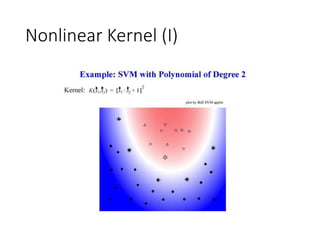
Nonlinear Kernel (I)
Nonlinear Kernel (II)
Why SVM Work?
• The feature space is often very high dimensional. Why don’t we have
the curse of dimensionality?
• A classifier in a high-dimensional space has many parameters and is
hard to estimate
• Vapnik argues that the fundamental problem is not the number of
parameters to be estimated. Rather, the problem is about the flexibility
of a classifier
• Typically, a classifier with many parameters is very flexible, but there are
also exceptions
• Let xi=10i where i ranges from 1 to n. The classifier
can classify all xi correctly for all possible
combination of class labels on xi
• This 1-parameter classifier is very flexible
Why SVM works?
• Vapnik argues that the flexibility of a classifier should not be
characterized by the number of parameters, but by the flexibility
(capacity) of a classifier
• This is formalized by the “VC-dimension” of a classifier
• Consider a linear classifier in two-dimensional space
• If we have three training data points, no matter how those points are
labeled, we can classify them perfectly
Choosing the Kernel Function
• Probably the most tricky part of using SVM.
• The kernel function is important because it creates the kernel
matrix, which summarizes all the data
• Many principles have been proposed (diffusion kernel, Fisher
kernel, string kernel, …)
• There is even research to estimate the kernel matrix from
available information
• In practice, a low degree polynomial kernel or RBF kernel with a
reasonable width is a good initial try
• Note that SVM with RBF kernel is closely related to RBF neural
networks, with the centers of the radial basis functions
automatically chosen for SVM
Other Aspects of SVM
• How to use SVM for multi-class classification?
• One can change the QP formulation to become multi-class
• More often, multiple binary classifiers are combined
• See DHS 5.2.2 for some discussion
• One can train multiple one-versus-all classifiers, or combine
multiple pairwise classifiers “intelligently”
• How to interpret the SVM discriminant function value as probability?
• By performing logistic regression on the SVM output of a set of data
(validation set) that is not used for training
• Some SVM software (like libsvm) have these features built-in
Strengths and Weaknesses of
SVM
• Strengths
• Training is relatively easy
• No local optimal, unlike in neural networks
• It scales relatively well to high dimensional data
• Tradeoff between classifier complexity and error can be
controlled explicitly
• Non-traditional data like strings and trees can be used as
input to SVM, instead of feature vectors
• Weaknesses
• Need to choose a “good” kernel function.
Other Types of Kernel Methods
• A lesson learnt in SVM: a linear algorithm in the
feature space is equivalent to a non-linear
algorithm in the input space
• Standard linear algorithms can be generalized to its
non-linear version by going to the feature space
• Kernel principal component analysis, kernel
independent component analysis, kernel canonical
correlation analysis, kernel k-means, 1-class SVM are
some examples
Questions…?

SVMs.pptx support vector machines machine learning

  • 1.
  • 2.
    History of SVM •SVM is related to statistical learning theory [3] • SVM was first introduced in 1992 [1] • SVM becomes popular because of its success in handwritten digit recognition • 1.1% test error rate for SVM. This is the same as the error rates of a carefully constructed neural network, LeNet 4. • See Section 5.11 in [2] or the discussion in [3] for details • SVM is now regarded as an important example of “kernel methods”, one of the key area in machine learning [1] B.E. Boser et al. A Training Algorithm for Optimal Margin Classifiers. Proceedings of the Fifth Annual Workshop on Computational Learning Theory 5 144-152, Pittsburgh, 1992. [2] L. Bottou et al. Comparison of classifier methods: a case study in handwritten digit recognition. Proceedings of the 12th IAPR International Conference on Pattern Recognition, vol. 2, pp. 77-82. [3] V. Vapnik. The Nature of Statistical Learning Theory. 2nd edition, Springer, 1999.
  • 3.
    What is agood Decision Boundary? • Consider a two-class, linearly separable classification problem • Many decision boundaries! • The Perceptron algorithm can be used to find such a boundary • Different algorithms have been proposed • Are all decision boundaries equally good? Class 1 Class 2
  • 4.
    Linear Classifiers f x a yest denotes +1 denotes-1 f(x,w,b) = sign(w. x + b) Any of these would be fine.. ..but which is best?
  • 5.
    Examples of BadDecision Boundaries Class 1 Class 2 Class 1 Class 2
  • 6.
    Classifier Margin f x a yest denotes +1 denotes-1 f(x,w,b) = sign(w. x + b) Define the margin of a linear classifier as the width that the boundary could be increased by before hitting a datapoint.
  • 7.
    Maximum Margin f x a yest denotes +1 denotes-1 f(x,w,b) = sign(w. x + b) The maximum margin linear classifier is the linear classifier with the, um, maximum margin. This is the simplest kind of SVM (Called an LSVM) Linear SVM
  • 8.
    Maximum Margin f x a yest denotes +1 denotes-1 f(x,w,b) = sign(w. x - b) The maximum margin linear classifier is the linear classifier with the, um, maximum margin. This is the simplest kind of SVM (Called an LSVM) Support Vectors are those datapoints that the margin pushes up against Linear SVM
  • 9.
    Why Maximum Margin? denotes+1 denotes -1 f(x,w,b) = sign(w. x - b) The maximum margin linear classifier is the linear classifier with the, um, maximum margin. This is the simplest kind of SVM (Called an LSVM) Support Vectors are those datapoints that the margin pushes up against 1. Intuitively this feels safest. 2. If we’ve made a small error in the location of the boundary (it’s been jolted in its perpendicular direction) this gives us least chance of causing a misclassification. 3. LOOCV is easy since the model is immune to removal of any non- support-vector datapoints. 4. There’s some theory (using VC dimension) that is related to (but not the same as) the proposition that this is a good thing. 5. Empirically it works very very well.
  • 10.
    Large-margin Decision Boundary •The decision boundary should be as far away from the data of both classes as possible • We should maximize the margin, m • Distance between the origin and the line wtx=k is k/||w|| Class 1 Class 2 m
  • 11.
    Finding the DecisionBoundary • Let {x1, ..., xn} be our data set and let yi  {1,-1} be the class label of xi • The decision boundary should classify all points correctly  • The decision boundary can be found by solving the following constrained optimization problem • This is a constrained optimization problem. Solving it requires some new tools
  • 12.
    Recap of Constrained Optimization •Suppose we want to: minimize f(x) subject to g(x) = 0 • A necessary condition for x0 to be a solution: • a: the Lagrange multiplier • For multiple constraints gi(x) = 0, i=1, …, m, we need a Lagrange multiplier ai for each of the constraints
  • 13.
    Recap of Constrained Optimization •The case for inequality constraint gi(x)0 is similar, except that the Lagrange multiplier ai should be positive • If x0 is a solution to the constrained optimization problem • There must exist ai0 for i=1, …, m such that x0 satisfy • The function is also known as the Lagrangrian; we want to set its gradient to 0
  • 14.
    Back to theOriginal Problem • The Lagrangian is • Note that ||w||2 = wTw • Setting the gradient of w.r.t. w and b to zero, we have
  • 15.
    The Dual Problem •If we substitute to , we have • Note that • This is a function of ai only Ready for the kernel trick!
  • 16.
    The Dual Problem •The new objective function is in terms of ai only • It is known as the dual problem: if we know w, we know all ai; if we know all ai, we know w • The original problem is known as the primal problem • The objective function of the dual problem needs to be maximized! • The dual problem is therefore: Properties of ai when we introduce the Lagrange multipliers The result when we differentiate the original Lagrangian w.r.t. b
  • 17.
    The Dual Problem •This is a quadratic programming (QP) problem • A global maximum of ai can always be found • w can be recovered by
  • 18.
    a6=1.4 A Geometrical Interpretation Class1 Class 2 a1=0.8 a2=0 a3=0 a4=0 a5=0 a7=0 a8=0.6 a9=0 a10=0
  • 19.
    Overlapping: Non-linearly Separable Problems •We allow “error” xi in classification; it is based on the output of the discriminant function wTx+b • xi approximates the number of misclassified samples Class 1 Class 2
  • 20.
    Soft Margin Hyperplane •If we minimize ixi, xi can be computed by • xi are “slack variables” in optimization • Note that xi=0 if there is no error for xi • xi is an upper bound of the number of errors • We want to minimize • C : tradeoff parameter between error and margin • The optimization problem becomes
  • 21.
    The Optimization Problem •The dual of this new constrained optimization problem is • w is recovered as • This is very similar to the optimization problem in the linear separable case, except that there is an upper bound C on ai now • Once again, a QP solver can be used to find ai
  • 22.
    Extension to Non-linearDecision Boundary • So far, we have only considered large-margin classifier with a linear decision boundary • How to generalize it to become nonlinear? • Key idea: transform xi to a higher dimensional space to “make life easier” • Input space: the space the point xi are located • Feature space: the space of f(xi) after transformation • Why transform? • Linear operation in the feature space is equivalent to non-linear operation in input space • Classification can become easier with a proper transformation. In the XOR problem, for example, adding a new feature of x1x2 make the problem linearly separable
  • 23.
    Transforming the Data •Computation in the feature space can be costly because it is high dimensional • The feature space can be infinite-dimensional! • The kernel trick comes to rescue f( ) f( ) f( ) f( ) f( ) f( ) f( ) f( ) f(.) f( ) f( ) f( ) f( ) f( ) f( ) f( ) f( ) f( ) f( ) Feature space Input space Note: feature space is of higher dimension than the input space in practice
  • 24.
    The Kernel Trick •Recall the SVM optimization problem • The data points only appear as inner product • As long as we can calculate the inner product in the feature space, we do not need the mapping explicitly • Many common geometric operations (angles, distances) can be expressed by inner products • Define the kernel function K by
  • 25.
    An Example forf(.) and K(.,.) • Suppose f(.) is given as follows • An inner product in the feature space is • So, if we define the kernel function as follows, there is no need to carry out f(.) explicitly • This use of kernel function to avoid carrying out f(.) explicitly is known as the kernel trick
  • 26.
    Kernel Functions • Inpractical use of SVM, the user specifies the kernel function; the transformation f(.) is not explicitly stated • Given a kernel function K(xi, xj), the transformation f(.) is given by its eigenfunctions (a concept in functional analysis) • Eigenfunctions can be difficult to construct explicitly • This is why people only specify the kernel function without worrying about the exact transformation • Another view: kernel function, being an inner product, is really a similarity measure between the objects
  • 27.
    Examples of KernelFunctions • Polynomial kernel with degree d • Radial basis function kernel with width s • Closely related to radial basis function neural networks • The feature space is infinite-dimensional • Sigmoid with parameter k and q • It does not satisfy the Mercer condition on all k and q
  • 28.
    Modification Due toKernel Function • Change all inner products to kernel functions • For training, Original With kernel function
  • 29.
    Modification Due toKernel Function • For evaluation, the new data z is classified as class 1 if f 0, and as class 2 if f <0 Original With kernel function
  • 30.
    The parameter Cfor non-linear SVMs • Perfect separation of training data can, in general be achieved in the enlarged feature space F • Such perfect separation is actually bad: it leads to the danger of overfitting the data. Then the classifier will generalize poorly. • A proper setting of C allows to avoid overfitting
  • 31.
    C in non-linearSVMs • Let’s look once again at the objective function • C is the penalty for errors of misclassification • Large C: discourages any positive parameters  tendency to overfit the data highly complicated boundaries in input space • Small C: encourages a small value of ||w||  larger margin more data on the wrong side of the margin  smoother decision boundary in input space • In practice: tune C to achieve best performance 2 1 1 2 N i i w C x    i x
  • 32.
    More on KernelFunctions • Since the training of SVM only requires the value of K(xi, xj), there is no restriction of the form of xi and xj • xi can be a sequence or a tree, instead of a feature vector • K(xi, xj) is just a similarity measure comparing xi and xj • For a test object z, the discriminat function essentially is a weighted sum of the similarity between z and a pre-selected set of objects (the support vectors)
  • 33.
    More on KernelFunctions • Not all similarity measures can be used as kernel function, however • The kernel function needs to satisfy the Mercer function, i.e., the function is “positive-definite” • This implies that the n by n kernel matrix, in which the (i,j)-th entry is the K(xi, xj), is always positive definite • This also means that the QP is convex and can be solved in polynomial time
  • 34.
  • 35.
  • 36.
    Why SVM Work? •The feature space is often very high dimensional. Why don’t we have the curse of dimensionality? • A classifier in a high-dimensional space has many parameters and is hard to estimate • Vapnik argues that the fundamental problem is not the number of parameters to be estimated. Rather, the problem is about the flexibility of a classifier • Typically, a classifier with many parameters is very flexible, but there are also exceptions • Let xi=10i where i ranges from 1 to n. The classifier can classify all xi correctly for all possible combination of class labels on xi • This 1-parameter classifier is very flexible
  • 37.
    Why SVM works? •Vapnik argues that the flexibility of a classifier should not be characterized by the number of parameters, but by the flexibility (capacity) of a classifier • This is formalized by the “VC-dimension” of a classifier • Consider a linear classifier in two-dimensional space • If we have three training data points, no matter how those points are labeled, we can classify them perfectly
  • 38.
    Choosing the KernelFunction • Probably the most tricky part of using SVM. • The kernel function is important because it creates the kernel matrix, which summarizes all the data • Many principles have been proposed (diffusion kernel, Fisher kernel, string kernel, …) • There is even research to estimate the kernel matrix from available information • In practice, a low degree polynomial kernel or RBF kernel with a reasonable width is a good initial try • Note that SVM with RBF kernel is closely related to RBF neural networks, with the centers of the radial basis functions automatically chosen for SVM
  • 39.
    Other Aspects ofSVM • How to use SVM for multi-class classification? • One can change the QP formulation to become multi-class • More often, multiple binary classifiers are combined • See DHS 5.2.2 for some discussion • One can train multiple one-versus-all classifiers, or combine multiple pairwise classifiers “intelligently” • How to interpret the SVM discriminant function value as probability? • By performing logistic regression on the SVM output of a set of data (validation set) that is not used for training • Some SVM software (like libsvm) have these features built-in
  • 40.
    Strengths and Weaknessesof SVM • Strengths • Training is relatively easy • No local optimal, unlike in neural networks • It scales relatively well to high dimensional data • Tradeoff between classifier complexity and error can be controlled explicitly • Non-traditional data like strings and trees can be used as input to SVM, instead of feature vectors • Weaknesses • Need to choose a “good” kernel function.
  • 41.
    Other Types ofKernel Methods • A lesson learnt in SVM: a linear algorithm in the feature space is equivalent to a non-linear algorithm in the input space • Standard linear algorithms can be generalized to its non-linear version by going to the feature space • Kernel principal component analysis, kernel independent component analysis, kernel canonical correlation analysis, kernel k-means, 1-class SVM are some examples
  • 42.